
Here is the live stream for Orthros and Divine Liturgy – Palm Sunday 4/17/2022 If you need, here are instructions for accessing this content from your phone, tablet, computer, or TV.
Monthly Archives: April 2022
Daily Readings for Sunday, April 17, 2022
PALM SUNDAY
ABSTAIN FROM MEAT, DAIRY, EGGS
Palm Sunday, Symeon the Holy Martyr, Bishop of Persepolis, and those with him, Makarios, Bishop of Corinth, Agapetos of Rome, Hadrian the New-Martyr, Donnan, Abbot of Eigg, and the Monk-Martyrs with him
ST. PAUL’S LETTER TO THE PHILIPPIANS 4:4-9
BRETHREN, rejoice in the Lord always; again I will say, Rejoice. Let all men know your forbearance. The Lord is at hand. Have no anxiety about anything, but in everything by prayer and supplication with thanksgiving let your requests be made known to God. And the peace of God, which passes all understanding, will keep your hearts and your minds in Christ Jesus. Finally, brethren, whatever is true, whatever is honorable, whatever is just, whatever is pure, whatever is lovely, whatever is gracious, if there is any excellence, if there is anything worthy of praise, think about these things. What you have learned and received and heard and seen in me, do; and the God of peace will be with you.
JOHN 12:1-18
Six days before Passover, Jesus came to Bethany, where Lazaros was, whom Jesus had raised from the dead. There they made him a supper; Martha served, and Lazaros was one of those at table with him. Mary took a pound of costly ointment of pure nard and anointed the feet of Jesus and wiped his feet with her hair; and the house was filled with the fragrance of the ointment. But Judas Iscariot, one of his disciples (he who was to betray him), said "Why was this ointment not sold for three hundred denarii and given to the poor?" This he said, not that he cared for the poor but because he was a thief, and as he had the money box he used to take what was put into it. Jesus said, "Let her alone, let her keep it for the day of my burial. The poor you always have with you, but you do not always have me."
When the great crowd of the Jews learned that he was there, they came, not only on account of Jesus but also to see Lazaros, whom he had raised from the dead. So the chief priests planned to put Lazaros also to death, because on account of him many of the Jews were going away and believing in Jesus.
The next day a great crowd who had come to the feast heard that Jesus was coming to Jerusalem. So they took branches of palm trees and went out to meet him, crying, "Hosanna! Blessed is he who comes in the name of the Lord, even the King of Israel!" And Jesus found a young donkey and sat upon it; as it is written, "Fear not, daughter of Zion; behold, your king is coming, sitting on a donkey's colt!" His disciples did not understand this at first; but when Jesus was glorified, then they remembered that this had been written of him and had been done to him. The crowd that had been with him when he called Lazaros out of the tomb and raised him from the dead bore witness. The reason why the crowd went to meet him was that they heard he had done this sign.
Entry of Our Lord into Jerusalem (Palm Sunday)

Palm Sunday
Palm Sunday is the celebration of the triumphant entrance of Christ into the royal city of Jerusalem. He rode on a colt for which He Himself had sent, and He permitted the people to hail Him publicly as a king. A large crowd met Him in a manner befitting royalty, waving palm branches and placing their garments in His path. They greeted Him with these words: “Hosanna! Blessed is he who comes in the name of the Lord, even the King of Israel! (John 12:13).
This day together with the raising of Lazarus are signs pointing beyond themselves to the mighty deeds and events which consummate Christ’s earthly ministry. The time of fulfillment was at hand. Christ’s raising of Lazarus points to the destruction of death and the joy of resurrection which will be accessible to all through His own death and resurrection. His entrance into Jerusalem is a fulfillment of the messianic prophecies about the king who will enter his holy city to establish a final kingdom. “Behold, your king is coming to you, humble, and mounted on an ass, and on a colt, the foal of an ass” (Zech 9:9).
Finally, the events of these triumphant two days are but the passage to Holy Week: the “hour” of suffering and death for which Christ came. Thus the triumph in a earthly sense is extremely short-lived. Jesus enters openly into the midst of His enemies, publicly saying and doing those things which mostly enrage them. The people themselves will soon reject Him. They misread His brief earthly triumph as a sign of something else: His emergence as a political messiah who will lead them to the glories of an earthly kingdom.
Our Pledge
The liturgy of the Church is more than meditation or praise concerning past events. It communicates to us the eternal presence and power of the events being celebrated and makes us participants in those events. Thus the services of Lazarus Saturday and Palm Sunday bring us to our own moment of life and death and entrance into the Kingdom of God: a Kingdom not of this world, a Kingdom accessible in the Church through repentance and baptism.
On Palm Sunday palm and willow branches are blessed in the Church. We take them in order to raise them up and greet the King and Ruler of our life: Jesus Christ. We take them in order to reaffirm our baptismal pledges. As the One who raised Lazarus and entered Jerusalem to go to His voluntary Passion stands in our midst, we are faced with the same question addressed to us at baptism: “Do you accept Christ?” We give our answer by daring to take the branch and raise it up: “I accept Him as King and God!”
Thus, on the eve of Christ’s Passion, in the celebration of the joyful cycle of the triumphant days of Lazarus Saturday and Palm Sunday, we reunite ourselves to Christ, affirm His Lordship over the totality of our life, and express our readiness to follow Him to His Kingdom:
… that I may know him and the power of his resurrection, and may share his sufferings, becoming like him in his death, that if possible I may attain the resurrection from the dead (Philippians 3:10-11).
Very Rev. Paul Lazor
Hieromartyr Simeon, Bishop in Persia, and those with him

The Hieromartyr Simeon, Bishop of Persia, suffered during a persecution against Christians under the Persian emperor Sapor II (310-381). They accused the saint of collaborating with the Roman Empire and of subversive activities against the Persian emperor.
In the year 344, the emperor issued an edict which imposed a heavy tax upon Christians. When some of them refused to pay it, this was regarded as an act of rebellion, so the emperor began a fierce persecution against Christians.
Saint Simeon was brought to trial in iron fetters as a supposed enemy of the Persian realm, together with the two hieromartyrs Habdelai and Ananias. The holy bishop would not even bow to the emperor, who asked why he would not show him the proper respect. The saint answered, “Formerly, I bowed because of your rank, but now, when you ask me to renounce my God and abandon my faith, it is not proper for me to bow to you.”
The emperor urged him to worship the sun, and he threatened to eradicate Christianity in his land if he refused. But neither urgings nor threats could shake the steadfast saint, and they led him off to prison. Along the way the eunuch Usphazanes, a counsellor of the emperor, saw the saint. He stood up and bowed to the bishop, but the saint turned away from him because he, a former Christian, out of fear of the emperor, now worshipped the sun.
The eunuch repented with all his heart, he exchanged his fine attire for coarse garb, and sitting at the doors of the court, he cried out bitterly, “Woe to me, when I stand before my God, from Whom I am cut off. Here was Simeon, and he has turned his back on me!”
The emperor Sapor learned about the grief of his beloved tutor and asked him what had happened. He told the emperor that he bitterly regretted his apostasy and would no more worship the sun, but only the one true God. The emperor was surprised at the old man’s sudden decision, and he urged him not to abjure the gods whom their fathers had reverenced. But Usphazanes was unyielding, and they condemned him to death. Saint Usphazanes asked that the city heralds report that he died not for crimes against the emperor, but for being a Christian. The emperor granted his request.
Saint Simeon also learned about the death of Usphazanes, and he gave thanks to the Lord. When they brought him before the emperor a second time, Saint Simeon again refused to worship the pagan gods and confessed his faith in Christ. The enraged emperor gave orders to behead all the Christians in the prison before the saint’s eyes.
Without fear the Christians went to execution, blessed by the holy hierarch, and they bent their heads beneath the sword. Saint Simeon’s companion, the Priest Habdelai, was also beheaded. When they came to the Priest Ananias, he suddenly trembled. Then one of the dignitaries, Saint Phusicus (Pusicius), a secret Christian, was afraid that Ananias would renounce Christ, and he cried out, “Do not fear the sword, Elder, and you will see the divine light of our Lord Jesus Christ.”
Saint Phusicus betrayed himself by this outburst. The emperor gave orders to pluck out his tongue and to flay the skin off him. Along with Saint Phusicus, his daughter Askitrea was also martyred. Saint Simeon was the last to go before the executioner, and he placed his head on the chopping-block (April 13, 344). Executions continued all during Bright Week until April 23.
Saint Azates the Eunuch, a close official to the emperor, also received the crown of martyrdom, along with Saints Abdechalas, Usthazanes, and Azades. The sources indicate that 1,150 Martyrs perished because they refused to accept the Persian religion.
Saint Acacius, Bishop of Melitene
Saint Acacius, Bishop of Melitene, was born into a pious family in the Armenian city of Melitene. His parents had been childless for a long time. They had prayed for a son, and vowed to dedicate him to God. Therefore, Acacius was given to Bishop Ostrychius of Melitene (November 7) to serve the Church. Saint Ostrychius was a firm supporter of Orthodoxy. When the heresy of Macedonius arose, it was Saint Ostrychius who set forth the Orthodox teaching about the Holy Spirit as the Third Person of the Holy Trinity One in Essence and Undivided at the Second Ecumenical Council (381).
The holy hierarch raised Acacius with love, made him a reader, and then ordained him a deacon and then to the holy priesthood. Saint Acacius devoutly served the Church. He instructed both adults and children in the Holy Scripture, and in the Orthodox Confession of faith.
Among his disciples was Saint Euthymius the Great (January 20).
After the death of Saint Ostrychius, Saint Acacius was elevated to the bishop’s throne of Melitene by general acclamation. He wisely governed his diocese. By his firm faith, humility and deeds, the saint acquired the gift of wonderworking. Once, during a dry summer, the saint celebrated Liturgy in an open field, suddenly the wine in the Holy Chalice was mixed by the falling rain, which fell throughout the land.
He prayed during a flood, and the advancing river turned away and did not rise higher than the stone which he had placed at the riverbank. On one of the islands of the River Azar, despite the opposition of the pagans, the saint built a temple in honor of the Most Holy Theotokos. The builders of the church either through carelessness or through malice, were not careful in building the dome. During the Liturgy the dome was ready to collapse. The people rushed out of the church in terror. But the saint halted their flight saying, “The Lord is the defender of my life, of whom shall I be afraid?” (Ps. 26/27:1). The dome remained suspended in the air. Only when the services were ended, and the saint was the last one to emerge from the church, did the dome collapse, causing harm to no one. After this, the church was rebuilt.
Saint Acacius participated in the Third Ecumenical Council (431) and he defended the Orthodox teaching of the Two Natures (Divine and Human) of the Savior, and of His seedless Birth from the Most Holy Virgin Mother of God.
Saint Acacius peacefully fell asleep in the Lord around the year 435. He should not be confused with Saint Acacius the Confessor (March 31), who was also a bishop of Melitene.
Venerable Zosimas, Abbot of Solovki

Saint Zosimas, the Igumen of Solovki and great luminary of the Russian North, was the founder of cenobitic monasticism on Solovki Island. He was born in the Novgorod diocese, in the village of Tolvui near Lake Onega. From his early years he was raised in piety, and after the death of his parents Gabriel and Barbara, he gave away his possessions and received the monastic tonsure.
In search of a solitary place, he journeyed to the shores of the White Sea, and at the mouth of the Suma he met Saint Herman (July 30), who told him of a desolate sea island, where he had spent six years with Saint Sabbatius (September 27).
About the year 1436, the ascetics crossed the sea and, providentially, they arrived at the Solovki islands. There Saint Zosimas beheld a vision of a beautiful church in the sky. With their own hands the monks built cells and an enclosure, and they began to cultivate the land and to plant seeds.
Once, in late autumn, Saint Herman had to go to the mainland for provisions. Because of the autumn weather he was unable to return. Saint Zosimas remained alone on the island all winter, enduring many temptations in his struggles with the demons. Death by starvation threatened him, but miraculously two strangers appeared and left him a supply of bread, flour and oil. In the spring Saint Herman returned to Solovki with a fisherman named Mark, and he brought supplies of food and some materials to make fishing nets.
When several hermits had gathered on the island, Saint Zosimas built a small wooden church in honor of the Transfiguration of the Lord, and a trapeza. At Saint Zosimas's request, an Igoumen was sent from Novgorod to the newly-formed monastery with an antimension for the church. Thus the renowned Solovki Monastery had its beginning. In the severe conditions of the remote island the monks knew how to economize. But the Igoumens who were sent from Novgorod to Solovki could not endure life under such harsh conditions, and so the brethren chose Saint Zosimas as their Igoumen.
Saint Zosimas occupied himself with building up the inner life of the monastery, and he introduced a strict cenobitic Rule. In 1465 he transferred the relics of Saint Sabbatius to Solovki from the River Vyg. The monastery suffered from the nobles of Novgorod, who confiscated the fish caught by the monks. The saint was obliged to go to Novgorod in order to seek the Archbishop's protection.
Following the Archbishop's advice, he visited the homes of the nobles and asked them not to allow the monastery to suffer harm. The influential and wealthy Martha Boretskaya impiously ordered Saint Zosimas to be thrown out, but then she repented and invited him to a meal. At this meal he suddenly saw that six of the illustrious nobles sat there without their heads. Saint Zosimas told his disciple Daniel about this vision, and predicted the impending death of the nobles. His prediction came to pass in the year 1478, when the six boyars were executed during the capture of Novgorod by Ivan III (1462-1505).
Shortly before his repose, the Saint prepared his own grave, in which he was buried beyond the altar of the Transfiguration church (+ April 17, 1478). Later on, a chapel was built over his relics. His relics and those of Saint Sabbatius were moved to the chapel which was dedicated to them at the Transfiguration cathedral on August 8, 1566.
Many miracles took place when Saint Zosimas and Saint Sabbatius appeared to fishermen who were perishing in the depths of the sea. Saint Zosimas is also considered a patron of bee-keeping and a guardian of beehives; and he is even known as "The Bee-keeper.” Those who are sick often hasten to Saint Zosimas, asking to be healed. The many hospital churches dedicated to him attest to the great healing power of his prayers to God.
Saint Zosimas is also commemorated on August 8, and on the First (1566) and Second (1992) transfers of the relics of Saints Zosimas and Sabbatius.
Uncovering of the relics of Venerable Alexander, Abbot of Svir

Saint Alexander of Svir died on August 30, 1533. His incorrupt relics were uncovered in 1641 during the reconstruction of the Transfiguration cathedral.
On April 17, 1641, the relics of Saint Alexander of Svir were found and examined. The discovery was accompanied by special signs; on April 15 and 16 there was extraordinary thunder and lightning, which ran along the ground above the grave of the holy founder of the monastery. Then during the Divine Liturgy on April 17 (the Saturday of the Righteous Lazarus) the workers were digging a hole for the walls of the new stone church of the Transfiguration of the Lord; and in the altar of the old church they found the Saint's coffin. The ground above it was in the shape of a cave, with nothing to support it.
All the monks came down to see the decayed coffin (only the lower board was well preserved). When Igoumen Abraham removed the top board, a strong fragrance was noticed. The Saint's body was intact, and was clothed in a mantya and the schema. His face was covered, and beneath the schema, part of his beard could be seen; both legs lay as if he were recently deceased, with the right foot upward, and the left foot facing to the side, both feet were in sandals.
From his body emanated a fragrance like myrrh, or flowers. Metropolitan Aphthonios of Novgorod was present at the uncovering of the relics. With reverence and joy, the relics were placed in a new coffin and were taken to the temple of Saint Nicholas the Wonderworker in that same Hermitage.
The monks, who had seen the incorrupt flesh of their heavenly patron, were amazed, and they made a detailed description of the shrine. Particularly surprising was the face, which was so life-like that the Saint seemed asleep. The face matched the icons which had been painted by his contemporaries. The authors of the description also noted the unusual position of the Saint's hands and feet and the amber-yellow color of his skin. Soon the relics were placed in a silver reliquary donated by Tsar Michael, and were moved to the newly rebuilt Transfiguration Cathedral.
At the same time, the commemoration of Saint Alexander was appointed on two dates: August 30, the day of his blessed repose, and April 17, the day of the uncovering of his relics.
The incorrupt relics of the saint were removed from the Svir Monastery by the Bolsheviks on December 20, 1918 after several unsuccessful attempts to confiscate them. There was an infamous campaign to liquidate the relics of the saints which continued from 1919 to 1922. Many relics of Russsian saints were stolen and subjected to “scientific examination” or displayed in antireligious museums. Some were completely destroyed.
Hoping to prove that the relics were fakes, the Soviets conducted many tests. However, the tests only confirmed that the relics were genuine. Finally, the holy relics were sent to Petrograd’s Military Medical Academy. There they remained for nearly eighty years.
A second uncovering of Saint Alexander’s relics took place in December 1997.
The relics were found to be incorrupt, just as they were when they were confiscated. The saint’s appearance matched the description in the records from 1641. Once it was determined that these were in fact the relics of Saint Alexander, Metropolitan Vladimir of Saint Petersburg permitted them to be taken to the church of Saint Sophia and her three daughters Faith, Hope, and Love (September 17) for four months before their return to the Svir Monastery. As people venerated Saint Alexander’s relics they noticed a fragrant myrrh flowing from them.
The holy relics were taken to the Saint Alexander of Svir Monastery in November 1998, and miraculous healings continue to take place before them.
See August 30 for the Life of Saint Alexander.
Martyr Adrian of Corinth
The Holy Martyr Adrian suffered during the time of the reign of the emperor Decius (249-251). Like many other Christians at that time, Saint Adrian was locked up in prison. During a pagan festival they brought out all the Christian prisoners to offer sacrifice to the idols. They ordered Saint Adrian to throw some incense on the coals, but the holy martyr scattered the fire and wrecked the sacrifice. The pagans fell upon him in a rage, beating him with sticks and iron rods, and striking him with stones. Finally, they threw him into a fire, and he won the crown of martyrdom.
Saint Agapitus, Pope of Rome

Saint Agapitus, Bishop of Rome, was a zealous adherent of Orthodoxy. By his pious life he won the general esteem and was elevated to the See of Rome in the year 535.
The Gothic king Theodoric the Great sent Agapitus to Constantinople for peace negotiations. Along the way, Saint Agapitus encountered a man who was lame and mute. He healed him of his lameness, and after receiving the Holy Mysteries the mute one spoke. After arriving in Constantinople, the saint healed a blind beggar.
At that time, a local Council was convened in Constantinople. Saint Agapitus participated in it and zealously defended the Orthodox teaching against the heretic Severus, who taught that the Body of the Lord Jesus Christ was subject to decay similar to every man’s body.
Saint Agapitus died at Constantinople in the year 536.
Venerable Makarius of Corinth

Saint Makarios was born in Trikala, of Corinth in 1731, to devout parents who were descended from the famous Notaras family of Constantinople. His father’s name was George and his mother’s was Anastasia. In Baptism he received the name Michael. His teacher in Kephalonia was named Eustathios. Young Michael was very zealous for the solitary life, and so he left his parents’ house in secret, and went to the Great Cave (Μέγα Σπήλαιον) Monastery. The Monastery was so named because it is the largest monastery of the Peloponnesos, and it was built in front of a cave. His father discovered where he was, however, and had Michael sent back home, where he spent much of his time studying the Divine Scriptures and other edifying books.
Since Corinth had lacked a teacher for a long time, Michael taught the young people for six years without payment. Even when he was very young, it was apparent that he did not care for the material things of this world, but only for spiritual treasures. When his father appointed him as the supervisor of an area where he could become very wealthy, he gave his money to the poor, and his father scolded him.
He excelled as a teacher, and the Corinthians loved him for his exemplary way of life. After the death of His godfather Archbishop Parthenios of Corinth in 1764, they suggested to Patriarch Samuel of Constantinople that he appoint Michael, who was then a layman, as his successor. Thus, he passed through the various degrees of ordination and was consecrated as Archbishop of Corinth by Patriarch Samuel.
The blessed one did not seek the hierarchal office for power, or as a means of acquiring wealth, but out of his paternal concern for the security and the salvation of his flock, for which he would have to render an account to the Lord and God of all. He rid the Church of corrupt and ineffectual priests and replaced them with priests who were virtuous and qualified. Those who were not qualified were sent to monasteries to be educated and trained how to serve.
When the Russo-Turkish War began in 1768, Archbishop Makarios was forced to flee to Zakynthos with his family, and from there to Hydra, where he lived in a monastery. When things settled down, the Holy Synod of Constantinople chose a new Archbishop of Corinth, perhaps because Archbishop Makarios had abandoned his See.1
He visited Hydra and from there he went to Chios. From Chios he went to Mount Athos, fulfilling his persistent and praiseworthy desire to visit the Holy Mountain and to experience its way of life. When the divine Makarios arrived on Mount Athos in 1777, he settled in the kelli2 of Saint Anthony, which belonged to his compatriot Elder David. There he met Saint Νikόdēmos the Hagiorite once again. At that time, the Athonite community was divided by quarrels and controversies over Memorial Services and kollyva. The reason for the dispute was a disagreement about when the departed ought to be commemorated in church.
The Church’s Tradition is to have services for the departed on Saturdays, and that Memorial Services are not permitted on Sundays or Feast Days. Hence, disputes arose out of the intense quarrels and contradictions which also extended to other areas of Church life. The situation there saddened the hierarch. Because of the riots and disturbances on the Holy Mountain, he feared for his own life, and so he returned to Chios. After remaining there for a brief time, he departed for Patmos.
During his stay in Patmos, the Saint sought a permanent residence, and since he was attracted by the location, he founded the Sacred Kathisma3 of All Saints (Ιερό Κάθισμα των Αγίων Πάντων) in 1782.
After the Saint’s father reposed, his two brothers wanted him to act as executor of his will. Saint Makarios gave everything to his brothers without keeping anything for himself. Then he returned to Chios to obtain some letters of recommendation, and went to Smyrna to meet with Prince John Maurogordatos of Moldovo-Vlakhia.4 The Prince knew Saint Makarios by reputation, and therefore he received him with reverence and respect for him as a man of God. Not only was he happy to show him hospitality in his home, but Maurogordatos also contributed money for the publication of The Philokalia, and for the publication of the Holy Catechism of Metropolitan Platon of Moscow.
From Smyrna the Saint returned to Chios. He chose his place of residence at the church of the Holy Apostles Peter and Paul in the north-northwestern edges of Vrontados at the foot of Aippus. He found spiritual peace with Saint Athanasios Parios (who wrote his Life), Saints Nikephoros and Niphon of Chios, Gregory of Nisyros, and Athanasios of Armenia, all of whom had left the Holy Mountain several years earlier, because of the disturbances and scandals over Memorial Services.
Saint Makarios remained in his hermitage on Chios for the rest of his life (1790-1805), engaging in severe ascetical struggles, practicing interior prayer, writing books, confessing and counseling people, instructing them in the Faith, inspiring them to virtue, and helping those in need.
He also prepared several individuals who had denied Christ to go back to the place where they had done this, and confess that they only worshiped Christ, the true God. Of course, the Turks put these New Martyrs to death when they heard such talk, so he encouraged the martyrs by his words, and strengthened them by prayer and fasting, so that they would not lose their courage and deny Christ again.
Saint Makarios departed to the Lord on April 17, 1805. His honorable body was buried in the courtyard of the church of the Holy Apostles Peter and Paul on the south side. The recovery of his relics took place in 1808.
1 It has been suggested that Saint Makarios was replaced because the Turks thought that he encouraged the Greeks in their desire to revolt. In any case, the Saint retained his rank and was permitted to serve unhindered anywhere he wished.
2 A Kelli is a monk’s cell, or a monastic establishment consisting of a building with a chapel in it, and some surrounding land. Usually it is occupied by three monks.
3 In an Orthodox context, a Kathisma refers to a division of the Psalter, a chair or seat, or a monastic establishment, perhaps a type of hermitage.
4 This region is now part of modern Romania.
Great Vespers – Sat 4/16/2022
Here is the live stream for Great Vespers – Sat 4/16/2022 If you need, here are instructions for accessing this content from your phone, tablet, computer, or TV.
Orthros and Divine Liturgy of the Raising of St. Lazarus – Sat 4/16/2022
Here is the live stream for Orthros and Divine Liturgy of the Raising of St. Lazarus – Sat 4/16/2022 If you need, here are instructions for accessing this content from your phone, tablet, computer, or TV.
Daily Readings for Saturday, April 16, 2022
LAZARUS SATURDAY
ABSTAIN FROM MEAT, FISH, DAIRY, EGGS
Lazarus Saturday, Agape, Chionia, and Irene, the Holy Martyrs, Righteous Amphilochios of Patmos, Leonidas and Charissa, Nike, Galene, Kallida, Nounenchia, Vasilissa, and Theodora the Martyrs
ST. PAUL’S LETTER TO THE HEBREWS 12:28-29; 13:1-8
BRETHREN, let us be grateful for receiving a kingdom that cannot be shaken, and thus let us offer to God acceptable worship, with reverence and awe; for our God is a consuming fire. Let brotherly love continue. Do not neglect to show hospitality to strangers, for thereby some have entertained angels unawares. Remember those who are in prison, as though in prison with them; and those who are ill-treated, since you also are in the body. Let marriage be held in honor among all, and let the marriage bed be undefiled; for God will judge the immoral and adulterous. Keep your life free from love of money, and be content with what you have; for he has said, ‘I will never fail you nor forsake you.’ Hence we can confidently say, ‘The Lord is my helper, I will not be afraid; what can man do to me?’ Remember your leaders, those who spoke to you the word of God; consider the outcome of their life, and imitate their faith. Jesus Christ is the same yesterday and today and for ever.
JOHN 11:1-45
At that time, a certain man was ill, Lazaros of Bethany, from the village of Mary and her sister Martha. It was Mary who anointed the Lord with ointment and wiped his feet with her hair, whose brother Lazaros was ill. So the sisters sent to him, saying, "Lord, he whom you love is ill." But when Jesus heard it he said, "This illness is not unto death; it is for the glory of God, so that the Son of God may be glorified by means of it."
Now Jesus loved Martha and her sister and Lazaros. So when he heard that he was ill, he stayed two days longer in the place where he was. Then after this he said to the disciples, "Let us go into Judea again." The disciples said to him, "Rabbi, the Jews were but now seeking to stone you, and are you going there again?" Jesus answered, "Are there not twelve hours in the day? If any one walks in the day, he does not stumble, because he sees the light of this world. But if any one walks in the night, he stumbles, because the light is not in him." Thus he spoke, and then he said to them, "Our friend Lazaros has fallen asleep, but I go to awake him out of sleep." The disciples said to him, "Lord, if he has fallen asleep, he will recover." Now Jesus had spoken of his death, but they thought that he meant taking rest in sleep. Then Jesus told them plainly, "Lazaros is dead; and for your sake I am glad that I was not there, so that you may believe. But let us go to him." Thomas, called the Twin, said to his fellow disciples, "Let us also go, that we may die with him."
Now when Jesus came, he found that Lazaros had already been in the tomb four days. Bethany was near Jerusalem, about two miles off, and many of the Jews had come to Martha and Mary to console them concerning their brother. When Martha heard that Jesus was coming, she went and met him, while Mary sat in the house. Martha said to Jesus, "Lord, if you had been here, my brother would not have died. And even now I know that whatever you ask from God, God will give you." Jesus said to her, "Your brother will rise again." Martha said to him, "I know that he will rise again in the resurrection at the last day." Jesus said to her, "I am the resurrection and the life; he who believes in me, though he die, yet shall he live, and whoever lives and believes in me shall never die. Do you believe this?" She said to him, "Yes, Lord; I believe that you are the Christ, the Son of God, he who is coming into the world."
When she had said this, she went and called her sister Mary, saying quietly, "The Teacher is here and is calling for you." And when she heard it, she rose quickly and went to him. Now Jesus had not yet come to the village, but was still in the place where Martha had met him. When the Jews who were with her in the house, consoling her, saw Mary rise quickly and go out, they followed her, supposing that she was going to the tomb to weep there. Then Mary, when she came where Jesus was and saw him, fell at his feet, saying to him, "Lord, if you had been here, my brother would not have died." When Jesus saw her weeping, and the Jews who came with her also weeping, he was deeply moved in spirit and troubled; and he said, "Where have you laid him?" They said to him, "Lord, come and see." Jesus wept. So the Jews said, "See how he loved him!" But some of them said, "Could not he who opened the eyes of the blind man have kept this man from dying?"
Then Jesus, deeply moved again, came to the tomb; it was a cave, and a stone lay upon it. Jesus said, "Take away the stone." Martha, the sister of the dead man, said to him, "Lord, by this time there will be an odor, for he has been dead four days." Jesus said to her, "Did I not tell you that if you would believe you would see the glory of God?" So they took away the stone. And Jesus lifted up his eyes and said, "Father, I thank you that you have heard me. I knew that you have heard me always, but I have said this on account of the people standing by, that they may believe that you did send me." When he had said this, he cried with a loud voice, "Lazaros, come out." The dead man came out, his hands and feet bound with bandages, and his face wrapped with a cloth. Jesus said to them, "Unbind him, and let him go." Many of the Jews therefore, who had come with Mary and had seen what he did, believed in him.
The Raising of Lazarus (Lazarus Saturday)

Lazarus Saturday and Palm Sunday
Visible triumphs are few in the earthly life of our Lord Jesus Christ. He preached a kingdom “not of this world.” At His nativity in the flesh there was “no room at the inn.” For nearly thirty years, while He grew “in wisdom and in stature, and in favor with God and man” (Luke 2:52), He lived in obscurity as “the son of Mary.” When He appeared from Nazareth to begin His public ministry, one of the first to hear of Him asked: “Can anything good come out of Nazareth?” (John 1:46). In the end He was crucified between two thieves and laid to rest in the tomb of another man.
Two brief days stand out as sharp exceptions to the above—days of clearly observable triumph. These days are known in the Church today as Lazarus Saturday and Palm Sunday. Together they form a unified liturgical cycle which serves as the passage from the forty days of Great Lent to Holy Week. They are the unique and paradoxical days before the Lord’s Passion. They are days of visible, earthly triumph, of resurrectional and messianic joy in which Christ Himself is a deliberate and active participant. At the same time they are days which point beyond themselves to an ultimate victory and final kingship which Christ will attain not by raising one dead man or entering a particular city, but by His own imminent suffering, death and resurrection.
By raising Lazarus from the dead before Thy Passion,
Thou didst confirm the universal resurrection, 0 Christ God!
Like the children with the palms of victory,
we cry out to Thee, 0 Vanquisher of Death:
Hosanna in the highest!
Blessed is He that comes in the name of the Lord!
(Troparion of the Feast, sung on both Lazarus Saturday and Palm Sunday)
Lazarus Saturday
In a carefully detailed narrative the Gospel relates how Christ, six days before His own death, and with particular mindfulness of the people “standing by, that they may believe that thou didst send me” (John 11:42), went to His dead friend Lazarus at Bethany outside of Jerusalem. He was aware of the approaching death of Lazarus but deliberately delayed His coming, saying to His disciples at the news of His friend’s death: “For your sake I am glad that I was not there, so that you may believe” (John 11:14).
When Jesus arrived at Bethany, Lazarus was already dead four days. This fact is repeatedly emphasized by the Gospel narrative and the liturgical hymns of the feast. The four-day burial underscores the horrible reality of death. Man, created by God in His own image and likeness, is a spiritual-material being, a unity of soul and body. Death is destruction; it is the separation of soul and body. The soul without the body is a ghost, as one Orthodox theologian puts it, and the body without the soul is a decaying corpse. “I weep and I wail, when I think upon death, and behold our beauty, fashioned after the image of God, lying in the tomb dishonored, disfigured, bereft of form.” This is a hymn of Saint John of Damascus sung at the Church’s burial services. This “mystery” of death is the inevitable fate of man fallen from God and blinded by his own prideful pursuits.
With epic simplicity the Gospel records that, on coming to the scene of the horrible end of His friend, “Jesus wept” (John 11:35). At this moment Lazarus, the friend of Christ, stands for all men, and Bethany is the mystical center of the world. Jesus wept as He saw the “very good” creation and its king, man, “made through Him” (John 1:3) to be filled with joy, life and light, now a burial ground in which man is sealed up in a tomb outside the city, removed from the fullness of life for which he was created, and decomposing in darkness, despair and death. Again as the Gospel says, the people were hesitant to open the tomb, for “by this time there will be an odor, for he has been dead four days” (John 11:39).
When the stone was removed from the tomb, Jesus prayed to His Father and then cried with a loud voice: “Lazarus, come out.” The icon of the feast shows the particular moment when Lazarus appears at the entrance to the tomb. He is still wrapped in his grave clothes and his friends, who are holding their noses because of the stench of his decaying body, must unwrap him. In everything stress is laid on the audible, the visible and the tangible. Christ presents the world with this observable fact: on the eve of His own suffering and death He raises a man dead four days! The people were astonished. Many immediately believed on Jesus and a great crowd began to assemble around Him as the news of the raising of Lazarus spread. The regal entry into Jerusalem followed.
Lazarus Saturday is a unique day: on a Saturday a Matins and Divine Liturgy bearing the basic marks of festal, resurrectional services, normally proper to Sundays, are celebrated. Even the baptismal hymn is sung at the Liturgy instead of Holy God: “As many as have been baptized into Christ, have put on Christ.”
Very Rev. Paul Lazor
Virgin Martyrs Agape, Irene and Chionia, in Illyria

The Holy Martyrs Agape, Irene, and Chionia were sisters who lived at the end of the third century to the beginning of the fourth century, near the Italian city of Aquilea. They were left orphaned at an early age.
The young women led a pious Christian life and they turned down many offers of marriage. Their spiritual guide was the priest Xeno. It was revealed to him in a vision that he would die very soon, and that the holy virgins would suffer martyrdom. Also at Aquilea and having a similar vision was the Great Martyr Anastasia (December 22), who is called “Deliverer from Potions,” because she fearlessly visited Christians in prison, encouraging them and healing them from potions, poisons, and other harmful things. The Great Martyr Anastasia visited the sisters and urged them to endure all things for Christ. Soon what was predicted in the vision came to pass. The priest Zeno died, and the three virgins were arrested and brought to trial before the emperor Diocletian (284-305).
Saint Chionia (“snow” in Greek) preserved the purity of her baptism according to the words of the Prophet-King David, “You will wash me, and I shall be whiter than snow” (Ps. 50/51:7).
Saint Irene (“peace” in Greek) preserved the peace of Christ within herself and manifested it to others, according to the Savior’s word, “My peace I give you” (John 14:27).
Saint Agape (“love” in Greek) loved God with all her heart, and her neighbor as herself (Mt.22:37-39).
Seeing the youthful beauty of the sisters, the emperor urged them to deny Christ and he promised to find them illustrious bridegrooms from his entourage. The holy sisters replied that their only Bridegroom was Christ, for Whom they were ready to suffer. The emperor demanded they renounce Christ, but neither the elder sisters, nor the youngest, would consent. They called the pagan gods mere idols made by human hands, and they preached faith in the true God.
By order of Diocletian, who was leaving for Macedonia, the holy sisters were also to be brought there. And they brought them to the court of the governor Dulcititus.
When he saw the beauty of the holy martyrs, he was aroused with impure passion. He put the sisters under guard, and he told them that they would receive their freedom if they agreed to fulfill his desires. But the holy martyrs replied that they were prepared to die for their Heavenly Bridegroom, Christ.
Then Dulcititus decided to have his way by force. When the holy sisters arose at night to glorify the Lord in prayer, Dulcititus came to the door and tried to enter, but an invisible force prevented him. He staggered about, unable to find his way out. Then he fell down in the kitchen among the cooking utensils, the pots and pans, and he was covered all over with soot. The servants and the soldiers recognized him only with difficulty. When he saw himself in a mirror, he then realized that the holy martyrs had made a fool of him, and he decided to take his revenge on them.
At his court, Dulcititus gave orders to strip the holy martyrs. But the soldiers were not able to do this, no matter how much they tried. Their clothing seemed to be stuck to the bodies of the holy virgins. During the trial Dulcititus suddenly fell asleep, and no one could rouse him. Just as they carried him into his house, he immediately awoke.
When they reported to the emperor Diocletian everything that had happened, he became angry with Dulcititus and he gave the holy virgins over to Sisinius for trial. He began with the youngest sister, Irene. Seeing that she remained unyielding, he sent her to prison and then attempted to sway Saints Chionia and Agape. He also failed to make them renounce Christ, and Sisinius ordered that Saints Agape and Chionia be burned. On hearing the sentence, the sisters gave thanks to the Lord for their crowns of martyrdom. In the fire, Agape and Chionia surrendered their pure souls to the Lord.
When the fire went out, everyone saw that the bodies of the holy martyrs and their clothing had not been scorched by the fire, and their faces were beautiful and peaceful, as if they were asleep. On the day following, Sisinius gave orders to bring Saint Irene to court. He threatened her with the fate of her older sisters and he urged her to renounce Christ. Then he threatened to hand her over for defilement in a brothel. But the holy martyr answered, “Even if my body is defiled by force, my soul will never be defiled by renouncing Christ.”
When the soldiers of Sisinius led Saint Irene to the brothel, two luminous soldiers overtook them and said, “Your master Sisinius commands you to take this virgin to a high mountain and leave her there, and then return to him and report to him that you have fulfilled his command.” And the soldiers did so.
When they reported back to Sisinius, he flew into a rage, since he had given no such orders. The luminous soldiers were angels of God, saving the holy martyr from defilement. Sisinius went to the mountain with a detachment of soldiers and saw Saint Irene on the summit. For a long while they searched for the way to the top, but they could not find it. Then one of the soldiers wounded Saint Irene with an arrow. The martyr cried out to Sisinius, “I mock your impotent malice, and I go my Lord Jesus Christ pure and undefiled.” Having given thanks to the Lord, she lay down upon the ground and surrendered her soul to God on the very day of Holy Pascha (+ 304).
The Great Martyr Anastasia heard about the end of the holy sisters, and she buried their bodies with reverence.
Martyrs Leonidas, Chariessa, Nice, Galina, Kalista, Nunechia, Basilissa, Theodora, and Irene, of Corinth
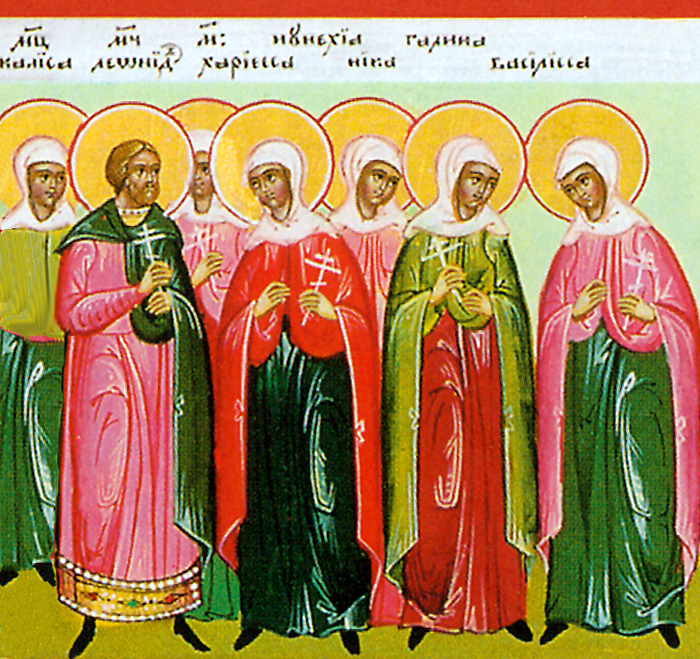
The Holy Martyr Leonidas and the Holy Martyrs Charissa, Nike (Nika, Victoria), Galina, Kalista (Kalida), Nunekhia, Basilissa, Irene, and Theodora suffered at Corinth in the year 258. They threw them into the sea, but they did not drown. Instead, they walked upon the water as if on dry land, singing spiritual hymns. The torturers overtook them in a ship, tied stones around their necks and drowned them.
Monastic Martyr Christopher of Dionysiou, Mount Athos
No information available at this time.
Hieromartyr Nikḗtas
No information available at this time.
Weeping “Ilyin Chernigov” Icon of the Mother of God
The Ilyin-Chernigov Icon of the Mother of God was painted in the year 1658 by the iconographer Gregory Dubensky (Gennadius in monasticism). Tears flowed from the icon for eight days in 1662, from April 16-24.
In this same year Tatars descended upon Chernigov and devastated it. At midnight they burst into the Trinity monastery, went into the church, overturned all the icons and grabbed all the utensils, but the wonderworking icon and its ornaments remained untouched.
An invisible power held back the impious from the holy icon. Previously, the Queen of Heaven had not permitted the enemy to enter the cave of Saint Anthony of the Caves, where the brethren of the monastery had hidden. The Tatars fled, as though terrified by a vision.
The miracle of the Mother of God and Her Chernigov Icon was described by Saint Demetrius of Rostov (October 28 and September 21) in his book, THE MOISTENED FLEECE [Runo Oroshennoe]. Later on, Saint John of Tobolsk (June 10) also wrote about the Chernigov Icon.
A wonderworking copy of the Chernigov Icon of the Mother of God, in the Gethsemane skete of the Trinity-Sergiev Lavra, was glorified in the year 1869 (September 1).
Tambov (Utkino) Icon of the Mother of God

In 1686, Saint Pitirim (July 28) arrived in Tambov. Along with other holy objects, he brought a copy of the Il'insk-Chernigov Icon of the Mother of God, which was considered to be the patroness of the southwest territory. Therefore, the copy was placed at the southwestern gate of the city. After a while, the Icon was called Tambov, especially since the copy differed slightly from the original Il’insk-Chernigov Icon. On either side of the Virgin, Saint Alexis, the man of God, and Saint Eudokia were depicted. It has been suggested that these were the patron saints of Saint Pitirim’s parents, and it is quite possible that he himself painted the images of these Saints.
Later, on the site of the southwestern city gates, a small wooden church was built and dedicated to the Holy Apostles Peter and Paul. In that church, there was an Icon. When the merchant Ivan Utkin built a stone church in honor of the Protomartyr Archdeacon Stephen with his own funds in 1771, the Tambov Icon was transferred here and placed in the altar above the Table of Oblation. People began to call the church Utkino, after the builder, and subsequently, the Icon was completely forgotten. The Queen of Heaven made them remember her, however.
At the beginning of the XIX century, a certain provincial priest from Kaluga suffered from an affliction in his leg, and he was unable to walk. It was this Icon of the Mother of God which appeared to him in a dream, and a voice told him, “Search for this icon. Pray before it, and you shall be healed.”
After this, the priest obtained some relief from his illness, so that he was able to walk. Right away, he began to search for the Icon he had seen in his dream. After visiting several villages and cities, he finally reached Tambov. He looked in all the churches until he found the Icon from his dream in the altar of the Utkino church. After praying before this Icon, he was completely healed. This incident became widely known in the city, and thereafter several more miraculous cures of the townspeople took place.
The Tambov Icon became known once again, and in 1835, when the old Utkino church was in a terrible state of disrepair, the townspeople requested that the right side altar be dedicated to the Tambov Icon of the Mother of God. Over time, the grateful people of Tambov diligently adorned the Icon. A luxurious silver riza was made, studded with many gems. There were so many cases of healing before the Icon that there was not enough time to record all of them. In 1888, by a decree of the Holy Synod, all the churches of the city were ordered to have a Cross Procession on April 16 in honor of the Tambov Icon. In 1900, the church itself was named for the Theotokos.
After the Russian Revolution, the churches of Tambov were ravaged, and the wonderworking Icon suffered. They removed the riza and picked out the gems, and the Icon itself disappeared without a trace. The city has preserved accounts of the miracles performed by the Icon.
Small Compline with the Canon of St. Lazarus – Fri 4/15/2022
Here is the live stream for Small Compline with the Canon of St. Lazarus – Fri 4/15/2022 If you need, here are instructions for accessing this content from your phone, tablet, computer, or TV.
Daily Readings for Friday, April 15, 2022
6TH FRIDAY OF LENT
ABSTAIN FROM MEAT, FISH, DAIRY, EGGS, WINE, OLIVE OIL
Crescens the Martyr, Leonidas, Bishop of Athens, Michael the New Martyr of Smyrna, The 9 Monk-martyrs of Corinth, Padarn, Bishop and Founder of Llandabarn Fawr
ISAIAH 66:10-24
Rejoice with Jerusalem, and be glad for her, all you who love her; rejoice with her in joy, all you who mourn over her; that you may suck and be satisfied with her consoling breasts; that you may drink deeply with delight from the abundance of her glory." For thus says the LORD: "Behold, I will extend prosperity to her like a river, and the wealth of the nations like an overflowing stream; and you shall suck, you shall be carried upon her hip, and dandled upon her knees. As one whom his mother comforts, so I will comfort you; you shall be comforted in Jerusalem. You shall see, and your heart shall rejoice; your bones shall flourish like the grass; and it shall be known that the hand of the LORD is with his servants, and his indignation is against his enemies. "For behold, the LORD will come in fire, and his chariots like the stormwind, to render his anger in fury, and his rebuke with flames of fire. For by fire will the LORD execute judgment, and by his sword, upon all flesh; and those slain by the LORD shall be many. "Those who sanctify and purify themselves to go into the gardens, following one in the midst, eating swine's flesh and the abomination and mice, shall come to an end together, says the LORD. "For I know their works and their thoughts, and I am coming to gather all nations and tongues; and they shall come and shall see my glory, and I will set a sign among them. And from them I will send survivors to the nations, to Tarshish, Put, and Lud, who draw the bow, to Tubal and Javan, to the coastlands afar off, that have not heard my fame or seen my glory; and they shall declare my glory among the nations. And they shall bring all your brethren from all the nations as an offering to the LORD, upon horses, and in chariots, and in litters, and upon mules, and upon dromedaries, to my holy mountain Jerusalem, says the LORD, just as the Israelites bring their cereal offering in a clean vessel to the house of the LORD. And some of them also I will take for priests and for Levites, says the LORD. "For as the new heavens and the new earth which I will make shall remain before me, says the LORD; so shall your descendants and your name remain. From new moon to new moon, and from sabbath to sabbath, all flesh shall come to worship before me, says the LORD. "And they shall go forth and look on the dead bodies of the men that have rebelled against me; for their worm shall not die, their fire shall not be quenched, and they shall be an abhorrence to all flesh.
GENESIS 49:33-50:26
When Jacob finished charging his sons, he drew up his feet into the bed, and breathed his last, and was gathered to his people. Then Joseph fell on his father's face, and wept over him, and kissed him. And Joseph commanded his servants the physicians to embalm his father. So the physicians embalmed Israel; forty days were required for it, for so many are required for embalming. And the Egyptians wept for him seventy days.
And when the days of weeping for him were past, Joseph spoke to the household of Pharaoh, saying, "If now I have found favor in your eyes, speak, I pray you, in the ears of Pharaoh, saying, My father made me swear, saying, 'I am about to die: in my tomb which I hewed out for myself in the land of Canaan, there shall you bury me.' Now therefore let me go up, I pray you, and bury my father; then I will return." And Pharaoh answered, "Go up, and bury your father, as he made you swear." So Joseph went up to bury his father; and with him went up all the servants of Pharaoh, the elders of his household, and all the elders of the land of Egypt, as well as all the household of Joseph, his brothers, and his father's household; only their children, their flocks, and their herds were left in the land of Goshen. And there went up with him both chariots and horsemen; it was a very great company. When they came to the threshing floor of Atad, which is beyond the Jordan, they lamented there with a very great and sorrowful lamentation; and he made a mourning for his father seven days. When the inhabitants of the land, the Canaanites, saw the mourning on the threshing floor of Atad, they said, "This is a grievous mourning to the Egyptians." Therefore the place was named Abelmizraim; it is beyond the Jordan. Thus his sons did for him as he had commanded them; for his sons carried him to the land of Canaan, and buried him in the cave of the field at Machpelah, to the east of Mamre, which Abraham bought with the field from Ephron the Hittite, to possess as a burying place. After he had buried his father, Joseph returned to Egypt with his brothers and all who had gone up with him to bury his father. When Joseph's brothers saw that their father was dead, they said, "It may be that Joseph will hate us and pay us back for all the evil which we did to him." So they sent a message to Joseph, saying, "Your father gave this command before he died, 'Say to Joseph, Forgive, I pray you, the transgression of your brothers and their sin, because they did evil to you.' And now, we pray you, forgive the transgression of the servants of the God of your father." Joseph wept when they spoke to him. His brothers also came and fell down before him, and said, "Behold, we are your servants." But Joseph said to them, "Fear not, for am I in the place of God? As for you, you meant evil against me; but God meant it for good, to bring it about that many people should be kept alive, as they are today. So do not fear; I will provide for you and your little ones." Thus he reassured them and comforted them.
So Joseph dwelt in Egypt, he and his father's house; and Joseph lived a hundred and ten years. And Joseph saw Ephraim's children of the third generation; the children also of Machir the son of Manasseh were born upon Joseph's knees. And Joseph said to his brothers, "I am about to die; but God will visit you, and bring you up out of this land to the land which he swore to Abraham, to Isaac, and to Jacob." Then Joseph took an oath of the sons of Israel, saying, "God will visit you, and you shall carry up my bones from here." So Joseph died, being a hundred and ten years old; and they embalmed him, and he was put in a coffin in Egypt.
PROVERBS 31:8-31
Open your mouth for the dumb, for the rights of all who are left desolate. Open your mouth, judge righteously, maintain the rights of the poor and needy. A good wife who can find? She is far more precious than jewels. The heart of her husband trusts in her, and he will have no lack of gain. She does him good, and not harm, all the days of her life. She seeks wool and flax, and works with willing hands. She is like the ships of the merchant, she brings her food from afar. She rises while it is yet night and provides food for her household and tasks for her maidens. She considers a field and buys it; with the fruit of her hands she plants a vineyard. She girds her loins with strength and makes her arms strong. She perceives that her merchandise is profitable. Her lamp does not go out at night. She puts her hands to the distaff, and her hands hold the spindle. She opens her hand to the poor, and reaches out her hands to the needy. She is not afraid of snow for her household, for all her household are clothed in scarlet. She makes herself coverings; her clothing is fine linen and purple. Her husband is known in the gates, when he sits among the elders of the land. She makes linen garments and sells them; she delivers girdles to the merchant. Strength and dignity are her clothing, and she laughs at the time to come. She opens her mouth with wisdom, and the teaching of kindness is on her tongue. She looks well to the ways of her household, and does not eat the bread of idleness. Her children rise up and call her blessed; her husband also, and he praises her: “Many women have done excellently, but you surpass them all.” Charm is deceitful, and beauty is vain, but a woman who fears the LORD is to be praised. Give her of the fruit of her hands, and let her works praise her in the gates.
Apostle Aristarchus of the Seventy

Saint Aristarchus was one of the Seventy Apostles, whom the Lord Jesus Christ sent to proclaim the good news of the Gospel (Luke. 10:1-24).
Saint Aristarchus, a co-worker of the holy Apostle Paul, became bishop of the Syrian city of Apamea. His name is repeatedly mentioned in the Acts of the Holy Apostles (Acts 19:29, 20:4, 27:2) and in the Epistles of Saint Paul (Col. 4:10, Philemon 1:24). He accompanied Saint Paul on his travels (Acts 16:29), and was Bishop of Apamea, Syria.
Saint Aristarchus is commemorated on April 15 with Saints Pudens and Trophimus and on September 27 together with Saints Mark and Zenas.
Apostle Pudens of the Seventy

Saint Pudens was one of the Seventy Apostles whom the Lord Jesus Christ sent before him with the good news of the Gospel (Luke 10:1-24).
Saint Pudens is mentioned in Saint Paul’s second Epistle to Timothy (2 Tim. 4:21). He occupied high position as a member of the Roman Senate. The saint received the foremost Apostles Peter and Paul in his home, where believing Christians gathered. His house was converted into a church, receiving the name “Pastorum”. According to Tradition, the holy Apostle Peter himself served in it as priest.
Saint Pudens suffered martyrdom at Rome under the emperor Nero (54-68). He is also commemorated on January 4.
Apostle Trophimus of the Seventy

Saint Trophimus was one of the Seventy Apostles, whom the Lord Jesus Christ sent to proclaim the good news of the Gospel (Luke. 10:1-24).
Saint Trophimus hailed from the city of Edessa. His name is mentioned in the Acts of the Holy Apostles (Acts 20:4) and in Saint Paul’s second Epistle to Timothy (2 Tim. 4:20). He was a disciple and companion of the Apostle Paul, sharing with him all the sorrows and persecution.
Saint Trophimus is also commemorated on January 4.
Martyrs Basilissa and Anastasia of Rome, disciples of Apostles Peter and Paul

The Holy Women Martyrs Basilissa (Vasilissa) and Anastasia lived in Rome and were converted to Christianity by the holy Apostles Peter and Paul. They devoted themselves to the service of the Lord.
When the emperor Nero (54-68) persecuted Christians and gave them over to torture and execution, Saints Basilissa and Anastasia took the bodies of the holy martyrs and gave them reverent burial. Rumors of this reached Nero, so Saints Basilissa and Anastasia were locked up in prison. They subjected them to cruel tortures: they scourged them with whips, scraped their skin with hooks, and burned them with fire. The holy martyrs remained unyielding, however, and bravely confessed their faith in Christ the Savior. By Nero’s command, they were beheaded with the sword (+ ca. 68).
Martyr Suchias and his Soldiers in Georgia

The Holy Martyr Suchias and his 16 Georgian Companions were illustrious dignitaries who served at the court of the Albanian (Hagbanite) ruler (i.e. “Caucasian Albania” on the present day territory of Azerbaizhan).
Escorting the Albanian ruler’s daughter Satenika, wife of the Armenian emperor Artaxar (88-123), Saint Suchias and his sixteen companions arrived in Artashat, the ancient capital of Armenia (the city was later destroyed by the Romans in the year 163).
Preaching there at the time was a Greek Christian named Chrysos, who had been enlightened and ordained by the holy Apostle Thaddeus (August 21). The Georgian dignitaries came to believe in Christ the Savior, and they resolved to devote their lives to the service of God. All seventeen of the newly-converted followed Chrysos into Mesopotamia. When Bishop Chrysos baptized them in the waters of the Euphrates, they were permitted to behold the Lord of Glory, Jesus Christ.
The holy martyrs set up a cross at the place of their Baptism and named it the “Cross of the Annunciation.” Bishop Chrysos gave all the saints new names: the eldest was called Suchias (replacing his old name Bagadras), and his companions were named Andrew, Anastasius, Talale, Theodoritus, Ivherion, Jordan, Kondrat, Lukian, Mimnenus, Nerangius, Polyeuctus, James, Phoka, Domentian, Victor and Zosimas.
After the martyric death of Bishop Chrysos, Saint Suchias became the spiritual leader of the brethren. All soon resettled in a wild locality on Mount Sukaketi, not far from the mountain village of Bagrevandi. Here the former dignitaries led very strict ascetic lives. The scant mountain vegetation served as their food, and they drank from a cold spring of water.
The new ruler of pagan Albania, Datianos, learned that his former officials had accepted Christianity and had gone into solitude. He sent his associate Barnapas with a detachment of soldiers to persuade them to return to court and return also to their former faith. Barnapas searched for Saint Suchias and his companions, but keeping their vow of service to God, they refused all entreaties.
Then by order of Barnapas, Saint Suchias and his companions were stretched out and nailed to the ground, and then burned. After this, their bodies were dismembered and scattered all about Mount Sukaketi, from which the martyrs received also the title the “Mesukevians” (more correctly, “Sukaketians”). This occurred in the year 123 (by another account, in the year 130; although an Athos manuscript of the eleventh century from the Ivḗron monastery gives the year as 100).
The holy relics of the martyrs remained incorrupt and unburied until the fourth century, when they were placed in graves and consigned to the earth by local Christians (the names of the holy martyrs were found written on a cliff).
The holy hieromartyr Gregory, Enlightener of Armenia (September 30), built a church on this spot and established a monastery. And afterwards, a curative spring of water was discovered there.
Martyr Savva the Goth of Wallachia
The Holy Martyr Savva, a Goth, lived during the fourth century. At this time the Arian bishop Wulfilas preached Christianity among the Goths, and Saint Savva was among those who were baptized.
Saint Savva led a virtuous life, devout, peaceful, temperate, simple, and quiet. He avoided women, and spent all his days in prayer. He often sang in church and devoted himself to its welfare, boldly preaching Christianity.
The Gothic princes and judges, under the influence of the pagan priests, began a persecution against the Christians and demanded that they eat meat offered to idols. Many of the pagans, to save the lives of their friends and relatives who had accepted Christianity, gave them ordinary meat instead of meat offered to idols.
Some Christians agreed to such a ruse, but Saint Savva refused and declared that Christians ought to confess their faith without dissimulation. After this, Saint Savva was driven out by those who lived in his village, but they later asked him to return. When the persecution of Christians had intensified, the fellow villagers of Saint Savva decided to go to the judge and swear that there were no Christians among them. Saint Savva declared, “Do not swear for me, because I am a Christian.”
The inhabitants then swore that there was only one Christian in their village. On the judge’s orders, Saint Savva was brought to him. The judge, seeing his poverty, decided that he could neither help nor harm anyone, so he set him free.
Meanwhile, the persecution continued. Soon, Atharid, one of the Gothic military commanders, descended on the village during the Feast of Holy Pascha. Saint Savva was preparing to greet the Great Feast with Bishop Guthik, but along the way an angel returned him to his own village. The priest Sapsal had recently arrived there from Greece. Soldiers arrested Sapsal and Saint Savva, whom they did not even allow to get dressed.
The priest rode on a cart, but Saint Savva had to walk naked behind the cart through the thorns, and they beat him with rods and switches. The Lord preserved the martyr, so that in the morning when they reached the city, Saint Savva said to his oppressors, “Look at my body, and see whether there are any traces of the thorns or of your blows.”
The soldiers were astonished, seeing the martyr healthy and unharmed, without the slightest trace of injury. Then they stretched Saint Savva on the axles of a cart, and they beat him the whole day. During the night, a certain pious woman got up to prepare food for the household, and seeing the martyr, she set him free. He began to help her with the housework.
During the day, by Atharid’s order, they suspended Saint Savva from the lintel of the house. They placed meat offered to idols before him and the priest, offering to set them free if they ate it. The priest Sapsal replied, “We would prefer that Atharid crucify us, than to eat meat defiled by devils.”
Saint Savva asked, “Who has sent this food?”
“Master Atharid,” the servant replied.
“There is only one Master, God, Who is in Heaven,” said the martyr. In anger one of the servants struck Saint Savva in the chest with a spear. Everyone thought that the martyr was dead, but the saint did not feel any pain. He said to the one who had struck him, “Your blow felt as if you had struck me with soft wool.”
Atharid gave orders to put Saint Savva to death. They left the priest Sapsal tied up, and led Saint Savva to the River Mussova to drown him. Along the way the saint gave thanks to God for allowing him to suffer for His Holy Name.
During all this the servants said, “Why shouldn’t we free this innocent man? Atharid will not find out if we free him.” Saint Savva heard them and cried out, “Do as you are commanded! For I see angels coming with glory to receive my soul!” Then they threw the martyr into the river, after they tied a large beam of wood to his neck.
Saint Savva suffered on April 12, 372, when he was thirty-eight years old. The executioners recovered the body of the martyr and threw it on shore, but Christians later hid it. Still later, one of the Scythian leaders, the Christian Junius Saran, brought the relics of Saint Savva to Cappadocia, where they were reverently received by Saint Basil the Great (January 1).
On June 20, 1992, the Romanian Orthodox Church glorified the Holy Martyr Savva of Buzău. This was the third canonization in its history, following those in 1517 and 1955-56.
The Romanian Orthodox Church has established the annual Feast Day of Saint Savva as April 12th. His Feast Day is on April 15 according to Slavic usage, but on April 18 in Greek practice.
Saint Ephraim the Great of Atsquri

Saint Ephraim the Great of Atsquri—one of the most important figures in the Georgian Church of the 8th and 9th centuries—was a disciple and companion of Saint Grigol of Khandzta.
On his way from Klarjeti in southern Georgia to Abkhazeti in the northwest, Saint Grigol met the young Ephraim and immediately perceived in him a like-minded companion and the future wonderworker and bishop of Atsquri.
Grigol promised to take the young man as his disciple. On his way back to Klarjeti Saint Grigol accompanied Ephraim and another youth, Arsenius, the future Catholicos of Georgia. He entrusted the upbringing of these two holy youths to his spiritual sons Christopher and Theodore.
The brothers of Khandzta Monastery objected to the arrival of the youths, since the monastery rules prohibited young visitors. But Saint Grigol told them that God had revealed this as His will and that, after being raised at the monastery, these young men would be like spiritual successors of Saint Ephraim the Syrian and Saint Arsenius the Great.
Saint Ephraim was later consecrated bishop of Atsquri and became a major figure in the Church of his time. He significantly contributed to the definitive strengthening of the autocephaly of the Georgian Church. As a result of his labors, the Georgian Church received a blessing from Antioch to prepare its own chrism in Mtskheta.
Saint Ephraim administered the diocese of Atsquri for forty years. God endowed him with the gifts of prophecy, wonderworking, and healing. He lived to an advanced age and reposed peacefully. Even today, those who approach his holy relics are healed of their infirmities.
Saint Ephraim of Atsquri is also mentioned in the Life of Saint Arsenius the Great [commemorated September 25].
Daily Readings for Thursday, April 14, 2022
6TH THURSDAY OF LENT
ABSTAIN FROM MEAT, FISH, DAIRY, EGGS, WINE, OLIVE OIL
Aristarchus, Pudens, Trophimus the Apostles of the 70, Thomais the Martyr of Alexandria, Ardalion the Actor and Martyr, Demetrios the New-Martyr of Arcadia
ISAIAH 65:8-16
Thus says the LORD: “As the wine is found in the cluster, and they say, ‘Do not destroy it, for there is a blessing in it, ‘ so I will do for my servants’ sake, and not destroy them all. I will bring forth descendants from Jacob, and from Judah inheritors of my mountains; my chosen shall inherit it, and my servants shall dwell there. Sharon shall become a pasture for flocks, and the Valley of Achor a place for herds to lie down, for my people who have sought me. But you who forsake the LORD, who forget my holy mountain, who set a table for Fortune and fill cups of mixed wine for Destiny; I will destine you to the sword, and all of you shall bow down to the slaughter; because, when I called, you did not answer, when I spoke, you did not listen, but you did what was evil in my eyes, and chose what I did not delight in.” Therefore thus says the Lord GOD: “Behold, my servants shall eat, but you shall be hungry; behold, my servants shall drink, but you shall be thirsty; behold, my servants shall rejoice, but you shall be put to shame; behold, my servants shall sing for gladness of heart, but you shall cry out for pain of heart, and shall wail for anguish of spirit. You shall leave your name to my chosen for a curse, and the Lord GOD will slay you; but his servants he will call by a different name. So that he who blesses himself in the land shall bless himself by the God of truth, and he who takes an oath in the land shall swear by the God of truth; because the former troubles are forgotten and are hid from my eyes.
GENESIS 46:1-7
So Israel took his journey with all that he had, and came to Beersheba, and offered sacrifices to the God of his father Isaac. And God spoke to Israel in visions of the night, and said, “Jacob, Jacob.” And he said, “Here am I.” Then he said, “I am God, the God of your father; do not be afraid to go down to Egypt; for I will there make of you a great nation. I will go down with you to Egypt, and I will also bring you up again; and Joseph’s hand shall close your eyes.” Then Jacob set out from Beersheba; and the sons of Israel carried Jacob their father, their little ones, and their wives, in the wagons which Pharaoh had sent to carry him. They also took their cattle and their goods, which they had gained in the land of Canaan, and came into Egypt, Jacob and all his offspring with him, his sons, and his sons’ sons with him, his daughters, and his sons’ daughters; all his offspring he brought with him into Egypt.
PROVERBS 23:15-24:5
My son, if your heart is wise, my heart too will be glad. My soul will rejoice when your lips speak what is right. Let not your heart envy sinners, but continue in the fear of the LORD all the day. Surely there is a future, and your hope will not be cut off. Hear, my son, and be wise, and direct your mind in the way. Be not among winebibbers, or among gluttonous eaters of meat; for the drunkard and the glutton will come to poverty, and drowsiness will clothe a man with rags. Hearken to your father who begot you, and do not despise your mother when she is old. Buy truth, and do not sell it; buy wisdom, instruction, and understanding. The father of the righteous will greatly rejoice; he who begets a wise son will be glad in him. Let your father and mother be glad, let her who bore you rejoice. My son, give me your heart, and let your eyes observe my ways. For a harlot is a deep pit; an adventuress is a narrow well. She lies in wait like a robber and increases the faithless among men. Who has woe? Who has sorrow? Who has strife? Who has complaining? Who has wounds without cause? Who has redness of eyes? Those who tarry long over wine, those who go to try mixed wine. Do not look at wine when it is red, when it sparkles in the cup and goes down smoothly. At the last it bites like a serpent, and stings like an adder. Your eyes will see strange things, and your mind utter perverse things. You will be like one who lies down in the midst of the sea, like one who lies on the top of a mast. "They struck me, " you will say, "but I was not hurt; they beat me, but I did not feel it. When shall I awake? I will seek another drink." Be not envious of evil men, nor desire to be with them; for their minds devise violence, and their lips talk of mischief. By wisdom a house is built, and by understanding it is established; by knowledge the rooms are filled with all precious and pleasant riches. A wise man is mightier than a strong man, and a man of knowledge than he who has strength.
Saint Martin the Confessor, Pope of Rome

Saint Martin the Confessor, Pope of Rome, was a native of the Tuscany region of Italy. He received a fine education and entered into the clergy of the Roman Church. After the death of Pope Theodore I (642-649), Martin was chosen to succeed him.
At this time the peace of the Church was disturbed by the Monothelite heresy (the false doctrine that in Christ there is only one will, whereas in fact He has a divine, and a human will). The endless disputes of the Monothelites with the Orthodox took place in all levels of the population. Even the emperor Constans (641-668) and Patriarch Paul of Constantinople (641-654) were adherents of the Monothelite heresy. The emperor Constans II published the heretical “Pattern of Faith” (Typos), obligatory for all the population. In it all further disputes were forbidden.
The heretical “Pattern of Faith” was received at Rome in the year 649. Saint Martin, a firm supporter of Orthodoxy, convened the Lateran Council at Rome to condemn the Monothelite heresy. At the same time Saint Martin sent a letter to Patriarch Paul, persuading him to return to the Orthodox confession of faith. The enraged emperor ordered the military commander Olympius to bring Saint Martin to trial. But Olympius feared the clergy and the people of Rome who had descended upon the Council, and he sent a soldier to murder the holy hierarch. When the assassin approached Saint Martin, he was blinded. The terrified Olympius fled to Sicily and was soon killed in battle.
In 654 the emperor sent another military commander, Theodore, to Rome. He accused Saint Martin of being in secret correspondence with the enemies of the Empire, the Saracens, and of blaspheming the Most Holy Theotokos, and of uncanonically assuming the papal throne.
Despite the proofs offered by the Roman clergy and laity of Saint Martin’s innocence, the military commander Theodore with a detachment of soldiers seized Saint Martin by night and took him to Naxos, one of the Cyclades islands in the Aegean Sea. Saint Martin spent an entire year on this almost unpopulated island, suffering deprivation and abuse from the guards. Then they sent the exhausted confessor to Constantinople for trial.
They carried the sick man on a stretcher, but the judges callously ordered him to stand up and answer their questions. The soldiers propped up the saint, who was weakened by illness. False witnesses came forward slandering the saint and accusing him of treasonous relations with the Saracens. The biased judges did not even bother to hear the saint’s defense. In sorrow he said, “The Lord knows what a great kindness you would show me if you would deliver me quickly over to death.”
After such a trial they brought the saint out in tattered clothes to a jeering crowd. They shouted, “Anathema to Pope Martin!” But those who knew the holy Pope was suffering unjustly, withdrew in tears. Finally the sentence was announced: Saint Martin was to be deposed from his rank and executed. They bound the half-naked saint with chains and dragged him to prison, where they locked him up with thieves. These were more merciful to the saint than the heretics.
In the midst of all this the emperor went to the dying Patriarch Paul and told him of the trial of Saint Martin. He turned away from the emperor and said, “Woe is me! This is another reason for my judgment.” He asked that Saint Martin’s torments be stopped. The emperor again sent a notary and other persons to the saint in prison to interrogate him. The saint answered, “Even if they cripple me, I will not have relations with the Church of Constantinople while it remains in its evil doctrines.” The torturers were astonished at the confessor’s boldness, and they commuted his death sentence to exile at Cherson in the Crimea.
Saint Martin departed to the Lord, exhausted by sickness, hunger and deprivations on September 16, 655. Two other bishops, who were banished to Cherson, also died after many hardships. The Saint was buried just outside the city of Cherson, in the Blachernae church of the Most Holy Theotokos. Great crowds of people visited his tomb because of the many miracles which took place there. Later, his relics were transferred to Rome, and placed in a church dedicated to Martin of Tours (November 11). The transfer of his relics is commemorated on November 12.
The Monothelite heresy was condemned at the Sixth Ecumenical Council in 680.
In Greek usage, the holy Confessor Martin is commemorated on April 13 and on September 20, while the Slavic churches commemorate him on April 14.
Martyrs Anthony, John, and Eustathius of Vilnius

The Holy Martyrs Anthony, John, and Eustathius (Kumetis, Nizilas, and Krulis) were brothers who suffered for Christ under the Lithuanian Great Prince Algirdas (1345-1377). The prince was married to the Orthodox princess Maria Yaroslavna (+ 1346). He was baptized and during his wife’s lifetime he allowed the preaching of Christianity. Two brothers, Nizilas and Kumetis (Nezhilo and Kumets), received holy Baptism from the priest Nestor, and they received the names Anthony and John. And at the request of Maria Yaroslavna an Orthodox church was built at Vilnius (Vilna).
After the death of his spouse, Prince Algirdas began to support the pagan priests of the fire-worshippers, who started a persecution against Christians. Saints John and Anthony endeavored not to flaunt their Christianity, but they did not observe pagan customs. They did not cut their hair as the pagans did, and on fast days they did not eat forbidden foods.
The prince soon became suspicious of the brothers, so he interrogated them and they confessed themselves Christians. Then he demanded that they eat meat (it was a fast day). The holy brothers refused, and the prince locked them up in prison. The brothers spent an entire year behind bars. John took fright at the impending tortures and declared that he would obey all the demands of the Great Prince. The delighted Algirdas released the brothers and brought them to himself.
But Anthony did not betray Christ. When he refused to eat meat on a fast day, the prince again locked him up in prison and subjected him to brutal tortures. The other brother remained free, but both Christians and pagans regarded him as a traitor and would not associate with him.
Repenting of his sin, John went to the priest Nestor and entreated him to ask his brother to forgive him. “When he openly confesses Christ, we will be reconciled,” Anthony replied. Once, while serving the prince at the bath, Saint John spoke privately with him about his reconciliation with the Church. Algirdas did not display any anger and said that he could believe in Christ, but must conduct himself like all the pagans. Then Saint John confessed himself a Christian in the presence of numerous courtiers. They beat him fiercely with rods and sent him to his brother in prison. The martyrs met with joy, and received the Holy Mysteries that same day.
Many people went to the prison to see the new confessor. The brothers converted many to Christ by their preaching. The prison was transformed into a Christian school. The frightened pagan priests demanded the execution of the brothers, but they did not fear death.
On the morning of April 14, 1347 the Martyr Anthony was hanged on a tree after receiving the Holy Mysteries. This oak, which the pagans considered sacred, became truly sacred for Orthodox Christians.
The pagan priests who hoped that Christian preaching would stop with the death of Saint Anthony, were disappointed. A multitude of the people gathered before the walls of the prison where Saint John was being held. On April 24, 1347 they strangled him and hanged his dead body upon the same oak. The venerable bodies of both martyrs were buried by Christians in the church of Saint Nicholas the Wonderworker.
A third sufferer for Christ was their relative Krulis (Kruglets). At Baptism the priest Nestor named him Eustathius. Krulis stood out because of his comeliness, valor and bravery, but even more because of his mind and virtue of soul. A favorite of Algirdas, he could count on a very promising future. However, he also refused to eat meat at the festal table. Saint Eustathius openly declared that he was a Christian and would not eat meat because of the Nativity Fast.
They began to beat him with iron rods, but the youth did not make a sound. The prince tried refining the torture. Algirdas gave orders to strip the martyr naked, take him out on the street and to pour icy water in his mouth. But this did not break his spirit. Then they broke his ankle bones, and ripped the hair and skin from his head, and cut off his ears and nose. Saint Eustathius endured the torments with such gladness and courage, that the very torturers themselves were astounded by the divine power which strengthened him. The martyr Eustathius was sentenced to death and hanged on the same oak where Saints John and Anthony received a martyr’s death (December 13, 1347).
For three days no one was permitted to take down the body of the martyr, and a column of cloud protected it from birds and beasts of prey. A church was later built on the hill where the holy martyrs suffered. The trinity of venerable passion bearers glorified the true God worshiped in the Holy Trinity, Father and Son and Holy Spirit. The church was dedicated to the Most Holy Trinity. The altar table was built on the stump of the sacred oak on which the martyrs died.
Soon their relics were found to be incorrupt. In 1364 Patriarch Philotheus of Constantinople (1354-1355, 1364-1376) sent a cross with the relics of the holy martyrs to Saint Sergius of Radonezh (September 25). The Church established the celebration of all three martyrs on April 14.
The holy martyrs were of immense significance for all the Western frontier. Vilnius’s monastery of the Holy Trinity, where the holy relics are kept, became a stronghold of Orthodoxy on this frontier. In 1915 during the invasion of the Germans, these relics were taken to Moscow.
The relics of the holy passion-bearers were returned to the Vilnius Holy Spirit monastery in 1946. The commemoration of their return (July 13) is solemnly observed at the monastery each year.
Martyr Ardalion the Actor
The Holy Martyr Ardalion suffered for Christ under the emperor Maximian Galerius (305-311). Saint Ardalion was a talented actor.
Once, he played the role of a Christian. In the play, the actor at first refused to offer sacrifice to idols, but then consented to renounce Christ. Suddenly the saint ordered everyone to be quiet and declared that he actually was a Christian.
Saint Ardalion continued to confess his faith in Christ. Then the governor ordered the martyr to be thrown onto a red-hot iron grill. So Saint Ardalion attained a martyr’s crown.
Martyr Azades the Eunuch and 1,000 Martyrs of Persia
Saint Azades (Azat) was a wealthy man who served in the household of King Shapur II of Persia, and enjoyed his confidence. He was arrested for professing Christianity, and then suffered martyrdom with 1000 other Christians. After this, the king repented and ordered an end to the persecution of Christians.
Icon of the Mother of God of Vilnius

The Vilnius (Vilna) Icon of the Mother of God was painted by the holy Evangelist Luke. For a long time it was in the family of the Greek emperors at Constantinople. In 1472 Sophia Paleologina, wife of the Moscow Great Prince Ivan III (1462-1505), transferred the icon to Moscow.
In 1495, the Great Prince blessed his daughter Elena with this icon before giving her in marriage to the Lithuanian king Alexander. The Church celebrates the transfer of this icon to Vilnius on February 15.
Later, the holy icon was placed in the church of Saint John the Forerunner, in which Princess Elena was buried. Afterwards, they transferred the icon to Vilnius’s Holy Trinity Monastery.
The Vilnius icon is also commemorated on February 15.
Daily Readings for Wednesday, April 13, 2022
6TH WEDNESDAY OF LENT
ABSTAIN FROM MEAT, FISH, DAIRY, EGGS, WINE, OLIVE OIL
Martin the Confessor, Pope of Rome, Theodosios the Martyr, Zoilos the Martyr
ISAIAH 58:1-11
Thus says the LORD: "Cry aloud, spare not, lift up your voice like a trumpet; declare to my people their transgression, to the house of Jacob their sins. Yet they seek me daily, and delight to know my ways, as if they were a nation that did righteousness and did not forsake the ordinance of their God; they ask of me righteous judgments, they delight to draw near to God. 'Why have we fasted, and thou seest it not? Why have we humbled ourselves, and thou takest no knowledge of it?' Behold, in the day of your fast you seek your own pleasure, and oppress all your workers. Behold, you fast only to quarrel and to fight and to hit with wicked fist. Fasting like yours this day will not make your voice to be heard on high. Is such the fast that I choose, a day for a man to humble himself? Is it to bow down his head like a rush, and to spread sackcloth and ashes under him? Will you call this a fast, and a day acceptable to the LORD? "Is not this the fast that I choose: to loose the bonds of wickedness, to undo the thongs of the yoke, to let the oppressed go free, and to break every yoke? Is it not to share your bread with the hungry, and bring the homeless poor into your house; when you see the naked, to cover him, and not to hide yourself from your own flesh? Then shall your light break forth like the dawn, and your healing shall spring up speedily; your righteousness shall go before you, the glory of the LORD shall be your rear guard. Then you shall call, and the LORD will answer; you shall cry, and he will say, "Here I am." "If you take away from the midst of you the yoke, the pointing of the finger, and speaking wickedness, if you pour yourself out for the hungry and satisfy the desire of the afflicted, then shall your light rise in the darkness and your gloom be as the noonday. And the LORD will guide you continually, and satisfy your desire with good things, and make your bones strong; and you shall be like a watered garden, like a spring of water, whose waters fail not.
GENESIS 43:26-31; 45:1-16
When Joseph came home, they brought into the house to him the present which they had with them, and bowed down to him to the ground. And he inquired about their welfare, and said, “Is your father well, the old man of whom you spoke? Is he still alive?” They said, “Your servant our father is well, he is still alive.” And they bowed their heads and made obeisance. And he lifted up his eyes, and saw his brother Benjamin, his mother’s son, and said, “Is this your youngest brother, of whom you spoke to me? God be gracious to you, my son!” Then Joseph made haste, for his heart yearned for his brother, and he sought a place to weep. And he entered his chamber and wept there. Then he washed his face and came out; and controlling himself he said, “Let food be served.” (Chapter 45:1-16) Then Joseph could not control himself before all those who stood by him; and he cried, “Make every one go out from me.” So no one stayed with him when Joseph made himself known to his brothers. And he wept aloud, so that the Egyptians heard it, and the household of Pharaoh heard it. And Joseph said to his brothers, “I am Joseph; is my father still alive?” But his brothers could not answer him, for they were dismayed at his presence. So Joseph said to his brothers, “Come near to me, I pray you.” And they came near. And he said, “I am your brother, Joseph, whom you sold into Egypt. And now do not be distressed, or angry with yourselves, because you sold me here; for God sent me before you to preserve life. For the famine has been in the land these two years; and there are yet five years in which there will be neither plowing nor harvest. And God sent me before you to preserve for you a remnant on earth, and to keep alive for you many survivors. So it was not you who sent me here, but God; and he has made me a father to Pharaoh, and lord of all his house and ruler over all the land of Egypt. Make haste and go up to my father and say to him, ‘Thus says your son Joseph, God has made me lord of all Egypt; come down to me, do not tarry; you shall dwell in the land of Goshen, and you shall be near me, you and your children and your children’s children, and your flocks, your herds, and all that you have; and there I will provide for you, for there are yet five years of famine to come; lest you and your household, and all that you have, come to poverty.’ And now your eyes see, and the eyes of my brother Benjamin see, that it is my mouth that speaks to you. You must tell my father of all my splendor in Egypt, and of all that you have seen. Make haste and bring my father down here.” Then he fell upon his brother Benjamin’s neck and wept; and Benjamin wept upon his neck. And he kissed all his brothers and wept upon them; and after that his brothers talked with him. When the report was heard in Pharaoh’s house, “Joseph’s brothers have come, ” it pleased Pharaoh and his servants well.
PROVERBS 21:23-22:4
He who keeps his mouth and his tongue keeps himself out of trouble. "Scoffer" is the name of the proud, haughty man who acts with arrogant pride. The desire of the sluggard kills him for his hands refuse to labor. All day long the wicked covets, but the righteous gives and does not hold back. The sacrifice of the wicked is an abomination; how much more when he brings it with evil intent. A false witness will perish, but the word of a man who hears will endure. A wicked man puts on a bold face, but an upright man considers his ways. No wisdom, no understanding, no counsel, can avail against the LORD. The horse is made ready for the day of battle, but the victory belongs to the LORD. A good name is to be chosen rather than great riches, and favor is better than silver or gold. The rich and the poor meet together; the LORD is the maker of them all. A prudent man sees danger and hides himself; but the simple go on, and suffer for it. The reward for humility and fear of the LORD is riches and honor and life.
Hieromartyr Artémon of Laodίkeia

The Hieromartyr Artémon was born of Christian parents in Laodίkeia, Syria in the III century. From his youth, he devoted himself to the service of the Church, and was a Reader for sixteen years. For his zeal, Bishop Sisίnnius ordained him as a Deacon. Saint Artémon also carried out this service with fervor and diligence for twenty-eight years, then he was ordained to the priesthood. In that position, Saint Artémon served the Church of God for another thirty-three years, preaching Christianity among pagans. When Emperor Diocletian (reigned 284-305) began his fierce persecution of the Church, issuing an edict ordering Christians to offer sacrifice to the idols, Saint Artémon was already quite old.
Knowing of the impending arrival of the military commander Patricius at Laodίkeia, Saint Sisίnnius went with the priest Artémon and some other Christians into the temple of the "goddess" Artemis. There they smashed and burned the idols, reducing them all to dust.
Afterward, Saint Sisίnnius and Saint Artémon gathered the flock into the church and fervently exhorted the Christians to remain firm in the Faith, and not to fear the threats of torturers.
When he arrived in Laodίkeia, Patricius celebrated a five-day festival in honor of the pagan "gods," and then entered the temple of Artemis to offer sacrifice. When he was told who had destroyed the temple, he went with a detachment of soldiers to the church where the Christians were praying.
As he approached the church, Patricius suddenly felt a chill, and then developed a fever, which left him scarcely alive. He was carried him home and put to bed. “The Christians have put a curse on me, and their God torments me,” he said to those around him. Although Patricius prayed to the idols, they did not relieve his sufferings. He sent a messenger to Bishop Sisίnnius, asking for his help, and promised to set up a gold statue of that Hierarch in the middle of the city. The Saint replied, “Keep your gold, but if you believe in Christ, He will heal you.”
Patricius was afraid of death, so he declared that he believed in Christ, and the affliction left him. But even this miracle did not affect the obdurate pagan's soul. Although he did not raise a hand against Bishop Sisίnnius, he did enforce the imperial edict against other Christians in the city of Caesarea.
Along the way he encountered Saint Artémon, who was followed by six wild donkeys and two deer. When Patricius asked how he was able to control these wild beasts, Saint Artémon replied that he held them with the Word of Christ. Patricius learned from the idolaters that it was Artémon who had destroyed the pagan temple of Artemis, so he ordered that Artémon be arrested and taken to the city of Caesarea. The Saint went with the soldiers without fear, but he told the animals to go to Saint Sisίnnius. Seeing the animals, Bishop Sisίnnius asked, “Why have these animals come here?”
A doe received the gift of speech from God and said, “The servant of God Artémon is being held by the impious Patricius, and is being brought to Caesarea in chains. He commanded us to come here to give you this news.”
Do not be astonished that the Lord, Who opened the mouth of Balaam’s ass (Numbers 22:28), also permitted the doe to speak. The Bishop sent Deacon Phileas to Caesarea to verify what he had been told.
At Caesarea, Patricius brought Saint Artémon to trial and tried to force him to offer sacrifice in the temple of Asclepius. In that pagan temple there were many poisonous vipers. The pagan priest never opened the doors, nor did he place the sacrifice before the idol. But Saint Artémon, calling on the Name of Jesus Christ, went into the temple and drove the snakes out. The pagans fled, but the Saint stopped them and killed the snakes by his breath. Vitalius, one of the pagan priests, believed in Christ and asked Saint Artémon to baptize him.
Patricius thought that Saint Artémon killed the snakes by sorcery, and again he interrogated and tortured him. Then the doe which had spoken arrived at Caesarea. She lay down at the Martyr's feet, licking his wounds. By God’s command the doe spoke again, denouncing the impious pagans. Addressing Patricius, the doe predicted that he would be seized by two birds of prey, and dropped into a cauldron of burning pitch. Patricius was enraged because he had been censured by a wild beast. He commanded his soldiers to shoot the doe with arrows, but she escaped. Afraid that the miracles performed by Saint Artémon would attract more people to him, Patricius ordered his execution.
An enormous cauldron was filled with boiling pitch, and the soldiers intended to throw Saint Artémon into it. But when Patricius rode up to the cauldron on horseback to see if the pitch was indeed boiling, two Angels in the form of eagles seized him and dropped him into the cauldron. His body was consumed so that not a single bone remained, but Saint Artémon survived.
Seeing this miracle, everyone ran away except Saint Artémon, who blessed and glorified God. When the Saint finished his prayer, a spring of water gushed forth from the ground. Saint Artémon baptized the pagan priest Vitalius and many pagans, who had come to believe in Christ. On the following morning, Saint Artémon communed the newly-baptized with the Holy Mysteries. Many of the baptized were ordained to the diaconate and the priesthood, and Vitalius was made Bishop of Palestine.
The Bishop of Caesarea came to visit Saint Artémon, noting the place where he had suffered. Subsequently, a church was built on that site.
Instructed by God's voice, Saint Artémon preached the Gospel in Asia Minor. Then an Angel appeared and transported him to the place which had been revealed to him, and there he converted many to Christ. The pagans arrested the Saint and beheaded him († 303).
In the Roman Martyrology, Saint Artémon is listed under October 8, while in Greek usage he is commemorated on April 12.
Saint Artémon the Presbyter of Laodίkeia should not be confused with Saint Artémon the Bishop of Seleukeia (March 24).
Martyr Crescens of Myra in Lycia
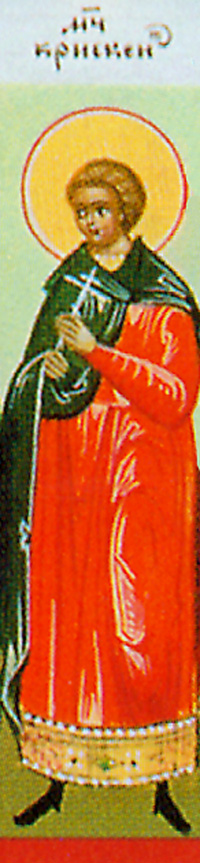
The Holy Martyr Crescens (Kreskes) was descended from an illustrious family and lived in Myra of Lycia. When a throng of city inhabitants were on the way to the pagan temple, he urged them to forsake paganism and come to Christ. This incident became known to the city prefect.
When the prefect asked the saint about his parentage, the saint, not wishing to bring unpleasantness to his parents, said nothing except that he was a Christian. The prefect knew Saint Crescens’ father and wanted to do him a favor. He suggested that Saint Crescens only appear to offer sacrifice to idols, while remaining a Christian.
The holy martyr replied, “It is impossible for the body not to do as the soul thinks, since the soul governs and moves the body.” They beat the holy martyr Crescens and raked him with iron claws, and then burned him in a fire.
Saint Andrew of Crete (July 4) mentions the Martyr Crescens in his Sermon on the Feast of Saint Nicholas the Wonderworker (December 6), who also came from Myra of Lycia.
Womanmartyr Thomais of Alexandria
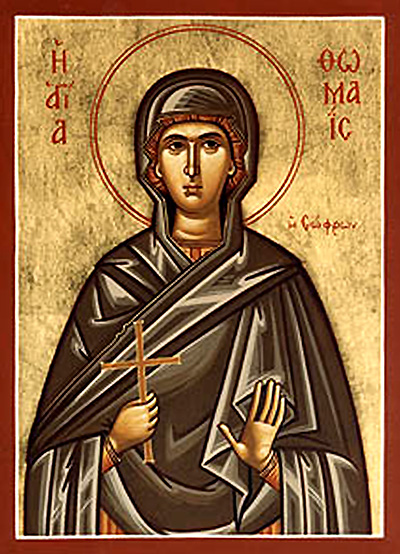
The Holy martyr Thomais was born into a Christian family in the city of Alexandria. She was raised in piety, and loved to read spiritual books.
When she was fifteen, the girl married a fisherman, who was also a Christian. The young couple lived in the house of her husband’s family, where Saint Thomais was loved for her mild and gentle disposition, and for other good traits.
Saint Thomais’ father-in-law, at the prompting of the devil, was captivated by her beauty. One night, when his son went out fishing, he attempted to lead his daughter-in-law into sin. Horrified, Saint Thomais admonished the senseless old man, reminding him of the Last Judgment and the penalty for sin. Infuriated by her steadfastness, he seized a sword and threatened to cut off her head. Saint Thomais answered resolutely, “Even if you cut me to pieces, I shall not stray from the commandments of the Lord.” Overcome with passion, the old man cut Saint Thomais in two with the sword. The saint received the crown of martyrdom in the year 476.
Divine punishment overtook the murderer. He became blind and could not find the door in order to escape. In the morning, the companions of the saint’s husband came to the door. They saw the body of the saint, and the blind old man covered with blood. The murderer confessed his evil deed and asked to be taken to the judge for punishment. He was beheaded for his crime.
At this time, Saint Daniel of Skete (June 7) happened to be in Alexandria. He told the monks of the Oktodekadian monastery (at the eighteenth mile on the road leading west from Alexandria) to bring the body of the martyr to the monastery and bury her in the cemetery with the departed fathers. Some of the monks were scandalized because he wanted to bury a woman’s body with the monks. Saint Daniel replied, “She is a mother to me and to you, because she died for her chastity.”
After the funeral Saint Daniel returned to his own skete. Soon one of the young monks began to complain to him that he was tormented by fleshly passions. Saint Daniel ordered him to go and pray at the grave of the holy martyr Thomais. The monk did the bidding of the Elder. While he prayed at the grave, he fell into a light sleep. Saint Thomais appeared to him and said, “Father, accept my blessing and go in peace.”
When he awakened, the monk felt joy and peace in his soul. After this, he told Saint Daniel that he was no longer bothered by the temptations of the flesh. Abba Daniel exclaimed, “Great is the boldness of those who have struggled for chastity.”
Many found both spiritual joy and release from their passions at the grave of Saint Thomais. Her holy relics were transferred to Constantinople to one of the women’s monasteries. The Russian pilgrim Archdeacon Zosimas venerated them in 1420.
Saint Thomais is invoked by those seeking deliverance from sexual impurity. Other saints whose intercession we seek for this purpose are: Saint John the Much-Suffering (July 18) and Saint Moses the Hungarian (July 26).
4/17 announcements
April 17, 2022
Feast of Palm Sunday
Entrance of Our Lord Jesus Christ into Jerusalem
Palm Sunday begins the observance of the eight days that encapsulate all of time and eternity as relates to man. The days begin with the proclamation on earth of the entry of the Messiah into Jerusalem and end with the Eternal King rising in incomprehensible victory to establish the heavenly Jerusalem and His eternal reign. On Palm Sunday, we begin the days of the full exhibition of the awful corruption sin has spread in mankind and the measureless love that heals and deifies our humanity. Today we thrill at the picture of Christ and the praises of the people, the object of adoration yet the perfection of humility. The imagery of the scene is beyond description: the King amidst His people, the palm and olive branches symbolizing His victory, His anointing, His peace; the cloaks and garments cast before Him symbolizing our complete submission to His will; the cries of adoration, of “Hosanna,” the coming of the Lord. Yet, on this day we are also near enough to feel acutely the dread of His passion, the desolation of the trial and Golgotha. This day also begins the week of the Eighth Day, the entry to eternity. As we observe Palm Sunday, we observe all history and the fulfillment of all history.
Philippians 4:4-9: Brethren, rejoice in the Lord always; again I will say, Rejoice! Let your forbearance be known to all people. The Lord is at hand. Be anxious for nothing, but in everything by prayer and supplication with thanksgiving let your petitions be made known to God. And the peace of God, which surpasses all understanding, will guard your hearts and your minds in Christ Jesus. Finally, brethren, whatever things are true, whatever things are honorable, whatever things are just, whatever things are pure, whatever things are lovely, whatever things are of good report; if there is any virtue, and if there is any praise, think about these things. The things which you both learned and received, and heard and saw in me, these things do; and the God of peace will be with you.
John 12:1-18: Six days before the Passover, Jesus came to Bethany, where Lazarus who had died was, whom Jesus had raised from the dead. There they made Him a supper; Martha served, and Lazarus was one of those at table with Him. Mary took a pound of costly ointment of pure nard and anointed the feet of Jesus and wiped His feet with her hair; and the house was filled with the fragrance of the ointment. But Judas Iscariot, Simon’s son, one of His Disciples (he who was to betray Jesus), said, “Why was this ointment not sold for three hundred denarii and given to the poor?” This he said, not because he cared for the poor but because he was a thief, and as he had the moneybox he used to take what was put into it. Jesus said, “Let her alone, let her keep it for the day of My burial. The poor you always have with you, but you do not always have Me.” When the great crowd of the Jews learned that He was there, they came, not only on account of Jesus but also to see Lazarus, whom Jesus had raised from the dead. So the chief priests planned to put Lazarus also to death, because on account of him many of the Jews were going away and believing in Jesus. The next day a great crowd who had come to the feast heard that Jesus was coming to Jerusalem. So they took branches of palm trees and went out to meet him, crying, “Hosanna! Blessed is He Who cometh in the Name of the Lord, the King of Israel!” And Jesus found a young ass and sat upon it; as it is written, “Fear not, daughter of Zion; behold, your king is coming, sitting on an ass’s colt!” His Disciples did not understand this at first; but when Jesus was glorified, then they remembered that this had been written of Him and had been done to Him. The crowd that had been with Jesus when He called Lazarus out of the tomb and raised him from the dead bore witness. The reason why the crowd went to meet Jesus was that they heard He had done this sign.
First Troparion of Palm Sunday: O Christ God, when thou didst raise Lazarus from the dead before thy Passion, thou didst confirm the universal resurrection. Wherefore, we, like babes, carry the insignia of triumph and victory, and cry to thee, O Vanquisher of death, Hosanna in the highest. Blessed is he that cometh in the Name of the Lord.
Second Troparion of Palm Sunday: O Christ God, when we were buried with thee in Baptism, we became deserving of thy Resurrection to immortal life. Wherefore, we praise thee, crying, Hosanna in the highest, blessed is he that cometh in the Name of the Lord.
Kontakion of Palm Sunday: Seated upon Thy throne in heaven, and a foal on earth, O Christ our God, Thou didst receive the praise of the angels and the hymns of the children: Blessed is He that cometh to recall Adam.
CALENDAR
UNTIL FURTHER NOTICE: All services listed on the calendar will be available through streaming and webcast.
Please continue to follow the CDC Guidelines to limit contagion and the spread of the COVID virus.
Sunday, April 17 (Palm Sunday)
8:50 a.m. — Orthros (webcast)
9:00 a.m. — Christian Education
10:00 a.m. — Divine Liturgy (webcast)
12:00 p.m. — Fish Fry Meal
6:30 p.m. — Bridegroom Matins
Monday, April 18 (Great and Holy Monday)
6:30 p.m. — Bridegroom Matins
Tuesday, April 19 (Great and Holy Tuesday)
6:30 p.m. — Bridegroom Matins
Wednesday, April 20 (Great and Holy Wednesday)
6:30 p.m. — Service of Holy Unction
Thursday, April 21 (Great and Holy Thursday)
7:00 a.m. — Vesperal Liturgy of St. Basil
6:30 p.m. — Reading of the Twelve Passion Gospels
Friday, April 22 (Great and Holy Friday)
7:00 a.m. — Royal Hours
3:00 p.m. — Taking down from the Cross
6:30 p.m. — Lamentations Service
Saturday, April 23 (Great and Holy Saturday)
9:00 a.m. — Vesperal Liturgy of St. Basil (with Baptism of Anthony Johnson)
10:30 p.m. — Rush Matins and the Paschal Service (webcast)
Sunday, April 24 (PASCHA)
NO Morning Services
4:00 p.m. — Agape Vespers at Holy Resurrection Orthodox Church in Clinton
Followed by Barbeque Meal
SPECIAL ANNOUNCEMENTS
The Eucharist Bread …was offered by the Meadows for the Divine Liturgy of Lazarus Saturday and by the Davises for the Divine Liturgy this morning.
Eucharist Bread Schedule:
Eucharist Bread Coffee Hour
April 17 (Palm Sunday) Davis D. Root/Baker
April 21 (Thurs. a.m.) D. Root Meadows
April 23 (Sat. a.m.) Karam Dansereau/Alaeetawi
April 23 (Sat. p.m.) Brock Everyone bring Pascha Baskets
Schedule for Epistle Readers – Page numbers refer to the Apostolos (book of the Epistles) located on the Chanters’ stand at the front of the nave. Please be sure to use this book when you read.
Reader Reading Page#
April 17 Sam Habeeb Phil. 4:4-9 294
April 21 (Thurs. a.m.) Ian Jones I Cor. 11:23-32 295
April 23 (Sat. a.m.) Reader Basil Baker Rom. 6:3-11 300
April 23 (Sat. p.m.) Walt Wood Acts 1:1-8 25
Also, please remember that we still need your tithes and offerings which may be placed in the tithe box at the back of the nave or be mailed to: St. Peter Orthodox Church, P.O. Box 2084, Madison, MS 39130-2084.
Continue to pray for Metropolitan Paul (who is also the brother of our Patriarch) and the Syriac Archbishop John of Aleppo who were abducted while on a humanitarian mission in Syria.
Please remember Fr. Joseph and Kh. Joanna Bittle, and their daughter Abigail, in your prayers.
Please remember the following in your prayers: Aidan Milnor, the Milnor family; Lamia Dabit and her family; Mary Greene (Lee and Kh. Sharon’s sister); Jay and Joanna Davis; Fr. Leo and Kh. Be’Be’ Schelver and their family; Kathy Willingham; Marilyn (Kyriake) Snell; Jack and Jill Weatherly; Lottie Dabbs (Sh. Charlotte Algood’s mother), Sh. Charlotte and their family; Maria Costas (currently at St. Catherine’s Village); Reader Basil and Brenda Baker; Buddy Cooper.
If you are not feeling well, PLEASE do not attempt to come to the services. This also includes anyone who may have been exposed to you during this time. Also, please let Fr. Herman know if you are not feeling well and have COVID like symptoms.
Anthony Johnson, son of former members Cain (Joshua) and Taylor Johnson, will be baptized during the Vesperal Divine Liturgy of Great and Holy Saturday on the morning of April 23rd. Simon and Rola Karam will be his godparents. Please keep all of them in your prayers.
Calendar Items:
* The Ladies will meet at the church at 10:00 a.m. on the second Saturday of the month to pray the Akathist to the Mother of God, Nurturer of Children on behalf of our children.
* The Ladies will meet for lunch on the last Tuesday of the month.
* The dates for Services of Palm Sunday and Holy Week are as follows:
Friday, April 15 — Small Compline with the Canon of St. Lazarus at 6:30 p.m.
Saturday, April 16 (Lazarus Saturday) — Orthros followed by Divine Liturgy at 9:00 a.m.
Sunday, April 17 (Palm Sunday) — morning services at usual Sunday times
(Sunday evening) — Bridegroom Matins, at 6:30 p.m.
Monday, April 18 (Great and Holy Monday)
 Saint Peter Antiochian Orthodox Church
You must be logged in to post a comment.