
Here is the live stream for Vesperal Liturgy of Saint Basil – Thursday 4/21/2022 If you need, here are instructions for accessing this content from your phone, tablet, computer, or TV.
Monthly Archives: April 2022
Service of Holy Unction – Wednesday 4/20/2022
Here is the live stream for Service of Holy Unction – Wednesday 4/20/2022 If you need, here are instructions for accessing this content from your phone, tablet, computer, or TV.
Daily Readings for Wednesday, April 20, 2022
HOLY WEDNESDAY
ABSTAIN FROM MEAT, FISH, DAIRY, EGGS, WINE, OLIVE OIL
Holy Wednesday, Theodore the Trichinas, Zacchaeus the Apostle of Caesaria, Gregory & Anastasios, Patriarchs of Antioch, Athanasios, Founder of the Monastery of Meteora
JOHN 12:17-50
At that time, the crowd that had been with Jesus when he called Lazarus out of the tomb and raised him from the dead bore witness. The reason why the crowd went to meet him was that they heard he had done this sign. The Pharisees then said to one another, "You see that you can do nothing; look, the world has gone after him.
Now among those who went up to worship at the feast were some Greeks. So these came to Philip, who was from Bethsaida in Galilee, and said to him, "Sir, we wish to see Jesus." Philip went and told Andrew; Andrew went with Philip and they told Jesus. And Jesus answered them, "The hour has come for the Son of man to be glorified. Truly, truly, I say to you, unless a grain of wheat falls into the earth and dies, it remains alone; but if it dies, it bears much fruit. He who loves his life loses it, and he who hates his life in this world will keep it for eternal life. If any one serves me, he must follow me; and where I am, there shall my servant be also; if any one serves me, the Father will honor him.
Now is my soul troubled. And what shall I say? 'Father, save me from this hour'? No, for this purpose I have come to this hour. Father, glorify your name." Then a voice came from heaven, "I have glorified it, and I will glorify it again." The crowd standing by heard it and said that it had thundered. Others said, "An angel has spoken to him." Jesus answered, "This voice has come for your sake, not for mine. Now is the judgment of this world, now shall the ruler of this world be cast out; and I, when I am lifted up from the earth, will draw all men to myself." He said this to show by what death he was to die. The crowd answered him, "We have heard from the law that the Christ remains for ever. How can you say that the Son of man must be lifted up? Who is this Son of man?" Jesus said to them, "The light is with you for a little longer. Walk while you have the light, lest the darkness overtake you; he who walks in the darkness does not know where he goes. While you have the light, believe in the light, that you may become sons of light.
When Jesus had said this, he departed and hid himself from them. Though he had done so many signs before them, yet they did not believe in him; it was that the word spoken by the prophet Isaiah might be fulfilled: "Lord, who has believed our report, and to whom has the arm of the Lord been revealed?" Therefore they could not believe. For Isaiah again said, "He has blinded their eyes and hardened their heart, lest they should see with their eyes and perceive with their heart, and turn for me to heal them." Isaiah said this because he saw his glory and spoke of him. Nevertheless many even of the authorities believed in him, but for fear of the Pharisees they did not confess it, lest they should be put out of the synagogue: for they loved the praise of men more than the praise of God.
And Jesus cried out and said, "He who believes in me, believes not in me but in him who sent me. And he who sees me sees him who sent me. I have come as light into the world, that whoever believes in me may not remain in darkness. If any one hears my sayings and does not keep them, I do not judge him; for I did not come to judge the world but to save the world. He who rejects me and does not receive my sayings has a judge; the word that I have spoken will be his judge on the last day. For I have not spoken on my own authority; the Father who sent me has himself given me commandment what to say and what to speak. And I know that his commandment is eternal life. What I say, therefore, I say as the Father has bidden me.
MATTHEW 26:6-16
When Jesus was at Bethany at the house of Simon the leper, a woman came up to him with an alabaster flask of very expensive ointment and she poured it on his head, as he sat at table. But when the disciples saw it, they were indignant, saying, "Why this waste? For this ointment might have been sold for a large sum, and given to the poor." But Jesus, aware of this, said to them, "Why do you trouble the woman? For she has done a beautiful thing to me. For you always have the poor with you, but you will not always have me. In pouring this ointment on my body she has done it to prepare me for burial. Truly, I say to you wherever this gospel is preached in the whole world, what she has done will be told in memory of her." Then one of the twelve, who was called Judas Iscariot, went to the chief priests and said, "What will you give me if I deliver him to you?" And they paid him thirty pieces of silver. And from that moment he sought an opportunity to betray him.
Great and Holy Wednesday
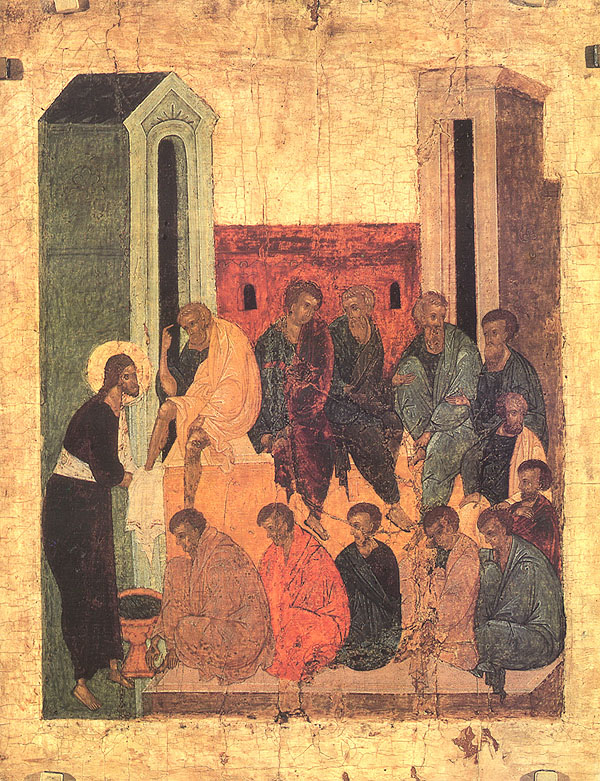
On Great and Holy Wednesday, the hymns of the Bridegroom Service remind us of the sinful woman who poured precious ointment on Christ’s head at Simon the leper’s house (Mt. 26:7).
The disciples complained about the wasteful extravagance, for the myrrh could have been sold and the money given to the poor. On this same day Judas agreed to betray the Lord for thirty pieces of silver. Because the betrayal took place on Wednesday, Orthodox Christians fast on most Wednesdays during the year.
On the other hand, the Savior declared that the woman’s actions would be remembered wherever the Gospel is preached (Mt. 26:13), for she had anointed Him in preparation for His burial (Mt. 26:12).
Venerable Theodore Trichinas “the Hair-Shirt Wearer” and Hermit Near Constantinople
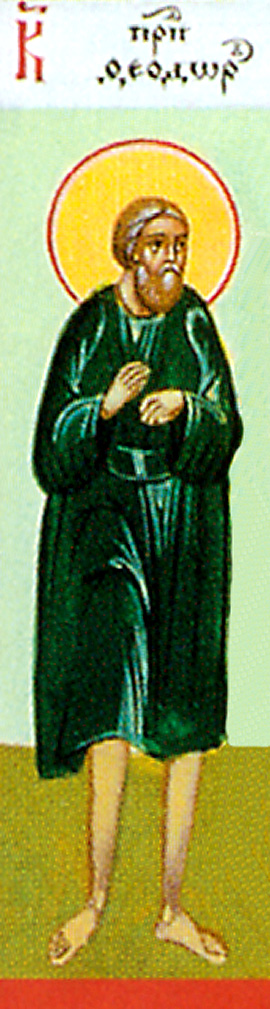
Saint Theodore Trichinas was born in Constantinople, the son of wealthy and pious parents. From childhood Saint Theodore was inclined toward monasticism, so he left his home, family, and former life in order to enter a monastery in Thrace. There he began his arduous ascetic struggles. He dressed in a hair-shirt, from which he derived the name “Trichinas,” (or “Hair-Shirt Wearer”). He even slept on a stone in order avoid bodily comfort, and to prevent himself from sleeping too much.
His life was adorned with miracles, and he had the power to heal the sick. He reposed at the end of the fourth century, or the beginning of the fifth century. A healing myrrh flows from his relics.
The name of Saint Theodore Trichinas is one of the most revered in the history of Orthodox monasticism. Saint Joseph the Hymnographer (April 4) has composed a Canon to the saint.
Venerable Alexander, Abbot of Oshevensk

Saint Alexander of Oshevensk (+ 1479) was the founder of the Oshevensk Dormition Monastery and enlightener of the Kargopol area, and was tonsured in the White Lake Monastery. He appeared to Saint Diodorus of George Hill (November 27) in the seventeenth century when his Holy Trinity Monastery ran out of supplies, and the brethren complained because there was nowhere to buy food in the wilderness. Saint Alexander reminded Diodorus of how the Lord had fed the five thousand in the wilderness, and ordered him to go fishing. Saint Diodorus, fearing that the vision was a demonic delusion, ignored it. When Saint Alexander appeared a third time, Diodorus, wishing to test him, asked him to say a prayer. Saint Alexander recited “It is Truly Meet,” and his face shone with a radiant light. The saint revealed himself as Alexander, the igumen of Oshevensk Dormition Monastery, and repeated his order to go fishing. Obeying this command, the monks went out and caught many fish.
Childmartyr Gabriel of Bialystok

Child Martyr Gabriel of Bialystok (+ 1690) was killed in Poland when he was only six years old. One day when his parents were not home, he was lured out of his house by a man named Schutko, and then killed. After thirty years, the martyred child’s body was found to be incorrupt.
Blessed Gregory, Patriarch of Antioch
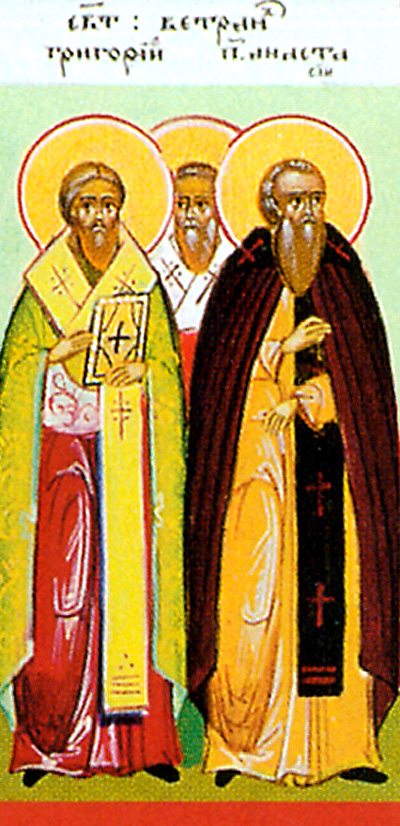
No information available at this time.
Venerable Anastasius, Abbot of Sinai
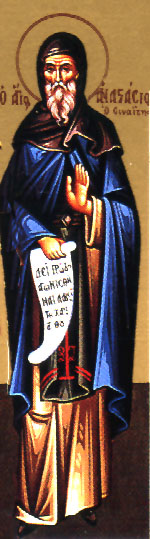
Saint Anastasius of Sinai lived in the seventh century, and was one of the great ascetics who flourished on Mt. Sinai.
From his youth, he was raised in great piety and love for God. When he reached manhood, Saint Anastasius left the world and entered a monastery to take upon himself the yoke of Christ (Mt.11:29). Wishing to perfect himself in virtue, he went to Saint Catherine’s Monastery on Mt. Sinai, where Saint John of the Ladder (March 30) was abbot. There he profited from the example of many holy men who were proficient in monasticism.
Because of his humility, Saint Anastasius received wisdom and spiritual discernment from God. He wrote the Lives of several holy Fathers, as well as other spiritually instructive books. In time, he was found worthy of ordination to the holy priesthood.
Following Saint John and his brother George, Saint Anastasius became abbot of Sinai. He was most zealous in his opposition to heresy, exposing it, refuting it, and covering its adherents with shame. He even traveled to Syria, Egypt, and Arabia to uproot heresy and strengthen the Church of Christ.
Saint Anastasius taught that God gives each Christian an angel to care for him throughout his life. However, we can drive our Guardian Angel away by our sins, just as bees are driven away by smoke. While the demons work to deprive us of the heavenly Kingdom, the holy angels guide us to do good. Therefore, only the most foolish individuals would drive away their Guardian Angel from themselves.
After a long life of faithfully serving God, Saint Anastasius fell asleep in the Lord in the year 685. He and the other ascetics of Mt. Sinai are also commemorated on Bright Wednesday, the Synaxis of the Monastic Fathers of Sinai.
Saint Betran, Bishop of Lesser Scythia
No information available at this time.
Saint Theotimus, Bishop of Lesser Scythia
Saint Theotimus the Scythian was Bishop of Tomis in Scythia. He was a native of Dacia Pontica, and was part Roman. He is believed to have been the teacher of Saint John Cassian (February 29) and Saint Germanus, because he was once living in the same monastery as they were.
Somewhere between 385-390, Saint Theotimus succeeded Saint Germanus as Bishop of Tomis. Saint Jerome mentions him in his book ON ILLUSTRIUS MEN. He describes Saint Theotimus as a good pastor, a wise theologian, and a talented writer. He also says that Saint Theotimus used to write short works in the form of dialogues, which reveal his training in rhetoric and philosophy.
In his writings, Saint Theotimus speaks of the role of the mind and the heart in prayer. Perhaps because of this he is considered to be the Father of the Romanian PHILOKALIA.
Saint Theotimus sometimes endured hardships from wandering barbarians, but he impressed them with the holiness of his life and the miracles he performed. He also had close ties with Saint John Chrysostom, and visited Constantinople at least twice.
Sometime around 410, Saint Theotimus fell asleep in the Lord. Ancient historians also refer to him as “the Philosopher.”
Translation of the relics of Saint Nikolai of Zhicha

No information available at this time.
Saint Joseph of Serbia
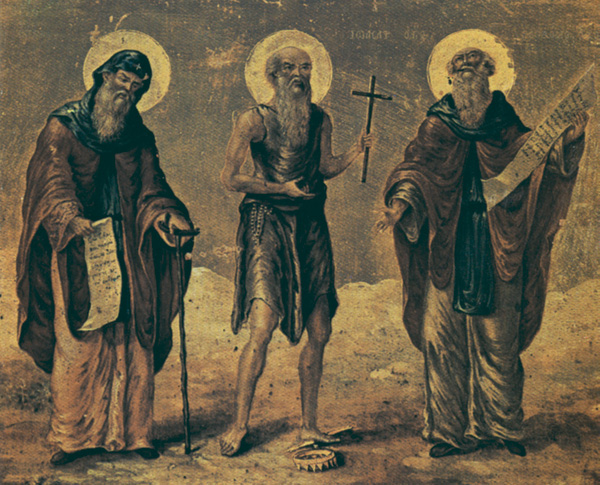
No information available at this time.
Apostle Zacchaeus
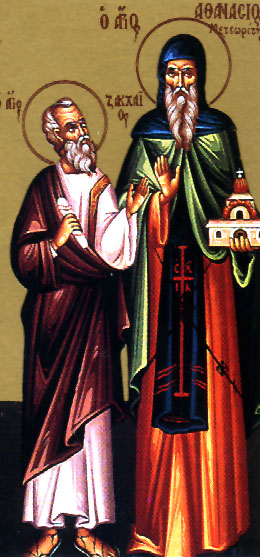
The holy Apostle Zacchaeus was a rich publican at Jericho. Since he was short of stature, he climbed a sycamore tree in order to see the Savior passing by. After the Ascension of the Lord, Saint Zacchaeus accompanied Saint Peter on his travels. Tradition says he became the Bishop of Caesarea in Palestine, where he died in peace.
The Gospel (Luke 19:1-10) describing Zacchaeus’ encounter with Christ is read on the Sunday before the Triodion begins.
Saint Athanasius of Meteora

No information available at this time.
Bridegroom Matins – Tuesday 4/19/2022
Due to technical difficulties, stream is unavailable today.
$/24 announcements
April 24, 2022
Sunday of Great and All-Holy PASCHA
“Unique and holy day, King and lord of days, feast of feasts, solemnity of solemnities. . . ” Thus we celebrate the Great Feast because of the resurrection of our Lord and begin the season of celebration which lasts through Pentecost. The paschal solemnities (of Maundy Thursday and Good Friday) are joined to the feast of the resurrection to endow the mystery of Christmas and the Incarnation with the fulness of its meaning and are the prerequisite condition for Pentecost. Easter, therefore, is the center, the heart of the Christian Year.
“Come, take light from the Light that has no evening, and glorify Christ, risen from the dead.” The Church again represents the Christian mystery in terms of light; this Light, whose birth was marked by the star of Bethlehem, is shining among us with growing intensity; the darkness of Golgotha could not extinguish it. The physical Resurrection of Jesus would be without value to us if the divine light did not shine at the same time among us, within us. But the good news of the Resurrection is that the light brought by the Saviour now completely overcomes the darkness of our sins!
“Christ is risen from the dead, trampling down Death by death, and to those in the tomb He has given life!”
Acts of the Apostles 1:1-8: In the first book, O Theophilus, I have dealt with all that Jesus began to do and teach, until the day when He was taken up, after He had given commandment through the Holy Spirit to the Apostles whom He had chosen. To them He presented Himself alive after His passion by many proofs, appearing to them during forty days, and speaking of the kingdom of God. And while staying with them He charged them not to depart from Jerusalem, but to wait for the promise of the Father, which, He said, “You heard from Me; for John baptized with water, but before many days you shall be baptized with the Holy Spirit.” So when they had come together, they asked Him, “Lord, will you at this time restore the kingdom to Israel?” He said to them, “It is not for you to know times or seasons which the Father has fixed by His own authority. But you shall receive power when the Holy Spirit has come upon you; and you shall be my witnesses in Jerusalem and in all Judea and Samaria and to the end of the earth.”
John 1:1-17: In the beginning was the Word, and the Word was with God, and the Word was God. He was in the beginning with God; all things were made through Him, and without Him was not anything made that was made. In Him was life, and the life was the light of men. The light shines in the darkness, and the darkness has not overcome it. There was a man sent from God, whose name was John. He came for testimony, to bear witness to the light, that all might believe through Great & Holy Pascha Liturgy Variables 4 Great & Holy Pascha him. He was not the light, but came to bear witness to the light. The true light that enlightens every man was coming into the world. He was in the world, and the world was made through Him, yet the world knew Him not. He came to His own home, and His own people received Him not. But to all who received Him, who believed in His Name, He gave power to become children of God; who were born, not of blood, nor of the will of the flesh, nor of the will of man, but of God. And the Word became flesh and dwelt among us, full of grace and truth; we have beheld His glory, glory as of the only Son from the Father. (John bore witness to Him, and cried, “This was He of Whom I said, ‘He Who comes after me ranks before me, for He was before me.’”) And from His fullness have we all received, grace upon grace. For the law was given through Moses; grace and truth came through Jesus Christ.
Paschal Troparion: Christ is risen from the dead; by Death has he trodden death, and upon those in the tombs, hath he bestowed life.
Hypakoe of Easter: They who were with Mary came before the dawn, found the stone rolled away from the sepulchre, and heard the angels say unto them, Why seek ye him as man with the dead, who dwelleth in light eternal? Behold the grave wrappings; make haste and declare to the world that the Lord is risen, and hath caused death to die; for he is the Son of God, the Saviour of mankind.
Kontakion of Pascha: When Thou didst descend into the grave, O Immortal, Thou didst destroy the power of Hades. In victory didst Thou arise, O Christ God, proclaiming Rejoice! to the myrrh-bearing women, granting peace to Thine apostles and bestowing resurrection on the fallen.
CALENDAR
UNTIL FURTHER NOTICE: All services listed on the calendar will be available through streaming and webcast.
Please continue to follow the CDC Guidelines to limit contagion and the spread of the COVID virus.
Sunday, April 24 (PASCHA)
NO Morning Services
4:00 p.m. — Agape Vespers at Holy Resurrection Orthodox Church in Clinton
Followed by Barbeque Meal
Monday, April 25 (Bright Monday)
Father Herman off
NO Services
Tuesday, April 26 (Bright Tuesday)
NO Services
11:30 a.m. — Ladies Lunch
Wednesday, April 27 (Bright Wednesday)
6:30 p.m. — Vespers of Bright Week
7:30 p.m. — Parish Council Meeting
Thursday, April 28 (Bright Thursday)
NO Services
Friday, April 29 (Bright Friday)
NO Services
Saturday, April 30 (Bright Saturday)
Sunday, May 1 (Thomas Sunday)
9:00 a.m. — Orthros (webcast)
9:00 a.m. — Christian Education
10:00 a.m. — Divine Liturgy (webcast)
SPECIAL ANNOUNCEMENTS
The Eucharist Bread …was offered by the Daniel Roots for the Vesperal Divine Liturgy of Great and Holy Thursday, by the Karams for the Vesperal Divine Liturgy of Great and Holy Saturday and by the Brocks for the Paschal Divine Liturgy this morning.
Eucharist Bread Schedule:
Eucharist Bread Coffee Hour
April 21 (Thurs. a.m.) D. Root Meadows
April 23 (Sat. a.m.) Karam Dansereau/Alaeetawi
April 23 (Sat. p.m.) Brock Everyone brings a Pascha basket
May 1 R. Root Ellis/Waites/Zouboukos
May 7 (Sat. p.m.) Pacurari (Artos Bread for Litia and Artoklasia)
May 8 Baker Lasseter/Pacurari/Miller
May 15 Henderson POT LUCK MEAL
Algood/Schelver
May 22 Algood Meadows/Pigott
May 29 Schelver D. Root/Baker/Cooper
Schedule for Epistle Readers – Page numbers refer to the Apostolos (book of the Epistles) located on the Chanters’ stand at the front of the nave. Please be sure to use this book when you read.
Reader Reading Page#
April 21 (Thurs. a.m.) Ian Jones I Cor. 11:23-32 295
April 23 (Sat. a.m.) Reader Basil Baker Rom. 6:3-11 300
April 23 (Sat. p.m.) Walt Wood Acts 1:1-8 25
May 1 Sh. Charlotte Algood Acts 5:12-20 32
May 8 Brenda Baker I John 1:1-7 382
May 15 Ian Jones Acts 9:32-42 45
May 22 Kh. Sharon Meadows Acts 11:33-12:2 52
May 29 Sam Habeeb Acts 16:16-34 58
Also, please remember that we still need your tithes and offerings which may be placed in the tithe box at the back of the nave or be mailed to: St. Peter Orthodox Church, P.O. Box 2084, Madison, MS 39130-2084.
Continue to pray for Metropolitan Paul (who is also the brother of our Patriarch) and the Syriac Archbishop John of Aleppo who were abducted while on a humanitarian mission in Syria.
Please remember Fr. Joseph and Kh. Joanna Bittle, and their daughter Abigail, in your prayers.
Please remember the following in your prayers: Aidan Milnor, the Milnor family; Lamia Dabit and her family; Mary Greene (Lee and Kh. Sharon’s sister); Jay and Joanna Davis; Fr. Leo and Kh. Be’Be’ Schelver and their family; Kathy Willingham; Marilyn (Kyriake) Snell; Jack and Jill Weatherly; Lottie Dabbs (Sh. Charlotte Algood’s mother), Sh. Charlotte and their family; Maria Costas (currently at St. Catherine’s Village); Reader Basil and Brenda Baker and their family; Buddy Cooper.
If you are not feeling well, PLEASE do not attempt to come to the services. This also includes anyone who may have been exposed to you during this time. Also, please let Fr. Herman know if you are not feeling well and have COVID like symptoms.
Welcome and Many Years! to Anthony Johnson (son of Joshua and Taylor Johnson) who was baptized this morning during the Vesperal Divine Liturgy of Great and Holy Saturday!
Calendar Items:
* The Ladies will meet at the church at 10:00 a.m. on the second Saturday of the month to pray the Akathist to the Mother of God, Nurturer of Children on behalf of our children.
* The Ladies will meet for lunch on the last Tuesday of the month.
* We will continue our celebration of PASCHA with Agape Vespers this afternoon at Holy Resurrection Orthodox Church in Clinton, beginning at 4:00 p.m.
* The dates for Stewpot for 2022 are Saturday, May 7th and Saturday, September 3rd.
Diocese of Miami and the Southeast Parish Life Conference: Registration is now open for the Parish Life Conference to be hosted June 15-18 by St. John Orthodox Church in Memphis. More information may be found on the Diocesan website at DOMSE.org.
Camp St. Thekla dates: The dates for Camp St. Thekla are: Session 1 is June 26 – July 2 and Session 2 is July 3 – 9. If you have a child registered for Camp, please see Daniel for information on scholarships available from the Order of St. Ignatius. If there is still a financial need, some additional funds may be available.
Fasting Discipline for April
Beginning with Clean Monday on March 7th, the traditional fasting discipline (no meat, dairy, eggs, fish, wine or oil) is observed on all days of the week until Pascha (except for the Feast of the Annunciation on March 25th and Palm Sunday on April 17th, when fish, wine and oil are permitted). There is no fasting of any kind during Bright Week following Pascha (April 25-May1).
Major Commemorations for April
April 24 PASCHA
April 25 Holy Apostle Mark
April 29 Apostle James, Son of Zebedee
Instructions for streaming our services can be found on the parish website.
Quotable “God is a fire that warms and kindles the heart and inward parts. Hence, if we feel in our hearts the cold which comes from the devil – for the devil is cold – let us call on the Lord. He will come to warm our hearts with perfect love, not only for Him but also for our neighbor, and the cold of him who hates the good will flee before the heat of His countenance.”
St. Seraphim of Sarov
Worship: Sunday, May 1, 2022 (Thomas Sunday)
Scripture: Acts 5:12-20; John 20:19-31
Celebrant: Father Herman
Epistle Reader: Sh. Charlotte Algood
Prosphora: R. Root
Coffee Hour: Ellis/Waites/Zouboukos
Daily Readings for Tuesday, April 19, 2022
HOLY TUESDAY
ABSTAIN FROM MEAT, FISH, DAIRY, EGGS, WINE, OLIVE OIL
Holy Tuesday, The Holy Hieromartyr Paphnutius, Tryphon, Patriarch of Constantinople, George the Confessor, Aelphege the Hieromartyr of Canterbury
MATTHEW 22:15-46; 23:1-39
At that time, the Pharisees went and took counsel against Jesus, how to entangle him in his talk. And they sent their disciples to him, along with the Herodians, saying, "Teacher, we know that you are true, and teach the way of God truthfully, and care for no man; for you do not regard the position of men. Tell us, then, what you think. Is it lawful to pay taxes to Caesar, or not?" But Jesus, aware of their malice, said, "Why put me to the test, you hypocrites? Show me the money for the tax." And they brought him a coin. And Jesus said to them, "Whose likeness and inscription is this?" They said, "Caesar's." Then he said to them, "Render, therefore to Caesar the things that are Caesar's, and to God the things that are God's. " When they heard it, they marveled; and they left him and went away.
The same day the Sadducees came to him, who say that there is no resurrection; and they asked him a question saying, "Teacher, Moses said, 'If a man dies, having no children, his brother must marry the widow, and raise up children for his brother.' Now there were seven brothers among us; the first married, and died, and having no children left his wife to his brother. So too the second and third, down to the seventh. After them all, the woman died. In the resurrection, therefore, to which of the seven will she be wife? For they all had her.
But Jesus answered them, "You are wrong, because you know neither the scriptures nor the power of God. For in the resurrection they neither marry nor are given in marriage, but are like angels of God in heaven. And as for the resurrection of the dead, have you not read what was said to you by God, 'I am the God of Abraham, and the God of Isaac, and the God of Jacob'? He is not God of the dead, but of the living." And when the crowd heard it, they were astonished at his teaching.
But when the Pharisees heard that he had silenced the Sadducees, they came together. And one of them, a lawyer, asked him a question, to test him. "Teacher, which is the great commandment in the law?" And he said to him, "You shall love the Lord your God with all your heart, and with all your soul, and with all your mind. This is the great and first commandment. And a second is like it. You shall love your neighbor as yourself. On these two commandments depend all the law and the prophets.
Now while the Pharisees were gathered together, Jesus asked them a question, saying: "What do you think of the Christ? Whose son is he?" They said to him, "The son of David." He said to them, "How is it then that David, inspired by the Spirit, calls him Lord, saying, 'The Lord said to my Lord, sit at my right hand, till I put your enemies under your feet'? If David thus calls him Lord, how is he his son?" And no one was able to answer him a word, nor from that day did any one dare to ask him any more questions.
Then said Jesus to the crowds and to his disciples, "The scribes and the Pharisees sit on Moses' seat; so practice and observe whatever they tell you, but not what they do; for they preach but do not practice. They bind heavy burdens, hard to bear, and lay them on men's shoulders; but they themselves will not move them with their finger. They do all their deeds to be seen by men; for they make their phylacteries broad and their fringes long, and they love the place of honor at feasts and the best seats in the synagogues, and salutations in the market places, and being called rabbi by men, but you are not to be called rabbi, for you have one teacher, and you are all brethren. And call no man your father on earth, for you have one Father, who is in heaven. Neither be called masters, for you have one master, the Christ. He who is greatest among you shall be your servant; whoever exalts himself will be humbled, and whoever humbles himself will be exalted.
But woe to you, scribes and Pharisees, hypocrites! for you devour widows' houses and for a pretense you make long prayers; therefore you will receive the greater condemnation. Woe to you, scribes and Pharisees, hypocrites! because you shut the kingdom of heaven against men; for you neither enter yourselves, nor allow those who would enter to go in. Woe to you, scribes and Pharisees, hypocrites! for you traverse sea and land to make a single proselyte, and when he becomes a proselyte, you make him twice as much a child of Gehenna as yourselves.
Woe to you, blind guides, who say, 'If any one swears by the temple, it is nothing; but if any one swears by the gold of the temple, he is bound by his oath.' You blind fools! For which is greater, the gold or the temple that has made the gold sacred? And you say, 'If any one swears by the altar, it is nothing; but if any one swears by the gift that is on the altar, he is bound by his oath.' You blind men! For which is greater, the gift or the altar that makes the gift sacred? So he who swears by the altar, swears by it and by everything on it; and he who swears by the temple, swears by it and by him who dwells in it; and he who swears by heaven, swears by the throne of God and by him who sits upon it.
Woe to you, scribes and Pharisees, hypocrites! for you tithe mint and dill and cumin, and have neglected the weightier matters of the law, justice and mercy and faith; these you ought to have done without neglecting the others. You blind guides, straining out a gnat and swallowing a camel! "Woe to you, scribes and Pharisees, hypocrites! for you cleanse the outside of the cup and of the plate, but inside they are full of extortion and rapacity. You blind Pharisee! first cleanse the inside of the cup and of the plate, that the outside also may be clean. Woe to you, scribes and Pharisees, hypocrites! for you are like white-washed tombs, which outwardly appear beautiful, but within they are full of dead men's bones and all uncleanness. So you also outwardly appear to men, but within you are full of hypocrisy and iniquity. Woe to you, scribes and Pharisees, hypocrites! for you build the tombs of the prophets and adorn the monuments of the righteous, saying, 'If we had lived in the days of our fathers, we would not have taken part with them in shedding the blood of the prophets.' Thus you witness against yourselves, that you are sons of those who murdered the prophets. Fill up, then, the measure of your fathers. You serpents, you brood of vipers, how are you to escape being sentenced to Gehenna? Therefore I send you prophets and wise men and scribes, some of whom you will kill and crucify, and some you will scourge in your synagogues and persecute from town to town, that upon you may come all the righteous blood shed on earth, from the blood of innocent Abel to the blood of Zacharias the son of Barachiah, whom you murdered between the sanctuary and the altar. Truly, I say to you, all this will come upon this generation.
O Jerusalem, Jerusalem, killing the prophets and stoning those who are sent to you! How often would I have gathered your children together as a hen gathers her brood under her wings, and you would not! Behold, your house is forsaken and desolate. For I tell you, you will not see me again, until you say, 'Blessed is he who comes in the name of the Lord.'
MATTHEW 24:36-51; 25:1-46; 26:1-2
The Lord said to his disciples, "Of that day and hour no one knows, not even the angels of heaven, but the Father only. As were the days of Noah, so will be the coming of the Son of man. For as in those days before the flood they were eating and drinking, marrying and giving in marriage, until the day when Noah entered the ark, and they did not know until the flood came and swept them all away, so will be the coming of the Son of man. Then two men will be in the field; one is taken and one is left. Two women will be grinding at the mill; one is taken and one is left. Watch therefore, for you do not know on what day your Lord is coming. But know this, that if the householder had known in what part of the night the thief was coming, he would have watched and would not have let his house be broken into. Therefore you also must be ready; for the Son of man is coming at an hour you do not expect.
Who then is the faithful and wise servant, whom his master has set over his household, to give them their food at the proper time? Blessed is that servant whom his master when he comes will find so doing. Truly, I say to you, he will set him over all his possessions. But if that wicked servant says to himself, 'My master is delayed, ' and begins to beat his fellow servants, and eats and drinks with the drunken, the master of that servant will come on a day when he does not expect him and at an hour he does not know, and will cut him in pieces, and put him with the hypocrites; there men will weep and gnash their teeth.
Then the kingdom of heaven shall be compared to ten maidens who took their lamps and went to meet the bridegroom. Five of them were foolish, and five were wise. For when the foolish took their lamps, they took no oil with them; but the wise took flasks of oil with their lamps. As the bridegroom was delayed, they all slumbered and slept. But at midnight there was a cry, 'Behold, the bridegroom! Come out to meet him.' Then all those maidens rose and trimmed their lamps. And the foolish said to the wise, 'Give us some of your oil, for our lamps are going out.' But the wise replied, 'Perhaps there will not be enough for us and for you; go rather to the dealers and buy for yourselves.' And while they went to buy, the bridegroom came, and those who were ready went in with him to the marriage feast; and the door was shut. Afterward the other maidens came also, saying, 'Lord, Lord, open to us.' But he replied, 'Truly, I say to you, I do not know you.' Watch therefore, for you know neither the day nor the hour when the Son of man shall come.
For it will be as when a man going on a journey called his servants and entrusted to them his property; to one he gave five talents, to another two, to another one, to each according to his ability. Then he went away. He who had received the five talents went at once and traded with them; and he made five talents more. So also, he who had the two talents made two talents more. But he who had received the one talent went and dug in the ground and hid his master's money. Now after a long time the master of those servants came and settled accounts with them. And he who had received the five talents came forward, bringing five talents more, saying, 'Master, you delivered to me five talents; here I have made five talents more.' His master said to him, 'Well done, good and faithful servant; you have been faithful over a little, I will set you over much; enter into the joy of your master.' And he also who had the two talents came forward, saying, 'Master, you delivered to me two talents; here I have made two talents more.' His master said to him, 'Well done, good and faithful servant; you have been faithful over a little, I will set you over much; enter into the joy of your master.' He also who had received the one talent came forward, saying, 'Master, I knew you to be a hard man, reaping where you did not sow, and gathering where you did not winnow; so I was afraid, and I went and hid your talent in the ground. Here you have what is yours.' But his master answered him, 'You wicked and slothful servant! You knew that I reap where I have not sowed, and gather where I have not winnowed? Then you ought to have invested my money with the bankers, and at my coming I should have received what was my own with interest. So take the talent from him, and give it to him who has the ten talents. For to every one who has will more be given, and he will have abundance; but from him who has not, even what he has will be taken away. And cast the worthless servant into the outer darkness; there men will weep and gnash their teeth.'
When the Son of man comes in his glory, and all the angels with him, then he will sit on his glorious throne. Before him will be gathered all the nations, and he will separate them one from another as a shepherd separates the sheep from the goats, and he will place the sheep at his right hand, but the goats at the left. Then the King will say to those at his right hand, 'Come, O blessed of my Father, inherit the kingdom prepared for you from the foundation of the world; for I was hungry and you gave me food, I was thirsty and you gave me drink, I was a stranger and you welcomed me, I was naked and you clothed me, I was sick and you visited me, I was in prison and you came to me.' Then the righteous will answer him, 'Lord, when did we see you hungry and feed you, or thirsty and give you drink? And when did we see you a stranger and welcome you, or naked and clothe you? And when did we see you sick or in prison and visit you?' And the King will answer them, 'Truly, I say to you, as you did it to one of the least of these my brethren, you did it to me.' Then he will say to those at his left hand, 'Depart from me, you cursed, into the eternal fire prepared for the devil and his angels; for I was hungry and you gave me no food, I was thirsty and you gave me no drink, I was a stranger and you did not welcome me, naked and you did not clothe me, sick and in prison and you did not visit me.' Then they also will answer, 'Lord, when did we see you hungry or thirsty or a stranger or naked or sick or in prison, and did not minister to you?' Then he will answer them, 'Truly, I say to you, as you did it not to one of the least of these, you did it not to me.' And they will go away into eternal punishment, but the righteous into eternal life.
When Jesus had finished all these sayings, he said to his disciples, "You know that after two days the Passover is coming, and the Son of man will be delivered up to be crucified.
Great and Holy Tuesday
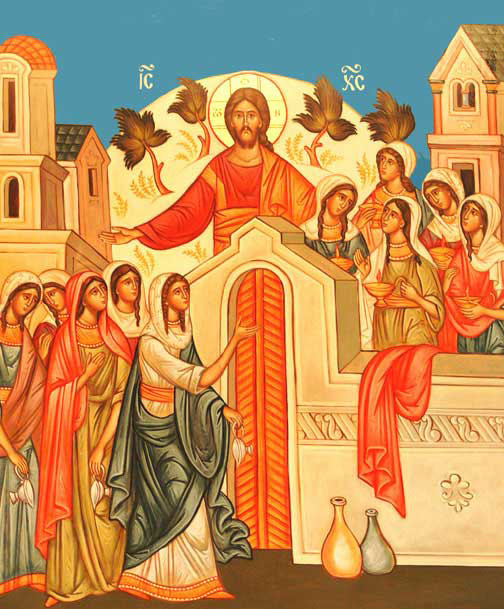
Holy Week: A Liturgical Explanation for the Days of Holy Week
3. MONDAY, TUESDAY, WEDNESDAY: THE END
These three days, which the Church calls Great and Holy have within the liturgical development of the Holy Week a very definite purpose. They place all its celebrations in the perspective of End Times; they remind us of the eschatological meaning of Pascha. So often Holy Week is considered one of the “beautiful traditions” or “customs,” a self-evident “part” of our calendar. We take it for granted and enjoy it as a cherished annual event which we have “observed” since childhood, we admire the beauty of its services, the pageantry of its rites and, last but not least, we like the fuss about the Paschal table. And then, when all this is done we resume our normal life. But do we understand that when the world rejected its Savior, when “Jesus began to be sorrowful and very heavy… and his soul was exceedingly sorrowful even unto death,” when He died on the Cross, “normal life” came to its end and is no longer possible. For there were “normal” men who shouted “Crucify Him” who spat at Him and nailed Him to the Cross. And they hated and killed Him precisely because He was troubling their normal life. It was indeed a perfectly “normal” world which preferred darkness and death to light and life…. By the death of Jesus the “normal” world, and “normal” life were irrevocably condemned. Or rather they revealed their true and abnormal inability to receive the Light, the terrible power of evil in them. “Now is the Judgment of this world” (John 12:31). The Pascha of Jesus signified its end to “this world” and it has been at its end since then. This end can last for hundreds of centuries, but this does not alter the nature of time in which we live as the “last time.” “The fashion of this world passeth away…” (I Cor. 7:31).
Pascha means passover, passage. The feast of Passover was for the Jews the annual commemoration of their whole history as salvation, and of salvation as passage from the slavery of Egypt into freedom, from exile into the promised land. It was also the anticipation of the ultimate passage—into the Kingdom of God. And Christ was the fulfillment of Pascha. He performed the ultimate passage: from death into life, from this “old world” into the new world into the new time of the Kingdom. And he opened the possibility of this passage to us. Living in “this world” we can already be “not of this world,” i.e. be free from slavery to death and sin, partakers of the “world to come.” But for this we must also perform our own passage, we must condemn the old Adam in us, we must put on Christ in the baptismal death and have our true life hidden in God with Christ, in the “world to come….”
And thus Easter is not an annual commemoration, solemn and beautiful, of a past event. It is this Event itself shown, given to us, as always efficient, always revealing our world, our time, our life as being at their end, and announcing the Beginning of the new life…. And the function of the three first days of Holy Week is precisely to challenge us with this ultimate meaning of Pascha and to prepare us to the understanding and acceptance of it.
1. This eschatological (which means ultimate, decisive, final) challenge is revealed, first, in the common troparion of these days:
Troparion—Tone 8
Behold the Bridegroom comes at midnight,
And blessed is the servant whom He shall find watching,
And again unworthy is the servant whom He shall find heedless.
Beware, therefore, O my soul, do not be weighed down with sleep,
Lest you be given up to death and lest you be shut out of the Kingdom.
But rouse yourself crying: Holy, Holy, Holy, are You, O our God!
Through the Theotokos have mercy on us!
Midnight is the moment when the old day comes to its end and a new day begins. It is thus the symbol of the time in which we live as Christians. For, on the one hand, the Church is still in this world, sharing in its weaknesses and tragedies. Yet, on the other hand, her true being is not of this world, for she is the Bride of Christ and her mission is to announce and to reveal the coming of the Kingdom and of the new day. Her life is a perpetual watching and expectation, a vigil pointed at the dawn of this new day. But we know how strong is still our attachment to the “old day,” to the world with its passions and sins. We know how deeply we still belong to “this world.” We have seen the light, we know Christ, we have heard about the peace and joy of the new life in Him, and yet the world holds us in its slavery. This weakness, this constant betrayal of Christ, this incapacity to give the totality of our love to the only true object of love are wonderfully expressed in the exapostilarion of these three days:
“Thy Bridal Chamber I see adorned, O my Savior
And I have no wedding garment that I may enter,
O Giver of life, enlighten the vesture of my soul
And save me.”
2. The same theme develops further in the Gospel readings of these days. First of all, the entire text of the four Gospels (up to John 13: 31) is read at the Hours. This recapitulation shows that the Cross is the climax of the whole life and ministry of Jesus, the Key to their proper understanding. Everything in the Gospel leads to this ultimate hour of Jesus and everything is to be understood in its light. Then, each service has its special Gospel lesson.
On Tuesday:
At Matins: Matthew 22: 15-23, 39. Condemnation of Pharisees, i.e. of the blind and hypocritical religion, of those who think they are the leaders of man and the light of the world, but who in fact “shut up the Kingdom of heaven to men.”
At the Presanctified Liturgy: Matthew 24: 36-26, 2. The End again and the parables of the End: the ten wise virgins who had enough oil in their lamps and the ten foolish ones who were not admitted to the bridal banquet; the parable of ten talents “. . . Therefore be ye also ready, for in such an hour as ye think not the Son of Man cometh.” And, finally the Last Judgment.
3. These Gospel lessons are explained and elaborated in the hymnology of these days: the stichiras and the triodia (short canons of three odes each sung at Matins). One warning, one exhortation runs through all of them: the end and the judgment are approaching, let us prepare for them:
“Behold, O my soul, the Master has conferred on thee a talent
Receive the gift with fear;
Lend to him who gave; distribute to the poor
And acquire for thyself thy Lord as thy Friend;
That when He shall come in glory,
Thou mayest stand on His right hand
And hear His blessed voice:
Enter, my servant, into the joy of thy Lord.”
(Tuesday Matins)
4. Throughout the whole Lent the two books of the Old Testament read at Vespers were Genesis and Proverbs. With the beginning of Holy Week they are replaced by Exodus and Job. Exodus is the story of Israel’s liberation from Egyptian slavery, of their Passover. It prepares us for the understanding of Christ’s exodus to His Father, of His fulfillment of the whole history of salvation. Job, the Sufferer, is the Old Testament icon of Christ. This reading announces the great mystery of Christ’s sufferings, obedience and sacrifice.
5. The liturgical structure of these three days is still of the Lenten type. It includes, therefore, the prayer of Saint Ephrem the Syrian with prostrations, the augmented reading of the Psalter, the Liturgy of the Presanctified Gifts and the Lenten liturgical chant. We are still in the time of repentance, for repentance alone makes us partakers of the Pascha of Our Lord, opens to us the doors of the Paschal banquet. And then, on Great and Holy Wednesday, as the last Liturgy of the Presanctified Gifts is about to be completed, after the Holy Gifts have been removed from the altar, the priest reads for the last time the Prayer of Saint Ephrem. At this moment, the preparation comes to an end. The Lord summons us now to His Last Supper.
by THE VERY REV. ALEXANDER SCHMEMANN
Venerable John of the Ancient Caves in Palestine

Saint John of the Ancient Caves is so called because he lived during the eighth century in the Lavra of Saint Chariton (September 28). This was called the “Old,” or ancient cave, since it was one the oldest of the Palestinian monasteries. The Lavra was situated not far from Bethlehem, near the Dead Sea.
Saint John in his early years left the world, went to venerate the holy places of Jerusalem, and settled at the Lavra, where he labored in fasting, vigil, and prayer. He was ordained to the holy priesthood, and glorified by his ascetic life.
Martyrs Christopher, Theonas, and Anthony, at Rome

The Holy Martyrs Christopher, Theonas, and Anthony were officers in the army of the emperor Diocletian (284-305). They were present at the sufferings of the Holy Great Martyr George (April 23), they saw the miracles accomplished by the power of God, and they witnessed Saint George’s faith and unshakable courage.
The soldiers came to believe in the Savior, threw down their golden military belts, and declared themselves Christians in front of the emperor. They were immediately thrown into prison. The next day the emperor urged the former soldiers to renounce Christ, but they firmly confessed their faith and glorified the Savior as the true God.
The emperor ordered that the martyrs be beaten with iron rods, and their bodies to be raked with hooks. The holy martyrs endured all the torments and remained unyielding. Then Diocletian gave orders to burn them. The martyric death of Saints Christopher, Theonas, and Anthony occurred in the year 303.
Hieromartyr Paphnutius of Jerusalem

Hieromartyr Paphnutius of Jerusalem was a bishop. He underwent many sufferings from the pagans and was tortured by fire, wild beasts, and finally was beheaded by the sword.
Some suggest that the hieromartyr Paphnutius was an Egyptian bishop and suffered together with many other Egyptians, exiled to the Palestinian mines during the persecution by Diocletian (284-305).
The myrrh-streaming relics of the hieromartyr were glorified by miracles. The Canon in his honor was composed during the Iconoclast period (before 842). In the final Ode is a petition for the hieromartyr to put an end to the heresy disrupting the Church.
Saint George the Confessor and Bishop of Antioch, in Pisidia

Saint George the Confessor, Bishop of Antioch in Pisidia, lived during the Iconoclast period. In his youth he became a monk, was known for his holiness of life and was made bishop of Antioch in Pisidia.
Saint George was at Constantinople during the iconoclastic persecution under Emperor Leo the Armenian (813-820). He denounced the Iconoclast heresy at a Council of bishops, calling on the emperor to abandon it. When Saint George refused to remove the icons from the church, as ordered by the emperor’s decree, he was exiled to imprisonment (813-820).
Saint Tryphon, Patriarch of Constantinople

Saint Tryphon, Patriarch of Constantinople, was a monk from the time of his youth, distinguished by his meekness, lack of malice, full submission to the will of God, and his firm faith and love for the Church. At this time the emperor Romanus (919-944) ruled in Constantinople. He wanted to elevate his younger son Theophylactus to the patriarchal throne. When Patriarch Stephanos (925-928) died, Theophylactus was only sixteen years old. The emperor then suggested that Saint Tryphon be “locum tenens” of the patriarchal throne until Theophylactus came of age.
Saint Tryphon meekly accepted the burden of patriarchal service and for three years he wisely governed the Church. When Theophylactus turned twenty (931), the emperor told Saint Tryphon to resign the patriarchal throne. Saint Tryphon did not consider it proper to hand over the throne to an inexperienced youth, and he refused to do so. The emperor could not intimidate Saint Tryphon, since his life was blameless. Then Romanus employed the cunning counsels of Bishop Theophilus of Caesarea.
The deceitful bishop went to Saint Tryphon and urged him not to obey the emperor, and not to resign the patriarchal throne. Then Bishop Theophilus craftily obtained Saint Tryphon’s signature on a blank sheet of paper. Not suspecting any treachery, the guileless saint took a clean sheet of paper and wrote: “Tryphon, by the Mercy of God, Archbishop of Constantinople, the New Rome, and Ecumenical Patriarch.”
When they presented this paper to the emperor, he ordered them to write over the saint’s signature: “I hereby resign the position of Patriarch, because I consider myself unworthy of this office.” When this false document was read before the imperial dignitaries, servants removed Saint Tryphon from the patriarchal chambers.
Saint Tryphon patiently endured the injustice done to him, and returned to his own monastery. He lived there as a simple monk for a year before his death (+ 933). His body was taken to Constantinople and buried with the Patriarchs.
Venerable Nikēphóros, Abbot of Catabad
Saint Nikēphóros was born at Constantinople into a rich and illustrious family. His parents, Andrew and Theodora, raised their son in the Christian Faith. After their death, young Nikēphóros distributed all his wealth to the poor and went to Chalcedon. The strict monastic life at the Monastery of Saint Andrew appealed to Nikēphóros, and he remained there with the brethren.
From the very start, the saint displayed unusual fervor in prayer and at work. He had such endurance in asceticism, that soon the igumen sent the saint to a Phoenician island to preach Christ, and he was made igumen of a monastery dedicated to the Most Holy Theotokos.
Saint Nikēphóros lived on the island for thirty-three years, and he brought many pagans to Christ. A church was built on the island on the site of a pagan temple.
Sensing the approach of death, the saint was carried aboard a ship and said to the captain, “I am going to the Lord, but take my body to Chalcedon to the monastery of Saint Andrew.” As soon as he said these words, he died.
The ship sailed to Chalcedon, and the brethren of the monastery of Saint Andrew reverently buried the body of the holy ascetic.
Monastic Martyr Agathangelus of Esphigmenou, Mount Athos

The Monkmartyr Agathangelus, in the world Athanasius, was born in the city of Enos, Thrace, and was raised in a strict Orthodox family. After the death of his parents Constantine and Krystalia, he became a sailor. The Turks wanted to convert the skilled and intelligent youth to Islam, but knew that he would not do so of his own free will. So they arrested him in the city of Smyrna, wounded him and threatened him with death, then demanded that he become a Moslem.
The youth was terrified and promised to do as they asked, hoping to escape from the bullies and then go back on his promise. However, he was unable to do this for a long time. Tormented by pangs of conscience, he was able to quit the city and seek refuge on Mount Athos. Igumen Euthymius of Esphigmenou monastery confessed him and blessed him to become a novice.
Saint Athanasius considered even his most intense efforts insufficient to atone for his sin of apostasy. He believed that he had to suffer martyrdom for Christ, and he began to pray about this.
On the fourth Sunday of Great Lent the nineteen-year-old youth was tonsured as a monk with the name Agathangelus.
Saint Nicholas the Wonderworker appeared to the new monk in a dream and promised to help him. The igumen of the monastery saw this as a special sign, and blessed Saint Agathangelus to bear witness to Christ at Smyrna before those who forced him to become a Moslem.
In the Ottoman courtroom the confessor told how they had compelled him to accept an alien faith. Then he publicly renounced Islam and confessed himself a Christian. They began to cajole and admonish Saint Agathangelus to reconsider his statement. He replied, “I will not give in to you, nor to your threats, nor to your promises. I love only Christ, I follow only Christ, only in my Christ do I hope to know happiness.”
The judge threatened him with death by torture. “I am prepared to endure all for my Christ! I accept every manner of torment with the greatest joy! I ask only that you do not tarry in carrying out your word,” the saint replied.
They bound Saint Agathangelus with heavy chains, hammered his feet into wooden boots, and threw him into prison. With him were two other wrongly condemned Christians. One of them, Nicholas, gave an account of the saint’s martyrdom.
On the following day, Saint Agathangelus was again brought before the judge in fetters. Bravely enduring all the torments which the Turks had readied for him, he again was sent to prison. Nicholas told him that a certain influential man would intervene before the judge for his release, but Saint Agathangelus wrote a note to this man asking that he not attempt to free him, but to pray to God that he be strengthened for martyrdom.
The saint readied himself for the final trial. At midnight, it was revealed to him in a vision that they would execute him no later than five o’clock, and he waited for the appointed hour. At about the fourth hour, a watch was placed over him. Seeing no possibility of converting the confessor from his faith in Christ, the judges decided to execute him. Absorbed in prayer, the martyr did not take notice the preparations for execution, nor the large throng of people.
He was beheaded at the fifth hour of the morning, on April 19, 1818. Christians gathered up the holy relics of the martyr and buried them in the city of Smyrna, in the church of the Great Martyr George.
A portion of the relics of Saint Agathangelus was sent to the Esphigmenou monastery on Mount Athos in 1844.
Venerable Simeon of Philotheou
Saint Simeon the Bare-Foot [Bosoi] was the son of a priest. When he was fifteen years old, he came under the spiritual guidance of Pachomius, the Bishop of Demetriada (Larissa diocese), who tonsured him and ordained him as hierodeacon. Desiring to follow a strict monastic life, Saint Simeon soon went to a monastery near Mount Olympus, and then to Mount Athos, to the Lavra of Saint Athanasius.
By his humility and obedience he gained the respect of the brethren and was ordained hieromonk. After he transferred to the Philotheou monastery, he intensified his God-pleasing labors, he became an example for the brethren, and was unanimously chosen as head of this monastery. Later, through the cunning of the Enemy of mankind, Saint Simeon had to endure the complaints of monks who thought he was too strict.
Leaving it to God to judge the culprits, Saint Simeon left the monastery and went to Mt. Phlamourion on Mt. Pelion. There, in solitude and quiet, with neither roof nor fire, the holy hermit engaged in spiritual struggles dressed in old clothing, with almost no food, in constant prayer either standing or on bended knees. After three years, he was found by certain God-loving people. Inspired with reverence for his way of life, they begged him to allow them to live with him.
After seven years, through the efforts and zeal of Saint Simeon, a monastery was formed. A church was built in honor of the Most Holy Trinity, where he served the Divine Liturgy every day. When the life of the brethren in the wilderness monastery had been put in order, the wise servant left the monastery and began to preach the Word of God in Epirus, Thessaly and Athens.
By his instructions and teaching the saint strengthened the wavering in their faith, and he set those in error on the path to salvation. He made those who were strong in their faith even stronger, and he taught everyone to love one another, and to attend church on Sundays and feastdays.
The boldness of the holy confessor aroused the malice of the opponents of Christianity. In the city of Euripa they slandered Saint Simeon before the city ruler, Ayan, accusing him of converting a Turk to Christianity. The saint was arrested and sentenced to public burning. However, God did not permit the unjust sentence to be carried out.
The condemned one was led to his interrogation in shackles, barefoot [bosoi] and in an old rassa. Saint Simeon, inspired by the Holy Spirit, answered the governor so wisely that Ayan could not impose the death sentence. The saint received his freedom and continued his efforts, sealing his preaching with healings and miracles.
Many followed Saint Simeon and submitted themselves to him. He accepted everyone, blessed them for the monastic life, and sent them to his monastery.
Saint Simeon ended his life at Constantinople. He fell asleep in the Lord and was buried by the Patriarch at Chalke, in a church dedicated to the Most Holy Theotokos. After two years, when the monks of the Phlamourion monastery decided to transfer his holy relics to their monastery, and his grave was opened, an ineffable fragrance came forth, and healings began.
The Life and the Service to Saint Simeon were published at Smyrna in 1646.
Bridegroom Matins – Monday 4/18/2022
Here is the live stream for Bridegroom Matins – Monday 4/18/2022 If you need, here are instructions for accessing this content from your phone, tablet, computer, or TV.
Homily for Sunday, April 17, 2022
Daily Readings for Monday, April 18, 2022
HOLY MONDAY
ABSTAIN FROM MEAT, FISH, DAIRY, EGGS, WINE, OLIVE OIL
Holy Monday, Holy Father John the Righteous, disciple of St. Gregory of Decapolis, Euthemios the Enlightener of Karelia, Cosmas, Bishop of Calcydon, John the New Martyr of Epiros, Athanasia the Wonderworker of Aegina
MATTHEW 21:18-43
At that time, as Jesus was returning to the city, he was hungry. And seeing a fig tree by the wayside he went to it, and found nothing on it but leaves only. And he said to it, "May no fruit ever come from you again!" And the fig tree withered at once. When the disciples saw it they marveled, saying, "How did the fig tree wither at once?" And Jesus answered them, "Truly, I say to you, if you have faith and never doubt, you will not only do what has been done to the fig tree, but even if you say to this mountain, 'Be taken up and cast into the sea, ' it will be done. And whatever you ask in prayer, you will receive, if you have faith. " And when he entered the temple, the chief priests and the elders of the people came up to him as he was teaching, and said, "By what authority are you doing these things, and who gave you this authority?" Jesus answered them, "I also will ask you a question; and if you tell me the answer, then I also will tell you by what authority I do these things. The baptism of John, whence was it? From heaven or from men?" And they argued with one another, "If we say, 'From heaven, ' he will say to us, 'Why then did you not believe him?' But if we say, 'From men, ' we are afraid of the multitude; for all hold that John was a prophet." So they answered Jesus, "We do not know." And he said to them, "Neither will I tell you by what authority I do these things. What do you think? A man had two sons; and he went to the first and said, 'Son, go and work in the vineyard today.' And he answered, 'I will not'; but afterward he repented and went. And he went to the second and said the same; and he answered, 'I go, sir, ' but did not go. Which of the two did the will of his father?" They said, "The first." Jesus said to them, "Truly, I say to you, the tax collectors and the harlots go into the kingdom of God before you. For John came to you in the way of righteousness, and you did not believe him, but the tax collectors and the harlots believed him; and even when you saw it, you did not afterward repent and believe him.
Hear another parable. There was a householder who planted a vineyard and set a hedge around it, and dug a wine press in it, and built a tower, and let it out to tenants, and went into another country. When the season of fruit drew near, he sent his servants to the tenants, to get his fruit; and the tenants took his servants and beat one, killed another, and stoned another. Again he sent other servants, more than the first; and they did the same to them. Afterward he sent his son to them, saying, 'They will respect my son.' But when the tenants saw the son, they said to themselves, 'This is the heir; come, let us kill him and have his inheritance.' And they took him and cast him out of the vineyard, and killed him. When therefore the owner of the vineyard comes, what will he do to those tenants?" They said to him, "He will put those wretches to a miserable death, and let out the vineyard to other tenants who will give him the fruits in their seasons." Jesus said to them, "Have you never read in the scriptures: 'The very stone which the builders rejected has become the head of the corner; this was the Lord's doing, and it is marvelous in our eyes'? Therefore I tell you, the kingdom of God will be taken away from you and given to a nation producing the fruits of it.
MATTHEW 24:3-35
At that time, as Jesus sat on the Mount of Olives, the disciples came to him privately, saying, "Tell us, when will this be, and what will be the sign of your coming and of the close of the age?" And Jesus answered them, "Take heed that no one leads you astray. For many will come in my name, saying, 'I am the Christ, ' and they will lead many astray. And you will hear of wars and rumors of wars; see that you are not alarmed; for this must take place, but the end is not yet. For nation will rise against nation, and kingdom against kingdom, and there will be famines and earthquakes in various places: all this is but the beginning of the sufferings.
Then they will deliver you up to tribulation, and put you to death; and you will be hated by all nations for my name's sake. And then many will fall away, and betray one another, and hate one another. And many false prophets will arise and lead many astray. And because wickedness is multiplied, most men's love will grow cold. But he who endures to the end will be saved. And this gospel of the kingdom will be preached throughout the whole world, as a testimony to all nations; and then the end will come.
So when you see the desolating sacrilege spoken of by the prophet Daniel, standing in the holy place (let the reader understand), then let those who are in Judea flee to the mountains; let him who is on the housetop not go down to take what is in his house; and let him who is in the field not turn back to take his mantle. And alas for those who are with child and for those who give suck in those days! Pray that your flight may not be in winter or on a sabbath. For then there will be great tribulation, such as has not been from the beginning of the world until now, no, and never will be. And if those days had not been shortened, no human being would be saved; but for the sake of the elect those days will be shortened. Then if anyone says to you, 'Lo, here is the Christ!' or 'There he is!' do not believe it. For false Christs and false prophets will arise and show great signs and wonders, so as to lead astray, if possible, even the elect. Lo, I have told you beforehand. So, if they say to you, 'Lo, he is in the wilderness, ' do not go out; if they say, 'Lo, he is in the inner rooms, ' do not believe it. For as the lightning comes from the east and shines as far as the west, so will be the coming of the Son of man. Wherever the body is, there the eagles will be gathered together. Immediately after the tribulation of those days the sun will be darkened, and the moon will not give its light, and the stars will fall from heaven, and the powers of the heavens will be shaken; then will appear the sign of the Son of man in heaven, and then all the tribes of the earth will mourn, and they will see the Son of man coming on the clouds of heaven with power and great glory; and he will send out his angels with a loud trumpet call, and they will gather his elect from the four winds, from one end of heaven to the other.
From the fig tree learn its lesson: as soon as its branch becomes tender and puts forth its leaves, you know that summer is near. So also, when you see all these things, you know that he is near, at the very gates. Truly, I say to you, this generation will not pass away till all these things take place. Heaven and earth will pass away, but my words will not pass away.
Great and Holy Monday
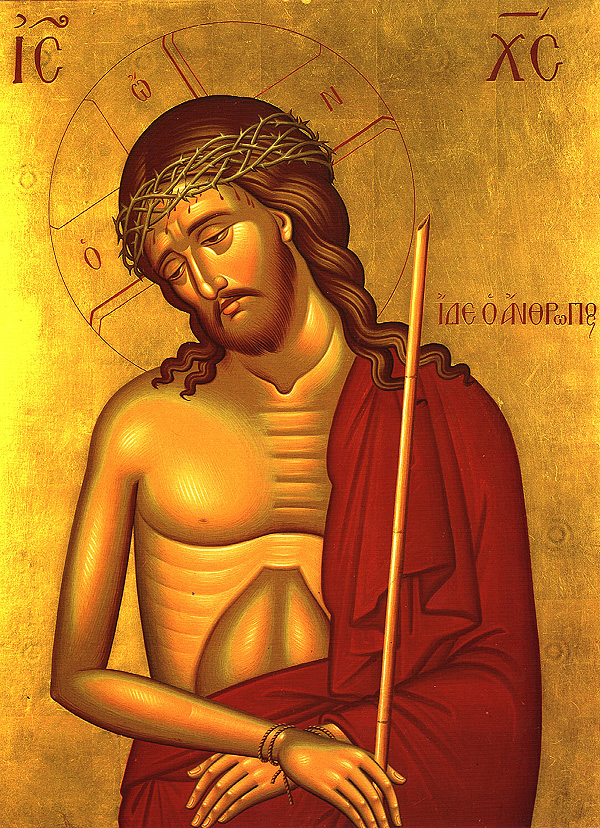
Holy Week: A Liturgical Explanation for the Days of Holy Week
3. MONDAY, TUESDAY, WEDNESDAY: THE END
These three days, which the Church calls Great and Holy have within the liturgical development of the Holy Week a very definite purpose. They place all its celebrations in the perspective of End Times; they remind us of the eschatological meaning of Pascha. So often Holy Week is considered one of the “beautiful traditions” or “customs,” a self-evident “part” of our calendar. We take it for granted and enjoy it as a cherished annual event which we have “observed” since childhood, we admire the beauty of its services, the pageantry of its rites and, last but not least, we like the fuss about the Paschal table. And then, when all this is done we resume our normal life. But do we understand that when the world rejected its Savior, when “Jesus began to be sorrowful and very heavy… and his soul was exceedingly sorrowful even unto death,” when He died on the Cross, “normal life” came to its end and is no longer possible. For there were “normal” men who shouted “Crucify Him” who spat at Him and nailed Him to the Cross. And they hated and killed Him precisely because He was troubling their normal life. It was indeed a perfectly “normal” world which preferred darkness and death to light and life…. By the death of Jesus the “normal” world, and “normal” life were irrevocably condemned. Or rather they revealed their true and abnormal inability to receive the Light, the terrible power of evil in them. “Now is the Judgment of this world” (John 12:31). The Pascha of Jesus signified its end to “this world” and it has been at its end since then. This end can last for hundreds of centuries, but this does not alter the nature of time in which we live as the “last time.” “The fashion of this world passeth away…” (I Cor. 7:31).
Pascha means passover, passage. The feast of Passover was for the Jews the annual commemoration of their whole history as salvation, and of salvation as passage from the slavery of Egypt into freedom, from exile into the promised land. It was also the anticipation of the ultimate passage—into the Kingdom of God. And Christ was the fulfillment of Pascha. He performed the ultimate passage: from death into life, from this “old world” into the new world into the new time of the Kingdom. And he opened the possibility of this passage to us. Living in “this world” we can already be “not of this world,” i.e. be free from slavery to death and sin, partakers of the “world to come.” But for this we must also perform our own passage, we must condemn the old Adam in us, we must put on Christ in the baptismal death and have our true life hidden in God with Christ, in the “world to come….”
And thus Easter is not an annual commemoration, solemn and beautiful, of a past event. It is this Event itself shown, given to us, as always efficient, always revealing our world, our time, our life as being at their end, and announcing the Beginning of the new life…. And the function of the three first days of Holy Week is precisely to challenge us with this ultimate meaning of Pascha and to prepare us to the understanding and acceptance of it.
1. This eschatological (which means ultimate, decisive, final) challenge is revealed, first, in the common troparion of these days:
Troparion—Tone 8
Behold the Bridegroom comes at midnight,
And blessed is the servant whom He shall find watching,
And again unworthy is the servant whom He shall find heedless.
Beware, therefore, O my soul, do not be weighed down with sleep,
Lest you be given up to death and lest you be shut out of the Kingdom.
But rouse yourself crying: Holy, Holy, Holy, are You, O our God!
Through the Theotokos have mercy on us!
Midnight is the moment when the old day comes to its end and a new day begins. It is thus the symbol of the time in which we live as Christians. For, on the one hand, the Church is still in this world, sharing in its weaknesses and tragedies. Yet, on the other hand, her true being is not of this world, for she is the Bride of Christ and her mission is to announce and to reveal the coming of the Kingdom and of the new day. Her life is a perpetual watching and expectation, a vigil pointed at the dawn of this new day. But we know how strong is still our attachment to the “old day,” to the world with its passions and sins. We know how deeply we still belong to “this world.” We have seen the light, we know Christ, we have heard about the peace and joy of the new life in Him, and yet the world holds us in its slavery. This weakness, this constant betrayal of Christ, this incapacity to give the totality of our love to the only true object of love are wonderfully expressed in the exapostilarion of these three days:
“Thy Bridal Chamber I see adorned, O my Savior
And I have no wedding garment that I may enter,
O Giver of life, enlighten the vesture of my soul
And save me.”
2. The same theme develops further in the Gospel readings of these days. First of all, the entire text of the four Gospels (up to John 13: 31) is read at the Hours (1, 3, 6 and 9). This recapitulation shows that the Cross is the climax of the whole life and ministry of Jesus, the Key to their proper understanding. Everything in the Gospel leads to this ultimate hour of Jesus and everything is to be understood in its light. Then, each service has its special Gospel lesson :
On Monday:
At Matins: Matthew 21: 18-43—the story of the fig tree, the symbol of the world created to bear spiritual fruits and failing in its response to God.
At the Liturgy of the Presanctified Gifts: Matthew 24: 3-35: the great eschatological discourse of Jesus. The signs and announcement of the End. “Heaven and earth shall pass away, but my words shall not pass away….”
“When the Lord was going to His voluntary Passion,
He said to His Apostles on the way:
Behold, we go up to Jerusalem,
And the Son of Man shall be delivered up
As it is written of Him.
Come, therefore, and let us accompany Him,
With minds purified from the pleasures of this life,
And let us be crucified and die with Him,
That we may live with Him,
And that we may hear Him say to us:
I go now, not to the earthly Jerusalem to suffer,
But unto My Father and your Father
And My God and your God,
And I will gather you up into the heavenly Jerusalem,
Into the Kingdom of Heaven….”
(Monday Matins)
by: The Very Reverend Alexander Schmemann
Venerable John, disciple of Venerable Gregory of Decapolis

Saint John was born at the end of the eighth century. At a young age he became a disciple of Saint Gregory of Decapolis (November 20) and accepted monastic tonsure from him at a monastery in Thessalonica. Under the guidance of this experienced teacher, Saint John attained great spiritual perfection.
When the emperor Leo the Armenian (813-820) renewed the persecution against Orthodox Christians because they venerated the holy icons, Saint Gregory of Decapolis and Saint Joseph the Hymnographer (April 4) and his disciple Saint John went from Thessalonica to Constantinople, to raise opposition to the Iconoclast heresy.
In spite of persecution, Saints Gregory and John fearlessly defended Orthodoxy for several years, and preached the veneration of icons. After many hardships Saint Gregory died (around 820), and soon after, his faithful disciple John also departed to the Lord. Saint Joseph the Hymnographer transferred the relics of Saints Gregory and John and placed them in the church of Saint Nicholas the Wonderworker.
Martyr Victor, and his companions, of Nicomedia

The Holy Martyrs Victor, Zoticus, Acindynus, Zeno, Severian and Caesarius suffered under the emperor Diocletian (284-305) when he began a fierce persecution against Christians. One of the first to suffer was the holy Great Martyr and Victory-Bearer George (April 23). Saint George’s unshakable faith and bravery during his suffering led many pagans to Christ.
The saints were struck with astonishment that Saint George suffered no harm from the wheel of torture, and they declared in the hearing of all that they also believed in Christ. At the judge’s order, the holy martyrs were beheaded at Nicomedia in 303.
Saint Cosmas, Bishop of Chalcedon, and his fellow ascetic, Saint Auxentius

Saint Cosmas, Bishop of Chalcedon, and his companion Saint Auxentius, lived during the ninth century, at a time when the Iconoclasts oppressed the Orthodox. Saint Cosmas while still in his youth had entered a monastery and received monastic tonsure. Later, he was consecrated as Bishop of Chalcedon, and zealously defended the Orthodox Faith against the Iconoclast heretics. Saint Auxentius helped the saint in this struggle.
The Iconoclasts tried in many ways to win the saint over to their side, but he remained faithful to Orthodoxy until the very end. Saint Cosmas did not obey the decree of Emperor Leo the Armenian (813-820) ordering the removal of the holy icons from the churches. For this he was expelled from his See and exiled to prison.
When the saint returned from exile, he and Saint Auxentius continued to defend the veneration of holy icons. At the end of the persecution, Saint Cosmas was weak in body, but remained strong in spirit. Saint Cosmas and Saint Auxentius steadfastly preserved the Orthodox Faith until the end of their lives.
New Martyr John the New of Epirus
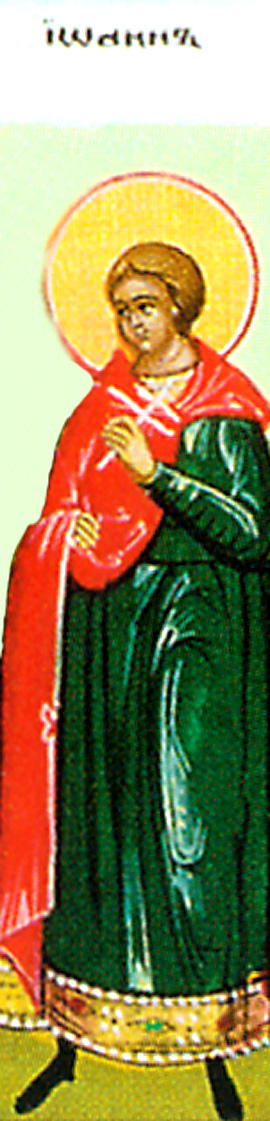
The holy martyr John Kulikos was born in the Greek district of Epirus, in the city of Ioannina. His parents were pious, but he was orphaned at an early age, and he went to Constantinople. With the means left him by his parents, he built a small stall in the city bazaar and was occupied with trade.
He loved to work, he honorably filled all his orders, and his business was successful. However, his soul did not yearn for earthly blessings, but for the Kingdom of Heaven.
Saint John lived during difficult times. Constantinople was under the dominion of the Turks, and Christians were subjected to oppressions. Many Christian tradesmen and merchants went over to the Moslem religion. Saint John reproached them for their betrayal of Christ, and he also sustained the unwavering in their faith. The apostates were filled with hatred for Saint John, and they desired his ruin. The saint knew this, but was not afraid. He was willing to suffer for Christ.
On Great and Holy Friday he went to his spiritual Father and asked his blessing to seek martyrdom. The priest counselled the youth to examine himself and to prepare himself by fasting and prayer, so that at the time of torture he would not deny Christ. Saint John prayed ardently to the Lord to strengthen him. At night on Great and Holy Saturday he saw himself in a dream, standing in a fiery furnace and singing praises to the Lord. Interpreting this vision as an indication to go to martyrdom, Saint John received the Holy Mysteries and asked the priest’s blessing.
When Saint John arrived at the market, the vexed tradesmen began to reproach him that he had promised to renounced Christ, but that he was not fulfilling his word. In reply, the martyr declared that he was a Christian and had never renounced, nor would he ever renounce Christ.
Then the envious merchants had him arrested. The judge tried to persuade Saint John to accept Islam, for he respected him as a skilled master craftsman. But the martyr steadfastly confessed himself a Christian. For several days, they wearied him with hunger and thirst, and beat him without mercy. They sentenced the martyr to be burned alive.
Saint John met his sentence with joy. When they led him to the blazing fire, he went boldly into the midst of the flames. The torturers, seeing that Saint John was prepared to die in the fire, pulled him out and beheaded him with the sword (+ 1526). They then threw the martyr’s head and body into the fire.
Christians gathered up the bones of the martyr which remained from the fire, and reverently brought them to the cathedral church.
Venerable Euthymius, Enlightener of Karelia, Finland and the Righteous Anthony and Felix

According to an ancient manuscript Hemerologion (Ημερολογιον), Saint Euthymios was born in the
second half of the XIV century. From his youth, he felt drawn to the monastic life, so when he reached adulthood, he travelled north around the year 1400, in order to live as an Anchorite. Later, about 1410, several disciples came to him, begging him to guide them in the monastic life. On the shores of the White Sea in Karelia, 34 versts from Archangelsk, they built a monastery dedicated to the Holy Wonderworker Saint Nicholas of Myra in Lycia (December 6), with cells for the monks.
At first, nothing seemed to go well for the monks, who had settled in an area inhabited by pagans. Saint Euthymius knew, however, that in the place where they labored, one day the monastic life would be firmly established, and the Faith would flourish.
In 1418, the Venerable Anthony and Felix, the two devout sons of Martha Boretska, the wife of a government official (посадница) from Novgorod, were drowned at the mouth of the North Dvina River while exploring the land. These young brothers were buried at Saint Nicholas monastery. In life, they were distinguished for their works of charity, and their grief-stricken mother asked Saint Euthymius to pray for the sons who had been taken from her. Subsequently, their names were included in the manuscript Lives of the Saints of Saint Nicholas Monastery.
In 1419, the monastery was destroyed by Norwegian invaders, who descended upon the monastery, burned the church, and killed several of the monks. Saint Euthymius decided that he would rebuild the monastery, and Martha Boretska gave a large sum of money for the monastery to be rebuilt over the graves of her sons.
Saint Euthymius reposed peacefully in 1435, and was buried at the monastery in Karelia, as were his disciples Stephen the Ascetic, Isaiah, and Nikanor.
In 1641, Saint Euthymios of Karelia was glorified for his apostolic labors in Karelia, and his holy relics were uncovered in 1647. Now they rest in a hidden place within the monastery.
A Church Service has been composed for Saints Euthymius, Anthony and Felix. They are commemorated on April 18, and again on May 21, the Synaxis of All Saints of Karelia.
“Maximov” Icon of the Mother of God

The Saint Maximus Icon is in the cathedral church of the city of Vladimir. Metropolitan Maximus (December 6), a Greek by birth, painted the Icon in 1299, as he was told to do in a vision while he slept in his cell. When St. Maximus arrived in Vladimir from Kiev, the Mother of God appeared to him in a dream and gave him an omophorion saying, "My servant Maximus, it is good that you have come to visit my city. Take this omophorion and shepherd the rational flock of my city."
When he awoke, he found he was holding an omophorion. The appearance of the Mother of God was regarded as a sign of approval for the transfer of the metropolitan See from Kiev to Vladimir.
A description of this vision was inscribed on the left side of his crypt. The Mother of God is shown in full stature, holding the Divine Child on her left arm. With her right hand, she offers the omophorion to Saint Maximus, who is standing on a pillar. The contrast in the size of their figures is meant to show the difference in their spiritual states. A variant Icon depicts Saint Maximus kneeling at the feet of the Theotokos.
Later, a golden coffer was made, and the omophorion was placed inside. This omophorion was kept in the Vladimir cathedral as a relic for 112 years. It was hidden by the cathedral’s doorkeeper Patrick in 1412 during an invasion by the Tartars, Patrick was killed when he refused to show them where the cathedral's treasures were hidden. The coffer has not yet been found.
This Icon, which measures five feet by two and a half feet, has been glorified by many miracles.
Saint Basil Ratishvili of Georgia
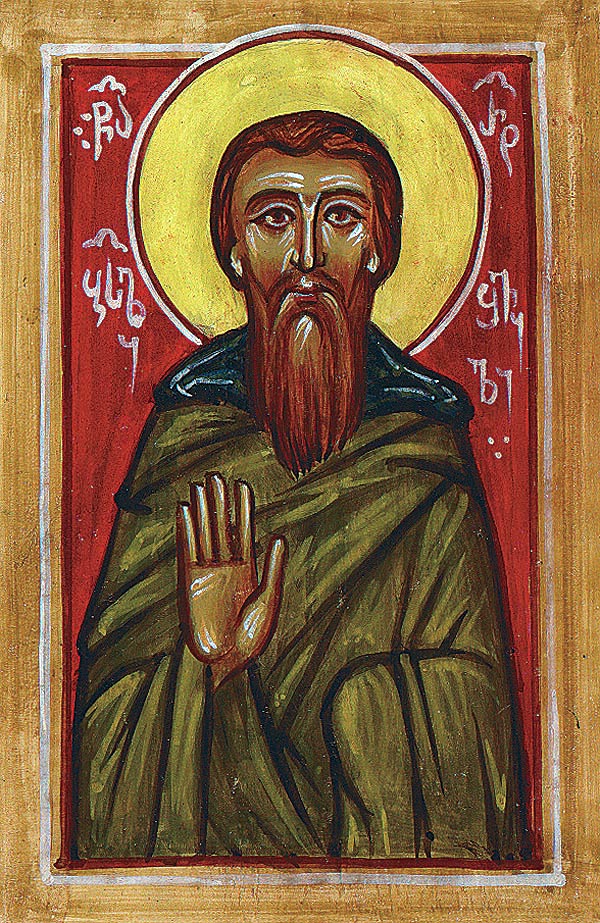
Saint Basil Ratishvili, one of the most prominent figures of the 13th-century Church, was the uncle of Catholicos Ekvtime III. He labored with the other Georgian fathers at the Ivḗron Monastery on Mt. Athos. Endowed with the gift of prophecy, Saint Basil beheld a vision in which the Most Holy Theotokos called upon him to censure King Demetre’s impious rule. (This is actually Saint Demetre the Devoted, who in his youth lived profligately but later laid down his life for his nation.)
Having arrived in Georgia and been brought before the king, the God-fearing father denounced the sovereign’s uncrowned marriage [i.e., a conjugal union without the blessing of the Church]. He promised the king that if he abandoned his present way of life, he would find great happiness and success. Saint Basil also condemned the ungodly ways of Georgia’s apostate feudal lords.
But the king and his court disregarded the virtuous elder’s admonitions, and in response Saint Basil prophesied: “A vicious enemy will kill you, and your kingdom will remain without refuge. Your children will be scattered, your kingdom conquered, and all your wealth seized. Know that, according to the will of the Most Holy Theotokos, everything I have told you will come to pass unless you repent and turn from this way of life. Now I will depart from you in peace.”
Saint Basil returned to Mt. Athos and peacefully reposed at the Ivḗron Monastery.
His vision was fulfilled.
Bridegroom Matins – Sunday 4/17/2022
Here is the live stream for Bridegroom Matins – Sunday 4/17/2022 If you need, here are instructions for accessing this content from your phone, tablet, computer, or TV.
 Saint Peter Antiochian Orthodox Church
You must be logged in to post a comment.