
Here is the live stream for Orthros and Divine Liturgy – March 20, 2022 If you need, here are instructions for accessing this content from your phone, tablet, computer, or TV.
Monthly Archives: March 2022
Daily Readings for Sunday, March 20, 2022
SUNDAY OF ST. GREGORY PALAMAS
ABSTAIN FROM MEAT, FISH, DAIRY, EGGS
Sunday of St. Gregory Palamas, Righteous Fathers slain at the Monastery of St. Savas, Myron the New Martyr of Crete, Cuthbert the Wonderworker, Bishop of Lindisfarne, Photini the Samaritan Woman
ST. PAUL’S LETTER TO THE HEBREWS 1:10-14; 2:1-3
IN THE BEGINNING, Thou, Lord, didst found the earth in the beginning, and the heavens are the work of thy hands; they will perish, but thou remainest; they will all grow old like a garment, like a mantle thou wilt roll them up, and they will be changed. But thou art the same, and thy years will never end." But to what angel has he ever said, "Sit at my right hand, till I make thy enemies a stool for thy feet?" Are they not all ministering spirits sent forth to serve, for the sake of those who are to obtain salvation?
Therefore we must pay closer attention to what we have heard, lest we drift away from it. For if the message declared by angels was valid and every transgression or disobedience received a just retribution, how shall we escape if we neglect such a great salvation? It was declared at first by the Lord, and it was attested to us by those who heard him.
MARK 2:1-12
At that time, Jesus entered Capernaum and it was reported that he was at home. And many were gathered together, so that there was no longer room for them, not even about the door; and he was preaching the word to them. And they came, bringing to him a paralytic carried by four men. And when they could not get near him because of the crowd, they removed the roof above him; and when they had made an opening, they let down the pallet on which the paralytic lay. And when Jesus saw their faith, he said to the paralytic, "My son, your sins are forgiven." Now some of the scribes were sitting there, questioning in their hearts, "Why does this man speak thus? It is a blasphemy! Who can forgive sins but God alone?" And immediately Jesus, perceiving in his spirit that they thus questioned within themselves, said to them, "Why do you question thus in your hearts? Which is easier, to say to the paralytic, 'Your sins are forgiven, ' or to say, 'Rise, take up your pallet and walk? But that you may know that the Son of man has authority on earth to forgive sins"-he said to the paralytic-"I say to you, rise, take up your pallet and go home." And he rose, and immediately took up the pallet and went out before them all; so that they were all amazed and glorified God, saying, "We never saw anything like this!
2nd Sunday of Great Lent: St Gregory Palamas

This Sunday was originally dedicated to Saint Polycarp of Smyrna (February 23). After his glorification in 1368, a second commemoration of Saint Gregory Palamas (November 14) was appointed for the Second Sunday of Great Lent as a second “Triumph of Orthodoxy.”
Saint Gregory Palamas, Archbishop of Thessalonica, was born in the year 1296 in Constantinople. Saint Gregory’s father became a prominent dignitiary at the court of Andronicus II Paleologos (1282-1328), but he soon died, and Andronicus himself took part in the raising and education of the fatherless boy. Endowed with fine abilities and great diligence, Gregory mastered all the subjects which then comprised the full course of medieval higher education. The emperor hoped that the youth would devote himself to government work. But Gregory, barely twenty years old, withdrew to Mount Athos in the year 1316 (other sources say 1318) and became a novice in the Vatopedi monastery under the guidance of the monastic Elder Saint Νikόdēmos of Vatopedi (July 11). There he was tonsured and began on the path of asceticism. A year later, the holy Evangelist John the Theologian appeared to him in a vision and promised him his spiritual protection. Gregory’s mother and sisters also became monastics.
After the demise of the Elder Νikόdēmos, Saint Gregory spent eight years of spiritual struggle under the guidance of the Elder Nikēphóros, and after the latter’s death, Gregory transferred to the Lavra of Saint Athanasius (July 5). Here he served in the trapeza, and then became a church singer. But after three years, he resettled in the small skete of Glossia, striving for a greater degree of spiritual perfection. The head of this monastery began to teach the young man the method of unceasing prayer and mental activity, which had been cultivated by monastics, beginning with the great desert ascetics of the fourth century: Evagrius Pontikos and Saint Macarius of Egypt (January 19).
Later on, in the eleventh century Saint Simeon the New Theologian (March 12) provided detailed instruction in mental activity for those praying in an outward manner, and the ascetics of Athos put it into practice. The experienced use of mental prayer (or prayer of the heart), requiring solitude and quiet, is called “Hesychasm” (from the Greek “hesychia” meaning calm, silence), and those practicing it were called “hesychasts.”
During his stay at Glossia the future hierarch Gregory became fully embued with the spirit of hesychasm and adopted it as an essential part of his life. In the year 1326, because of the threat of Turkish invasions, he and the brethren retreated to Thessalonica, where he was then ordained to the holy priesthood.
Saint Gregory combined his priestly duties with the life of a hermit. Five days of the week he spent in silence and prayer, and only on Saturday and Sunday did he come out to his people. He celebrated divine services and preached sermons. For those present in church, his teaching often evoked both tenderness and tears. Sometimes he visited theological gatherings of the city’s educated youth, headed by the future patriarch, Isidore. After he returned from a visit to Constantinople, he found a place suitable for solitary life near Thessalonica the region of Bereia. Soon he gathered here a small community of solitary monks and guided it for five years.
<br
In 1331 the saint withdrew to Mt. Athos and lived in solitude at the skete of Saint Savva, near the Lavra of Saint Athanasius. In 1333 he was appointed Igumen of the Esphigmenou monastery in the northern part of the Holy Mountain. In 1336 the saint returned to the skete of Saint Savva, where he devoted himself to theological works, continuing with this until the end of his life.
In the 1330s events took place in the life of the Eastern Church which put Saint Gregory among the most significant universal apologists of Orthodoxy, and brought him great renown as a teacher of hesychasm.
About the year 1330 the learned monk Barlaam had arrived in Constantinople from Calabria, in Italy. He was the author of treatises on logic and astronomy, a skilled and sharp-witted orator, and he received a university chair in the capital city and began to expound on the works of Saint Dionysius the Areopagite (October 3), whose “apophatic” (“negative”, in contrast to “kataphatic” or “positive”) theology was acclaimed in equal measure in both the Eastern and the Western Churches. Soon Barlaam journeyed to Mt. Athos, where he became acquainted with the spiritual life of the hesychasts. Saying that it was impossible to know the essence of God, he declared mental prayer a heretical error. Journeying from Mount Athos to Thessalonica, and from there to Constantinople, and later again to Thessalonica, Barlaam entered into disputes with the monks and attempted to demonstrate the created, material nature of the light of Tabor (i.e. at the Transfiguration). He ridiculed the teachings of the monks about the methods of prayer and about the uncreated light seen by the hesychasts.
Saint Gregory, at the request of the Athonite monks, replied with verbal admonitions at first. But seeing the futility of such efforts, he put his theological arguments in writing. Thus appeared the “Triads in Defense of the Holy Hesychasts” (1338). Towards the year 1340 the Athonite ascetics, with the assistance of the saint, compiled a general response to the attacks of Barlaam, the so-called “Hagiorite Tome.” At the Constantinople Council of 1341 in the church of Hagia Sophia Saint Gregory Palamas debated with Barlaam, focusing upon the nature of the light of Mount Tabor. On May 27, 1341 the Council accepted the position of Saint Gregory Palamas, that God, unapproachable in His Essence, reveals Himself through His energies, which are directed towards the world and are able to be perceived, like the light of Tabor, but which are neither material nor created. The teachings of Barlaam were condemned as heresy, and he himself was anathemized and fled to Calabria.
But the dispute between the Palamites and the Barlaamites was far from over. To these latter belonged Barlaam’s disciple, the Bulgarian monk Akyndinos, and also Patriarch John XIV Kalekos (1341-1347); the emperor Andronicus III Paleologos (1328-1341) was also inclined toward their opinion. Akyndinos, whose name means “one who inflicts no harm,” actually caused great harm by his heretical teaching. Akyndinos wrote a series of tracts in which he declared Saint Gregory and the Athonite monks guilty of causing church disorders. The saint, in turn, wrote a detailed refutation of Akyndinos’ errors. The patriarch supported Akyndinos and called Saint Gregory the cause of all disorders and disturbances in the Church (1344) and had him locked up in prison for four years. In 1347, when John the XIV was replaced on the patriarchal throne by Isidore (1347-1349), Saint Gregory Palamas was set free and was made Archbishop of Thessalonica.
In 1351 the Council of Blachernae solemnly upheld the Orthodoxy of his teachings. But the people of Thessalonica did not immediately accept Saint Gregory, and he was compelled to live in various places. On one of his travels to Constantinople the Byzantine ship fell into the hands of the Turks. Even in captivity, Saint Gregory preached to Christian prisoners and even to his Moslem captors. The Hagarenes were astonished by the wisdom of his words. Some of the Moslems were unable to endure this, so they beat him and would have killed him if they had not expected to obtain a large ransom for him. A year later, Saint Gregory was ransomed and returned to Thessalonica.
Saint Gregory performed many miracles in the three years before his death, healing those afflicted with illness. On the eve of his repose, Saint John Chrysostom appeared to him in a vision. With the words “To the heights! To the heights!” Saint Gregory Palamas fell asleep in the Lord on November 14, 1359. In 1368 he was canonized at a Constantinople Council under Patriarch Philotheus (1354-1355, 1364-1376), who compiled the Life and Services to the saint.
</br
Synaxis of the Venerable Fathers of the Kiev Caves Lavra
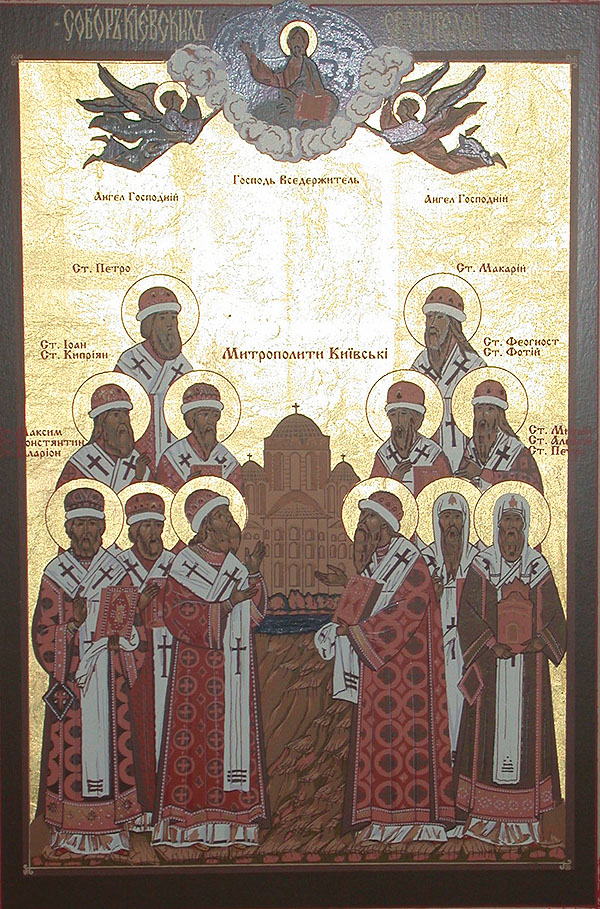
On the second Sunday of Great Lent, we commemorate the Synaxis of all the Venerable Fathers of the Kiev Caves Monastery: those who rest in the Near Caves of Saint Anthony (see September 28), as well as those who rest in the Far Caves of Saint Theodosios (see August 28).
The Canon, which was added to the Service for today's Feast, was composed by Hieromonk Meletios during the second half of the XVII century.
Martyred Holy Fathers who were slain at the Monastery of Saint Savva

Saints John, Sergius, Patrick and others were slain in the Monastery of Saint Savva. During the VIII century the area around Jerusalem was subjected to frequent incursions by the Saracens. The monastery of Saint Chariton was devastated and fell into ruin. Twice the Saracens tried to plunder the Lavra of Saint Savva the Sanctified, but God’s Providence protected the monastery. The monks would have been able to escape the barbarians by going to Jerusalem, but they decided not to forsake the place where they had sought salvation for so many years.
On March 13, the Saracens broke into the monastery and demanded all the valuables. The monks told them that there was nothing in the monastery but a meager supply of food and old clothing. Then the Saracens began shooting arrows at the monks.
Thirteen men were killed and many wounded, and monastery cells were set afire. The Saracens intended to torch the monastery church, but seeing a throng of people in the distance, they mistook this for an army sent from Jerusalem. The Saracens managed to get away, carrying off the little they were able to plunder. After the enemy fled, Father Thomas, an experienced physician, began to help those who remained alive.
On Great Thursday, March 20, the Saracens again descended upon the Lavra with a larger force and started to beat the monks. The survivors were driven into the church, where they were tortured in order to force them to reveal where any treasure might be hidden. The monastery was surrounded, so no one could save himself by fleeing. The barbarians seized Saint John, a young monk, who had cared for vagrants. They beat him savagely, then they cut the sinews of his hands and feet and dragged him over stones by his feet, which tore the skin from the martyr’s back.
The keeper of the Church vessels, Saint Sergius, hid them and attempted to flee, but he was captured and beheaded. Several of the monks nevertheless managed to hide themselves outside the monastery in a cave, but they were spotted by a sentry on a hill, and they ordered everyone to come out. Inside the cave Saint Patrick whispered to the brethren with him, “Fear not, I will go alone and meet my death. Meanwhile, sit and pray.”
The Saracens asked whether there was anyone else in the cave, and Patrick said that he was alone. They led him to the Lavra, where the captives awaited their fate. The Saracens demanded of them a ransom of 4,000 gold pieces and the sacred vessels. The monks were not able to give such a ransom. Then they led them into the cave of Saint Savva inside the monastery walls. They lit a fire on which they piled up dung in front of the entrance to the cave, hoping to suffocate the monks with the poisonous fumes. Eighteen men perished in the cave, among whom were Saints John and Patrick. The Saracens continued to torture those who were still alive, but got nothing out of them. Finally, they left the monastery.
Later, on the night of Great Friday, the monks hidden in the hills returned to the Lavra, they took up the bodies of the murdered Fathers to the church and buried them there.
The barbarians who plundered the monastery were punished by God. They were stricken with a sudden illness, and they all perished. Their bodies were devoured by wild beasts.
The Saints commemorated today should not be confused with other martyrs of the Saint Savva Lavra, who suffered in 610, and are commemorated on May 16. The two dates reflect separate attacks on the monastery at different times. History tells us that barbarians raided Saint Savva Lavra on several occasions.
Monastic Martyr Euphrosynus of Blue Jay Lake, Novgorod

Saint Euphrosynos of Blue Jay Lake, (Ephraim in the world) was born in Karelia near Lake Ladoga in the second half of the XVI century. When he was young he lived near Valaam Monastery, and later he moved to Novgorod the Great. After spending some time there, the Saint then withdrew to a place on the outskirts of Novgorod – the Bezhetsk “pentary” (one fifth of the “Pyatiny Novgorodskiya,” comprising five outlying districts of Novgorod the Great).
He became a Reader for the Church services in the village of Doloska, twenty versts from the city of Ustiuzhna of Zhelezopolska. He was tonsured at the Tikhvin Dormition Monastery with the name Euphrosynos. After living there for some time, he told the Superior of his desire to go into the wilderness for greater solitude, and a life of fasting and silence. The Superior told him about some of the dangers of the eremetic life, and then gave his blessing. So, in 1600 he began his solitary life in the wild marshlands by the shore of Blue Jay Lake. Here the Saint planted a Cross and dug a cave. He lived here for two years, eating nothing but wild vegetation, berries, and mushrooms.
Unexpectedly, people from neighboring villages found him, and they came to him for instruction, prayer, and spiritual counsel. Several of them remained with him. Soon it became necessary to build a church, where all the brethren could pray together. They cleared the forest, hewed the timber, and built a log church. Since the Elder, out of humility, had not been ordained, the church was consecrated by his fellow ascetic Saint Gurias of Shalatsk (November 15), and dedicated to the Annunciation to the Most Holy Theotokos. This was done with the blessing of Archbishop Isidore of Novgorod (1603-1609). Saint Gurias sometimes visited Blue Jay Lake in order to pray with the brethren, converse with them about spiritual matters, and to give them Holy Communion. On one of these visits Saint Euphrosynos was tonsured into the Great Schema by Saint Gurias.
In 1612, when Polish troops were laying waste to Russia, many people saved their lives by hiding at the Monastery of the Annunciation in the wilderness. On March 19, Saint Euphrosynos revealed to everyone that the Poles were on their way to the monastery, and he advised everyone to flee.
"My brethren and beloved children in Christ, whoever wishes to escape certain death, leave the Monastery of the Mother of God and save yourselves from this great calamity, for it is pleasing to God's righteous judgment that enemies will come soon to this holy place."
Many did not believe him. “Then why don’t you leave this place yourself?” they asked.
The Elder replied, “I have come here to die for Christ.”
Those who obeyed the Saint and left the monastery were spared, but all those who remained met a horrible death.
Saint Jonah was one of the monks at the monastery. Frightened by the Elder's clairvoyant prediction, he wanted to flee with the others, but Saint Euphrosynos held him back, inspiring him with zeal for the house of God.
“Brother Jonah,” he said, "why do you allow faint-hearted fear into your soul? When the battle begins, that is the time for courage. For the love of Christ, let us not be afraid of some passing fear. We have vowed to live and die here in the wilderness. We must be faithful to our vow, made before the Lord. It is different for laymen, who are not bound by a vow. They must spare themselves for the sake of their children.”
Becoming inflamed in spirit, Saint Jonah placed all his hope in God, and decided to die there in the wilderness with his Elder.
After this Saint Euphrosynos clothed himself in the Great Schema, and spent the entire night in prayer. On the following day, March 20, Polish forces descended upon the monastery. In the garb of a Schema-monk, the Saint emerged from his cell and stood beside the Cross he had planted. The enemy said to him, “Old man, give us all the monastery’s possessions."
“All my possessions, and those of this monastery, are in the church of the All-Pure Theotokos,” he replied.
He was referring to spiritual treasures which cannot be stolen (Matthew 6:19-21). Failing to comprehend this, the Poles rushed to the church. One of them drew a sword and struck Saint Euphrosynos. His neck was cut half way through, and the holy Elder fell to the ground dead. When the Poles returned, angry because they had found nothing in the church, one of them struck the Saint's head with an axe. Saint Jonah perished in the attack along with his Elder, and he is also commemorated today with Saint Euphrosynos.
A certain pious Christian, Ioann Suma, had also stayed at the monastery with the monks. When the Poles attacked, he was in the Elder's cell. Despite the grievous wounds he received from these ruffians, Ioann remained alive, but unconscious. After the Poles left, he regained his senses and told his son Emilian what had transpired. From them, the nearby inhabitants learned about the destruction of the monastery and the martyric death of Saint Euphrosynos.
On March 28, the bodies of Saint Euphrosynos, Saint Jonah, and all the others who had perished by the sword, were buried with due reverence by the Cross where they suffered martyrdom.
Thirty-four years after the death of the Saint, a new church was built by a man named Moses, and dedicated to the Most Holy Trinity. With the blessing of Metropolitan Makarios of Novgorod, the incorrupt relics of Saint Euphrosynos were transferred to a new reliquary beneath the belfry on March 25, 1655.
According to the Monastery's records, the Monastic Martyr Euphrosynos was of medium height, with wide shoulders and a broad chest. His hair was brown, with traces of gray. His beard was long, and divided in two at the bottom.
Saint Euphrosynus was glorified by the Russian Orthodox Church on June 29, 1912.
Martyr Photinḗ the Samaritan Woman, her sons, and those with them

The Holy Martyr Photinḗ (Svetlana) the Samaritan Woman, her sons Victor (named Photinos) and Iosḗs; and her sisters Anatolḗ, Photó, Photida, Paraskevḗ, Kyriakḗ, Nero’s daughter Domnina; and the Martyr Sebastian.
The holy Martyr Photinḗ was the Samaritan Woman, with whom the Savior conversed at Jacob’s Well (John. 4:5-42).
During the time of the Emperor Nero (54-68), who displayed excessive cruelty against Christians, Saint Photinḗ lived in Carthage with her younger son Iosḗs, and fearlessly preached the Gospel there. Her eldest son Victor fought bravely in the Roman army against barbarians, and was appointed as military commander of the city of Attalia (Asia Minor). Later, Nero called him to Italy to arrest and punish Christians.
Sebastian, an official in Italy, said to Saint Victor, “I know that you, your mother and your brother, are followers of Christ. As a friend I advise you to submit to the will of the Emperor. If you inform on any Christians, you will receive their wealth. I shall write to your mother and brother, asking them not to preach Christ in public. Let them practice their faith in secret.”
Saint Victor replied, “I want to be a preacher of Christianity like my mother and brother.” Sebastian said, “O Victor, we all know what woes await you, your mother and brother.” Then Sebastian suddenly felt a sharp pain in his eyes. He was dumbfounded, and his face was somber.
For three days he lay there blind, without uttering a word. On the fourth day he declared, “The God of the Christians is the only true God.” Saint Victor asked why Sebastian had suddenly changed his mind. Sebastian replied, “Because Christ is calling me.” Soon he was baptized, and immediately he regained his sight. After witnessing the miracle Saint Sebastian’s servants were also baptized.
Reports of this reached Nero, and he commanded that the Christians be brought to him at Rome. Then the Lord Himself appeared to the confessors and said, “Fear not, for I am with you. Nero, and all who serve him, shall be vanquished.”
The Lord said to Saint Victor, “From this day forward, your name will be Photinos, because through you, many will be enlightened and will believe in me." The Lord then told the Christians to strengthen and encourage Saint Sebastian to persevere until the end. All these things, and even future events, were revealed to Saint Photinḗ. She left Carthage in the company of several Christians and joined the confessors in Rome.
In Rome the Emperor ordered the Saints to be brought before him and he asked them whether they truly believed in Christ. All the confessors refused to renounce the Savior. Then Nero ordered that the joints of the martyrs' fingers be broken. During their torments, the confessors felt no pain, and their hands remained unharmed.
Nero ordered that Saints Sebastian, Photinos and Iosḗs be blinded and locked up in prison, and Saint Photinḗ and her five sisters Anatolḗ, Photó, Photida, Paraskevḗ and Kyriakḗ were sent to the imperial court under the supervision of Nero’s daughter Domnina. Saint Photinḗ converted both Domnina and all her servants to Christ. She also converted a sorcerer, who had brought her poisoned food.
Three years passed, and Nero sent to the prison for one of his servants, who had been locked up. The messengers reported to him that Saints Sebastian, Photinos and Iosḗs, who had been blinded, had recovered their sight, and that people were visiting them to hear their preaching, and indeed the whole prison had been transformed into a bright and fragrant place where God was glorified.
Nero then commanded the Saints to be crucified, and their naked bodies to be beaten with straps. On the fourth day the Emperor sent servants to see whether the martyrs were still alive. But, approaching the place of the tortures, the servants became blind. An Angel of the Lord freed the martyrs from their crosses and healed them. The Saints took pity on the blinded servants, and restored their sight by their prayers to the Lord. Those who were healed came to believe in Christ and were soon baptized.
Enraged, Nero ordered that the skin to be flayed from from Saint Photinḗ's body, and then to throw her into a well. Sebastian, Photinos and Iosḗs had their legs amputated, and they were thrown to dogs. Then their was skin flayed off. Saint Photinḗ's sisters also suffered terrible torments. Nero ordered soldiers to cut off their breasts, and then to flay their skin. An expert in cruelty, the Emperor prepared the most painful execution for Saint Photida. Her feet were tied to the tops of two trees which had been bent to the ground. When the ropes were cut the trees sprang upright, tearing the martyr apart. The Emperor ordered the others beheaded. Saint Photinḗ was removed from the well and locked up in prison for twenty days.
After this Nero had her brought to him and asked if she would now relent and offer sacrifice to the idols. The courageous Photinḗ spat in the Emperor's face. Mocking him she said, “O most impious of the blind, you profligate and stupid man! Do you think me so deluded that I would consent to renounce my Lord Christ and instead offer sacrifice to idols which are as blind as you are?"
After hearing such words, Nero ordered that the martyr be thrown into the well again. There she surrendered her soul to God (+ ca. 66).
In Greek usage Saint Photinḗ is commemorated on February 26.
In Constantinople there were two churches dedicated to Saint Photinḗ, where many miracles occurred, especially the healing of eye diseases.
The head of Saint Photinḗ is kept at Grigoriou Monastery on Mount Athos.
Virgin Martyrs Alexandra, Claudia, Euphrasia, Matrona, Juliana, Euphemia and Theodosia, of Amisus
The holy virgin martyrs Alexandra, Claudia, Euphrasia, Matrona, Juliania, Euphemia and Theodosia were arrested in the city of Amisa (on the coastal region of the Black Sea) during the persecution against Christians under the emperor Maximian Galerius (305-311). Under interrogation they confessed their faith and were subjected to cruel tortures for this. The malefactors scourged and beat them with rods, and cut off their breasts. After this, they were suspended and torn with sharp hooks. Finally, the holy virgins were burned alive in a red-hot oven (+ 310).
Saint Nikḗtas the Confessor, Archbishop of Apollonias in Bithynia
Saint Nikḗtas the Confessor, Archbishop of Apollonias in Bithynia, was noted for his profound knowledge of Holy Scripture, and was a pious and kindly man. During the reign of the Iconoclast emperor Leo the Armenian (813-820), the saint championed the veneration of holy icons, and so was exiled and died in prison.
Saint Cuthbert, Wonderworker of Britain

Saint Cuthbert, the wonderworker of Britain, was born in Northumbria around 634. Very little information has come down to us about Cuthbert’s early life, but there is a remarkable story of him when he was eight.
As a child, Cuthbert enjoyed games and playing with other children. He could beat anyone his own age, and even some who were older, at running, jumping, wrestling, and other exercises. One day he and some other boys were amusing themselves by standing on their heads with their feet up in the air. A little boy who was about three years old chided Cuthbert for his inappropriate behavior. “Be sensible,” he said, “and give up these foolish pranks.”
Cuthbert and the others ignored him, but the boy began to weep so piteously that it was impossible to quiet him. When they asked him what the matter was, he shouted, “O holy bishop and priest Cuthbert, these unseemly stunts in order to show off your athletic ability do not become you or the dignity of your office.” Cuthbert immediately stopped what he was doing and attempted to comfort the boy.
On the way home, he pondered the meaning of those strange words. From that time forward, Cuthbert became more thoughtful and serious.This incident reveals Saint Cuthbert as God’s chosen vessel (2 Tim. 2:20-21), just like Samuel, David, Jeremiah, John the Baptist, and others who, from an early age, were destined to serve the Lord.
On another occasion, he was suffering from an injured knee. It was quite swollen and the muscles were so contracted that he limped and could scarcely place his foot on the ground. One day a handsome stranger of noble bearing, dressed in white, rode up on horseback to the place where Cuthbert was sitting in the sun beside the house. The stranger asked courteously if the boy would receive him as a guest. Cuthbert said that if only he were not hampered by his injuries, he would not be slow to offer hospitality to his guest.
The man got down from his horse and examined Cuthbert’s knee, advising him to cook up some wheat flour with milk, and to spread the warm paste on his sore knee. After the stranger had gone, it occurred to him that the man was really an angel who had been sent by God. A few days later, he was completely well. From that time forward, as Saint Cuthbert revealed in later years to a few trusted friends, he always received help from angels whenever he prayed to God in desperate situations.
In his prose Life of Saint Cuthbert, Saint Bede of Jarrow (May 27) reminds skeptics that it is not unknown for an angel to appear on horseback, citing 2 Maccabees 11:6-10 and 4 Maccabees 4:10.
While the saint was still young, he would tend his master’s sheep in the Lammermuir hills south of Edinburgh near the River Leader. One night while he was praying, he had a vision of angels taking the soul of Saint Aidan (August 31) to heaven in a fiery sphere. Cuthbert awakened the other shepherds and told them what he had seen. He said that this must have been the soul of a holy bishop or some other great person. A few days later they learned that Bishop Aidan of Lindisfarne had reposed at the very hour that Cuthbert had seen his vision.
As an adult, Saint Cuthbert decided to give up his life in the world and advanced to better things. He entered the monastery at Melrose in the valley of the Tweed, where he was received by the abbot Saint Boisil (February 23). Saint Cuthbert was accepted into the community and devoted himself to serving God. His fasting and vigils were so extraordinary that the other monks marveled at him. He often spent entire nights in prayer, and would not eat anything for days at a time.
Who can describe his angelic life, his purity or his virtue? Much of this is known only to God, for Saint Cuthbert labored in secret in order to avoid the praise of men.
A few years later, Saint Eata (October 26) chose some monks of Melrose to live at the new monastery at Ripon. Among them was Saint Cuthbert. Both Eata and Cuthbert were expelled from Ripon and sent back to Melrose in 661 because they (and some other monks) refused to follow the Roman calculation for the date of Pascha. The Celtic Church, which followed a different, older reckoning, resisted Roman practices for a long time. However, in 664 the Synod of Whitby determined that the Roman customs were superior to those of the Celtic Church, and should be adopted by all. Saint Bede discusses this question in his HISTORY OF THE ENGLISH CHURCH AND PEOPLE (Book III, 25).
Saint Cuthbert was chosen to be abbot of Melrose after the death of Saint Boisil, guiding the brethren by his words and by his example. He made journeys throughout the surrounding area to encourage Christians and to preach the Gospel to those who had never heard it. Sometimes he would be away from the monastery for a month at a time, teaching and preaching. He also worked many miracles, healing the sick and freeing those who were possessed by demons.
In 664, Cuthbert went with Saint Eata to Lindisfarne, and extended his territory to include the inhabitants of Northumberland and Durham. Soon Saint Eata appointed Cuthbert as prior of Lindisfarne (Holy Island). At that time both monasteries were under the jurisdiction of Saint Eata. While at Lindisfarne, Saint Cuthbert continued his habit of visiting the common people in order to inspire them to seek the Kingdom of Heaven.
Though some of the monks prefered their negligent way of life to the monastic rule, Saint Cuthbert gradually brought them around to a better state of mind. At first he had to endure many arguments and insults, but eventually he brought them to obedience through his patience and gentle admonition. He had a great thirst for righteousness, and so he did not hesitate to correct those who did wrong. However, his gentleness made him quick to forgive those who repented. When people confessed to him, he often wept in sympathy with their weakness. He also showed them how to make up for their sins by doing their penances himself.
Saint Cuthbert was a true father to his monks, but his soul longed for complete solitude, so he went to live on a small island (Saint Cuthbert’s Isle), a short distance from Lindisfarne. After gaining victory over the demons through prayer and fasting, the saint decided to move even farther away from his fellow men. In 676, he retired to Inner Farne, an even more remote location. Saint Cuthbert built a small cell which could not be seen from the mainland. A few yards away, he built a guest house for visitors from Lindisfarne. Here he remained for nearly nine years.
A synod at Twyford, with the holy Archbishop Theodore (September 19) presiding, elected Cuthbert Bishop of Hexham in 684. Letters and messengers were sent to inform him of the synod’s decision, but he refused to leave his solitude. King Ecgfrith and Bishop Trumwine (February 10) went to him in person, entreating him in Christ’s name to accept. At last, Saint Cuthbert came forth and went with them to the synod. With great reluctance, he submitted to the will of the synod and accepted the office of bishop. Almost immediately, he exchanged Sees with Saint Eata, and became Bishop of Lindisfarne while Saint Eata went to Hexham.
Bishop Cuthbert remained as humble as he had been before his consecration, avoiding finery and dressing in simple clothing. He fulfilled his office with dignity and graciousness, while continuing to live as a monk. His virtue and holiness of life only served to enhance the authority of his position.
His life as Bishop of Lindisfarne was quite similar to what it had been when he was prior of that monastery. He devoted himself to his flock, preaching and visiting people throughout his diocese, casting out demons, and healing all manner of diseases. He served as a bishop for only two years, however.
Once, Saint Cuthbert was invited to Carlisle to ordain seven deacons to the holy priesthood. The holy priest Hereberht was living in solitude on an island in that vicinity. Hearing that his spiritual friend Cuthbert was staying at Carlisle, he went to see him in order to discuss spiritual matters with him. Saint Cuthbert told him that he should ask him whatever he needed to ask, for they would not see one another in this life again. When he heard that Saint Cuthbert would die soon, Hereberht fell at his feet and wept. By God’s dispensation, the two men would die on the very same day.
Though he was only in his early fifties, Saint Cuthbert felt the time of his death was approaching. He laid aside his archpastoral duties, retiring to the solitude of Inner Farne shortly after the Feast of the Lord’s Nativity in 686 to prepare himself. He was able to receive visitors from Lindisfarne at first, but gradually he weakened and was unable to walk down to the landing stage to greet them.
His last illness came upon him on February 27, 687. The pious priest Herefrith (later the abbot of Lindisfarne) came to visit him that morning. When he was ready to go back, he asked Saint Cuthbert for his blessing to return. The saint replied, “Do as you intend. Get into your boat and return safely home.”
Saint Cuthbert also gave Father Herefrith instructions for his burial. He asked to be laid to rest east of the cross that he himself had set up. He told him where to find a stone coffin hidden under the turf. “Put my body in it,” he said, “and wrap it in the cloth you will find there.” The cloth was a gift from Abbess Verca, but Saint Cuthbert thought it was too fine for him to wear. Out of affection for her, he kept it to be used as his winding sheet.
Father Herefrith wanted to send some of the brethren to look after the dying bishop, but Saint Cuthbert would not permit this. “Go now, and come back at the proper time.”
When Herefrith asked when that time might be, Saint Cuthbert replied, “When God wishes. He will show you.”
Herefrith returned to Lindisfarne and told the brethren to pray for the ailing Cuthbert. Storms prevented the brethren from returning to Inner Farne for five days. When they did land there, they found the saint sitting on the beach by the guest house. He told them he had come out so that when they arrived to take care of him they would not have to go to his cell to find him. He had been sitting there for five days and nights, eating nothing but onions. He also revealed that during those five days he had been more severely assailed by demons than ever before.
This time, Saint Cuthbert consented to have some of the brethren attend him. One of these was his personal servant, the priest Bede. He asked particularly for the monk Walhstod to remain with him to help Bede take care of him. Father Herefrith returned to Lindisfarne and informed the brethren of Cuthbert’s wish to be buried on his island.
Herefrith and the others, however, wanted to bury him in their church with proper honor. Therefore, Herefrith went back to Cuthbert and asked for permission to do this. Saint Cuthbert said that he wanted to be buried there at the site of his spiritual struggles, and he pointed out that the peace of the brethren would be disturbed by the number of pilgrims who would come to Lindisfarne to venerate his tomb.
Herefrith insisted that they would gladly endure the inconvenience out of love for Cuthbert. Finally, the bishop agreed to be buried in the church on Lindisfarne so the monks would always have him with them, and they would also be able to decide which outsiders would be allowed to visit his tomb.
Saint Cuthbert grew weaker and weaker, so the monks carried him back into his cell. No one had ever been inside, so they paused at the door and asked that at least one of them be permitted to see to his needs. Cuthbert asked for Wahlstod to come in with him. Now Wahlstod had suffered from dysentery for a long time. Even though he was sick, he agreed to care for Cuthbert. As soon as he touched the holy bishop, his illness left him. Although he was sick and dying, Saint Cuthbert healed his servant Wahlstod. Remarkably, the holy man’s spiritual power was not impaired by his bodily weakness. About three o’clock in the afternoon Wahlstod came out and announced that the bishop wanted them to come inside.
Father Herefrith asked Cuthbert if he had any final instructions for the monks. He spoke of peace and harmony, warning them to be on guard against those who fostered pride and discord. Although he encouraged them to welcome visitors and offer them hospitality, he also admonished them to have no dealings with heretics or with those who lived evil lives. He told them to learn the teachings of the Fathers and put them into practice, and to adhere to the monastic rule which he had taught them.
After passing the evening in prayer, Saint Cuthbert sat up and received Holy Communion from Father Herefrith. He surrendered his holy soul to God on March 20, 687at the time appointed for the night office
Eleven years later, Saint Cuthbert’s tomb was opened and his relics were found to be incorrupt. In the ninth century, the relics were moved to Norham, then back to Lindisfarne. Because of the threat of Viking raids, Saint Cuthbert’s body was moved from place to place for seven years so that it would not be destroyed by the invaders.
Saint Cuthbert’s relics were moved to Chester-le-Street in 995. They were moved again because of another Viking invasion, and then brought to Durham for safekeeping. Around 1020 the relics of Saints Bede (May 27), Aidan (August 31), Boisil (February 23), Aebbe (August 25), Eadberht (May 6), Aethilwald (February 12), and other saints associated with Saint Cuthbert were also brought to Durham.
The tomb was opened again on August 24, 1104, and the incorrupt and fragrant relics were placed in the newly-completed cathedral. Relics of the other saints mentioned above were placed in various places around the church. The head of Saint Oswald of Northumbria (August 5), however, was left in Saint Cuthbert’s coffin.
In 1537 three commissioners of King Henry VIII came to plunder the tomb and desecrate the relics. Saint Cuthbert’s body was still incorrupt, and was later reburied. The tomb was opened again in 1827. A pile of bones was found in the outer casket, probably the relics of the various saints which had been collected seven centuries before, then replaced after the Protestant commissioners had completed their work.
In the inner casket was a skeleton wrapped in a linen shroud and five robes. In the vestments a gold and garnet cross was found, probably Saint Cuthbert’s pectoral cross. Also found were an ivory comb, a portable wood and silver altar, a stole (epitrachilion), pieces of a carved wooden coffin, and other items. These may be seen today in the Dean and Chapter library of Durham Cathedral. The tomb was opened again in 1899, and a scientific examination determined that the bones were those of a man in his fifties, Cuthbert’s age when he died.
Today Saint Cuthbert’s relics (and the head of Saint Oswald) lie beneath a simple stone slab on the site of the original medieval shrine in the Chapel of the Nine Altars, and Saint Bede’s relics rest at the other end of the cathedral. The relics and the treasures in the Library make Durham an appropriate place for pilgrims to visit.
New Martyr Myron of Crete

No information available at this time.
Great Vespers – March 19, 2022
Here is the live stream for Great Vespers – March 19, 2022 If you need, here are instructions for accessing this content from your phone, tablet, computer, or TV.
Daily Readings for Saturday, March 19, 2022
SECOND SATURDAY OF LENT
ABSTAIN FROM MEAT, FISH, DAIRY, EGGS
Second Saturday of Lent, The Holy Martyrs Chrysanthus and Daria, Demetrios the New Martyr
ST. PAUL’S LETTER TO THE HEBREWS 3:12-16
BRETHREN, take care lest there be in any of you an evil, unbelieving heart, leading you to fall away from the living God. But exhort one another every day, as long as it is called ‘today, ‘ that none of you may be hardened by the deceitfulness of sin. For we share in Christ, if only we hold our first confidence firm to the end, while it is said, ‘Today, when you hear his voice, do not harden your hearts as in the rebellion.’ Who were they that heard and yet were rebellious? Was it not all those who left Egypt under the leadership of Moses?
MARK 1:35-44
At that time, Jesus went out to a lonely place, and there he prayed. And Simon and those who were with him pursued him, and they found him and said to him, “Everyone is searching for you.” And he said to them, “Let us go on to the next towns, that I may preach there also; for that is why I came out.” And he went throughout all Galilee, preaching in their synagogues and casting out demons. And a leper came to him beseeching him, and kneeling said to him, “If you will, you can make me clean.” Moved with pity, he stretched out his hand and touched him, and said to him, “I will; be clean.” And immediately the leprosy left him, and he was made clean. And he sternly charged him, and sent him away at once, and said to him, “See that you say nothing to any one; but go, show yourself to a priest, and offer for your cleansing what Moses commanded, for a proof to them.”
2nd Saturday of Great Lent: Memorial Saturday
Saturday is the day which the Church has set aside for the commemoration of faithful Orthodox Christians departed this life in the hope of resurrection to eternal life. Since the Divine Liturgy cannot be served on weekdays during Great Lent, the second, third, and fourth Saturdays of the Fast are appointed as Soul Saturdays when the departed are remembered at Liturgy.
In addition to the Liturgy, kollyva (wheat or rice cooked with honey and mixed with raisins, figs, nuts, sesame, etc.) is blessed in church on these Saturdays. The kollyva reminds us of the Lord’s words, “Unless a grain of wheat falls into the earth and dies, it remains alone; but if it dies, it bears much fruit” (John 12:24).The kollyva symbolizes the future resurrection of all the dead. As Saint Simeon of Thessalonica (September 15) says, man is also a seed which is planted in the ground after death, and will be raised up again by God’s power. Saint Paul also speaks of this (I Cor. 15:35-49).
It is customary to give alms in memory of the dead in addition to the prayers we offer for their souls. The angel who spoke to Cornelius testifies to the efficacy of almsgiving, “Your prayers and your alms have ascended as a memorial before God” (Acts 10:4).
Memorial services for the dead may be traced back to ancient times. Chapter 8 of the Apostolic Constitutions recommends memorial services with Psalms for the dead. It also contains a beautiful prayer for the departed, asking that their voluntary and involuntary sins be pardoned, that they be given rest with the Patriarchs, Prophets, and Apostles in a place where sorrow, suffering, and sighing have fled away (Isaiah 35:10). Saint John Chrysostom mentions the service for the dead in one of his homilies on Philippians, and says that it was established by the Apostles. Saint Cyprian of Carthage (Letter 37) also speaks of our duty to remember the martyrs.
The holy Fathers also testify to the benefit of offering prayers, memorial services, Liturgies, and alms for the dead (Saint John Chrysostom, Saint Cyril of Jerusalem, Saint John of Damascus, etc.). Although both the righteous and those who have not repented and corrected themselves may receive benefit and consolation from the Church’s prayer, it has not been revealed to what extent the unrighteous can receive this solace. It is not possible, however, for the Church’s prayer to transfer a soul from a state of evil and condemnation to a state of holiness and blessedness. Saint Basil the Great points out that the time for repentance and forgiveness of sins is during the present life, while the future life is a time for righteous judgment and retribution (Moralia 1). Saint John Chrysostom, Saint Gregory the Theologian, and other patristic writers concur with Saint Basil’s statement.
By praying for others, we bring benefit to them, and also to ourselves, because “God is not so unjust as to forget your work and the love which you showed for His sake in serving the saints…” (Heb. 6:10).
Martyrs Chrysanthus and Daria, and those with them at Rome
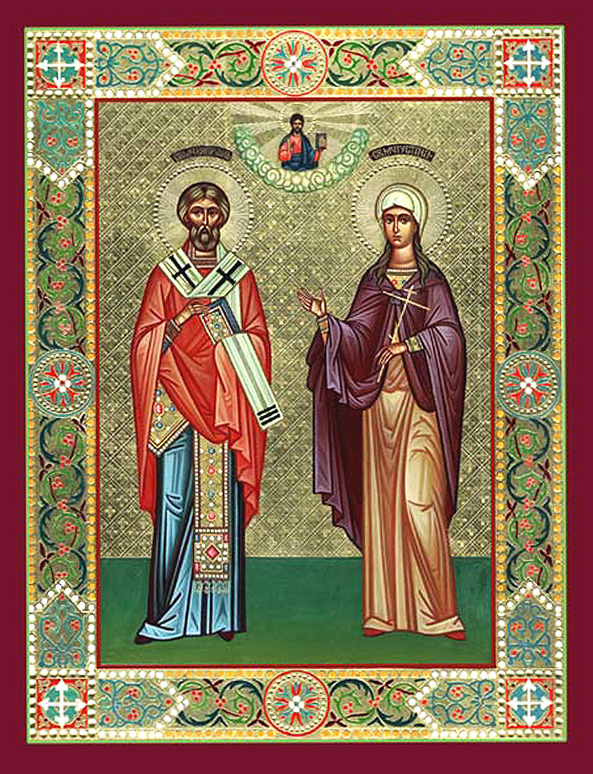
Saint Chrysanthus came from a pagan family who had moved to Rome from Alexandria. He received a fine education, and among the books he read were those in which pagans discussed Christianity. The young man, however, wanted to read books written by Christians themselves. He finally managed to find a copy of the New Testament, which enlightened his rational soul.
Seeking someone to instruct him in the Holy Scriptures, he found the presbyter Carpophoros hiding from persecution, and received holy Baptism from him. After this, he began to preach the Gospel. Chrysanthus’ father tried to turn his son from Christianity, and finally married him to Daria, a priestess of Minerva.
Saint Chrysanthus managed to convert his wife to Christ, and the young couple mutually agreed to lead celibate lives. After the death of the father, they began to live in separate houses. Saint Chrysanthus converted several young men to Christ, and many pious women gathered around Saint Daria.
The people of Rome complained to the eparch Celerinus that Saints Chrysanthus and Daria were preaching celibacy and attracting too many young men and women to monasticism. Saint Chrysanthus was sent to the tribune Claudius for torture.
The torments, however, did not shake the bravery of the young martyr, since the power of God clearly aided him. Struck by this, the tribune Claudius himself came to believe in Christ and accepted holy Baptism together with his wife Hilaria, their sons Jason and Maurus, and all his household and soldiers. When news of this reached the emperor Numerian (283-284), he commanded them all to be executed. The Martyr Claudius was drowned in the sea, and his sons and soldiers were beheaded. Christians buried the bodies of the holy martyrs in a nearby cave, and Saint Hilaria constantly went there to pray. Once, they followed her and led her off for torture. The saint asked that they give her a few moments to pray, and as soon as she finished, she gave up her soul to God. A servant buried the saint in the cave beside her sons.
The torturers sent Saint Daria to a brothel, where she was protected by a lion sent by God. A certain man who tried to defile the saint was knocked to the ground and pinned down by the lion, but the lion did not kill him. The martyr preached to them about Christ and set them to the path of salvation.
They threw Saint Chrysanthus into a foul-smelling pit, into which all the filth of the city flowed. But a heavenly light shone on him, and the pit was filled with a sweet fragrance.
Then the emperor Numerian ordered Saints Chrysanthus and Daria to be turned over to the executioners. After many cruel tortures, the martyrs were buried alive in the ground.
In a cave near the place of execution, Christians began to gather to honor the anniversary of the saints’ martyrdom. They celebrated Church services and partook of the Holy Mysteries. Learning of this, the pagan authorities sealed the entrance to the cave, and those within received the crown of martyrdom. Two of these martyrs are known by name: the Presbyter Diodorus and the Deacon Marianus.
Saint Innocent of Komel, disciple of Saint Nilus of Sora, Vologda

Saint Innocent of Komel and Vologda was born at Moscow, and was descended from the Moscow princely family of Okhlyabinin. He became a monk in the monastery of Saint Cyril of White Lake (June 9), and was put under the guidance of Saint Nilus of Sora (May 7).
Sts Innocent and Nilus wandered through the East visiting Palestine, Constantinople, and spent several years at the monasteries of Mt. Athos. Having returned to Rus, the saints did not return to their original Saint Cyril of White Lake monastery, but to solitary cells for monastic seclusion. Out of love for wilderness-life they then withdrew into the impassable forest at the River Sora, some fifteen versts from the monastery. Here they set up a cross, dug a well, and built separate cells, after the manner of the skete monasteries. A church was built on a marshy spot, and there the hermits led strict lives.
Foreseeing his own demise, Saint Nilus sent Saint Innocent to the River Nurma and predicted to him: “God is sending you there, and yours shall be a cenobitic monastery; after my death, my wilderness monastery will remain as it was during my life, with the brothers living separately each in his own cell.”
Upon the death of Saint Nilus, his holy disciple withdrew into the Vologda hinterland and in 1491 he built a cell at the River Eda, which flows into the River Nurma. In a short while disciples began to gather to him. Following the final command of his teacher, Saint Innocent did not seek any donations for it.
Saint Innocent labored for thirty years at building his monastery. He left behind an instruction for the brethren, based on the works of the holy Fathers, particularly the writings of Saint Nilus of Sora. Saint Innocent bade them first of all to avoid wrangling and disputes and asked them to preserve love for Christ and spiritual peace.
The saint forbid young and beardless monks to be accepted and tonsured at his monastery, and he forbid women to enter the monastery. A monk who left the monastery lost his right to a cell, and if he returned, then he could occupy it only with the consent of the igumen and the brethren. The monk asked that a future church be consecrated in the name of Saint John the Forerunner, and Baptizer of the Lord, in commemoration of the Third Finding of his Venerable Head (25 May), because Saint John is a patron for all monks and wilderness dwellers (later, the monastery was called Transfiguration after its chief temple).
Saint Innocent died on March 19, 1521. In accordance with his last wish, he was buried in a corner of the monastery near a marsh. A stone was placed on his grave inscribed with the year, month and day of his repose.
Martyr Pancharius at Nicomedia
The Holy Martyr Pancharius was a friend of the emperor Diocletian. He abandoned Christianity and became a pagan. His mother and sister sent him a letter in which they urged the apostate to fear God and the dread Last Judgment. Having repented, Saint Pancharius openly confessed his faith before the emperor, for which he suffered torture at Rome. Then he was sent to Nicomedia and beheaded in 303.
Icon of the Mother of God of Lubyatov
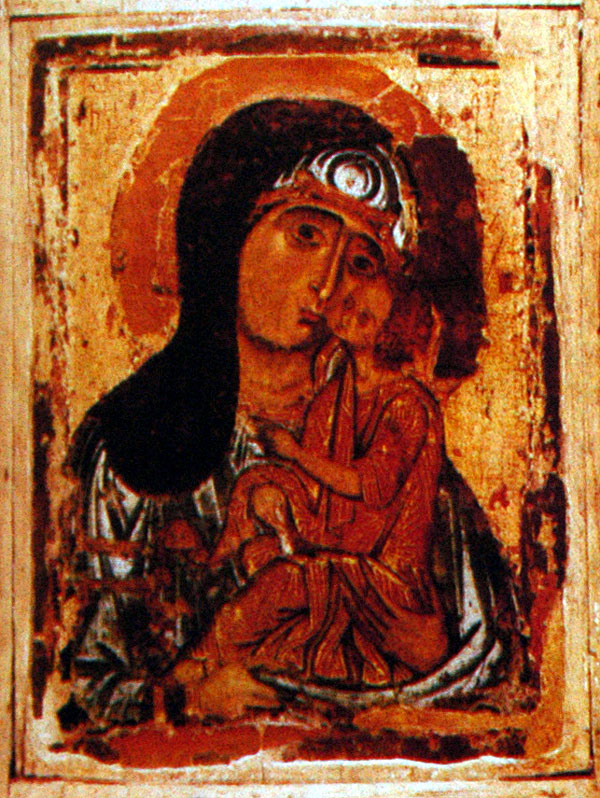
This holy icon, which dates from the fifteenth century, was in the Saint Nicholas monastery church in the Pskov region.
There was once a silver plaque with an inscription from 1890 on the reverse of the icon. It told of how Tsar Ivan the Terrible came to the monastery of Saint Nicholas at Lubyatov during Great Lent in 1570. He had stopped there on his way to punish the people of Pskov, for he believed that they were about to give their allegiance to the Prince of Lithuania.
During the morning service, he happened to gaze at the icon of the Mother of God, and his heart was moved to compunction. “Let the killing stop,” he said. “Put away your swords.”
Soldiers of the Polish king Stephen Batory shot at the icon as they were on their way to attack Pskov in 1581.
Communists confiscated the icon in 1928, and in 1930 it was placed in the Tretiakov Gallery.
The icon has elements from three other types of icons of the Mother of God. Essentially, it belongs to the Eleousa type, like the Vladimir Icon (May 21, June 23, August 26). The gesture of the divine Child resembles the “Sweet-Kissing” or “Tenderness” Icon of Smolensk (March 19), and the scroll seems to come from the Hodēgḗtria Icon (July 28).
“Sweet-Kissing” Icon of the Mother of God of Smolensk

The Smolensk “Tenderness” Icon of the Mother of God manifested itself in the year 1103 at Smolensk. There is another Smolensk “Tenderness” Icon from the vicinity of Okopa (down from Smolensk). This icon was in the encampment of the Russian armies of the military commander Shein, restraining the Polish besiegers from destroying Smolensk for twenty months (1611-1613).
The Mother of God is depicted gazing tenderly at the Divine Child, Who reclines in her lap, resting His head on her left arm. Both of her hands rest just below her neck.
The Savior holds an orb in His right hand, the symbol of sovereignty and power. In some icons, however, the orb is in His left hand.
The nine hundredth anniversary of the Smolensk Tenderness Icon's appearance was observed in 2003.
Akathist Hymn to the Theotokos – March 18, 2022
Here is the live stream for Akathist Hymn to the Theotokos – March 18, 2022 If you need, here are instructions for accessing this content from your phone, tablet, computer, or TV.
Daily Readings for Friday, March 18, 2022
2ND FRIDAY OF LENT
ABSTAIN FROM MEAT, FISH, DAIRY, EGGS, WINE, OLIVE OIL
Cyril, Patriarch of Jerusalem, Trophimos & Eukarpion, Monk-martyrs of Nicomedea, Edward the Martyr, King of England
ISAIAH 7:1-14
In the days of Ahaz the son of Jotham, son of Uzziah, king of Judah, Rezin the king of Syria and Pekah the son of Remaliah the king of Israel came up to Jerusalem to wage war against it, but they could not conquer it. When the house of David was told, "Syria is in league with Ephraim, " his heart and the heart of his people shook as the trees of the forest shake before the wind.
And the LORD said to Isaiah, "Go forth to meet Ahaz, you and Shearjashub your son, at the end of the conduit of the upper pool on the highway to the Fuller's Field, and say to him, 'Take heed, be quiet, do not fear, and do not let your heart be faint because of these two smoldering stumps of firebrands, at the fierce anger of Rezin and Syria and the son of Remaliah. Because Syria, with Ephraim and the son of Remaliah, has devised evil against you, saying, "Let us go up against Judah and terrify it, and let us conquer it for ourselves, and set up the son of Tabeel as king in the midst of it, " thus says the Lord GOD: It shall not stand, and it shall not come to pass. For the head of Syria is Damascus, and the head of Damascus is Rezin. (Within sixty-five years Ephraim will be broken to pieces so that it will no longer be a people.) And the head of Ephraim is Samaria, and the head of Samaria is the son of Remaliah. If you will not believe, surely you shall not be established.'
Again the LORD spoke to Ahaz, "Ask a sign of the LORD your God; let it be deep as Sheol or high as heaven." But Ahaz said, "I will not ask, and I will not put the LORD to the test." And he said, "Hear then, O house of David! Is it too little for you to weary men, that you weary my God also? Therefore the Lord himself will give you a sign. Behold, a virgin shall conceive and bear a son, and shall call his name Immanuel.
GENESIS 5:32-6:8
After Noah was five hundred years old, Noah became the father of Shem, Ham, and Japheth. When men began to multiply on the face of the ground, and daughters were born to them, the sons of God saw that the daughters of men were fair; and they took to wife such of them as they chose. Then the LORD said, “My spirit shall not abide in man for ever, for he is flesh, but his days shall be a hundred and twenty years.” The Nephilim were on the earth in those days, and also afterward, when the sons of God came in to the daughters of men, and they bore children to them. These were the mighty men that were of old, the men of renown. The LORD saw that the wickedness of man was great in the earth, and that every imagination of the thoughts of his heart was only evil continually. And the LORD was sorry that he had made man on the earth, and it grieved him to his heart. So the LORD said, “I will blot out man whom I have created from the face of the ground, man and beast and creeping things and birds of the air, for I am sorry that I have made them.” But Noah found favor in the eyes of the LORD.
PROVERBS 6:20-7:1
My son, keep your father’s commandment, and forsake not your mother’s teaching. Bind them upon your heart always; tie them about your neck. When you walk, they will lead you; when you lie down, they will watch over you; and when you awake, they will talk with you. For the commandment is a lamp and the teaching a light, and the reproofs of discipline are the way of life, to preserve you from the evil woman, from the smooth tongue of the adventuress. Do not desire her beauty in your heart, and do not let her capture you with her eyelashes; for a harlot may be hired for a loaf of bread, but an adulteress stalks a man’s very life. Can a man carry fire in his bosom and his clothes not be burned? Or can one walk upon hot coals and his feet not be scorched? So is he who goes in to his neighbor’s wife; none who touches her will go unpunished. Do not men despise a thief if he steals to satisfy his appetite when he is hungry? And if he is caught, he will pay sevenfold; he will give all the goods of his house. He who commits adultery has no sense; he who does it destroys himself. Wounds and dishonor will he get, and his disgrace will not be wiped away. For jealousy makes a man furious, and he will not spare when he takes revenge. He will accept no compensation, nor be appeased though you multiply gifts. My son, keep my words and treasure up my commandments with you.
Repose of Saint Nikolai of Zhicha

Saint Nikolai of Zhicha, “the Serbian Chrysostom,” was born in Lelich in western Serbia on January 4, 1881 (December 23, 1880 O.S.). His parents were Dragomir and Katherine Velimirovich, who lived on a farm where they raised a large family. His pious mother was a major influence on his spiritual development, teaching him by word and especially by example. As a small child, Nikolai often walked three miles to the Chelije Monastery with his mother to attend services there.
Sickly as a child, Nikolai was not physically strong as an adult. He failed his physical requirements when he applied to the military academy, but his excellent academic qualifications allowed him to enter the Saint Savva Seminary in Belgrade, even before he finished preparatory school.
After graduating from the seminary in 1905, he earned doctoral degrees from the University of Berne in 1908, and from King’s College, Oxford in 1909. When he returned home, he fell ill with dysentery. Vowing to serve God for the rest of his life if he recovered, he was tonsured at the Rakovica Monastery on December 20, 1909 and was also ordained to the holy priesthood.
In 1910 he went to study in Russia to prepare himself for a teaching position at the seminary in Belgrade. At the Theological Academy in Saint Petersburg, the Provost asked him why he had come. He replied, “I wanted to be a shepherd. As a child, I tended my father’s sheep. Now that I am a man, I wish to tend the rational flock of my heavenly Father. I believe that is the way that has been shown to me.” The Provost smiled, pleased by this response, then showed the young man to his quarters.
After completing his studies, he returned to Belgrade and taught philosophy, logic, history, and foreign languages at the seminary. He spoke seven languages, and this ability proved very useful to him throughout his life.
Saint Nikolai was renowned for his sermons, which never lasted more than twenty minutes, and focused on just three main points. He taught people the theology of the Church in a language they could understand, and inspired them to repentance.
At the start of World War I, Archimandrite Nikolai was sent to England on a diplomatic mission to seek help in the struggle of the Serbs against Austria. His doctorate from Oxford gained him an invitation to speak at Westminster Abbey. He remained in England for three short months, but Saint Nikolai left a lasting impression on those who heard him. His writings “The Lord’s Commandments,” and “Meditations on the Lord’s Prayer” impressed many in the Church of England.
Archimandrite Nikolai left England and went to America, where he proved to be a good ambassador for his nation and his Church.
The future saint returned to Serbia in 1919, where he was consecrated as Bishop of Zhicha, and was later transferred to Ochrid. The new hierarch assisted those who were suffering from the ravages of war by establishing orphanages and helping the poor.
Bishop Nikolai took over as leader of Bogomljcki Pokret, a popular movement for spiritual revival which encouraged people to pray and read the Bible. Under the bishop’s direction, it also contributed to a renewal of monasticism. Monasteries were restored and reopened, and this in turn revitalized the spiritual life of the Serbian people.
In 1921, Bishop Nikolai was invited to visit America again and spent two years as a missionary bishop. He gave more than a hundred talks in less than six months, raising funds for his orphanages. Over the next twenty years, he lectured in various churches and universities.
When Germany invaded Yugoslavia on April 6, 1941, Bishop Nikolai, a fearless critic of the Nazis, was arrested and confined in Ljubostir Vojlovici Monastery. In 1944, he and Patriarch Gavrilo were sent to the death camp at Dachau. There he witnessed many atrocities and was tortured himself. When American troops liberated the prisoners in May 1945, the patriarch returned to Yugoslavia, but Bishop Nikolai went to England.
The Communist leader Tito was just coming to power in Yugoslavia, where he persecuted the Church and crushed those who opposed him. Therefore, Bishop Nikolai believed he could serve the Serbian people more effectively by remaining abroad. He went to America in 1946, following a hectic schedule in spite of his health problems which were exacerbated by his time in Dachau. He taught for three years at Saint Savva’s Seminary in Libertyville, IL before he settled at Saint Tikhon’s Monastery in South Canaan, PA in 1951.
He taught at Saint Tikhon’s and also served as the seminary’s Dean and Rector. He was also a guest lecturer at Saint Vladimir’s Seminary in NY, and at Holy Trinity Monastery in Jordanville, NY.
On Saturday March 17, 1956 Bishop Nikolai served his last Liturgy. After the service he went to the trapeza and gave a short talk. As he was leaving, he bowed low and said, “Forgive me, brothers.” This was something unusual which he had not done before.
On March 18, 1956 Saint Nikolai fell asleep in the Lord Whom he had served throughout his life. He was found in his room kneeling in an attitude of prayer. Though he was buried at Saint Savva’s Monastery in Libertyville, IL, he had always expressed a desire to be buried in his homeland. In April of 1991 his relics were transferred to the Chetinje Monastery in Lelich. There he was buried next to his friend and disciple Father Justin Popovich (+ 1979).
English readers are familiar with Saint Nikolai’s Prologue from Ochrid, The Life of Saint Savva, A Treasury of Serbian Spirituality, and other writings which are of great benefit for the whole Church. He thought of his writings as silent sermons addressed to people who would never hear him preach. In his life and writings, the grace of the Holy Spirit shone forth for all to see, but in his humility he considered himself the least of men.
Though he was a native of Serbia, Saint Nikolai has a universal significance for Orthodox Christians in all countries. He was like a candle set upon a candlestick giving light to all (MT 5:15). A spiritual guide and teacher with a magnetic personality, he attracted many people to himself. He also loved them, seeing the image of God in each person he met. He had a special love for children, who hastened to receive his blessing whenever they saw him in the street.
He was a man of compunctionate prayer, and possessesed the gift of tears which purify the soul (Saint John Climacus, LADDER, Step 7). He was a true pastor to his flock protecting them from spiritual wolves, and guiding them on the path to salvation. He has left behind many soul-profiting writings which proclaim the truth of Christ to modern man. In them he exhorts people to love God, and to live a life of virtue and holiness. May we also be found worthy of the Kingdom of Heaven through the prayers of Saint Nikolai, and by the grace of our Lord Jesus Christ, to Whom be glory forever. Amen.
Saint Cyril, Archbishop of Jerusalem

Saint Cyril, Archbishop of Jerusalem, was born in Jerusalem in the year 315 and was raised in strict Christian piety. Upon reaching the age of maturity, he became a monk, and in the year 346 he became a presbyter. In the year 350, upon the death of Archbishop Maximus, he succeeded him on the episcopal throne of Jerusalem.
As Patriarch of Jerusalem, Saint Cyril zealously fought against the heresies of Arius and Macedonius. In so doing, he aroused the animosity of the Arian bishops, who sought to have him deposed and banished from Jerusalem.
There was a miraculous portent in 351 at Jerusalem: at the third hour of the day on the Feast of Pentecost, the Holy Cross appeared in the heavens, shining with a radiant light. It stretched from Golgotha above the Mount of Olives. Saint Cyril reported this portent to the Arian emperor Constantius (351-363), hoping to convert him to Orthodoxy.
The heretic Acacius, deposed by the Council of Sardica, was formerly the Metropolitan of Caesarea, and he collaborated with the emperor to have Saint Cyril removed. An intense famine struck Jerusalem, and Saint Cyril expended all his wealth in charity. But since the famine did not abate, the saint pawned church utensils, and used the money to buy wheat for the starving. The saint’s enemies spread a scandalous rumor that they had seen a woman in the city dancing around in clerical garb. Taking advantage of this rumor, the heretics forcibly expelled the saint.
The saint found shelter with Bishop Silvanus in Tarsus. After this, a local Council was held at Seleucia, at which there were about 150 bishops, and among them Saint Cyril. The heretical Metropolitan Acacius did not want to allow him to take a seat, but the Council would not consent to this. Acacius stormed out of the Council, and before the emperor and the Arian patriarch Eudoxius, he denounced both the Council and Saint Cyril. The emperor had the saint imprisoned.
When the emperor Julian the Apostate (361-363) ascended the throne he repealed all the anti-Orthodox decrees of Constantius, seemingly out of piety. Saint Cyril returned to his own flock. But after a certain while, when Julian had become secure upon the throne, he openly apostasized and renounced Christ. He permitted the Jews to start rebuilding the Temple of Jerusalem that had been destroyed by the Romans, and he even provided them part of the funds for the building from the state treasury.
Saint Cyril predicted that the words of the Savior about the destruction of the Temple down to its very stones (Luke. 21:6) would undoubtedly transpire, and the blasphemous intent of Julian would come to naught. Soon there was such a powerful earthquake, that even the solidly set foundation of the ancient Temple of Solomon shifted in its place, and what had been rebuilt fell down and shattered into dust. When the Jews resumed construction, a fire came down from the heavens and destroyed the tools of the workmen. Great terror seized everyone. On the following night, the Sign of the Cross appeared on the clothing of the Jews, which they could not remove by any means.
After this heavenly confirmation of Saint Cyril’s prediction, they banished him again, and the bishop’s throne was occupied by Saint Cyriacus. But Saint Cyriacus soon suffered a martyr’s death (October 28).
After the emperor Julian perished in 363, Saint Cyril returned to his See, but during the reign of the emperor Valens (364-378) he was exiled for a third time. It was only under the holy emperor Saint Theodosius the Great (379-395) that he finally returned to his archpastoral activity. In 381 Saint Cyril participated in the Second Ecumenical Council, which condemned the heresy of Macedonius and affirmed the Nicea-Constantinople Symbol of Faith (Creed).
Saint Cyril’s works include twenty-three Instructions (Eighteen are Catechetical, intended for those preparing for Baptism, and five are for the newly-baptized) and two discourses on Gospel themes: “On the Paralytic,” and “Concerning the Transformation of Water into Wine at Cana.”
At the heart of the Catechetical Instructions is a detailed explanation of the Symbol of Faith. The saint suggests that a Christian should inscribe the Symbol of Faith upon “the tablets of the heart.”
“The articles of the Faith,” Saint Cyril teaches, “were not written through human cleverness, but they contain everything that is most important in all the Scriptures, in a single teaching of faith. Just as the mustard seed contains all its plethora of branches within its small kernel, so also does the Faith in its several declarations combine all the pious teachings of the Old and the New Testaments.”
Saint Cyril, a great ascetic and a champion of Orthodoxy, died in the year 386.
Martyrs Trophimus and Eucarpus of Nicomedia

The Holy Martyrs Trophimus and Eucarpion were soldiers at Nicomedia during the persecution against Christians under the emperor Diocletian (284-305). They distinguished themselves by their great ferocity in carrying out all of the emperor’s decrees.
Once, when these soldiers had caught up with some Christians, they suddenly saw a large fiery cloud which had come down from the sky, thickening in form as it drew close to them. From out of the cloud came forth a Voice: “Why are you so zealous in threatening My servants? Don’t be deluded! No one can suppress those believing in Me through their own strength. It is better to join them and discover the Heavenly Kingdom yourselves.”

The soldiers fell to the ground in fright, not daring to lift up their eyes, and only said to one another, “Truly this is the great God, Who has manifested Himself to us. We would do well to become His servants.” The Lord then spoke saying, “Rise up, repent, for your sins are forgiven.” As they got up, they beheld within the cloud the image of a Radiant Man and a great multitude standing about Him.
The astonished soldiers cried out with one voice, “Receive us, for our sins are inexpressibly wicked. There is no other God but You, the Creator and true God, and we are not yet numbered among Your servants.” But just as they spoke this, the cloud receded and rose up into the sky.
Spiritually reborn after this miracle, the soldiers released all the jailed Christians from the prisons. For this Saints Trophimus and Eucarpion were handed over to terrible torments: they suspended the saints and tore their bodies with iron hooks. They gave thanks unto God, certain that the Lord would forgive them their former sins. When a fire had been lit, the holy martyrs went willingly into the fire and there gave up their souls to God.
Venerable Aninas of the Euphrates

Saint Aninas was born at Chalcedon into a Christian family. After the death of his parents, he withdrew at age fifteen into a monastery, where he received monastic tonsure. In search of complete solitude, he went off into the heart of the desert where the River Euphrates separates Syria from Persia. There he came upon an Elder named Maium and settled there with him. Both ascetics led a very strict life. During the forty days of the Great Fast they ate nothing, taking delight and joy instead in spiritual nourishment.
Every day Saint Aninas carried drinking water from afar. Once, he returned with full water pitchers earlier than usual, since an angel had filled the vessels with water. The Elder Maium realized that his disciple had attained to high level of spiritual accomplishment, and he in turn asked Saint Aninas to become his guide, but the Saint refused out of humility. Later, the Elder went to a monastery, and Saint Aninas remained alone in the wilderness.
By constant struggles the saint conquered the passions within himself, and he was granted gifts of healing and clairvoyance. Even the wild beasts became docile and served him. Wherever the saint went, two lions followed after him, one of which he had healed of a wound on its paw.
Accounts of the saint spread throughout all the surrounding area, and the sick and those afflicted by evil spirits began to come to him, seeking healing. Several disciples also gathered around the saint. Once, in his seventeenth year as an ascetic, several men had come to the saint and asked for something to quench their thirst. Relying on the power of God, the saint sent one of his disciples to a dried-up well. The well miraculously filled up to its very top, and this water remained for many days. When the water ended, the saint did not dare to ask for a miracle for himself, and so he began to carry water from the Euphrates at night.
Bishop Patrick of Neocaesarea repeatedly visited the monk and ordained him presbyter, although the humble ascetic was resolved not to accept the priestly office. When he learned that the saint himself carried water from a distance, Bishop Patrick twice gave him donkeys, but each time Saint Aninas gave them away to the poor and continued to carry the water himself. Then the bishop ordered that a large well be dug, which they filled from time to time, bringing donkeys from the city.
Saint Aninas discerned the desire of a certain stylite monk, who struggled far from him, to come down off his pillar and make a complaint in court against a robber who had hurt him with a stone. Saint Aninas wrote a letter to the stylite, advising him not to carry out his intent. The letter was brought to the stylite by a trusty lion, and it brought him to his senses.
A certain pious woman, who had fallen ill, went to Saint Aninas to ask for his prayers. Along the way a robber chanced upon her. Since the woman had no money, he decided to assault her and force her into sin. The woman called on the saint’s help and cried out, “Saint Aninas, help me!” Terror suddenly overcame the robber, and he let go of the woman.
The woman went to Saint Aninas and told him everything, and she also received healing. The robber also came to the monk in repentance, was baptized, and then tonsured as a monk. A spear which he had thrust into the ground when he attacked the woman, grew into a mighty oak.
At the age of 110 the saint predicted the time of his death, and he directed his successor as igumen to assemble the brethren.
Before his death, Saint Aninas conversed with the holy Prophets Moses, Aaron and Or [or Hur: Ex. 24:14]. He fell asleep in the Lord saying, “ O Lord, receive my soul.”
Saint Cyril of Astrakhan

No information available at this time.
Daily Readings for Thursday, March 17, 2022
2ND THURSDAY OF LENT
ABSTAIN FROM MEAT, FISH, DAIRY, EGGS, WINE, OLIVE OIL
Alexis the Man of God, Paul the Righteous Martyr, Patrick the Enlightener of Ireland, Marinos the Martyr, Theocteristos the Confessor
ISAIAH 6:1-12
In the year that King Uzziah died I saw the Lord sitting upon a throne, high and lifted up; and his train filled the temple. Above him stood the seraphim; each had six wings: with two he covered his face, and with two he covered his feet, and with two he flew. And one called to another and said: "Holy, holy, holy is the LORD of hosts; the whole earth is full of his glory." And the foundations of the thresholds shook at the voice of him who called, and the house was filled with smoke. And I said: "Woe is me! For I am lost; for I am a man of unclean lips, and I dwell in the midst of a people of unclean lips; for my eyes have seen the King, the LORD of hosts!" Then flew one of the seraphim to me, having in his hand a burning coal which he had taken with tongs from the altar. And he touched my mouth, and said: "Behold, this has touched your lips; your guilt is taken away, and your sin forgiven." And I heard the voice of the Lord saying, "Whom shall I send, and who will go for us?" Then I said, "Here am I! Send me." And he said, "Go, and say to this people: 'Hear and hear, but do not understand; see and see, but do not perceive.' Make the heart of this people fat, and their ears heavy, and shut their eyes; lest they see with their eyes, and hear with their ears, and understand with their hearts, and turn and be healed." Then I said, "How long, O Lord?" And he said: "Until cities lie waste without inhabitant, and houses without men, and the land is utterly desolate, and the LORD removes men far away, and the forsaken places are many in the midst of the land.
GENESIS 5:1-24
This is the book of the generations of Adam. When God created man, he made him in the likeness of God. Male and female he created them, and he blessed them and named them Man when they were created. When Adam had lived a hundred and thirty years, he became the father of a son in his own likeness, after his image, and named him Seth. The days of Adam after he became the father of Seth were eight hundred years; and he had other sons and daughters. Thus all the days that Adam lived were nine hundred and thirty years; and he died. When Seth had lived a hundred and five years, he became the father of Enosh. Seth lived after the birth of Enosh eight hundred and seven years, and had other sons and daughters. Thus all the days of Seth were nine hundred and twelve years; and he died. When Enosh had lived ninety years, he became the father of Kenan. Enosh lived after the birth of Kenan eight hundred and fifteen years, and had other sons and daughters. Thus all the days of Enosh were nine hundred and five years; and he died. When Kenan had lived seventy years, he became the father of Mahalalel. Kenan lived after the birth of Mahalalel eight hundred and forty years, and had other sons and daughters. Thus all the days of Kenan were nine hundred and ten years; and he died. When Mahalalel had lived sixty-five years, he became the father of Jared. Mahalalel lived after the birth of Jared eight hundred and thirty years, and had other sons and daughters. Thus all the days of Mahalalel were eight hundred and ninety-five years; and he died. When Jared had lived a hundred and sixty-two years he became the father of Enoch. Jared lived after the birth of Enoch eight hundred years, and had other sons and daughters. Thus all the days of Jared were nine hundred and sixty-two years; and he died. When Enoch had lived sixty-five years, he became the father of Methuselah. Enoch walked with God after the birth of Methuselah three hundred years, and had other sons and daughters. Thus all the days of Enoch were three hundred and sixty-five years. Enoch walked with God; and he was not, for God took him.
PROVERBS 6:3-20
Then do this, my son, and save yourself, for you have come into your neighbor's power: go, hasten, and importune your neighbor. Give your eyes no sleep and your eyelids no slumber; save yourself like a gazelle from the hunter, like a bird from the hand of the fowler.
Go to the ant, O sluggard; consider her ways, and be wise. Without having any chief, officer or ruler, she prepares her food in summer, and gathers her sustenance in harvest. How long will you lie there, O sluggard? When will you arise from your sleep? A little sleep, a little slumber, a little folding of the hands to rest, and poverty will come upon you like a vagabond, and want like an armed man. A worthless person, a wicked man, goes about with crooked speech, winks with his eyes, scrapes with his feet, points with his finger, with perverted heart devises evil, continually sowing discord; therefore calamity will come upon him suddenly; in a moment he will be broken beyond healing.
There are six things which the LORD hates, seven which are an abomination to him: haughty eyes, a lying tongue, and hands that shed innocent blood, a heart that devises wicked plans, feet that make haste to run to evil, a false witness who breathes out lies, and a man who sows discord among brothers. My son, keep your father's commandment, and forsake not your mother's teaching.
Venerable Alexis the Man of God

Saint Alexis was born at Rome into the family of the pious and poverty-loving Euphemianus and Aglais. The couple was childless for a long time and constantly prayed the Lord to grant them a child. And the Lord consoled the couple with the birth of their son Alexis.
At six years of age the child began to read and successfully studied the mundane sciences, but it was with particular diligence that he read Holy Scripture. When he was a young man, he began to imitate his parents: he fasted strictly, distributed alms and beneath his fine clothing he secretly wore a hair shirt. Early on there burned within him the desire to leave the world and serve God. His parents, however, had arranged for Alexis to marry a beautiful and virtuous bride.
On his wedding night, Alexis gave her his ring and his belt (which were very valuable) and said, “Keep these things, Beloved, and may the Lord be with us until His grace provides us with something better.” Secretly leaving his home, he boarded a ship sailing for Mesopotamia.
Arriving in the city of Edessa, where the Icon of the Lord “Not-made-by-Hands” (August 16) was preserved, Alexis sold everything that he had, distributed the money to the poor and began to live near the church of the Most Holy Theotokos under a portico. The saint used a portion of the alms he received to buy bread and water, and he distributed the rest to the aged and infirm. Each Sunday he received the Holy Mysteries.
The parents sought the missing Alexis everywhere, but without success. The servants sent by Euphemianus also arrived in Edessa, but they did not recognize the beggar sitting at the portico as their master. His body was withered by fasting, his comeliness vanished, his stature diminished. The saint recognized them and gave thanks to the Lord that he received alms from his own servants.
The inconsolable mother of Saint Alexis confined herself in her room, incessantly praying for her son. His wife also grieved with her in-laws.
Saint Alexis dwelt in Edessa for seventeen years. Once, the Mother of God spoke to the sacristan of the church where the saint lived: “Lead into My church that Man of God, worthy of the Kingdom of Heaven. His prayer rises up to God like fragrant incense, and the Holy Spirit rests upon him.” The sacristan began to search for such a man, but was not able to find him for a long time. Then he prayed to the Most Holy Theotokos, beseeching Her to clear up his confusion. Again a voice from the icon proclaimed that the Man of God was the beggar who sat in the church portico.
The sacristan found Saint Alexis and brought him into the church. Many recognized him and began to praise him. The saint secretly boarded a ship bound for Cilicia, intending to visit the church of Saint Paul in Tarsus. But God ordained otherwise. A storm took the ship far to the West and it reached the coast of Italy. The saint journeyed to Rome and decided to live in his own house. Unrecognized, he humbly asked his father’s permission to settle in some corner of his courtyard. Euphemianus settled Alexis in a specially constructed cell and gave orders to feed him from his table.
Living at his parental home, the saint continued to fast and he spent day and night at prayer. He humbly endured insults and jeering from the servants of his father. The cell of Alexis was opposite his wife’s windows, and the ascetic suffered grievously when he heard her weeping. Only his immeasurable love for God helped the saint endure this torment. Saint Alexis dwelt at the house of his parents for seventeen years and the Lord revealed to him the day of his death. Then the saint, taking paper and ink, wrote certain things that only his wife and parents would know. He also asked them to forgive him for the pain he had caused them.
On the day of Saint Alexis’ death in 411, Archbishop Innocent (402-417) was serving Liturgy in the presence of the emperor Honorius (395-423). During the services a Voice was heard from the altar: “Come unto Me, all ye who labor and are heavy laden, and I will give you rest” (Mt.11:28). All those present fell to the ground in terror.
The Voice continued: “On Friday morning the Man of God comes forth from the body; have him pray for the city, that you may remain untroubled.” They began to search throughout Rome, but they did not find the saint. Thursday evening the Pope was serving Vigil in the Church of Saint Peter. He asked the Lord to show them where to find the Man of God.
After Liturgy the Voice was heard again in the temple: “Seek the Man of God in the house of Euphemianus.” All hastened there, but the saint was already dead. His face shone like the face of an angel, and his hand clasped the paper, and they were unable to take it. They placed the saint’s body on a cot, covered with costly coverings. The Pope and the Emperor bent their knees and turned to the saint, as to one yet alive, asking him to open his hand. And the saint heard their prayer. When the letter was read, the righteous one’s wife and parents tearfully venerated his holy relics.
The body of the saint was placed in the center of the city. The emperor and the Pope carried the body of the saint into the church, where it remained for a whole week, and then was placed in a marble crypt. A fragrant myrrh began to flow from the holy relics, bestowing healing upon the sick.
The venerable relics of Saint Alexis, the Man of God, were buried in the church of Saint Boniface. The relics were uncovered in the year 1216.
The Life of Saint Alexis, the Man of God, was always very popular in Russia.
Venerable Macarius the Wonderworker, Abbot of Kalyazin
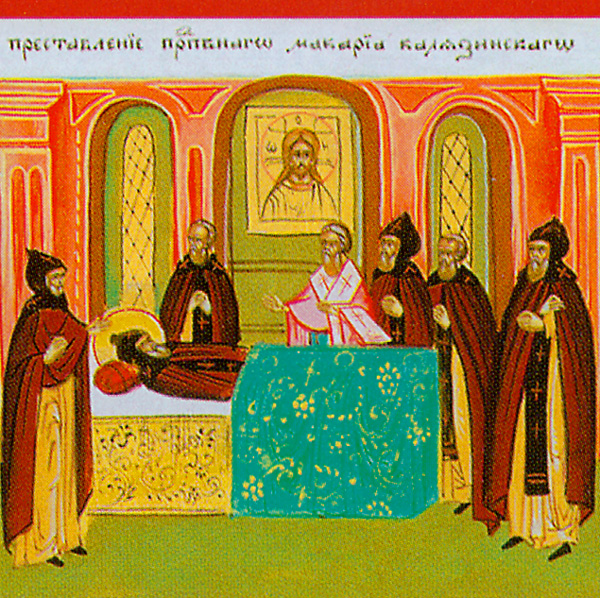
Saint Macarius of Kalyazin (in the world Matthew) was born in 1400 in the village of Gribkovo (Kozhino), near the city of Kashin, into the family of the boyar Basil Kozha. From youth he yearned for monasticism, but he married at the insistence of his parents.
After a year his parents died, and after three more years his wife Elena also reposed. Having nothing to bind him to his former life, Matthew became a monk at the Nikolaev Klobukov monastery. Desiring solitude, he left the city monastery with the abbot’s blessing, and he found a suitable place between two lakes, eighteen versts from Kashin. Here the monk raised a cross and founded a solitary wilderness monastery.
The boyar Ivan Kolyaga, to whom the nearby lands belonged, began to fear that a monastery would grow up there, and that monks would begin to cultivate the wastelands. The Enemy of our salvation planted such spite and enmity in the boyar, that he decided to kill the saint. Suddenly, he was stricken with a grievous illness. Fear of death awakened repentance in the boyar. Ivan Kolyaga was carried to the saint and told him of his evil intent, asking forgiveness.
“God forgive you”, the humble ascetic replied. Wishing to expiate his sin and to help the saint, the boyar gave his lands to the growing monastery. The monks built a temple dedicated to the Most Holy Trinity. Word of the boyar Kolyaga’s conversion brought many people to the monk, seeking salvation. Saint Macarius tonsured Kolyaga and named the monastery Kalyazin for him.
It became necessary to choose an igumen. Saint Macarius was then fifty-three years of age, but he considered himself unworthy of this dignity and he asked each of the older men coming to him to become the monastery’s priest and igumen. Yielding to the common will, the saint was made igumen by Bishop Moses of Tver.* The new igumen prepared for his first service at the altar of God with long solitary prayer, and then communed all the brethren with the Holy Mysteries.
In the rank of igumen, Saint Macarius labored to guide the brethren. The monastery had two chalices, a diskos and two plates fashioned by Saint Macarius on a lathe. He guided not only the monks, but also laypeople coming to the monastery, dealing with both the educated and the simple.
Despite his noble origin and his position of igumen, the saint wore ragged, frayed and patched clothing. In his conduct and his way of life Saint Macarius was so simple that the haughty heretic Vassian, sneeringly called him the “peasant of Kalyazin.” The saint preferred to hear himself mocked rather than praised. He went to solitary places, delighted to be alone with nature. Wild animals, sensing his holiness, walked with him like sheep, they submitted to him, and sometimes took food from him.
The spiritual stature of Saint Macarius was close to the spiritual stature of Saint Paphnutius of Borov (May 1, 1477). Not by chance did Saint Paphnutius’ disciple, Saint Joseph of Volokolamsk (September 9, 1515), visit Saint Macarius in 1478 and write down his impressions of him: “When I arrived at this place,” said Saint Macarius, “seven Elders came with me from the monastery of Klobukov. They were so excellent in virtues, fasting and monastic life, that all the brethren came to them to receive instruction and benefit. They enlightened all and taught them for their benefit. They affirmed the virtuous life, and censured those inclined to misconduct, and neither did they seek to do their own will.”
Though the humble igumen was silent about his own efforts, they were not hidden from Saint Joseph. Perceiving the holiness of the igumen, he accounted him blessed and spoke about the life of the monastery: “Such piety and decorum were in that monastery, where everything was done in harmony with the patristic and communal traditions, that even the great Elder Metrophanes Byvaltsev was amazed. He had just come from Mount Athos, where he spent nine years, and said to the brethren: ‘My efforts and my journey to the Holy Mountain were in vain, because one can find salvation in the Kalyazin monastery. Life here is similar to life in the cenobitic monasteries of the Holy Mountain.’”
From the moment Saint Macarius settled in the wilderness, he did not abandon his strict Rule because of old age. Even during his lifetime the saint repeatedly healed the paralyzed and the demon-possessed.
The saint reposed on March 17, 1483. At the time of his death they found heavy chains on him, about which no one knew. The incorrupt relics of Saint Macarius were uncovered on May 26, 1521 when ditches were dug for a new church. A Council of 1547 established his local festal celebration.
* The successor of Bishop Moses was Saint Macarius’ brother, Bishop Gennadius (Kozhin) (1460-1477). The nephew of Saint Macarius, Saint Paisius of Uglich (January 8 and June 6) was also famed for his sanctity. The Kalyazin monastery had a collection of the sermons of Saint Gregory the Theologian, which Saint Macarius had copied in his own hand.
Martyr Marinus

Saint Marinus, inspired by ardent love for Christ the Savior, destroyed a temple of the idolaters during one of the pagan festivals, trampling the sacrifices underfoot and confessed himself a Christian. After cruel tortures, the saint was beheaded.
Saint Patrick, Bishop of Armagh, Enlightener of Ireland
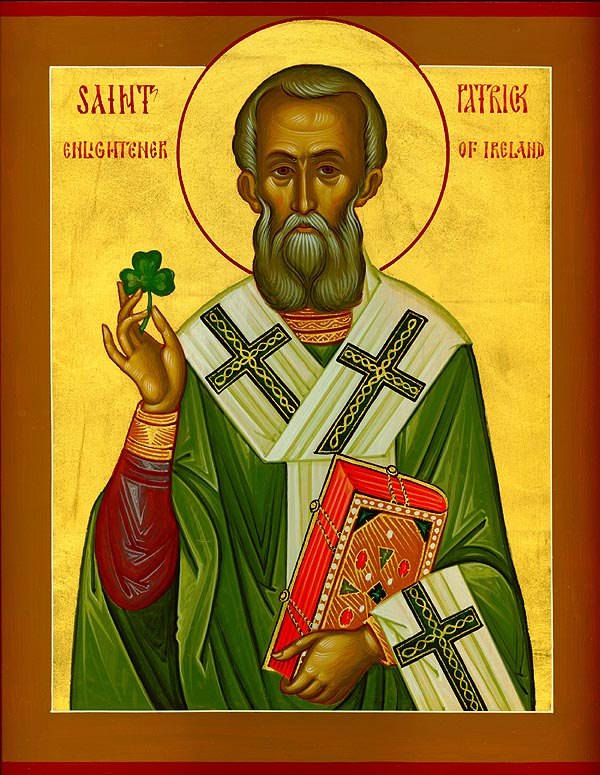
Saint Patrick, the Enlightener of Ireland was born around 385, the son of Calpurnius, a Roman decurion (an official responsible for collecting taxes). He lived in the village of Bannavem Taberniae, which may have been located at the mouth of the Severn River in Wales. The district was raided by pirates when Patrick was sixteen, and he was one of those taken captive. He was brought to Ireland and sold as a slave, and was put to work as a herder of swine on a mountain identified with Slemish in Co. Antrim. During his period of slavery, Patrick acquired a proficiency in the Irish language which was very useful to him in his later mission.
He prayed during his solitude on the mountain, and lived this way for six years. He had two visions. The first told him he would return to his home. The second told him his ship was ready. Setting off on foot, Patrick walked two hundred miles to the coast. There he succeeded in boarding a ship, and returned to his parents in Britain.
Some time later, he went to Gaul and studied for the priesthood at Auxerre under Saint Germanus (July 31). Eventually, he was consecrated as a bishop, and was entrusted with the mission to Ireland, succeeding Saint Palladius (July 7). Saint Palladius did not achieve much success in Ireland. After about a year he went to Scotland, where he died in 432.
Patrick had a dream in which an angel came to him bearing many letters. Selecting one inscribed “The Voice of the Irish,” he heard the Irish entreating him to come back to them.
Although Saint Patrick achieved remarkable results in spreading the Gospel, he was not the first or only missionary in Ireland. He arrived around 432 (though this date is disputed), about a year after Saint Palladius began his mission to Ireland. There were also other missionaries who were active on the southeast coast, but it was Saint Patrick who had the greatest influence and success in preaching the Gospel of Christ. Therefore, he is known as “The Enlightener of Ireland.”
His autobiographical Confession tells of the many trials and disappointments he endured. Patrick had once confided to a friend that he was troubled by a certain sin he had committed before he was fifteen years old. The friend assured him of God’s mercy, and even supported Patrick’s nomination as bishop. Later, he turned against him and revealed what Patrick had told him in an attempt to prevent his consecration. Many years later, Patrick still grieved for his dear friend who had publicly shamed him.
Saint Patrick founded many churches and monasteries across Ireland, but the conversion of the Irish people was no easy task. There was much hostility, and he was assaulted several times. He faced danger, and insults, and he was reproached for being a foreigner and a former slave. There was also a very real possibility that the pagans would try to kill him. Despite many obstacles, he remained faithful to his calling, and he baptized many people into Christ.
The saint’s Epistle to Coroticus is also an authentic work. In it he denounces the attack of Coroticus’ men on one of his congregations. The Breastplate (Lorica) is also attributed to Saint Patrick. In his writings, we can see Saint Patrick’s awareness that he had been called by God, as well as his determination and modesty in undertaking his missionary work. He refers to himself as “a sinner,” “the most ignorant and of least account,” and as someone who was “despised by many.” He ascribes his success to God, rather than to his own talents: “I owe it to God’s grace that through me so many people should be born again to Him.”
By the time he established his episcopal See in Armargh in 444, Saint Patrick had other bishops to assist him, many native priests and deacons, and he encouraged the growth of monasticism.

Saint Patrick is often depicted holding a shamrock, or with snakes fleeing from him. He used the shamrock to illustrate the doctrine of the Holy Trinity. Its three leaves growing out of a single stem helped him to explain the concept of one God in three Persons. Many people now regard the story of Saint Patrick driving all the snakes out of Ireland as having no historical basis.
Saint Patrick died on March 17, 461 (some say 492). There are various accounts of his last days, but they are mostly legendary. Muirchu says that no one knows the place where Saint Patrick is buried. Saint Columba of Iona (June 9) says that the Holy Spirit revealed to him that Patrick was buried at Saul, the site of his first church. A granite slab was placed at his traditional grave site in Downpatrick in 1899.
Hieromartyr Gabriel the Lesser

Saint Gabriel the Lesser was a major figure in the eighteenth-century Georgian Church. Few details of his life are known, but it is evident that the education he received was quite good for the period. Striving toward the monastic life but still living in the world, Gabriel tried in every way to close himself off from the vanity of the world. He kept a small sewing shop in Tbilisi and distributed most of his profits to the poor.
One day Saint Gabriel abandoned his business and set off for the Davit-Gareji Wilderness, where he was tonsured a monk.
Saint Gabriel occupied much of his time with writing, and his works left a significant mark on the spiritual literature of Georgia. He compiled several collections of patristic writings, and he also wrote original works of a theological nature. His original writings include An Explanation of the Hierarchical Liturgy, which describes in detail the meaning of every part of the service, Spiritual Stories of the Pious, The Life and Labors of Venerable Schemamonk Onisphore, A Short Story of Porphyry, and writings on the Nomocanon of the Sixth Ecumenical Council.
Among the brothers at his monastery, Saint Gabriel was distinguished by a remarkable capacity for love and a fervent desire to help others: he helped all, cared for all, and encouraged all. During the Great Fast in 1802, a certain archdeacon came from Tbilisi to Davit-Gareji Monastery, desiring to draw closer to the ascetic way of life. After some time, however, he became anxious to see his family and decided to return home. Saint Gabriel accompanied him on his way, but the two men were suddenly assailed by Dagestanis, and the holy father was killed. The brothers carried his relics back to the monastery and buried them there with great honor.
Pre-Sanctified Liturgy – March 16, 2022
Here is the live stream for Pre-Sanctified Liturgy – March 16, 2022 If you need, here are instructions for accessing this content from your phone, tablet, computer, or TV.
Daily Readings for Wednesday, March 16, 2022
2ND WEDNESDAY OF LENT
ABSTAIN FROM MEAT, FISH, DAIRY, EGGS, WINE, OLIVE OIL
Sabine the Martyr of Egypt, Christodulus the Wonderworker of Patmos, Aristovoulos, Apostle of the 70, Julian the Martyr, Romanos the Hieromartyr of Parium
ISAIAH 5:16-25
But the LORD of hosts is exalted in justice, and the Holy God shows himself holy in righteousness. Then shall the lambs graze as in their pasture, fatlings and kids shall feed among the ruins. Woe to those who draw iniquity with cords of falsehood, who draw sin as with cart ropes, who say: “Let him make haste, let him speed his work that we may see it; let the purpose of the Holy One of Israel draw near, and let it come, that we may know it!” Woe to those who call evil good and good evil, who put darkness for light and light for darkness, who put bitter for sweet and sweet for bitter! Woe to those who are wise in their own eyes, and shrewd in their own sight! Woe to those who are heroes at drinking wine, and valiant men in mixing strong drink, who acquit the guilty for a bribe, and deprive the innocent of his right! Therefore, as the tongue of fire devours the stubble, and as dry grass sinks down in the flame, so their root will be as rottenness, and their blossom go up like dust; for they have rejected the law of the LORD of hosts, and have despised the word of the Holy One of Israel. Therefore the anger of the LORD was kindled against his people, and he stretched out his hand against them and smote them, and the mountains quaked; and their corpses were as refuse in the midst of the streets. For all this his anger is not turned away and his hand is stretched out still.
GENESIS 4:16-26
Then Cain went away from the presence of the LORD, and dwelt in the land of Nod, east of Eden. Cain knew his wife, and she conceived and bore Enoch; and he built a city, and called the name of the city after the name of his son, Enoch. To Enoch was born Irad; and Irad was the father of Mehujael, and Mehujael the father of Methushael, and Methushael the father of Lamech. And Lamech took two wives; the name of the one was Adah, and the name of the other Zillah. Adah bore Jabal; he was the father of those who dwell in tents and have cattle. His brother's name was Jubal; he was the father of all those who play the lyre and pipe. Zillah bore Tubalcain; he was the forger of all instruments of bronze and iron. The sister of Tubalcain was Naamah. Lamech said to his wives: "Adah and Zillah, hear my voice; you wives of Lamech, hearken to what I say: I have slain a man for wounding me, a young man for striking me. If Cain is avenged sevenfold, truly Lamech seventy-sevenfold." And Adam knew his wife again, and she bore a son and called his name Seth, for she said, "God has appointed for me another child instead of Abel, for Cain slew him." To Seth also a son was born, and he called his name Enosh. At that time men began to call upon the name of the LORD.
PROVERBS 5:15-6:3
Drink water from your own cistern, flowing water from your own well. Should your springs be scattered abroad, streams of water in the streets? Let them be for yourself alone, and not for strangers with you. Let your fountain be blessed, and rejoice in the wife of your youth, a lovely hind, a graceful doe. Let her affection fill you at all times with delight, be infatuated always with her love. Why should you be infatuated, my son, with a loose woman and embrace the bosom of an adventuress? For a man's ways are before the eyes of the LORD, and he watches all his paths. The iniquities of the wicked ensnare him, and he is caught in the toils of his sin. He dies for lack of discipline, and because of his great folly he is lost.
My son, if you have become surety for your neighbor, have given your pledge for a stranger; if you are snared in the utterance of your lips, caught in the words of your mouth; then do this, my son, and save yourself, for you have come into your neighbor's power: go, hasten, and importune your neighbor.
3/20 announcements
March 20, 2022
Second Sunday of Great Lent
Commemoration of St. Gregory Palamas
St. Gregory Palamas (c. 1296-1359) – St. Gregory was a Greek monk and theologian and the chief exponent of Hesychasm. He was ordained a priest in the year 1326 and became Bishop of Thessalonica in 1347. The political conditions made it impossible for him to take possession of the see until 1350. He died on November 14, 1359, which is his feast day. He was canonized in 1368. St. Gregory stressed the biblical notion of man as a single and united whole, body and soul together. In virtue of this, he argued that the physical exercises used by the Hesychasts in prayer, as well as their claim to see the Divine Light with their bodily eyes, could be defended as legitimate. He distinguished between the essence and the energies of God: God’s essence remains unknowable, but his uncreated energies, which are God Himself, permeate all things and can be directly experienced by man in the form of deifying grace.
In the earlier period, there was on this day a commemoration of the Great Martyr Polycarp of Smyrna (c. 155). St. Gregory replaced St. Polycarp on the Second Sunday of Lent in the fourteenth century.
Hebrews 1:10-2:3: Thou, “O Lord, in the beginning didst lay the foundation of the earth, and the heavens are the works of Thy hands; they will perish; but Thou remainest; and they will all grow old like a garment, and like a mantle Thou wilt roll them up, and they shall be changed; but Thou art the same, and Thy years will not fail.” But to which of the angels did He say at any time, “Sit on My right hand, until I make thine enemies a footstool for thy feet?” Are they not all spirits for liturgical ministry, sent forth to minister for the sake of those who are to inherit salvation? Therefore, we ought to give the more earnest heed to the things that were heard, lest at any time we drift away from them. For if the word spoken through angels was confirmed, and every transgression and disobedience received a just retribution, how shall we escape, if we neglect so great a salvation, which having at first been spoken through the Lord, was confirmed to us by those who heard?
Mark 2:1-12: At that time, when Jesus returned to Capernaum after some days, it was reported that He was at home. And many were gathered together, so that there was no longer room for them, not even about the door; and He was preaching the Word to them. And they came, bringing to Jesus a paralytic carried by four men. And when they could not get near Jesus because of the crowd, they removed the roof above Him; and when they had made an opening, they let down the pallet on which the paralytic lay. And when Jesus saw their faith, He said to the paralytic, “Son, your sins are forgiven.” Now, some of the scribes were sitting there, reasoning in their hearts, “Why does this man speak thus? It is blasphemy! Who can forgive sins but God alone?” And immediately Jesus, perceiving in His spirit that they thus reasoned within themselves, said to them, “Why do you reason thus in your hearts? Which is easier, to say to the paralytic, ‘Your sins are forgiven,’ or to say, ‘Rise, take up your pallet and walk’? But that you may know that the Son of Man has authority on earth to forgive sins” – He said to the paralytic – “I say to you, rise, take up your pallet and go home.” And he rose, and immediately took up the pallet and went out before them all. So that they were all amazed and glorified God, saying, “We never saw anything like this!”
Troparion of the Resurrection: When Mary stood at thy grave looking for thy sacred body, angelic powers shone above thy revered tomb, and the soldiers who were to keep guard became as dead men. Thou led hades captive and wast not tempted thereby. Thou didst meet the Virgin and didst give life to the world; O thou who art risen from the dead! O Lord, glory to thee.
Troparion of St. Gregory Palamas: O Gregory the Wonderworker, light of Orthodoxy, support and teacher of the Church, glory of monks and invincible protector of theologians, pride of Thessalonica and preacher of grace, pray without ceasing for the salvation of our souls.
Troparion of the Chains of St. Peter: O Holy Apostle, Peter, thou dost preside over the Apostles by the precious chains which thou didst bear. We venerate them with faith and beseech thee that by thine intercessions we be granted the great mercy.
Kontakion of the Sundays of Lent: To thee the champion leader, I thy servant offer thanks for victory, O Theotokos, thou who hast delivered me form terror. As thou hast power invincible, free me from every danger that I may cry unto thee: Rejoice, O bride without bridegroom.
CALENDAR
UNTIL FURTHER NOTICE: All services listed on the calendar will be available through streaming and webcast.
Please continue to follow the CDC Guidelines to limit contagion and the spread of the COVID virus.
Sunday, March 20 (Commemoration of St. Gregory Palamas)
8:50 a.m. — Orthros (webcast)
9:00 a.m. — Christian Education
10:00 a.m. — Divine Liturgy (webcast)
12:00 p.m. — Pot Luck Meal
Monday, March 21
Father Herman off
Tuesday, March 22
NO Services
Wednesday, March 23
6:30 p.m. — Pre-sanctified Liturgy followed by Soup Supper
Thursday, March 24
6:00 p.m. — Orthros followed by Divine Liturgy
Friday, March 25 (Feast of the Annunciation)
THE SCRIPTURE (Luke 1:26-38): The Angel Gabriel was sent from God to a city of Galilee (the northernmost district of Palestine) named Nazareth, to a virgin betrothed to a man whose name was Joseph, of the house (family) of David; and the virgin’s name was Mary. And he came to her and said, “Rejoice, you who are full of grace, the Lord is with you! Do not be afraid, Mary, for you have found favor with God. And behold you shall conceive in your womb and bear a son, and you shall call His name Jesus. He will be great, and will be called the Son of the Most High, and the Lord God will give to Him the throne of His father (ancestor) David, and He will reign over the house of Jacob (the father of all the tribes of Israel) for ever; and of His kingdom there will be no end.” And Mary said to the Angel, “How can this be, since I have no husband?” And the Angel said to her, “The Holy Spirit will come upon you, and the power of the Most High will overshadow you, therefore the child to be born will be called holy, the Son of God.” And Mary said, “Behold, I am the handmaid (servant) of the Lord; let it be to me according to your word.” And the Angel departed from her.
THE SIGNIFICANCE: This feast commemorates the day when the Archangel Gabriel announced to a young virgin named Mary that she, among all women, had found favor with the Father. She was invited to cooperate with Him for the Incarnation of His pre-eternal Son through the operation of the Holy Spirit. This, “the beginning of our salvation,” was conditioned not only by God’s will and His election of Mary, but also by Mary’s own “YES” to do God’s will – “Behold, I am the handmaid of the Lord; let it be to me according to your word.”
6:30 p.m. — Akathist Hymn to the Theotokos
Saturday, March 26 (Synaxis of the Archangel Gabriel)
4:45 p.m. — Choir Practice
6:00 p.m. — Great Vespers
Sunday, March 27 (Sunday of the Adoration of the Holy Cross)
8:50 a.m. — Orthros (webcast)
9:00 a.m. — Christian Education
10:00 a.m. — Divine Liturgy (webcast)
SPECIAL ANNOUNCEMENTS
The Eucharist Bread …was offered by the Algoods for the Divine Liturgy this morning.
Eucharist Bread Schedule:
Eucharist Bread Coffee Hour
March 20 Algood POT LUCK MEAL
Henderson/Jones
March 24 (Thurs. p.m.) Katool Dansereau/Alaeetawi
(Feast of the Annunciation)
March 27 Schelver Meadows/Pigott
April 3 Morris Algood/Schelver
April 10 Jones Lasseter/Pacurari/Miller
April 16 (Sat. a.m.) Meadows Henderson/Jones
(Lazarus Saturday)
April 17 (Palm Sunday) Davis D. Root/Baker
Schedule for Epistle Readers – Page numbers refer to the Apostolos (book of the Epistles) located on the Chanters’ stand at the front of the nave. Please be sure to use this book when you read.
Reader Reading Page#
March 20 Kh. Sharon Meadows Heb. 1:10-2:3 283
March 24 (Thurs. p.m.) Brenda Baker Heb. 2:11-18 376
March 27 Kh. Be’Be’ Schelver Heb. 4:14-5:6 285
Also, please remember that we still need your tithes and offerings which may be placed in the tithe box at the back of the nave or be mailed to: St. Peter Orthodox Church, P.O. Box 2084, Madison, MS 39130-2084.
Continue to pray for Metropolitan Paul (who is also the brother of our Patriarch) and the Syriac Archbishop John of Aleppo who were abducted while on a humanitarian mission in Syria.
Please remember Fr. Joseph and Kh. Joanna Bittle, and their daughter Abigail, in your prayers.
Please remember the following in your prayers: Aidan Milnor, the Milnor family; Lamia Dabit and her family; Mary Greene (Lee and Kh. Sharon’s sister); Jay and Joanna; Fr. Leo and Kh. Be’Be’ and their family; Kathy Willingham; Marilyn (Kyriake) Snell; Jack and Jill Weatherly; Lottie Dabbs (Sh. Charlotte Algood’s mother), Sh. Charlotte and their family; Maria Costas (currently at St. Catherine’s Village); Fr. James and all their family.
A movie has been released about St. Nectarius of Aegina. It’s called Man of God. It is scheduled to play at the theaters in Pearl and Madison one showing only, March 21, 2022, at 7:00 p.m. Here is the link: https://www.imdb.com/showtimes/title/tt6060964/?date=2022-03-21
If you are not feeling well, PLEASE do not attempt to come to the services. This also includes anyone who may have been exposed to you during this time. Also, please let Fr. Herman know if you are not feeling well and have COVID like symptoms.
Calendar Items:
* On Saturday, April 9th, instead of praying the Akathist to the Mother of God, Nurturer of Children as we usually do, we will participate in a Virtual Lenten Retreat with the other Ladies in our Diocese. We will meet in the Fellowship Hall around 8:30 a.m. for coffee and bagels and attend the retreat via Zoom, beginning at 9:00 a.m. More details in the announcement about upcoming Lenten Retreats.
* The Ladies will meet for lunch on the last Tuesday of the month.
* As is our parish custom during Great Lent, we will celebrate the Pre-sanctified Liturgy on Wednesday evenings and pray the Akathist to the Theotokos on Friday evenings. Both services begin at 6:30 p.m.
* We will celebrate the Feast of the Annunciation with Orthros followed by Divine Liturgy on Thursday evening, March 24th, beginning at 6:00 p.m.
* On Wednesday, April 6th, instead of the Presanctified Liturgy we will pray Small Compline with the Canon of St. Andrew of Crete and the Life of St. Mary of Egypt, beginning at 6:30 p.m.
* The dates for Stewpot for 2022 are Saturday, May 7th and Saturday, September 3rd.
Camp St. Thekla dates: The dates for Camp St. Thekla are: Session 1 is June 26 – July 2 and Session 2 is July 3 – 9. If you have a child registered for Camp, please see Daniel for information on scholarships available from the Order of St. Ignatius. If there is still a financial need, some additional funds may be available.
Instructions for streaming our services can be found on the parish website.
Upcoming DOMSE 2022 Lenten Retreats: The following Diocesan Lenten Virtual Retreats are scheduled:
Saturday, March 26 AMEN Lenten Virtual Retreat 2022
9:00 a.m.-12:30 p.m. CDT
Guest Speaker: Fr. Andrew Stephen Damick
Saturday, April 2 Teen SOYO Cyber Retreat 2022
11:00 a.m.-1:00 p.m. CDT
Theme: Keeping a Routine Prayer Rule
Speaker: Fr. Gabriel Tannous
Saturday, April 9 Antiochian Women Lenten Retreat 2022
9:00-11:00 a.m. CDT
Theme: Your Current Status is Salvific
Led by: His Grace Bishop NICHOLAS and
Sh. Shell Keim
Fasting Discipline for March
Beginning with Clean Monday on March 7th, the traditional fasting discipline (no meat, dairy, eggs, fish, wine or oil) is observed on all days of the week until Pascha (except for the Feast of the Annunciation on March 25th and Palm Sunday on April 17th, when fish, wine and oil are permitted).
Major Commemorations for March
March 20 2nd Sunday of Lent; Gregory Palamas
March 25 Feast of the Annunciation
March 26 Synaxis of the Archangel Gabriel
March 27 3rd Sunday of Lent; Adoration of the Holy Cross
Diocese of Miami and the Southeast Parish Life Conference: Registration is now open for the Parish Life Conference to be hosted June 15-18 by St. John Orthodox Church in Memphis. More information may be found on the Diocesan website at DOMSE.org.
Quotable: “The person who truly wishes to be healed is he who does not refuse treatment. This treatment consists of the pain and distress brought on by various misfortunes. He who refuses them does not realize what they accomplish in this world or what he will gain from them when he departs this life.”
St Maximus the Confessor
Worship: Sunday, March 27, 2022 (Third Sunday of Lent; Sunday of the Adoration of the Holy Cross)
Scripture: Hebrews 4:14-5:6; Mark 8:34-9:1
Celebrant: Father Herman
Epistle Reader: Kh. Be’Be’ Schelver
Prosphora: Schelver
Coffee Hour: Meadows/Pigott
 Saint Peter Antiochian Orthodox Church
You must be logged in to post a comment.