
Here is the live stream for Orthros and Divine Liturgy – Sun 02/06/2022 If you need, here are instructions for accessing this content from your phone, tablet, computer, or TV.
Monthly Archives: February 2022
Great Vespers – Sat 02/05/2022
Due to internet issues this stream is not available tonight. Sorry!
Daily Readings for Saturday, February 05, 2022
SATURDAY OF THE 15TH WEEK
NO FAST
Agatha the Martyr, Polyeuktos, Patriarch Of Constantinople, Antonios the New Martyr of Athens, Theodosios, Archbishop of Chernigov, Afterfeast of the Presentation of Our Lord and Savior in the Temple, Theodosios of Antioch
ST. PAUL’S FIRST LETTER TO THE THESSALONIANS 5:14-23
Brethren, we exhort you, admonish the idlers, encourage the fainthearted, help the weak, be patient with them all. See that none of you repays evil for evil, but always seek to do good to one another and to all. Rejoice always, pray constantly, give thanks in all circumstances; for this is the will of God in Christ Jesus for you. Do not quench the Spirit, do not despise prophesying, but test everything; hold fast what is good, abstain from every form of evil. May the God of peace himself sanctify you wholly; and may your spirit and soul and body be kept sound and blameless at the coming of our Lord Jesus Christ.
LUKE 17:3-10
The Lord said, "Take heed to yourselves; if your brother sins, rebuke him, and if he repents, forgive him; and if he sins against you seven times in the day, and turns to you seven times, and says, 'I repent, ' you must forgive him." The apostles said to the Lord, "Increase our faith!" And the Lord said, "If you had faith as a grain of mustard seed, you could say to this sycamore tree, 'Be rooted up, and be planted in the sea, ' and it would obey you. Will any one of you, who has a servant plowing or keeping sheep, say to him when he has come in from the field, 'Come at once and sit down at table?'" Will he not rather say to him, 'Prepare supper for me, and gird yourself and serve me, till I eat and drink; and afterward you shall eat and drink?' Does he thank the servant because he did what was commanded? So you also, when you have done all that is commanded you, say, 'We are unworthy servants; we have only done what was our duty.'
Afterfeast of the Meeting of our Lord in the Temple

The third day of the Afterfeast of the Meeting of the Lord falls on February 5.
Martyr Agatha of Palermo in Sicily

The Holy Virgin Martyr Agatha was the fifteen-year-old daughter of rich and respected Christian parents from the city of Palermo (formerly Panormos) in Sicily. During the persecution under the emperor Decius (249-251), the city prefect of Catania, Quintianus, having heard about Agatha’s wealth and beauty, sent his soldiers after her to bring her to trial as a Christian.
At Catania they housed the saint with a certain rich woman, who had five daughters. They all attempted to tempt Saint Agatha with fine clothes, amusements and entertainment, urging her to offer sacrifice to the pagan gods, but the saint disdained all these things. The more they tried to move her, the more resolute she became. She prayed that she might soon face martyrdom.
During her interrogation under Quintianus, the holy martyr was swayed neither by the flattery, nor by the threats, and she was subjected to cruel torments. They also tried to remove her breasts with metal tongs, and when this failed, they used knives.
The holy Apostle Peter appeared to her in prison and healed her wounds. Saint Agatha was led to torture again, and Quintianus was astonished to see her completely healed, with no trace of cutting. Then the torture began once more.
At this moment an earthquake took place in the city, and many buildings were destroyed. Among those killed were two of Quintianus’s advisors. The terrified inhabitants rushed to Quintianus, demanding an end to Agatha’s tortures. Fearing a revolt by the people, Quintianus sent Saint Agatha back to prison. There the martyr, offering thanks to God, peacefully surrendered her soul to the Lord.
Repose of Saint Theodosius of Chernigov

Saint Theodosius, Archbishop of Chernigov, was born in the seventeenth century at the beginning of the decade of the thirties in Podolsk governance. He was descended from a noble family, the Polonitsky-Uglitskys. His parents were the priest Nikḗtas and Maria. The saint was taught Christian piety in his parents’ home, and this piety remained with him throughout his life.
From childhood he was distinguished by a fervent love for God and zeal for the Church. The innate abilities of the youth came to light in the Kiev Brotherhood school at Kiev’s Theophany monastery. The school was flourishing at the end of the 1640s, when its rectors were Archimandrite Innocent (Gizel), and Igumen Lazar (Baranovich), who later became Archbishop of Chernigov. Among its instructors were: Hieromonk Epiphanius (Slavinetsky), Hieromonk Arsenius (Satanovsky), Bishop Theodosius (Baevsky) of Belorus, Igumen Theodosius (Saphonovich) and Meletius Dzik. These were the enlightened men of those days. The comrades of Saint Theodosius at the school would become future outstanding pastors: Simeon Polotsky, Joannicius Golyatovsky, Anthony Radivillovsky, Barlaam Yasninsky. The Kiev Brotherhood Theophany school was the chief center in the struggle of Orthodoxy against the assaults of Catholic clergy, particularly the Jesuits.
Saint Theodosius grew to spiritual maturity near the relics of Saints Anthony and Theodosius and other God-pleasers of the Kiev Caves, and he tried to imitate their holy life as much as he could. He devoted all his free time to prayer, meditation on God, and the reading of Holy Scripture.
It might be surmised that the saint did not finish the full course of studies, since the school ceased its activity for several years following the devastation of Podolia by the Poles. All his life the saint had a deep regard for the Kiev Brotherhood monastery where he was educated. In the Synodikon of the Kiev-Vydubitsk monastery is the following comment about Saint Theodosius: “He was a man of fine intellect, and generous to the Kiev Brotherhood monastery.”
Upon receiving his education, the future hierarch received monastic tonsure at the Kiev Caves Lavra with the name Theodosius, in honor of Saint Theodosius of the Caves (May 3).
Metropolitan Dionysius (Balaban) of Kiev made him archdeacon of Kiev’s cathedral of Holy Wisdom (Hagia Sophia) , and then appointed him steward of the episcopal household. Soon he left Kiev and went to the distant Krupitsky monastery near Baturino (in the Chernigov diocese), which was famed for its strict monastic life. There he was ordained to the holy priesthood, but remained there only a short time.
In 1662, Saint Theodosius was appointed Igumen of the Korsun monastery in Kiev diocese, and in the year 1664 he was made head of the ancient Kiev-Vydubitsky monastery. This monastery had fallen into the hands of the Uniates and Poles at the beginning of the seventeenth century and was in complete ruin. Thanks to the energy and initiative of Saint Theodosius, the Vydubitsky Mikhailovsk monastery was quickly restored.
He was particularly concerned with the order of church services. He formed an excellent choir, which was famed not only in Little Russia, but also in Moscow. Saint Theodosius sent his singers to Moscow in 1685 to instruct their choirs in Kievan chant.
As a strict ascetic himself, Saint Theodosius was concerned with the spiritual growth of his monks. He founded a small skete on the island of Mikhailovschina, not far from the monastery, for brethren wishing to live in solitude. He appointed the hieromonk Job (Opalinsky), one of the most zealous monks of his monastery, to organize and administer the skete.
Saint Theodosius had to live through some quite difficult days, enduring many sorrows. He and other Igumens were accused by Bishop Methodius of Mstislav and Orshansk of betraying Russia in a supposed correspondence with the enemies of Russia.
On September 20, 1668 Saint Theodosius explained the matter. On November 17, 1668 the lie was exposed, and Saint Theodosius together with the other Igumens were vindicated. Archbishop Lazar (Baranovich) esteemed the high spiritual qualities of Saint Theodosius and befriended him. He called him “a sheep of the flock of Christ, teaching by humility,” and he prophetically expressed the wish that the name of Saint Theodosius might be inscribed in Heaven.
When Archbishop Lazar became locum tenens of Kiev’s Metropolitan See in 1689, he appointed Saint Theodosius as his vicar in Kiev, while he remained at Chernigov. In his capacity as vicar of the locum tenens of the Kiev Metropolitan See, Saint Theodosius had an active role in many churchly events. In 1685 he participated with the right of a decisive vote in the election of Bishop Gideon (Chetverinsky) as Metropolitan of Kiev, and he was sent to Moscow with news of this event with Igumen Jerome (Dubin) of Pereyaslavl . In Moscow, both representatives were received with honor and esteem. Indeed, the result of this delegation was the reuniting of the Kiev Metropolitan See with the Russian Orthodox Church.
In 1688 Saint Theodosius was appointed archimandrite of Chernigov’s Eletsy monastery, replacing the deceased Archimandrite Joannicius (Golyatovsky). In appointing Saint Theodosius, Archbishop Lazar told him to spare no effort in placing the Eletsy monastery in good order. This monastery had not yet been set aright after the expulsion of the Jesuits and Dominicans, and it was in great disorder.
Through the efforts of Saint Theodosius, in his two or three years as igumen, the monastery’s revenues and properties increased, the church of the Dormition was repaired, and the Elets Icon (February 5) was enshrined there.
In his new position, the saint also assisted Archbishop Lazar in many important matters. He participated in drafting a conciliar reply to Patriarch Joachim of Moscow in response to his questions about the attitude of the Kiev Metropolitan See to the Council of Florence, and its judgment on the question of the transformation of the Holy Gifts as accepted by this Florentine Council. When the Patriarch proved to be unsatisfied by these answers, the Baturino Igumen Saint Demetrius (the future Metropolitan of Rostov) was sent to him at the beginning of 1689. Saint Theodosius journeyed with him as the representative of Archbishop Lazar. He was entrusted with the delivery of a letter to the Patriarch, and to clear up the misunderstandings.
Because of his poor health, Archbishop Lazar wished to see Saint Theodosius consecrated to the episcopate, seeing in the saint a worthy successor to himself. On September 11, 1692 the election of Saint Theodosius as Archbishop of Chernigov was confirmed, and he was consecrated in the Dormition cathdral of the Moscow Kremlin two days later.
Little information regarding Saint Theodosius’s administration of the Chernigov diocese has been preserved. The saint worked incessantly to raise the level of true Christian piety in his flock. He also focused on maintaining old monasteries, and founding new communities.
At the very beginning of his episcopate, the the Pecheniksk women’s monastery was established with his blessing, and he himself consecrated the monastery church in honor of the Dormition of the Most Holy Theotokos.
In 1694, a skete was founded near Liubech. The same year, at the Domnitsky men’s monastery, the saint consecrated a temple in honor of the Nativity of the Most Holy Theotokos. In the summer of 1695, he consecrated a majestic temple in honor of the Most Holy Theotokos, on the summit of Boldino Hill, near the ancient monastery of Saint Elias. Under Saint Theodosius there was a special enthusiasm for and strengthening of monasticism in the Chernigov diocese.
The saint also devoted much attention to the clergy, and he tried to choose worthy candidates for the priesthood. He also encouraged the pastoral education of the Chernigov clergy. He invited learned monks from Kiev, among whom was Saint John (Maximovitch), the future Metropolitan of Tobolsk (June 10), and also a helper and successor of Saint Theodosius in organizing the Chernigov clergy school.
Strict uprightness in regard to clergy and flock, deep compassion, concern and Christian love of peace were distinguishing features in the activity of Saint Theodosius. Not only did the Orthodox turn to him for help and advice, but even persons of other confessions.
Saint Theodosius did not remain with his Chernigov flock very long. Sensing the approach of death, he summoned the administrator of the Briansk Svensk monastery, Saint John (Maximovitch), and appointed him Archimandrite of the Chernigov Elets monastery.
Saint Theodosius died on February 5, 1696, and was buried in Chernigov’s Saints Boris and Gleb cathedral church, in a special crypt near the right cleros. His successor Saint John (Maximovitch), who was healed of a grievous illness by Saint Theodosius, later placed a stone plaque over his grave with a poetic inscription in gratitude for the saint’s help. The special grace which Saint Theodosius attained is shown by his ascetic life and his assistance to all who turn to him in prayer.
The glorification of Saint Theodosius occurred on September 9, 1896.
Martyr Theodula of Anazarbus, and the Martyrs Helladius, Macarius and Evagrius, in Cilicia
The Holy martyr Theodula lived in the city of Anazarbus (Asia Minor) during the reign of the Roman emperors Diocletian (284-305) and Maximian (305-311). The prefect of the city, Pelagius, was a very cruel man. His servants sought out Christians throughout the entire region and brought them to trial, where which the imperial edict was read to them, and they were ordered to worship idols.
One day they brought to him a Christian woman named Theodula. She was afraid, not so much of the tortures, but that she might be defiled by the pagans, and so she had offered them much gold. However, the servants would not accept the gold, and they brought her before the prefect. Pelagius asked her name and he ordered her to worship the pagan gods. He threatened her with cruel tortures if she refused. Saint Theodula replied, “I am a Christian. My very name means ‘servant of God,’ and so people call me Theodula. I worship the One True God and will not worship a mere stone.”
Pelagius became furious and he gave orders to begin the tortures. The Lord granted Theodula His help, and she did not feel any pain. Pelagius, however, said this was done by the gods, who had spared Theodula in the hope that she would turn to them.
Saint Theodula said to the prefect, “Where are your gods, who spare me? Show them to me, that I might show honor to them.” They brought her into the temple of the “deified” Roman emperor Hadrian, whom they regarded as a mighty god. The saint however, in praying to the One True God, merely blew a breath at the idol, and it crumbled into dust. Seeing this, Pelagius trembled with fright. If the idol’s destruction was reported to the emperor, he himself would be thrown to the wild beasts. He fell down at the feet of Saint Theodula, begging her to restore the idol, and promised to accept Christianity.
The saint prayed to the Lord Jesus Christ, and the idol again stood in its place, whole and intact. The prefect Pelagius, however, not only did not keep his promise to become a Christian, but instead he began to torture the martyr with an even greater fury.
During these torments a certain fellow named Helladius came up to the prefect, and looking at the captives, he asked to be given the maiden Theodula, promising to make her worship the pagan gods, doing this because he wanted to ingratiate himself with the city prefect and to receive honors.
Helladius subjected Saint Theodula to harsh torments, exceeding Pelagius in cruelty. The saint prayed that God would grant her the ability to persevere. She immediately received help from God and was healed. The tormentor was awestruck, and Saint Theodula admonished him. “Become a Christian,” she said, “and attain eternal honors in the Kingdom of our Lord Jesus Christ, Who shall judge both the living and the dead and render to each man according to his deeds.”
By her prayers and her words, Saint Theodula led Helladius to the knowledge of truth. He believed in Christ and confessed the True God before the prefect. He also received the crown of martyrdom. They cut off his head with a sword, and threw his body into the sea.
Saint Theodula was thrown into a blazing oven, but she remained unharmed. After this, they stretched her out on a metal plate. They poured boiling tar, wax and oil on her, but the red-hot plate shattered into pieces, and the fire scorched many people, including the city prefect Pelagius, who indeed died of fright, but Saint Theodula remained unharmed.
Seeing such a miracle, many people believed in Christ, among whom were the respected citizens Macarius and Evagrius. The pagans continued to torture Christians. They heated an oven and threw Saint Theodula, Macarius, Evagrius and many others who believed in Christ into it. They all suffered martyrdom, and were translated into life immortal.
Icon of the Mother of God “Seeker of the Perishing”

From time immemorial the Russian people, with faith in the all-powerful help of the Most Holy Theotokos, considered the title “Seeker of the Perishing” to refer not only to those who are dying, but to those whose souls are in danger of spiritual death.
There are no reliable accounts of the origin of the “Seeker of the Perishing" Icon. There are, however, several wonderworking icons of this name, through which the Theotokos showed her mercy to persons at the very brink of death.
In the mid-eighteenth century, in the village of Bor (Kaluga Gubernia), the pious peasant Theodotos Obukhov lost his way in a blizzard on the Feast of the Lord’s Baptism. The horse became exhausted and paused on the edge of an impassable ravine. Seeing no way to save himself, Obukhov lay down in his sleigh, where he began to freeze.
In these terrible moments, he prayed with all his being, asking the Queen of Heaven for help, and he vowed that if he were rescued he would have a copy of the “Seeker of the Perishing” Icon painted and donate it to his parish church. She heard his prayer and helped him in a marvelous way. A certain peasant in the nearby village heard a voice outside his window saying, “Take him.” He went out and saw the half-frozen Obukhov on his sleigh. When he recovered his health, Obukhov fulfilled his vow and commissioned a copy of the Icon from the Saint George church in the city of Volkhov (Orlov Gubernia). From that time the Bor “Seeker of the Perishing” Icon was glorified by many manifestations of grace and miracles.
There are other “Seeker of the Perishing” Icons: one manifested itself in 1770 in the village of Malizhino (Kharkov Gubernia), and delivered the people from cholera three times. There was another in the village of Krasnoe (Chernigov Gubernia), and another from Voronezh and Kozlov (Tambov Gubernia). In the year 1835, at the Moscow Alexandrov Orphanage Institute, a church was dedicated to the “Seeker of the Perishing” Icon.
Of particular interest is the “Seeker of the Perishing” Icon in the Church of the Glorious Resurrection in Moscow. This Icon had been transferred from the church of the Nativity of Christ to the Palashev alley. Its final owner had become widowed and was on the verge of complete poverty. Fervent prayer to the Most Holy Theotokos saved him from despair and arranged matters for his daughters. This man felt that he was not worthy to have this wonderworking Icon in his house, so he gave it to the church.
In 1812 the Palashev church was pillaged by the French. The desecrated Icon was found among the rubble, broken into three pieces. After the Icon was found, numerous miracles of healing took place. Brides entering into marriage pray before this Icon so that their marriage might be a happy one. People come to it, overwhelmed by drunkenness, perishing in poverty, or suffering from illness, and they turn to the Icon in prayer as to a Mother with her perishing children.
The Icon has several names. In Slavonic it is called «Взыскание погибших» (Recovery of the Perishing, Seeker of the Perishing, Seeker of the Lost). In Greek it is known as "Ἡ τῶν ἀπολωλότων ἀναζήτησις" (Seeker of the Perishing).
Icon of the Mother of God “Elets-Chernigov”

The Elets-Chernigov (Chernigov Spruce Tree) Icon of the Mother of God appeared on a spruce or fir tree near Chernigov in the year 1060, in the time of Prince Svyatoslav Yaroslavich, as was recorded in the Synodikon of Bishop Zosimus Prokopovich of Chernigov (1655-1657). The icon was placed in a church built in honor of the Elets-Spruce Icon of the Mother of God. Saint Anthony (July 10), while living an ascetical life on the Boldino Heights (1068-1069), had given his blessing to found a monastery at this place.
In 1238 the monastery was pillaged by the Tatars (Mongols), but the icon was hidden inside the monastery walls. In the year 1470, Prince Simeon Olelkovich of Kiev restored the monastery, and they placed the icon in the church.
The ultimate fate of the icon is unclear. According to one tradition, a descendant of the Chernigov princes, Baryatinsky, carried the icon to Moscow in the year 1579, when Chernigov fell into the hands of the Polish King Stephen Bathory. In 1687, Prince Daniel Baryatinsky was returning from a campaign in the Crimea. At Kharkov he fell seriously ill, and before his death he bequeathed the Elets Icon to the nearby Kharkov Dormition church.
According to another tradition, the icon vanished from the monastery when it was sacked in the seventeenth century by the forces of Sigismund III. In 1676, Prince Constantine Ostrozhsky presented the Elets monastery a copy of the Elets Icon of the Mother of God, brought from Vladimir by the Kozel brothers. Archimandrite Joannicius (Golyatovsky) was at this time restoring the monastery and he described numerous miracles of this icon in his book, “Skorbnitsa” (or “Sokrovischnitsa”, i.e. “Consoler” or “Treasury”), published in 1676 in Novgorod.
There is still another Elets Icon of the Mother of God, also appearing in the year 1060. It received its name because it appeared in the city of Elets, in a cathedral church dedicated to the Smolensk Icon of the Mother of God. The feastday of this icon was set for January 11.
Icon of the Mother of God “Divnogorsk”
The Divnogorsk-Sicilian Icon of the Mother of God received the first part of its title from where it was enshrined when it was glorified: the Dormition monastery of Divnogorsk, in the former Ostrogozhsk district in Voronezh governance. Its title of “Sicilian” comes from its place of origin, since by tradition this icon at Diva (i.e. “Wondrous Heights”) was brought from Sicily by the pious monastic Elders Xenophon and Joasaph. They suggest that these saints were Orthodox Greeks by birth, and that they had arrived there not earlier than the end of the fifteenth century. Xenophon and Joasaph founded a monastery at a scenic spot above the River Don, near the confluence of the River Tikha Sosna [Quiet Pine River]. The place was called Wondrous Heights by those struck by the form of the chalk columns throughout the hills.
It is said that Xenophon and Joasaph lived in a cave (where later the church of Saint John the Forerunner was built), and that they carved out the first church in a chalk column, into which also they put the Sicilian Icon of the Mother of God which they had brought with them. Here is where they found their eternal repose.
On the Divnogorsk-Sicilian Icon of the Mother of God, the Theotokos is depicted sitting in the clouds. In Her right hand is a white lily blossom, and with Her left arm She supports the Divine Infant, Who sits upright upon Her knees. The Savior holds a lily blossom in His left hand, and blesses with His right hand. Around the face of the Mother of God are eight angels. The two beneath are shown on bended knee and with hands upraised in prayer. Over the head of the Theotokos is the Holy Spirit in the form of a dove.
The special glorification of the icon began in the year 1831, when cholera was raging. At Korotoyak, 7-8 versts from the monastery, the Most Holy Virgin appeared (as She is depicted in the Divnogorsk Icon) to a certain elderly woman, Ekaterina Kolomenska, in a dream. She commanded that Her icon be brought and a Molieben be served before it. The wonderworking icon was brought to Korotoyak, and after a Molieben before the holy icon, the cholera ceased.
By the intercession of the Mother of God, the city of Ostrogozhsk also was saved from cholera. The people of Korotoyak and Ostrogozhsk were also saved from cholera in 1847 and 1848 through the miraculous intercession of the Mother of God, which occurred after a church procession around these towns with the holy icon.
According to Tradition, the feastday of the wonderworking icon on February 5 was established already at its original habitation by Xenophon and Joasaph.
2/6 announcements
February 30, 2022
Seventeenth Sunday after Pentecost
After-feast of the Presentation (Meeting) of the Lord in the Temple
Corinthians 6:16-7:1: Brethren, you are the temple of the living God; as God said, “I will live in them and move among them, and I will be their God, and they shall be My people. Therefore, come out from them, and be separate from them,” says the Lord, “and touch nothing unclean; then I will welcome you, and I will be a father to you, and you shall be My sons and daughters,” says the Lord Almighty. Since we have these promises, beloved, let us cleanse ourselves from every defilement of body and spirit, and make holiness perfect in the fear of God.
Matthew 15:21-28: At that time, Jesus went to the district of Tyre and Sidon. And behold, a Canaanite woman from that region came out and cried, “Have mercy on me, O Lord, Son of David; my daughter is severely possessed by a demon.” But He did not answer her one word. And His disciples came and begged Him, saying, “Send her away, for she is crying after us.” He answered, “I was sent only to the lost sheep of the house of Israel.” But she came and knelt before Him, saying, “Lord, help me.” And He answered, “It is not fair to take the children’s bread and throw it to the dogs.” She said, “Yes, Lord, yet even the dogs eat the crumbs that fall from their master’s table.” Then Jesus answered her, “O woman, great is your faith! Be it done for you as you desire.” And her daughter was healed instantly.
Troparion of the Resurrection: O compassionate One, thou didst descend from the heights; thou didst submit to the three-day burial, that thou might deliver us from passion. Thou art our Life and our Resurrection, O Lord, glory to thee.
Troparion of the Presentation: Rejoice, O Virgin Theotokos, full of grace; for from thee arose the Sun of justice, Christ our God, lighting those who are in darkness. Rejoice and be glad, O righteous old man, carrying in thine arms the Deliverer of our souls, who granteth us resurrection.
Troparion of St. Julian of Homs: O holy passion-bearer and healing physician Julian, intercede with the merciful God that He grant unto our souls forgiveness of sins.
Troparion of the Chains of St. Peter: O Holy Apostle, Peter, thou dost preside over the Apostles by the precious chains which thou didst bear. We venerate them with faith and beseech thee that by thine intercessions we be granted the great mercy.
Kontakion of the Presentation: Thou, O Christ God, who by your Birth, didst sanctify the Virgin’s womb, and as is meet, didst bless Simeon’s arms, and didst also come to save us, preserve thy fold in wars, and confirm them whom thou didst love; for thou alone art the Lover of mankind.
CALENDAR
UNTIL FURTHER NOTICE: All services listed on the calendar will be available through streaming and webcast.
Please continue to follow the CDC Guidelines to limit contagion and the spread of the COVID virus.
Sunday, February 6 (Seventeenth Sunday after Pentecost)
8:50 a.m. — Orthros (webcast)
9:00 a.m. — Christian Education
10:00 a.m. — Divine Liturgy (webcast)
Monday, February 7
Father Herman off
Tuesday, February 8
NO Services
Wednesday, February 9
6:30 p.m. — Daily Vespers
Thursday, February 10 (Hieromartyr Haralampos)
Friday, February 11 (Blaise, Bishop of Sebaste)
NO Services
Saturday, February 12
10:00 a.m. — Ladies meet for Akathist and Reading Group
6:00 p.m. — Great Vespers
Sunday, February 13 (Sunday of the Pharisee and the Publican)
8:50 a.m. — Orthros (webcast)
9:00 a.m. — Christian Education
10:00 a.m. — Divine Liturgy (webcast)
SPECIAL ANNOUNCEMENTS
The Eucharist Bread …was offered by the Pacuraris for the Divine Liturgy this morning.
Eucharist Bread Schedule:
Eucharist Bread Coffee Hour
No Coffee Hour for the remainder of the month
February 6 Pacurari
February 13 Davis
February 20 Karam
February 23 (Wed. p.m.) Meadows (Artoklasia Bread)
(Feast of The Forerunner)
February 26 (Sat. a.m.) Brock
(Saturday of the Souls)
February 27 R. Root
Schedule for Epistle Readers – Page numbers refer to the Apostolos (book of the Epistles) located on the Chanters’ stand at the front of the nave. Please be sure to use this book when you read.
Reader Reading Page#
February 6 Walt Wood II Cor. 6:16-7:1 173
February 13 Kh. Be’Be’ Schelver II Tim. 3:10-15 258
February 20 Sam Habeeb I Cor. 6:12-20 265
February 26 (Sat. a.m. Ian Jones I Thess. 4:13-17 412
February 27 Walt Wood I Cor. 8:8-9:2 273
There will be no Coffee Hour this next two weeks due to the rise in Co-vid cases. In the coming week we will re-evaluate the resumption of Coffee Hour on February 20th.
Also, please remember that we still need your tithes and offerings which may be placed in the tithe box at the back of the nave or be mailed to: St. Peter Orthodox Church, P.O. Box 2084, Madison, MS 39130-2084.
We will pray the Trisagion Prayers for the Departed for the Forty Day Memorial for Tom Willingham on Sunday, February 13th and for Saliba Dabit on Sunday, February 27th.
Continue to pray for Metropolitan Paul (who is also the brother of our Patriarch) and the Syriac Archbishop John of Aleppo who were abducted while on a humanitarian mission in Syria.
Please remember Fr. Joseph and Kh. Joanna Bittle, and their daughter Abigail, in your prayers.
Please remember the following in your prayers: Aidan Milnor, the Milnor family; Lamia Dabit and her family; Mary Greene (Lee and Kh. Sharon’s sister); Jay and Joanna; Fr. Leo and Kh. Be’Be’ and their family; Kathy Willingham; Marilyn (Kyriake) Snell; Jack and Jill Weatherly; Lottie Dabbs (Sh. Charlotte Algood’s mother), Sh. Charlotte and their family; Maria Costas (currently at St. Catherine’s Village); Vernie Meadows (Fr. James’ mother) and all their family.
Calendar Items:
* The Ladies will meet at the church at 10:00 a.m. on the second Saturday of the month to pray the Akathist to the Mother of God, Nurturer of Children on behalf of our children. They will also enjoy a book study afterwards.
* The Ladies will meet for lunch on the last Tuesday of the month.
* There will be a workday at the Church on Saturday morning, February 19th, beginning at 8:30 a.m.
* His Grace, Bishop NICHOLAS will be at St. Peter the weekend of March 5-6, 2022 to help us celebrate Fr. John’s retirement and our 35th anniversary as a parish. Please mark your calendars now.
* Great Lent begins on Clean Monday (March 7th). As is our parish custom, we will celebrate Forgiveness Vespers on Sunday evening, March 6th, beginning at 6:30 p.m. We will pray the Canon of St. Andrew of Crete on Monday, Tuesday and Thursday that week March 7-11) and celebrate the Pre-sanctified Liturgy on Wednesday and the Akathist Hymn to the Mother of God on Friday. All services will begin at 6:30 p.m.
* The dates for Stewpot for 2022 are Saturday, May 7th and Saturday, September 3rd.
Pledge Letters have been mailed. Please return them to the church as soon as possible.
House Blessings: Fr. Herman will be blessing homes January 7 – February 25 (except for February 23-37 when he will be out for the Winter Retreat). A sign-up sheet is located on the bureau in the hallway. Please indicate 3 dates that would work for your family and he will get back with you to schedule your house blessing. Everyone should their house blessed, but the responsibility for scheduling this lies with individuals and not Fr. Herman.
The letters acknowledging tithes and offerings for 2021 were mailed earlier this week. Please check your letter carefully to be sure that it matches your records. If you do not get your letter, or if there is a discrepancy with it, please let Kh. Sharon know as soon as possible.
If you are not feeling well, PLEASE do not attempt to come to the services. This also includes anyone who may have been exposed to you during this time. Also, please let Fr. Herman know if you are not feeling well and have COVID like symptoms.
DOMSE Winter Retreat! The Diocese of Miami and the Southeast has rescheduled the annual Winter Retreat to the week-end of February 25-27, at St. Elias Orthodox Church in Atlanta. Registration is now open. Please go to the Diocesan website, DOMSE.org for information on registration, hotels, etc.
A movie has been released about St. Nectarius of Aegina. It’s called Man of God. It is scheduled to play at the theaters in Pearl and Madison one showing only, March 21, 2022, at 7:00 p.m. Here is the link: https://www.imdb.com/showtimes/title/tt6060964/?date=2022-03-21
Camp St. Thekla dates and registration: The dates for Camp St. Thekla are: Session 1 is June 26 – July 2 and Session 2 is July 3 – 9. Registration will begin Sunday, February 13 at 4:00 p.m.
Dn. Richard is in charge of showing photos from St. Peter’s last 35 years for the celebration on March 5th. Please look through your photos and submit good selections to him within the next couple of weeks. They may be physical prints or digital clips. Be sure to put your name on them if you want them returned. The deadline for submitting your photos to Dn. Richard is the end of January. Suggested Categories:
Weddings, Baptisms, Chrismations Bible Studies
Fishing Trips Men’s and Women’s lunches
Retreats Angel Tree
Fall Festival Sunday School and Garden work
Stew Pot Work Days
Any other things involving the life of our parish
Instructions for streaming our services can be found on the parish website.
Fasting Discipline for February
In February the fasting discipline (no meat, dairy, eggs, fish, wine or oil) is observed on all Wednesdays and Fridays except February 2nd (Feast of the Presentation of the Lord in the Temple when fish, wine and oil are permitted) and the week following the Sunday of the Pharisee and the Publican (February 14-18) when there is no fasting at all. Following Meatfare Sunday on February 27th, meat will no longer be eaten until Pascha.
Major Commemorations for February
February 10 Hieromartyr Haralampos
February 11 Blaise, Bishop of Sebaste
February 13 Sunday of the Pharisee and the Publican
February 20 Sunday of the Prodigal Son
February 24 The Forerunner (1st and 2nd Discoveries)
February 26 Saturday of the Souls
February 27 Sunday of Meatfare
Quotable: “Firmly purpose in your soul to hate every sin of thought, word, and deed, and when you are tempted to sin resist it valiantly and with a feeling of hatred for it; only beware lest your hatred should turn against the person of your brother who gave occasion for the sin. Hate the sin with all your heart, but pity your brother; instruct him, and pray for him to the Almighty, Who sees all of us and tries our hearts and innermost parts. ‘Ye have not yet resisted unto blood, striving against sin.’ It is impossible not to often fall into sin unless you have a hatred of it implanted in your heart. Self-love must be eradicated. Every sin comes from the love of self. Sin always appears, or feigns to be, to wish us well, promising us plenteousness and ease. ‘The tree was good for food, and it was pleasant to the eyes, and a tree to be desired to make one wise.’ This is how sin always appears to us.”
St. John of Kronstadt, My Life in Christ
Worship: Sunday, February 13, 2022 (Sunday of the Pharisee and the Publican)
Scripture: II Timothy 3:10-15; Luke 18:10-14
Celebrant: Father Herman
Epistle Reader: Kh. Be’Be’ Schelver
Prosphora: Davis
Coffee Hour: NO Coffee Hour
Daily Readings for Friday, February 04, 2022
FRIDAY OF THE 15TH WEEK
ABSTAIN FROM MEAT, FISH, DAIRY, EGGS, WINE, OLIVE OIL
Isidore of Pelusium, Nicholas the Confessor, Hieromartyr Abramius, John the Righteous, Bishop of Irinopolis, Theodosios the Righteous, Joseph the New Martyr of Aleppo, Afterfeast of the Presentation of Our Lord and Savior in the Temple
ST. PETER’S FIRST UNIVERSAL LETTER 1:1-25; 2:1-10
Peter, an apostle of Jesus Christ, to the exiles of the Dispersion in Pontos, Galatia, Cappadocia, Asia, and Bithynia, chosen and destined by God the Father and sanctified by the Spirit for obedience to Jesus Christ and for sprinkling with his blood:
May grace and peace be multiplied to you. Blessed be the God and Father of our Lord Jesus Christ! By his great mercy we have been born anew to a living hope through the resurrection of Jesus Christ from the dead, and to an inheritance which is imperishable, undefiled, and unfading, kept in heaven for you, who by God's power are guarded through faith for a salvation ready to be revealed in the last time. In this you rejoice, though now for a little while you may have to suffer various trials, so that the genuineness of your faith, more precious than gold which though perishable is tested by fire, may redound to praise and glory and honor at the revelation of Jesus Christ. Without having known him you love him; though you do not now see him you believe in him and rejoice with unutterable and exalted joy. As the outcome of your faith you obtain the salvation of your souls.
The prophets who prophesied of the grace that was to be yours searched and inquired about this salvation; they inquired what person or time was indicated by the Spirit of Christ within them when predicting the sufferings of Christ and the subsequent glory. It was revealed to them that they were serving not themselves but you, in the things which have now been announced to you by those who preached the good news to you through the Holy Spirit sent from heaven, things into which angels long to look.
Therefore gird up your minds, be sober, set your hope fully upon the grace that is coming to you at the revelation of Jesus Christ. As obedient children, do not be conformed to the passions of your former ignorance, but as he who called you is holy, be holy yourselves in all your conduct; since it is written, "You shall be holy, for I am holy." And if you invoke as Father him who judges each one impartially according to his deeds, conduct yourselves with fear throughout the time of your exile. You know that you were ransomed from the futile ways inherited from your fathers, not with perishable things such as silver or gold, but with the precious blood of Christ, like that of a lamb without blemish or spot. He was destined before the foundation of the world but was made manifest at the end of the times for your sake. Through him you have confidence in God, who raised him from the dead and gave him glory, so that your faith and hope are in God.
Having purified your souls by your obedience to the truth for a sincere love of the brethren, love one another earnestly from the heart. You have been born anew, not of perishable seed but of imperishable, through the living and abiding word of God; for "All flesh is like grass and all its glory like the flower of grass. The grass withers, and the flower falls, but the word of the Lord abides for ever." That word is the good news which was preached to you.
So put away all malice and all guile and insincerity and envy and all slander. Like newborn babes, long for the pure spiritual milk, that by it you may grow up to salvation; for you have tasted the kindness of the Lord.
Come to him, to that living stone, rejected by men but in God's sight chosen and precious; and like living stones be yourselves built into a spiritual house, to be a holy priesthood, to offer spiritual sacrifices acceptable to God through Jesus Christ. For it stands in scripture: 'Behold, I am laying in Zion a stone, a cornerstone chosen and precious, and he who believes in him will not be put to shame.' To you therefore who believe, he is precious, but for those who do not believe, 'The very stone which the builders rejected has become the head of the corner,' and 'A stone that will make men stumble, a rock that will make them fall'; for they stumble because they disobey the word, as they were destined to do. But you are a chosen race, a royal priesthood, a holy nation, God's own people, that you may declare the wonderful deeds of him who called you out of darkness into his marvelous light. Once you were no people but now you are God's people; once you had not received mercy but now you have received mercy.
MARK 12:1-12
The Lord said this parable, "A man planted a vineyard, and set a hedge around it, and dug a pit for the wine press, and built a tower, and let it out to tenants, and went into another country. When the time came, he sent a servant to the tenants, to get from them some of the fruit of the vineyard. And they took him and beat him, and sent him away empty handed. Again he sent to them another servant, and they wounded him in the head, and treated him shamefully. And he sent another, and him they killed; and so with many others, some they beat and some they killed. He had still one other, a beloved son; finally he sent him to them, saying, 'They will respect my son.' But those tenants said to one another, 'This is the heir; come, let us kill him, and the inheritance will be ours.' And they took him and killed him, and cast him out of the vineyard. What will the owner of the vineyard do? He will come and destroy the tenants, and give the vineyard to others. Have you not read this scripture: 'The very stone which the builders rejected has become the head of the corner; this was the Lord's doing, and it is marvelous in our eyes'?" And they tried to arrest him, but feared the multitude, for they perceived that he had told the parable against them; so they left him and went away.
Afterfeast of the Meeting of our Lord in the Temple

The second day of the Afterfeast of the Meeting of the Lord falls on February 4.
Venerable Isidore of Pelusium

Saint Isidore of Pelusium lived during the fourth-fifth centuries. He was a native of Alexandria, and was raised among pious Christians. He was a relative of Theophilus, Archbishop of Alexandria, and of his successor, Saint Cyril (January 18). While still a youth he quit the world and withdrew to Egypt to Mount Pelusium, which became the site of his monastic efforts.
Saint Isidore’s spiritual wisdom and strict asceticism, combined with his broad learning and innate knowledge of the human soul, enabled him to win the respect and love of his fellow monks in a short time. They chose him as their head and had him ordained a priest (the earliest sources for his life, however, say nothing of him being an igumen).
Following the example of Saint John Chrysostom, whom he had managed to see and hear during a trip to Constantinople, Saint Isidore devoted himself primarily to Christian preaching, that “practical wisdom” which, in his own words, is both “the foundation of the edifice and the edifice itself”, while logic is “its embellishment, and contemplation its crown”.
He was a teacher and a willingly provided counsel for anyone who turned to him for spiritual encouragement, whether it was a simple man, a dignitary, a bishop, the Patriarch of Alexandria, or even the emperor. He left behind about 10,000 letters, of which 2,090 have survived. A large portion of these letters reveal profound theological thought and contain morally edifying interpretations of Holy Scripture. Saint Photius (February 6) calls Isidore a model of priestly and ascetical life, and also a master of style.
Saint Isidore’s love for Saint John Chrysostom resulted in his support of Saint John when he was persecuted by the empress Eudoxia and Archbishop Theophilus. After the death of Saint John, Saint Isidore persuaded Theophilus’ successor Saint Cyril to inscribe the name of Saint John Chrysostom into the Church diptychs as a confessor. Through the initiative of Saint Isidore the Third Ecumenical Council was convened at Ephesus (431), at which the false teaching of Nestorius concerning the person of Jesus Christ was condemned.
Saint Isidore lived into old age and died around the year 436. The Church historian Evagrius (sixth century) writes of Saint Isidore, “his life seemed to everyone the life of an angel upon the earth.” Another historian, Nikēphóros Callistus (ninth century), praises Saint Isidore thus: “He was a vital and inspired pillar of monastic rules and divine vision, and as such he presented a very lofty image of most fervent example and spiritual teaching.”
Right-believing George the Great Prince of Vladimir
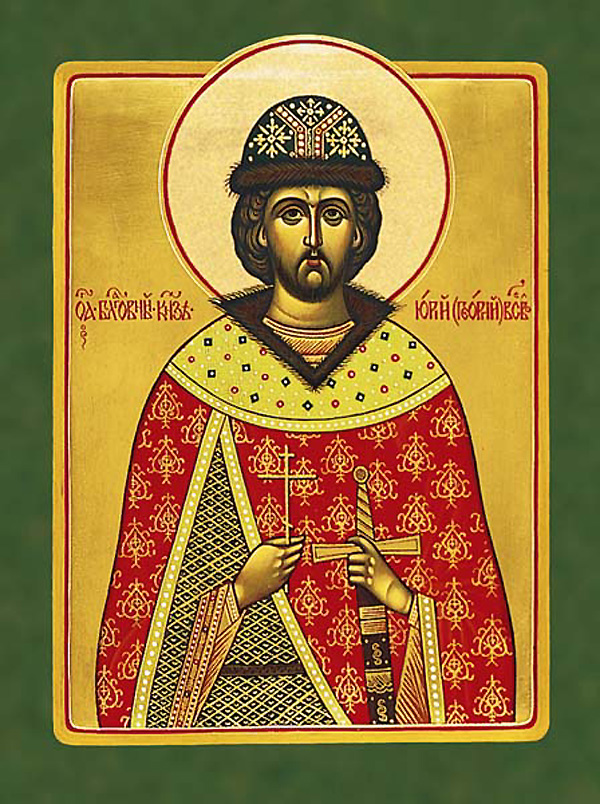
Holy Great Prince George was a son of Great Prince Vsevolod, nicknamed “Big Nest.” He was born in the year 1189, and he assumed the great princely throne of Vladimir in 1212. He was distinguished for his military valor and his piety. In the year 1237 the Tatar (Mongol) Horde of Batu descended upon the Russian land. Saint George was compelled to leave the capital city in charge of his sons, and went north to meet up with the other princes.
On March 4, 1238 the Battle at the River Sita was fought, in which the Tatars destroyed the small but valiant company of the Great Prince. The saint himself fell in this fight, and Bishop Cyril buried his body at the Rostov cathedral. Two years later, it was transferred to Vladimir’s Dormition cathedral with great solemnity.
The Church glorification of the saint occurred in 1645.
Venerable Cyril the Wonderworker, Abbot of Novoezersk, Novgorod

Saint Cyril of New Lake was born into a pious family. The Lord marked him as one of the chosen even before he was born. Cyril’s mother was praying in church during the Divine Liturgy, and the infant in her womb cried out, “Holy, Holy, Holy, Lord of Sabaoth!”
From the time of his childhood the saint was fond of solitude and prayer, and he dreamt of monastic life. At fifteen years of age Cyril secretly left his parental home, intending to enter the Pskov Caves monastery. He did not know the way to the monastery, and took nothing from home for the journey. He went his way, putting all his trust in the Lord and His All-Pure Mother. Twenty versts from the city the youth met a magnificent monastic Elder, who led him to the monastery. As he left, he blessed him with the words, “May God bless you, my child, and grant you the angelic schema, and may you be a chosen vessel of the Divine Spirit.” Having said this, the Elder became invisible. The boy realized that this had been a messenger from God, and he gave thanks to the Lord.
The igumen Saint Cornelius (February 20) saw with his clairvoyant eye the grace manifest in the young man. He provided him with much guidance and tonsured him into the monastic schema with the name Cyril. The fifteen-year-old monk astonished the brethren with his efforts. He emaciated the flesh through fasting and prayer, and zealously fulfilled obediences. Day and night he was ready to study the Word of God. Even then he thought to end his days in solitude in the wilderness.
The boy’s parents mourned him as one dead, but once an Elder of the monastery of Saint Cornelius came to them and told them about their son and his life at the monastery. The joyful news confirmed in Cyril’s mother her love for God. She spoke with her husband about leaving to the monastery her portion of the inheritance, then left the world and became a nun with the name Elena (Helen). She died in peace a short time later.
The saint’s father came to the monastery, and Igumen Cornelius told Cyril to meet with him. The saint was troubled, but not daring to disobey the igumen, he fell down at his father’s feet, imploring forgiveness for secretly leaving home. The father forgave his son, and he himself remained at the monastery. Saint Cornelius tonsured him into monasticism with the name Barsanuphius, and gave him to his son for instruction.
Three years later, he peacefully fell asleep in the Lord. His son continued to toil more fervently for the Lord, disdaining his own will, and in was obedient not only to the igumen, but also to the brethren. He thirsted to go about all the Russian land, venerating its holy shrines and to find for himself a wilderness place for a life of silence.
With the blessing of Saint Cornelius, Saint Cyril left the monastery in which he had grown strong spiritually, and he went to the coastal regions, roaming through the forests and the wild places, eating tree roots and berries. The saint spent about twenty years in this difficult exploit of wanderer, and he went to the outskirts of Moscow, Novgorod and Pskov, but he never entered any house nor did he accept alms. He wandered about during the day, and spent his nights at prayer on church porches, and he attended the church services.
Once while at prayer, Saint Cyril saw a heavenly light indicating the direction where he should found a monastery. He set off on his way at once, and having reached the Tikhvin monastery, he spent three days and three nights there in ceaseless prayer to the Most Holy Theotokos. The Mother of God appeared to him in a dream. Showing Her approval of him, She said, “My servant Cyril, pleaser of the Most Holy Trinity, go to the Eastern region of White Lake, and the Lord My Son will show you the place of rest for your old age.”
The saint proceeded to White Lake, weeping copious tears at the miraculous vision. On the lake he saw a small island, from which a pillar of fire rose up to the sky. There, beneath a centuries-old spruce tree, Saint Cyril built a hut, and then set up two cells: one for himself, the other for future brethren. The hermit also constructed two small churches, one in honor of the Resurrection of Christ and the other in honor of the Mother of God Hodēgḗtria. He underwent many temptations from invisible enemies, and from idlers roving about, but he overcame everything by brave endurance and constant prayer. News of his holy life spread everywhere, and brethren gathered around him.
There were many instances of healing through his prayers, and the Lord also granted His saint the gift of foresight. Sensing his impending end, Saint Cyril summoned the brethren. With tears of humility the saint instructed his spiritual children one last time, until his voice gave out. For a long time then he was silent, but suddenly he cried out with loud sobbing, “I go to the Lord unto life eternal, but I entrust you to God the Word and His Grace, bestowing an inheritance and sanctification upon all. May it help you. But I beseech you, do not become lax in fasting and prayers, guard yourself from the snares of the Enemy, and the Lord in His ineffable mercy will not condemn your humility.”
Having said this, the saint gave a final kiss to the brethren, received the Holy Mysteries, signed himself with the Sign of the Cross, and with the words “Glory to God for everything!” he gave up his pure soul to the Lord on February 4, 1532.
Venerable Abraham and Coprius, of Pechenga
Saints Abraham and Coprius of Pechenga in 1492 founded the Savior wilderness monastery at the River Pechenga, in Gryazovetsk district, 21 versts from Vologda. It required great work to bring in the necessities to the wilderness spot, in order to build the monastery and set everything in proper order. The blessed toilers did not spare themselves, zealously living in asceticism until their death.
Martyr Jadorus
Saint Jadorus suffered martyrdom with Saint Isidore (not Isidore of Pelusium) in the reign of Decius (249-251).
Hieromartyr Abramius, Bishop of Arbela in Assyria

The Hieromartyr Abramius, Bishop of Arbela, suffered during a persecution against Christians in Persia under the emperor Sapor II. When they demanded that the saint renounce Christ and worship the sun, he answered, “How foolish to forsake the Creator and instead worship creatures! Isn’t the sun just a creation of my God?”
After this, they fiercely beat and tortured him. Saint Abramius prayed during torture, echoing the words of the Savior: “Lord, do not count this sin against them, for they know not what they do!” The hieromartyr was beheaded by the sword in the village of Felman.
Venerable Nicholas the Confessor, Abbot of Studion

Saint Nicholas the Confessor, Igumen of the Studion Monastery, lived during the ninth century. He was born on the island of Crete in the village of Kedonia into a Christian family. When he was ten, his parents sent him to Constantinople to his uncle, Saint Theophanes (October 11), who was a monk at the Studion monastery. With the approval of Saint Theodore (November 11), the head of the Studion monastery, the boy was enrolled in the monastery school. When he finished school at sixteen years of age, he was tonsured a monk. After several years, he was ordained a priest.
During this time there was a fierce persecution, initiated by the Byzantine emperor Leo the Armenian (813-820), against those who venerated the holy icons. Saint Nicholas and Saint Theodore the Studite were repeatedly locked up in prison, tortured in various ways, and humiliated. However, they zealously continued to defend Orthodoxy.
Under the holy Empress Theodora (February 11), who ruled the realm while her son Michael was still a minor, icon veneration was restored, and a time of relative peace followed. Saint Nicholas returned to the Studite monastery and was chosen its head. But this calm did not last very long.
The Empress Theodora was removed from the throne, and the emperor’s uncle, Bardas, a man who defiled himself by open cohabitation with his son’s wife, came to power. The attempts of Patriarch Ignatius (October 23) to restrain the impiety of Bardas proved unsuccessful. On the contrary, he was deposed from the patriarchal throne and sent into exile.
Unwilling to witness the triumph of iniquity, Saint Nicholas left Constantinople. He spent seven years at various monasteries. Later on, he returned as a prisoner to the Studite monastery, where he spent two years imprisoned, until the death of the emperor Michael (855-867) and Bardas. When the emperor Basil I the Macedonian (867-886) ascended the throne, Saint Nicholas was set free, and again became igumen on the orders of the emperor. Because of his life as a confessor and ascetic he received from God the gift of healing, which continued even after his repose in the year 868.
Saint Evagrisi, disciple of Saint Shio

Saint Evagrisi was born to God-fearing and pious parents who read the Holy Scriptures to him from the earliest years of his childhood. When he reached manhood, Evagrisi became ruler of Tsikhedidi.
One day Evagrisi went hunting in the Sarkineti Mountains where Shio of Mgvime had settled. While he was hunting, his companions dispersed in various directions, and he was left alone to survey his surroundings. There he beheld a bird, resembling a dove, on its way to bring food to Fr. Shio, and noted the place where it landed.
The next day he located the hermit’s cave dwelling.
Astonished at Fr. Shio’s strict asceticism, Saint Evagrisi was filled with holy envy, having a desire to emulate the hermit, and he told him, “God is truly alive. I will not leave you, I will not go back.” Saint Shio advised him to be wary of such an impulsive decision, since it would be quite difficult for a man who had grown up in luxury to suddenly begin a new life in the wilderness. But Evagrisi answered him firmly, “Even if it means I must die here with you today, I will not depart from this place.”
In order to test his faith, Saint Shio entrusted Evagrisi with his staff and instructed him, saying, “Put my staff in the Mtkvari River; it will part the water and clear a path for you to cross. Secure your home and return to me. On your return when you reach the Mtkvari, use my staff again to clear a path for yourself. If it fails, then continue on your way as before. That would mean that it is not God’s will to fulfill your desire.”
Evagrisi obediently took Saint Shio’s staff and touched it to the water of the Mtkvari. The river parted, and he crossed confidently to the other side.
Having returned to the palace, Evagrisi distributed all his possessions to the poor, secured his home, and set off again to find Fr. Shio. He performed the same miracle on his return: the river parted in two, and the faithful Evagrisi passed through.
Fr. Shio tonsured Evagrisi into the monastic life, and the former ruler settled near the holy father’s cave. There he learned to be patient and watchful and how to pray, while acquiring other virtues as fruits of his ascetic labors.
Saint Shio anticipated that the number of monks in the wilderness would multiply, and he built a church for them in a place that God had revealed. The great gifts of the holy fathers were soon made known, and many pilgrims journeyed to the Sarkineti Mountains to receive their blessings. When King Parsman heard, belatedly, that his beloved army chief had been tonsured a monk, he became sorrowful and personally traveled to Saint Shio’s wilderness. His hope was to bring Evagrisi back into the world, but the blessed father responded with monastic composure: “O King! Why are you disturbing me, a man born to serve God, by asking me to become like a dog who returns to his own vomit (c.f. Prov. 26:11)?”
The news of Saint Shio, Evagrisi, and the other holy strugglers spread throughout Georgia, and many laymen were inspired to enter the monastic life.
After many years Saint Shio grew old, and he gathered the brotherhood of monks around him. “You must choose one from among you to lead this community. From now on I will labor in the well that I have prepared for my grave,” he told them. The brothers were exceedingly sorrowful at having to part with their beloved teacher, and in vain they pleaded with him to remain at the monastery. At last they asked Fr. Shio to appoint a successor, and he chose Evagrisi as the monastery’s next abbot.
The humble, gracious Evagrisi objected to this appointment, considering himself unfit to fulfill such a difficult responsibility. He begged Saint Shio to reconsider his decision, but the elder simply responded, “If you consent to our will, you will receive a joyous reward from God: when He returns in His glory, He will repay you for your obedience.”
At last Saint Evagrisi accepted his teacher’s counsel, and he directed the monastery’s activity with the help of God from that day forward.
Daily Readings for Thursday, February 03, 2022
AFTERFEAST OF THE PRESENTATION OF OUR LORD AND SAVIOR IN THE TEMPLE
NO FAST
Afterfeast of the Presentation of Our Lord and Savior in the Temple, The Synaxis of the Holy and Righteous Symeon the God-Receiver and the Holy Prophetess Anna, Stamatios, John, & Nicholas, New Martyrs of Spetses, Synaxis of the Most Holy Theotokos , Nicholas, Archbishop & Enlightener of Japan, Ansgar of Hamburg-Bremen, Werburga
ST. PAUL’S LETTER TO THE HEBREWS 9:11-14
BRETHREN, when Christ appeared as a high priest of the good things that have come, then through the greater and more perfect tent (not made with hands, that is, not of this creation) he entered once for all into the Holy Place, taking not the blood of goats and calves but his own blood, thus securing an eternal redemption. For if the sprinkling of defiled persons with the blood of goats and bulls and with the ashes of a heifer sanctifies for the purification of the flesh, how much more shall the blood of Christ, who through the eternal Spirit offered himself without blemish to God, purify your conscience from dead works to serve the living God.
LUKE 2:25-38
At that time, there was a man in Jerusalem, whose name was Symeon and this man was righteous and devout, looking for the consolation of Israel, and the Holy Spirit was upon him. And it had been revealed to him by the Holy Spirit that he should not see death before he had seen the Lord's Christ. And inspired by the Spirit he came into the temple; and when the parents brought in the child Jesus, to do for him according to the custom of the law, he took him up in his arms and blessed God and said, "Lord, now let your servant depart in peace, according to your word; for my eyes have seen your salvation which you have prepared in the presence of all peoples, a light for revelation to the Gentiles, and for glory to your people Israel." And his father and his mother marveled at what was said about him; and Symeon blessed them and said to Mary his mother, "Behold, this child is set for the fall and rising of many in Israel, and for a sign that is spoken against (and a sword will pierce through your own soul also), that thoughts out of many hearts may be revealed." And there was a prophetess, Anna, the daughter of Phanuel, of the tribe of Asher; she was of a great age, having lived with her husband seven years from her virginity, and as a widow till she was eighty-four. She did not depart from the temple, worshiping with fasting and prayer night and day. And coming up at that very hour she gave thanks to God, and spoke of him to all who were looking for the redemption of Jerusalem.
Afterfeast of the Meeting of our Lord in the Temple

On this first day of the Afterfeast of the Meeting of the Lord, the Church commemorates the righteous Simeon and Anna the prophetess. The following words are ascribed to Christ in Ode 9 of the Canon: “I am not held by the Elder; it is I Who hold him, for he asks Me for forgiveness.”
Holy, Righteous Simeon the God-Receiver

Righteous Simeon the God-Receiver was, according to the testimony of the holy Evangelist Luke, a just and devout man waiting for the consolation of Israel, and the Holy Spirit was upon him (Luke 2:25). God promised him that he would not die until the promised Messiah, Christ the Lord, came into the world.
Ancient historians tell us that the Egyptian pharaoh Ptolemy II Philadelphus (285-247 B.C.) wished to include texts of Holy Scripture in the famous Library at Alexandria. He invited scholars from Jerusalem, and the Sanhedrin sent their wise men. The Righteous Simeon was one of the seventy scholars who came to Alexandria to translate the Holy Scriptures into Greek. The completed work was called “The Septuagint,” and is the version of the Old Testament used by the Orthodox Church.
Saint Simeon was translating a book of the Prophet Isaiah, and read the words: “Behold, a virgin shall conceive in the womb, and shall bring forth a Son” (Is 7:14). He thought that “virgin” was inaccurate, and he wanted to correct the text to read “woman.” At that moment an angel appeared to him and held back his hand saying, “You shall see these words fulfilled. You shall not die until you behold Christ the Lord born of a pure and spotless Virgin.”
From this day, Saint Simeon lived in expectation of the Promised Messiah. One day, the righteous Elder received a revelation from the Holy Spirit, and came to the Temple. It was on the very day (the fortieth after the Birth of Christ) when the All-Pure Virgin Mary and Saint Joseph had come to the Temple in order to perform the ritual prescribed by Jewish Law.
When Saint Simeon beheld their arrival, the Holy Spirit revealed to him that the divine Child held by the All-Pure Virgin Mary was the Promised Messiah, the Savior of the world. The Elder took the Child in his arms and said, “Lord, now lettest Thou Thy servant depart in peace, according to Thy word, for mine eyes have seen Thy salvation, which Thou hast prepared before the face of all people, a light to enlighten the Gentiles, and the glory of Thy people Israel” (Luke 2:29-32).
There is a Christian epigram (Number 46) in “The Greek Anthology” which is addressed to Saint Simeon. It tells the righteous Elder to receive the Child Who was born before Adam, and Who will deliver Simeon from this life and bring him to eternal life. A similar idea is expressed in the Aposticha (Slavic use) for the Forefeast of the Nativity of the Lord (December 24). There the Mother of God refers to her Son as “older than ancient Adam.”
Simeon blessed the All-Pure Virgin and Saint Joseph, and turning to the Mother of God he said, “Behold, this child is set for the fall and rising again of many in Israel, and for a sign which shall be spoken against. Yea, a sword shall pierce through your own soul also, that the thoughts of many hearts may be revealed” (Luke 2:34-35).
The holy Evangelist continues: “And there was one Anna, a prophetess, the daughter of Phanuel of the tribe of Aser. She was of a great age, and had lived with a husband for seven years from her virginity; and she was a widow of about eighty-four years, who did not leave the temple, but served God with fastings and prayers night and day. And coming at that very hour, also gave thanks to the Lord, and spoke of Him to all those who looked for redemption at Jerusalem” (Luke 2:36-38).
The holy righteous Simeon the God-Receiver died at a great age (Tradition says he was 360). His holy relics were transferred to Constantinople in the sixth century. His grave was seen by the Russian pilgrim Saint Anthony, the future Archbishop of Novgorod (October 8) in 1200.
Holy, Righteous Anna the Prophetess

According to Saint Luke’s Gospel, “And there was one Anna, a prophetess, the daughter of Phanuel of the tribe of Aser. She was of a great age, and had lived with a husband for seven years from her virginity; and she was a widow of about eighty-four years, who did not leave the temple, but served God with fastings and prayers night and day. And coming at that very hour, also gave thanks to the Lord, and spoke of Him to all those who looked for redemption at Jerusalem” (Luke 2:36-38).
Right-Believing Prince Roman of Uglich

The Holy Right-Believing Prince Roman of Uglich, son of Prince Vladimir and Princess Photina of Uglich, and nephew of Saint Basil (Basilko) of Rostov (March 4), was born on October 1, 1235. Upon the death of his father (in 1248) and his older brother Andrew (in 1261), Saint Roman, at the age of twenty-six, took upon himself the governance of Uglich and became a father to his subjects.
He established a poor-house and took in the destitute, who came to him from everywhere. In the principality he built fifteen more churches. Saint Roman was present every day at the divine services, and he often conversed with pious monks.
After the death of his wife in 1280, he devoted himself entirely to ascetic exploits of fasting, prayer and works of righteousness. He built the city Romanov (now Tutaev) on the high bank of the Volga. The holy prince died peacefully on February 3, 1285 and was buried in the Church of the Transfiguration in Uglich.
In 1486, the relics of Saint Roman were found to be incorrupt and were transferred into the new cathedral Church of the Transfiguration. In the year 1595 with the blessing of Patriarch Job in consequence of the fame concerning miracles the relics were witnessed to by the Metropolitan (later Patriarch) Saint Hermogenes (February 17), and Saint Roman was numbered among the saints. In 1609, the holy relics were burned along with the church during an invasion by the Poles.
Prophet Azariah
The Holy Prophet Azariah1 was son of Oded (or Addo) and lived during the reign of King Asa (910-870 B.C. See 2 Chronicles 15:1) who was the son and successor of Abijah in the kingdom of Judah. Azariah came from the land of Sembatha and urged the people not to worship false “gods,” but to remain faithful to the Covenant with the Lord.
Asa worshiped the one true God, and removed the altars of foreign “gods” from his land, tearing down the pillars and cutting down their sacred groves. He told the people to seek earnestly the God of their fathers, and to obey the Law and the Commandments. After removing the pagan altars and idols from all the cities of Judah he commanded his people to fortify their cities with walls and towers.
King Asa had 300,000 warriors in Judah, and 280,000 mighty warriors in the land of Benjamin. According to the narratives of 2 Chronicles chapters 14 and 15, Zerah the Ethiopian2 went out against Judah with a million men.
Asa prayed fervently to God, asking that he might prevail, even against such overwhelming odds. The Lord smote the Ethiopians and Asa’s army pursued them and crushed them. He destroyed their towns and pillaged their cities, and then he returned to Jerusalem.
After King Asa had won the victory, the Spirit of the Lord came upon Azariah. He went out to meet Asa and said, “Hear me, King Asa, and all the people of the tribes of Judah and Benjamin. The Lord will be with you as long as you are with Him, worshiping His name and observing His commandments. When you seek Him you will find Him; but if you forsake Him, He will also forsake you.” These words ought to be esteemed by every State and by all people.
The Prophet Azariah reposed in peace and was buried in his field. In iconography he is depicted as an old man with curly hair. The name Azariah means “whom God helps.”
1 It is said that Azariah was actually son of Ananias (Tobit 5:12); perhaps an error for Zachariah the son of Addo (1 Esdras 6:1).
2 Zerah is a Hebrew name, and is not Ethiopian or Egyptian, as some have said.
Martyrs Papias, Diodorus and Claudianus, at Perge in Pamphylia
Saint Papias was martyred with Saints Claudianus and Diodorus at Perge, Pamphylia in 250.
Saint Savva of Ioannina
It is not known where Saint Savva was born. He lived a life of asceticism in the Holy Monastery of the Honorable Forerunner on an island in the lake of Ioannina around the middle of the XV century. He was the Spiritual Father of Saints Nektarios (+ 1550) and Theophanes (+ 1544), who were descended from the distinguished Apsaras family of the Byzantine Empire. They are commemorated jointly on May 17.
Saint Savva was the son of an aristocratic family, and from an early age he loved the poverty of Jesus Christ. Until his last breath, he lived as a humble and poor hermit. No one ever saw him angry, judgmental, or as a person who remembered wrongs. His heart overflowed with humility, concerning which he himself said: “Humility is the solid and indestructible cornerstone upon which the spiritual life is built.”
He was a hechycast, and his ascetical life was very strict. He prayed every night until morning. His food was plain, and he ate very little. No meat, fish, or cheese ever appeared on his table, and he never poured a drop of oil on his food.
Saint Savva reposed peacefully in 1505. When he delivered his soul to the Lord, an inexpressible fragrance arose from the tabernacle of his body. The saint was buried in the monastery of Honorable Forerunner. A holy relic of the saint is kept and revered in the Roussanou Monastery of the Transfiguration at Meteora.
Martyr Adrian at Caesarea, Cappadocia
Saint Adrian of Baneas of Caesarea in Cappadocia. suffered martyrdom under Governor Firmilianus. He was put to death by the sword, but entered into eternal life.
Martyr Eubulus at Caesarea, Cappadocia
Saint Eubulus, like Saint Adrian, was from Baneas, in Caesarea of Cappadocia. He went to Caesarea to visit Christians in prison, and was arrested by Governor Firmilianus. He was thrown to the wild beasts, and thereby received the crown of martyrdom.
Martyr Blaise of Caesarea, in Cappadocia

Saint Blaise of Caesarea lived in the third century. He was from Caesarea in Cappadocia (Asia Minor) and was a shepherd.
When a persecution against Christians began, Saint Blaise surrendered himself into the hands of the torturers. They subjected him to torture, and beat him with leather thongs, but the Lord healed his wounds. They then threw Blaise into a cauldron of boiling water, but he remained there unharmed. The pagan soldiers, seeing this miracle, came to believe in Christ.
The governor, wishing to show that the martyr remained unharmed because the water had cooled, jumped into the cauldron and died.
Having brought many to faith in Christ, Saint Blaise peacefully surrendered his soul to God. They thrust the saint’s shepherd’s staff into the ground, and it grew up into a large tree, which covered with its branches a church built over his relics.
Saint Simeon, Bishop of Polotsk and Tver
Saint Simeon, Bishop of Tver was descended from the Polotsk princes. He was the seventh bishop of Polotsk and the first bishop of the Tver diocese. The saint’s cathedra was first at Polotsk, but hostile attacks and conflicts with the Lithuanian princes, and the murder of the Polotsk prince (his relative) in 1263, compelled him to move to Tver (Prince Yaroslav Yaroslavich had become Great Prince of Russia, and he chose Tver as his ruling city).
Saint Simeon was well-disposed and kind to the down-trodden and destitute, attentive to the monastic and priestly orders, and a zealous defender of truth.
The Nikonov Chronicle relates that this holy bishop was “knowledgeable about medicine, and well versed in the books of Holy Scripture; he was a teacher, a virtuous man, concerned for the needy, widows and orphans, a defender of the down-trodden and deliverer of the oppressed.”
History preserves for us a conversation of Saint Simeon with Prince Constantine of Polotsk who, wishing to make a jest about his court, asked the saint at supper: “Where shall the courts be in that world?” Simeon answered, “Those courts shall also be where the prince is.”
The prince did not care for this, and he said, “A court might judge unjustly, and take bribes, or torture people, and is it I who do the harm?” The bishop explained to him, “If a prince is good and God-fearing, and is concerned for the people, and loves truth and he appoints good, God-fearing, intelligent and truth-loving men to his council, that prince shall be in Paradise and his court with him. If, however, a prince is without the fear of God, and is not concerned for Christians and does not think of orphans and widows, and if he appoints wicked counselors who lack integrity in order to bring him money, that prince shall be in Hell and his court with him.”
Saint Simeon died on February 3, 1289.
Saint Jacob, Archbishop of Serbia
No information available at this time.
Great Vespers – Wed 02/02/2022
Here is the live stream for Great Vespers – Wed 02/02/2022 If you need, here are instructions for accessing this content from your phone, tablet, computer, or TV.
Daily Readings for Wednesday, February 02, 2022
THE PRESENTATION OF OUR LORD AND SAVIOR IN THE TEMPLE
ABSTAIN FROM MEAT, DAIRY, EGGS
The Presentation of Our Lord and Savior in the Temple, Gabriel the New Martyr of Constantinople, Jordan the New Martyr, Agathadoros the Martyr of Cappadocia
ST. PAUL’S LETTER TO THE HEBREWS 7:7-17
BRETHREN, it is beyond dispute that the inferior is blessed by the superior. Here tithes are received by mortal men; there, by one whom it is testified that he lives. One might even say that Levi himself, who receives tithes, paid tithes through Abraham, for he was still in the loins of his ancestor when Melchizedek met him. Now if perfection had been attainable through the Levitical priesthood (for under it the people received the law), what further need would there have been for another priest to arise after the order of Melchizedek, rather than one named after the order of Aaron? For when there is a change in the priesthood, there is necessarily a change in the law as well. For the one of whom these things are spoken belonged to another tribe, from which no one has ever served at the altar. For it is evident that our Lord was descended from Judah, and in connection with that tribe Moses said nothing about priests. This becomes even more evident when another priest arises in the likeness of Melchizedek, who has become a priest, not according to a legal requirement concerning bodily descent but by the power of an indestructible life. For it is witnessed of him, ‘Thou art a priest for ever, after the order of Melchizedek.’
LUKE 2:22-40
At that time, the parents brought the child Jesus up to Jerusalem to present him to the Lord (as it is written in the law of the Lord, "Every male that opens the womb shall be called holy to the Lord") and to offer a sacrifice according to what is said in the law of the Lord, "a pair of turtle doves, or two young pigeons." Now there was a man in Jerusalem, whose name was Symeon, and this man was righteous and devout, looking for the consolation of Israel, and the Holy Spirit was upon him. And it had been revealed to him by the Holy Spirit that he should not see death before he had seen the Lord's Christ. And inspired by the Spirit he came into the temple; and when the parents brought in the child Jesus, to do for him according to the custom of the law, he took him up in his arms and blessed God and said,
Lord, now let your servant depart in peace, according to your word; for my eyes have seen your salvation which you have prepared in the presence of all peoples, a light for revelation to the Gentiles, and for glory to your people Israel.
And his father and his mother marveled at what was said about him; and Symeon blessed them and said to Mary his mother, "Behold, this child is set for the fall and rising of many in Israel, and for a sign that is spoken against (and a sword will pierce through your own soul also), that thoughts of many hearts may be revealed." And there was a prophetess, Anna, the daughter of Phanuel, of the tribe of Asher; she was of a great age, having lived with her husband seven years from her virginity, and as a widow till she was eighty-four. She did not depart from the temple, worshiping with fasting and prayer night and day. And coming up at that very hour she gave thanks to God, and spoke of him to all who were looking for the redemption of Jerusalem. And when they had performed everything according to the law of the Lord, they returned into Galilee, to their own city, Nazareth. And the child grew and became strong, filled with wisdom; and the favor of God was upon him.
The Meeting of our Lord and Savior Jesus Christ in the Temple

The Meeting of our Lord God and Savior Jesus Christ is described in the third Gospel (Luke 2:22-40). Forty days after His birth the Divine Child was brought to the Temple at Jerusalem to be presented to the Lord. According to the Law of Moses (Lev. 12:2-8), a woman who gave birth to a male child was forbidden to enter the Temple for forty days. At the end of the time of her purification, the mother went to the Temple with the child, to offer a young lamb, two turtledoves, or pigeons to the Lord as a sacrifice. The Most Holy Virgin had no need of purification, since she had given birth to the Source of purity and sanctity. Out of humility, however, she fulfilled the requirements of the Law.
At this time the righteous Elder Simeon (February 3) was living in Jerusalem. It had been revealed to him that he would not die until he beheld the promised Messiah. By divine inspiration, Saint Simeon went to the Temple at the very moment when the Most Holy Theotokos and Saint Joseph had brought the Child Jesus to fulfill the Law.
Saint Simeon received the divine Child in his arms,1 and giving thanks to God, he spoke the words repeated by the Church each evening at Vespers: “Lord, now lettest Thou Thy servant depart in peace, according to Thy word, for mine eyes have seen Thy salvation, which Thou hast prepared before the face of all people, a light to enlighten the Gentiles, and the glory of Thy people Israel” (Luke 2:29-32). Saint Simeon said to the Most Holy Virgin: “Behold, this child is set for the fall and rising again of many in Israel, and for a sign which shall be spoken against. Yea, a sword shall pierce through your own soul also, that the thoughts of many hearts may be revealed” (Luke 2:34-35).
At the Temple was an 84-year-old widow, Saint Anna the Prophetess, the daughter of Phanuel (February 3), “who did not leave the temple, but served God with fasting and prayers night and day." She arrived just when Saint Simeon met the Divine Child. She also gave thanks to the Lord and spoke of Him to all those who were looking for redemption of Jerusalem” (Luke 2:38). In the icon of the Feast she holds a scroll which reads: “This Child has established Heaven and earth.”
Before Christ was born, the righteous men and women lived by faith in the promised Messiah, and awaited His coming. The Righteous Simeon and the Prophetess Anna, the last righteous persons of the Old Testament, were deemed worthy to meet Him in the Temple.
The Feast of the Meeting of the Lord is among the most ancient feasts of the Christian Church. We have sermons by the holy bishops Methodios of Patara (+ 312), Cyril of Jerusalem (+ 360), Gregory the Theologian (+ 389), Amphilokhios of Iconium (+ 394), Gregory of Nyssa (+ 400), and John Chrysostom (+ 407). Despite its early origin, this Feast was not celebrated so splendidly until the VI century.
In 528, during the reign of Justinian, an earthquake killed many people in Antioch. Other misfortunes followed this one. In 541 a terrible plague broke out in Constantinople, carrying off several thousand people each day. During this time of widespread suffering, a solemn prayer service (Litia) for deliverence from evils was celebrated on the Feast of the Meeting of the Lord, and the plague ceased. Giving thanks to God, the Church established a more solemn celebration of this Feast.
Church hymnographers have adorned this Feast with their hymns: Saint Andrew of Crete in the VII century; Saint Cosmas Bishop of Maium, Saint John of Damascus, and Saint Germanus Patriarch of Constantinople in the VIII century; and Saint Joseph, Archbishop of Thessaloniki in the IX century.
Today we also commemorate the Icon of the Most Holy Theotokos known as “the Softening of Evil Hearts” or “Simeon’s Prophecy.” The Mother of God is depicted without her Child, and seven swords piercing her breast: three from the left side, three from the right, and one from below.
A similar Icon, “Of the Seven Swords” (August 13) shows three swords on the left side and four from the right. The "Softening of Evil Hearts” Is also commemorated on August 13.
The Icon “Simeon’s Prophecy” symbolizes the fulfillment of the prophecy of the righteous Elder Simeon: “a sword shall pierce through your own soul” (Luke 2:35).
In Constantinople, the Emperors would celebrate the Feast Day at the Blakhernae church during the All-Night Vigil. This custom continued until the Fall of the Byzantine Empire.
1 For this reason, he is known as the God-Receiver (Θεοδόχος).
Great Vespers with Litia and Artoklasia – Tues 02/01/2022
Here is the live stream for Great Vespers with Litia and Artoklasia – Tues 02/01/2022 If you need, here are instructions for accessing this content from your phone, tablet, computer, or TV.
Daily Readings for Tuesday, February 01, 2022
TRYPHO THE MARTYR
NO FAST
Trypho the Martyr, Forefeast of the Presentation of Our Lord and Savior in the Temple, Perpetua & her Companions, Our Holy Father Basil, Archbishop of Thessolonica, Anastasios the New Martyr of Navplion, The Four Martyrs Andrianus, Polyeuktos, Plato and George who contested in Megara, Timothy the Confessor, Bridget of Ireland
ST. PAUL’S LETTER TO THE ROMANS 8:28-39
Brethren, we know that everything works for good with those who love God, who are called according to his purpose. For those whom he foreknew he also predestined to be conformed to the image of his Son, in order that he might be the first-born among many brethren. And those whom he predestined he also called; and those whom he called he also justified; and those whom he justified he also glorified.
What then shall we say to this? If God is for us, who is against us? He who did not spare his own Son but gave him up for us all, will he not also give us all things with him? Who shall bring any charge against God's elect? It is God who justifies; who is to condemn? It is Christ Jesus, who died, yes, who was raised from the dead, who is at the right hand of God, who indeed intercedes for us. Who shall separate us from the love of Christ? Shall tribulation, or distress, or persecution, or famine, or nakedness, or peril, or sword? As it is written, "For thy sake we are being killed all the day long; we are regarded as sheep to be slaughtered." No, in all these things we are more than conquerors through him who loved us. For I am sure that neither death, nor life, nor angels, nor principalities, nor things present, nor things to come, nor powers, nor height, nor depth, nor anything else in all creation, will be able to separate us from the love of God in Christ Jesus our Lord.
LUKE 10:19-21
The Lord said to his disciples, "Behold, I have given you authority to tread upon serpents and scorpions, and over all the power of the enemy; and nothing shall hurt you. Nevertheless do not rejoice in this, that the spirits are subject to you; but rejoice that your names are written in heaven." In that same hour he rejoiced in the Holy Spirit and said, "I thank you, Father, Lord of heaven and earth, that you have hidden these things from the wise and understanding and revealed them to babes; yes, Father, for such was your gracious will.
Forefeast of the Meeting of our Lord in the Temple
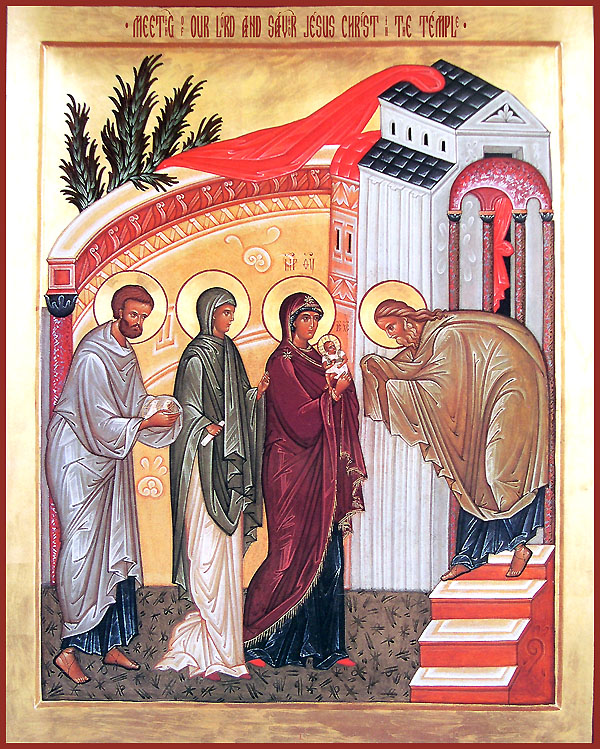
The Typikon should be consulted if the Forefeast falls on the Sunday of the Pharisee, the Publican, or Meatfare.
Because of the Forefeast of the Meeting of the Lord, the service to Saint Tryphon (February 1) may be moved to Compline or to another day, as the rector decides, unless the parish is dedicated to Saint Tryphon, or there is a particular devotion to him.
Martyr Tryphon of Lampsacus Near Apamea in Syria
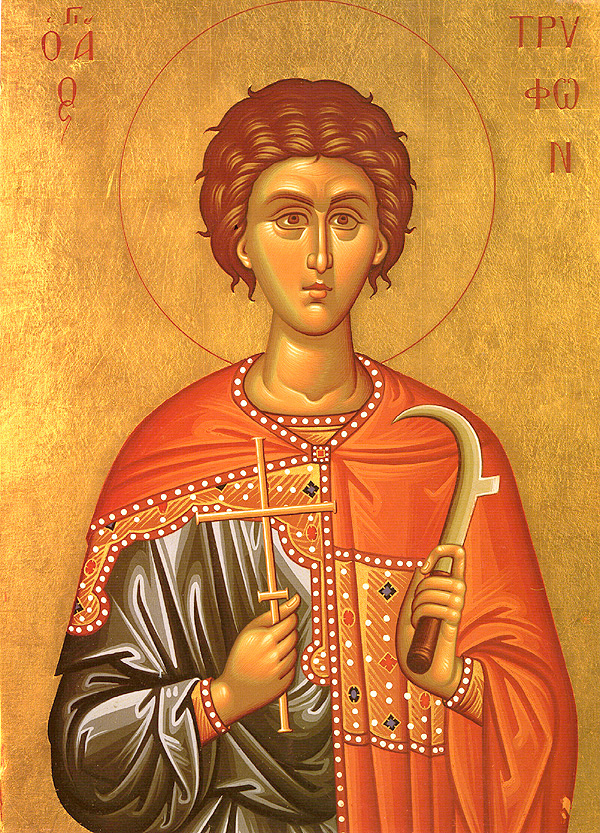
The Martyr Tryphon was born in Phrygia, one of the districts of Asia Minor, in the village of Lampsacus. From his early years the Lord granted him the power to cast out demons and to heal various maladies. He once saved the inhabitants of his native city from starvation. Saint Tryphon, by the power of his prayer, turned back a plague of locusts that were devouring the grain and devastating the fields.
Saint Tryphon gained particular fame by casting out an evil spirit from the daughter of the Roman emperor Gordian (238-244). Helping everyone in distress, he asked only one thing from them: faith in Jesus Christ, by Whose grace he healed them.
When the emperor Decius (249-251) assumed the imperial throne, he began a fierce persecution of Christians. Someone reported to the commander Aquilinus that Saint Tryphon was boldly preaching faith in Christ, and that he led many to Baptism. The saint was arrested and subjected to interrogation, during which he fearlessly confessed his faith.
He was subjected to harsh tortures: they beat him with clubs, raked his body with iron hooks, they scorched his flesh with fire, and led him through the city, after iron nails were hammered into his feet. Saint Tryphon bravely endured all the torments without complaint.
Finally, he was condemned to beheading with a sword. The holy martyr prayed before his execution, thanking God for strengthening him in his sufferings. He also asked the Lord to bless those who should call upon his name for help. Just as the soldiers raised the sword over the head of the holy martyr, he surrendered his soul into the hands of God. This event occurred in the city of Nicea in the year 250.
Christians wrapped the holy body of the martyr in a clean shroud and wanted to bury him in the city of Nicea, where he suffered, but Saint Tryphon in a vision commanded them to take his body to his native land to the village of Lampsacus. Later on, the relics of Saint Tryphon were transferred to Constantinople, and then to Rome.
In Russia, Saint Tryphon is regarded as the patron saint of birds. There is a story that when Tsar Ivan the Terrible was out hunting, his falconer carelessly allowed the Tsar’s favorite falcon to fly away. The Tsar ordered the falconer Tryphon Patrikeiev to find the bird within three days, or else he would be put to death. Tryphon searched all through the forest, but without luck.
On the third day, exhausted by long searching, he returned to Moscow to the place called Marinaya Grove. Overcome with weariness, he lay down to rest, fervently praying to his patron saint, the Martyr Tryphon, for help.
In a dream he saw a youth on a white horse, holding the Tsar’s falcon on his hand. The youth said, “Take the lost bird, go to the Tsar and do not grieve.” When he awakened, the falconer actually spotted the falcon on a pine tree. He took it to the Tsar and told him about the miraculous help he received from the holy Martyr Tryphon. Grateful to Saint Tryphon for saving his life, Tryphon Patrikeiev built a chapel on the spot where the saint appeared. Later on, he also built a church dedicated to the holy Martyr Tryphon in Moscow.
The holy martyr is greatly venerated in the Russian Orthodox Church as the heavenly protector of Moscow. Many Russian icons depict the saint holding a falcon on his arm.
Martyrs Perpetua, a woman of Carthage, and the Catechumens: Saturus, Revocatus, Saturninus, Secundulus and Felicitas
The Holy Martyrs Perpetua, Felicitas and those with them. Vibia Perpetua was from a patrician family, and lived in Carthage. She came to believe in Christ, and was baptized after her arrest as a Christian. A few days later, the twenty-two-year-old woman was taken to prison with her infant son. Arrested with her were her brother Saturus, the servants Felicitas, Revocatus, Saturninus and Secundulus, who were also catechumens.
Despite the exhortations of her father, who persistently appealed to her maternal feelings, the widowed Saint Perpetua refused to offer sacrifice to the pagan gods.
Before their execution, Saints Perpetua and Saturus had visions from God, which strengthened their souls. Saint Felicitas, who was eight months pregnant, gave birth to a baby girl while in prison. She rejoiced because now she would be permitted to die with her companions. There was a law forbidding the execution of pregnant women.
The martyrs were led from the prison into the amphitheatre. Saturninus and Revocatus had to face a leopard and a bear. Saints Perpetua and Felicitas were brought to the arena in nets, and they were pitted against a wild heifer. After being tossed to the ground by the heifer, the two women were led out of the arena. Saturus was bitten by a leopard, but did not die. The martyrs were then led to a certain spot to be killed by the sword. The young gladiator who was to execute Saint Perpetua was inexperienced and did not kill her with the first blow. She herself took his hand and guided it to her throat, and so she received the crown of martyrdom. This occurred in about the year 203.
The amphitheatre where these saints perished is located a few miles from the city of Tunis. In 1881, a room was discovered opposite the modern entrance into the arena. Some say this was a cell where the victims waited to be brought into the arena.
Venerable Peter the Hermit of Galatia Near Antioch, in Syria
Saint Peter of Galatia lived during the IV-V century, and came from the region of the Black Sea. From a young age was distinguished by his fervent piety and his determination to acquire spiritual treasures. When he was seven years old, he went to Galatia and then to Palestine, where his faith grew even stronger. During the second quarter of the IV century, He lived an ascetical life in the mountains, which had been glorified by so many great spiritual athletes and teachers of Christianity.
Saint Peter was able to perform miracles, just as Christ did, so that even his garments had miraculous power, just as the Apostle Paul's handkerchiefs and aprons did (Acts 29:22). It did not take long for his spiritual fruits to be noticed, and many people came to him, reaping valuable advice and solace for the wounds of their souls, which were very difficult to cure.
Because of his great virtue, he also received from God the gift (charism, χάρισμα) of having demons subject to him. He delivered a possessed man named Daniel from the demons, whom he instructed in asceticism, and then accepted him as his co-struggler.
Later, he healed the mother of the historian Bishop Theodoret of Cyrrhus, a devout woman who suffered from an incurable disease in one eye. Hearing about Saint Peter's gift of working miracles, she hoped that he would heal her of this terrible affliction. Theodoret's mother was only twenty-three years old when she went to see him. She was very beautiful, and she wore a lot of make-up, an expensive silk dress, and gold bracelets on her arms, as well as gold rings in her ears. When the holy monk looked at her, he discerned some good soil (Matthew 13:8) in her for a word of profitable instruction, but decided that first he would cure her fondness for fine clothing.
He said, "My child, just as a painter who does not paint according to the rules of his art, but as he pleases, insults the art of painting, so do those who cover their faces with red, white, or black paint, offend the Creator; for in this way they seem to accuse Him of imperfection in His creation, but He has the power to do as He wishes. As the Prophet-King David wrote: 'All that the Lord willed, He created' (Psalm 134/135:6). He gives to everyone everything that is useful, and nothing which is harmful. Do not disfigure the divine image created by God."
The monk's words fell on fertile ground and produced good fruit. The young woman fell at the ascetic's feet and begged him to pray for her and to heal her. Saint Peter replied, "If you have firm faith in God's help, you will be cured of your illness; for God is always ready to grant the petitions of a believing soul."
Then he placed his hand on the afflicted eye and, making the Sign of the Cross, he healed her.
The Saint once blinded a city magistrate, who wanted to rape a certain nun, thereby preventing him from carrying out his unholy desire. Saint Peter performed many other great miracles, as Bishop Theodoret (who wrote his Life) relates.
After living in a God-pleasing manner for ninety-nine years, Saint Peter surrendered his soul to God and received the reward for his spiritual and ascetical labors in the year 429 at the age of 95 (or 99, according to other sources).
In Greek usage, Saint Peter is commemorated on November 25. He should not be confused with the other Saint Peter of Galatia, who lived during the IX century, and is commemorated on October 9.
Venerable Vendemianus the Hermit of Bithynia
Saint Vendemianus (Bendemianus) was born in Myzia. In his youth he was a disciple of Saint Auxentius, one of the Fathers of the Fourth Ecumenical Council. He went to the monastery founded by Saint Auxentius (February 14) on Mount Oxia, not far from Chalcedon (Asia Minor), where he lived in asceticism for forty-two years at the cell of his teacher in the crevice of a cliff. He spent his life in fasting and prayer, and was tempted by demons. Because of his holy life and spiritual struggles, the saint was granted the gift of healing. He died around the year 512.
Venerable Brigid (Bridget) of Ireland
.jpg)
Saint Brigid, “the Mary of the Gael,” was born around 450 in Faughart, about two miles from Dundalk in County Louth. According to Tradition, her father was a pagan named Dubthach, and her mother was Brocessa (Broiseach), one of his slaves.
Even as a child, she was known for her compassion for the poor. She would give away food, clothing, and even her father’s possessions to the poor. One day he took Brigid to the king’s court, leaving her outside to wait for him. He asked the king to buy his daughter from him, since her excessive generosity made her too expensive for him to keep. The king asked to see the girl, so Dubthach led him outside. They were just in time to see her give away her father’s sword to a beggar. This sword had been presented to Dubthach by the king, who said, “I cannot buy a girl who holds us so cheap.”
Saint Brigid received monastic tonsure at the hands of Saint Mael of Ardagh (February 6). Soon after this, she established a monastery on land given to her by the King of Leinster. The land was called Cill Dara (Kildare), or “the church of the oak.” This was the beginning of women’s cenobitic monasticism in Ireland.
The miracles performed by Saint Brigid are too numerous to relate here, but perhaps one story will suffice. One evening the holy abbess was sitting with the blind nun Dara. From sunset to sunrise they spoke of the joys of the Kingdom of Heaven, and of the love of Christ, losing all track of time. Saint Brigid was struck by the beauty of the earth and sky in the morning light. Realizing that Sister Dara was unable to appreciate this beauty, she became very sad. Then she prayed and made the Sign of the Cross over Dara’s eyes. All at once, the blind nun’s eyes were opened and she saw the sun in the east, and the trees and flowers sparkling with dew. She looked for a while, then turned to Saint Brigid and said, “Close my eyes again, dear Mother, for when the world is visible to the eyes, then God is seen less clearly by the soul.” Saint Brigid prayed again, and Dara became blind once more.
Saint Brigid fell asleep in the Lord in the year 523 after receiving Holy Communion from Saint Ninnidh of Inismacsaint (January 18). She was buried at Kildare, but her relics were transferred to Downpatrick during the Viking invasions. It is believed that she was buried in the same grave with Saint Patrick (March 17) and Saint Columba of Iona (June 9).
Late in the thirteenth century, her head was brought to Portugal by three Irish knights on their way to fight in the Holy Land. They left this holy relic in the parish church of Lumiar, about three miles from Lisbon. Portions of the relic were brought back to Ireland in 1929 and placed in a new church of Saint Brigid in Dublin.
The relics of Saint Brigid in Ireland were destroyed in the sixteenth century by Lord Grey during the reign of Henry VIII.
The tradition of making Saint Brigid’s crosses from rushes and hanging them in the home is still followed in Ireland, where devotion to her is still strong. She is also venerated in northern Italy, France, and Wales.
Saint Tryphon, Bishop of Rostov
Saint Tryphon, Bishop of Rostov was head of Moscow’s Novospassky (New Savior) monastery and was confessor to Great Prince Basil the Dark. On May 23, 1462 he was consecrated as Bishop of Rostov by Metropolitan Theodosius of Moscow.
In 1466, he retired to the Savior monastery in Yaroslavl, where he died on December 30, 1468 (certain local documents indicate the year 1466). His commemoration was transferred to February 1, it seems, so that he would be honored with his namesake Saint Tryphon of Lampsacus. Saint Prochorus was also buried at this monastery, as the schemamonk Tryphon, also a Bishop of Rostov, who died in 1328 (September 7).
Icon of the Mother of God “Socola”
The Socola Icon of the Mother of God was in the church of the Transfiguration in the Orthodox Theological Seminary at the Socola Monastery in Romania. In February 1854, it became famous for the remarkable miracle of shedding tears.
After the Divine Liturgy on February 1, 1854, a frightened member of the clerical staff went to Hieromonk Isaiah, the ecclesiarch, and said that he had seen tears on the Icon of the Most Holy Theotokos. Several of those serving ran to the church. There they all witnessed tears running down from the eyes of the Mother of God.
Bishop Philaret Skriban, the rector of the seminary, removed the Icon of the Mother of God from its frame, and carefully examined it. Believing that it may have been sprinkled with holy water for the Feast of Saint Tryphon, the bishop wiped away the tears with a towel, and put the Icon back in its place. Then, after ordering everyone to leave the church, he looked all around the church, and then locked it.
Several hours later, the seminary professors and students went into the church with the rector for Vespers, and all were amazed to see the same miraculous flow of tears from the eyes of the Theotokos depicted on the Icon. Immediately, Bishop Philaret served a Moleben and Akathist to the Mother of God. Soon, all of Romania learned of this miraculous event, and people from all parts of the country began to arrive at the Socola Monastery to venerate the newly-revealed Weeping Icon of the Theotokos. The tears sometimes flowed every day; and sometimes they appeared two, three, or four days apart. As a result, many people were able to see the actual miracle of weeping first hand, and bear witness to it. Those who did not see the actual miracle were convinced that a genuine miracle had taken place because they observed traces of the dried tears on the surface of the Icon.
During the Crimean War (1854-1856), the Principality of Moldavia was occupied by Austrian troops. General Paar, the commanding officer of the Austrian army, heard about the Socola Icon and ordered a staff officer to investigate the reported miracle and to give a report of his results. The Colonel went to the monastery and examined the Icon, which was not weeping at the time. Finding nothing unusual, he returned the Icon to its frame. Taking a lighted candle, he looked carefully at the face of the Virgin. Suddenly, two small shining tears formed in the eyes of the Mother of God, and the tears began to flow. The officer recoiled in terror, and exclaimed, “It is weeping! This is a great miracle! Fathers, pray unto God!”
The Colonel reported what had transpired to his commanding officer. His description of the miraculous flow of tears from the Icon is of unquestionable importance, for he had come to Socola Monastery with no faith that such a miracle was possible. When he left, however, he was convinced that it was an indisputable fact. His was not the only evidence that a true miracle had taken place. There were many other eyewitness accounts, including accounts by individuals whose sincerity there would be no reason to question.
Reports of the weeping Socola Icon also spread to Russia, and some people believe that the weeping icon mentioned in Tolstoy’s “War and Peace“ (Book 5, Ch. 11) may have been based on this Icon.
The account provided by Bishop Melchizedek Ştefănescu of Romania deserves particular attention. He was one of the first to witness this miracle, when he was a professor in the seminary at Socola Monastery. Reminiscing 35 years later about seeing tears flow from the eyes of the Mother of God, the Elder recalled how he had speculated about the reason for its tears. He knew that in times past there had also been such Icons, which wept from time to time, and that such events always presaged difficult trials for Christ’s Church and for the homeland.
History supported the Elder’s conclusion. Soon after the miraculous appearance of the tears, the Moldavian Principalities were subjected to severe trials. Socola Monastery also suffered great hardship. It was as important to Romanians as St. Sergius Lavra is to the Russian people.
Romania’s great religious and educational center was destroyed. The seminary was moved to Iași, and the local instructors and monastics were dispersed. Thus, where the glorious historical seminary had stood, serving for almost a century as a center of religious education, there remained only a small elementary school. When the Seminary moved from Socola to Iași in 1886, the icon was transferred to the new Metropolitan Cathedral in Iași.
The name Socola probably came from a Slavic source, from the word socola, or “hawk” (perhaps because there were many hawks near the monastery).
Saint Seririol of Wales

No information available at this time.
 Saint Peter Antiochian Orthodox Church