Monthly Archives: February 2022

2/20 announcements

February 20, 2022

Sunday of the Prodigal Son

Yes, it is that time again. Lent begins on Monday, March 7th, but we begin the preparations for the journey of “bright-sadness” by especially dealing with our hearts and our spiritual condition. In her wisdom the Church is a great aid to us, for the four Sundays before Lent carry special themes that enable us to examine ourselves.

The theme of the third Sunday before Lent is RETURN FROM EXILE and the Gospel lesson of the Prodigal Son (Luke 15:11-32) is read. We are taught by this lesson that even as we stray from God, a banquet is set for our return. And we find that nothing in this fallen world truly satisfies, and thus we find ourselves on a pilgrimage of repentance – returning to God.

I Corinthians 6:12-20: Brethren, all things are lawful for me, but not all things are expedient. All things are lawful for me, but I will not be brought under the authority of anything. Foods are for the belly, and the belly for foods; but God will destroy both it and them. Now the body is not for fornication, but for the Lord, and the Lord for the body; and God both raised up the Lord, and will also raise us up through His power. Do you not know that your bodies are members of Christ? Shall I therefore take away the members of Christ, and make them members of a harlot? God forbid! Or, do you not know that he who is joined to a harlot is one body with her? For, “The two,” He says, “shall become one flesh.” But he who is joined to the Lord is one spirit. Flee fornication! Every sin that a person commits is outside the body, but whoever commits fornication sins against his own body. Or, do you not know that your body is a temple of the Holy Spirit within you, whom you have received from God, and that you are not your own? For you were bought with a price; therefore glorify God in your body and in your spirit, which are God’s.

Luke 15:11-32: The Lord spoke this parable: “There was a man who had two sons; and the younger of them said to his father, ‘Father, give me the share of property that falls to me.’ And he divided his living between them. Not many days later, the younger son gathered all he had and took his journey into a far country, and there he squandered his property in loose living. And when he had spent everything, a great famine arose in that country, and he began to be in want. So he went and joined himself to one of the citizens of that country, who sent him into his fields to feed swine. And he would gladly have fed on the pods that the swine ate; and no one gave him anything. But when he came to himself he said, ‘How many of my father’s hired servants have bread enough and to spare, but I perish here with hunger! I will arise and go to my father, and I will say to him, “Father, I have sinned against heaven and before you; I am no longer worthy to be called your son; treat me as one of your hired servants.”’ And he arose and came to his father. But while he was yet at a distance, his father saw him and had compassion, and ran and embraced him and kissed him. And the son said to him, ‘Father, I have sinned against heaven and before you; I am no longer worthy to be called your son.’ But the father said to his servants, ‘Bring quickly the best robe, and put it on him; and put a ring on his hand, and shoes on his feet; and bring the fatted calf and kill it, and let us eat and make merry; for this my son was dead, and is alive again; he was lost, and is found.’ And they began to make merry. Now his elder son was in the field; and as he came and drew near to the house, he heard music and dancing. And he called one of the servants and asked what this meant. And he said to him, ‘Your brother has come, and your father has killed the fatted calf, because he has received him safe and sound.’ But he was angry and refused to go in. His father came out and entreated him, but he answered his father, ‘Lo, these many years I have served you, and I never disobeyed your command; yet you never gave me a kid that I might make merry with my friends. But when this son of yours came, who has devoured your living with harlots, you killed for him the fatted calf!’ And he said to him, ‘Son, you are always with me, and all that is mine is yours. It was fitting to make merry and be glad, for this your brother was dead, and is alive; he was lost, and is found.’”

Troparion of the Resurrection: When thou, O immortal Life, didst humble thyself unto death, then didst thou destroy death by the brightness of thy Godhead; and when thou didst raise the bowels of the earth, then all the heavenly powers exclaimed, O Christ, thou art the Giver of life! Glory to thee, O our God!

Troparion of the Chains of St. Peter: O Holy Apostle, Peter, thou dost preside over the Apostles by the precious chains which thou didst bear. We venerate them with faith and beseech thee that by thine intercessions we be granted the great mercy.

Kontakion of the Prodigal Son: Foolishly I sprang away from Thy great fatherly glory, and dispersed in wicked deeds the riches that Thou didst give me. With the Prodigal I therefore cry unto Thee now: I have sinned against Thee, O compassionate Father. But receive me in repentance; make me as one of Thy hired servants, O Lord.

CALENDAR

UNTIL FURTHER NOTICE: All services listed on the calendar will be available through streaming and webcast.

Please continue to follow the CDC Guidelines to limit contagion and the spread of the COVID virus.

Sunday, February 20 (Sunday of the Prodigal Son)

8:50 a.m. — Orthros (webcast)

9:00 a.m. — Christian Education

10:00 a.m. — Divine Liturgy (webcast)

Monday, February 21

Father Herman off

Tuesday, February 22

NO Services

11:30 a.m. — Ladies’ Lunch

Wednesday, February 23

6:30 p.m. — Great Vespers with Litia and Artoklasia

Thursday, February 24 (The Forerunner – 1st & 2nd Discoveries)

NO Services

Friday, February 25

NO Services

Saturday, February 26 (Saturday of the Souls)

9:00 a.m. — Orthros followed by Divine Liturgy


4:45 p.m. — Choir Practice

6:00 p.m. — Great Vespers

Sunday, February 27 (Sunday of Meat Fare)

8:50 a.m. — Orthros (webcast)

9:00 a.m. — Christian Education

10:00 a.m. — Divine Liturgy (webcast)

SPECIAL ANNOUNCEMENTS

The Eucharist Bread …was offered by the Karams for the Divine Liturgy this morning.

Eucharist Bread Schedule:

Eucharist Bread Coffee Hour

No Coffee Hour for the remainder of the month

February 20 Karam Dansereau/Alaeetawi

February 23 (Wed. p.m.) Meadows (Artoklasia Bread)

(Feast of The Forerunner)

February 26 (Sat. a.m.) Brock Koliva: Jones

(Saturday of the Souls)

February 27 R. Root Algood/Schelver

March 6 Baker Lasseter/Pacurari/Miller

March 13 Henderson D. Root/Baker

March 20 Algood POT LUCK MEAL

Henderson/Jones

March 24 (Thurs. p.m.) Katool Dansereau/Alaeetawi

(Feast of the Annunciation)

March 27 Schelver Meadows/Pigott

Schedule for Epistle Readers – Page numbers refer to the Apostolos (book of the Epistles) located on the Chanters’ stand at the front of the nave. Please be sure to use this book when you read.

Reader Reading Page#

February 20 Walt Wood I Cor. 6:12-20 265

February 26 (Sat. a.m. Ian Jones I Thess. 4:13-17 412

February 27 Walt Wood I Cor. 8:8-9:2 273

March 6 Sh. Charlotte Algood Rom. 13:11-14:4 279

March 13 Kh. Sharon Meadows Heb. 11:24-26, 32-40 281

March 20 Kh. Be’Be’ Schelver Heb. 1:10-2:3 283

March 24 (Thurs. p.m.) Brenda Baker Heb. 2:11-18 376

March 27 Kh. Sharon Meadows Heb. 4:14-5:6 285

Also, please remember that we still need your tithes and offerings which may be placed in the tithe box at the back of the nave or be mailed to: St. Peter Orthodox Church, P.O. Box 2084, Madison, MS 39130-2084.

We will pray the Trisagion Prayers for the Departed for the Forty Day Memorial for Caroline Halley and Tatiana Ruhlinka today (February 20th) and for Saliba Dabit on Sunday, February 27th.

Continue to pray for Metropolitan Paul (who is also the brother of our Patriarch) and the Syriac Archbishop John of Aleppo who were abducted while on a humanitarian mission in Syria.

Please remember Fr. Joseph and Kh. Joanna Bittle, and their daughter Abigail, in your prayers.

Please remember the following in your prayers: Aidan Milnor, the Milnor family; Lamia Dabit and her family; Mary Greene (Lee and Kh. Sharon’s sister); Jay and Joanna; Fr. Leo and Kh. Be’Be’ and their family; Kathy Willingham; Marilyn (Kyriake) Snell; Jack and Jill Weatherly; Lottie Dabbs (Sh. Charlotte Algood’s mother), Sh. Charlotte and their family; Maria Costas (currently at St. Catherine’s Village); Fr. James and all their family.

Calendar Items:

* The Ladies will meet at the church at 10:00 a.m. on the second Saturday of the month to pray the Akathist to the Mother of God, Nurturer of Children on behalf of our children. They will also enjoy a book study afterwards.

* The Ladies will meet for lunch on the last Tuesday of the month.

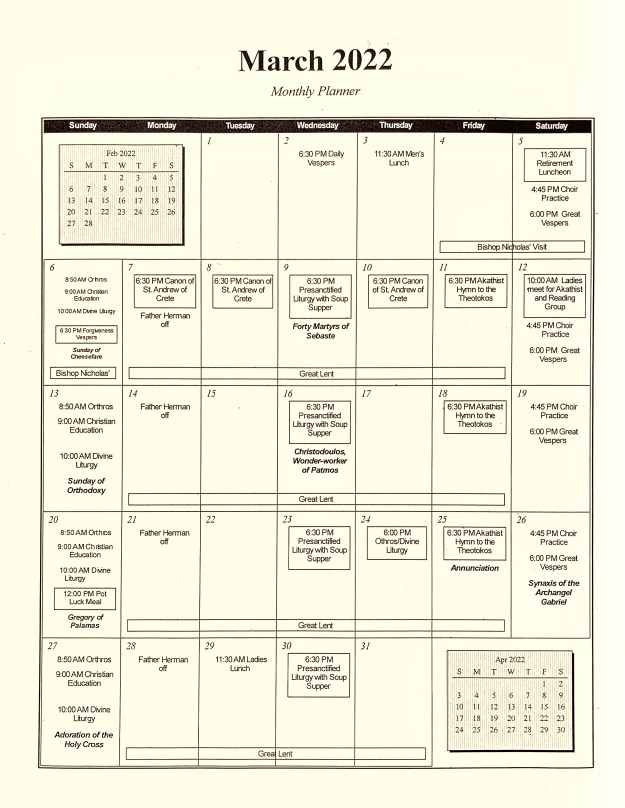
* His Grace, Bishop NICHOLAS will be at St. Peter the weekend of March 5-6, 2022 to help us celebrate Fr. John’s retirement and our 35th anniversary as a parish. Please mark your calendars now.

* Great Lent begins on Clean Monday (March 7th). As is our parish custom, we will celebrate Forgiveness Vespers on Sunday evening, March 6th, beginning at 6:30 p.m. We will pray the Canon of St. Andrew of Crete on Monday, Tuesday and Thursday that week March 7-11) and celebrate the Pre-sanctified Liturgy on Wednesday and the Akathist Hymn to the Mother of God on Friday. All services will begin at 6:30 p.m.

* The dates for Stewpot for 2022 are Saturday, May 7th and Saturday, September 3rd.

Pledge Letters have been mailed. Please return them to the church as soon as possible.

House Blessings: Fr. Herman will be blessing homes January 7 – February 25 (except for February 23-37 when he will be out for the Winter Retreat). A sign-up sheet is located on the bureau in the hallway. Please indicate 3 dates that would work for your family and he will get back with you to schedule your house blessing. Everyone should their house blessed, but the responsibility for scheduling this lies with individuals and not Fr. Herman.

The letters acknowledging tithes and offerings for 2021 were mailed recently. Please check your letter carefully to be sure that it matches your records. If you did not get your letter, or if there was a discrepancy with it, please let Kh. Sharon know as soon as possible.

If you are not feeling well, PLEASE do not attempt to come to the services. This also includes anyone who may have been exposed to you during this time. Also, please let Fr. Herman know if you are not feeling well and have COVID like symptoms.

A movie has been released about St. Nectarius of Aegina. It’s called Man of God. It is scheduled to play at the theaters in Pearl and Madison one showing only, March 21, 2022, at 7:00 p.m. Here is the link: https://www.imdb.com/showtimes/title/tt6060964/?date=2022-03-21

Camp St. Thekla dates and registration: The dates for Camp St. Thekla are: Session 1 is

June 26 – July 2 and Session 2 is July 3 – 9.

Dn. Richard is in charge of showing photos from St. Peter’s last 35 years for the celebration on March 5th. Please look through your photos and submit good selections to him within the next couple of weeks. They may be physical prints or digital clips. Be sure to put your name on them if you want them returned. Dn Richard will continue to accept photos through next week. Suggested Categories:

Weddings, Baptisms, Chrismations Bible Studies

Fishing Trips Men’s and Women’s lunches

Retreats Angel Tree

Fall Festival Sunday School and Garden work

Stew Pot Work Days

Any other things involving the life of our parish

Fasting Discipline for February

In February the fasting discipline (no meat, dairy, eggs, fish, wine or oil) is observed on all Wednesdays and Fridays except February 2nd (Feast of the Presentation of the Lord in the Temple when fish, wine and oil are permitted) and the week following the Sunday of the Pharisee and the Publican (February 14-18) when there is no fasting at all. Following Meatfare Sunday on February 27th, meat will no longer be eaten until Pascha.

Major Commemorations for February

February 20 Sunday of the Prodigal Son

February 24 The Forerunner (1st and 2nd Discoveries)

February 26 Saturday of the Souls

February 27 Sunday of Meatfare

Instructions for streaming our services can be found on the parish website.

Quotable: “What does the daily invocation of the saints signify — of different ones each day, during the whole year, and during our whole life? It signifies that God’s saints — as our brethren, but perfect — live, and are near us, ever ready to help us, by the grace of God. We live together with them in the house of our Heavenly Father, only in different parts of it. We live in the earthly, they in the heavenly half; but we can converse with them, and they with us. God’s saints are near to the believing heart, and are ready in a moment to help those who call upon them with faith and love.”

St. John of Kronstadt, My Life in Christ

Worship: Sunday, February 27, 2022 (Sunday of Meat Fare)

Scripture: I Corinthians 8:8-9:2; Matthew 25:31-46

Celebrant: Father Herman

Epistle Reader: Walt Wood

Prosphora: R. Root

Coffee Hour: Algood/Schelver

Daily Readings for Friday, February 18, 2022

FRIDAY OF PRODIGAL SON

NO FAST

Leo the Great, Pope of Rome, Agapetus the Confessor, Bishop of Sinai, Flavian the Confessor, Patriarch of Constantinople

ST. JOHN’S FIRST UNIVERSAL LETTER 2:7-17

Brethren, I am writing you no new commandment, but an old commandment which you had from the beginning; the old commandment is the word which you have heard. Yet I am writing you a new commandment, which is true in him and in you, because the darkness is passing away and the true light is already shining. He who says he is in the light and hates his brother is in the darkness still. He who loves his brother abides in the light, and in it there is no cause for stumbling. But he who hates his brother is in the darkness and walks in the darkness, and does not know where he is going, because the darkness has blinded his eyes. I am writing to you, little children, because your sins are forgiven for his sake. I am writing to you, fathers, because you know him who is from the beginning. I am writing to you, young men, because you have overcome the evil one. I write to you, children, because you know the Father. I write to you, fathers, because you know him who is from the beginning. I write to you, young men, because you are strong, and the word of God abides in you, and you have overcome the evil one. Do not love the world or the things in the world. If any one loves the world, love for the Father is not in him. For all that is in the world, the lust of the flesh and the lust of the eyes and the pride of life, is not of the Father but is of the world. And the world passes away, and the lust of it; but he who does the will of God abides for ever.

MARK 14:3-9

At that time, while Jesus was at Bethany in the house of Simon the leper, as he sat at table, a woman came with an alabaster flask of ointment of pure nard, very costly, and she broke the flask and poured it over his head. But there were some who said to themselves indignantly, “Why was the ointment thus wasted? For this ointment might have been sold for more than three hundred denarii, and given to the poor.” And they reproached her. But Jesus said, “Let her alone; why do you trouble her? She has done a beautiful thing to me. For you always have the poor with you, and whenever you will, you can do good to them; but you will not always have me. She has done what she could; she has anointed my body beforehand for burying. And truly, I say to you, wherever the gospel is preached in the whole world, what she has done will be told in memory of her.”

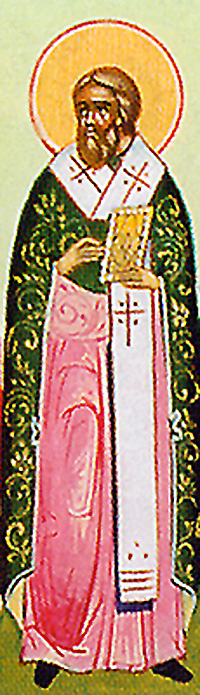
Saint Leo the Great, Pope of Rome

Saint Leo I the Great, Pope of Rome (440-461), received a fine and diverse education, which opened for him the possibility of an excellent worldly career. He yearned for the spiritual life, however, and so he chose the path of becoming an archdeacon under holy Pope Sixtus III (432-440), after whose death Saint Leo was chosen as Bishop of Rome in September 440.

These were difficult times for the Church, when heretics assaulted Orthodoxy with their false teachings. Saint Leo combined pastoral solicitude and goodness with an unshakable firmness in the confession of the Faith. He was in particular one of the basic defenders of Orthodoxy against the heresies of Eutyches and Dioscorus, who taught that there was only one nature in the Lord Jesus Christ. He was also a defender against the heresy of Nestorius.

He exerted all his influence to put an end to the unrest by the heretics in the Church, and by his letters to the holy emperors Theodosius II (408-450) and Marcian (450-457), he actively promoted the convening of the Fourth Ecumenical Council, at Chalcedon in 451, to condemn the heresy of the Monophysites.

At the Council at Chalcedon, at which 630 bishops were present, a letter of Saint Leo to the deceased Saint Flavian, Patriarch of Constantinople (447-449) was read. Saint Flavian had suffered for Orthodoxy under the “Robber Council” of Ephesus in the year 449. In the letter of Saint Leo the Orthodox teaching about the two natures [the divine and the human] in the Lord Jesus Christ was set forth. All the bishops present at the Council were in agreement with this teaching, and so the heretics Eutyches and Dioscorus were excommunicated from the Church.

Saint Leo was also a defender of his country against the incursions of barbarians. In 452, by the persuasive power of his words, he stopped Attila the Hun from pillaging Italy. Again in the year 455, when the leader of the Vandals [a Germanic tribe], Henzerich, turned towards Rome, he persuaded him not to pillage the city, burn buildings, nor to spill blood.

He knew the time of his death beforehand, and he prepared himself, with forty days of fasting and prayer, to pass from this world into eternity.

He died in the year 461 and was buried at Rome. His literary and theological legacy is comprised of 96 sermons and 143 letters, of which the best known is his Epistle to Saint Flavian.

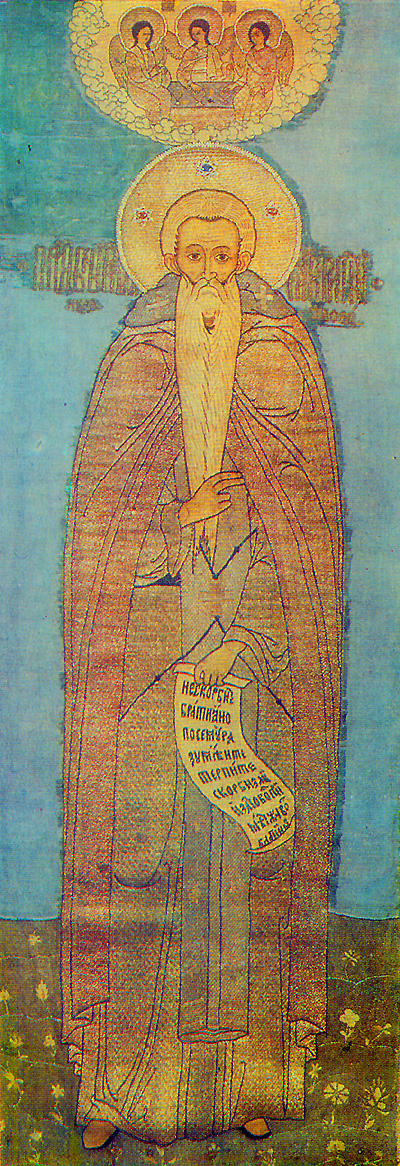
Venerable Cosmas of Yakhrom

Saint Cosmas of Yakhrom was the servant of a certain nobleman, whom he comforted during his prolonged illness by reading him books. And so, travelling from city to city, they happened to stop at the River Yakhroma. Here in the woods an icon of the Dormition of the Most Holy Theotokos appeared to Cosmas, and he heard a voice commanding him to become a monk and to build a monastery. His sick master then received healing from the icon, and Cosmas went to Kiev, where he was tonsured in the Monastery of the Caves. Then with the icon of the Mother of God, and on an inspiration from above, he again went to Yakhrom, 40 versts from the city of Vladimir, constructing a temple in honor of the Dormition of the Most Holy Theotokos with the help of some good Christians.

Brethren began to gather around the monk, and a monastery was formed. Saint Cosmas was chosen as igumen. During this time, word of the monk’s ascetic struggles reached even the Great Prince. Saint Cosmas died at an advanced old age on February 18, 1492, and was buried in the monastery he founded. His memory is celebrated also on October 14, the day that the Yakhrom Icon of the Mother of God is commemorated.

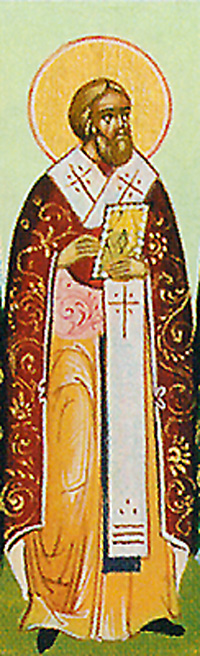
Saint Agapitos the Confessor and Wonderworker, Bishop of Synnada in Phrygia

Saint Agapitos came from Cappadocia and was the son of pious and God-loving parents. He lived during the time of the emperors Diocletian (284-305) and Maximian (285-305). At a young age he departed for a monastery near Synnada in Phrygia, where he became a monk. He was loved by the Igumen because of his virtuous life and so he was taught how to read and write. He also received from God the gift of working miracles, performing over a hundred of them. By his prayers he killed a great dragon, which had appeared near the monastery, carrying off both people and animals. This was a great benefit for those who had turned to him for help.

Later on, during the reign of Licinius (308-323) Saint Agapitos was recruited into the army against his will. There he saw the victorious Martyrs Victor, Dorotheos, Theodoulos, Agrippa and many others, being tortured for their faith in Christ. Right away he wanted to join them in their martyrdom. Though they were perfected in Christ by the sword, he was preserved and, by God's providence, he suffered no harm, even though they wounded him with a spear. His life was spared so that he might lead many to salvation.

The holy Emperor Constantine the Great (May 21) heard that Saint Agapitos could heal people by his prayers. The emperor sent him a sick servant, and he was cured. Saint Constantine wished to reward Saint Agapitos, but he asked only that he be discharged from military service and be permitted to return to his monastery. His request was granted, and so he went back to the monastery.

Saint Agapitos devoted himself to the study of the Holy Gospel, and the Bishop of Synnada ordained him to the holy priesthood. After the bishop reposed, Saint Agapitos was chosen to succeed him in this position by the common consent of the clergy and the people.

After governing his flock in a God-pleasing manner, instructing them in the Orthodox Faith, and in virtuous living, Saint Agapitos reposed in peace

Saint Flavian the Confessor, Patriarch of Constantinople

Saint Flavian the Confessor, Patriarch of Constantinople, occupied the patriarchal throne of Constantinople under the holy Emperor Theodosius the Younger (408-450) and his sister the holy Empress Pulcheria (September 10).

At first he was a presbyter and caretaker of church-vessels in the cathedral. He became Patriarch after the death of holy Patriarch Proclus (November 20). During this time, various disturbances and heresies threatened church unity.

In the year 448, Saint Flavian convened a local Council at Constantinople to examine the heresy of Eutyches, which admitted only one nature (the divine) in the Lord Jesus Christ. Persisting in his error, the heretic Eutyches was excommunicated from the Church and deprived of dignity, but Eutyches had a powerful patron in the person of Chrysathios, a eunuch close to the emperor.

Through intrigue Chrysathios brought Bishop Dioscorus of Alexandria over to the side of Eutyches, and obtained permission from the emperor to convene a church council at Ephesus, afterwards known as the “Robber Council.”

Dioscorus presided at this council, gaining the acquittal of Eutyches and the condemnation of Patriarch Flavian by threats and force. Saint Flavian was fiercely beaten up during the sessions of this council by impudent monks led by a certain Barsumas.

Even the impious president of the Robber Council, the heretic Dioscorus, took part in these beatings. After this heavy chains were put upon Saint Flavian, and he was sentenced to banishment at Ephesus. The Lord, however, ended his further suffering, by sending him his death (+ August 449). The holy Empress Pulcheria withdrew from the imperial court. Soon the intrigues of Chrysathios were revealed. The emperor dismissed him, and restored his sister Saint Pulcheria. Through her efforts, the relics of holy Patriarch Flavian were reverently transferred from Ephesus to Constantinople.

Saint Nicholas, Catholicos of Georgia

Nicholas Batonishvili was the son of Levan I, King of Kakheti (1520-1574). He lived during the grievous period of the Persian invasion of eastern Georgia. The young prince chose the path of monastic life and bravely helped his elder brother, King Alexandre II (1574-1605).

Despite his royal blood, he preferred the monk’s habit and the sweet, light yoke of Christ to the glamour and opulence of his inheritance.

According to God’s will, Nicholas was enthroned as Catholicos of All Georgia. The Georgian chronicle Life of Kartli (Kartlis Tskhovreba) relates the date of his enthronement as Saturday, February 28, 1584.

Armed with the highest hierarchical rank, royal blood, and personal integrity, Catholicos Nicholas was an exemplary leader for the Georgian nation. He struggled to plant the seeds of Christian love between countries of like faith.

He corresponded with Patriarch Job of Russia (1586-1590) and even sent him a horse. He also donated a leather-bound illuminated manuscript of the Gospels, copied in 1049, to the Metekhi Church of the Theotokos.

In his book Pilgrimage, the renowned eighteenth-century historian Archbishop Timote (Gabashvili) reports that there is an icon of Holy Catholicos Nicholas hanging in the refectory at the Ivḗron Monastery on Mt. Athos. Bishop Timote also describes another refectory, built by Ashotan Mukhran-Batoni, and notes, “There, I believe, Catholicos Nicholas Batonishvili reposed.”

Saint Theodore (Komogovin) of Serbia

No information available at this time.

Saint Colman of Lindesfarne

No information available at this time.

Daily Readings for Thursday, February 17, 2022

THEODORE THE TYRO, GREAT MARTYR

NO FAST

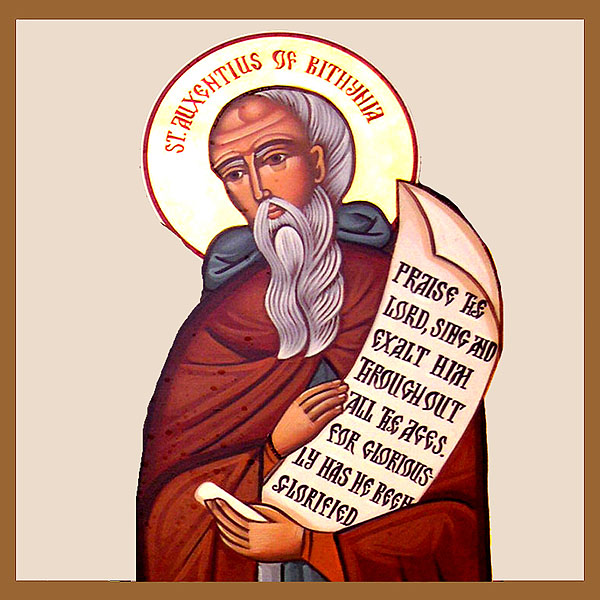
Theodore the Tyro, Great Martyr, Mariamne, Sister of Apostle Philip, and Equal to the Apostles, Righteous Auxentius, The Pious Rulers Marcian and Pulcheria, Theodore the New Martyr of Byzantium, Hermogenes (Germogen), Patriarch of Moscow

ST. PAUL’S SECOND LETTER TO TIMOTHY 2:1-10

Timothy, my son, be strong in the grace that is in Christ Jesus, and what you have heard from me before many witnesses entrust to faithful men who will be able to teach others also. Share in suffering as a good soldier of Christ Jesus. No soldier on service gets entangled in civilian pursuits, since his aim is to satisfy the one who enlisted him. An athlete is not crowned unless he competes according to the rules. It is the hardworking farmer who ought to have the first share of the crops. Think over what I say, for the Lord will grant you understanding in everything.
Remember Jesus Christ, risen from the dead, descended from David, as preached in my gospel, the gospel for which I am suffering and wearing fetters like a criminal. But the word of God is not fettered. Therefore I endure everything for the sake of the elect, that they also may obtain salvation in Christ Jesus with its eternal glory.

LUKE 20:46-47; 21:1-4

The Lord said to his disciples, “Beware of the scribes, who like to go about in long robes, and love salutations in the market places and the best seats in the synagogues and the places of honor at feasts, who devour widows’ houses and for a pretense make long prayers. They will receive the greater condemnation.” He looked up and saw the rich putting their gifts into the treasury; and he saw a poor widow put in two copper coins. And he said, “Truly, I tell you, this poor widow has put in more than all of them; for they all contributed out of their abundance, but she out of her poverty put in all the living that she had.” Having said this, he proclaimed, “He who has ears let him hear.”

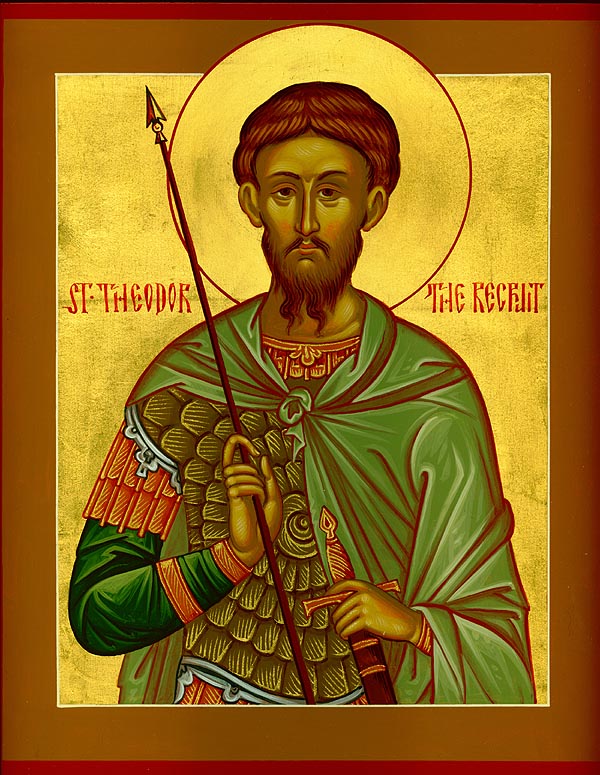
Greatmartyr Theodore the Tyro (“the Recruit”)

The Holy Great Martyr Theodore the Recruit (Tyro) was a soldier in the city of Alasium of the Pontine district (northeast province of Asia Minor, stretching along the coast of the Euxine, i.e. the Black Sea), under the command of a certain Brincus. They commanded him to offer sacrifice to idols. Saint Theodore firmly confessed his faith in Christ the Savior in a loud voice. The commander gave him several days to think it over, during which time Saint Theodore prayed.

They charged him with setting a pagan temple on fire, and threw him into prison to be starved to death. The Lord Jesus Christ appeared to him there, comforting and encouraging him. Brought to the governor, Saint Theodore boldly and fearlessly confessed his faith, for which he was subjected to new torments and condemned to burning. The martyr Theodore climbed onto the fire without hesitation, and with prayer gave up his holy soul to God.

This occurred in about the year 306 under the Roman emperor Galerius (305-311). Unharmed by the fire, the body of Saint Theodore was buried in the city of Euchaita, not far from Amasium. His relics were afterwards transferred to Constantinople, to a church dedicated to him. His head is in Italy, in the city of Gaeto.

Later on, fifty years after the death of Saint Theodore, the emperor Julian the Apostate (361-363), wanting to commit an outrage upon the Christians, commanded the city-commander of Constantinople during the first week of Great Lent to sprinkle all the food provisions in the marketplaces with the blood offered to idols. Saint Theodore appeared in a dream to Archbishop Eudoxius, ordering him to inform all the Christians that no one should buy anything at the marketplaces, but rather to eat cooked wheat with honey (kolyva).

In memory of this occurrence, the Orthodox Church annually celebrates the holy Great Martyr Theodore the Recruit on the first Saturday of Great Lent. On Friday evening, at the Divine Liturgy of the Presanctified Gifts following the prayer at the ambo, the Canon to the holy Great Martyr Theodore, composed by Saint John of Damascus, is sung. After this, kolyva is blessed and distributed to the faithful. The celebration of the Great Martyr Theodore on the first Saturday of Great Lent was set by the Patriarch Nectarius of Constantinople (381-397).

The Troparion to Saint Theodore is quite similar to the Troparion for the Prophet Daniel and the Three Holy Youths (December 17, Sunday Before Nativity). The Kontakion to Saint Theodore, who suffered martyrdom by fire, reminds us that he also had faith as his breastplate (see I Thessalonians 5:8).

We pray to Saint Theodore for the recovery of stolen articles.

Hieromartyr Hermogenes, Patriarch of Moscow, Wonderworker of All Russia

The Hieromartyr Hermogenes, Patriarch of Moscow and all Rus, was born in Kazan around 1530, and was descended from the Don Cossacks. According to the Patriarch’s own testimony, he served as priest in Kazan in a church dedicated to Saint Nicholas (December 6 and May 9), near the Kazan bazaar. Soon he became a monk, and from 1582 was archimandrite of the Savior-Transfiguration monastery at Kazan. On May 13, 1589 he was consecrated bishop and became the first Metropolitan of Kazan.

While he was the priest at Saint Nicholas, the wonderworking Kazan Icon of the Mother of God (July 8) was discovered in Kazan in 1579. With the blessing of Archbishop Jeremiah of Kazan, he carried the newly-appeared icon from the place of its discovery to the Church of Saint Nicholas. Having remarkable literary talent, the saint in 1594 compiled an account describing the appearance of the wonderworking icon and the miracles accomplished through it. In 1591 the saint gathered newly-baptized Tatars into the cathedral church and for several days he instructed them in the Faith.

The relics of Saint Germanus, the second archbishop of Kazan (September 25, November 6, and June 23), who died at Moscow on November 6, 1567 during a plague, were transfered and buried in Saint Nicholas Church in 1592. With the blessing of Patriarch Job (1589-1605), Saint Hermogenes reburied the relics at the Sviyazhsk Dormition monastery.

On January 9, 1592 Saint Hermogenes addressed a letter to Patriarch Job, in which he asked for permission to commemorate in his See of Kazan those Orthodox soldiers who gave their lives for the Faith and the nation in a battle against the Tatars. In the past, it was customary to enter into the diptychs the names of all Orthodox warriors who had fallen in battle, and to commemorate them.

At the same time he mentioned three martyrs who had suffered at Kazan for their faith in Christ, one of whom was a Russian named John (January 24) born at Nizhny Novgorod and captured by the Tatars. The other two, Stephen and Peter (March 24), were newly-converted Tatars.

The saint expressed regret that these martyrs were not inserted into the diptychs read on the Sunday of Orthodoxy, and that “Memory Eternal” was not sung for them. In answer to Saint Hermogenes, the Patriarch issued a decree on February 25, which said: “to celebrate at Kazan and throughout all the Kazan metropolitanate a panikhida for all the Orthodox soldiers killed at Kazan and the environs of Kazan, on the Saturday following the Feast of the Protection of the Most Holy Theotokos (October 1), and to inscribe them in the great Synodikon read on the Sunday of Orthodoxy,” and also ordered that the three Kazan martyrs be inscribed in the Synodikon, leaving it to Saint Hermogenes to set the day of their memory. Saint Hermogenes circulated the Patriarchal decree throughout his diocese, and required all the churches and monasteries to serve Liturgies, Panikhidas and Lityas for the three Kazan martyrs on January 24.

Saint Hermogenes displayed zeal in the faith and firmness in the observance of Church traditions, and he devoted himself to the enlightenment of Kazan Tatars with the faith of Christ.

In 1595, with the active participation of the Saint Hermogenes, the relics of the Kazan Wonderworkers Saint Gurias, the first archbishop of Kazan (October 4, December 5, June 20), and Saint Barsanuphius bishop of Tver (October 4, April 11) were discovered and uncovered. Tsar Theodore Ioannovich (1584-1598) had given orders to erect at the Kazan Savior-Transfiguration monastery a new stone church on the site of the first one, where the saints were buried.

When the graves of the saints were discovered, Saint Hermogenes came with a gathering of clergy. He commanded the graves to be opened and, when he saw the incorrupt relics and clothing of the saints, he notified the Patriarch and the Tsar. With the blessing of Patriarch Job and by order of the Tsar, the relics of the newly-appeared wonderworkers were placed in the new church. Saint Hermogenes himself compiled the lives of hierarchs Gurias and Barsanuphius.

Having been found worthy of the patriarchal throne, Metropolitan Hermogenes was elected to the primatial See, and on July 3, 1606 he was installed as Patriarch by the assembly of the holy hierarchs at Moscow’s Dormition cathedral. Metropolitan Isidore handed the Patriarch the staff of the holy hierarch Peter, Moscow Wonderworker (October 5, December 21, August 24), and the Tsar gave as a gift to the new Patriarch a panagia, embellished with precious stones, a white klobuk and staff. In the ancient manner, Patriarch Hermogenes made his entrance riding upon a donkey.

The activity of Patriarch Hermogenes coincided with a difficult period for the Russian state: the appearance of the false Tsarevich Demetrius and the Polish king Sigismund III. The first hierarch devoted all his powers to the service of the Church and the nation.

Patriarch Hermogenes was not alone in this exploit: his self-sacrificing fellow-countrymen followed his example and assisted him. With special inspiration His Holiness the Patriarch stood up against the traitors and enemies of the nation, who wanted to spread Uniatism and Western Catholicism throughout Russia and to wipe out Orthodoxy, while enslaving the Russian nation.

When the imposter arrived at Moscow and settled himself at Tushino, Patriarch Hermogenes sent two letters to the Russian traitors. In one of them he wrote: “…You have forgotten the vows of our Orthodox Faith, in which we are born, baptized, nourished and raised. You have violated your oath and the kissing of the Cross to stand to the death for the house of the Most Holy Theotokos and for the Moscow realm, but have fallen for your false would-be Tsarevich … My soul aches, my heart is sickened, all within me agonizes, and all my frame shudders; I weep and with sobbing I lament: Have mercy, have mercy, brethren and children, on your own souls and your parents departed and living … Consider, how our nation is devastated and plundered by foreigners, who offer insult to the holy icons and churches, and how innocent blood is spilled, crying out to God. Think! Against whom do you take up arms: is it not against God, Who has created you? Is it not against your own brothers? Do you not devastate your own country?… I adjure you in the name of God, give up your undertaking, there is yet time, so that you do not perish in the end.” In the second document the saint appeals: “For the sake of God, come to your senses and turn around, gladden your parents, your wives and children; and we stand to pray God for you…”

Soon the righteous judgment of God fell upon the Brigand of Tushino: he was killed by his own close associates on December 11, 1610. But Moscow continued to remain in peril, since the Poles and traitors, loyal to Sigismund III, remained in the city. The documents sent by Patriarch Hermogenes throughout the cities and villages, exhorted the Russian nation to liberate Moscow from the enemies and to choose a lawful Russian Tsar.

The Muscovites rose up in rebellion, and the Poles burned the city, shutting themselves up in the Kremlin. Together with Russian traitors they forcefully seized Patriarch Hermogenes from the patriarchal throne and imprisoned him in the Chudov monastery.

On Bright Monday in 1611, the Russian militia approached Moscow and began the seige of the Kremlin, which continued for several months. Besieged within the Kremlin, the Poles often sent messengers to the Patriarch with the demand that he order the Russian militia to leave the city, threatening him with execution if he refused.

The saint firmly replied, “What are your threats to me? I fear only God. If all our enemies leave Moscow, I shall bless the Russian militia to withdraw from Moscow; but if you remain here, I shall bless all to stand against you and to die for the Orthodox Faith.”

While still in prison, the hieromartyr Hermogenes sent a final epistle to the Russian nation, blessing the liberating army to fight the invaders. The Russian commanders could not come to an agreement over a way to take the Kremlin and free the Patriarch. He languished more than nine months in dreadful confinement, and on February 17, 1612 he died a martyr’s death from starvation.

The liberation of Russia, for which Saint Hermogenes stood with such indestructible valor, was successfully achieved. The body of the hieromartyr Hermogenes was buried in the Chudov monastery, but in 1654 was transferred to the Moscow Dormition cathedral. The glorification of Patriarch Hermogenes as a saint occurred on May 12, 1913.

Venerable Theodore the Silent of the Kiev Caves

Saint Theodore the Silent of the Caves chose the exploit of silence, in order to dwell constantly in remembrance of God, and to safeguard himself from temptation even by a word. He was glorified by the Lord with the gift of wonderworking. His memory is celebrated also on August 28.

Saint Mariamne the sister of the Apostle Philip

Righteous Mariamne “The Apostolic Virgin” and sister of the holy Apostle Philip (November 14), made a vow of virginity and became the companion of her brother Philip and the holy Apostle Bartholomew (June 11), actively assisting them in their apostolic work.

The Church historian Nikēphóros Callistus describes their successful preaching in the Phrygian city of Hieropolis, where they were arrested and locked up in prison. They put the Apostle Philip to death on a cross, but Saint Mariamne and Saint Bartholomew were set free. Saint Bartholomew went to preach the Gospel in India. Saint Mariamne, after burying the body of Saint Philip, preached the Gospel at Lykaonia (Asia Minor). She died there in peace.

Uncovering of the relics of the Martyr Menas of Alexandria

The Holy Martyr Menas Kallikelados (Well Speaking), an Athenian, died as a martyr with Saints Hermogenes and Eugraphus in about the year 313 (December 10). During the reign of Emperor Basil the Macedonian (867-886), the military commander Marcian discovered the saint’s relics after Saint Menas appeared to a certain pious man in a dream to reveal where they were.

Weeping “Tikhvin” Icon of the Mother of God on Mount Athos

The Weeping Tikhvin Icon of Mt. Athos is to be found behind the altar in the Prophet Elias Skete. On February 17, 1877 (Thursday of the Second Week of Lent) seven monks remained in the church after the Hours had been read. They were astonished to see tears flowing from the right eye of the icon, and collecting on the frame. Then a single large tear came from the left eye.

The monks wiped the tears from the icon’s face, then left the church and locked the doors behind them. Three hours later, they returned for Vespers and saw traces of tears on the icon, and a single tear in the left eye. Again they wiped the tears from the icon, but they did not reappear.

Regarding this manifestation of tears as a sign of mercy from the Mother of God, the monks established an annual commemoration of the icon on February 17. The weeping Tikhvin Icon of Mt. Athos is not to be confused with the original wonderworking Tikhvin Icon (June 26).

Saint Joseph of Dionysiou

Saint Joseph was a monk of Dionysiou Monastery on Mt. Athos, where he shone forth with the virtues of monastic life. He was an iconographer, and he painted the icon of the holy Archangels on the iconostasis of Dionysiou’s main church.

In obedience to the instructions of Igumen Stephen, Saint Joseph traveled to Constantinople with Eudocimus, who had apostasized from Orthodoxy to become a Moslem. Eudocimus repented, and wished to wipe out his sin through martyrdom.

When faced with torture and death, however, the unfortunate Eudocimus denied Christ again, blaming Joseph for turning him from Islam.

Saint Joseph was arrested and threatened with death. In spite of many tortures, he refused to convert to Islam. This holy martyr of Christ was hanged on February 17, 1819, and so he obtained an incorruptible crown of glory.

Some sources list his commemoration on February 17, while others list him on September 14 or October 26.

Saint Auxibius Bishop of Soli, Cyprus

Saint Auxibius was born at Rome in a rich family. He was raised with his brother Tempstagoras, and from an early age he displayed remarkable talents. In the schools of Rome he easily learned the secular sciences. His parents wanted their son to marry. Learning of this, the youth secretly left Rome and journeyed to the East.

Arriving upon the island of Cyprus, he settled in the environs of Limnitis, not far from the city of Soli. By God’s dispensation, he encountered the holy Apostle and Evangelist Mark (September 27, October 30, January 4, April 25), preaching the Word of God at Cyprus. Saint Mark established Auxibius as bishop in the city of Soli, and himself went to preach at Alexandria.

Saint Auxibius went toward the western gates of the city and settled near the pagan temple of Zeus. Gradually he converted the local pagan priest and other idol-worshippers to Christianity. Once, Saint Heraklides (September 17) came to Saint Auxibius. He had been made a bishop in Cyprus earlier by Saint Mark, and he consulted with Saint Auxibius to preach the Gospel of Christ.

One day, Saint Auxibius arrived at the marketplace and began to preach to the people about Christ. Many, seeing the miracles and the signs worked by the saint, believed in Christ. Among the converted were many people from the surrounding villages. One man, by the name of Auxinios, remained with Saint Auxibius and assisted him until the end of his days.

After a certain while Tempstagoras, the brother of Saint Auxibius, came from Rome. He was baptized with his wife, became a priest, and served in one of the churches. Saint Auxibius guided his diocese for fifty years and died peacefully in the year 102, leaving his disciple Auxinios upon the cathedra.

New Martyr Theodore

The Holy New Martyr Theodore was born of pious parents in Neochorion near Constantinople in 1774. He worked in the palace of the Sultan, where he converted to Islam.

When a plague broke out in Constantinople, he realized the gravity of his sin and returned to Christianity. He went to Chios and then to Mytilene, where he confessed Christ before the Moslem authorities. He was imprisoned, tortured, then hanged by the Turks in 1795.

Saint Theodosius the Bulgarian, with his disciple Romanos

Saint Theodosius the Bulgarian and his disciple Romanus. Saint Theodosius began his exploit in the city of Viddino, at the Nikolaev monastery. After the death of the igumen Job he settled near Trnovo, then the capital city of Bulgaria, at the Holy Mountain monastery of the Most Holy Theotokos in search of a spiritual guide.

He left the Holy Mountain monastery and for a long time went from monastery to monastery. Finally, he learned about the desert monastery called “Concealed” where in pursuit of asceticism Saint Gregory of Sinai (August 8) had moved from Athos. Saint Theodosius found in him an experienced guide of the contemplative life. Saint Gregory taught, “Before death we lay in Hades; whoever does not recognize sincerely that he is a sinner, and that the beasts and cattle are more pure, is more wicked than the demons, having become their obedient slave.”

The wilderness monastery of Saint Gregory of Sinai suffered often from robbers. The abbot sent Saint Theodosius to the emperor Alexander with a request to defend the monastery. The pious Bulgarian Tsar, at the request of the ascetic, provided him with the means to surround the monastery with strong walls with towers, and made the monastery secure with land and cattle.

During his final journey to Trnovo on an errand for the abbot to the Tsar, a nobleman asked Saint Theodosius to take him along to the monastery. The holy ascetic brought him to Saint Gregory of Sinai. This was Romanus, who became the sincere and beloved disciple of Saint Theodosius.

After the death of Saint Gregory of Sinai (November 27, 1347), Saint Theodosius refused to become head of the monastery, and he left the monastery with his disciple Romanus for solitary struggles. They founded a monastery on a hill near Trnovo, afterwards called Theodosiev.

Saint Theodosius was famous as a zealous defender of Orthodoxy against many heresies, especially the Bogomils, Judaizers and Messalians. Their false teachings were especially pernicious. The Patriarch and the Tsar rendered great help to Saint Theodosius in the struggle with the heretics. In addition to this, the holy ascetic translated Greek writings into Slavonic.

In 1360, he became grievously ill. Wishing to see his friend Saint Callistus once more, he went to him at Constantinople, entrusting the direction of the monastery to his disciple Romanus.

Saint Theodosius died at Constantinople on February 17, 1362. His disciple Saint Romanus became head of the monastery.

Saint Nicholas Kandaurov

No information available at this time.

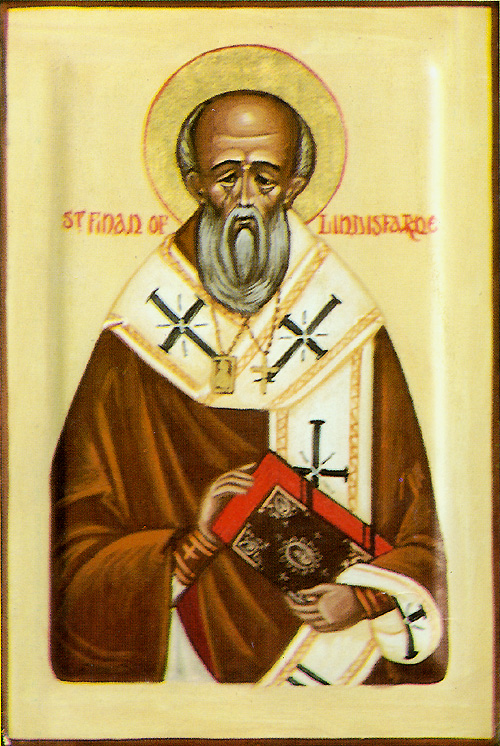
Saint Finan of Lindisfarne

No information available at this time.

Hieromartyr Theodore of Atchara

Holy Hieromartyr Theodore of Atchara belongs to the glorious multitude of Atcharan faithful who were martyred at the hands of the Ottomans.

Saint Theodore was born in the late 18th century. At that time the Ottoman invaders had nearly completed the forced Islamization of the Atcharan region. They had already annihilated those who resisted the conversion and were beginning to evict those who, in spite of their apparent acceptance of Islam, continued to “arouse suspicions.” Some abandoned their native region and fled to foreign lands.

Saint Theodore was born to a family that had been forced into exile. From his childhood he watched his fellow countrymen, who had been forcibly converted to Islam, secretly retain their Christian way of life. It is unclear how the saint’s family settled in Trebizond (modern Trabzon). It is known, however, that Saint Theodore managed to free himself from Islam, receive Christianity, and find refuge at a Georgian monastery in Smyrna (now Izmir). There he was tonsured a monk and later raised to the rank of proigoumenos (deputy abbot). It is also known that Saint Theodore converted his nephew to Christianity during that time.

In 1822 Saint Theodore set out on a pilgrimage to Mt. Athos. But at the same time the Ottomans were attempting to crush the Greek independence movement, and the Holy Mountain was surrounded by Ottoman soldiers. They captured the faithful pilgrim and killed him. Then they tossed the holy martyr’s body into the sea.

The Holy Synod of the Georgian Apostolic Orthodox Church canonized Holy Martyr Theodore on October 17, 2002.

Daily Readings for Wednesday, February 16, 2022

WEDNESDAY OF PRODIGAL SON

NO FAST

Pamphilus the Martyr & his Companions, Flavianos, Patriarch of Constantinople, Romanos the Younger

ST. PETER’S SECOND UNIVERSAL LETTER 3:1-18

Beloved, this is now the second letter that I have written to you, and in both of them I have aroused your sincere mind by way of reminder; that you should remember the predictions of the holy prophets and the commandment of the Lord and Savior through your apostles. First of all you must understand this, that scoffers will come in the last days with scoffing, following their own passions and saying, "Where is the promise of his coming? For ever since the fathers fell asleep, all things have continued as they were from the beginning of creation." They deliberately ignore this fact, that by the word of God heavens existed long ago, and an earth formed out of water and by means of water, through which the world that then existed was deluged with water and perished. But by the same word the heavens and earth that now exist have been stored up for fire, being kept until the day of judgment and destruction of ungodly men.
But do not ignore this one fact, beloved, that with the Lord one day is as a thousand years, and a thousand years as one day. The Lord is not slow about his promise as some count slowness, but is forbearing toward you, not wishing that any should perish, but that all should reach repentance. But the day of the Lord will come like a thief, and then the heavens will pass away with a loud noise, and the elements will be dissolved with fire, and the earth and the works that are upon it will be burned up.
Since all these things are thus to be dissolved, what sort of persons ought you to be in lives of holiness and godliness, waiting for and hastening the coming of the day of God, because of which the heavens will be kindled and dissolved, and the elements will melt with fire! But according to his promise we wait for new heavens and a new earth in which righteousness dwells.
Therefore, beloved, since you wait for these, be zealous to be found by him without spot or blemish, and at peace. And count the forbearance of our Lord as salvation. So also our beloved brother Paul wrote to you according to the wisdom given him, speaking of this as he does in all his letters. There are some things in them hard to understand, which the ignorant and unstable twist to their own destruction, as they do the other scriptures. You therefore, beloved, knowing this beforehand, beware lest you be carried away with the error of lawless men and lose your own stability. But grow in the grace and knowledge of our Lord and Savior Jesus Christ. To him be the glory both now and to the day of eternity. Amen.

MARK 13:24-31

The Lord said to his disciples, “In those days, after that tribulation, the sun will be darkened, and the moon will not give its light, and the stars will be falling from heaven, and the powers in the heavens will be shaken. And then they will see the Son of man coming in clouds with great power and glory. And he will send out the angels, and gather his elect from the four winds, from the ends of the earth to the ends of heaven. From the fig tree learn its lesson: as soon as its branch becomes tender and puts forth its leaves, you know that summer is near. So also, when you see these things taking place, you know he is near, at the very gates. Truly, I say to you, this generation will not pass away before all these things take place. Heaven and earth will pass away, but my words will not pass away.”

Martyrs Pamphilius the Presbyter, Valens the Deacon, and those with them, at Caesarea in Palestine

The Holy Martyrs Pamphilius the Presbyter, Valens the Deacon, Paul, Porphyrius, Seleucius, Theodulus, Julian, Samuel, Elias, Daniel, Jeremiah and Isaiah suffered during the persecution against Christians, initiated by the emperor Diocletian in the years 308-309 at Caesarea in Palestine.

The holy martyr Pamphilius, a native of the city of Beirut, was educated at Alexandria, after which he was made a priest at Caesarea. He devoted much labor to collating manuscripts and correcting copyist errors in the texts of the New Testament. The corrected texts of Saint Pamphilius were copied and distributed to anyone who wanted them. Many pagans were converted to Christ through them.

His works were collected into the extensive library of spiritual books available for the enlightening of Christians. Saint Jerome (4th-5th century) deeply respected Saint Pamphilius and considered himself fortunate to have located and acquired several of his manuscripts.

Actively assisting Saint Pamphilius in proclaiming the faith in Christ were Saint Valens, deacon of the church at Eleia, a man stooped with age and well-versed in the Holy Scriptures, and Saint Paul, ardent in faith and love for Christ the Savior. All three were imprisoned for two years by Urban, the governor of Palestinian Caesarea.

During the rule of his successor Firmilian, 130 Christians were sentenced in Egypt and sent to Cilicia (Asia Minor) to work in the gold mines. Five young brothers accompanied them to the place of exile. On their return to Egypt they were detained at Caesarea and thrown into prison for confessing Christ.

The youths appeared before Firmilian, together with those imprisoned earlier: Saints Pamphilius, Valens and Paul. The five Egyptian youths took the names of Old Testament prophets, Elias, Jeremiah, Isaiah, Samuel and Daniel. Asked where they were from, the youths said that they were citizens of Jerusalem, meaning the heavenly Jerusalem. Firmilian knew nothing of such a city, since Jerusalem had been razed to the ground by the emperor Titus in the year 70. The emperor Hadrian (117-138) built a new city on the site, which was called Aelia Capitolina.

Firmilian tortured the youths for a long time. He sought to learn the location of the unknown city, and he sought to persuade the youths to apostatize. But nothing was accomplished, and the governor ordered them to be beheaded by the sword with Pamphilius, Valens and Paul.

Before this occurred, a servant of Pamphilius endured suffering. This was the eighteen-year-old youth Porphyrius, meek and humble. He had heard the sentence of death for the condemned martyrs, and asked the governor’s permission to bury the bodies after their execution. For this he was sentenced to death, and thrown into a fire.

A witness of this execution, the pious Christian Seleucius, a former soldier, in saluting the deeds of the sufferers, went to Pamphilius and told him about the martyric death of Saint Porphyrius. He was seized by soldiers and, on Firmilian’s orders, was beheaded by the sword together with the condemned.

One of the governor’s servants, Theodulus, a man of venerable age and a secret Christian, met the martyrs being led to execution, embraced them and asked them to pray for him. He was taken by soldiers to Firmilian, on whose orders he was crucified.

The young Julian, a native of Cappadocia who had come to Caesarea, saw the bodies of the saints which had been thrown to wild beasts without burial. Julian went down on his knees and venerated the bodies of the sufferers. Soldiers standing by at the wall seized him and took him to the governor, who condemned him to burning. The bodies of all twelve martyrs remained unburied for four days, but neither beasts nor birds would touch them. Embarrassed by this situation, the pagans permitted Christians to take the bodies of the martyrs and bury them.

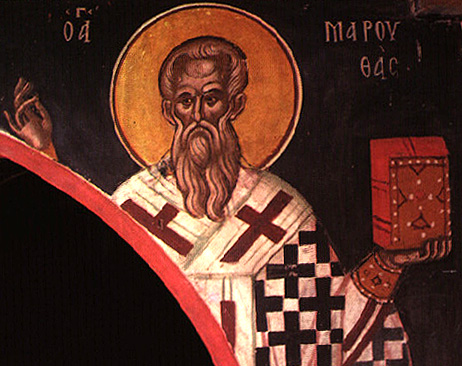
Saint Maruthas, Bishop of Martyropolis in Mesopotamia

Saint Maruthas was Bishop of Tagrith (Martyropolis), a city which he founded between the Byzantine Empire and Persia. He was famed for his knowledge and his piety, he wrote about the martyrs, and he suffered for his faith in Christ under the Persian emperor Sapor. He also left behind other works in the Syrian language, among which the most famous are: “Commentary on the Gospel,” “Verses of Maruthas,” “Liturgy of Maruthas” and “The 73 Canons of the Ecumenical Council at Nicea” (325) with an account of the acts of the Council.

In the year 381 Saint Maruthas participated in the Second Ecumenical Council at Constantinople, convened against the heresy of Macedonius. In 383, he attended the Council of Antioch against the Messalians.

During the years 403-404 Saint Maruthas set off to Constantinople to plead with the emperor Arcadius to protect Persian Christians. He was twice sent by the emperor Theodosius the Younger to the Shah Izdegerd to secure the peace between the Empire and Persia.

In the year 414 Saint Maruthas, having done his duty as envoy to the court of Izdegerd, persuaded the Shah to a favorable disposition towards Christians, and he assisted greatly in the freedom of Christians in Persia. He rebuilt Christian churches razed during the persecution by the Persian ruler Sapor. He also located relics of saints who had suffered martyrdom and transferred them to Martyropolis. He died there in 422. The relics of Saint Maruthas were later transferred to Egypt and placed in a skete monastery of the Mother of God.

Persian Martyrs in Martyropolis in Mesopotamia

No information available at this time.

Saint Flavian, Archbishop of Antioch

Saint Flavian, Archbishop of Antioch, was a contemporary of Saint John Chrysostom. He attempted to obtain from the emperor Theodosius (379-395) a pardon for the citizens of Antioch, who had angered the emperor by destroying his statue. Saint Flavian’s death was peaceful and without illness. He is also commemorated on September 27.

Saint Nicholas, Equal of the Apostles, Archbishop of Japan

Saint Nicholas, Enlightener of Japan, was born Ivan Dimitrievich Kasatkin on August 1, 1836 in the village of Berezovsk, Belsk district, Smolensk diocese, where his father served as deacon. At the age of five he lost his mother. He completed the Belsk religious school, and afterwards the Smolensk Theological Seminary. In 1857 Ivan Kasatkin entered the Saint Peterburg Theological Academy. On June 24, 1860, in the academy temple of the Twelve Apostles, Bishop Nectarius tonsured him with the name Nicholas.

On June 29, the Feast of the foremost Apostles Peter and Paul, the monk Nicholas was ordained deacon. The next day, on the altar feast of the academy church, he was ordained to the holy priesthood. Later, at his request, Father Nicholas was assigned to Japan as head of the consular church in the city of Hakodate.

At first, the preaching of the Gospel in Japan seemed completely impossible. In Father Nicholas’s own words: “the Japanese of the time looked upon foreigners as beasts, and on Christianity as a villainous sect, to which only villains and sorcerers could belong.” He spent eight years in studying the country, the language, manners and customs of the people among whom he would preach.

In 1868, the flock of Father Nicholas numbered about twenty Japanese. At the end of 1869 Hieromonk Nicholas reported in person to the Synod in Peterburg about his work. A decision was made, on January 14, 1870, to form a special Russian Spiritual Mission for preaching the Word of God among the pagan Japanese. Father Nicholas was elevated to the rank of archimandrite and appointed as head of this Mission.

Returning to Japan after two years in Russia, he transferred some of the responsibility for the Hakodate flock to Hieromonk Anatolius, and began his missionary work in Tokyo. In 1871 there was a persecution of Christians in Hakodate. Many were arrested (among them, the first Japanese Orthodox priest Paul Sawabe). Only in 1873 did the persecution abate somewhat, and the free preaching of Christianity became possible.

In this year Archimandrite Nicholas began the construction of a stone building in Tokyo which housed a church, a school for fifty men, and later a religious school, which became a seminary in 1878.

In 1874, Bishop Paul of Kamchatka arrived in Tokyo to ordain as priests several Japanese candidates recommended by Archimandrite Nicholas. At the Tokyo Mission, there were four schools: for catechists, for women, for church servers, and a seminary. At Hakodate there were two separate schools for boys and girls.

In the second half of 1877, the Mission began regular publication of the journal “Church Herald.” By the year 1878 there already 4115 Christians in Japan, and there were a number of Christian communities. Church services and classes in Japanese, the publication of religious and moral books permitted the Mission to attain such results in a short time. Archimandrite Nicholas petitioned the Holy Synod in December of 1878 to provide a bishop for Japan.

Archimandrite Nicholas was consecrated bishop on March 30, 1880 in the Trinity Cathedral of Alexander Nevsky Lavra. Returning to Japan, he resumed his apostolic work with increased fervor. He completed construction on the Cathedral of the Resurrection of Christ in Tokyo, he translated the service books, and compiled a special Orthodox theological dictionary in the Japanese language.

Great hardship befell the saint and his flock at the time of the Russo-Japanese War. For his ascetic labor during these difficult years, he was elevated to the rank of Archbishop.

In 1911, half a century had passed since the young hieromonk Nicholas had first set foot on Japanese soil. At that time there were 33,017 Christians in 266 communities of the Japanese Orthodox Church, including 1 Archbishop, 1 bishop, 35 priests, 6 deacons, 14 singing instructors, and 116 catechists.

On February 3, 1912, Archbishop Nicholas departed peacefully to the Lord at the age of seventy-six. The Holy Synod of the Russian Orthodox Church glorified him on April 10, 1970, since the saint had long been honored in Japan as a righteous man, and a prayerful intercessor before the Lord.

Daily Readings for Tuesday, February 15, 2022

TUESDAY OF PRODIGAL SON

NO FAST

Onesimus the Apostle of the 70, Our Righteous Father Anthimus the Elder of Chios, Onesimos, Patriarch of Constantinople, Eusebius the Righteous of Syria, Major the Martyr

ST. PAUL’S LETTER TO PHILEMON 1:1-25

PAUL, a prisoner for Christ Jesus, and Timothy our brother, To Philemon our beloved fellow worker, and Apphia our sister and Archippos our fellow soldier, and the church in your house: Grace to you and peace from God our Father and the Lord Jesus Christ. I thank my God always when I remember you in my prayers, because I hear of your love and of the faith which you have toward the Lord Jesus and all the saints, and I pray that the sharing of your faith may promote the knowledge of all the good that is ours in Christ. For I have derived much joy and comfort from your love, my brother, because the hearts of the saints have been refreshed through you. Accordingly, though I am bold enough in Christ to command you to do what is required, yet for love's sake I prefer to appeal to you – I, Paul, an ambassador and now a prisoner also for Christ Jesus – I appeal to you for my child, Onesimos, whose father I have become in my imprisonment. (Formerly he was useless to you, but now he is indeed useful to you and to me.) I am sending him back to you, sending my very heart. I would have been glad to keep him with me, in order that he might serve me on your behalf during my imprisonment for the gospel; but I preferred to do nothing without your consent in order that your goodness might not be by compulsion but of your own free will. Perhaps this is why he was parted from you for a while, that you might have him back for ever, no longer as a slave but more than a slave, as a beloved brother, especially to me but how much more to you, both in the flesh and in the Lord. So if you consider me your partner, receive him as you would receive me. If he has wronged you at all, or owes you anything, charge that to my account. I, Paul, write this with my own hand, I will repay it – to say nothing of your owing me even your own self. Yes, brother, I want some benefit from you in the Lord. Refresh my heart in Christ. Confident of your obedience, I write to you, knowing that you will do even more than I say. At the same time, prepare a guest room for me, for I am hoping through your prayers to be granted to you. Epaphras, my fellow prisoner in Christ Jesus, sends greetings to you, and so do Mark, Aristarchos, Demas, and Luke, my fellow workers. The grace of the Lord Jesus Christ be with your spirit. Amen.

MARK 13:14-23

The Lord said to his disciples, “When you see the desolating sacrilege spoken of by Daniel the prophet, set up where it ought not to be (let the reader understand), then let those who are in Judea flee to the mountains; let him who is on the housetop not go down, nor enter his house, to take anything away; and let him who is in the field not turn back to take his mantle. And alas for those who are with child and for those who give suck in those days! Pray that it may not happen in winter. For in those days there will be such tribulation as has not been from the beginning of the creation which God created until now, and never will be. And if the Lord had not shortened the days, no human being would be saved; but for the sake of the elect, whom he chose, he shortened the days. And then if any one says to you, ‘Look, here is the Christ!’ or ‘Look, there he is!’ do not believe it. False Christs and false prophets will arise and show signs and wonders, to lead astray, if possible, the elect. But take heed; I have told you all things beforehand.”

Apostle Onesimus of the Seventy

Saint Onesimus, Apostle of the Seventy in his youth was a servant of Philemon, a Christian of distinguished lineage, living in the city of Colossae, Phrygia. Guilty of an offense against his master and fearing punishment, Saint Onesimus fled to Rome, but as a runaway slave he wound up in prison. In prison he encountered the Apostle Paul, was enlightened by him, and was baptized.

In prison Saint Onesimus served the Apostle Paul like a son. Saint Paul was personally acquainted with Philemon, and wrote him a letter filled with love, asking him to forgive the runaway slave and to accept him like a brother. He sent Saint Onesimus with this letter to his master, depriving himself of help, of which he was very much in need.

After he received the letter, Saint Philemon not only forgave Onesimus, but also sent him back to Rome to the apostle. Saint Philemon (January 4, February 19, and November 22) was afterwards consecrated bishop of the city of Gaza.

After the death of the Apostle Paul, Saint Onesimus served the apostles until their end, and he was made a bishop. After the death of the holy apostles he preached the Gospel in many lands and cities: in Spain, Carpetania, Colossae, Patras. In his old age, Saint Onesimus occupied the bishop’s throne at Ephesus, after the Apostle Timothy. When they took Saint Ignatius the God-Bearer (December 20) to Rome for execution, Bishop Onesimus came to meet with him with other Christians, as Saint Ignatius mentions in his Epistle to the Ephesians.

During the reign of the emperor Trajan (89-117), Saint Onesimus was arrested and brought to trial before the eparch Tertillus. He held the saint in prison for eighteen days, and then sent him to prison in the city of Puteoli. After a certain while, the eparch sent for the prisoner and, convincing himself that Saint Onesimus maintained his faith in Christ, had him stoned, after which they beheaded the saint with a sword. A certain illustrious woman took the body of the martyr and placed it in a silver coffin. This took place in the year 109.

Venerable Paphnutius the Recluse of the Kiev Caves

Saint Paphnutius had the gift of tears, which Saint John of the Ladder says (Step 6:1) is preceded by the remembrance of death. For worldly people, this remembrance may lead to fear and distress, but for Saint Paphnutius it led to constant prayer and the guarding of his mind.

By remembering the hour of death and God’s judgment, Saint Paphnutius was able to free himself from worldly distractions and passions through prayer, repentance and fasting. This, in turn, led to tears.

Venerable Paphnutius and Euphrosynē of Alexandria

Our venerable Mother Euphrosynē was born at the beginning of the fifth century in the city of Alexandria. She was the only child of illustrious and wealthy parents. When she was twelve years old, her mother reposed, and so the girl was raised by her Father, Paphnutios, who was a very devout Christian. He was in the habit of visiting a certain monastery, where the Igoumen was his Spiritual Father.

When Euphrosynē turned eighteen, her father wanted her to marry. He went to the monastery to obtain the Igoumen's blessing for his daughter's wedding. The Igoumen talked with her and gave her his blessing, but Saint Euphrosynē longed for the monastic life. One day, she gave away her possessions to the poor, and then she snuck out of the house.

The Saint had decided to enter a monastery in order to spend her life in solitude and prayer, but she was afraid that her father was apt to find find her in a women’s monastery. Therefore, she disguised herself as a man and entered the same men's monastery which she had visited with her father from her childhood, calling herself Smaragdos. The monks did not recognize Euphrosynē dressed in men’s clothes, and so they received her into the monastery. The monks were impressed by her spiritual struggles and by her willingness to serve everyone.

There in a solitary cell, Saint Euphrosynē spent 38 years in spiritual endeavors, fasting and prayer, thereby attaining a high level of spiritual accomplishment.

Paphnutios was deeply saddened by the loss of his beloved daughter; more than once, on the advice of his Spiritual Father, he spoke to the "monk" Smaragdos, disclosing his grief and receiving spiritual comfort. Before her death, Saint Euphrosynē revealed her secret to her grieving parent and insisted that no one but he should prepare her body for burial. After he buried his daughter, Paphnutios distributed all his wealth to the poor and to the monastery, and then he was tonsured. For ten years, until the time of his own repose, he labored in his daughter's cell.

By her life, Saint Euphrosynē reminds us that we must renounce "worldly passions and live soberly, uprightly, and devoutly" (Titus 2:12). That is, after rejecting the desires of this vain and sinful world, we ought to live abstemiously, with justice toward our fellow human beings, and with piety toward God.

Saint Euphrosynē and her father are also commemorated on September 25.

Venerable Eusebius the Hermit of Syria

Saint Eusebius the Hermit lived in the fourth century and lived in asceticism on a mountain near the village of Asicha in Syria. He led a very strict life under the open sky, patiently enduring the summer heat and winter cold. He wore skins for clothing, and nourished himself on the pods of peas and beans.

Though he was elderly and infirm, he ate only fifteen figs during the Great Forty day Fast. When many people began to flock to Saint Eusebius, he went to a nearby monastery, built a small enclosure at the monastery walls and lived in it until his death.

Saint Eusebius died at the age of ninety, sometime after the year 400.

Vil'na Icon of the Mother of God

Today's celebration commemorates the transfer of the Icon from Moscow to Vil'na (Vilnius), Lithuania. According to local tradition, this Icon (of the Hodēgḗtria type) was painted by the Holy Evangelist Luke, and was brought from Palestine to Constantinople. For many years it belonged to the family of the Byzantine emperors. Later, they sent the Icon to the rulers of Galicia and Chervona Rus'.

After the fall of the Galician principality, the Icon became the property of the Great Princes of Moscow. It did not stay In Moscow very long, however. In 1495, Grand Duke Ivan III (1462-1505), blessed his daughter Elena with the Icon before giving her in marriage to the Lithuanian Grand Duke Alexander. Thus, the Icon came with her to the Lithuanian capital of Vil'na, where it remains today.

According to another legend, which is more credible, this Icon was brought to Moscow by Princess Sophia Palaiologina in 1472 when she married Ivan III. Both legends converge in all other details.

When Princess Elena died, the holy Icon of the Mother of God was placed above her tomb in the Cathedral of the Most Holy Theotokos.

After the relationship between the courts of Moscow and Lithuania came to an end, Ivan the Terrible (1530-1584) tried to bring the wonderworking Icon back to Moscow, offering Grand Duke Sigismund II of Lithuania (1520-1572) fifty noble Lithuanian prisoners in exchange, but Sigismund strongly opposed this, because all the clergy, both the Orthodox and the Uniates, did not want to lose this treasure.

The Icon remained In the Cathedral of the Mother of God until the XVIII century, Later, it was moved to the church of Saint John the Forerunner. Afterward, the Icon was transferred to Vil'na's Holy Trinity Monastery, which was then in possession of the Uniates, and the Cathedral of the Mother if God was also given to them.

Only in 1839 were Holy Trinity Monastery and the Hodēgḗtria Icon returned to the Orthodox. Since that time, the Icon of the Mother of God has been there with other local icons, and was honored by all the Orthodox. It has replaced her lost Ostro Bram (the Dawn Gates) Icon (which is commemorated on December 26 and April 14).

The Hodēgḗtria Icon is painted on four boards which have been joined together. Some are made of cypress wood, and the others of birch. It was restored in 1864.

In a monastery on the outskirts of Vil'na, there is another Vil'na Icon, which appeared in 1341. It is not unlike the Hodēgḗtria Icon. It is a full length depiction of the Mother of God, who stands on a crescent moon, and Holy Angels hold a crown over her pure head. In some variations of this Icon she stands on clouds, surrounded by Angels, and is wearing a crown.
The Vil'na Icon is also commemorated on April 14.

Icon of the Mother of God of Dalmatia

In Perm Gubernia, Shadrinsk county, on the banks of the Iseti River, is the Dalmatian Monastery of the Dormition. In the cathedral church of this monastery is a wonderworking Icon of the Dormition of the Mother of God, which belonged to Father Dalmatios (Δαλμάτιος), the founder of this monastery.

In the first half of the XVII century, a certain resident of Tobolsk, a nobleman by the name of Demetrios Mokrinsky, left his wife and children, and went to the Nev'yan Monastery (Tobolsk Diocese), where he was tonsured with the name Dalmatios, in honor of the fourth century ascetic Saint Dalmatios of Constantinople (August 3).

Since Father Dalmatios was known for his exalted life of asceticism and virtue, the brethren of the Nev'yan Monastery wanted to choose him as their Igoumen, but out of humility, the Elder would not accept such an august position with all its responsibilities. He left the monastery, taking with him an Icon of the Dormition of the Mother of God.

In 1644 he arrived in Perm Gubernia, where he settled in a cave on land owned by the Tyumen Tatar Ilegei. When Iligei discovered that a monk had settled on his property, and even intended to establish a monastery there, he was indignant. Gathering his relatives, he went with the intention of expelling Dalmatios. Iligei spent the night near the cave, beyond the River Iseti, waiting for dawn to make an unexpected attack on the recluse.

Father Dalmatios seemed to be in imminent danger of death, if he tried to resist or defend himself. He could not expect help from anyone anywhere, nor could he flee, since he did not know that an enemy lurked beyond the river in the darkness of night, ready to spill his blood at any moment. The monk did not require any human protection, however, for his protector was the Queen of Heaven.

When Iligei was asleep, the Mother of God appeared to him in a dream, wearing a crown and dressed in a crimson robe, holding a flaming sword in her hands. The Most Holy Theotokos strictly forbade him to harm Father Dalmatios, and ordered Iligei to give the monk some land for a monastery. Awakened by this terrible vision, the Tatar went to Father Dalmatios, accompanied by all his companions, and gave him a piece of land on which to build a monastery.

The Queen of Heaven's wondrous protection of Dalmatios occurred in 1646. In that same year, the Dalmatian Monastery was founded.

At the end of 1646, the newly-established monastery was attacked by the Kalmyks. They set fire to the monastery's buildings; some of the monks who fled were killed, and some were taken captive. During this time, only Dalmatios, the founder of the monastery, escaped death, saved by the wonderworking Icon. This was the same Icon of the Dormition of the Mother of God which he brought with him from the Nev'yan Monastery. When the Kalmyks went away, Elder Dalmatios returned to the same site and began working alone to rebuild the monastery. A few years later, because of his diligence, a wooden church was already standing on the site of the ruined monastery, and nearby there were also cells for monks. Pilgrims began to visit and made donations for the adornment of the monastery and the temple. From that time, word of the monastery quickly spread all over, not only in the places close by, but also in very remote places.

In 1651, less than twenty years after the founding of the Dalmatian Monastery, it was attacked again. This time it was attacked by the Siberian Prince Devlet-Girei. He ransacked and burned the monastery. The Icon of the Mother of God, however, remained unscathed, although the church completely burned down. In just one place, on the back of the board, there was a scorched spot where a certain Muslim had put his hand.

In 1702, the icon was restored by the Tobolsk iconographer Ivan Nikitin.

The monastery was restored by Archimandrite Isaac, the son of Father Dalmatios. He built a stone church in 1707, and in it he placed the wonderworking Icon of the Dormition of the Mother of God.

During the reign of Empress Catherine II, the monastery withstood a three-day siege by the troops of Emelian I. Pugachev, while the monks prayed before the Dalmatian Icon.

In 1800 the Icon was adorned with a gilded riza with silver crowns and precious gems, by order of Igoumen Gideon. In 1864 Archimandrite Methodios ordered a new silver and gilded riza from Moscow, decorated with precious stones. The Icon was in a special kiot, decorated with carvings, and was covered with a colorful silk curtain, which could be opened when necessary.

On April 19, 1852, many of the Monastery buildings, including the upper church, were destroyed by fire.

Once again, the Dalmatian Icon remained damaged.

Every year on February 15th, and again on August 15th, the Monastery's Altar Feast, great crowds would travel to the Dalmatian Monastery in order to venerate the wonderworking Icon. The sick receive healing, according to their faith, from this wonderworking Icon of the Mother of God. This custom continued until 1917.

In the early 1920s, after the monastery was abolished, the monks went to other monasteries, taking the Dalmatian Icon with them. At present, there is no information about the location of the Icon.

Those who experience physical or spiritual suffering pray before the Dalmatian Icon of the Most Holy Theotokos for deliverance.

Saint Anthimus of Chios

Saint Anthimos (Argyrios K. Bagianos) was born on July 1, 1869 in the vicinity of Saint Luke at Livadion, Chios. His righteous and virtuous parents, Constantine and Argyro, took care to give their child a Christian education. The young Argyrios was endowed by the Holy Spirit with the spirit of wisdom; he was foreordained by God to shine forth as a chosen vessel and to become a great guide who would lead others to Christ. His entire childhood development and upbringing was apparently due to the strong and profound influence of his Christian family environment.

On Sundays Argyrios and his family attended services at the Monastery of Nea Moni.1 When he was eight years old he met Saint Nektarios, who was a Deacon at the time. After conversing with young Argyrios, he said to Igumen Pachomios, "Elder, do you see that child? Someday he will become a Saint."

Argyrios had little formal education, and was limited to simple elementary school knowledge. So with no theoretical knowledge of worldly acclaim, but with a good disposition, spiritual discernment, and with a particularly intense desire for the spiritual life, he advanced unwaveringly in the virtuous life with the precious gift of unshakable faith.

Divine love led him to renounce the world and its noisy turmoil, and to enter the monastic state where his virtues shone forth. The starting point for him to follow the path of monasticism was his visit to the Skete of the Holy Fathers of Chios for the restoration of his own wonderworking icon of the All Holy Virgin the Helper (Παναγία Βοηθεία), which he had received from his mother. Since that time, this icon remained an integral part of his entire life. The Theotokos became a source of inexhaustible strength for him in his later difficult struggles, and she was also a fount of refreshment and respite.

His guide in the ascetical life was the venerable Elder Pachomios of Sketis, by whom he was tonsured into the small Schema, and who renamed him Anthimos.

He submitted to Elder Pachomios and through unceasing prayer and fasting, and by the harsh struggles which he undertook with God’s good will, he grew great in asceticism and in virtue. His physical and spiritual struggles left him exhausted and ill. So, with the blessing of Father Pachomios, he returned to his home in order to recuperate. Saint Anthimos, however, did not abandon his struggles. Once his health was partially restored he retired to a small isolated cell on his father’s estates in Livadia, Chios, and continued his spiritual contests. At the same time he worked as a shoemaker in order to help his poor parents, and to show mercy to those who were afflicted.

In his cell, by unceasing prayer, and by studying the lives of the great ascetics, he was strengthened and he made progress in his spiritual formation, but he also provoked the demonic rage of the Evil One. He struggled severely and effectively, conducting multifaceted and victorious contests against the Evil One with ardent prayer, and each day he ascended the blessed Ladder of virtues and holiness. In 1909, at the age of forty, he was tonsured into the Great Schema by Hieromonk Andronikos, the successor of Father Pachomios.

The virtuous ascetic Anthimos was a chosen vessel and was ready for the office of the priesthood, but the local bishop refused to ordain him because of his lack of education. In 1910, he was invited to Adramyttium in Asia Minor by his godfather, Stephen Diomataris, for this purpose. The saint’s ordination by the Bishop of Smyrna was not a typical event.

In his case, there were signs of divine approval following the ordination. Earthquake, lightning, thunder, and a cataclysmic rainfall occurred at that sacred hour. The vigil lamps swayed, and one of them fell down. After the ordination there was calm, stillness, and joy from God. These physical phenomena revealed and bore witness to the fact that God was pleased by his ordination.

As long as he remained in Adramyttium, he shone forth in a dazzling way because of his virtue and holiness, by which he healed those in the region who were possessed by demons, something his fellow priests were unable to do. His spiritual radiance stirred up the passion of jealousy in his concelebrants. Wishing to free them from this passion, the Saint left Adramyttium in 1911 and went to Mount Athos, where the Hagiorite monks freely bestowed many honors upon him.

Returning to Chios, he was assigned as the priest for the home for lepers, which became a new setting for his virtues and charitable activities. The icon of the Panagia Ypapanti (the Meeting of the Lord), the protectress of the hospital for lepers, focuses on all her acts of kindness.

The Lady Theotokos, through the prayers of Saint Anthimos, performed countless miracles of healing the infirmities of the faithful, both those whose names are known and those who remain anonymous. This institution for unfortunate lepers became a spiritual center of physical and mental health. His entire ministry at the home for lepers shows his deepest faith and his very valuable contributions.

Here the greatness of the Saint is revealed. As the priest of that church, Saint Anthimos was always found with the lepers: he ate with them, he talked to them, and he communed them with the Spotless Mysteries. After the Divine Liturgy he rested.

In that hallowed atmosphere, he envisioned the establishment of a Monastery to shelter nuns who had fled there from Asia Minor following the exchange of populations (1922-1924).2 So his dreams moved forward toward their fulfillment. In 1927, after he had a vision of the Theotokos, he received permission to build such a monastery. He also built the magnificent temple dedicated the icon of the Mother of God the Helper (Παναγία Βοηθεία) in 1930. From that time he settled in the Monastery filled with devotion to the Most Holy Theotokos, and there he advanced in his life of asceticism, filled with a multitude of virtues and holiness through the intercession and help of the Theotokos, and he shepherded his flock with great affection and love, strengthening and consoling them with his sweet and simple speech, healing the sicknesses and afflictions of those who had recourse to him.

After his life-long ministry, now at the age of 90, fully ripe and full of days, with a dignity which was reminiscent of the great ascetics of the desert, he celebrated his last Divine Liturgy on January 27, 1960. A few days later he reposed in peace.

Saint Anthimos was glorified by the Church of Constantinople on August 13, 1992.


1 The monastery was dedicated to Saints Nikḗtas, John, and Joseph.

2 At that time many Greeks in Asia Minor were sent to Greece, and many Turks in Greece went to Turkey.

Daily Readings for Monday, February 14, 2022

MONDAY OF PRODIGAL SON

NO FAST

Holy Father Auxentius of the Mountain, Cyril, Equal-to-the-Apostles & Teacher of the Slavs, Nicholas the New Martyr of Corinth, Abraham, Bishop of Carrhes in Mesopotamia

ST. PETER’S SECOND UNIVERSAL LETTER 1:20-21; 2:1-9

Beloved, first of all you must understand this, that no prophecy of scripture is a matter of one's own interpretation, because no prophecy ever came by the impulse of man, but men moved by the Holy Spirit spoke from God.
But false prophets also arose among the people, just as there will be false teachers among you, who will secretly bring in destructive heresies, even denying the Master who bought them, bringing upon themselves swift destruction. And many will follow their licentiousness, and because of them the way of truth will be reviled. And in their greed they will exploit you with false words; from of old their condemnation has not been idle, and their destruction has not been asleep.
For if God did not spare the angels when they sinned, but cast them into hell and committed them to pits of nether gloom to be kept until the judgment; if he did not spare the ancient world, but preserved Noah, a herald of righteousness, with seven other persons, when he brought a flood upon the world of the ungodly; if by turning the cities of Sodom and Gomorrah to ashes he condemned them to extinction and made them an example to those who were to be ungodly; and if he rescued righteous Lot, greatly distressed by the licentiousness of the wicked (for by what that righteous man saw and heard as he lived among them, he was vexed in his righteous soul day after day with their lawless deeds), then the Lord knows how to rescue the godly from trial, and to keep the unrighteous under punishment until the day of judgment.

MARK 13:9-13

The Lord said to his disciples, "Take heed to yourselves; for they will deliver you up to councils; and you will be beaten in synagogues; and you will stand before governors and kings for my sake, to bear testimony before them. And the gospel must first be preached to all nations. And when they bring you to trial and deliver you up, do not be anxious beforehand what you are to say; but say whatever is given you in that hour, for it is not you who speak, but the Holy Spirit. And brother will deliver up brother to death, and the father his child, and children will rise against parents and have them put to death; and you will be hated by all for my name's sake. But he who endures to the end will be saved.

Venerable Auxentius of Bithynia

Saint Auxentius, by origin a Syrian, served at the court of the emperor Theodosius the Younger (418-450). He was known as a virtuous, learned and wise man, and he was, moreover, a friend of many of the pious men of his era.

Distressed by worldly vanity, Saint Auxentius was ordained to the holy priesthood, and then received monastic tonsure. After this he went to Bithynia and found a solitary place on Mount Oxia, not far from Chalcedon, and there he began the life of a hermit (This mountain was afterwards called Mt. Auxentius). The place of the saint’s efforts was discovered by shepherds seeking their lost sheep. They told others about him, and people began to come to him for healing. Saint Auxentius healed many of the sick and the infirm in the name of the Lord.

In the year 451 Saint Auxentius was invited to the Fourth Ecumenical Council at Chalcedon, where he denounced the Eutychian and Nestorian heresies. Familiar with Holy Scripture and learned in theology, Saint Auxentius easily bested those opponents who disputed with him. After the end of the Council, Saint Auxentius returned to his solitary cell on the mountain. With his spiritual sight he saw the repose of Saint Simeon the Stylite (459) from a great distance.

Saint Auxentius died about the year 470, leaving behind him disciples and many monasteries in the region of Bithynia. He was buried in the Monastery of Saint Hypatius at Rufiananas, Syria.

Repose of Saint Cyril, Equal of the Apostles and Teacher of the Slavs

Saint Cyril Equal of the Apostles, Teacher of the Slavs (Constantine in the schema), and his older brother Methodius (April 6), were Slavs, born in Macedonia in the city of Thessalonica.

Saint Cyril received the finest of educations, and from the age of fourteen he was raised with the son of the emperor. Later, he was ordained as a priest. Upon his return to Constantinople, he worked as a librarian of the cathedral church, and as a professor of philosophy. Saint Cyril successfully held debates with iconoclast heretics and with Moslems.

Yearning for solitude, he went to Mount Olympos to his older brother Methodius, but his solitude lasted only a short while. Both brothers were sent by the emperor Michael on a missionary journey to preach Christianity to the Khazars in the year 857. Along the way they stopped at Cherson and discovered the relics of the Hieromartyr Clement of Rome (November 25).

Arriving at the territory of the Khazars, the holy brothers spoke with them about the Christian Faith. Persuaded by the preaching of Saint Cyril, the Khazar prince together with all his people accepted Christianity. The grateful prince wanted to reward the preachers with rich presents, but they refused this and instead asked the prince to free and send home with them all the Greek captives. Saint Cyril returned to Constantinople together with 200 such captives set free.

In the year 862 began the chief exploit of the holy brothers. At the request of Prince Rostislav, the emperor sent them to Moravia to preach Christianity in the Slavic language. Saints Cyril and Methodius by a revelation from God compiled a Slavonic alphabet and translated the Gospel, Epistles, the Psalter and many Service books into the Slavonic language. They introduced divine services in Slavonic.

The holy brothers were then summoned to Rome at the invitation of the Roman Pope. Pope Adrian received them with great honor, since they brought with them the relics of the Hieromartyr Clement. Sickly by nature and in poor health, Saint Cyril soon fell ill from his many labors, and after taking the schema, he died in the year 869 at the age of forty-two. Before his death, he expressed his wish for his brother to continue the Christian enlightenment of the Slavs. Saint Cyril was buried in the Roman church of Saint Clement, whose own relics also rest there, brought to Italy from Cherson by the Enlighteners of the Slavs.

Venerable Isaac the Recluse of the Kiev Near Caves

Saint Isaac was the first person in northern lands to live as a fool for Christ. His name in the world was Chern. Before becoming a monk, he was a rich merchant in the city of Toropets in the Pskov lands. Having distributed all his substance to the poor, he went to Kiev and received the monastic tonsure from Saint Anthony (July 10).

He led a very strict life of reclusion, eating only a single prosphora and a little water at the end of the day. After seven years as a hermit, he was subjected to a fierce temptation by the devil. Having mistaken the Evil One for Christ, he worshipped him, after which he fell down terribly crippled. Saints Anthony and Theodosius took care of him and nursed him. Only after three years did he begin to walk and to speak. He did not wish to attend church, but he was brought there by force.

Upon his return to health he took upon himself the exploit of holy foolishness, enduring beatings, nakedness and cold. Before his death he went into seclusion, where again he was subjected to an onslaught of demons, from which he was delivered by the Sign of the Cross and by prayer.

After his healing he spent about twenty years in asceticism. He died in the year 1090. His relics rest in the Caves of Saint Anthony, and part of them were transferred to Toropets by the igumen of the Kudin monastery in the year 1711. The Life of the Blessed Isaac was recorded by Saint Nestor in the Chronicles (under the year 1074). The account in the Kiev Caves Paterikon differs somewhat from that of Saint Nestor. In the Great Reading Menaion under April 27 is the “Account of Saint Isaac and his Deception by the Devil.”

12 Greeks who built the Dormition Cathedral in the Kiev Caves, Far Caves, Lavra

The Kiev Caves Icon of the Dormition of the Most Holy Theotokos (May 3) is one of the most ancient icons in the Russian Orthodox Church. The Mother of God entrusted it to four Byzantine architects, who in 1073 brought the icon to Saints Anthony and Theodosius of the Caves. The architects arrived at the monks’ cave and asked, “Where do you want to build the church?” The saints answered, “Go, the Lord will point out the place.”

“How is it that you, who are about to die, have still not designated the place?” the architects wondered. “And they gave us much gold.”

Then the monks summoned all the brethren and they began to question the Greeks, saying, “Tell us the truth. Who sent you, and how did you end up here?”

The architects answered, “One day, when each of us was asleep in his own home, handsome youths came to us at sunrise, and said, ‘The Queen summons you to Blachernae.’ We all arrived at the same time and, questioning one another we learned that each of us had heard this command of the Queen, and that the youths had come to each of us. Finally, we beheld the Queen of Heaven with a multitude of warriors. We bowed down to Her, and She said, ‘I want to build Myself a Church in Rus, at Kiev, and so I ask you to do this. Take enough gold for three years.’”

“We bowed down and asked, ‘Lady Queen! You are sending us to a foreign land. To whom are we sent?’ She answered, ‘I send you to the monks Anthony and Theodosius.’”

“We wondered, ‘Why then, Lady, do You give us gold for three years? Tell us that which concerns us, what we shall eat and what we shall drink, and tell us also what You know about it.’”

“The Queen replied, ‘Anthony will merely give the blessing, then depart from this world to eternal repose. The other one, Theodosius, will follow him after two years. Therefore, take enough gold. Moreover, no one can do what I shall do to honor you. I shall give you what eye has not seen, what ear has not heard, and what has not entered into the heart of man (1 Cor.2:9). I, Myself, shall come to look upon the church and I shall dwell within it.’”

“She also gave us relics of the holy martyrs Menignus, Polyeuctus, Leontius, Acacius, Arethas, James, and Theodore, saying, ‘Place these within the foundation.’ We took more than enough gold, and She said, ‘Come out and see the resplendent church.’ We went out and saw a church in the air. Coming inside again, we bowed down and said, ‘Lady Queen, what will be the name of the church?’”

“She answered, ‘I wish to call it by My own name.’ We did not dare to ask what Her name was, but She said again, ‘It will be the church of the Mother of God.’ After giving us this icon, She said, ‘This will be placed within.’ We bowed down to Her and went to our own homes, taking with us the icon we received from the hands of the Queen.”

After hearing this account, everyone glorified God, and Saint Anthony said, “My children, we never left this place. Those handsome youths summoning you were holy angels, and the Queen in Blachernae was the Most Holy Theotokos. As for those who appeared to be us, and the gold they gave you, the Lord only knows how He deigned to do this with His servants. Blessed be your arrival! You are in good company: the venerable icon of the Lady.” For three days Saint Anthony prayed that the Lord would show him the place for the church.

After the first night there was a dew throughout all the land, but it was dry on the holy spot. On the second morning throughout all the land it was dry, but on the holy spot it was wet with dew. On the third morning, they prayed and blessed the place, and measured the width and length of the church with a golden sash. (This sash had been brought long ago by the Varangian Shimon, who had a vision about the building of a church.) A bolt of lightning, falling from heaven by the prayer of Saint Anthony, indicated that this spot was pleasing to God. So the foundation of the church was laid.

The icon of the Mother of God was glorified by numerous miracles.

Translation of the Relics of Martyrs Michael and his councilor, Theodore, of Chernígov

On February 14, 1572, at the wish of Tsar Ivan Vasilievich the Terrible, and with the blessing of Metropolitan Anthony, the relics of the holy martyrs Michael and his councilor Theodore were transferred to Moscow, to the temple dedicated to them. From there in 1770 they were transferred to the Visitation cathedral, and on November 21, 1774 to the Archangel cathedral of the Moscow Kremlin. See September 20 for their Life.

Venerable Maron the Hermit of Syria

Saint Maron was born in the fourth century near the city of Cyrrhus in Syria. He spent almost all his time beneath the open sky in prayer, vigil, ascetical works and strict fasting. He obtained from God the gift of healing the sick and casting out demons. He counselled those who turned to him for advice to be temperate, to be concerned for their salvation, and to guard against avarice and anger.

Saint Maron, a friend of Saint John Chrysostom, died before 423 at an advanced age.

Some of Saint Maron’s disciples were James the Hermit (November 26), Limnius (February 23), and Domnina (March 1). Saint Maron founded many monasteries around Cyrrhus, and converted a pagan temple near Antioch into a Christian church.

Saint Abraham, Bishop of Charres, Mesopotamia

Saint Abraham, Bishop of Charres, lived during the mid-fourth and early fifth centuries, and was born in the city of Cyrrhus. In his youth he entered a monastery. Later he became a hermit in Lebanon, a place where many pagans lived.

Saint Abraham suffered much vexation from the pagans, who wanted to expel him from their area. He once saw tax-collectors beating those who were unable to pay. Moved to pity, he paid the taxes for them, and those people later accepted Christ.

The Christian inhabitants of this village built a church and they fervently besought Saint Abraham to accept the priesthood and become their pastor. The monk fulfilled their wish. Having encouraged his flock in the faith, he left them in place of himself another priest, and he again retired to a monastery.

For his deep piety he was made bishop of Charres; his pastors the saint constantly taught by his God-pleasing life. From the time of his accepting of the priesthood, he never used cooked food. The emperor Theodosius the Younger wanted to meet the bishop and made him an invitation. After he arrived in Constantinople, Saint Abraham soon died. His remains were solemnly transferred to the city of Charres and there given over to burial.

Saint Hilarion the New of Georgia

Holy Hiero-schema monk Hilarion the Georgian (Ise Qanchaveli in the world) was born in 1776 in the village of Losiantkhevi, in the Shorapani district of Kutaisi. His parents, Khakhuli and Mariam Qanchaveli, were pious and God-fearing nobles.

According to God’s will, Ise’s uncle, the hermit Hierodeacon Stepane, took his six-year-old nephew into his care. When Stepane reposed, Ise moved to Tabakini Monastery, but learning that a seminary had opened in Tbilisi, he set off for it. On his way he visited a certain Bishop Athanasios of Nikozi to receive his blessing, but the bishop, delighted by the youth’s fervent prayers, advised him to return home to his family: “My son, you will learn much more in the wilderness than you ever could in the classroom. Return home, and the Lord, having instructed you in prayer, will lead you on a path that will serve your people and the Church.”

Ise returned to the bosom of his family, and his father took him to Kutaisi to be raised in the court of the Imeretian king. King Solomon II (1789-1815) soon recognized that the young Ise stood above all the other courtiers in piety, and he appointed him to be his personal spiritual adviser and instructor. At the king’s suggestion, Ise married the Princess Mariam. Soon after his marriage, the humble nobleman was ordained to the priesthood and appointed confessor of the court church. Only two years later Princess Mariam reposed, leaving Fr. Ise a widower.

After the Russian annexation of Kartli-Kakheti, the imperial court of the tsar increased diplomatic correspondence with the court of King Solomon II. The king was urged likewise to unite the Imeretian Kingdom to Russia. Solomon summoned a council of noblemen, and it was decided that Imereti would remain independent, while maintaining friendly relations with Russia until the king’s death. However, it was agreed that since King Solomon had no heir, after his repose the court of the imperial tsar would acquire jurisdiction over the region.

But the political climate in Georgia became increasingly tense, and the ability of the Imeretian court to govern was severely undermined.

The court was suddenly besieged with cases of envy and treason, and it became necessary for the king to flee to Turkey. Protopresbyter Ise Qanchaveli accompanied King Solomon II to his place of exile and remained with him to the end of the king’s life.

After the king’s death in 1815, Fr. Ise received an amnesty from Tsar Alexander I (1801-1825) on behalf of the king and his court. Ise himself planned to go into reclusion in the village where he was born, but King Solomon’s widow, Queen Mariam, summoned him to Moscow where she was being held in “honorable captivity.” Fr. Ise brought to her a piece of the Life-giving Cross of our Lord, which had belonged to King Solomon, and the queen preserved her husband’s treasure in the court church.

But life at the imperial court was tiresome for the God-fearing Fr. Ise, so he exchanged his clothing for beggars’ rags and set off for Mt. Athos in the year 1819.

Fr. Ise appeared before the holy fathers of Mt. Athos as an unknown pilgrim, who had come to venerate the holy places. He first visited Ivḗron Monastery and from there crossed over the peninsula to Dionysiou Monastery.

In 1821 Ise was tonsured a monk and given the name Hilarion. He was presented with new monastic garments for the tonsure service, but asked permission to remain dressed in his own rags.

Fr. Hilarion fulfilled his every obedience with love. He was dispirited only by his ignorance of the Greek language, which prevented him from hearing and understanding the Word of God during the divine services. Finally he received permission from the abbot of Dionysiou to borrow some of the Georgian books from the large collection of sacred manuscripts at Ivḗron Monastery.

Upon arriving at the monastery, Fr. Hilarion went to venerate the Ivḗron Icon of the Mother of God. While praying on his knees before the icon, a Greek archimandrite whom he knew from Moscow saw and recognized him. He bowed before him, kissed his hands and cried out: “Fr. Ise! Holy Shepherd! Confessor of the king!”

Soon the news spread through all the monasteries of Mt. Athos that the spiritual father of the king had concealed himself as a beggar.

Everywhere the monks greeted him with great reverence. But Fr. Hilarion, ashamed of the attention, withdrew to the wilderness not far from the monastery.

At that time, in retaliation for the Greek Insurrection of 1821, the Turks were pillaging Greece and slaughtering the Christians. In 1822 a certain Abdul Robut-Pasha surrounded the Holy Mountain with an enormous army and commanded the abbots of all the monasteries to submit to his authority. Representatives of all the monasteries, including Fr. Hilarion and two others from Dionysiou were sent to Chromitsa to petition the pasha. Fr. Hilarion stood boldly before the pasha, burning with a desire to be martyred at the hands of an unbeliever.

Having learned that Fr. Hilarion was a Georgian, Robut-Pasha was overjoyed: he himself was also Georgian by descent but had been kidnapped by the Turks in his early adolescence.

The pasha proposed that Saint Hilarion leave the monastery and move to his palace in Thessalonica, promising him every kind of material wealth. But Fr. Hilarion refused and condemned the ruler’s unbelief. The furious pasha began to curse the Orthodox believers and all the Christian saints, among them the Most Holy Theotokos. The holy father was allowed no opportunity to reply to the pasha’s blasphemous remarks; instead they released him and took the other monks captive.

Having returned to the monastery, Fr. Hilarion regretted that he had not properly rebuffed the blasphemous pasha. His suffering was aggravated when the unbeliever continued to martyr and massacre other Christians. Finally he asked the abbot for his blessing and set off for the Turkish court in Thessalonica. There he stood before the pasha and fearlessly trampled upon his false teachings: “You sought to deny the virginity of the Most Holy Mother of God,” he charged. “Even your prophet Muhammad admits that Jesus was born without seed of a Virgin and that the mystery of the birth of God is necessarily beyond human comprehension. He is the True God, Who took on flesh for the salvation of mankind, to rescue fallen man from the curse of sin and death!”

The pasha began to argue, but Saint Hilarion told him, “You, the son of Christian parents, are on such a brutal rampage that you have deadened the pangs of conscience calling you back to the true Faith!”

The pasha laughed and answered that he was glad to have been delivered from the “ridiculous” Christian Faith. “I am indebted to the man who kidnapped me from my parents and sold me to the Turks,” he said, “and I have since rewarded him generously for his deed. If your Faith is indeed true, why have you fallen into the hands of the invaders? Why has your beloved God punished you so?”

“You misunderstand everything, Pasha,” answered Saint Hilarion.

“Does not a loving father take up the rod when his beloved son runs wild? Truly he does this not out of hatred but out of love, desiring to save the ignorant from grave misfortune. When the father sees that his child has corrected his behavior, he casts the rod into the fire. The Lord has permitted these sorrows to befall us because of our sins. You are a staff in the hands of the Lord: when He sees that we have mended our ways, He will cast you into the fire as well!”

For three consecutive days Saint Hilarion confronted the pasha in his palace, desiring to infuriate him to the point that he would order his execution. On the fourth day Saint Hilarion arrived at the palace and began to speak about the falseness of Muhammad and the Islamic faith.

Then the pasha provoked him even further, demanding, “What do you think—where will we go after death?”

Standing amidst believers of divers faiths, Saint Hilarion boldly answered that only those who truly believe in God, who are found in the bosom of the Orthodox Faith of Christ, will be saved. The enraged bystanders demanded that the insolent monk be executed, and Abdul Robut-Pasha finally ordered his death. Saint Hilarion prepared to meet death with joy, but a pair of the pasha’s servants, Georgians by descent, requested that the pasha repeal his death sentence, since it would be shameful for them to murder their fellow countryman.

They intended to send him in secret to Mt. Athos, but instead Saint Hilarion began to minister to the sick prisoners held in Thessalonica, and he selflessly dedicated himself to their service for six months. Then, according to God’s will, he set off again for Mt. Athos. Having returned to his monastery, Fr. Hilarion labored for three years as a hermit and afterwards withdrew to the tower of New Skete (a dependency of the Monastery of Saint Paul) to lead a life of strict asceticism.

On Fridays he kept a strict fast, and on other days he ate only tiny pieces of dried bread. These he would place in a narrow-mouthed jar and eat only what he was able to draw out with his hand. He drank just one glass of water a day. Throughout the period of his reclusion in the tower, demons tempted Saint Hilarion with terrible visions.

Once a group of faithful Christians desired to visit the hermit. As the elder received no one, they were not admitted. The pilgrims therefore decided to form a human ladder, standing one on top of the other in order to reach the small window of his cell. Fearing for their lives but not wanting to break his vow of reclusion, Saint Hilarion temporarily abandoned his cell and fled to the forest.

After some time, Saint Hilarion became physically weak from his strict ascetic labors and was forced to leave behind the solitary life. With the help of his faithful friend Benedict the Georgian, he gradually regained some of his strength and moved to the Ivḗron Monastery.

At the Ivḗron Monastery he took charge of the Georgian library, organized a catalog, and compiled twelve volumes of Lives of the Saints, which he entitled The Flower Garden. He presented the twelve volumes to the abbot of Zographou Monastery before the latter departed for Russia. In Russia the abbot published the twelve volumes in the Georgian language—without mention of the name of their compiler.

Saint Hilarion reposed at Saint Panteleimon Monastery, known as the Russikon, in a cell named for Great-martyr George, on February 14, 1864. Though he was desperately ill, Saint Hilarion continued to thank the Lord sincerely until his last day. “Glory to God!” he would say. “I desired martyrdom, but God did not grant it to me. Instead He sent me an illness which will be equal in merit to martyrdom if I am able to bear it!”

Prior to his death he asked his disciple, Father Savva, to bury his body in secret, but circumstances later required that his burial place be revealed. In 1867, during the vigil for the feast of the Ascension of our Lord, a group of monks opened Saint Hilarion’s burial vault and immediately sensed a sweet fragrance issuing forth from his body. At that moment one of the hermits saw a brilliant sphere of light shining like the sun over Fr. Hilarion’s cell.

The Holy Synod of the Georgian Apostolic Orthodox Church canonized Hieroschemamonk Hilarion (Qanchaveli) on October 17, 2002, and to differentiate him from Saint Hilarion the Georgian (commemorated November 19), called him “Hilarion Kartveli, Akhali” or “Hilarion the Georgian, the New.”

Daily Readings for Sunday, February 13, 2022

SUNDAY OF THE PUBLICAN AND PHARISEE: TRIODION BEGINS TODAY

NO FAST

Sunday of the Publican and Pharisee: Triodion Begins Today, Martinian of Palestine, Apostles Aquila and Priscilla, Eulogios, Patriarch of Alexandria, Symeon the Myrrhbearer of Serbia

ST. PAUL’S SECOND LETTER TO TIMOTHY 3:10-15

TIMOTHY, my son, you have observed my teaching, my conduct, my aim in life, my faith, my patience, my love, my steadfastness, my persecutions, my sufferings, what befell me at Antioch, at lconion, and at Lystra, what persecutions I endured; yet from them all the Lord rescued me. Indeed all who desire to live a godly life in Christ Jesus will be persecuted, while evil men and impostors will go on from bad to worse, deceivers and deceived. But as for you, continue in what you have learned and have firmly believed, knowing from whom you learned it and how from childhood you have been acquainted with the sacred writings which are able to instruct you for salvation through faith in Christ Jesus.

LUKE 18:10-14

The Lord said this parable, “Two men went up into the temple to pray, one a Pharisee and the other a tax collector. The Pharisee stood and prayed thus with himself, ‘God, I thank you that I am not like other men, extortioners, unjust, adulterers, or even like this tax collector. I fast twice a week, I give tithes of all that I get.’ But the tax collector, standing far off, would not even lift up his eyes to heaven, but beat his breast, saying, ‘God, be merciful to me a sinner!’ I tell you, this man went down to his house justified rather than the other; for everyone who exalts himself will be humbled, but he who humbles himself will be exalted.”

Sunday of the Publican and the Pharisee Beginning of the Lenten Triodion

The Sunday after the Sunday of Zacchaeus is devoted to the Publican and the Pharisee. At Vespers the night before, the Triodion (the liturgical book used in the services of Great Lent) begins.

Two men went to the Temple to pray. One was a Pharisee who scrupulously observed the requirements of religion: he prayed, fasted, and contributed money to the Temple. These are very good things, and should be imitated by anyone who loves God. We who may not fulfill these requirements as well as the Pharisee did should not feel entitled to criticize him for being faithful. His sin was in looking down on the Publican and feeling justified because of his external religious observances.

The second man was a Publican, a tax-collector who was despised by the people. He, however, displayed humility, and this humility justified him before God (Luke 18:14).

The lesson to be learned is that we possess neither the Pharisee’s religious piety, nor the Publican’s repentance, through which we can be saved. We are called to see ourselves as we really are in the light of Christ’s teaching, asking Him to be merciful to us, deliver us from sin, and to lead us on the path of salvation.

Two weeks before the beginning of the Fast, as part of our preparation for Great Lent, Holy Week, and Pascha, the Church prescribes the reading of Saint Mark's Gospel. From Monday to Friday the focus is on the end times, and the Savior's death and burial.

Saints Martinian, Zoe, and Photina of Caesarea in Palestine

Saint Martinian went to live in the wilderness at the age of eighteen, not far from the city of Caesarea in Palestine. For twenty-five years, he devoted himself to ascetic deeds and silence, and he was granted the gift of healing illnesses and casting out demons. However, the Enemy of the human race would not stop troubling the holy ascetic with various temptations.

One day a prostitute overheard some citizens of Caesarea speaking of Saint Martinian's virtuous life, so she asked them why they were amazed by it. She said that he went to live in the desert because he could not endure the temptations of the flesh in the city. Furthermore, she made a wager with them that she could topple this pillar of virtue with her beauty and seduce him.

She came to him one night, dressed in shabby clothes, pretending that she had lost her way in the storm, and asking for shelter. Reluctantly, the saint allowed her to enter his cell, because he did not wish to be the cause of her death. He went into the inner room of his cell, telling her she would have to leave in the morning. After chanting Psalms according to his Rule, he went to sleep on the floor, but he was disturbed by carnal thoughts. Meanwhile, the wicked guest opened the bag she had been carrying and changed into her beautiful clothes and adorned herself with jewels.

When morning came, Saint Martinian came out to send the woman away. Though he was tempted by the woman’s beauty, he was determined not to fall into sin. Lighting a fire, he stepped into it, saying, “You want me to burn with temptation, but I will not give in to it.. Instead, I choose to burn in this fire in order to preserve my purity and to escape the unquenchable fires of Hell."

zoe
Saint Zoe

The woman was astonished at the lengths Saint Martinian was willing to go, and she realized how evil she was. She repented and asked the saint to guide her onto the way of salvation. He told her to go to Bethlehem, and enter the convent founded by Saint Paula (January 26). There she lived as a nun for twelve years in strict asceticism until her blessed repose. The woman’s name was Zoe.

After his burns healed, Saint Martinian went to an uninhabited rocky island, and lived on it under the open sky for several years, nourished by the provisions brought by a certain sailor from time to time. In return the monk wove baskets for him.

One day a ship was wrecked by a powerful storm, and a woman named Photina floated to the island on pieces of the wreckage Saint Martinian helped her to survive on the island. “Remain here,” he told her, “for I am leaving you bread and water, and in two months a boat will come and return you to the mainland."

Saint Martinian refused to stay on the island with the woman, believing that it would be better to drown than to burn with lust. He jumped into the sea and swam away, and a pair of dolphins carried him to dry land. Thereafter, Saint Martinian led the life of a wanderer. Later, he came to Athens and fell ill. Sensing the approach of death, he went into a church and lay upon the floor. God revealed to the Bishop of Athens who Saint Martinian was, and the hierarch buried his body with honor. This occurred around the year 422.

As for Saint Photina, she did not board the ship when it came to the island, electing to stay there by herself. She asked the captain of the ship to have his wife bring her men's clothing and some wool, promising to make clothes for his family. She also asked the woman to bring her bread and water in addition to the other supplies.

Saint Photina lived on the island for six years, and then she went to the Lord. Two months after her repose, the captain and his wife found her incorrupt relics and brought them to Caesarea in Palestine. He had a vision which revealed many details of Saint Photina's life, which he shared with the bishop. Then they buried her with great honor and reverence.

Venerable Stephen (in monasticism Simeon), the Myrrhgusher and Prince of Serbia

Saint Simeon the Myrrh-Gusher, King of Serbia Stephen Nemanya was the Great Zhupan of Serbia, and lived during the twelfth century. The saint toiled much for his fatherland: he united a large portion of the Serbian lands, and strove for the political independence of his country from the Byzantine Empire. In his zeal for the Orthodox Church, he defended his nation against heresy and false teaching.

At the age of eighty, Stephen went to Mt. Athos, where his son Saint Savva (January 12), was glorified by the holiness of his life. Together they restored the desolate Hilandar monastery, to which monks from various lands began to gather.

Saint Simeon was a great ascetic and wise guide for the monks. He died on February 13, 1200, and his relics began to exude myrrh. Saint Savva transported his father’s relics back to Serbia, and placed them in a church of the Most Holy Theotokos at the River Studenitsa. Saint Simeon had richly adorned this church while he was still ruler of Serbia.

Saint Eulogius, Archbishop of Alexandria

Saint Eulogius, Patriarch of Alexandria, was one of the enlightened hierarchs of the sixth century. At first he was igumen of the monastery of the Mother of God in Antioch, and then in 579 he was chosen as Patriarch of Alexandria, where he served for twenty-seven years. Throughout his life, the saint struggled vigorously against heresies. He was also a friend of Saint Gregory Dialogus (March 12), and some of their correspondence has been preserved.

Saint Eulogius died in 607 or 608. Saint Photius quotes from his writings, which reveal an Orthodox theology of the two natures of our Lord Jesus Christ. Only one of his sermons, for Palm Sunday, has survived in complete form.

Appearance of Christ to Saint Martin of
Tours

On February 13, the Russian Orthodox Church commemorates the appearance of Christ to Saint Martin of Tours (October 12 and November 11).

From childhood, Saint Martin was known for his compassionate heart and great pity for the poor. When he was twenty-two years old, even before he was baptized, he began to give away all his possessions to those in need, and soon he was left with just one set of clothes and a knife.

Saint Martin, like many young men, had to serve in the army for several years. One day, when the weather was very harsh and unusually cold, he met a man at the city gates of Amiens, almost naked, and begging for alms. Martin saw that people just walked past the man without taking any notice. Since Martin had already given away everything he owned, he had only his cloak and his uniform. No one else would help the beggar, so Martin felt that it was his responsibility to do something for him.

Recalling the Savior's words: "If anyone wishes to judge you and take away your tunic, let him have your cloak as well" (Matthew 5:40), Martin drew his sword and cut his cloak in two. Giving half to the beggar, he wrapped himself in the other half. Seeing him in the torn cloak, those standing by began to laugh at his strange appearance. Others, who had more sense, regretted the fact that they had done nothing for the man, although they could have clothed the beggar without uncovering themselves as Saint Martin did.

That night, in his sleep, Martin saw Christ wearing half of his cloak, which he had given the beggar. The Lord told him to look at Him and to notice that it was the same garment. Then the Savior said to the Angels who surrounded Him, "Martin is still just a catechumen, but he has clothed me in this garment."

Saint Martin did not become puffed up with pride because of this vision. Instead, he saw this as a sign of God's goodness, which confirmed Christ's words: "Truly, I say to you, inasmuch as you did it to one of the least of my brethren, you did it to me" (Matthew 25:40).

Because Saint Martin gave alms throughout his life, he was rewarded with the gift of working miracles. Let us follow his example so that we might be granted a small corner of Paradise.

Saint Seraphima

Saint Seraphima (Euthymia Euthymova Morgacheva, in the world), was born on September 14, 1806 in the village of Ningvo-Lomov in the diocese of Ryazan and lived an ascetical life at a monastery in Sezhenovo, Russia. She departed to the Lord in the year 1877.

Saint George, Archbishop of Mogilev, Belarus

Saint George (in the world Gregory Iosifovich Konissky) was born into a prominent family on November 20, 1717 in the town of Nezin. He studied at the Kiev Theological Academy and became a monk in the Kiev Caves Lavra.

Later he served as Archbishop of Mogilev, Belarus and reposed peacefully in the year 1795.