Here is the homily for Sunday, January 02, 2022.
You can also download the homily here .

FOREFEAST OF THE THEOPHANY OF OUR LORD AND SAVIOUR JESUS CHRIST
NO FAST
Forefeast of the Theophany of Our Lord and Saviour Jesus Christ, Malachi the Prophet, Gordios the Martyr of Caesarea, Righteous Genevieve of Paris, Righteous Peter of Atroas, Righteous Akakios the Wonderworker, Righteous Thomais of Lesbos
TIMOTHY, my son, those who serve well as deacons gain a good standing for themselves and also great confidence in the faith which is in Christ Jesus. I hope to come to you soon, but I am writing these instructions to you so that, if I am delayed, you may know how one ought to behave in the household of God, which is the church of the living God, the pillar and bulwark of the truth. Great indeed, we confess, is the mystery of our religion:
God was manifested in the flesh, <br />justified in the Spirit, <br />seen by angels, <br />preached among the nations, <br />believed on in the world, <br />taken up in glory.
Now the Spirit expressly says that in later times some will depart from the faith by giving heed to deceitful spirits and doctrines of demons, through the pretensions of liars whose consciences are seared, who forbid marriage and enjoin abstinence from foods which God created to be received with thanksgiving by those who believe and know the truth. For everything created by God is good, and nothing is to be rejected if it is received with thanksgiving; for then it is consecrated by the word of God and prayer.
At that time, John the Baptist came preaching in the wilderness of Judea, “Repent, for the kingdom of heaven is at hand.” For this is he who was spoken of by the prophet Isaiah when he said, “The voice of one crying in the wilderness: prepare the way of the Lord, make his paths straight.” Now John wore a garment of camel’s hair, and a leather girdle around his waist; and his food was locusts and wild honey. Then went out to him Jerusalem and all Judea and all the region about the Jordan, and they were baptized by him in the river Jordan, confessing their sins.

The second day of the Forefeast of Theophany falls on January 3. Today’s hymns invite us to go in spirit to the Jordan River where the Creator comes to be baptized. He is the Light which shines in the darkness (John 1:5), and today He begins to overcome that darkness.

The Holy Prophet Malachi lived 400 years before the Birth of Christ, at the time of the return of the Jews from the Babylonian Captivity. Malachi was the last of the Old Testament prophets, therefore the holy Fathers call him “the seal of the prophets.”
Manifesting himself an image of spiritual goodness and piety, he astounded the nation and was called Malachi, i.e., an angel. His prophetic book is included in the Canon of the Old Testament. In it he upbraids the Jews, foretelling the coming of Jesus Christ and His Forerunner, and also the Last Judgment (Mal 3:1-5; 4:1-6).

The Martyr Gordius was born at the end of the third century in the city of Caesarea of Cappadocia into a Christian family. When he came of age, he entered military service. Because of his valor and military skill, he was made a centurion. During the persecution of Christians at the beginning of the fourth century, he left the world and settled in the Sinai desert to prepare himself for the good deed of confessing the Name of Christ the Savior.
In the year 320, Gordius openly appeared before the prefect of a city where pagan games were being held, and identified himself as a Christian. He was arrested, suffered terrible torments, then was beheaded.

Saint Genevieve was born of wealthy parents in Gaul (modern France) in the village of Nanterre, near Paris, around 422. Her father’s name was Severus, and her mother was called Gerontia. According to the custom of the time, she often tended her father’s flocks on Mt. Valerien.
When she was about seven years old, Saint Germanus of Auxerre (July 31) noticed her as he was passing through Nanterre. The bishop kissed her on the head and told her parents that she would become great in the sight of God, and would lead many to salvation. After Genevieve told him that she wished to dedicate herself to Christ, he gave her a brass medal with the image of the Cross upon it. She promised to wear it around her neck, and to avoid wearing any other ornaments around her neck or on her fingers.
When it was reported that Attila the Hun was approaching Paris, Genevieve and the other nuns prayed and fasted, entreating God to spare the city. Suddenly, the barbarians turned away from Paris and went off in another direction.
Years later, when she was fifteen, Genevieve was taken to Paris to enter the monastic life. Through fasting, vigil and prayer, she progressed in monasticism, and received from God the gifts of clairvoyance and of working miracles. Gradually, the people of Paris and the surrounding area regarded Genevieve as a holy vessel (2 Tim. 2:21).
Saint Genevieve considered the Saturday night Vigil service to be very important, since it symbolizes how our whole life should be. “We must keep vigil in prayer and fasting so that the Lord will find us ready when He comes,” she said. She was on her way to church with her nuns one stormy Saturday night when the wind blew out her lantern. The nuns could not find their way without a light, since it was dark and stormy, and the road was rough and muddy. Saint Genevieve made the Sign of the Cross over the lantern, and the candle within was lit with a bright flame. In this manner they were able to make their way to the church for the service.
There is a tradition that the church which Saint Genevieve suggested that King Clovis build in honor of Saints Peter and Paul became her own resting place when she fell asleep in the Lord around 512 at the age of eighty-nine. Her holy relics were later transferred to the church of Saint Etienne du Mont in Paris. Most of her relics, and those of other saints, were destroyed during the French Revolution.
In the Middle Ages, Saint Genevieve was regarded as the patron saint of wine makers.

Saint Ekvtime (Euthymius) Takaishvili, called the “Man of God,” was born January 3, 1863, in the village of Likhauri, in the Ozurgeti district of Guria, to the noble family of Svimeon Takaishvili and Gituli Nakashidze. He was orphaned at a young age and raised by his uncle.
From early childhood Saint Ekvtime demonstrated a great passion for learning. Having completed his studies at the village grammar school, he enrolled at Kutaisi Classical High School. In 1883 he graduated with a silver medal and moved to Saint Petersburg to continue his studies in the department of history-philology at Saint Petersburg University. In 1887, having successfully completed his studies and earned a degree in history, Saint Ekvtime returned to Georgia and began working in the field of academia. His profound faith and love for God and his motherland determined his every step in this demanding and admirable profession.
In 1895, Ekvtime married Nino Poltoratskaya, daughter of the famous Tbilisi attorney Ivan Poltoratsky, who was himself a brother in-law and close friend of Saint Ilia Chavchavadze the Righteous. From the very beginning of his career Saint Ekvtime began to collect historical-archaeological and ethnographical materials from all over Georgia. His sphere of scholarly interests was broad, including historiography, archaeology, ethnography, epigraphy, numismatics, philology, folklore, linguistics, and art history. Above all, Saint Ekvtime strove to learn more about Georgian history and culture by applying the theories and methodologies of these various disciplines to his work.
In 1889, Saint Ekvtime established the Exarchate Museum of Georgia, in which were preserved ancient manuscripts, sacred objects, theological books, and copies of many important frescoes that had been removed from ancient churches. This museum played a major role in rediscovering the history of the Georgian Church.
In 1907, Saint Ekvtime founded the Society for Georgian History and Ethnography. Of the many expeditions organized by this society, the journey through Muslim (southwestern) Georgia was one of the most meaningful. Having witnessed firsthand the aftermath of the forced isolation and Islamization of this region, Saint Ekvtime and his fellow pilgrims acquired a greater love for the Faith of their forefathers and became more firmly established in their national identity. Though they no longer spoke the Georgian language, the residents of this region received the venerable Ekvtime with great respect, having sensed from his greeting and kindness that he had come from their far-off motherland.
There was not a single patriotic, social or cultural movement in Georgia during the first quarter of the 20th century in which Saint Ekvtime did not actively take part. Among his other important achievements, he was one of the nine professors who founded Tbilisi University in 1918. Saint Ekvtime also vigorously advocated the restoration of the autocephaly of the Georgian Orthodox Church.
On March 11, 1921, the Georgian government went into exile in France. The government archives and the nation’s spiritual and cultural treasures were also flown to France for protection from the Bolshevik danger. Saint Ekvtime was personally entrusted to keep the treasures safe, and he and his wife accompanied them on their flight to France. Saint Ekvtime bore the hardships of an emigrant’s life and the horrors of World War II with heroism, while boldly resisting the onslaught of European and American scholars and collectors and the claims of other Georgian emigrants to their “family relics.”
In 1931 Saint Ekvtime’s wife, Nino, his faithful friend and companion, died of starvation. The elderly widower himself often drew near to the brink of death from hunger, cold, and stress, but he never faltered in his duty before God and his motherland—he faithfully protected his nation’s treasures.
The perils were great for Saint Ekvtime and the treasures he protected: British and American museums sought to purchase the Georgian national artifacts; a certain Salome Dadiani, the widow of Count Okholevsky, declared herself the sole heir of the Georgian national treasure; during World War II the Nazis searched Saint Ekvtime’s apartment; even the French government claimed ownership of the Georgian treasures.
Finally, the Soviet victory over fascist Germany created conditions favorable for the return of the national treasures to Georgia. According to an agreement between Stalin and De Gaulle, the treasures and their faithful protector were loaded onto an American warplane and flown back to their motherland on April 11, 1945. When he finally stepped off the plane and set foot on Georgian soil, Saint Ekvtime bowed deeply and kissed the earth where he stood. Georgia greeted its long-lost son with great honor. The people overwhelmed Saint Ekvtime with attention and care, restored his university professorship, and recognized him as an active member of the Academy of Sciences. They healed the wounds that had been inflicted on his heart.
Exhausted by the separation from his motherland and the woes of emigration, Saint Ekvtime rejoined society with the last of his strength. But mankind’s enemy became envious of the victory of good over evil and rose up against Saint Ekvtime’s unshakable spirit. In 1951 the Chekists arrested his stepdaughter, Lydia Poltoratskaya. Saint Ekvtime, who by that time was seriously ill, was now left without his caregiver.
In 1952, without any reasonable explanation, Saint Ekvtime was forbidden to lecture at the university he himself had helped to found, and he was secretly placed under house arrest. The people who had reverently greeted him upon his return now trembled in fear of his persecution and imminent death. Many tried to visit and support Saint Ekvtime, but they were forbidden. On February 21, 1953, Saint Ekvtime died of a heart attack, and three days later a group of approximately forty mourners accompanied the virtuous prince to his eternal resting place.
On February 10, 1963, the centennial of Saint Ekvtime’s birth, his body was reburied at the Didube Pantheon in Tbilisi. When his grave was uncovered, it was revealed that not only his body, but even his clothing and footwear had remained incorrupt. Saint Ekvtime’s relics were moved once again, to the Pantheon at the Church of Saint Davit of Gareji on Mtatsminda, where they remain today.
The body of Nino Poltoratskaya-Takaishvili was brought from Leville (France) and buried next to Saint Ekvtime on February 22, 1987.
The Holy Synod of the Georgian Apostolic Orthodox Church canonized Saint Ekvtime on October 17, 2002, and joyously proclaimed him a “Man of God.”

The holy New Martyr and wonderworker Ephraim was born in Greece on September 14, 1384. His father died when the saint was young, and his pious mother was left to care for seven children by herself.
When Ephraim reached the age of fourteen, the all-good God directed his steps to a monastery on the mountain of Amoman near Nea Makri in Attica. The monastery was dedicated to the Annunciation and also to Saint Paraskevḗ. Here he took on his shoulders the Cross of Christ, which all His followers must bear (Matt. 16:24). Being enflamed with love for God, Saint Ephraim eagerly placed himself under the monastic discipline. For nearly twenty-seven years he imitated the life of the great Fathers and ascetics of the desert. With divine zeal, he followed Christ and turned away from the attractions of this world. By the grace of God, he purified himself from soul-destroying passions and became an abode of the All-Holy Spirit. He was also found worthy to receive the grace of the priesthood, and served at the altar with great reverence and compunction.
On September 14, 1425, the barbarous Turks launched an invasion by sea, destroying the monastery and and looting the surrounding area. Saint Ephraim was one of the victims of their frenzied hatred. Many of the monks had been tortured and beheaded, but Saint Ephraim remained calm. This infuriated the Turks, so they imprisoned him in order to torture him and force him to deny Christ.
They locked him in a small cell without food or water, and they beat him every day, hoping to convince him to become a Moslem. For several months, he endured horrible torments. When the Turks realized that the saint remained faithful to Christ, they decided to put him to death. On Tuesday May 5, 1426, they led him from his cell. They turned him upside down and tied him to a mulberry tree, then they beat him and mocked him. “Where is your God,” they asked, “and why doesn’t he help you?” The saint did not lose courage, but prayed, “O God, do not listen to the words of these men, but may Thy will be done as Thou hast ordained.”
The barbarians pulled the saint’s beard and tortured him until his strength ebbed. His blood flowed, and his clothes were in tatters. His body was almost naked and covered with many wounds. Still the Hagarenes were not satisfied, but wished to torture him even more. One of them took a flaming stick and plunged it violently into the saint’s navel. His screams were heart-rending, so great was his pain. The blood flowed from his stomach, but the Turks did not stop. They repeated the same painful torments many times. His body writhed, and all his limbs were convulsed. Soon, the saint grew too weak to speak, so he prayed silently asking God to forgive his sins. Blood and saliva ran from his mouth, and the ground was soaked with his blood. Then he lapsed into unconsciousness.
Thinking that he had died, the Turks cut the ropes which bound him to the tree, and the saint’s body fell to the ground. Their rage was still not diminished, so they continued to kick and beat him. After a while, the saint opened his eyes and prayed, “Lord, I give up my spirit to Thee.” About nine o’clock in the morning, the martyr’s soul was separated from his body.
These things remained forgotten for nearly 500 years, hidden in the depths of silence and oblivion until January 3, 1950. By then a women’s monastery had sprung up on the site of the old monastery. Abbess Makaria (+ April 23, 1999) was wandering through the ruins of the monastery, thinking of the martyrs whose bones had been scattered over that ground, and whose blood had watered the tree of Orthodoxy. She realized that this was a holy place, and she prayed that God would permit her to behold one of the Fathers who had lived there.
After some time, she seemed to sense an inner voice telling her to dig in a certain spot. She indicated the place to a workman whom she had hired to make repairs at the old monastery. The man was unwilling to dig there, for he wanted to dig somewhere else. Because the man was so insistent, Mother Makaria let him go where he wished. She prayed that the man would not be able to dig there, and so he struck rock. Although he tried to dig in three or four places, he met with the same results. Finally, he agreed to dig where the abbess had first indicated.
In the ruins of an old cell, he cleared away the rubble and began to dig in an angry manner. The abbess told him to slow down, for she did not want him to damage the body that she expected to find there. He mocked her because she expected to find the relics of a saint. When he reached the depth of six feet, however, he unearthed the head of the man of God. At that moment an ineffable fragrance filled the air. The workman turned pale and was unable to speak. Mother Makaria told him to go and leave her there by herself. She knelt and reverently kissed the body. As she cleared away more earth, she saw the sleeves of the saint’s rasson. The cloth was thick and appeared to have been woven on the loom of an earlier time. She uncovered the rest of the body and began to remove the bones, which appeared to be those of a martyr.
Mother Makaria was still in that holy place when evening fell, so she read the service of Vespers. Suddenly she heard footsteps coming from the grave, moving across the courtyard toward the door of the church. The footsteps were strong and steady, like those of a man of strong character. The nun was afraid to turn around and look, but then she heard a voice say, “How long are you going to leave me here?”
She saw a tall monk with small, round eyes, whose beard reached his chest. In his left hand was a bright light, and he gave a blessing with his right hand. Mother Makaria was filled with joy and her fear disappeared. “Forgive me,” she said, “I will take care of you tomorrow as soon as God makes the day dawn.” The saint disappeared, and the abbess continued to read Vespers.
In the morning after Matins, Mother Makaria cleaned the bones and placed them in a niche in the altar area of the church, lighting a candle before them. That night Saint Ephraim appeared to her in a dream. He thanked her for caring for his relics, then he said, “My name is Saint Ephraim.” From his own lips, she heard the story of his life and martyrdom.
Since Saint Ephraim glorified God in his life and by his death, the Lord granted him the grace of working miracles. Those who venerate his holy relics with faith and love have been healed of all kinds of illnesses and infirmities, and he is quick to answer the prayers of those who call upon him.
Saint Ephraim is also commemorated on May 5.
Here is the live stream for Orthros and Divine Liturgy – Sun 01/02/2022 If you need, here are instructions for accessing this content from your phone, tablet, computer, or TV.
SUNDAY BEFORE THEOPHANY
NO FAST
Sunday before Epiphany, Forefeast of the Theophany of Our Lord and Saviour Jesus Christ, Sylvester, Pope of Rome, Cosmas, Archbishop of Constantinople, Seraphim the Wonderworker of Sarov, Juliana the Righteous, Theagenes the Hieromartyr, Bishop of Parios, Theopemptos, Theodota, the Mother of the Holy Anargyroi, Righteous Mark the Deaf, Basil the Martyr of Ankyra, Sergios, Theopistos the Martyr, George the New Martyr of Georgia, Nilos the Sanctified, Sylvester of the Kiev Caves
TIMOTHY, my son, always be steady, endure suffering, do the work of an evangelist, fulfil your ministry.For I am already on the point of being sacrificed; the time of my departure has come. I have fought the good fight, I have finished the race, I have kept the faith. Henceforth there is laid up for me the crown of righteousness, which the Lord, the righteous judge, will award to me on that Day, and not only to me but also to all who have loved his appearing.
The beginning of the Gospel of Jesus Christ, the Son of God. As it is written in the prophets, ‘Behold, I send my messenger before your face, who shall prepare your way; the voice of one crying in the wilderness: prepare the way of the Lord, make his paths straight.’ John was baptizing in the wilderness, preaching a baptism of repentance for the forgiveness of sins. And there went out to him all the country of Judea, and all the people of Jerusalem; and they were baptized by him in the river Jordan, confessing their sins. Now John was clothed with camel’s hair, and had a leather girdle around his waist, and ate locusts and wild honey. And he preached, saying, “After me comes he who is mightier than I, the thong of whose sandals I am not worthy to stoop down and untie. I have baptized you with water; but he will baptize you with the Holy Spirit.”

The first day of the Forefeast of Theophany falls on January 2. Like the hymns for the Nativity, many of the Church’s hymns of this period are slightly modified versions of the hymns of Holy Week.
One of the hymns at Matins today says that the coming Feast of Theophany will be “even more radiant” than the Feast of the Nativity.
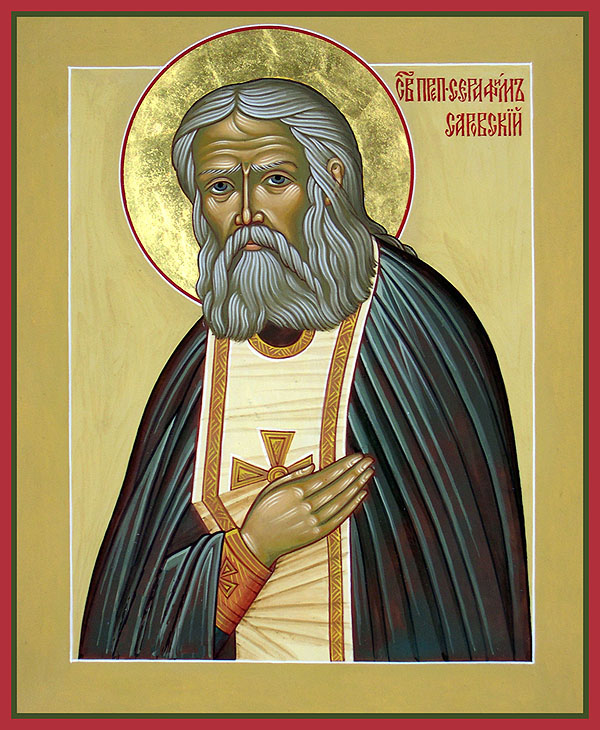
Saint Seraphim of Sarov, a great ascetic of the Russian Church, was born on July 19, 1754. His parents, Isidore and Agathia Moshnin, were inhabitants of Kursk. Isidore was a merchant. Toward the end of his life, he began construction of a cathedral in Kursk, but he died before the completion of the work. His little son Prochorus,the future Seraphim, remained in the care of his widowed mother, who raised her son in piety.
After the death of her husband, Agathia Moshnina continued with the construction of the cathedral. Once she took the seven-year-old Prochorus there with her, and he fell from the scaffolding around the seven-storey bell tower. He should have been killed, but the Lord preserved the life of the future luminary of the Church. The terrified mother ran to him and found her son unharmed.
Young Prochorus, endowed with an excellent memory, soon mastered reading and writing. From his childhood he loved to attend church services, and to read both the Holy Scripture and the Lives of the Saints with his fellow students. Most of all, he loved to pray or to read the Holy Gospel in private.
At one point Prochorus fell grievously ill, and his life was in danger. In a dream the boy saw the Mother of God, promising to visit and heal him. Soon past the courtyard of the Moshnin home came a church procession with the Kursk Root Icon of the Sign (November 27). His mother carried Prochorus in her arms, and he kissed the holy icon, after which he speedily recovered.
While still in his youth Prochorus made his plans to devote his life entirely to God and to go to a monastery. His devout mother did not object to this and she blessed him on his monastic path with a copper cross, which he wore on his chest for the rest of his life. Prochorus set off on foot with pilgrims going from Kursk to Kiev to venerate the Saints of the Caves.
The Elder Dositheus (actually a woman, Daria Tyapkina), whom Prochorus visited, blessed him to go to the Sarov wilderness monastery, and there seek his salvation. Returning briefly to his parental home, Prohkor bid a final farewell to his mother and family. On November 20, 1778 he arrived at Sarov, where the monastery then was headed by a wise Elder, Father Pachomius. He accepted him and put him under the spiritual guidance of the Elder Joseph. Under his direction Prochorus passed through many obediences at the monastery: he was the Elder’s cell-attendant, he toiled at making bread and prosphora, and at carpentry. He fulfilled all his obediences with zeal and fervor, as though serving the Lord Himself. By constant work he guarded himself against despondency (accidie), this being, as he later said, “the most dangerous temptation for new monks. It is treated by prayer, by abstaining from idle chatter, by strenuous work, by reading the Word of God and by patience, since it is engendered by pettiness of soul, negligence, and idle talk.”
With the blessing of Igumen Pachomius, Prochorus abstained from all food on Wednesdays and Fridays, and went into the forest, where in complete isolation he practiced the Jesus Prayer. After two years as a novice, Prochorus fell ill with dropsy, his body became swollen, and he was beset with suffering. His instructor Father Joseph and the other Elders were fond of Prochorus, and they provided him care. The illness dragged on for about three years, and not once did anyone hear from him a word of complaint. The Elders, fearing for his very life, wanted to call a doctor for him, but Prochorus asked that this not be done, saying to Father Pachomius: “I have entrusted myself, holy Father, to the True Physician of soul and body, our Lord Jesus Christ and His All-Pure Mother.”
He asked that a Molieben be offered for his health. While the others were praying in church, Prochorus had a vision. The Mother of God appeared to him accompanied by the holy Apostles Peter and John the Theologian. Pointing with Her hand towards the sick monk, the Most Holy Virgin said to Saint John, “He is one of our kind.” Then She touched the side of the sick man with Her staff, and immediately the fluid that had swelled up his body began to flow through the incision that She made. After the Molieben, the brethren found that Prochorus had been healed, and only a scar remained as evidence of the miracle.
Soon, at the place of the appearance of the Mother of God, an infirmary church was built for the sick. One of the side chapels was dedicated to Saints Zosimas and Sabbatius of Solovki (April 17). With his own hands, Saint Seraphim made an altar table for the chapel out of cypress wood, and he always received the Holy Mysteries in this church.
After eight years as a novice at the Sarov monastery, Prochorus was tonsured with the name Seraphim, a name reflecting his fiery love for the Lord and his zealous desire to serve Him. After a year, Seraphim was ordained as hierodeacon.
Earnest in spirit, he served in the temple each day, incessantly praying even after the service. The Lord granted him visions during the church services: he often saw holy angels serving with the priests. During the Divine Liturgy on Great and Holy Thursday, which was celebrated by the igumen Father Pachomius and by Father Joseph, Saint Seraphim had another vision. After the Little Entrance with the Gospel, the hierodeacon Seraphim pronounced the words “O Lord, save the God-fearing, and hear us.” Then, he lifted his orarion saying, “And unto ages of ages.” Suddenly, he was blinded by a bright ray of light.
Looking up, Saint Seraphim beheld the Lord Jesus Christ, coming through the western doors of the temple, surrounded by the Bodiless Powers of Heaven. Reaching the ambo, the Lord blessed all those praying and entered into His Icon to the right of the royal doors. Saint Seraphim, in spiritual rapture after this miraculous vision, was unable to utter a word, nor to move from the spot. They led him by the hand into the altar, where he just stood for another three hours, his face having changed color from the great grace that shone upon him. After the vision the saint intensified his efforts. He toiled at the monastery by day, and he spent his nights praying in his forest cell.
In 1793, Hierodeacon Seraphim was ordained to the priesthood, and he served the Divine Liturgy every day. After the death of the igumen Father Pachomius, Saint Seraphim received the blessing of the new Superior Father Isaiah, to live alone in a remote part of the forest three and a half miles from the monastery. He named his new home “Mount Athos,” and devoted himself to solitary prayer. He went to the monastery only on Saturday before the all-night Vigil, and returned to his forest cell after Sunday’s Liturgy, at which he partook of the Divine Mysteries.
Father Seraphim spent his time in ascetical struggles. His cell rule of prayer was based on the rule of Saint Pachomius for the ancient desert monasteries. He always carried the Holy Gospels with him, reading the entire New Testament in the course of a week. He also read the holy Fathers and the service books. The saint learned many of the Church hymns by heart, and sang them while working in the forest. Around his cell he cultivated a garden and set up a beehive. He kept a very strict fast, eating only once during the entire day, and on Wednesdays and Fridays he completely abstained from food. From the first Sunday of the Great Fast he did not partake of food at all until the following Saturday, when he received the Holy Mysteries.
The holy Elder was sometimes so absorbed by the unceasing prayer of the heart that he remained without stirring, neither hearing nor seeing anything around him. The schemamonk Mark the Silent and the hierodeacon Alexander, also wilderness-dwellers, would visit him every now and then. Finding the saint immersed in prayer, they would leave quietly, so they would not disturb his contemplation.
In the heat of summer the righteous one gathered moss from a swamp as fertilizer for his garden. Gnats and mosquitoes bit him relentlessly, but he endured this saying, “The passions are destroyed by suffering and by afflictions.”
His solitude was often disturbed by visits from monks and laymen, who sought his advice and blessing. With the blessing of the igumen, Father Seraphim prohibited women from visiting him, then receiving a sign that the Lord approved of his desire for complete silence, he banned all visitors. Through the prayers of the saint, the pathway to his wilderness cell was blocked by huge branches blown down from ancient pine trees. Now only the birds and the wild beasts visited him, and he dwelt with them as Adam did in Paradise. They came at midnight and waited for him to complete his Rule of prayer. Then he would feed bears, lynxes, foxes, rabbits, and even wolves with bread from his hand. Saint Seraphim also had a bear which would obey him and run errands for him.
In order to repulse the onslaughts of the Enemy, Saint Seraphim intensified his toil and began a new ascetical struggle in imitation of Saint Simeon the Stylite (September 1). Each night he climbed up on an immense rock in the forest, or a smaller one in his cell, resting only for short periods. He stood or knelt, praying with upraised hands, “God, be merciful to me, a sinner.” He prayed this way for 1,000 days and nights.
Three robbers in search of money or valuables once came upon him while he was working in his garden. The robbers demanded money from him. Though he had an axe in his hands, and could have put up a fight, he did not want to do this, recalling the words of the Lord: “Those who take up the sword will perish by the sword” (Mt. 26: 52). Dropping his axe to the ground, he said, “Do what you intend.” The robbers beat him severely and left him for dead. They wanted to throw him in the river, but first they searched the cell for money. They tore the place apart, but found nothing but icons and a few potatoes, so they left. The monk, regained consciousness, crawled to his cell, and lay there all night.
In the morning he reached the monastery with great difficulty. The brethren were horrified, seeing the ascetic with several wounds to his head, chest, ribs and back. For eight days he lay there suffering from his wounds. Doctors called to treat him were amazed that he was still alive after such a beating.
Father Seraphim was not cured by any earthly physician: the Queen of Heaven appeared to him in a vision with the Apostles Peter and John. Touching the saint’s head, the Most Holy Virgin healed him. However, he was unable to straighten up, and for the rest of his life he had to walk bent over with the aid of a stick or a small axe. Saint Seraphim had to spend about five months at the monastery, and then he returned to the forest. He forgave his abusers and asked that they not be punished.
In 1807 the abbot, Father Isaiah, fell asleep in the Lord. Saint Seraphim was asked to take his place, but he declined. He lived in silence for three years, completely cut off from the world except for the monk who came once a week to bring him food. If the saint encountered a man in the forest, he fell face down and did not get up until the passerby had moved on. Saint Seraphim acquired peace of soul and joy in the Holy Spirit. The great ascetic once said, “Acquire the spirit of peace, and a thousand souls will be saved around you.”
The new Superior of the monastery, Father Niphon, and the older brethren of the monastery told Father Seraphim either to come to the monastery on Sundays for divine services as before, or to move back into the monastery. He chose the latter course, since it had become too difficult for him to walk from his forest cell to the monastery. In the spring of 1810, he returned to the monastery after fifteen years of living in the wilderness.
Continuing his silence, he shut himself up in his cell, occupying himself with prayer and reading. He was also permitted to eat meals and to receive Communion in his cell. There Saint Seraphim attained the height of spiritual purity and was granted special gifts of grace by God: clairvoyance and wonderworking. After five years of solitude, he opened his door and allowed the monks to enter. He continued his silence, however, teaching them only by example.
On November 25, 1825 the Mother of God, accompanied by the two holy hierarchs commemorated on that day (Hieromartyr Clement of Rome, and Saint Peter, Archbishop of Alexandria), appeared to the Elder in a vision and told him to end his seclusion and to devote himself to others. He received the igumen’s blessing to divide his time between life in the forest, and at the monastery. He did not return to his Far Hermitage, but went to a cell closer to the monastery. This he called his Near Hermitage. At that time, he opened the doors of his cell to pilgrims as well as his fellow-monks.
The Elder saw into the hearts of people, and as a spiritual physician, he healed their infirmities of soul and body through prayer and by his grace-filled words. Those coming to Saint Seraphim felt his great love and tenderness. No matter what time of the year it was, he would greet everyone with the words, “Christ is Risen, my joy!” He especially loved children. Once, a young girl said to her friends, “Father Seraphim only looks like an old man. He is really a child like us.”
The Elder was often seen leaning on his stick and carrying a knapsack filled with stones. When asked why he did this, the saint humbly replied, “I am troubling him who troubles me.”
In the final period of his earthly life Saint Seraphim devoted himself to his spiritual children, the Diveyevo women’s monastery. While still a hierodeacon he had accompanied the late Father Pachomius to the Diveyevo community to its monastic leader, Mother Alexandra, a great woman ascetic, and then Father Pachomius blessed Saint Seraphim to care always for the “Diveyevo orphans.” He was a genuine father for the sisters, who turned to him with all their spiritual and material difficulties.
Saint Seraphim also devoted much effort to the women’s monastic community at Diveyevo. He himself said that he gave them no instructions of his own, but it was the Queen of Heaven who guided him in matters pertaining to the monastery. His disciples and spiritual friends helped the saint to feed and nourish the Diveyevo community. Michael V. Manturov, healed by the monk from grievous illness, was one of Diveyvo’s benefactors. On the advice of the Elder he took upon himself the exploit of voluntary poverty. Elena Vasilievna Manturova, one of the Diveyevo sisters, out of obedience to the Elder, voluntarily consented to die in place of her brother, who was still needed in this life.
Nicholas Alexandrovich Motovilov, was also healed by the monk. In 1903, shortly before the glorification of the saint, the remarkable “Conversation of Saint Seraphim of Sarov with N. A. Motovilov” was found and printed. Written by Motovilov after their conversation at the end of November 1831, the manuscript was hidden in an attic in a heap of rubbish for almost seventy years. It was found by the author S. A. Nilus, who was looking for information about Saint Seraphim’s life. This conversation is a very precious contribution to the spiritual literature of the Orthodox Church. It grew out of Nicholas Motovilov’s desire to know the aim of the Christian life. It was revealed to Saint Seraphim that Motovilov had been seeking an answer to this question since childhood, without receiving a satisfactory answer. The holy Elder told him that the aim of the Christian life is the acquisition of the Holy Spirit, and went on to explain the great benefits of prayer and the acquisition of the Holy Spirit.
Motovilov asked the saint how we can know if the Holy Spirit is with us or not. Saint Seraphim spoke at length about how people come to be in the Spirit of God, and how we can recognize His presence in us, but Motovilov wanted to understand this better. Then Father Seraphim took him by the shoulders and said, “We are both in the Spirit of God now, my son. Why don’t you look at me?”
Motovilov replied, “I cannot look, Father, for your eyes are flashing like lightning, and your face is brighter than the sun.”
Saint Seraphim told him, “Don’t be alarmed, friend of God. Now you yourself have become as bright as I am. You are in the fulness of the Spirit of God yourself, otherwise you would not be able to see me like this.”
Then Saint Seraphim promised Motovilov that God would allow him to retain this experience in his memory all his life. “It is not given for you alone to understand,” he said, “but through you it is for the whole world.”
Everyone knew and esteemed Saint Seraphim as a great ascetic and wonderworker. A year and ten months before his end, on the Feast of the Annunciation, Saint Seraphim was granted to behold the Queen of Heaven once more in the company of Saint John the Baptist, the Apostle John the Theologian and twelve Virgin Martyrs (Saints Barbara, Katherine, Thekla, Marina, Irene, Eupraxia, Pelagia, Dorothea, Makrina, Justina, Juliana, and Anysia). The Most Holy Virgin conversed at length with the monk, entrusting the Diveyevo sisters to him. Concluding the conversation, She said to him: “Soon, My dear one, you shall be with us.” The Diveyevo nun Eupraxia was present during this visit of the Mother of God, because the saint had invited her.
In the last year of Saint Seraphim’s life, one of those healed by him saw him standing in the air during prayer. The saint strictly forbade this to be mentioned until after his death.
Saint Seraphim became noticeably weaker and he spoke much about his approaching end. During this time they often saw him sitting by his coffin, which he had placed in the ante-room of his cell, and which he had prepared for himself.
The saint himself had marked the place where finally they would bury him, near the altar of the Dormition cathedral. On January 1, 1833 Father Seraphim came to the church of Saints Zosimas and Sabbatius one last time for Liturgy and he received the Holy Mysteries, after which he blessed the brethren and bid them farewell, saying: “Save your souls. Do not be despondent, but watchful. Today crowns are being prepared for us.”
On January 2, Father Paul, the saint’s cell-attendant, left his own cell at six in the morning to attend the early Liturgy. He noticed the smell of smoke coming from the Elder’s cell. Saint Seraphim would often leave candles burning in his cell, and Father Paul was concerned that they could start a fire.
“While I am alive,” he once said, “there will be no fire, but when I die, my death shall be revealed by a fire.” When they opened the door, it appeared that books and other things were smoldering. Saint Seraphim was found kneeling before an icon of the Mother of God with his arms crossed on his chest. His pure soul was taken by the angels at the time of prayer, and had flown off to the Throne of the Almighty God, Whose faithful servant Saint Seraphim had been all his life.
Saint Seraphim has promised to intercede for those who remember his parents, Isidore and Agathia.
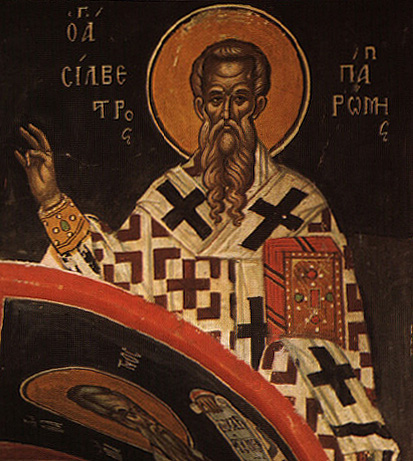
Saint Sylvester, Bishop of Rome (314-335) was born at Rome of Christian parents named Rufinus and Justa. His father soon died, and the saint remained in the care of his mother. Sylvester’s teacher, the presbyter Quirinus, gave him a fine education and raised him as a true Christian.
When he was an adult, Sylvester fulfilled the Lord’s command to love one’s neighbor. He often received strangers and travelers, serving them like a slave in his own home. During a persecution against Christians, Sylvester did not hesitate to take in the holy confessor Bishop Timothy of Antioch, who dwelt with him for more than a year, and who converted many to Christ by his preaching.
Bishop Timothy was arrested and executed on orders of the Prefect Tarquinius. Sylvester secretly took the body of the saint and buried it. This came to the attention of Tarquinius, and the saint was arrested and brought to trial. Tarquinius demanded that he renounce Christ, threatening him with torture and death. Saint Sylvester was however not intimidated, and he remained steadfast in his confession of faith, and was then thrown into prison. When Tarquinius suddenly died after the trial, the saint was set free and fearlessly he evangelized the pagans, converting many to Christianity.
At thirty years of age Saint Sylvester was ordained as a deacon, and then presbyter, by Bishop Marcellinus (296-304). After the death of Bishop Militiades (or Melchiades, 311-314), Saint Sylvester was chosen Bishop of Rome. He encouraged his flock to live in a righteous manner, and he insisted that priests strictly fulfill their duty, and not be involved with secular businesses.
Saint Sylvester became renowned as an expert on Holy Scripture and as a staunch defender of the Christian Faith. During the reign of the emperor Saint Constantine the Great, when the period of persecution had ended for the Church, the Jews arranged a public debate to determine which faith was true. Saint Constantine and his mother, the holy Empress Helen, were present together with a large crowd.
Saint Sylvester spoke for the Christians, and the Jews had one hundred and twenty learned rabbis led by Zambres, a magician and sorcerer. Quoting the sacred books of the Old Testament, Saint Sylvester convincingly demonstrated that all the prophets foretold the birth of Jesus Christ from the all-pure Virgin, and also His voluntary suffering and death for the redemption of the fallen race of mankind, and His glorious Resurrection.
The saint was declared the victor in the debate. Then Zambres tried to resort to sorcery, but the saint obstructed the evil by calling on the name of the Lord Jesus Christ. Zambres and the other Jews came to believe in Jesus Christ, and they asked to be baptized.
Saint Sylvester guided the Roman Church for more than twenty years, earning the esteem of his flock. He died peacefully in old age in the year 335.
Saint Sylvester of the Caves lived during the twelfth century and was igumen of the Mikhailovsk Vydubitsk monastery at Kiev. He continued the work of Saint Nestor the Chronicler (October 27) and he wrote nine lives of the holy saints of the Kiev Caves. In the service to the Fathers venerated in the Near Caves, Saint Sylvester is called blessed and endowed with “a miraculous gift to ward off demonic suggestions” (Ode 9 of the Canon). Saint Sylvester was buried in the Near Caves, and his memory is celebrated on September 28, and on the second Sunday of Great Lent.

Righteous Juliana of Lazarevo and Murom presents an astonishing example of a self-denying Russian Christian woman. She was the daughter of the nobleman Justin Nediurev. From her early years she lived devoutly, kept the fasts strictly and set aside much time for prayer. Having been orphaned at an early age, she was given over into the care of relatives, who did not take to her and laughed at her. Juliana bore everything with patience and without complaint. Her love for people was expressed by nursing the sick and sewing clothing for the poor.
The pious and virtuous life of the maiden attracted the attention of the Lazarevo village owner, Yurii Osoryin, who soon married her. The husband’s parents loved their gentle daughter-in-law and left the running of the household in her hands. Domestic concerns did not disrupt the spiritual efforts of Juliana. She always found time for prayer and she was always prepared to feed the orphaned and clothe the poor. During a harsh famine, she herself remained without food, having given away her last morsel to someone begging. When an epidemic started after the famine, Juliana devoted herself completely to the nursing of the sick.
Righteous Juliana had six sons and a daughter. After the death of two of her sons she decided to withdraw to a monastery, but her husband persuaded her to remain in the world, and to continue to raise their children. On the testimony of Juliana’s son, Kallistrat Osoryin, who wrote her Life, at this time she became all the more demanding towards herself: she intensified her fasting and prayer, slept not more than two hours at night, and then laying her head upon a board.
Upon the death of her husband, Juliana distributed to the poor her portion of the inheritance. Living in extreme poverty, she was none the less vivacious, cordial, and in everything she thanked the Lord. The saint was vouchsafed a visitation by Saint Nicholas the Wonderworker and guidance by the Mother of God in church. When Righteous Juliana fell asleep in the Lord, she was then buried beside her husband at the church of Saint Lazarus. Here also her daughter, the schemanun Theodosia was buried. In 1614 the relics of Righteous Juliana were uncovered, exuding a fragrant myrrh, from which many received healing.
The Hieromartyr Theogenes was bishop of the Asia Minor city of Parion at the beginning of the fourth century. During the reign of the emperor Licinius (311-324), a coruler with Constantine the Great, the tribune Zalinkinthius demanded that he give up the priesthood, to renounce Christ and to enlist in military service.
When he refused, Saint Theogenes was mercilessly beaten with rods and thrown into prison, where he was not allowed any food. Then they sentenced him to be drowned in the sea. Before his execution, the saint requested time to pray. As he prayed, an extraordinary light shone on him. The sailors and some of the soldiers who were ordered to drown the saint were struck by the light and were converted to Christ. Other soldiers hastened to cast him into the sea.
Saint Theogenes received the unfading crown of martyrdom around the year 320. His body was later taken from the water by Christians and buried at the city walls. At this spot, numerous healings occurred.

Saint George (Zorzes) was from Georgia, and was sold into slavery when he was young. His master, a Muslim from the Greek island of Mytilene, forced him to embrace Islam and renamed him Sali. After his master died, George remained on the island and opened a small shop.
In 1770, when he was seventy years old, he appeared before the authorities and announced that he was an Orthodox Christian. The kadi thought that George had lost his mind, since his declaration would lead to his death.
The next day George was questioned again, and then he was beaten. He endured his torments with silence, but would not be turned from his confession of faith. After more torture, the holy martyr was hanged on January 2, 1770, receiving a crown of glory from the Savior Christ.
Due to storms, there will not be vespers tonight. We will pray the service for the Indiction of the New Year (Civil) tomorrow at the end of the Liturgy as we have done for many years. Please be reminded that Coffee Hour has been cancelled for tomorrow as a precaution during this recent surge of the COVID virus.
CIRCUMCISION OF OUR LORD AND SAVIOR JESUS CHRIST
NO FAST
Circumcision of Our Lord and Savior Jesus Christ, Basil the Great, Archbishop of Caesarea in Cappadocia, Emmelia, Mother of Basil the Great, Gregory of Nyssa, Makrina, and Peter of Sebaste, Gregory, Bishop of Nanzianzos, Father of Gregory the Theologian, Peter the New Martyr of the Peloponnesos, Theodotos the Martyr, Righteous Theodosios of Triglia, Telemachos the Martyr, Fulgentius, Bishop of Ruspe
BRETHREN, see to it that no one makes a prey of you by philosophy and empty deceit, according to human tradition, according to the elemental spirits of the universe, and not according to Christ. For in him the whole fulness of deity dwells bodily, and you have come to fulness of life in him, who is the head of all rule and authority. In him also you were circumcised with a circumcision made without hands, by putting off the body of flesh in the circumcision of Christ; and you were buried with him in baptism, in which you were also raised with him through faith in the working of God, who raised him from the dead.
At that time, the shepherds returned, glorifying and praising God for all they had heard and seen, as it had been told them. And at the end of eight days, when he was circumcised, he was called Jesus, the name given by the angel before he was conceived in the womb. And the child grew and became strong, filled with wisdom; and the favor of God was upon him. Now his parents went to Jerusalem every year at the feast of the Passover. And when he was twelve years old, they went up according to custom; and when the feast was ended, as they were returning, the boy Jesus stayed behind in Jerusalem. His parents did not know it, but supposing him to be in the company they went a day's journey, and they sought him among their kinsfolk and acquaintances; and when they did not find him, they returned to Jerusalem, seeking him. After three days, they found him in the temple, sitting among the teachers, listening to them and asking them questions; and all who heard him were amazed at his understanding and his answers. And when they saw him they were astonished; and his mother said to him, "Son, why have you treated us so? Behold, your father and I have been looking for you anxiously." And he said to them, "How is it that you sought me? Did you not know that I must be in my Father's house?" And they did not understand the saying which he spoke to them. And he went down with them and came to Nazareth, and was obedient to them; and his mother kept all these things in her heart. And Jesus increased in wisdom and in stature, and in favor with God and man.

On the eighth day after His Nativity, our Lord Jesus Christ was circumcised in accordance with the Old Testament Law. All male infants underwent circumcision as a sign of God’s Covenant with the holy Forefather Abraham and his descendants [Genesis 17:10-14, Leviticus 12:3].
After this ritual, the Divine Infant was given the name Jesus, as the Archangel Gabriel declared on the day of the Annunciation to the Most Holy Theotokos [Luke 1:31-33, 2:21]. The Fathers of the Church explain that the Lord, the Creator of the Law, underwent circumcision in order to give people an example of how faithfully the divine ordinances ought to be fulfilled. The Lord was circumcised so that later no one would doubt that He had truly assumed human flesh, and that His Incarnation was not merely an illusion, as certain heretics had taught.
In the New Testament, the ritual of circumcision gave way to the Mystery of Baptism, which it prefigured [Colossians 2:11-12]. Accounts of the Feast of the Circumcision of the Lord continue in the Eastern Church right up through the fourth century. The Canon of the Feast was written by Saint Stephen of the Saint Savva Monastery.
In addition to circumcision, which the Lord accepted as a sign of God’s Covenant with mankind, He also received the Name Jesus [Savior] on the eighth day after His Nativity as an indication of His service, the work of the salvation of the world [Matthew 1:21; Mark 9:38-39, 16:17; Luke 10:17; Acts 3:6, 16; Philippians 2:9-10]. These two events — the Lord’s Circumcision and Naming — remind Christians that they have entered into a New Covenant with God and “are circumcised with a circumcision made without hands, in putting off the body of the sins of the flesh by the circumcision of Christ” [Colossians 2:11]. The very name “Christian” is a sign of mankind’s entrance into a New Covenant with God.
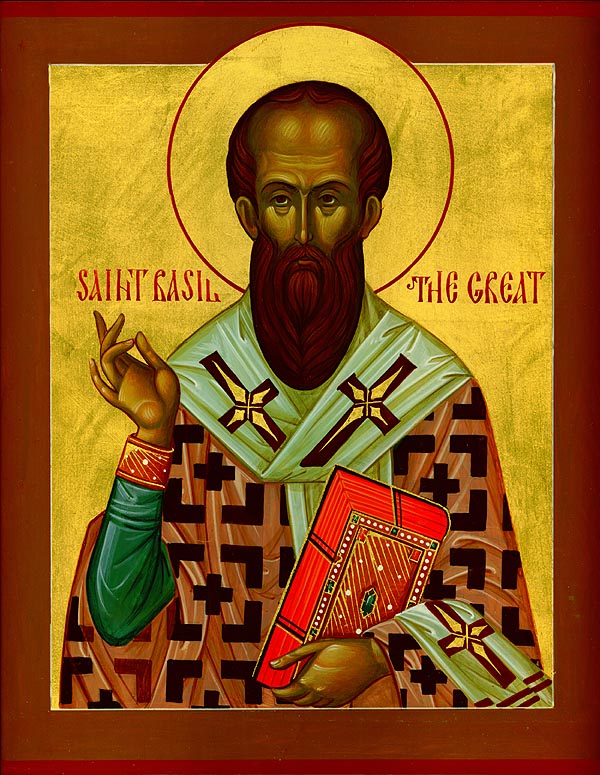
Saint Basil the Great, Archbishop of Caesarea in Cappadocia, “belongs not to the Church of Caesarea alone, nor merely to his own time, nor was he of benefit only to his own kinsmen, but rather to all lands and cities worldwide, and to all people he brought and still brings benefit, and for Christians he always was and will be a most salvific teacher.” Thus spoke Saint Basil’s contemporary, Saint Amphilochius, Bishop of Iconium.
Saint Basil was born in the year 330 at Caesarea, the administrative center of Cappadocia. He was of illustrious lineage, famed for its eminence and wealth, and zealous for the Christian Faith. The saint’s grandfather and grandmother on his father’s side had to hide in the forests of Pontus for seven years during the persecution under Diocletian.
Saint Basil’s mother Saint Emilia was the daughter of a martyr. On the Greek calendar, she is commemorated on May 30. Saint Basil’s father was also named Basil. He was a lawyer and renowned rhetorician, and lived at Caesarea.
Ten children were born to the elder Basil and Emilia: five sons and five daughters. Five of them were later numbered among the saints: Basil the Great; Macrina (July 19) was an exemplar of ascetic life, and exerted strong influence on the life and character of Saint Basil the Great; Gregory, afterwards Bishop of Nyssa (January 10); Peter, Bishop of Sebaste (January 9); and Theosebia, a deaconess (January 10).
Saint Basil spent the first years of his life on an estate belonging to his parents at the River Iris, where he was raised under the supervision of his mother Emilia and grandmother Macrina. They were women of great refinement, who remembered an earlier bishop of Cappadocia, Saint Gregory the Wonderworker (November 17). Basil received his initial education under the supervision of his father, and then he studied under the finest teachers in Caesarea of Cappadocia, and it was here that he made the acquaintance of Saint Gregory the Theologian (January 25 and January 30). Later, Basil transferred to a school at Constantinople, where he listened to eminent orators and philosophers. To complete his education Saint Basil went to Athens, the center of classical enlightenment.
After a four or five year stay at Athens, Basil had mastered all the available disciplines. “He studied everything thoroughly, more than others are wont to study a single subject. He studied each science in its very totality, as though he would study nothing else.” Philosopher, philologist, orator, jurist, naturalist, possessing profound knowledge in astronomy, mathematics and medicine, “he was a ship fully laden with learning, to the extent permitted by human nature.”
At Athens a close friendship developed between Basil the Great and Gregory the Theologian (Nazianzus), which continued throughout their life. In fact, they regarded themselves as one soul in two bodies. Later on, in his eulogy for Basil the Great, Saint Gregory the Theologian speaks with delight about this period: “Various hopes guided us, and indeed inevitably, in learning… Two paths opened up before us: the one to our sacred temples and the teachers therein; the other towards preceptors of disciplines beyond.”
About the year 357, Saint Basil returned to Caesarea, where for a while he devoted himself to rhetoric. But soon, refusing offers from Caesarea’s citizens who wanted to entrust him with the education of their offspring, Saint Basil entered upon the path of ascetic life.
After the death of her husband, Basil’s mother, her eldest daughter Macrina, and several female servants withdrew to the family estate at Iris and there began to lead an ascetic life. Basil was baptized by Dianios, the Bishop of Caesarea, and was tonsured a Reader (On the Holy Spirit, 29). He first read the Holy Scriptures to the people, then explained them.
Later on, “wishing to acquire a guide to the knowledge of truth”, the saint undertook a journey into Egypt, Syria and Palestine, to meet the great Christian ascetics dwelling there. On returning to Cappadocia, he decided to do as they did. He distributed his wealth to the needy, then settled on the opposite side of the river not far from his mother Emilia and sister Macrina, gathering around him monks living a cenobitic life.
By his letters, Basil drew his good friend Gregory the Theologian to the monastery. Saints Basil and Gregory labored in strict abstinence in their dwelling place, which had no roof or fireplace, and the food was very humble. They themselves cleared away the stones, planted and watered the trees, and carried heavy loads. Their hands were constantly calloused from the hard work. For clothing Basil had only a tunic and monastic mantle. He wore a hairshirt, but only at night, so that it would not be obvious.
In their solitude, Saints Basil and Gregory occupied themselves in an intense study of Holy Scripture. They were guided by the writings of the Fathers and commentators of the past, especially the good writings of Origen. From all these works they compiled an anthology called Philokalia. Also at this time, at the request of the monks, Saint Basil wrote down a collection of rules for virtuous life. By his preaching and by his example Saint Basil assisted in the spiritual perfection of Christians in Cappadocia and Pontus; and many indeed turned to him. Monasteries were organized for men and for women, in which places Basil sought to combine the cenobitic (koine bios, or common) lifestyle with that of the solitary hermit.
During the reign of Constantius (337-361) the heretical teachings of Arius were spreading, and the Church summoned both its saints into service. Saint Basil returned to Caesarea. In the year 362 he was ordained deacon by Bishop Meletius of Antioch. In 364 he was ordained to the holy priesthood by Bishop Eusebius of Caesarea. “But seeing,” as Gregory the Theologian relates, “that everyone exceedingly praised and honored Basil for his wisdom and reverence, Eusebius, through human weakness, succumbed to jealousy of him, and began to show dislike for him.” The monks rose up in defense of Saint Basil. To avoid causing Church discord, Basil withdrew to his own monastery and concerned himself with the organization of monasteries.
With the coming to power of the emperor Valens (364-378), who was a resolute adherent of Arianism, a time of troubles began for Orthodoxy, the onset of a great struggle. Saint Basil hastily returned to Caesarea at the request of Bishop Eusebius. In the words of Gregory the Theologian, he was for Bishop Eusebius “a good advisor, a righteous representative, an expounder of the Word of God, a staff for the aged, a faithful support in internal matters, and an activist in external matters.”
From this time church governance passed over to Basil, though he was subordinate to the hierarch. He preached daily, and often twice, in the morning and in the evening. During this time Saint Basil composed his Liturgy. He wrote a work “On the Six Days of Creation” (Hexaemeron) and another on the Prophet Isaiah in sixteen chapters, yet another on the Psalms, and also a second compilation of monastic rules. Saint Basil wrote also three books “Against Eunomius,” an Arian teacher who, with the help of Aristotelian concepts, had presented the Arian dogma in philosophic form, converting Christian teaching into a logical scheme of rational concepts.
Saint Gregory the Theologian, speaking about the activity of Basil the Great during this period, points to “the caring for the destitute and the taking in of strangers, the supervision of virgins, written and unwritten monastic rules for monks, the arrangement of prayers [Liturgy], the felicitous arrangement of altars and other things.” Upon the death of Eusebius, the Bishop of Caesarea, Saint Basil was chosen to succed him in the year 370. As Bishop of Caesarea, Saint Basil the Great was the newest of fifty bishops in eleven provinces. Saint Athanasius the Great (May 2), with joy and with thanks to God welcomed the appointment to Cappadocia of such a bishop as Basil, famed for his reverence, deep knowledge of Holy Scripture, great learning, and his efforts for the welfare of Church peace and unity.
Under Valens, the external government belonged to the Arians, who held various opinions regarding the divinity of the Son of God, and were divided into several factions. These dogmatic disputes were concerned with questions about the Holy Spirit. In his books Against Eunomios, Saint Basil the Great taught the divinity of the Holy Spirit and His equality with the Father and the Son. Subsequently, in order to provide a full explanation of Orthodox teaching on this question, Saint Basil wrote his book On the Holy Spirit at the request of Saint Amphilochius, the Bishop of Iconium.
Saint Basil’s difficulties were made worse by various circumstances: Cappadocia was divided in two under the rearrangement of provincial districts. Then at Antioch a schism occurred, occasioned by the consecration of a second bishop. There was the negative and haughty attitude of Western bishops to the attempts to draw them into the struggle with the Arians. And there was also the departure of Eustathius of Sebaste over to the Arian side. Basil had been connected to him by ties of close friendship. Amidst the constant perils Saint Basil gave encouragement to the Orthodox, confirmed them in the Faith, summoning them to bravery and endurance. The holy bishop wrote numerous letters to the churches, to bishops, to clergy and to individuals. Overcoming the heretics “by the weapon of his mouth, and by the arrows of his letters,” as an untiring champion of Orthodoxy, Saint Basil challenged the hostility and intrigues of the Arian heretics all his life. He has been compared to a bee, stinging the Church’s enemies, yet nourishing his flock with the sweet honey of his teaching.
The emperor Valens, mercilessly sending into exile any bishop who displeased him, and having implanted Arianism into other Asia Minor provinces, suddenly appeared in Cappadocia for this same purpose. He sent the prefect Modestus to Saint Basil. He began to threaten the saint with the confiscation of his property, banishment, beatings, and even death.
Saint Basil said, “If you take away my possessions, you will not enrich yourself, nor will you make me a pauper. You have no need of my old worn-out clothing, nor of my few books, of which the entirety of my wealth is comprised. Exile means nothing to me, since I am bound to no particular place. This place in which I now dwell is not mine, and any place you send me shall be mine. Better to say: every place is God’s. Where would I be neither a stranger and sojourner (Ps. 38/39:13)? Who can torture me? I am so weak, that the very first blow would render me insensible. Death would be a kindness to me, for it will bring me all the sooner to God, for Whom I live and labor, and to Whom I hasten.”
The official was stunned by his answer. “No one has ever spoken so audaciously to me,” he said.
“Perhaps,” the saint remarked, “ that is because you’ve never spoken to a bishop before. In all else we are meek, the most humble of all. But when it concerns God, and people rise up against Him, then we, counting everything else as naught, look to Him alone. Then fire, sword, wild beasts and iron rods that rend the body, serve to fill us with joy, rather than fear.”
Reporting to Valens that Saint Basil was not to be intimidated, Modestus said, “Emperor, we stand defeated by a leader of the Church.” Basil the Great again showed firmness before the emperor and his retinue and made such a strong impression on Valens that the emperor dared not give in to the Arians demanding Basil’s exile. “On the day of Theophany, amidst an innumerable multitude of the people, Valens entered the church and mixed in with the throng, in order to give the appearance of being in unity with the Church. When the singing of Psalms began in the church, it was like thunder to his hearing. The emperor beheld a sea of people, and in the altar and all around was splendor; in front of all was Basil, who acknowledged neither by gesture nor by glance, that anything else was going on in church.” Everything was focused only on God and the altar-table, and the clergy serving there in awe and reverence.
Saint Basil celebrated the church services almost every day. He was particularly concerned about the strict fulfilling of the Canons of the Church, and took care that only worthy individuals should enter into the clergy. He incessantly made the rounds of his own church, lest anywhere there be an infraction of Church discipline, and setting aright any unseemliness. At Caesarea, Saint Basil built two monasteries, a men’s and a women’s, with a church in honor of the Forty Martyrs (March 9) whose relics were buried there. Following the example of monks, the saint’s clergy, even deacons and priests, lived in remarkable poverty, to toil and lead chaste and virtuous lives. For his clergy Saint Basil obtained an exemption from taxation. He used all his personal wealth and the income from his church for the benefit of the destitute; in every center of his diocese he built a poor-house; and at Caesarea, a home for wanderers and the homeless.
Sickly since youth, the toil of teaching, his life of abstinence, and the concerns and sorrows of pastoral service took their toll on him. Saint Basil died on January 1, 379 at age 49. Shortly before his death, the saint blessed Saint Gregory the Theologian to accept the See of Constantinople.
Upon the repose of Saint Basil, the Church immediately began to celebrate his memory. Saint Amphilochius, Bishop of Iconium (November 23), in his eulogy to Saint Basil the Great, said: “It is neither without a reason nor by chance that holy Basil has taken leave from the body and had repose from the world unto God on the day of the Circumcision of Jesus, celebrated between the day of the Nativity and the day of the Baptism of Christ. Therefore, this most blessed one, preaching and praising the Nativity and Baptism of Christ, extolling spiritual circumcision, himself forsaking the flesh, now ascends to Christ on the sacred day of remembrance of the Circumcision of Christ. Therefore, let it also be established on this present day annually to honor the memory of Basil the Great festively and with solemnity.”
Saint Basil is also called “the revealer of heavenly mysteries” (Ouranophantor), a “renowned and bright star,” and “the glory and beauty of the Church.” His honorable head is in the Great Lavra on Mount Athos.
In some countries it is customary to sing special carols today in honor of Saint Basil. He is believed to visit the homes of the faithful, and a place is set for him at the table. People visit the homes of friends and relatives, and the mistress of the house gives a small gift to the children. A special bread (Vasilopita) is blessed and distributed after the Liturgy. A silver coin is baked into the bread, and whoever receives the slice with the coin is said to receive the blessing of Saint Basil for the coming year.
Saint Basil lived in the time of Julian the Apostate (331-363), and confessed his faith in Christ before the governor Saturninus. He was tortured in Ancyra, then sent to Constantinople, where he was suspended from a tree, stretched on a rack, beaten, then stabbed with red-hot needles. He was also thrown into a fiery furnace, but was not harmed. He was sent to Caesarea and was torn to pieces by lions in the arena.
This saint, a layman, should not be confused with the other Saint Basil of Ancyra, who was a priest (March 22).
Saint Basil the Great’s mother Saint Emilia was the daughter of a martyr. On the Greek calendar, she is commemorated on May 30. Saint Basil’s father was also named Basil. He was a lawyer and renowned rhetorician, and lived at Caesarea.
Ten children were born to the elder Basil and Emilia: five sons and five daughters. Five of them were later numbered among the saints: Basil the Great; Macrina (July 19) was an exemplar of ascetic life, and exerted strong influence on the life and character of Saint Basil; Gregory, afterwards Bishop of Nyssa (January 10); Peter, Bishop of Sebaste (January 9); and Theosebia, a deaconess (January 10).

On the Feast of Saint Basil the Great, we commemorate an Icon of the Most Holy Theotokos known as "You are a Vineyard," because on this day, through her Icon, the Most Holy Theotokos healed an unbelieving man of an incurable disease. After he was healed, he began to believe. Later, the Icon flowed with myrrh, and a multitude of healing miracles occurred.
This Icon is also commemorated on May 23.

Here is the live stream for Great Vespers with Litia and Artoklasia – Sat 12/31/2021 If you need, here are instructions for accessing this content from your phone, tablet, computer, or TV.
 Saint Peter Antiochian Orthodox Church
You must be logged in to post a comment.