Paul of Thebes, John the Hut-Dweller, Pansophios the Martyr of Alexandria
ST. PAUL’S LETTER TO THE GALATIANS 5:22-26; 6:1-2
Brethren, the fruit of the Spirit is love, joy, peace, patience, kindness, goodness, faithfulness, gentleness, self-control; against such there is no law. And those who belong to Christ Jesus have crucified the flesh with its passions and desires. If we live by the Spirit, let us also walk by the Spirit. Let us have no self-conceit, no provoking of one another, no envy of one another. Brethren, if a man is overtaken in any trespass, you who are spiritual should restore him in a spirit of gentleness. Look to yourself, lest you too be tempted. Bear one another’s burdens, and so fulfill the law of Christ.
LUKE 12:32-40
The Lord said, “Fear not, little flock, for it is your Father’s good pleasure to give you the Kingdom. Sell your possessions, and give alms; provide yourselves with purses that do not grow old, with a treasure in the heavens that does not fail, where no thief approaches and no moth destroys. For where your treasure is, there will your heart be also. Let your loins be girded and your lamps burning, and be like men who are waiting for their master to come home from the marriage feast, so that they may open to him at once when he comes and knocks. Blessed are those servants whom the master finds awake when he comes; truly, I say to you, he will gird himself and have them sit at table, and he will come and serve them. If he comes in the second watch, or in the third, and finds them so, blessed are those servants! But know this, that if the householder had known at what hour the thief was coming, he would not have left his house to be broken into. You also must be ready; for the Son of man is coming at an unexpected hour.”
Venerable Paul of Thebes
Saint Paul of Thebes was born in Egypt around 227 in the Thebaid of Egypt. Left orphaned, he suffered many things from a greedy relative over his inheritance. During the persecution against Christians under the emperor Decius (249-251), Saint Paul learned of his brother-in-law’s insidious plan to deliver him into the hands of the persecutors, and so he fled the city and fled into the wilderness.
Settling into a mountain cave, Saint Paul dwelt there for ninety-one years, praying incessantly to God both day and night. He sustained himself on dates and bread, which a raven brought him, and he clothed himself with palm leaves.
Saint Anthony the Great (January 17), who also lived as an ascetic in the Thebaid desert, had a revelation from God concerning Saint Paul. Saint Anthony thought that there was no other desert dweller such as he. Then God said to him, “Anthony, there is a servant of God more excellent than you, and you should go and see him.”
Saint Anthony went into the desert and came to Saint Paul’s cave. Falling to the ground before the entrance to the cave, he asked to be admitted. The Elders introduced themselves, and then embraced one another. They conversed through the night, and Saint Anthony revealed how he had been led there by God. Saint Paul disclosed to Saint Anthony that for sixty years a bird had brought him half a loaf of bread each day. Now the Lord had sent a double portion in honor of Saint Anthony’s visit. The next morning, Saint Paul spoke to Anthony of his approaching death, and instructed him to bury him. He also asked Saint Anthony to return to his monastery and bring back the cloak he had received from Saint Athanasius. He did not really need a garment, but wished to depart from his body while Saint Anthony was absent.
As he was returning with the cloak, Saint Anthony beheld the soul of Saint Paul surrounded by angels, prophets, and apostles, shining like the sun and ascending to God. He entered the cave and found Abba Paul on his knees with his arms outstretched. Saint Anthony mourned for him, and wrapped him in the cloak. He wondered how he would bury the body, for he had not remembered to bring a shovel. Two lions came running from the wilderness and dug a grave with their claws.
Saint Anthony buried the holy Elder, and took his garment of palm leaves, then he returned to his own monastery. Saint Anthony kept this garb as a precious inheritance, and wore it only twice a year, on Pascha and Pentecost.
Saint Paul of Thebes died in the year 341, when he was 113 years old. He did not establish a single monastery, but soon after his end there were many imitators of his life, and they filled the desert with monasteries. Saint Paul is honored as the first desert-dweller and hermit.
In the twelfth century Saint Paul’s relics were transferred to Constantinople and placed in the Peribleptos monastery of the Mother of God, on orders of the emperor Manuel (1143-1180). Later, they were taken to Venice, and finally to Hungary, at Ofa. Part of his head is in Rome.
Saint Paul of Thebes, whose Life was written by Saint Jerome, is not to be confused with Saint Paul the Simple (October 4).
Venerable John Calabytes “the Hut-Dweller”
Saint John the Hut-Dweller was the son of rich and illustrious parents, and was born in Constantinople in the early fifth century. He received a fine education, and he mastered rhetoric and philosophy by the age of twelve. He also loved to read spiritual books. Perceiving the vanity of worldly life, he chose the path that was narrow and extremely difficult. Filled with longing to enter a monastery, he confided his intention to a passing monk. John made him promise to come back for him when he returned from his pilgrimage to Jerusalem, and take him to his monastery.
He asked his parents for a Gospel so that he might study the words of Christ. John’s parents hired a calligrapher to copy the text, and had the volume bound in a golden cover studded with gems. John read the Gospel constantly, delighting in the Savior’s words.
The monk kept his promise to come back for John, and they went secretly to Bithynia. At the monastery of the “Unsleeping” (Akoimitoi), he received monastic tonsure. The young monk began his ascetical labors with zeal, astonishing the brethren with his unceasing prayer, humble obedience, strict abstinence, and perseverance at work.
After six years, he began to undergo temptations. He remembered his parents, how much they loved him, and what sorrow he caused them. He regretted leaving them, and was filled with a burning desire to see them again.
Saint John explained his situation to the igumen Saint Marcellus (December 29) and he asked to be released from the monastery. He begged the igumen for his blessing and prayers to return home. He bid farewell to the brethren, hoping that by their prayers and with the help of God, he would both see his parents and overcome the snares of the devil. The igumen then blessed him for his journey.
Saint John returned to Constantinople, not to resume his former life of luxury, but dressed as a beggar, and unknown to anyone. He settled in a corner by the gates of his parents’ home. His father noticed the “pauper,” and began to send him food from his table, for the sake of Christ. John lived in a small hut for three years, oppressed and insulted by the servants, enduring cold and frost, unceasingly conversing with the Lord and the holy angels.
Before his death, the Lord appeared to the monk in a vision, revealing that the end of his sorrows was approaching, and that in three days he would be taken into the Heavenly Kingdom. Therefore, he asked the steward to give his mother a message to come to him, for he had something to say to her.
At first, she did not wish to go, but she was curious to know what this beggar had to say to her. Then he sent her another message, saying that he would die in three days. John thanked her for the charity he had received, and told her that God would reward her for it. He then made her promise to bury him beneath his hut, dressed in his rags. Only then did the saint give her his Gospel, which he always carried with him, saying, “May this console you in this life, and guide you to the next life.”
She showed the Gospel to her husband, saying that it was similar to the one they had given their son. He realized that it was, in fact, the very Gospel they had commissioned for John. They went back to the gates, intending to ask the pauper where he got the Gospel, and if he knew anything about their son. Unable to restrain himself any longer, he admitted that he was their child. With tears of joy they embraced him, weeping because he had endured privation for so long at the very gates of his parental home.
The saint died in the mid-fifth century, when he was not quite twenty-five years old. On the place of his burial the parents built a church, and beside it a hostel for strangers. When they died, they were buried in the church they had built.
In the twelfth century the head of the saint was taken by Crusaders to Besançon (in France), and other relics of the saint were taken to Rome.
Venerable Pansophius of Alexandria, the Martyr
The Monk Martyr Pansophius, was a son of the Alexandrian proconsul Nilus. After the death of his father, he distributed his inheritance to the poor and settled in the desert, where he lived in asceticism for twenty-seven years.
During the persecution by Decius (249-251) Saint Pansophius was brought to trial before the prefect of Alexandria. The monk boldly confessed his faith in Christ and denounced pagan errors, for which he was fiercely beaten with rods. He died from these beatings, thereby receiving a martyr’s crown (249-251).
Saint Prochorus, Abbot in the Vranski Desert on the River Pshina in Bulgaria
Saint Prochorus of Pshina pursued asceticism in the Bransk wilderness at the River Pshina, and he founded a monastery there. He is renowned as one of the great ascetics of monastic life. He died at the end of the tenth century. Miracles occurred from the saint’s relics. According to the Serbian Chronicles, the pious King Milutin (1276-1320) built a church in honor of Saint Prochorus.
Venerable Gabriel, Founder of Lesnov Monastery in Bulgaria
Saint Gabriel, founder of the Lesnov monastery near the city of Kratov. Receiving a large inheritance after the death of his parents, he rejected marriage and became a monk on a mountain at Lesnov. There he built a church in the name of the Archangel Michael, and gathered many monks around him. He appointed an igumen, and left all his inheritance to the monastery. He then hid himself in a mine, where he lived in asceticism for thirty years, conquering demonic temptations through prayer and fasting.
He then returned to the Lesnov monastery and ended his life in peace. After thirty years, his relics were uncovered, and healings worked through them. Long afterwards, they were transferred to Trnovo [Tirnova] in Bulgaria.
Saint Ita, Hermitess of Killeedy
Saint Ita, “the Foster Mother of the Irish Saints,” was born in the fifth century. She, like many of the Irish saints, was of the nobility. Her parents were devout Christians who lived in County Waterford. She founded a school and convent at Killeedy (Cille Ide) which still bears her name near Newcastle West in Co. Limerick. A holy well still marks the site of her church.
When she decided to settle in Killeedy, a local chieftain offered her a grant of land for the support of the convent, which Saint Ita accepted and cultivated. The convent became known as a training ground for young boys, many of whom became famous churchmen. She received Saint Brendan the Voyager (May 16) when he was only a year old, and kept him until he was six. She also cared for her nephew Saint Mochaemhoch (March 13) in his infancy. She called him “Pulcherius,” because he was such a handsome child.
Many people sought her spiritual counsels, and she also seems to have practiced medicine to some degree. Her life was spent in repentance and asceticism.
Saint Ita once told Saint Brendan that the three things most displeasing to God are: A face that hates mankind, a will that clings to the love of evil, and placing one’s entire trust in riches (Compare Proverbs 6:16-19).
The three things most pleasing to God are: The firm belief of a pure heart in God, the simple religious life, and liberality with charity.
Saint Ita fell asleep in the Lord in 570. Her Feast Day is a local holiday in the district, and her name is a popular one for Irish girls.
Saints Salome of Ujarma and Perozhavra of Sivnia
Saints Salome of Ujarma and Perozhavra of Sivnia were the helpers and closest companions of Saint Nino, Enlightener of Georgia. Saint Nino herself had converted them to the Christian Faith.
Salome was the wife of Revi, the son of King Mirian, and Perozhavra was married to the ruler of the Kartli region. Both women were queens, but they succeeded in serving Saint Nino while retaining their imperial roles. Saint Nino taught them to pray, and the women fasted regularly and performed good works. As a result of their influential social status, the two queens were able to help Saint Nino tremendously in spreading the Christian Faith.
After the conversion of Kartli, with inspiration from Saint Nino and by the order of King Mirian, Saint Salome erected a cross in Ujarma in the Kakheti region.
When Saint Nino fell ill in the village of Bodbe, the queens Salome and Perozhavra stood by her bed and wept bitterly at having to part with their beloved teacher and healer. They entreated Saint Nino, who was finishing her last hours on this earth, saying, “Tell us, our Queen, how did you come to our country to free our souls, and where were you raised? Tell us how to continue your good works. You who have delivered us from bondage to the enemy, tell us, what shall we do?”
From the information that Saint Nino then related to them, Saints Salome and Perozhavra wrote The Life of Saint Nino, Enlightener of Georgia. The Apostolic Orthodox Church of Georgia commemorates them on January 15, the day following the commemoration of Saint Nino.
Saint Barlaam of Keretsk
Saint Barlaam of Keretsk served during the sixteenth century as a priest in the Keretsk area of the Kolsk peninsula on the White Sea. He was venerated as the patron of White Sea industrial workers and sea-farers. He was glorified by posthumous miracles, saving those in danger of drowning.
LEAVETAKING OF THE THEOPHANY OF OUR LORD AND SAVIOUR JESUS CHRIST
ABSTAIN FROM MEAT, FISH, DAIRY, EGGS
Leavetaking of the Theophany of Our Lord and Saviour Jesus Christ, The Holy Fathers slain at Sinai and Raitho, Plato the Hieromartyr, Bishop of Tallini and all Estonia, and the Priest Martyrs Michael and Nicholas, Agnes the Virgin-martyr, Sabbas (Sava), Archbishop of Serbia, Nina of Georgia
ACTS OF THE APOSTLES 2:38-43
In those days, Peter said to the people, “Repent and be baptized every one of you in the name of Jesus Christ for the forgiveness of your sins; and you shall receive the gift of the Holy Spirit. For the promise is to you and to your children and to all that are far off, every one whom the Lord our God calls to him.” And he testified with many other words and exhorted them, saying, “Save yourselves from this crooked generation.” So those who received his word were baptized, and there were added that day about three thousand souls. And they devoted themselves to the apostles’ teaching and fellowship, to the breaking of bread and the prayers. And fear came upon every soul; and many wonders and signs were done through the apostles.
LUKE 4:1-15
At that time Jesus returned from the Jordan, and was led by the Spirit for forty days in the wilderness, tempted by the devil. And he ate nothing in those days; and when they were ended, he was hungry. The devil said to him, "If you are the Son of God, command this stone to become bread." And Jesus answered him, "It is written, 'Man shall not live by bread alone.'" And the devil took him up, and showed him all the kingdoms of the world in a moment of time, and said to him, "To you I will give all this authority and their glory; for it has been delivered to me, and I will give it to whom I will. If you, then, will worship me, it shall all be yours." And Jesus answered him, "It is written, 'You shall worship the Lord your God, and him only shall you serve.'
And he took him to Jerusalem, and set him on the pinnacle of the temple, and said to him, "If you are the Son of God, throw yourself down from here; for it is written, 'He will give his angels charge of you, to guard you, ' and 'On their hands they will bear you up, lest you strike your foot against a stone.'" And Jesus answered him, "It is said, 'You shall not tempt the Lord your God.'" And when the devil had ended every temptation, he departed from him until an opportune time. And Jesus returned in the power of the Spirit into Galilee, and a report concerning him went out through all the surrounding country. And he taught in their synagogues, being glorified by all.
Leavetaking of the Theophany of our Lord and Savior Jesus Christ
The Leavetaking of the Feast of Theophany takes place on January 14. The entire office of the Feast is repeated except for the Entrance, festal readings, Litya, Blessing of Loaves at Vespers, and the Polyeleos and festal Gospel at Matins. The festal Antiphons are not sung at Liturgy, and the Epistle and Gospel of the day are read.
Saint Savva I, first Archbishop of Serbia
Saint Savva, First Archbishop of Serbia, in the world Rostislav (Rastko), was a son of the Serbian king Stephen Nemanya and Anna, daughter of the Byzantine Emperor Romanus. From his early years he fervently attended church services and had a special love for icons.
At seventeen years of age, Rostislav met a monk from Mount Athos, secretly left his father’s house and set off for the Saint Panteleimon monastery. (By divine Providence in 1169, the year of the saint’s birth, the ancient monastery of the Great Martyr and healer Panteleimon was given to Russian monks.)
Knowing that his son was on Athos, his father mobilized his retainers headed by a faithful voevod and wrote to the governor of the district which included Athos, saying that if his son were not returned to him, he would go to war against the Greeks. When they arrived at the monastery, the voevod was ordered not to take his eyes off Rostislav. During the evening services, when the soldiers had fallen asleep under the influence of wine, Rostislav received monastic tonsure (in 1186) and sent to his parents his worldly clothes, his hair and a letter. Saint Savva sought to persuade his powerful parents to accept monasticism. The monk’s father (in monasticism Simeon, commemorated on February 13) and his son pursued asceticism at the Vatopedi monastery. On Athos they established the Serbian Hilandar monastery, and this monastery received its name by imperial grant. At Hilandar monastery, Saint Savva was ordained to the diaconate and then presbyter. His mother Anna became a nun with the name Anastasia (June 21).
For his holy life and virtuous deeds on Mount Athos, the monk was made an archimandrite at Thessalonica. At Nicea in the year 1219 on the Feast of the Dormition of the Most Holy Theotokos, the Ecumenical Patriarch Germanus consecrated Archimandrite Savva as Archbishop of Serbia. The saint petitioned the Byzantine Emperor to grant permission for Serbian bishops to elect their own Archbishop in future. This was a very important consideration in a time of frequent wars between the eastern and western powers.
Having returned to the Holy Mountain from Nicea, the saint visited all the monasteries for the last time. He made prostrations in all the churches and, calling to mind the blessed lives of the wilderness Fathers, he made his farewells to the ascetics with deep remorse, “leaving the Holy Mountain, as if from Paradise.”
Saddened by his separation from the Holy Mountain, the saint went along the path from Athos just barely moving. The Most Holy Theotokos spoke to the saint in a dream, “Having My Patronage, why do you remain sorrowful?” These words roused him from despondency, changing his sorrow into joy. In memory of this appearance, the saint commissioned large icons of the Savior and of the Mother of God at Thessalonica, and put them in a church.
In Serbia, the activity of the Hierarch in organizing the work of his native Church was accompanied by numerous signs and miracles. During the Liturgy and the all-night Vigil, when the saint came to cense the grave of his father the monk Simeon, the holy relics exuded fragrant myrrh.
Being in charge of negotiations with the Hungarian King Vladislav, who had declared war on Serbia, the holy bishop not only brought about the desired peace for his country, but he also brought the Hungarian monarch to Orthodoxy. Thus he facilitated the start of the historical existence of the autonomous Serbian Church. Saint Savva also contributed to strengthening the Serbian state. In order to insure the independence of the Serbian state, Archbishop Savva crowned his powerful brother Stephen as king. Upon the death of Stephen, his eldest son Radislav was crowned king, and Saint Savva set off to the Holy Land “to worship at the holy tomb of Christ and fearsome Golgotha.”
When he returned to his native land, the saint blessed and crowned Vladislav as king. To further strengthen the Serbian throne, he betrothed him to the daughter of the Bulgarian prince Asan. The holy hierarch visited churches all across Serbia, he reformed monastic rules on the model of Athos and Palestine, and he established and consecrated many churches, strengthening the Orthodox in their faith. Having finished his work in his native land, the saint appointed the hieromonk Arsenius as his successor, consecrating him bishop and giving his blessing to all.
He then set off on a journey of no return, desiring “to end his days as a wanderer in a foreign land.” He passed through Palestine, Syria and Persia, Babylon, Egypt and Anatolia, everywhere visiting the holy places, conversing with great ascetics, and collecting the holy relics of saints. The saint finished his wanderings at Trnovo in Bulgaria at the home of his kinsman Asan, where with spiritual joy he gave up his soul to the Lord (+ 1237).
At the time of transfer of the holy relics of Saint Savva to Serbia in 1237, there were so many healings that the Bulgarians began to complain about Asan, “because he had given up such a treasure.” In the saint’s own country, his venerable relics were placed in the Church of Mileshevo, bestowing healing on all who approached with faith. The inhabitants of Trnovo continued to receive healing from the remnants of the saint’s coffin, which Asan ordered to be gathered together and placed in a newly built sarcophagus.
The legacy of Saint Savva lives on in the Orthodox Church traditions of the Slavic nations. He is associated with the introduction of the Jerusalem Typikon as the basis for Slavic Monastic Rules. The Serbian Hilandar monastery on Mt. Athos lives by the Typikon of Saint Savva to this day. Editions of The Rudder (a collection of church canons) of Saint Savva, with commentary by Alexis Aristines, are the most widely disseminated in the Russian Church. In 1270 the first copy of The Rudder of Saint Savva was sent from Bulgaria to Metropolitan Cyril of Kiev. From this was copied one of the most ancient of the Russian Rudders, the Ryazan Rudder of 1284. It in turn was the source for a printed Rudder published in 1653, and since that time often reprinted by the Russian Church. Such was the legacy of Saint Savva to the canonical treasury of Orthodoxy.
Holy Monastic Fathers slain at Sinai and Raithu
There were two occasions when the monks and hermits at Sinai and Raithu were murdered by the barbarians. The first took place in the fourth century when forty Fathers were killed at Mt. Sinai, and thirty-nine were slain at Raithu on the same day.
Mount Sinai, where the Ten Commandments had been given to Moses, was also the site of another miracle. Ammonios, an Egyptian monk, witnessed the murder of the forty holy Fathers at Sinai. He tells of how the Saracens attacked the monastery and would have killed them all, if God had not intervened. A fire appeared on the summit of the peak, and the whole mountain smoked. The barbarians were terrified, and fled, while the surviving monks thanked God for sparing them.
That day, the Blemmyes (an Arab tribe) killed thirty-nine Fathers at Raithu (on the shores of the Red Sea). Igumen Paul of Raithu exhorted his monks to endure their suffering with courage and a pure heart.
The second massacres occurred nearly a hundred years later, and was also recorded by an eyewitness who miraculously escaped: Saint Nilus the Faster (November 12). The Arabs permitted some of the monks to run for their lives. They crossed the valley and climbed up a mountain. From this vantage point, they saw the bedouin kill the monks and ransack their cells.
The Sinai and Raithu ascetics lived a particularly strict life: they spent the whole week at prayer in their cells. On Saturday they gathered for the all-night Vigil, and on Sunday they received the Holy Mysteries. Their only food was dates and water. Many of the ascetics of the desert were glorified by the gift of wonderworking: the Elders Moses, Joseph and others. Mentioned in the service to these monastic Fathers are: Isaiah, Savva, Moses and his disciple Moses, Jeremiah, Paul, Adam, Sergius, Domnus, Proclus, Hypatius, Isaac, Macarius, Mark, Benjamin, Eusebius and Elias.
Saint Nino (Nina), Equal of the Apostles, Enlightener of Georgia
The virgin Nino of Cappadocia was a relative of Great-martyr George and the only daughter of a widely respected and honorable couple. Her father was a Roman army chief by the name of Zabulon, and her mother, Sosana, was the sister of Patriarch Juvenal of Jerusalem. When Nino reached the age of twelve, her parents sold all their possessions and moved to Jerusalem. Soon after, Nino’s father was tonsured a monk. He bid farewell to his family and went to labor in the wilderness of the Jordan.
After Sosana had been separated from her husband, Patriarch Juvenal ordained her a deaconess. She left her daughter Nino in the care of an old woman, Sara Niaphor, who raised her in the Christian Faith and related to her the stories of Christ’s life and His suffering on earth. It was from Sara that Nino learned how Christ’s Robe had arrived in Georgia, a country of pagans.
Soon Nino began to pray fervently to the Theotokos, asking for her blessing to travel to Georgia and be made worthy to venerate the Sacred Robe that she had woven for her beloved Son. The Most Holy Virgin heard her prayers and appeared to Nino in a dream, saying, “Go to the country that was assigned to me by lot and preach the Gospel of our Lord Jesus Christ. He will send down His grace upon you and I will be your protector.”
But the blessed Nino was overwhelmed at the thought of such a great responsibility and answered, “How can I, a fragile woman, perform such a momentous task, and how can I believe that this vision is real?” In response, the Most Holy Theotokos presented her with a cross of grapevines and proclaimed, “Receive this cross as a shield against visible and invisible enemies!”
When she awoke, Nino was holding the cross in her hands. She dampened it with tears of rejoicing and tied it securely with strands of her own hair. (According to another source, the Theotokos bound the grapevine cross with strands of her own hair.)
Nino related the vision to her uncle, Patriarch Juvenal, and revealed to him her desire to preach the Gospel in Georgia. Juvenal led her in front of the Royal Doors, laid his hands on her, and prayed, “O Lord, God of Eternity, I beseech Thee on behalf of my orphaned niece: Grant that, according to Thy will, she may go to preach and proclaim Thy Holy Resurrection. O Christ God, be Thou to her a guide, a refuge, and a spiritual father. And as Thou didst enlighten the Apostles and all those who feared Thy name, do Thou also enlighten her with the wisdom to proclaim Thy glad tidings.”
When Nino arrived in Rome, she met and baptized the princess Rhipsimia and her nurse, Gaiana. At that time the Roman emperor was Diocletian, a ruler infamous for persecuting Christians. Diocletian (284-305) fell in love with Rhipsimia and resolved to marry her, but Saint Nino, Rhipsimia, Gaiana, and fifty other virgins escaped to Armenia. The furious Diocletian ordered his soldiers to follow them and sent a messenger to Tiridates, the Armenian king (286-344), to put him on guard.
King Tiridates located the women and, following Diocletian’s example, was charmed by Rhipsimia’s beauty and resolved to marry her. But Saint Rhipsimia would not consent to wed him, and in his rage the king had her tortured to death with Gaiana and the fifty other virgins. Saint Nino, however, was being prepared for a different, greater task, and she succeeded in escaping King Tiridates’ persecutions by hiding among some rose bushes.
When she finally arrived in Georgia, Saint Nino was greeted by a group of Mtskhetan shepherds near Lake Paravani, and she received a blessing from God to preach to the pagans of this region.
With the help of her acquaintances Saint Nino soon reached the city of Urbnisi. She remained there a month, then traveled to Mtskheta with a group of Georgians who were making a pilgrimage to venerate the pagan idol Armazi. There she watched with great sadness as the Georgian people trembled before the idols. She was exceedingly sorrowful and prayed to the Lord, “O Lord, send down Thy mercy upon this nation…that all nations may glorify Thee alone, the One True God, through Thy Son, Jesus Christ.”
Suddenly a violent wind began to blow and hail fell from the sky, shattering the pagan statues. The terrified worshipers fled, scattering across the city.
Saint Nino made her home beneath a bramble bush in the garden of the king, with the family of the royal gardener. The gardener and his wife were childless, but through Saint Nino’s prayers God granted them a child. The couple rejoiced exceedingly, declared Christ to be the True God, and became disciples of Saint Nino. Wherever Saint Nino went, those who heard her preach converted to the Christian Faith in great numbers. Saint Nino even healed the terminally ill Queen Nana after she declared Christ to be the True God.
King Mirian, a pagan, was not at all pleased with the great impression Saint Nino’s preaching had made on the Georgian nation. One day while he was out hunting, he resolved to kill all those who followed Christ.
According to his wicked scheme, even his wife, Queen Nana, would face death for failing to renounce the Christian Faith. But in the midst of the hunt, it suddenly became very dark. All alone, King Mirian became greatly afraid and prayed in vain for the help of the pagan gods. When his prayers went unanswered, he finally lost hope and, miraculously, he turned to Christ: “God of Nino, illumine this night for me and guide my footsteps, and I will declare Thy Holy Name. I will erect a cross and venerate it and I will construct for Thee a temple. I vow to be obedient to Nino and to the Faith of the Roman people!”
Suddenly the night was transfigured, the sun shone radiantly, and King Mirian gave great thanks to the Creator. When he returned to the city, he immediately informed Saint Nino of his decision. As a result of the unceasing labors of Equal-to-the-Apostles Nino, Georgia was established as a nation solidly rooted in the Christian Faith.
Saint Nino reposed in the village of Bodbe in eastern Georgia and, according to her will, she was buried in the place where she took her last breath. King Mirian later erected a church in honor of Saint George over her grave.
Saint Joseph Analytinus of Raithu
Saint Joseph Analytinus of Raithu was a strict ascetic. He attained such a high degree of perfection in the spiritual life that a light shone upon him while he prayed. He foretold the time of his death to his disciple Gelasius, and died in peace, before the slaughter of the Sinai Fathers.
Venerable Theodulus, son of Venerable Nilus of Sinai
Saint Theodulus was the son of Saint Nilus the Faster (November 12), and he recorded the slaughter of the holy Fathers at Raithu in the fifth century. While still a child, Saint Theodulus left the world and went to Mount Sinai with his father.
During a barbarian assault on the desert dwellers, the saint fell into the hands of brigands, who decided to offer the youth as a sacrifice to the morning dawn, which they worshipped in place of God. But the Lord saved the boy through the prayers of his father, Saint Nilus. The barbarians slept past sunrise, and giving up on the idea of making him a sacrificial offering, they took the youth with them.
Brought by the brigands to the city of Eluza, Saint Theodulus was ransomed by the local bishop, in whose house he was later found by his grateful father. Blessed by the bishop and presbyters, Saints Theodulus and Nilus returned to Mount Sinai, where they served the Lord until the end of their days. Their incorrupt relics were transferred to Constantinople under Emperor Justin the Younger (565-578) and placed in the church of the holy Apostles at Orphanotrophia.
Venerable Stephen, Abbot of Khenolakkos Monastery, near Chalcedon
Saint Stephen lived during the eighth century, and was born into a family in Cappadocia, who raised him in great piety. As he reached maturity, he was greatly impressed by reading the lives of the holy ascetics, and so he visited many monasteries in Palestine in order to observe their way of life. In the wilderness he visited the monasteries of Saints Euthymios the Great (January 20), Savva the Sanctified (December 5) and Theodosios the Great (January 11), studying the Rule (Typikon) of each monastery.
Later, during the reign of the iconoclast Emperor Leo the Isaurian (717-741), he visited Constantinople. The holy Patriarch Germanos (May 12) had a high regard for Stephen, and aided him in building a monastery in Bithynia in which he could establish a monastic Rule based on the great lessons that he had learned in the course of his many years of experience. Saint Stephen founded the Monastery of Khenolakkos [“by the goose-pond”], which was northeast of Triglia (near Moudania in Asia Minor). Many monks were drawn there by reports of his virtue.
Saint Stephen was distinguished for his paternal administration of the monastery, and for his moral influence on the monks. After many years as the Superior of the monastery, the holy ascetic foresaw his own death. When he fell asleep in the Lord, some of the brethren were found worthy to behold the glorious departure of his soul into Heaven, escorted by angels.
Saint Kentigern, first Bishop of Glasgow, Scotland
Saint Kentigern was from Lothian (in Scotland), and may have been of royal blood. He left home at an early age and was brought up by a hermit named Servan (July 1) on the Firth of Forth. It was Saint Servan who gave him the name Mungo (or dear friend).
Saint Kentigern Mungo labored in Strathclyde, and founded a monastery where the city of Glasgow stands today. He was made a bishop, taking Glasgow for his See.
Driven from Scotland by the enmity of a local ruler, Saint Kentigern went to Wales and founded the monastery of Saint Asaph. Eventually, he returned to Scotland and resumed his missionary work, baptizing many people.
In 584 he met Saint Columba (June 9), and exchanged croziers with him.
Saint Kentigern was a strict ascetic who traveled everywhere on foot. It is believed that he died in Glasgow around 612 at the age of eighty-five. A Gothic cathedral was built over his shrine in the thirteenth century.
Saint Meletios, Bishop of Ryazan
Bishop Meletios, one of the last preachers of the Holy Gospel to the people of Siberia with all the self-denial of a true missionary, reposed on January 14, 1900. He spent nearly thirty-five years of ascetic labors in eastern Siberia, spreading the light of Christ among the native Buryats, Tungus, and Yakuts. In 1896, he was consecrated as Bishop of Ryazan, where he continued his missionary work until the last days of his truly ascetical life.
Bishop Meletios (Michael Koz’mich Yakimov in the world) was from the Viatka Diocese, and he was born on October 29, 1835, the son of a village priest. His father died when Michael was just a year old, leaving his wife to take care of the children in great poverty. Despite the family’s destitution and Michael’s poor health, he successfully completed his primary and secondary schooling, and as one of the best students in the seminary, he was able to continue his education at the Academy. Even then, his soul was attracted to solitude.
After graduating from seminary, Michael spoke to the rector, Archimandrite Ambrose, the Igoumen of the Dormition Monastery, asking to be accepted into the monastery, and to be tonsured. His request was not fully granted, however. He was received into the monastery, but was not tonsured. Here, he fulfilled the obediences of preaching and working in the library. Later, he was appointed as a teacher of Church History and Church singing in the primary school in Viatka.
Still later, he was asked to supervise the students who lived in the monastery. He remained in the humble position of a young novice for a year. In August of 1858 he entered the Kazan Academy, and on February 1, 1859 he was tonsured with the name Meletios in honor of Saint Meletios of Antioch (February 12). On March 16, he was ordained to the diaconate by Bishop Νikόdēmos.
By a Synodal ukaz, he was sent to the Posol’sk Monastery of the Savior at Lake Baikal in the Diocese of Irkutsk (southeastern Siberia). He arrived at the monastery on June 23, 1862 and began his beneficial work among the Buryats at once. This resulted in the Baptism of many natives, the building of churches, and establishing villages for the newly-baptized (most of them were nomadic or semi-nomadic). In December of that same year, Deacon Meletios was ordained to the holy priesthood.
About this time Father Meletios became the close friend of Vicar Bishop Benjamin of Selengin (later Archbishop of Irkutsk), and this friendship endured for the rest of their lives. Father Meletios’s work took him from place to place on the very borders of Mongolia. He did not remain there long, however. On August 30, 1873 Archbishop Benjamin placed him in charge of the Irkutsk mission, and on February 2, 1874 he was elevated to the rank of Archimandrite of the Nilov Hermitage in the Sayansk Mountains. From that time, his missionary work expanded a great deal, and even more so when he went to Kazan to learn the methods for translating Christian books into the native languages.
During his stay outside the mission, he visited his family in Viatka Province, visiting his mother and his brother, who was a priest in the village of Verkhovskoy, Nolinsky district, and made a pilgrimage in Moscow and Kiev. He lived in Kazan until May 1875.
There, his relationship with Professor Nicholas I. Il’minsky (1822-1891) and his assistants had great significance for the Saint’s future missionary work. In the work of translating Christian teachings into spoken Buryat, Father Meletios was helped by the Buryat Jacob Chistokhin, his cell attendant (later a missionary of the Tunkinsky Territory). The first book in the Buryat language was published at Kazan: “Teaching the newly-baptized about the Holy Christian Faith” (Поучение к новокрещёным о святой христианской вере).
This was a very important step, which led to the success of the work of evangelizing the natives during the five years that Archimandrite Meletios was in charge of the mission, and 11,000 natives were baptized. His labors increased after his consecration as Vicar Bishop of the Irkutsk Diocese (1888-1896), and he was appointed to oversee the missionary territory east of Lake Baikal.
The regional city of Chita (Чита) became the center from which the missionary bishop went all around Lake Baikal, especially in 1881 (which was the 200th anniversary of the founding of the Trans-Baikal mission by the missionaries Theodosios and Makarios). He went around preaching the Word of God throughout Trans-Baikal, enlightening his flock and shaping the churchly and secular lives of the newly- baptized in order to integrate them into the permanent Russian population. Vladika Meletios founded the Church Brotherhood of Saints Cyril and Methodios, and of Saint Innocent of Irkutsk in Chita, in order to reinforce the spread of Christianity in his flock. He did everything possible to strengthen his spiritual children by starting church schools. The result of these measures while he was the head of the Eastern Baikal Mission was the conversion of some 4000 natives to Christianity from shamanism, and Lamaites.1
On July 5, 1889 he was appointed Bishop of Yakutsk and arrived there on September 16. The Diocese of Yakutsk previously had a worthy missionary bishop named Dionysios, who later became Bishop of Ufa. He may certainly be called the Apostle to the Yakuts.
During the first year in his new Diocese, Saint Meletios employed the methods he had learned from experience in his new territory. Each year he would inspect different sections of his vast Diocese. Although there were no roads, he covered tens of thousands of miles in one trip. He built churches, and found generous donors for this purpose. On his journeys he consecrated many of these churches himself, and organized church schools for them. By the end of 1889, there were 77 churches in his Diocese, and 118 chapels. In 1895, there were nine stone churches, 214 wooden churches, chapels, and houses of prayer. Later, the number of churches and schools increased. Always looking for ways to support the schools, Bishop Meletios requested and obtained an annual allowance of 6000 rubles, paid to him by the Department of Revenue. In 1892, he organized the Church Brotherhood of Christ the Savior.
There was another aspect to his missionary work at Yakutsk, he was the first person to reduce and help to eradicate leprosy among his flock. In 1890 there was an article in the Yakutsk Diocesan Journal # 17, entitled “Leprosy in the Vilyusk Region.” The following year, Miss Marsden, who was an English nurse, came to the region, and worked very hard to help those who were sick. Bishop Meletios was so energetic in his efforts to help her that he received a letter of thanks from the Anglican Archbishop of Canterbury. Needless to say, his flock was most grateful to him for this. Therefore, when he left to go to the Diocese of Riazan, his farewell was exceptionally warm. Seldom has a bishop received such a farewell.
On October 14, 1896 he was named Bishop of Ryazan and Zaraysk. On November 27, he left Yakutsk and arrived in Ryazan on February 17, 1897. It was no wonder that his flock at Riazan awaited their new Archpastor with great enthusiasm and expectation, since they knew of his past life of asceticism and missionary activity, and they were not disappointed in their expectations. This kindly hierarch, who demanded much of himself, yet was condescending to the weakness of others, was an excellent preacher and a true missionary. He left behind a vast legacy of good deeds which caused him to be remembered by the people of Ryazan. Also in 1897, he was made an honorary member of the Kazan Theological Academy.
His missionary activities in Siberia had a profound influence on his labors in his new Diocese. In the Diocese of Ryazan there were many Old Ritualists, and even Moslems. Bishop Meletios revived the mission to the Mohammedans, and he also wrote a great deal. He published many of his sermons, missionary notes, and reports about the Eastern Baikal and Irkutsk missions. He also contributed many historical articles to various Orthodox journals, all for the sake of his missionary work, and not for personal gain. All of his articles came from his apostolic spirit and his character, which were revealed in all the places where he labored for the glory of God. During his thirty-five years of missionary work, he was known as the “Apostle to the Yakuts, and Enlightener of the Gentiles in Siberia and Asia.”
Saint Meletios reposed on January 14, 1900, and was buried in the Cathedral of the Ryazan Kremlin. Saint Meletios was included in the Synaxis of the Siberian Saints in 1983. The Lord Himself decided to glorify the relics of His saint: almost a hundred years after his repose his holy relics were found on June 18, 1998 in the Cathedral of the Archangel Michael of the Ryazan Kremlin, on the eve of the celebration of the Synaxis of the Ryazan Saints and the Synaxis of the Siberian Saints, and the eve of the celebration of the 800th anniversary of the Ryazan Diocese. On September 18, 1998, his relics were transferred to Ryazan’s Trinity Monastery.
Over the course of 35 years of work in this field, he was called “The Apostle of the Yakuts and the Enlightener of the Pagans in Siberia and Asia.“
1 These were natives from southeastern Siberia, in the area near Tibet, who acknowledged the spiritual authority of the Dalai Lama.
Hieromartyr Platon, the first Bishop of Estonia, and all the New Martyrs of Estonia
The holy Hieromartyr Platon (Πλάτων) was born on July 13, 1869, at Pootsi in Pätnu county, Estonia. At Holy Baptism, he received the name Paul.
After attending various theological schools, Paul Kulbusch was ordained as a priest. Father Paul travelled about, preaching the Word of God in the Orthodox churches of Estonia.
On December 31, 1917 he was consecrated as the first Bishop of Estonia, engaging in numerous activities in his efforts to elevate the Orthodox parishes. Less than two months after his consecration, Estonia was occupied by the German army. At that time it was very difficult to travel, but that did not stop the Bishop from visiting almost all of the Orthodox parishes in Estonia during that summer.
In 1919, he was arrested by the atheist regime in Moscow and, after being tortured, he was shot on January 14, 1919. Afterward, Archpriest Nicholas Bezhanitsky and Archpriest Michael Bleive were also put to death. Saint Platon's relics rest in the Cathedral of the Transfiguration in Tallinn.
Today the Church also commemorates all the New Martyrs of Estonia: Priests, Deacons and laymen.
Bishop Platon, Archpriests Nicholas Bezhanitsky and Michael Bleive were glorified as martyrs by the Russian Orthodox Church Outside of Russia in 1982, and by the Patriarchate of Constantinople in 2000.
A Church Service in honor of Saint Platon was composed by Metropolitan Joel of Edessa.
AFTERFEAST OF THE THEOPHANY OF OUR LORD AND SAVIOUR JESUS CHRIST
NO FAST
Afterfeast of the Theophany of Our Lord and Saviour Jesus Christ, The Holy Martyrs Hermylus and Stratonicus, Synaxis of the Most Holy Theotokos – Mediatress, Maximos the Righteous of Kapsokalyvia, Mount Athos, Hilary of Poitiers, Kentigern, Bishop of Glasgow
ST. PAUL’S LETTER TO THE GALATIANS 3:23-29; 4:1-5
Brethren, before faith came, we were confined under the law, kept under restraint until faith should be revealed. So that the law was our custodian until Christ came, that we might be justified by faith. But now that faith has come, we are no longer under a custodian; for in Christ Jesus you are all sons of God, through faith. For as many of you as were baptized into Christ have put on Christ. There is neither Jew nor Greek, there is neither slave nor free, there is neither male nor female; for you are all one in Christ Jesus. And if you are Christ’s, then you are Abraham’s offspring, heirs according to promise. I mean that the heir, as long as he is a child, is no better than a slave, though he is the owner of all the estate; but he is under guardians and trustees until the date set by the father. So with us; when we were children, we were slaves to the elemental spirits of the universe. But when the time had fully come, God sent forth his Son, born of a woman, born under the law, to redeem those who were under the law, so that we might receive adoption as sons.
LUKE 20:1-8
At that time, as Jesus was teaching the people in the temple and preaching the gospel, the chief priests and the scribes with the elders came up and said to Him, ‘Tell us by what authority you do these things, or who it is that gave you this authority.’ He answered them, ‘I also will ask you a question; now tell me, was the baptism of John from heaven or from men?’ And they discussed it with one another, saying, ‘If we say, ‘From heaven, ‘ he will say, ‘Why did you not believe him?’ But if we say, ‘From men, ‘ all the people will stone us; for they are convinced that John was a prophet.’ So they answered that they did not know whence it was. And Jesus said to them, ‘Neither will I tell you by what authority I do these things.’
Afterfeast of the Theophany of our Lord and Savior Jesus Christ
The seventh day of the Afterfeast of Theophany falls on January 13. Many of the Church’s hymns during this period rejoice in the manifestation of God (Theophany) at Christ’s baptism in the Jordan. The voice of the Father is heard, the Son enters the water, and the Holy Spirit appears in the form of a dove.
Martyrs Hermylus and Stratonicus of Belgrade
The Holy Martyrs Hermylus and Stratonicus, Slavs by origin, lived at the beginning of the fourth century during a persecution against Christians by the emperor Licinius (311-324). Saint Hermylus served as deacon in the city of Singidunum (Belgrade). Condemned by Licinius to imprisonment, he was long and cruelly tortured for Christ, but he remained unyielding.
Hermylus mocked the pagan gods, calling them deaf, dumb, and blind idols. In anger Licinius ordered more severe torments for him, saying that he could avoid them if he would offer sacrifice. The holy martyr predicted that Licinius would suffer terrible wounds himself because he worshiped idols instead of the Creator. His words came true, for Licinius was killed in 324.
After three days Hermylus was brought before the tribunal again and asked whether he would avoid more torture by offering sacrifice. The saint replied that he would offer worship and sacrifice only to the true God.
Saint Hermylus prayed that the Lord would give him strength to endure his torments and triumph over the pagans. A voice was heard saying, “Hermylus, you will be delivered from your suffering in three days, and will receive a great reward.” The torturers fell to the ground in fear, and took the saint back to prison.
Saint Stratonicus was one of the prison guards and a secret Christian. Seeing the agonizing torments of his friend, he was unable to keep from weeping, and he revealed that he was a Christian. They also subjected him to punishment.
After the torture, they put both martyrs into a net and threw them into the Danube. On the third day, the bodies of the saints were found by Christians on the bank of the river and buried near Singidunum. Their venerable heads were in the Church of Hagia Sophia, where the Russian pilgrim Anthony saw them in the year 1200.
Venerable Irenarchus the Recluse of Rostov
Irenarchus, Hermit of Rostov, was born into a peasant family in the village of Kondakovo in the Rostov district. In Baptism he received the name Elias. In his thirtieth year, he was tonsured a monk at the Rostov Saints Boris and Gleb monastery. There he began fervently to labor at monastic tasks, he attended church services, and by night he prayed and slept on the ground. Once, taking pity on a vagrant who did not have shoes, Saint Irenarchus gave him his own boots, and from that time he began to go barefoot through the snow.
The igumen did not care for such behavior, and he began to humiliate him, compelling him to stand for an hour or nearly two in the snow opposite his cell, or to ring the bells for a long time. The saint endured everything with patience but he did not change his conduct. The igumen continued to be hard-hearted, and the monk was obliged to transfer to the Abramiev Theophany monastery, where he was accepted into the number of the brethren and he was soon chosen as steward.
The saint fulfilled his monastic obediences with zeal, but grieved that the brethren and servants did not look after the property of the monastery, but imprudently wasted it. Once in a dream he saw Saint Abraham of Rostov (October 29), who comforted him and blessed him to distribute necessities to all without trouble. Later, Saint Irenarchus sobbed loudly during the singing of the Cherubimic hymn. The archimandrite asked him why he wept, and he answered, “My mother has died!”
Leaving Abramiev monastery, Saint Irenarchus transferred to the Rostov monastery of Saint Lazarus, settled into a solitary cell and lived for three years in privation and hunger. Here he was visited by Blessed John the Fool, nicknamed “the Big Simpleton.” The saints encouraged each other by spiritual conversation. The Elder, however, had a desire to return to the Saints Boris and Gleb monastery. He was accepted back with love by the strict Barlaam, and he began to pursue even greater ascetic deeds at the monastery.
Having withdrawn into solitude, Saint Irenarchus chained himself to a wooden chair, and he placed on himself heavy chains and crosses. For this he endured the mockery and sneers of the brethren. During this time he was visited by his old friend, Blessed John the Fool, who predicted the Lithuanian invasion of Moscow.
Saint Irenarchus spent twenty-five years shackled in chains and in arduous tasks. His ascetic deeds were a silent reproach to those living carelessly at the monastery, and they lied to the igumen about him. They said that the Elder taught that they should not do monastic work, but rather pursue asceticism as he did. The igumen believed the slander and he banished the holy Elder from the monastery. Humbly submitting, Saint Irenarchus again went to Rostov and lived in the monastery of Saint Lazarus for one year.
Meanwhile the igumen of Saints Boris and Gleb regretted his conduct and sent monks after Saint Irenarchus. He returned, blaming himself that he did not live like the brethren who engaged in righteous works, in which he was lacking. The monk continued to bear his own heavy fetters. He made clothes for the needy, and he knitted hairshirts and klobuks. He slept at night for only an hour or two, the rest of the time he prayed and beat his body with an iron rod.
Saint Irenarchus had a vision that Lithuania would invade Moscow, and that churches there would be destroyed. He began to weep bitterly about the impending disaster, and the igumen ordered him to go to Moscow and warn Tsar Basil Shuisky (1606-1610) about the terrible misfortune. Saint Irenarchus carried out the order. He refused the gifts offered him and when he returned, he began to pray fervently that the Lord would show mercy on the Russian land.
Enemies appeared against Russia, they began the conquest of the city, beat the inhabitants, and robbed churches and monasteries. The False Demetrius and a second Pretender sought to conquer Russia for the Polish king. Saints Boris and Gleb monastery was also overrun by the enemy, who came to the holy hermit and were amazed at the direct and bold words of the Elder, predicting catastrophe for them.
Sapega, remaining at the Saints Boris and Gleb monastery, wanted to see the Elder sitting in chains, and he was amazed at such an ascetic exploit. When the Polish nobles with Sapega told him that the Elder prayed for Shuisky, the monk boldly said, “I am born and baptized in Russia, and I pray to God for the Russian Tsar.” Sapega answered, “Grandfather speaks truly; in whatever land one lives, there one also serves.” After this Saint Irenarchus began to urge Sapega to leave Russia, predicting death for him if he did not do so.
Saint Irenarchus followed the course of the war and sent his blessings and a prosphora to Prince Demetrius Pozharsky. He told him to come to Moscow, predicting, “You shall see the glory of God.” To assist Pozharsky and Minin, the saint handed over his cross. With the help of God the Russians vanquished the Lithuanians, Prince Pozharsky took possession of the Kremlin, and peace gradually began to return to the Russian land. Saint Irenarchus incessantly prayed God with tears for the deliverance of Russia from enemies and, with the power to work miracles, he healed the sick and demoniacs.
The day of his death was revealed to him, and summoning his disciples Alexander and Cornelius, he gave them his final instructions. After taking leave of all he quietly fell asleep in the Lord. The holy Elder left behind 142 copper crosses, seven shoulder chains, other chains which he wore on his neck, iron foot shackles, eighteen hand fetters, heavy “bonds” which he wore on his belt, and iron rods with which he thrashed his body to drive away demons.
In these works, as the Elder called them, he spent thirty-eight years, and having lived in the world for thirty years, he died in his sixty-eighth year. After the death of Saint Irenarchus, many miracles took place at his grave, especially the healing of the sick and the demoniacs by laying the holy ascetic’s crosses and chains upon them.
Venerable Eleazar of Anzersk Island, Solovki
Saint Eleazar of Anzersk was born in the city of Kozelsk into the merchant family Severiukov. With the blessing of his parents he went off to the Solovki monastery, where he received monastic tonsure from the igumen Saint Irenarchus (July 17).
At the monastery he displayed an astonishing artistic gift: he learned woodcarving and he took part in the embellishment of the Transfiguration Cathedral. With the blessing of the igumen, he went to the island of Anzersk in 1612, where he became a hermit, devoting himself to constant prayer and meditation on God.
In order to obtain subsistence for himself on the island wilderness, Saint Eleazar carved wooden cups, which he left at the dock. On the cups he wrote a message requesting food. Fishermen left bread and other supplies for the ascetic, and they were rewarded with a great catch of fish.
In the year 1616 Saint Eleazar was elevated to schemamonk. Disciples gathered around the saint wishing to live near him and benefit from his instruction. He organized a skete with a strict rule of monastic life following the ancient form. Monastic cells were built far away from one another, and the hermits gathered together only for Saturday and Sunday services.
Among the disciples of Saint Eleazar was the hieromonk Nikḗtas, the future Patriarch Nikon. Tsar Michael (1613-1645), learning of the saint’s ascetic life, summoned him to Moscow. Saint Eleazar predicted the birth of a son, and in return the Tsar generously gave him help to build a stone church on the island dedicated to the Holy Trinity, and also a monastery.
Saint Eleazar loved books. He compiled three books, “Flower Gardens,” collecting edifying sayings and examples from various sources. He also wrote a commentary on the Rule for monastic cell life.
Saint Eleazar died in great old age, forseeing the time of his death. It is not known how old he was, but he lived at Ansersk for forty years, and he was at Solovki for some time before that.
Martyr Peter of Anium, at Hieropolis
Saint Peter was slain at Hieropolis between 309—320 for confessing Christ.
Saint James, Bishop of Nisibis
Saint James, Bishop of Nisibis, was the son of prince Gefal (Armenia) and received a fine upbringing. From the time of his youth he loved solitude, and for a long time he lived in the mountains around about the city of Niziba (on the border of the Persian and Roman Empires), where he carried out strict ascetic exploits: he lived under the open sky, fed himself with tree fruits and greens, and dressed himself in goat-skins. The monk passed all this time in prayerful conversations with God.
During a persecution by the emperor Maximian (284-305) he was glorified by a courageous confession of faith. Because of his strict and pious life the inhabitants of Nisibis chose him as their bishop (no later than the year 314). Saint James was glorified by his ardent zeal for the Orthodox Faith, by great miracles and by the gift of clairvoyance. By his prayers Nisibis was saved from an invasion by Sapor, the emperor of Persia.
Saint James, among the Fathers of the First Ecumenical Council, was one of the prominent defenders of the Orthodox Faith. A wise and educated pastor, he constructed a public school at Nisibis, in which he himself was an instructor. He made a strong impression on the hearts of his listeners by the high morality of his life.
Saint Gregory, bishop of great Armenia, turned to him with a request to write about the faith, and the Nisibis pastor sent to him by way of reply a detailed Discourse (18 Chapters): about the faith, about love, fasting, prayer, spiritual warfare, the resurrection of the dead, the duties of pastors, about circumcision (against the Jews), about the choice of foods, about Christ as the Son of God, and so on. His composition distinguishes itself by its persuasive clear exposition and warmth.
Saint James died peacefully in about the year 350.
Saint Hilary, Bishop of Poitiers
Saint Hilary, the great opponent of Arianism, was born around 320. He was raised as a pagan, but converted to Christianity as an adult. He became Bishop of Poitiers in 350. When the emperor Constantius II attempted to impose Arianism on the western Church, Saint Hilary led a vigorous opposition to his efforts. Because of his outspoken criticism, he was exiled to Phrygia in 356. There he became such a defender and champion of Orthodoxy that the emperor decided it would be less trouble to allow him to return to his diocese.
Saint Hilary continued to fight against Arianism until his death in 368. His holy relics still rest in the cathedral bearing his name at Poitiers in France.
He has lent his name to the “Hilary term” of English law courts and universities, which begin on or near his Feast Day.
Venerable Maximus Kavsokalyvites of Mount Athos
Saint Maximus Kavsokalyvites was educated at the church of the Most Holy Theotokos at Lampsakos. At seventeen years of age he left his parental home, became a monk, and passed his obedience under Elder Mark, the finest spiritual instructor in Macedonia. After the death of his teacher, the saint pursued asceticism under the guidance of several desert Fathers of extremely strict life. Arriving in Constantinople, Saint Maximus was constantly at the Blachernae church of the Most Holy Theotokos, as though he had taken up his abode at the entrance.
From his youth, Saint Maximus had a great love for the Mother of God. He persistently entreated Her to grant him the gift of unceasing mental prayer. One day, as he was venerating her icon, he felt a warmth and a flame enter his heart from the icon. It did not burn him, but he felt a certain sweetness and contrition within. From that time, his heart began to repeat the Jesus Prayer of itself. In this way, the Virgin Theotokos fulfilled his request.
Saint Maximus fulfilled his obedience in the Lavra of Saint Athanasius on Mt. Athos. In order to conceal his ascetic deeds of fasting and prayer, and to avoid celebrity, he behaved like a fool. One day, he had a vision of the Mother of God, who told him to ascend the mountain. On the summit of the Holy Mountain, he prayed for three days and nights. Again, the Most Holy Theotokos appeared to him surrounded by angels, and holding Her divine Son in Her arms.
Prostrating himself, the saint heard the All-Holy Virgin speak to him, “Receive the gift against demons… and settle at the foot of Athos, for this is the will of My Son.” She told him that he would ascend the heights of virtue, and become a teacher and guide for many. Then, since he had not eaten for several days, a heavenly bread was given to him. As soon as he put it in his mouth, he was surrounded by divine light, and he saw the Mother of God ascending into Heaven.
Saint Maximus told his vision to a certain Elder living by the church of the holy Prophet Elias at Carmel. He was skeptical, but the saint turned his disbelief to good. He pretended to be slightly crazy in order to conceal his prodigious ascetic deeds, privations, his hardship and solitude. Saint Maximus did not live in a permanent abode, but wandered from place to place like a lunatic. Whenever he moved, he would burn his hut down. Therefore, he was called “Kavsokalyvites,” or “Hut Burner.”
Those on the Holy Mountain, knowing of the extreme deprivations and sorrows of Saint Maximus, for a long time regarded him with contempt, even though he had attained the height and perfection of spiritual life. When Saint Gregory of Sinai (August 8) arrived on Athos, he encountered the holy fool. After speaking to him, he began to call him an earthly angel. Saint Gregory persuaded Saint Maximus to stop behaving like a fool and to live in one place so that others might benefit from his spiritual experience. Heeding the words of Saint Gregory and the advice of other Elders, Saint Maximus selected a permanent dwelling in a cave near the renowned Elder Isaiah.
Knowing of his gift of clairvoyance, the Byzantine Emperors John Paleologos (1341-1376) and John Kantakouzenos (1341-1355) visited him and were surprised by the fulfillment of his predictions. Theophanes, the igumen of Vatopedi monastery, wrote about Saint Maximus: “I invoke God as my witness, that I myself saw several of his miracles. Once, for instance, I saw him travel through the air from one place to another. I listened as he made a prediction concerning me, that first I would be an igumen, and then Metropolitan of Ochrid. He even revealed to me how I would suffer for the Church.”
Saint Maximus abandoned his solitude only just before his death, and settled near the Lavra of Saint Athanasius, where he surrendered his soul to the Lord at 95 years of age (+ 1354). After his death, as in life, Saint Maximus was glorified by many miracles.
Saint Elian, Missionary to Cornwall, England
Little is known of Saint Elian. While some accounts hold that he came by sea from Rome and landed in Anglesey at Porth yr Yehen in Northern Wales, where he established a church around 450 AD, others claim that he was of Cornish or Breton roots and lived during the sixth century. He was said to have been related to Saint Ismael, the sixth century Welsh Bishop of Rhos. He is remembered for his missionary efforts in Cornwall, England and for establishing several religious houses.
AFTERFEAST OF THE THEOPHANY OF OUR LORD AND SAVIOUR JESUS CHRIST
ABSTAIN FROM MEAT, FISH, DAIRY, EGGS, WINE, OLIVE OIL
Afterfeast of the Theophany of Our Lord and Saviour Jesus Christ, Tatiana the Martyr of Rome, Basil and John the Hieromartyrs, Martyr Mertios, Euthasia the Virgin-Martyr, Peter of Absalom, Benedict
ACTS OF THE APOSTLES 18:22-28
IN THOSE DAYS, when Paul had landed at Caesarea, he went up and greeted the church, and then went down to Antioch. After spending some time there he departed and went from place to place through the region of Galatia and Phrygia, strengthening all the disciples. Now a Jew named Apollos, a native of Alexandria, came to Ephesos. He was an eloquent man, well versed in the scriptures. He had been instructed in the way of the Lord; and being fervent in the spirit, he spoke and taught accurately the things concerning Jesus, though he knew only the baptism of John. He began to speak boldly in the synagogue; but when Priscilla and Aquila heard him, they took him and expounded to him the way of God more accurately. And when he wished to cross to Achaia, the brethren encouraged him, and wrote to the disciples to receive him. When he arrived, he greatly helped those who through grace had believed, for he powerfully confuted the Jews in public, showing by the scriptures that the Christ was Jesus.
JOHN 10:39-42
At that time, the Jews tried to arrest Jesus, but he escaped from their hands. He went away again across the Jordan to the place where John at first baptized, and there he remained. And many came to him; and they said, “John did no sign, but everything that John said about this man was true.” And many believed in him there.
Afterfeast of the Theophany of our Lord and Savior Jesus Christ
The sixth day of the Afterfeast of Theophany falls on January 12. Divine grace shines forth so that we might be freed from the power of the devil, and cleansed of our sins in Baptism.
“He who once assumed the appearance of a malignant serpent and implanted death in the creation, is now cast into
darkness by Christ’s coming in the flesh….” (Ode 3, second Canon at Matins).
“Through the Spirit and by the grace that comes through water, He grants a new birth to all who acknowledge His divinity, delivering them from their faults” (Ode 6, first Canon at Matins).
Martyr Tatiana of Rome, and those who suffered with her
The Holy Virgin Martyr Tatiana was born into an illustrious Roman family, and her father was elected consul three times. He was secretly a Christian and raised his daughter to be devoted to God and the Church. When she reached the age of maturity, Tatiana decided to remain a virgin, betrothing herself to Christ. Disdaining earthly riches, she sought instead the imperishable wealth of Heaven. She was made a deaconess in one of the Roman churches and served God in fasting and prayer, tending the sick and helping the needy.
When Rome was ruled by the sixteen-year-old Alexander Severus (222-235), all power was concentrated in the hands of the regent Ulpian, an evil enemy and persecutor of Christians. Christian blood flowed like water. Tatiana was also arrested, and they brought her into the temple of Apollo to force her to offer sacrifice to the idol. The saint began praying, and suddenly there was an earthquake. The idol was smashed into pieces, and part of the temple collapsed and fell down on the pagan priests and many pagans. The demon inhabiting the idol fled screeching from that place. Those present saw its shadow flying through the air.
Then they tore holy virgin’s eyes out with hooks, but she bravely endured everything, praying for her tormentors that the Lord would open their spiritual eyes. And the Lord heard the prayer of His servant. The executioners saw four angels encircle the saint and beat her tormentors. A voice was heard from the heavens speaking to the holy virgin. Eight men believed in Christ and fell on their knees before Saint Tatiana, begging them to forgive them their sin against her. For confessing themselves Christians they were tortured and executed, receiving Baptism by blood.
The next day Saint Tatiana was brought before the wicked judge. Seeing her completely healed of all her wounds, they stripped her and beat her, and slashed her body with razors. A wondrous fragrance then filled the air. Then she was stretched out on the ground and beaten for so long that the servants had to be replaced several times. The torturers became exhausted and said that an invisible power was beating them with iron rods. Indeed, the angels warded off the blows directed at her and turned them upon the tormentors, causing nine of them to fall dead. They then threw the saint in prison, where she prayed all night and sang praises to the Lord with the angels.
A new morning began, and they took Saint Tatiana to the tribunal once more. The torturers beheld with astonishment that after such terrible torments she appeared completely healthy and even more radiant and beautiful than before. They began to urge her to offer sacrifice to the goddess Diana. The saint seemed agreeable, and they took her to the heathen temple. Saint Tatiana made the Sign of the Cross and began to pray. Suddenly, there was a crash of deafening thunder, and lightning struck the idol, the sacrificial offerings and the pagan priests.
Once again, the martyr was fiercely tortured. She was hung up and scraped with iron claws, and her breasts were cut off. That night, angels appeared to her in prison and healed her wounds as before. On the following day, they took Saint Tatiana to the circus and loosed a hungry lion on her. The beast did not harm the saint, but meekly licked her feet.
As they were taking the lion back to its cage, it killed one of the torturers. They threw Tatiana into a fire, but the fire did not harm the martyr. The pagans, thinking that she was a sorceress, cut her hair to take away her magical powers, then locked her up in the temple of Zeus.
On the third day, pagan priests came to the temple intending to offer sacrifice to Zeus. They beheld the idol on the floor, shattered to pieces, and the holy martyr Tatiana joyously praising the Lord Jesus Christ. The judge then condemned the valiant sufferer to be beheaded with a sword. Her father was also executed with her, because he had raised her to love Christ.
The Relics of Saint Tatiana in Craiova
The honorable head of the Holy Martyr Tatiana was first brought to Romania in 1204, when members of the ruling family (Asanestan dynasty) placed it in a church in Tarnovo (Bulgaria) and then in Bucovat Monastery (near Craiova). Later, however, in 1393, the head of the Saint was taken to a church in the town of Nicaea (where the First Ecumenical Synod met), and then to Constantinople, and placed in the Church of the Holy Apostles.
In 1453, after the conquest of Constantinople by the Turks, during the reign of Neagoe Basarab, the Craioveşti boyars brought the head of the holy Martyr Tatiana to this country, as well as the entire body of Saint Gregory the Decapolite (November 20), which they placed in the church of Bistriţa Monastery. From that monastery, the relics of Saint Tatiana were taken by Saint Neagoe Basarab (September 15) and brought to the royal church at Curtea de Argeș. Later, with the reorganization of the Metropolitan Church of Oltenia (1950-1955), the honorable skull of Saint Tatiana was taken from Curtea de Argeș and brought to the Episcopal Cathedral of Râmnicu Vâlcea in 1955. Finally, the honored relics were permanently enshrined in the Metropolitan Cathedral of Craiova.
Today, the holy relics of Saint Tatiana are kept, with great honor, in the Metropolitan Cathedral of the Holy Great Martyr Demetrios in Craiova, in the same reliquary with the relics of Saint Niphon of Constantinople (August 11), and the Holy Martyrs Sergius and Bacchus (October 7).
Venerable Martinian, Abbot of Belozersk
Saint Martinian of White Lake, in the world Michael, was born in the year 1370 in the village of Berezniko, not far from the Cyrilov monastery. At age thirteen he left his parents and went secretly to Saint Cyril of White Lake (June 9), whom many described as a great ascetic.
The young Martinian began zealously to imitate his teacher, with whom he dwelt in complete obedience. At the monastery he studied reading and writing, and with the blessing of Saint Cyril, he occupied himself with the copying of books. In time Martinian was ordained deacon and then hieromonk.
After the death of Saint Cyril (+ 1427), Martinian withdrew to a deserted island on Lake Vozha. Several monks gradually gathered around him. Saint Martinian established for them the church of the Transfiguration of the Lord and introduced a general Rule for the inhabitants. Yielding to the persistent requests of the brethren of Therapon monastery, he consented to become igumen of the monastery and brought it into an improved condition.
Saint Martinian gave spiritual support to Great Prince Basil in the difficulties of his time, when his first-cousin Demetrius Shemyaka illicitly sought the Moscow throne. He was always an advocate of truth and justice. Afterwards, upon the entreaty of the Great Prince, the saint accepted the governance of the monastery of Saint Sergius of Radonezh.
In 1455, Saint Martinian returned to the Therapon monastery. In his last years he was grievously ill and not able to walk, so the brethren carried him to church. He died at age 85. His relics were uncovered in the year 1514, and this event is celebrated on October 7.
Martyr Mertius of Mauretania
The Holy Martyr Mertius was a soldier. He suffered for Christ in Africa during the reign of Diocletian (284-305). The emperor demanded that he offer sacrifice to idols, and when he refused, gave him over to torture. The saint suffered fierce torments, not making a sound. He was thrown into prison, where he died from hunger and his wounds.
Martyr Peter Apselamus of Palestine
The Holy Martyr Peter Apselamus was a native of the village of Aneia in Palestine. During the fourth century persecution against Christians he was arrested and brought to Severus, the governor of Palestine. In vain did the judge and the people urge him to escape torture by sacrificing to the pagan gods.
“I will spare myself by remaining faithful to the truth and refusing to offer sacrifice to lifeless idols,” the saint replied. “Whoever offers sacrifice to false gods will perish.”
Severus was enraged, and ordered the holy martyr to be tortured without mercy. Finally, he was crucified during the reign of Maximian, while our Lord Jesus Christ was reigning unto the ages of ages.
In some Lives of the Saints he is listed twice: on January 12 as the martyr Peter Apselamus, and on January 13 as Peter of Aneia, because it was mistakenly assumed that they were different persons.
Venerable Eupraxia of Tabenna, in Egypt
Saint Eupraxia the Elder was the mother of Saint Eupraxia, maiden of Tabennisi (July 25). She was the wife of the pious senator Antigonus, who was related to the emperor Theodosius the Great (379-395). Following the birth of their daughter, the couple decided to live from that time forward as brother and sister. They distributed alms to the poor, hoping to inherit the heavenly Kingdom.
After she was widowed, Saint Eupraxia devoted herself completely to the service of the Lord. After visiting several monastic establishments and bestowing liberal alms, she came to the Tabennisi monastery in Egypt, where the abbess was the nun Theodula, known for her strict rule.
Deeply moved by the pure way of monastic life, Saint Eupraxia came often to this monastery and always brought her eight-year-old daughter with her. The virtues and prayers of her parents bestowed a particular grace of God upon the child, who desired to dedicate herself to God. To her mother’s great joy, the abbess Theodula kept the younger Eupraxia at the convent and blessed her to receive monastic tonsure.
Saint Eupraxia the elder continued her works of charity, and increased her fasting and prayer. Abbess Theodula, possessing the gift of clairvoyance, told her of her impending end. Learning of her imminent death, Eupraxia gave thanks to the Lord for His great mercy towards her. She bid farewell to the sisters of the convent and to her daughter. She left her with these parting words: “Love the Lord Jesus Christ, and respect the sisters. Never dare to think that they are below you and should serve you. Be poor in your thoughts in order to profit by spiritual treasures. Also remember your father and me, and pray for the salvation of our souls.” After three days the saint surrendered her soul to the Lord (+ 393) and was buried at the monastery, where her daughter continued her ascetic struggles.
Icon of the Mother of God of “the Akathist”
The “Akathist” Icon of the Mother of God is on the iconostasis of the Hilandar monastery’s katholikon. It is known as the “Akathist” Icon because, during a fire at the katholikon in 1837 an Akathist was being read before the icon, and it remained unharmed, to the joy of the monks.
This icon should not be confused with the Zographou Icon “Of the Akathist” (October 10).
Icon of the Mother of God the “Milkgiver”
The “Milk-Giver” Icon of the Mother of God was originally located at the Lavra of Saint Savva the Sanctified near Jerusalem. Before his death, the holy founder of the Lavra foretold that a royal pilgrim having the same name as himself would visit the Lavra. Saint Savva told the brethren to give the wonderworking icon to that pilgrim as a blessing.
In the thirteenth century, Saint Savva of Serbia visited the Lavra. As he approached the reliquary of Saint Savva the Sanctified, the saint’s staff fell at his feet. The brethren asked the visitor his name, and he told them he was Archbishop Savva of Serbia. Obeying the instructions of their founder, the monks gave Saint Savva his staff, the “Milk-Giver” Icon, and the Icon “Of the Three Hands” (June 28 & July 12).
The holy archbishop took the icon to Hilandar on Mount Athos and put it on the right side of the iconostasis in the church of Saint Savva at the kellion of Karyes, which is attached to Hilandar. The icon was later named Typikonissa, since the Rule (Typikon) of Saint Savva was preserved there.
Icon of the Mother of God, the “Priestly”
The “Priestly” Icon of the Mother of God stands in the katholikon of Hilandar Monastery by a column of the left kliros. A certain heretical priest, having declared himself Orthodox, acted at the Hilandar monastery with evil purpose, but he was punished. During the procession for the blessing of water he took this icon but stumbled, fell into the sea and drowned. Since that time the cross procession is always done with this icon, and invariably a priest carries it, so it was called “Priestly” by the Serbs.
Virgin Martyrs Neollina, Domnina, and Parthena
On the first Sunday after Theophany (January 7-13), we celebrate the memory of the Virgin Martyrs Neollina, Domnina and Parthena (Νεολλίνα, Δομνίνα, Παρθένα) of Edessa in the Holy Metropolis of Edessa and Pella.
Nothing is known about Saints Neollina and Domnina, but only about Saint Parthena. The Holy Virgin Martyr Parthena came from Edessa in Macedonia and was born in the 14th century. Her life was in accord with her virginal name, for she lived ascetically, and with the utmost modesty.
In the year 1375 Edessa was besieged by the Turks, and the residents put up a strong defense, aided and encouraged by Hieromonk Seraphim, the rector of the cathedral of the Dormition of the Theotokos. The enemy was perfectly organized and numerous, but it as it happened, they were preparing to end the siege.
At the last minute, Peter, one of the city's priests, who was Parthena's father, was paid a large sum of money by the Turkish Pasha, and so he betrayed the city.
The Turks invaded Edessa on December 26, 1375 from the southeast, where he was on guard, and where one of the major battles for the city took place. Afterward, its citizens were massacred or sold into slavery; homes were looted, and women were raped. Hieromonk Seraphim was arrested and subjected to severe torments, and then he was drowned in the great waterfall called "Itseri Pasha" (the Pasha's water).
The traitor Peter, after his heinous act which led to the fall of the city, denied Christ and became a Muslim. As if that were not enough, he also gave his daughter Parthena to the Pasha as a concubine, because he was unable to persuade her to deny Christ. After hearing her father's words, Saint Parthena, like another Saint Barbara, shuddered, and with spiritual courage she told her wretched father that she would never deny the sweetest name of her heavenly Bridegroom, Jesus Christ. Instead of being put to shame and moved to repentance, he became angry and behaved like a wild beast. He beat the Saint until she was bloody and unconscious. Then he stripped her and handed her over to the Turks. The soldiers tortured her for three days. In the end, she was led up a hillside, where she was buried alive. To this day, the hill is called Parthena's Hill.
As shocking as the father's conduct may seem, the Savior predicted that such atrocities would take place: "Brother will deliver up brother to death, and the father his child, and children will rise up against parents and have them put to death; and you will be hated by everyone for my name's sake. But he who endures to the end will be saved" (Matthew 10:21-22).
Through the prayers of the Holy Virgin Martyr Parthena, may the Lord strengthen us to persevere until the end of our earthly lives, and make us worthy of a small corner of Paradise.
Veneration of the Precious Chains of the Apostle Peter
Colossians 3:4-11: Brethren, when Christ, Who is our life, appears, then you also will appear with him in glory. Put to death therefore what is earthly in you: fornication, impurity, passion, evil desire, and covetousness, which is idolatry. On account of these, the wrath of God is coming upon the sons of disobedience. In these you once walked, when you lived in them. But now put them all away: anger, wrath, malice, slander, and foul talk from your mouth. Do not lie to one another, seeing that you have put off the old nature with its practices and have put on the new nature, which is being renewed in knowledge after the image of its Creator. Here there cannot be Greek and Jew, circumcised and uncircumcised, barbarian, Scythian, slave, free man, but Christ is all, and in all.
Luke 17:12-19: At that time, as Jesus entered a village, He was met by ten lepers, who stood at a distance and lifted up their voices and said, “Jesus, Master, have mercy on us.” When He saw them He said to them, “Go and show yourselves to the priests.” And as they went they were cleansed. Then one of them, when he saw that he was healed, turned back, praising God with a loud voice; and he fell on his face at Jesus’ feet, giving Him thanks. Now he was a Samaritan. Then Jesus said, “Were not ten cleansed? Where are the nine? Was no one found to return and give praise to God except this foreigner?” And He said to him, “Rise and go your way; your faith has made you well.”
Troparion of the Resurrection: Let us believers praise and worship the Word, co-eternal with the Father and the Spirit, born of the Virgin for our salvation; for he took pleasure in ascending the Cross in the flesh, to suffer death, and to raise the dead by his glorious Resurrection.
Troparion of the Chains of St. Peter: O Holy Apostle, Peter, thou dost preside over the Apostles by the precious chains which thou didst bear. We venerate them with faith and beseech thee that by thine intercessions we be granted the great mercy.
Kontakion of the Presentation: Thou, O Christ God, who by your Birth, didst sanctify the Virgin’s womb, and as is meet, didst bless Simeon’s arms, and didst also come to save us, preserve thy fold in wars, and confirm them whom thou didst love; for thou alone art the Lover of mankind.
CALENDAR
UNTIL FURTHER NOTICE: All services listed on the calendar will be available through streaming and webcast.
Please continue to follow the CDC Guidelines to limit contagion and the spread of the COVID virus.
Sunday, January 16 (Veneration of the Chains of St. Peter)
8:50 a.m. — Orthros (webcast)
9:00 a.m. — Christian Education
10:00 a.m. — Divine Liturgy (webcast)
NO Pot Luck Meal today
Monday, January 17 (Anthony the Great)
Father Herman off
Tuesday, January 18 (Athanasios and Cyril of Alexandria)
January 16 Schelver No Coffee Hour for the remainder of the
month
January 23 Morris
January 30 Jones
February 1 (Tues. p.m.) D. Root (Artoklasia Bread)
(Feast of the Presentation of our Lord in the Temple)
February 6 Pacurari
February 13 Davis
February 20 Karam
February 23 (Wed. p.m.) Meadows (Artoklasia Bread)
(Feast of The Forerunner)
February 26 (Sat. a.m.) Brock
(Saturday of the Souls)
February 27 R. Root
We will discontinue Coffee Hour for the remainder of January due to the rise in Co-vid cases. We will re-evaluate the resumption of Coffee Hour and Pot Luck for the month of February.
Also, please remember that we still need your tithes and offerings which may be placed in the tithe box at the back of the nave or be mailed to: St. Peter Orthodox Church, P.O. Box 2084, Madison, MS 39130-2084.
We will pray the Trisagion Prayers for the Departed for the Forty Day Memorial for Tom Willingham on Sunday, February 13th.
Schedule for Epistle Readers – Page numbers refer to the Apostolos (book of the Epistles) located on the Chanters’ stand at the front of the nave. Please be sure to use this book when you read.
ReaderReadingPage#
January 9 Sh. Charlotte Algood Eph. 4:7-13 364
January 16 Kh. Sharon Meadows Col. 3:4-11 233
January 23 Ian Jones I Tim. 1:15-17 245
January 30 Brenda Baker Heb. 13:7-16 365
February 6 Walt Wood II Cor. 6:16-7:1 173
February 13 Kh. Be’Be’ Schelver II Tim. 3:10-15 258
February 20 Sam Habeeb I Cor. 6:12-20 265
February 26 (Sat. a.m. Ian Jones I Thess. 4:13-17 412
February 27 Walt Wood I Cor. 8:8-9:2 273
Continue to pray for Metropolitan Paul (who is also the brother of our Patriarch) and the Syriac Archbishop John of Aleppo who were abducted while on a humanitarian mission in Syria.
Please remember Fr. Joseph and Kh. Joanna Bittle, and their daughter Abigail, in your prayers.
Please remember the following in your prayers: Aidan Milnor, the Milnor family; Saliba and Lamia Dabit; Mary Greene (Lee and Kh. Sharon’s sister); Jay and Joanna; Fr. Leo and Kh. Be’Be’ and their family; Kathy Willingham; Marilyn (Kyriake) Snell; Jack and Jill Weatherly; Lottie Dabbs (Sh. Charlotte Algood’s mother), Sh. Charlotte and their family; Maria Costas (currently at St. Catherine’s Village).
Calendar Items:
* The Ladies will meet at the church at 10:00 a.m. on the second Saturday of the month to pray the Akathist to the Mother of God, Nurturer of Children on behalf of our children. They will also enjoy a book study afterwards.
* The Ladies will meet for lunch on the last Tuesday of the month.
* His Grace, Bishop NICHOLAS will be at St. Peter the weekend of March 5-6, 2022 to help us celebrate Fr. John’s retirement and our 35th anniversary as a parish. Please mark your calendars now.
House Blessings: Fr. Herman will be blessing homes January 7 – February 25 (except for January 25-30 when he will be out for the Winter Retreat). A sign-up sheet is located on the bureau in the hallway. Please indicate 3 dates that would work for your family and he will get back with you to schedule your house blessing. Everyone should their house blessed, but the responsibility for scheduling this lies with individuals and not Fr. Herman.
Pledge Letters have been mailed. Please return them to the church as soon as possible.
If you are not feeling well, PLEASE do not attempt to come to the services. This also includes anyone who may have been exposed to you during this time. Also, please let Fr. Herman know if you are not feeling well and have COVID like symptoms.
Save the Date! The Diocese of Miami and the Southeast will hold their annual Winter Retreat January 28-30, at St. Elias Orthodox Church in Atlanta. Registration is now open. Please go to the Diocesan website, DOMSE.org for information on registration, hotels, etc.
Dn. Richard is in charge of showing photos from St. Peter’s last 35 years for the celebration on March 5th. Please look through your photos and submit good selections to him within the next couple of weeks. They may be physical prints or digital clips. Be sure to put your name on them if you want them returned. The deadline for submitting your photos to Dn. Richard is the end of January. Suggested Categories:
Weddings, Baptisms, Chrismations Bible Studies
Fishing Trips Men’s and Women’s lunches
Retreats Angel Tree
Fall Festival Sunday School and Garden work
Stew Pot Work Days
Any other things involving the life of our parish
Instructions for streaming our services can be found on the parish website.
Fasting Discipline for January
Following January 6th, the traditional fasting discipline (no meat, dairy, eggs, fish, wine or oil) is observed on the remaining Wednesdays and Fridays of the month.
Major Commemorations for January
January 16 Veneration of the Chains of St. Peter
January 17 Anthony the Great
January 18 Athanasios and Cyril of Alexandria
January 20 Euthymios the Great
January 25 Gregory the Theologian
January 27 John Chrysostom
January 30 The Three Hierarchs
January 31 Cyros and John the Unmercenary Healers
Quotable: “Avoid by every means occasions, causes, and words that produce enmity, and avail yourself of every opportunity and occasion to show holy and sincere love. By doing the first, the inimical disposition of the soul will little by little be eradicated, and by the second, love will be nourished and strengthened. Do not allow yourself for a moment to have any ill-feeling against anyone; always be kind to everyone, conquering your evil disposition by the love that endureth all things and conquereth all things. Avoid obstinacy, self-will, and opposing your neighbor; do not persist in having your own way, in order to satisfy your caprice, or in order to intentionally injure anyone.”
St. John of Kronstadt, My Life in Christ
Worship: Sunday, January 23, 2022 (Thirty-first Sunday after Pentecost)
AFTERFEAST OF THE THEOPHANY OF OUR LORD AND SAVIOUR JESUS CHRIST
NO FAST
Afterfeast of the Theophany of Our Lord and Saviour Jesus Christ, Our Righteous Father Theodosius the Cenobiarch, Nikephoros the New Martyr of Crete, Vitalis of Gaza
ST. PAUL’S LETTER TO THE HEBREWS 13:7-16
Brethren, remember your leaders, those who spoke to you the word of God; consider the outcome of their lives, and imitate their faith. Jesus Christ is the same yesterday and today and for ever. Do not be led away by diverse and strange teachings; for it is well that the heart be strengthened by grace, not by foods, which have not benefited their adherents. We have an altar from which those who serve the tent have no right to eat. For the bodies of those animals whose blood is brought into the sanctuary by the high priest as a sacrifice for sin are burned outside the camp. So Jesus also suffered outside the gate in order to sanctify the people through his own blood. Therefore let us go forth to him outside the camp and bear the abuse he endured. For here we have no lasting city, but we seek the city which is to come. Through him then let us continually offer up a sacrifice of praise to God, that is, the fruit of lips that acknowledge his name. Do not neglect to do good and to share what you have, for such sacrifices are pleasing to God.
LUKE 4:1-15
At that time Jesus returned from the Jordan, and was led by the Spirit for forty days in the wilderness, tempted by the devil. And he ate nothing in those days; and when they were ended, he was hungry. The devil said to him, "If you are the Son of God, command this stone to become bread." And Jesus answered him, "It is written, 'Man shall not live by bread alone.'" And the devil took him up, and showed him all the kingdoms of the world in a moment of time, and said to him, "To you I will give all this authority and their glory; for it has been delivered to me, and I will give it to whom I will. If you, then, will worship me, it shall all be yours." And Jesus answered him, "It is written, 'You shall worship the Lord your God, and him only shall you serve.'
And he took him to Jerusalem, and set him on the pinnacle of the temple, and said to him, "If you are the Son of God, throw yourself down from here; for it is written, 'He will give his angels charge of you, to guard you, ' and 'On their hands they will bear you up, lest you strike your foot against a stone.'" And Jesus answered him, "It is said, 'You shall not tempt the Lord your God.'" And when the devil had ended every temptation, he departed from him until an opportune time. And Jesus returned in the power of the Spirit into Galilee, and a report concerning him went out through all the surrounding country. And he taught in their synagogues, being glorified by all.
Afterfeast of the Theophany of our Lord and Savior Jesus Christ
The fifth day of the Afterfeast of Theophany falls on January 11. Many of the hymns of this period glorify Christ as God Who sanctifies the waters of Jordan by being baptized in them.
Venerable Theodosius the Great, the Cenobiarch
Saint Theodosius the Great lived during the fifth-sixth centuries, and was the founder of cenobitic monasticism. He was born in Cappadocia of pious parents. Endowed with a splendid voice, he zealously toiled at church reading and singing. Saint Theodosius prayed fervently that the Lord would guide him on the way to salvation. In his early years he visited the Holy Land and met with Saint Simeon the Stylite (September 1), who blessed him and predicted future pastoral service for him.
Yearning for the solitary life, Saint Theodosius settled in Palestine into a desolate cave, in which, according to Tradition, the three Magi had spent the night, having come to worship the Savior after His Nativity. He lived there for thirty years in great abstinence and unceasing prayer. People flocked to the ascetic, wishing to live under his guidance. When the cave could no longer hold all the monks, Saint Theodosius prayed that the Lord Himself would indicate a place for the monks. Taking a censer with cold charcoal and incense, the monk started walking into the desert.
At a certain spot the charcoal ignited by itself and the incense smoke began to rise. Here the monk established the first cenobitic monastery, or Lavra (meaning “broad” or “populous”). Soon the Lavra of Saint Theodosius became renowned, and up to 700 monks gathered at it. According to the final testament of Saint Theodosius, the Lavra rendered service to neighbor, giving aid to the poor and providing shelter for wanderers.
Saint Theodosius was extremely compassionate. Once, when there was a famine in Palestine and a multitude of people gathered at the monastery, the monk gave orders to allow everyone into the monastery enclosure. His disciples were annoyed, knowing that the monastery did not have the means to feed all those who had come. But when they went into the bakery, they saw that through the prayers of the abba, it was filled with bread. This miracle was repeated every time Saint Theodosius wanted to help the destitute.
At the monastery, Saint Theodosius built a home for taking in strangers, separate infirmaries for monks and laymen, and also a shelter for the dying. Seeing that people from various lands gathered at the Lavra, the saint arranged for services in the various languages: Greek, Georgian and Armenian. All gathered to receive the Holy Mysteries in the large church, where divine services were chanted in Greek.
During the reign of the Byzantine Emperor Anastasius (491-518) there arose the heresy of Eutychius and Severus, which recognized neither the sacraments nor the clergy. The emperor accepted the false teaching, and the Orthodox began to suffer persecution. Saint Theodosius stood firmly in defense of Orthodoxy and wrote a letter to the emperor on behalf of the monks, in which they denounced him and refuted the heresy with the teachings of the Ecumenical Councils. He affirmed moreover, that the desert-dwellers and monks would firmly support the Orthodox teaching. The emperor showed restraint for a short while, but then he renewed his persecution of the Orthodox. The holy Elder then showed great zeal for the truth. Leaving the monastery, he came to Jerusalem and in the church, he stood at the high place and cried out for all to hear: “Whoever does not honor the four Ecumenical Councils, let him be anathema!” For this bold deed the monk was sent to prison, but soon returned after the death of the emperor.
Saint Theodosius accomplished many healings and other miracles during his life, coming to the aid of the needy. Through his prayers he once destroyed the locusts devastating the fields in Palestine. Also by his intercession, soldiers were saved from death, and he also saved those perishing in shipwrecks and those lost in the desert.
Once, the saint gave orders to strike the semandron (a piece of wood hit with a mallet), so that the brethren would gather at prayer. He told them, “The wrath of God draws near the East.” After several days it became known that a strong earthquake had destroyed the city of Antioch at the very hour when the saint had summoned the brethren to prayer.
Before his death, Saint Theodosius summoned to him three beloved bishops and revealed to them that he would soon depart to the Lord. After three days, he died at the age of 105. The saint’s body was buried with reverence in the cave in which he lived at the beginning of his ascetic deeds.
Venerable Michael the Fool-for-Christ of the Klops Monastery, Novgorod
Blessed Michael of Klops was of noble lineage, and he was a relative of Great Prince Demetrius of the Don (1363-1389). He took upon himself the exploit of foolishness for Christ to avoid the praise of men. Leaving Moscow dressed in rags, he arrived at the Klops monastery, near Novgorod.
No one knew how he got into the locked cell of the hieromonk Macarius, who was going round the cell censing during the Ninth Ode of the Canon. A man in monastic garb sat there beneath a candle, copying out the Acts of the Holy Apostles. After the end of Matins the igumen came with some of the brethren and asked the stranger who he was, and what his name was. But he responded only by repeating the questions, and did not reveal his origin.
In church the stranger sang in the choir and read the Epistle, and he also read the Lives of the Saints at meals. All who listened were moved by the beauty and spirituality of his reading. On the Feast of the Transfiguration of the Lord, the Klops monastery was visited by Prince Constantine Dimitrievich (son of Great Prince Demetrius of the Don ).
After Communion he was in the trapeza with the princess, during which time the unknown stranger read from the Book of Job. Hearing the reading, the prince approached the reader and looked him over. Then he bowed down to him, calling his kinsman Michael Maximovich by name. The fool remarked, “Only the Creator knows me, and who I am,” but he confirmed that his name was Michael.
Saint Michael soon set an example for the brethren in all the monastic efforts. He lived at the Klops monastery for forty-four years, exhausting his body in work, vigils and various deprivations, and he received from the Lord the gift of clairvoyance.
He denounced the vices of people, not fearing the powerful of this world. He predicted the birth of Great Prince Ivan III on January 22, 1440, and his capture of Novgorod. He denounced Prince Demetrius Shemyaka for blinding his brother the Great Prince Basil the Dark (1425-1462).
On a sandy spot Saint Michael summoned forth a spring of water, having written upon the earth: “I will take the cup of salvation (Ps. 115/116:13), let the well-spring show forth on this spot.” And during a time of famine, the supplies of bread at the monastery granary did not diminish, though they distributed grain abundantly to the hungry.
Having indicated beforehand the place of his burial, the saint died on January 11, 1453.
Saint Theodosius of Antioch
Saint Theodosius of Antioch in his early years left the rich home of his illustrious parents and entered upon the straight and arduous path of asceticism. He settled into a small cell on the shore of the Gulf of Isska, near the city of Ossos. The saint weakened his body with prostrations and by lying upon the bare ground. He also wore a hairshirt and heavy iron chains. His hair grew so long that it covered his feet.
By continuous feats of fasting and prayer he conquered his fleshly and spiritual passions, he quieted his temper, and drove away unclean thoughts. He labored much, tilling his garden and occupying himself with plaiting ropes. In his native land Saint Theodosius founded a monastery (Skupela). He imparted to the monks a love for physical toil and for spiritual deeds. Saint Theodosius had a special concern for strangers.
The sublime life of the saint was known even beyond the confines of the monastery. Both Christians and pagans knew him. Seafarers in time of peril called out for help to “the God of Theodosius.” It happened that at the mere mention of Saint Theodosius, the waves of the sea were calmed. Brigands feared and respected him, and sought his prayers. Fleeing the praise of people, the saint settled near the village of Maraton, founding here the Maratonia monastery. There the great ascetic peacefully finished the days of his God-pleasing life (412).
Venerable Theodosius, Metropolitan of Trebizond
Saint Theodosius, Metropolitan of Trebizond, was born in the village of Koritsa, near the Kastorian hills. At eighteen years of age he became a monk at Constantinople and went to the Philotheou monastery on Mt. Athos, where he led a strict ascetic life.
He was chosen igumen of the monastery in 1375, and afterwards was made Metropolitan of Trebizond because of the holiness of his life. He persuaded John Alexius Komnenos to build the monastery of Dionysiou on Mt. Athos. After a God-pleasing life, he died in Trebizond in 1392.
Yelets Icon of the Mother of God
The only thing we known about this Icon is that it was located in the city of Yelts, Orlov Gubernia. In addition, the annals record the year of its appearance – 1060, which is the same as that of the Yelets-Chernigov Icon (February 5). Researchers believe that the Yelets Icon is a late copy of the Yelets-Chernigov Icon. In addition to the belt image of the Mother of God, there is another kind of Yelets Icon which depicts the appearance of the Queen of Heaven to Tamerlane in 1395 in the city of Yelets, before his march on Moscow.
The Holy Virgin appeared with a multitude of Saints, in a threatening vision to Tamerlane as he was resting in his tent on Mount Argamach. On the same day (August 26) the residents of Moscow met the wonderworking Vladimir Icon of the Mother of God, praying before it for deliverance from the terrible invasion. Terrified by the vision, Tamerlane exclaimed, "So, we shall not defeat the land of Russia!" and then he retreated with his horde.
The Yelets Icon is commemorated on January 11, and also on August 26, in remembrance of Tamerlane's retreat. The Elets-Chernigov (or Chernigov Spruce Tree) Icon of the Mother of God is commemorated On February 5.
AFTERFEAST OF THE THEOPHANY OF OUR LORD AND SAVIOUR JESUS CHRIST
NO FAST
Afterfeast of the Theophany of Our Lord and Saviour Jesus Christ, Gregory of Nyssa, Dometian, Bishop of Melitene, Theosebia the Deaconess, sister of Basil the Great & Gregory of Nyssa, Markianos, Priest and Oikonomos of the Great Church
ST. PAUL’S LETTER TO THE EPHESIANS 4:7-13
BRETHREN, grace was given to each of us according to the measure of Christ’s gift. Therefore it is said, “When he ascended on high he led a host of captives, and he gave gifts to men.” (in saying, “He ascended, ” what does it mean but that he had also descended into the lower parts of the earth? He who descended is he who also ascended far above all the heavens, that he might fill all things.) And his gifts were that some should be apostles, some prophets, some evangelists, some pastors and teachers, to equip the saints for the work of ministry, for building up the body of Christ, until we all attain to the unity of the faith and of the knowledge of the Son of God, to mature manhood, to the measure of the stature of the fullness of Christ.
LUKE 3:19-22
At that time, Herod the tetrarch, who had been reproved by John for Herodias, his brother’s wife, and for all the evil things that Herod had done, added this to them all, that he shut up John in prison. Now when all the people were baptized, and when Jesus also had been baptized and was praying, the heaven was opened, and the Holy Spirit descended upon him in bodily form, as a dove, and a voice came from heaven, “You are my beloved Son; with you I am well pleased.”
Afterfeast of the Theophany of our Lord and Savior Jesus Christ
The fourth day of the Afterfeast of Theophany falls on January 10. Some of the hymns of this period compare the streams of the Jordan to the life-giving waters of Baptism.
Saint Gregory, Bishop of Nyssa
Saint Gregory, Bishop of Nyssa, was a younger brother of Saint Basil the Great (January 1). His birth and upbringing came at a time when the Arian disputes were at their height. Having received an excellent education, he was at one time a teacher of rhetoric. In the year 372, he was consecrated by Saint Basil the Great as bishop of the city of Nyssa in Cappadocia.
Saint Gregory was an ardent advocate for Orthodoxy, and he fought against the Arian heresy with his brother Saint Basil. Gregory was persecuted by the Arians, by whom he was falsely accused of improper use of church property, and thereby deprived of his See and sent to Ancyra.
In the following year Saint Gregory was again deposed in absentia by a council of Arian bishops, but he continued to encourage his flock in Orthodoxy, wandering about from place to place. After the death of the emperor Valens (378), Saint Gregory was restored to his cathedra and was joyously received by his flock. His brother Saint Basil the Great died in 379.
Only with difficulty did Saint Gregory survive the loss of his brother and guide. He delivered a funeral oration for him, and completed Saint Basil’s study of the six days of Creation, the Hexaemeron. That same year Saint Gregory participated in the Council of Antioch against heretics who refused to recognize the perpetual virginity of the Mother of God. Others at the opposite extreme, who worshipped the Mother of God as being God Herself, were also denounced by the Council. He visited the churches of Arabia and Palestine, which were infected with the Arian heresy, to assert the Orthodox teaching about the Most Holy Theotokos. On his return journey Saint Gregory visited Jerusalem and the Holy Places.
In the year 381 Saint Gregory was one of the chief figures of the Second Ecumenical Council, convened at Constantinople against the heresy of Macedonius, who incorrectly taught about the Holy Spirit. At this Council, on the initiative of Saint Gregory, the Nicean Symbol of Faith (the Creed) was completed.
Together with the other bishops Saint Gregory affirmed Saint Gregory the Theologian as Archpastor of Constantinople.
In the year 383, Saint Gregory of Nyssa participated in a Council at Constantinople, where he preached a sermon on the divinity of the Son and the Holy Spirit. In 386, he was again at Constantinople, and he was asked to speak the funeral oration in memory of the empress Placilla. Again in 394 Saint Gregory was present in Constantinople at a local Council, convened to resolve church matters in Arabia.
Saint Gregory of Nyssa was a fiery defender of Orthodox dogmas and a zealous teacher of his flock, a kind and compassionate father to his spiritual children, and their intercessor before the courts. He was distinguished by his magnanimity, patience and love of peace.
Having reached old age, Saint Gregory of Nyssa died soon after the Council of Constantinople. Together with his great contemporaries, Saints Basil the Great and Gregory the Theologian, Saint Gregory of Nyssa had a significant influence on the Church life of his time. His sister, Saint Macrina, wrote to him: “You are renowned both in the cities, and gatherings of people, and throughout entire districts. Churches ask you for help.” Saint Gregory is known in history as one of the most profound Christian thinkers of the fourth century. Endowed with philosophical talent, he saw philosophy as a means for a deeper penetration into the authentic meaning of divine revelation.
Saint Gregory left behind many remarkable works of dogmatic character, as well as sermons and discourses. He has been called “the Father of Fathers.”
Saint Dometian, Bishop of Melitene
Saint Dometian, Bishop of Melitene, was born and lived during the sixth century, in the time of the emperor Justin the Younger. He was married but was widowed, and thereafter he became a monk and lived a strict and holy life.
At thirty years of age he was chosen bishop of the city of Melitene (in Armenia). Wise and zealous in questions of faith, strong in word and deed, Saint Dometian quickly gained fame as a good and dedicated pastor. More than once he carried out government commissions in Persia to avoid conflict with the Greeks. Beloved by all, Saint Dometian often received rich gifts, which he distributed to the poor. Both during his life and after his death in 601, Saint Dometian was glorified by God with miracles.
Saint Marcian the Presbyter in Constantinople
Saint Marcian, Presbyter of the Great Church, was born at Rome and in his youth he received a first-rate education in Constantinople. After the death of his parents, Saint Marcian used his inheritance on the building, renovation and embellishment of churches. Thus, he built a church dedicated to the holy Martyr Anastasia (December 22), richly adorned it, and had the holy relics of the saint transferred to it. He also built a church of the Great Martyr Irene (May 5), and the church of Saint Isidore.
His moral purity and strict asceticism were resented by those who were slothful and avaricious, for they regarded his life as an unspoken criticism of their own lack of virtue. However, his meekness and silence overcame their slanders and brought him to the attention of the Patriarch, who ordained Saint Marcian a presbyter and appointed him treasurer of the Church of Constantinople.
From his wealth Saint Marcian distributed generous alms, and distinguished himself by non-covetousness, denying himself in everything. In accord with the command of the Savior, he did not even have an extra set of clothes, which he might need should he be caught in inclement weather. Having received a gift of wonderworking, Saint Marcian healed the sick and cast out devils. Saint Marcian died between 472-474 and was buried at the monastery of Saint John the Forerunner at Constantinople.
Venerable Paul, Abbot of Obnora, Vologda
Saint Paul of Obnora, a famed disciple of Saint Sergius of Radonezh, was born at Moscow in the year 1317. From his youth he distinguished himself by his piety and kindliness towards the poor and suffering. His rich parents prepared him for a secular life, but at twenty-two years of age he secretly left his parental home and received tonsure at the Nativity monastery on the Volga (in the Yaroslav diocese).
From there Paul transferred to the Holy Trinity monastery to Saint Sergius of Radonezh, spending several years with him as his disciple, obeying the holy Elder in all things. With the blessing of Saint Sergius, he settled a short distance from the monastery in a separate cell, where he spent fifteen years as a hermit. Having asked the blessing of Saint Sergius to go off into the wilderness for a quiet and solitary life, Saint Paul wandered about for a long while, seeking a place of solitude. He wandered a great deal in the wilderness. He spent time with Saint Abraham of Chukhloma (July 20) and finally, he remained in the Komel forest.
At the Gryazovitsa River, in the hollow of an old linden tree, the monk built a small cell and dwelt there for three years in complete silence, “not giving his body rest, that he might receive future rest.” Then he moved on to the River Nurma, where he built a hut and dug a well, spending his days in vigil and prayer.
Five days out of the week he went without food, and only on Saturday and Sunday did he partake of some bread and water. The news about the hermit spread abroad, and those wishing spiritual guidance began coming to him. Despite his love for the solitary life, Saint Paul never refused anyone spiritual consolation and guidance. He was also visited by Saint Sergius of Nurma (October 7), who sought solitude with the blessing of Saint Sergius of Radonezh, and who also spent his ascetic life in these places.
With the blessing of Saint Sergius and the agreement of Metropolitan Photius, Saint Paul built the Holy Trinity church in 1414, around which a monastery sprang up (later called the Monastery of Saint Paul of Obnora). Having written a strict monastic Rule for the brethren, Saint Paul entrusted the guidance of the new monastery to his disciple Alexis, while he himself continued as before to live in a solitary cell on a hill. He remained a responsive and good counsellor for anyone needing his help. Saint Paul died at 112 years of age. His final words were, “Brethren, have love one for another and keep to the rule of the monastic community.”
The Life of the saint was written in about the year 1546, and his glorification occurred in 1547.
Venerable Macarius, Abbot of Pisma
Saint Macarius of Pisma and Kostroma was a fellow ascetic of Saint Paul of Obnora. In the second half of the fourteenth century, he founded the Makariev Transfiguration monastery at the River Pisma on the outskirts of Kostroma.
Blessed Theosebia the Deaconess, sister of Saints Basil the Great and Gregory of Nyssa
Saint Theosebia the Deaconess was the sister of Saints Basil the Great, Gregory of Nyssa, and Peter, Bishop of Sebaste. She was a virgin and served the Holy Church as a deaconess, caring for the sick, distributing food to vagrants, raising orphans and preparing women for holy Baptism.
When her brother, Saint Gregory of Nyssa, was in exile for three years, Saint Theosebia was with him and she shared in all the tribulations of a life of wandering. Saint Theosebia died in 385, and Saint Gregory the Theologian praised her in a eulogy.
Venerable Antipas of Valaam Monastery
Saint Antipas was born in Moldavia, Romania in 1816. His father was a deacon in the village church, and his mother ended her life in a women’s monastery as a schemanun.
Saint Antipas came to Valaam Monastery from Mt Athos on November 6, 1865. He spent the rest of his life in the skete at Valaam, living like a hermit.
Blessed with the gift of clairvoyance, Saint Antipas fell asleep in the Lord on January 10, 1882.
Saint Theophan the Recluse, Bishop of Tambov
George Govorov, the future Saint Theophan, was born on January 10, 1815 in the village of Chernavsk in the Orlov province where his father was a priest.
At first, George attended a primary school at Liven, then a military school. From 1837-1841 he studied at the Kiev Theological Academy, and probably visited the Monastery of the Caves several times. In these surroundings, it was not surprising that he received the monastic tonsure while he was still a student. After graduation Hieromonk Theophan was appointed rector of Kiev’s church schools, and later became rector of the seminary in Novgorod. Before he retired from teaching, Father Theophan served as a professor and Assistant Inspector at the Petersburg Academy.
Saint Theophan was not completely happy with academic work, so he asked to be relieved of his duties. He was assigned to be a member of the Russian Mission in Jerusalem. After being raised to the rank of Archimandrite, he became Rector of Olnets Seminary. Soon he was assigned as the chief priest of the embassy church in Constantinople. Saint Theophan was eventually recalled to Russia to become rector of the Petersburg Academy, and supervisor of religious education in the capital’s secular schools.
On May 9, 1859 Saint Theophan was consecrated as Bishop of Tambov, where he established a diocesan school for girls. During his time in Tambov he came to love the secluded Vysha Monastery in his diocese. In 1863 he was transferred to Vladimir and remained there for three years. He also established a diocesan school for girls at Vladimir.
The holy bishop visited parishes throughout his diocese serving, preaching, restoring churches, and sharing the joys and sorrows of his flock. It was very difficult for Bishop Theophan to live in the world and become involved with vain worldly disputes. Many abused his trust, but he could not bring himself to chastise anyone. Instead, he left such unpleasant tasks to the Archpriest of his cathedral.
He was present at the uncovering of the relics of Saint Tikhon of Zadonsk in 1861, and this made a tremendous impression on him, for he had much in common with that saint. He had loved Saint Tikhon from early childhood, and always spoke about him with great enthusiasm. When Saint Tikhon was glorified as a saint on August 13, Bishop Theophan’s joy knew no bounds.
In 1866 his request to be relieved of his duties as Bishop of Vladimir was granted. He was appointed as Superior of the Vysha Monastery, but soon resigned from that position. He was permitted to live there and to celebrate services whenever he wished. He also received a pension of 1000 rubles.
As he prepared to leave his diocese, he wished to focus on his own salvation, and to concentrate on undisturbed communion with God. On July 24, 1866 he bade his diocese farewell, leaving the world for a life of reclusion, and to devote himself to writing spiritual books. Through these books, Saint Theophan has become the spiritual benefector of all Orthodox Christians. Although he sought the Kingdom of God and His righteousness (Mt. 6:33), a reputation as a writer of great significance for the whole world was also added to him.
Bishop Theophan wrote many books, but received no profits from their sale. He tried to keep them as inexpensive as possible, and they quickly sold out. He wrote about topics which others before him had not fully treated, such as how to live a Christian life, how to overcome sinful habits, and how to avoid despair. He tried to explain the steps of spiritual perfection systematically, as one who had himself gone through these various steps. Some of his books include THE SPIRITUAL LIFE AND HOW TO BE ATTUNED TO IT, THE PATH TO SALVATION, and LETTERS ON THE SPIRITUAL LIFE. He also translated the PHILOKALIA in five volumes, and THE SERMONS OF ST SIMEON THE NEW THEOLOGIAN.
For the first six years in the monastery, Bishop Theophan attended all the services, including the early Liturgy. He stood still in church with his eyes closed so that he would not be distracted. He often celebrated Liturgy on Sundays and Feast Days.
Beginning in 1872, he cut off all relationships with people (except for his confessor) and no longer left his cell to attend church. He built a small chapel in his quarters and dedicated it to the Lord’s Baptism. For ten years he served there on Sundays and Feast Days. For the last eleven years of his life he served every day by himself. Sometimes he would sing, and sometimes he kept completely silent.
Whenever anyone visited him on business, Bishop Theophan would reply with as few words as possible, then immerse himself in prayer. If anyone sent him money, he would distribute it to the poor, keeping only a small portion to purchase books.
Whenever he was not occupied with writing or praying, the reclusive bishop worked at carpentry or painting icons. He received from twenty to forty letters each day, and he answered all of them. He was able to discern each writer’s spiritual condition, then give detailed answers to the questions of those who were struggling for the salvation of their souls.
His eyesight deteriorated in his latter years, but he did not curtail his work because of it. In the evening, his cell attendant would prepare everything for the bishop to serve Liturgy the next morning. After finishing the Liturgy, Bishop Theophan would knock on the wall to signal the cell attendant to serve him tea. On days when there was no fasting, he would eat lunch at 1:00 P.M. This consisted of one egg and a glass of milk. At four o’clock he would have some tea, and then no more food that day.
Bishop Theophan began to get weaker at the beginning of 1894. He was still writing on the afternoon of January 6, but when the cell attendant came to check on him at 4:30 he found that the bishop had departed to the Lord.
Saint Theophan’s body lay in the small church in his cell for three days, then three more days in the cathedral. There was no trace of corruption, however. He was laid to rest in the Kazan church of the Vysha Monastery.
Several of Saint Theophan’s books have been translated into English, and are reliable spiritual guides for Orthodox Christians of today. Saint Theophan’s gift was the ability to present the wisdom of the Fathers in terms which modern people can understand. Since he lived close to our own time, many readers find his books “more approachable” than the earlier patristic literature. He treats the life of the soul and the life of the body as a unified whole, not as two separate elements, and reveals to people the path of salvation.


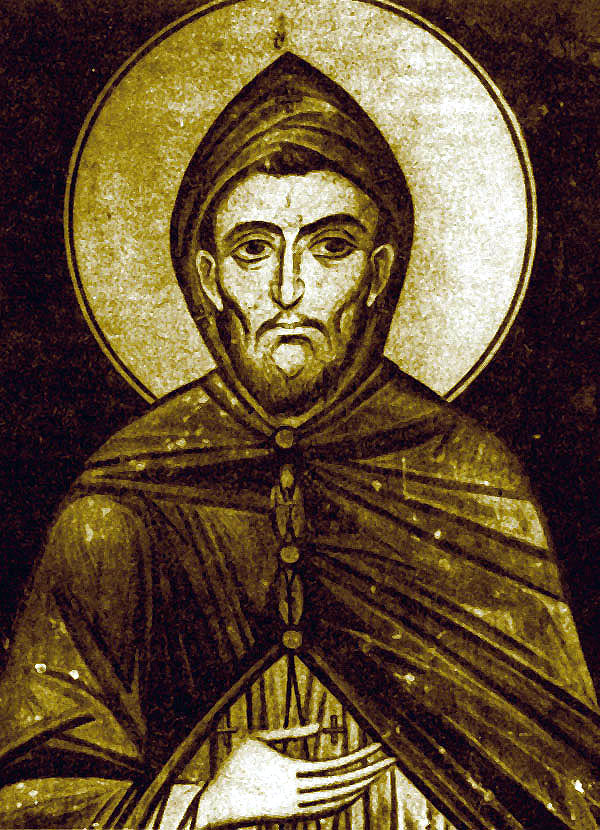


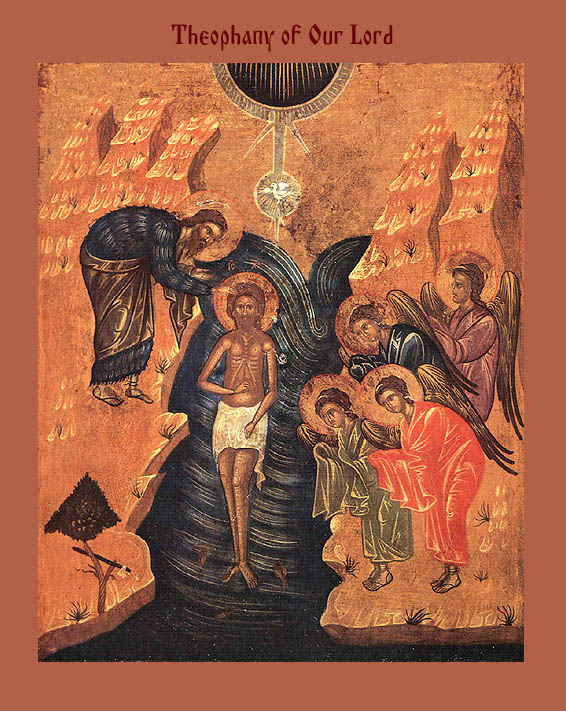


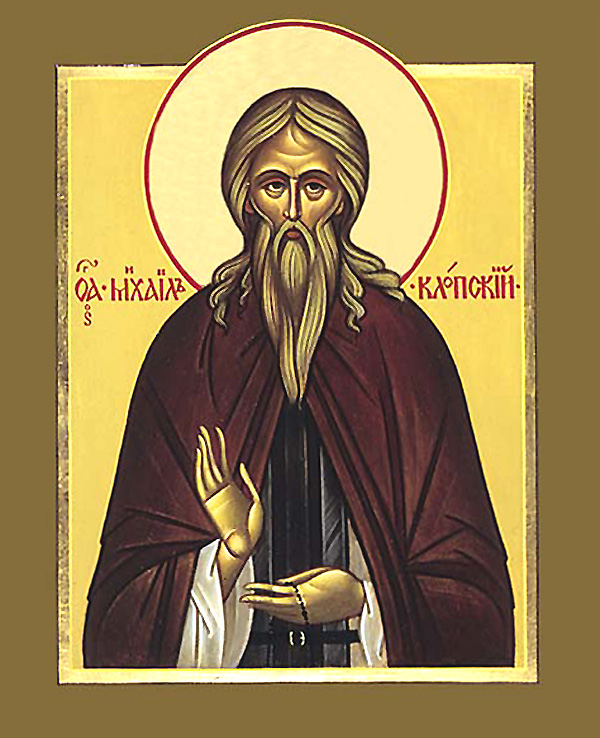
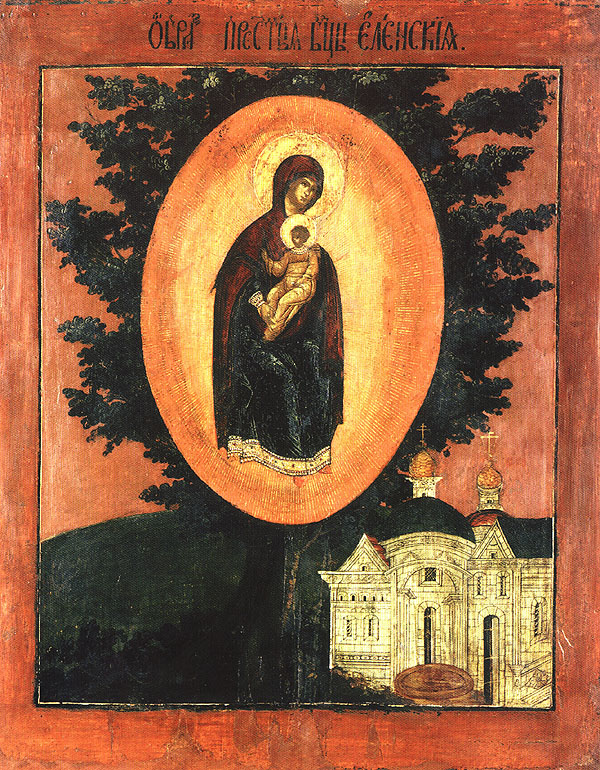
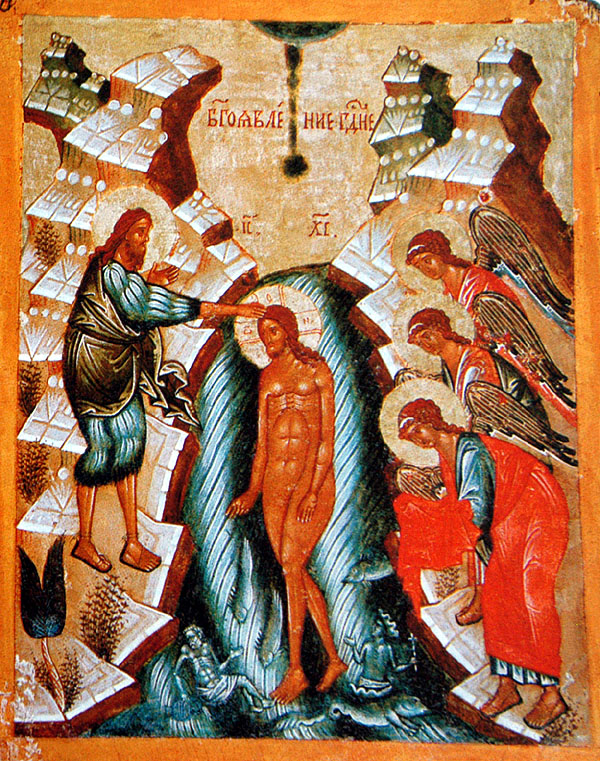


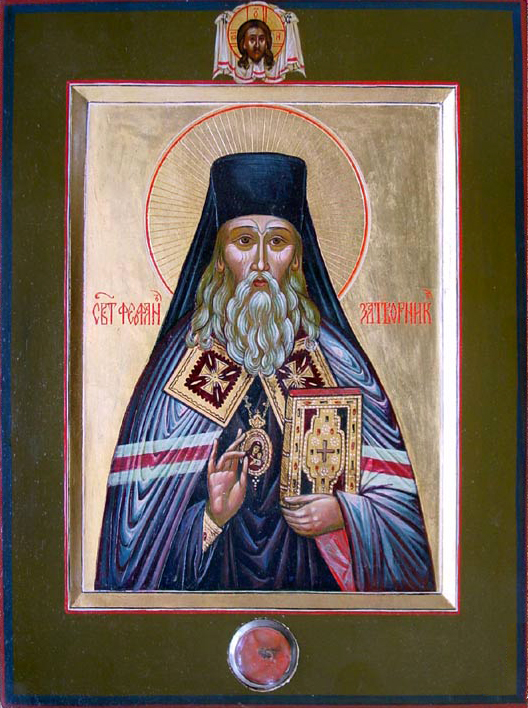
 Saint Peter Antiochian Orthodox Church
You must be logged in to post a comment.