Monthly Archives: January 2022

Daily Readings for Thursday, January 20, 2022

RIGHTEOUS EUTHYMIUS THE GREAT

NO FAST

Righteous Euthymius the Great, John the Hieromartyr, Zacharias the New Martyr of Patra

ST. PAUL’S SECOND LETTER TO THE CORINTHIANS 4:6-15

Brethren, it is the God who said, "Let light shine out of darkness, " who has shone in our hearts to give the light of the knowledge of the glory of God in the face of Christ.
But we have this treasure in earthen vessels, to show that the transcendent power belongs to God and not to us. We are afflicted in every way, but not crushed; perplexed, but not driven to despair; persecuted, but not forsaken; struck down, but not destroyed; always carrying in the body the death of Jesus, so that the life of Jesus may also be manifested in our bodies. For while we live we are always being given up to death for Jesus' sake, so that the life of Jesus may be manifested in our mortal flesh. So death is at work in us, but life in you.
Since we have the same spirit of faith as he had who wrote, "I believed, and so I spoke, " we too believe, and so we speak, knowing that he who raised the Lord Jesus will raise us also with Jesus and bring us with you into his presence. For it is all for your sake, so that as grace extends to more and more people it may increase thanksgiving, to the glory of God.

LUKE 6:17-23

At that time, Jesus stood on a level place, with a great crowd of his disciples and a great multitude of people from all Judea and Jerusalem and the seacoast of Tyre and Sidon, who came to hear him and to be healed of their diseases; and those who were troubled with unclean spirits were cured. And all the crowd sought to touch him, for power came forth from him and healed them all. And he lifted up his eyes on His disciples, and said: “Blessed are you poor, for yours is the Kingdom of God. Blessed are you that hunger now, for you shall be satisfied. Blessed are you that weep now, for you shall laugh. Blessed are you when men hate you, and when they exclude you and revile you, and cast out your name as evil, on account of the Son of man! Rejoice in that day, and leap for joy, for behold, your reward is great in heaven.”

Venerable Euthymius the Great

Saint Euthymius the Great came from the city of Melitene in Armenia, near the River Euphrates. His parents, Paul and Dionysia, were pious Christians of noble birth. After many years of marriage they remained childless, and in their sorrow they entreated God to give them offspring. Finally, they had a vision and heard a voice saying, “Be of good cheer! God will grant you a son, who will bring joy to the churches.” The child was named Euthymius (“good cheer”).

Saint Euthymius’ father died soon after this, and his mother, fulfilling her vow to dedicate her son to God, gave him to her brother, the priest Eudoxius, to be educated. He presented the child to Bishop Eutroius of Melitene, who accepted him with love. Seeing his good conduct, the bishop soon made him a Reader.

Saint Euthymius later became a monk and was ordained to the holy priesthood. At the same time, he was entrusted with the supervision of all the city monasteries. Saint Euthymius often visited the monastery of Saint Polyeuctus, and during Great Lent he withdrew into the wilderness. His responsibility for the monasteries weighed heavily upon the ascetic, and conflicted with his desire for stillness, so he secretly left the city and headed to Jerusalem. After venerating the holy shrines, he visited the Fathers in the desert.

Since there was a solitary cell in the Tharan lavra, he settled into it, earning his living by weaving baskets. Nearby, his neighbor Saint Theoctistus (September 3) also lived in asceticism. They shared the same zeal for God and for spiritual struggles, and each strove to attain what the other desired. They had such love for one another that they seemed to share one soul and one will.

Every year, after the Feast of Theophany, they withdrew into the desert of Coutila (not far from Jericho). One day, they entered a steep and terrifying gorge with a stream running through it. They saw a cave upon a cliff, and settled there. The Lord, however, soon revealed their solitary place for the benefit of many people. Shepherds driving their flocks came upon the cave and saw the monks. They went back to the village and told people about the ascetics living there.

People seeking spiritual benefit began to visit the hermits and brought them food. Gradually, a monastic community grew up around them. Several monks came from the Tharan monastery, among them Marinus and Luke. Saint Euthymius entrusted the supervision of the growing monastery to his friend Theoctistus.

Saint Euthymius exhorted the brethren to guard their thoughts. “Whoever desires to lead the monastic life should not follow his own will. He should be obedient and humble, and be mindful of the hour of death. He should fear the judgment and eternal fire, and seek the heavenly Kingdom.”

The saint taught young monks to fix their thoughts on God while engaging in physical labor. “If laymen work in order to feed themselves and their families, and to give alms and offer sacrifice to God, then are not we as monks obliged to work to sustain ourselves and to avoid idleness? We should not depend on strangers.”

The saint demanded that the monks keep silence in church during services and at meals. When he saw young monks fasting more than others, he told them to cut off their own will, and to follow the appointed rule and times for fasting. He urged them not to attract attention to their fasting, but to eat in moderation.

In these years Saint Euthymius converted and baptized many Arabs. Among them were the Saracen leaders Aspebet and his son Terebon, both of whom Saint Euthymius healed of sickness. Aspebet received the name Peter in Baptism and afterwards he was a bishop among the Arabs.

Word of the miracles performed by Saint Euthymius spread quickly. People came from everywhere to be healed of their ailments, and he cured them. Unable to bear human fame and glory, the monk secretly left the monastery, taking only his closest disciple Dometian with him. He withdrew into the Rouba desert and settled on Mt. Marda, near the Dead Sea.

In his quest for solitude, the saint explored the wilderness of Ziph and settled in the cave where David once hid from King Saul. Saint Euthymius founded a monastery beside David’s cave, and built a church. During this time Saint Euthymius converted many monks from the Manichean heresy, he also healed the sick and cast out devils.

Visitors disturbed the tranquillity of the wilderness. Since he loved silence, the saint decided to return to the monastery of Saint Theoctistus. Along the way they found a quiet level place on a hill, and he remained there. This would become the site of Saint Euthymius’ lavra, and a little cave served as his cell, and then as his grave.

Saint Theoctistus went with his brethren to Saint Euthymius and requested him to return to the monastery, but the monk did not agree to this. However, he did promise to attend Sunday services at the monastery.

Saint Euthymius did not wish to have anyone nearby, nor to organize a cenobium or a lavra. The Lord commanded him in a vision not to drive away those who came to him for the salvation of their souls. After some time brethren again gathered around him, and he organized a lavra, on the pattern of the Tharan Lavra. In the year 429, when Saint Euthymius was fifty-two years old, Patriarch Juvenal of Jerusalem consecrated the lavra church and supplied it with presbyters and deacons.

The lavra was poor at first, but the saint believed that God would provide for His servants. Once, about 400 Armenians on their way to the Jordan came to the lavra. Seeing this, Saint Euthymius called the steward and ordered him to feed the pilgrims. The steward said that there was not enough food in the monastery. Saint Euthymius, however, insisted. Going to the storeroom where the bread was kept, the steward found a large quantity of bread, and the wine casks and oil jars were also filled. The pilgrims ate their fill, and for three months afterwards the door of the storeroom could not be shut because of the abundace of bread. The food remained undiminished, just like the widow of Zarephath’s barrel of meal and cruse of oil (1/3 Kings 17:8-16).

Once, the monk Auxentius refused to carry out his assigned obedience. Despite the fact that Saint Euthymius summoned him and urged him to comply, he remained obstinate. The saint then shouted loudly, “You will be rewarded for your insubordination.” A demon seized Auxentius and threw him to the ground. The brethren asked Abba Euthymius to help him, and then the saint healed the unfortunate one, who came to himself, asked forgiveness and promised to correct himself. “Obedience,” said Saint Euthymius, “is a great virtue. The Lord loves obedience more than sacrifice, but disobedience leads to death.”

Two of the brethren became overwhelmed by the austere life in the monastery of Saint Euthymius, and they resolved to flee. Saint Euthymius saw in a vision that they would be ensnared by the devil. He summoned them and admonished them to abandon their destructive intention. He said, “We must never admit evil thoughts that fill us with sorrow and hatred for the place in which we live, and suggest that we go somewhere else. If someone tries to do something good in the place where he lives but fails to complete it, he should not think that he will accomplish it elsewhere. It is not the place that produces success, but faith and a firm will. A tree which is often transplanted does not bear fruit.”

In the year 431, the Third Ecumenical Council was convened in Ephesus to combat the Nestorian heresy. Saint Euthymius rejoiced over the affirmation of Orthodoxy, but was grieved about Archbishop John of Antioch who defended Nestorius.

In the year 451 the Fourth Ecumenical Council met in Chalcedon to condemn the heresy of Dioscorus who, in contrast to Nestorius, asserted that in the Lord Jesus Christ there is only one nature, the divine (thus the heresy was called Monophysite). He taught that in the Incarnation, Christ’s human nature is swallowed up by the divine nature.

Saint Euthymius accepted the decisions of the Council of Chalcedon and he acknowledged it as Orthodox. News of this spread quickly among the monks and hermits. Many of them, who had previously believed wrongly, accepted the decisions of the Council of Chalcedon because of the example of Saint Euthymius.

Because of his ascetic life and firm confession of the Orthodox Faith, Saint Euthymius is called “the Great.” Wearied by contact with the world, the holy abba went for a time into the inner desert. After his return to the lavra some of the brethren saw that when he celebrated the Divine Liturgy, fire descended from Heaven and encircled the saint. Saint Euthymius himself revealed to several of the monks that often he saw an angel celebrating the Holy Liturgy with him. The saint had the gift of clairvoyance, and he could discern a person’s thoughts and spiritual state from his outward appearance. When the monks received the Holy Mysteries, the saint knew who approached worthily, and who received unworthily.

When Saint Euthymius was 82 years old, the young Savva (the future Saint Savva the Sanctified, December 5), came to his lavra. The Elder received him with love and sent him to the monastery of Saint Theoctistus. He foretold that Saint Savva would outshine all his other disciples in virtue.

When the saint was ninety years of age, his companion and fellow monk Theoctistus became grievously ill. Saint Euthymius went to visit his friend and remained at the monastery for several days. He took leave of him and was present at his end. After burying his body in a grave, he returned to the lavra.

God revealed to Saint Euthymius the time of his death. On the eve of the Feast of Saint Anthony the Great (January 17) Saint Euthymius gave the blessing to serve the all-night Vigil. When the service ended, he took the priests aside and told them that he would never serve another Vigil with them, because the Lord was calling him from this earthly life.

All were filled with great sadness, but the saint asked the brethren to meet him in church in the morning. He began to instruct them, “If you love me, keep my commandments (John 14:15). Love is the highest virtue, and the bond of perfectness (Col. 3:14). Every virtue is made secure by love and humility. The Lord humbled Himself because of His Love for us and became man. Therefore, we ought to praise Him unceasingly, especially since we monks have escaped worldly distractions and concerns.”

“Look to yourselves, and preserve your souls and bodies in purity. Do not fail to attend the church services, and keep the traditions and rules of our community. If one of the brethren struggles with unclean thoughts, correct, console, and instruct him, so that he does not fall into the devil’s snares. Never refuse hospitality to visitors. Offer a bed to every stranger. Give whatever you can to help the poor in their misfortune.”

Afterwards, having given instructions for the guidance of the brethren, the saint promised always to remain in spirit with them and with those who followed them in his monastery. Saint Euthymius then dismissed everyone but his disciple Dometian. He remained in the altar for three days, then died on January 20, 473 at the age of ninety-seven.

A multitude of monks from all the monasteries and from the desert came to the lavra for the holy abba’s burial, among whom was Saint Gerasimus. The Patriarch Anastasius also came with his clergy, as well as the Nitrian monks Martyrius and Elias, who later became Patriarchs of Jerusalem, as Saint Euthymius had foretold.

Dometian remained by the grave of his Elder for six days. On the seventh day, he saw the holy abba in glory, beckoning to his disciple. “Come, my child, the Lord Jesus Christ wants you to be with me.”

After telling the brethren about the vision, Dometian went to church and joyfully surrendered his soul to God. He was buried beside Saint Euthymius. The relics of Saint Euthymius remained at his monastery in Palestine, and the Russian pilgrim Igumen Daniel saw them in the twelfth century.

Venerable Euthymius the Schemamonk

The Schemamonk Euthymius of the Kiev Caves imposed upon himself a vow of silence, opening his mouth only for church services and for prayer. The silent schemamonk ate only herbs. He was buried in the Far Caves of Saint Theodosius at the Kiev Caves monastery. His memory is also celebrated on August 28 and on the second Sunday of Great Lent.

Saint Laurence, Recluse of the Kiev Far Caves

Disdaining the vain glory of this world, Saint Laurence lived in a cave and conquered the passions through prayer and fasting. His incorrupt relics lie in the Far Caves of the Kiev Caves Lavra.

Venerable Euthymius of Syanzhemsk, Vologda

Saint Euthymius of Syanzhemsk and Vologda was born in Vologda, and received monastic tonsure at the Savior-Stone monastery at Lake Kuben. For some time he lived in a solitary cell on the River Kuben, and then gave up the place to Saint Alexander of Kushta (June 9) and moved to Syanzhem, where he founded the Ascension monastery and became its igumen.

Saint Euthymius died around the year 1465, after appointing Saint Chariton (September 28) as his successor. The story of the appearance of his relics was recorded in the sixteenth century by Bishop Ioasaph of Vologda, a noted hagiographer of his time.

Martyrs Inna, Pinna, and Rimma, disciples of the Apostle Andrew, in Scythia

The Holy Martyrs Inna, Pinna and Rimma were Slavs from northern Scythia (modern Bulgaria), and they were disciples of the holy Apostle Andrew the First-Called. They preached the Gospel of Christ and they baptized many barbarians who converted to the true Faith. They were seized by the local chieftain, but they would not deny Christ, nor would they offer sacrifice to idols.

It was wintertime, and the rivers were so frozen that not only people, but also horses with carts could travel on the ice. The chieftain had the saints tied to logs on the ice, and gradually lowered them into the freezing water. When the ice reached their necks, they surrendered their blessed souls to the Lord.

Martyrs Bassus, Eusebius, Euthychius, and Basileides, at Nicomedia

The holy Martyrs Bassos, Eusebios, Eutychios and Basileides lived during the reign of Emperor Diocletian (284-305), and suffered martyrdom in 303. They were wealthy and members of the Senate. They came to believe in Christ and were baptized after witnessing the martyrdom of Bishop Theopemptos of Nicomedia (January 5), who endured with spiritual bravery the horrible tortures to which the pagans had had subjected him.

The idolaters denounced these men as Christians and brought them before the emperor because they refused to worship the gods of the pagans. The Saints showed no fear whatsoever, but boldly proclaimed their faith in Christ and their eagerness to follow the path which would lead to martyrdom.

In the Synaxarion it is stated that the martyrs removed their belts, the symbols of their rank, and then each of them submitted to severe tortures.

Saint Bassos was buried in the ground up to his waist, and his upper body was cut to pieces. Saint Eusebios was suspended head downwards, and his limbs were cut off with axes. Saint Eutychios was tied to four poles by his hands and feet, and he was pulled apart. Saint Basileides was stabbed in the stomach with a knife.

Saint Euthymius, Patriarch of Trnovo and Bulgaria
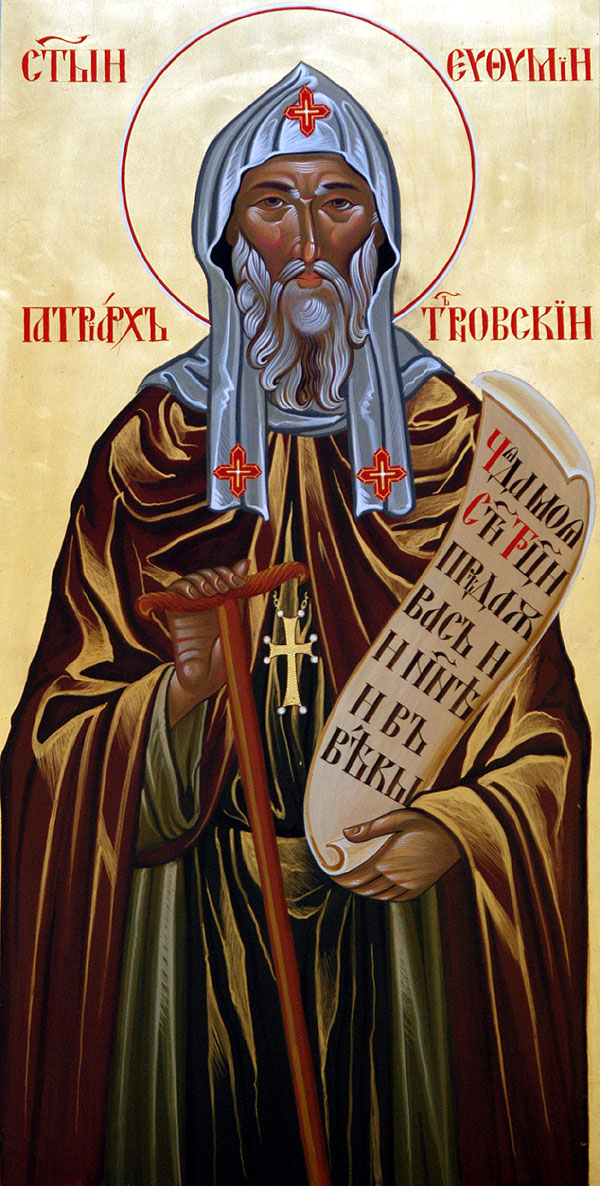
No information available at this time.

New Martyr Zachariah

The Holy New Martyr Zachariah was from the Peloponnesos in Greece. He renounced Christ to become a Moslem, then went to ancient Patras and worked there as a furrier. He had a book, The Salvation of Sinners, which he often read. The book moved him to repentance, and he wept bitterly for the great evil he had done.

Saint Zachariah met a certain Elder and told him of his sin. After praying and fasting for twenty days, he returned to the Elder and confessed all the sins he had committed during his life. When he asked the Elder’s blessing to seek martyrdom, the holy man tried to discourage him. He warned that he might not be killed swiftly, but only after much torture. He also pointed out the danger that Zachariah would betray Christ a second time under the torments he would endure. The saint, aflame with zeal for martyrdom, said he was prepared to suffer myriad punishments for the sake of Christ.

The Elder read the prayers of absolution and chrismated the saint (as is done when apostates from the Faith are received back into the Church), then administered the Holy Mysteries to him. Then he blessed Zachariah to go back to the Moslems and declare his faith in Christ. On his way, the saint asked forgiveness from each Christian he met.

The holy martyr went to the judge’s house and said that he had been deceived when he accepted their religion, but now he had come to his senses and returned to Christ. Saint Zachariah was thrown into prison, where he was beaten three times a day.

Finally, the saint died by being stretched out on a rack. Christians asked for his body so they might bury it, but the Moslems refused. They said, “He is neither one of you, nor one of us, for he denied both religions. Therefore, he is unworthy of burial.” His body was dragged through the streets and thrown into a dry well, landing on its knees in an upright position. Christians saw a radiant light over the well the next night, and hastened to venerate the saint. The Turks filled the well with dirt and debris to prevent such gatherings in the future.

By shedding his blood, the holy New Martyr Zachariah washed away the sin of his denial of Christ and received an unfading crown of glory in the year 1782.

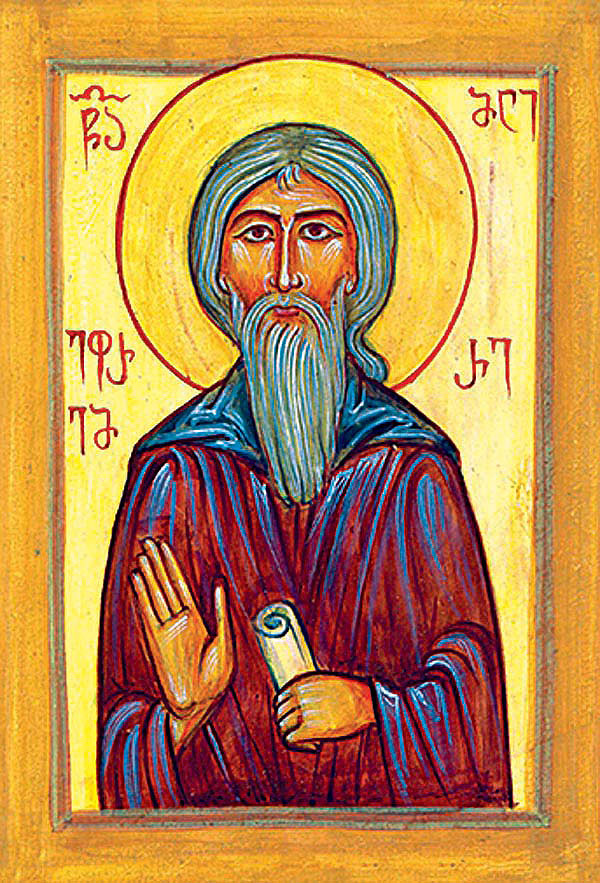
Saint Euthymius the Confessor

Abbot Euthymius Kereselidze was born in 1865 in the village of Sadmeli (Racha region) to the pious Solomon and Marta Kereselidze. At birth he was given the name Evstate. After completing his studies at the local parish school, fifteen-year-old Evstate traveled first to Kutaisi, then Tbilisi, in search of work. With the help of other pious young men Evstate founded a kind of theological “book club” in Tbilisi. The objectives of the organization were to strengthen the Orthodox Faith among the Georgian people, to better understand the ancient school of Georgian chant, and to spread knowledge of this venerable musical tradition among the general public.

In the 1890s the organization purchased a print shop with the help of Saint Ilia the Righteous. In the twenty-five years that followed, these young men zealously published theological texts and distributed them to the public free of charge. After some time Evstate resolved to take upon himself the heavy yoke of monasticism, for which he had been preparing from an early age. His spiritual father, the venerable Saint Alexi (Shushania), supported his decision. In 1912, with the blessing of Bishop Giorgi (Aladashvili) of Imereti, Evstate began to labor as a novice at Gelati Monastery. On December 23, 1912, he was tonsured a monk by a certain Antimos, the abbot of the monastery. He was given the name Ekvtime in honor of Saint Ekvtime of Mt. Athos. In May of 1913 he was ordained a hierodeacon.

In 1917 Fr. Ekvtime was ordained to the priesthood by the same Bishop Giorgi. In the terrible year of 1921, immediately after the Communists seized power in Kutaisi, the authorities deemed Fr. Ekvtime untrustworthy and arrested him. But, according to God’s will, he was released due to the lack of evidence against him. In this ungodly era, the clergy and monks of Gelati Monastery came to expect abuses and persecutions each day. But the faithful hieromonk Ekvtime persevered in his work, gathering hundreds of ancient Georgian hymns for eventual publication according to Western notation.

In 1924 the Communists destroyed the Cathedral of King Davit the Restorer in Kutaisi. Later that year they shot and killed Metropolitan Nazar of Kutaisi-Gaenati and the clergy who served under him. The hysteria had reached its peak. Fr. Ekvtime planned to leave Gelati Monastery and to move the ancient manuscripts with which he had been working to a more secure location. At that time thousands of travelers were killed on the road between Kutaisi and Tbilisi, but Fr. Ekvtime safely transported himself and his cartload of manuscripts from Kutaisi to Mtskheta, a short distance from Tbilisi.

Fr. Ekvtime brought the manuscripts to Svetitskhoveli Cathedral for safekeeping, and he was soon appointed dean of this parish. Even in 1925, when Catholicos-Patriarch Ambrosi was imprisoned at Metekhi and threats to the Georgian clergy increased significantly, Fr. Ekvtime continued to guard the ancient manuscripts faithfully. He transcribed the music from the medieval neume system of notation to the European-style staff system. At the same time, Fr. Ekvtime served as spiritual father to the nuns of Samtavro Convent, located a short distance from Svetitskhoveli.

In 1929 Fr. Ekvtime was relocated to Zedazeni Monastery outside of Mtskheta. He brought the ancient music manuscripts with him to his new home, concealed them in metal vessels, and buried them beneath the earth. Six years later, in November of 1935, he turned over thirty-four volumes of music containing 5,532 chants and several theological manuscripts to the State Museum of Georgia.

During World War II conditions in the Georgian monasteries grew ever more bleak. The abbot of Zedazeni Monastery, Archimandrite Mikael (Mandaria), was taking food to the monks of Saguramo when the Communists shot and killed him for violating the curfew they had imposed.

The young monk Parten (Aptsiauri) was falsely accused and arrested. After the repose of the elder Saba (Pulariani), Fr. Ekvtime was the only monk remaining at Zedazeni. Fr. Ekvtime’s spiritual children, the nuns of Samtavro Convent, cared for him as he grew older. In the winter of 1944 the nun Zoile (Dvalishvili) and several others went to visit him at Zedazeni and found him lying enfeebled in bed.

After a short time Fr. Ekvtime peacefully gave up his soul to the Lord. Fr. Ekvtime was buried in the yard of Zedazeni Monastery, near the church sanctuary.

Part of his rich library was moved to Samtavro. To this day several of the original manuscripts of hymns he transcribed to European-style notation are preserved there.

The ancient school of Georgian chant is preserved up to this day primarily as a result of Abbot Ekvtime’s fearless labors. Saint Ekvtime (Kereselidze), like Saint Ekvtime of Mt. Athos for whom he was named, dedicated his life to the enrichment of his mother Church. Like Saint Ekvtime Taqaishvili, the “Man of God”, he gave his talents and energies to the preservation of Georgia’s unique spiritual heritage. He was a monk-ascetic and a scholar who prayed fervently. (Several of his theological treatises are preserved at Samtavro.) From his youth Saint Ekvtime was for others an example of virginity, humility and patience.

On September 18, 2003, the Holy Synod of the Georgian Orthodox Church declared Ekvtime (Kereselidze) worthy of being numbered among the saints. The Synod called him “Ekvtime the Confessor,” thereby recognizing his confession of the Faith and his vital role in the preservation of the rich tradition of national liturgical song.

Daily Readings for Wednesday, January 19, 2022

MACARIUS THE GREAT OF EGYPT

ABSTAIN FROM MEAT, FISH, DAIRY, EGGS, WINE, OLIVE OIL

Macarius the Great of Egypt, Makarios of Alexandria, Mark, Bishop of Ephesus, Makarios, Hierodeacon of Kalogera, Patmos, Arsenius of Corfu, Removal of the Honorable Relics of Saint Gregory the Theologian, Branwallader, Bishop of Jersey

ST. PAUL’S LETTER TO THE GALATIANS 5:22-26; 6:1-2

Brethren, the fruit of the Spirit is love, joy, peace, patience, kindness, goodness, faithfulness, gentleness, self-control; against such there is no law. And those who belong to Christ Jesus have crucified the flesh with its passions and desires. If we live by the Spirit, let us also walk by the Spirit. Let us have no self-conceit, no provoking of one another, no envy of one another. Brethren, if a man is overtaken in any trespass, you who are spiritual should restore him in a spirit of gentleness. Look to yourself, lest you too be tempted. Bear one another’s burdens, and so fulfill the law of Christ.

MATTHEW 21:33-42

The Lord said this parable, “There was a householder who planted a vineyard, and set a hedge around it, and dug a wine press in it, and built a tower, and let it out to tenants, and went into another country. When the season of fruit drew near, he sent his servants to the tenants, to get his fruit; and the tenants took his servants and beat one, killed another, and stoned another. Again he sent other servants, more than the first; and they did the same to them. Afterward he sent his son to them, saying ‘They will respect my son.’ But when the tenants saw the son, they said to themselves, ‘This is the heir; come, let us kill him and have his inheritance.’ And they took him and cast him out of the vineyard and killed him. When therefore the owner of the vineyard comes, what will he do to those tenants?” They said to him, “He will put those wretches to a miserable death, and let out the vineyard to other tenants who will give him the fruits in their seasons.” Jesus said to them, “Have you never read in the scriptures: ‘The very stone which the builders rejected has become the head of the corner; this was the Lord’s doing, and it is marvelous in our eyes?'”

Venerable Macarius the Great of Egypt

Saint Macarius the Great of Egypt was born in the early fourth century in the village of Ptinapor in Egypt. At the wish of his parents he entered into marriage, but was soon widowed. After he buried his wife, Macarius told himself, “Take heed, Macarius, and have care for your soul. It is fitting that you forsake worldly life.”

The Lord rewarded the saint with a long life, but from that time the memory of death was constantly with him, impelling him to ascetic deeds of prayer and penitence. He began to visit the church of God more frequently and to be more deeply absorbed in Holy Scripture, but he did not leave his aged parents, thus fulfilling the commandment to honor one’s parents.

Until his parents died, Saint Macarius used his remaining substance to help them and he began to pray fervently that the Lord might show him a guide on the way to salvation. The Lord sent him an experienced Elder, who lived in the desert not far from the village. The Elder accepted the youth with love, guided him in the spiritual science of watchfulness, fasting and prayer, and taught him the handicraft of weaving baskets. After building a separate cell not far from his own, the Elder settled his disciple in it.

The local bishop arrived one day at Ptinapor and, knowing of the saint’s virtuous life, ordained him against his will. Saint Macarius was overwhelmed by this disturbance of his silence, and so he went secretly to another place. The Enemy of our salvation began a tenacious struggle with the ascetic, trying to terrify him, shaking his cell and suggesting sinful thoughts. Saint Macarius repelled the attacks of the devil, defending himself with prayer and the Sign of the Cross.

Evil people slandered the saint, accusing him of seducing a woman from a nearby village. They dragged him out of his cell and jeered at him. Saint Macarius endured the temptation with great humility. Without a murmur, he sent the money that he got for his baskets for the support of the pregnant woman.

The innocence of Saint Macarius was manifested when the woman, who suffered torment for many days, was not able to give birth. She confessed that she had slandered the hermit, and revealed the name of the real father. When her parents found out the truth, they were astonished and intended to go to the saint to ask forgiveness. Though Saint Macarius willingly accepted dishonor, he shunned the praise of men. He fled from that place by night and settled on Mt. Nitria in the Pharan desert.

Thus human wickedness contributed to the prospering of the righteous. Having dwelt in the desert for three years, he went to Saint Anthony the Great, the Father of Egyptian monasticism, for he had heard that he was still alive in the world, and he longed to see him. Abba Anthony received him with love, and Macarius became his devoted disciple and follower. Saint Macarius lived with him for a long time and then, on the advice of the saintly abba, he went off to the Skete monastery (in the northwest part of Egypt). He so shone forth in asceticism that he came to be called “a young Elder,” because he had distinguished himself as an experienced and mature monk, even though he was not quite thirty years old.

Saint Macarius survived many demonic attacks against him. Once, he was carrying palm branches for weaving baskets, and a devil met him on the way and wanted to strike him with a sickle, but he was not able to do this. He said, “Macarius, I suffer great anguish from you because I am unable to vanquish you. I do everything that you do. You fast, and I eat nothing at all. You keep vigil, and I never sleep. You surpass me only in one thing: humility.”

When the saint reached the age of forty, he was ordained to the priesthood and made the head of the monks living in the desert of Skete. During these years, Saint Macarius often visited with Saint Anthony the Great, receiving guidance from him in spiritual conversations. Abba Macarius was deemed worthy to be present at the death of Saint Anthony and he received his staff. He also received a double portion of the Anthony’s spiritual power, just as the prophet Elisha once received a double portion of the grace of the prophet Elias, along with the mantle that he dropped from the fiery chariot.

Saint Macarius worked many healings. People thronged to him from various places for help and for advice, asking his holy prayers. All this unsettled the quietude of the saint. He therefore dug out a deep cave under his cell, and hid there for prayer and meditation.

Saint Macarius attained such boldness before God that, through his prayers, the Lord raised the dead. Despite attaining such heights of holiness, he continued to preserve his unusual humility. One time the holy abba caught a thief loadng his things on a donkey standing near the cell. Without revealing that he was the owner of these things, the monk began to help tie up the load. Having removed himself from the world, the monk told himself, “We bring nothing at all into this world; clearly, it is not possible to take anything out from it. Blessed be the Lord for all things!”

Once, Saint Macarius was walking and saw a skull lying upon the ground. He asked, “Who are you?” The skull answered, “I was a chief priest of the pagans. When you, Abba, pray for those in hell, we receive some mitigation.”

The monk asked, “What are these torments?” “We are sitting in a great fire,” replied the skull, “and we do not see one another. When you pray, we begin to see each other somewhat, and this affords us some comfort.” Having heard such words, the saint began to weep and asked, “Are there still more fiercesome torments?” The skull answered, “Down below us are those who knew the Name of God, but spurned Him and did not keep His commandments. They endure even more grievous torments.”

Once, while he was praying, Saint Macarius heard a voice: “Macarius, you have not yet attained such perfection in virtue as two women who live in the city.” The humble ascetic went to the city, found the house where the women lived, and knocked. The women received him with joy, and he said, “I have come from the desert seeking you in order to learn of your good deeds. Tell me about them, and conceal nothing.”

The women answered with surprise, “We live with our husbands, and we have not such virtues.” But the saint continued to insist, and the women then told him, “We married two brothers. After living together in one house for fifteen years, we have not uttered a single malicious nor shameful word, and we never quarrel among ourselves. We asked our husbands to allow us to enter a women’s monastery, but they would not agree. We vowed not to utter a single worldly word until our death.”

Saint Macarius glorified God and said, “In truth, the Lord seeks neither virgins nor married women, and neither monks nor laymen, but values a person’s free intent, accepting it as the deed itself. He grants to everyone’s free will the grace of the Holy Spirit, which operates in an individual and directs the life of all who yearn to be saved.”

During the years of the reign of the Arian emperor Valens (364-378), Saint Macarius the Great and Saint Macarius of Alexandria was subjected to persecution by the followers of the Arian bishop Lucius. They seized both Elders and put them on a ship, sending them to an island where only pagans lived. By the prayers of the saints, the daughter of a pagan priest was delivered from an evil spirit. After this, the pagan priest and all the inhabitants of the island were baptized. When he heard what had happened, the Arian bishop feared an uprising and permitted the Elders to return to their monasteries.

The meekness and humility of the monk transformed human souls. “A harmful word,” said Abba Macarius, “makes good things bad, but a good word makes bad things good.” When the monks asked him how to pray properly, he answered, “Prayer does not require many words. It is needful to say only, “Lord, as Thou wilt and as Thou knowest, have mercy on me.” If an enemy should fall upon you, you need only say, “Lord, have mercy!” The Lord knows that which is useful for us, and grants us mercy.”

When the brethren asked how a monk ought to comport himself, the saint replied, “Forgive me, I am not yet a monk, but I have seen monks. I asked them what I must do to be a monk. They answered, ‘If a man does not withdraw himself from everything which is in the world, it is not possible to be a monk.’ Then I said, ‘I am weak and cannot be as you are.’ The monks responded, ‘If you cannot renounce the world as we have, then go to your cell and weep for your sins.’”

Saint Macarius gave advice to a young man who wished to become a monk: “Flee from people and you shall be saved.” That one asked: “What does it mean to flee from people?” The monk answered: “Sit in your cell and repent of your sins.”

Saint Macarius sent him to a cemetery to rebuke and then to praise the dead. Then he asked him what they said to him. The young man replied, “They were silent to both praise and reproach.” “If you wish to be saved, be as one dead. Do not become angry when insulted, nor puffed up when praised.” And further: “If slander is like praise for you, poverty like riches, insufficiency like abundance, then you shall not perish.”

The prayer of Saint Macarius saved many in perilous circumstances of life, and preserved them from harm and temptation. His benevolence was so great that they said of him: “Just as God sees the whole world, but does not chastize sinners, so also does Abba Macarius cover his neighbor’s weaknesses, which he seemed to see without seeing, and heard without hearing.”

The monk lived until the age of ninety. Shortly before his death, Saints Anthony and Pachomius appeared to him, bringing the joyful message of his departure to eternal life in nine days. After instructing his disciples to preserve the monastic Rule and the traditions of the Fathers, he blessed them and began to prepare for death. Saint Macarius departed to the Lord saying, “Into Thy hands, O Lord, I commend my spirit.”

Abba Macarius spent sixty years in the wilderness, being dead to the world. He spent most of his time in conversation with God, often in a state of spiritual rapture. But he never ceased to weep, to repent and to work. The saint’s profound theological writings are based on his own personal experience. Fifty Spiritual Homilies and seven Ascetic Treatises survive as the precious legacy of his spiritual wisdom. Several prayers composed by Saint Macarius the Great are still used by the Church in the Prayers Before Sleep and also in the Morning Prayers.

Man’s highest goal and purpose, the union of the soul with God, is a primary principle in the works of Saint Macarius. Describing the methods for attaining mystical communion, the saint relies upon the experience of the great teachers of Egyptian monasticism and on his own experience. The way to God and the experience of the holy ascetics of union with God is revealed to each believer’s heart.

Earthly life, according to Saint Macarius, has only a relative significance: to prepare the soul, to make it capable of perceiving the heavenly Kingdom, and to establish in the soul an affinity with the heavenly homeland.

“For those truly believing in Christ, it is necessary to change and transform the soul from its present degraded nature into another, divine nature, and to be fashioned anew by the power of the Holy Spirit.”

This is possible, if we truly believe and we truly love God and have observed all His holy commandments. If one betrothed to Christ at Baptism does not seek and receive the divine light of the Holy Spirit in the present life, “then when he departs from the body, he is separated into the regions of darkness on the left side. He does not enter into the Kingdom of Heaven, but has his end in hell with the devil and his angels” (Homily 30:6).

In the teaching of Saint Macarius, the inner action of the Christian determines the extent of his perception of divine truth and love. Each of us acquires salvation through grace and the divine gift of the Holy Spirit, but to attain a perfect measure of virtue, which is necessary for the soul’s assimilation of this divine gift, is possible only “by faith and by love with the strengthening of free will.” Thus, the Christian inherits eternal life “as much by grace, as by truth.”

Salvation is a divine-human action, and we attain complete spiritual success “not only by divine power and grace, but also by the accomplishing of the proper labors.” On the other hand, it is not just within “the measure of freedom and purity” that we arrive at the proper solicitude, it is not without “the cooperation of the hand of God above.” The participation of man determines the actual condition of his soul, thus inclining him to good or evil. “If a soul still in the world does not possess in itself the sanctity of the Spirit for great faith and for prayer, and does not strive for the oneness of divine communion, then it is unfit for the heavenly kingdom.”

The miracles and visions of Blessed Macarius are recorded in a book by the presbyter Rufinus, and his Life was compiled by Saint Serapion, bishop of Tmuntis (Lower Egypt), one of the renowned workers of the Church in the fourth century. His holy relics are in the city of Amalfi, Italy.

Venerable Macarius of Alexandria

Saint Macarius of Alexandria was a contemporary and friend of Saint Macarius of Egypt (January 19). He was born in the year 295, and until the age of forty he was occupied in trade. Later, he was baptized and withdrew into the desert, where he spent more than sixty years.

After several years of ascetic life he was ordained to the holy priesthood and made head of the monastery the Cells in the desert between Nitria and Skete, where hermits silently lived in asceticism, each separately in his own cell. There were three deserts in northern Egypt: the first was the Cells (the inner desert), so designated because of the many cells carved into the rocks. The second was called Skete (utter desert). The third was the Nitrian desert which reached the western bank of the Nile.

Saint Macarius of Alexandria, like Macarius of Egypt, was a great ascetic and monastic head, and he worked many miracles. Learning about some monk’s ascetic feat, he attempted to imitate it. Thus, when he heard that someone ate only one pound of bread a day, he would eat only that much or even less. Wishing to shorten his sleep, he stayed for twenty whole days under the open sky, enduring heat by day and cold by night.

Saint Macarius once received a bunch of newly-picked grapes. He very much wanted to eat them, but he conquered this desire in himself and gave the grapes to another monk who was sick. That monk, wanting to preserve his abstinence, gave the grapes to another, and he gave them to a third and so forth. In the end the bunch of grapes returned to Saint Macarius. The ascetic was astonished at the abstinence of his disciples and gave thanks to God.

Once, a proud thought came to the saint to go to Rome and heal the sick. Struggling with the temptation, the saint filled up a sack of sand, loaded it on himself and walked into the desert until he exhausted his body. The proud thought then left him.

By his ascetic life, fasting, and renunciation of earthly things, Saint Macarius acquired the gifts of wonderworking and of discerning the inner thoughts of people, and he also saw many visions. He once saw how one of the ascetics of the holy monastery, Saint Mark, received the Holy Mysteries from the hands of angels, and how during Communion the careless brethren received burning coals from the demons instead of the Body of Christ.

Saint Macarius was glorified by many miracles of healing the sick and casting out devils. Saint Macarius of Alexandria died in about 394-395 at age of one hundred. He wrote a Discourse on the Origin of the Soul included in the text of the Annotated Psalter.

Saint Mark, Archbishop of Ephesus

Saint Mark Eugenikos, Archbishop of Ephesus, was a stalwart defender of Orthodoxy at the Council of Florence. He would not agree to a union with Rome which was based on theological compromise and political expediency (the Byzantine Emperor was seeking military assistance from the West against the Moslems who were drawing ever closer to Constantinople). Saint Mark countered the arguments of his opponents, drawing from the well of pure theology, and the teachings of the holy Fathers. When the members of his own delegation tried to pressure him into accepting the Union he replied, “There can be no compromise in matters of the Orthodox Faith.”

Although the members of the Orthodox delegation signed the Tomos of Union, Saint Mark was the only one who refused to do so. When he returned from Florence, Saint Mark urged the inhabitants of Constantinople to repudiate the dishonorable document of union. He died in 1457 at the age of fifty-two, admired and honored by all.

Venerable Macarius the Faster, of the Kiev Near Caves

Saint Macarius the Faster of the Near Caves of Kiev was a deacon. He is commemorated on January 19 because of his namesake, Saint Macarius of Egypt.

Saint Macarius of the Near Caves (twelfth century) is also commemorated on September 28. There is a general commemoration of all the wonderworkers of the Kiev Caves on the second Sunday of Great Lent.

Venerable Macarius the Deacon of the Kiev Caves

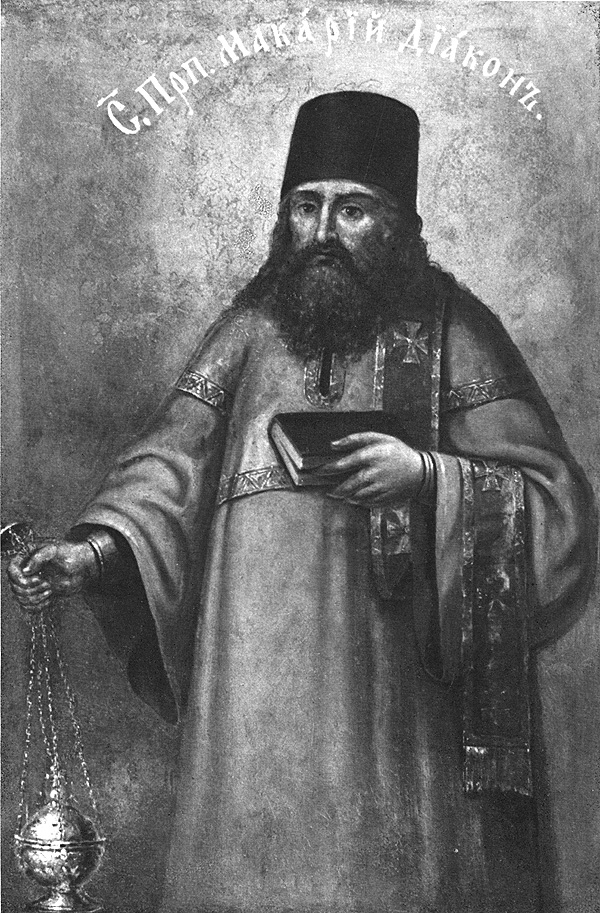
Saint Macarius the Deacon lived in the Far Caves of Kiev, and is commemorated on January 19 because of his namesake, Saint Macarius of Egypt. Saint Macarius lived during the thirteenth-fourteenth centuries, and was distinguished by his lack of covetousness. He possessed great fervor for the temple of God and he continuously labored in reading Holy Scripture and in fasting.

According to Tradition, he was frequently ill as a child, and his parents vowed that they would offer their son to the Monastery of the Caves if he were made healthy. By his mildness and humility he earned the love of the brethren, who taught him to read and to write. Because of his piety of life he was ordained as a deacon. The Lord also granted him the gift of wonderworking.

Saint Macarius of the Far Caves is also commemorated on August 28. There is a general commemoration of all the wonderworkers of the Kiev Caves on the second Sunday of Great Lent.

Righteous Theodore of Novgorod the Fool-For-Christ

Blessed Theodore of Novgorod was the son of pious parents, wealthy citizens of Novgorod. Having been raised in strict Christian piety, and having reached the age of maturity, he took on himself the ascetic deed of foolishness for Christ’s sake. He gave all his possessions to the poor, and he lived in great poverty until the end of his life, not even having a roof over his head, nor warm clothes on cold days.

When he discovered a mutual enmity between the Novgorod citizens of the Torgov quarter and the inhabitants of the Sophia quarter, Blessed Theodore pretended to be feuding with Blessed Nicholas Kochanov (July 27) who lived in asceticism on the opposite Sophia side. When Blessed Theodore happened to cross over the Volkhov Bridge to the Sophia side, then Blessed Nicholas pushed him over to the Torgov side. Theodore did the same thing when Nicholas chanced upon on the Torgov side. The blessed ones, spiritually in agreement with each other, by their unusual behavior reminded the people of Novgorod of their own internecine strife, which often ended in bloody skirmishes.

The blessed one possessed the gift of clairvoyance. By warning people to see to their bread, he was actually predicting an impending famine. Another time he said, “This will be bare, it will be fine for sowing turnips.” This was his prediction of a fire that devastated the streets of the Torgov quarter. Blessed Theodore foresaw his own end and said to the Novgorod people, “Farewell, I’m going far away.”

During his life, the citizens of Novgorod saw him as a saint pleasing to God, and had a high regard for him. After his death in the year 1392, the holy fool was buried, at his request, in the Torgov quarter, at Lubyanitsa in the church of the holy Great Martyr George, at the porch where the saint usually loved to spend his time in unceasing prayer. A chapel was built over his holy relics.

Opening of the Relics of Venerable Savva of Storozhev, or Zvenigorod

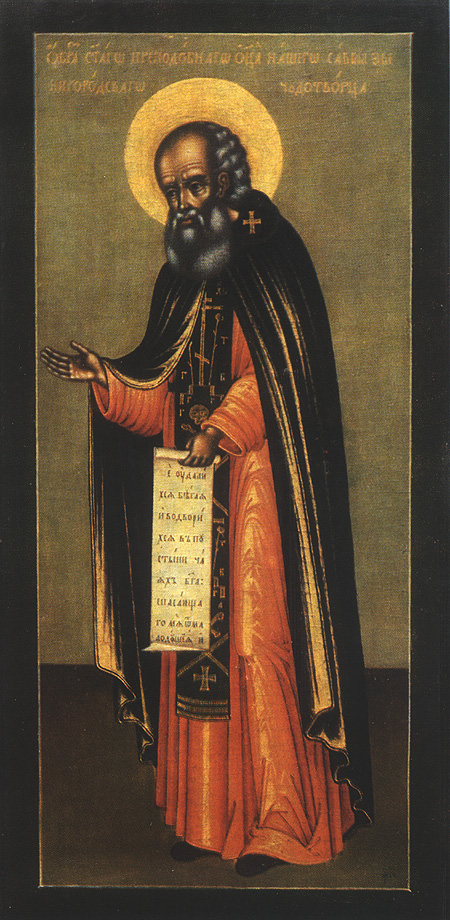
Today we commemorate opening of the incorrupt relics of Saint Savva of Storozhev and Zvenigorod on January 19, 1652.

Saint Savva is also also commemorated on December 3, as determined by the Moscow Council of 1547.

Venerable Macarius the Roman of Novgorod

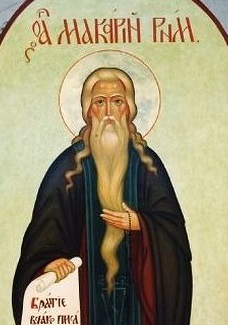
Saint Macarius the Roman was born at the end of the fifteenth century into a wealthy family of Rome. His parents raised him in piety and gave him an excellent education. He might have expected a successful career in public service, but he did not desire honors or earthly glory. Instead, he focused on how to save his soul.

He lived in an age when the Christian West was shaken by the Protestant Reformation. While others around him were pursuing luxury and lascivious pleasures, he studied the Holy Scriptures and the writings of the Fathers. Saint Macarius was grieved to see so many darkened by sin and worldly vanity, and was disturbed by the rebellions and conflicts within the Western Church. With tears, he asked God to show him the path of salvation, and his prayer did not go unanswered. He came to realize that he would find the safe harbor of salvation in the Orthodox Church.

Saint Macarius left Rome secretly, and set out for Russia without money, and wearing an old garment. After many sufferings on his journey, he arrived in Novgorod, where he rejoiced to see so many churches and monasteries. One of these monasteries had been founded three centuries before by his fellow countryman, Saint Anthony the Roman (August 3).

Saint Macarius came to the banks of the River Svir, where Saint Alexander of Svir (April 17 and August 30) had founded the monastery of the Holy Trinity. Saint Alexander received Macarius into the Orthodox Church and tonsured him as a monk. Macarius, however longed for the solitary life. He moved to an island on the River Lezna, forty-five miles from Novgorod, where he engaged in ascetical struggles and unceasing prayer.

The winters were very cold, and the summers were hot and humid. The marshy area was also a breeding ground for mosquitos, which tormented the saint. Saint Macarius survived on berries, roots, and herbs. Sometimes bears would come to him for food, and they allowed him to pet them.

Such a great lamp of the spiritual life could not remain hidden for long. One rainy night someone knocked on his door and asked him to open it. Several people, who seemed to be hunters, entered his cell. Astonished by his appearance, and the divine light shining from his face, the men asked for his blessing. They told him they had come to the forest to hunt, and only by the prayers of the saint did God permit them to find him.

“It is not my sinful prayers,” he told them, “but the grace of God which led you here.”

After feeding them, he spoke and prayed with them, then showed them the way out of the marsh. Saint Macarius was concerned that his peace would be disturbed, now that his dwelling place was known. His fears were justified, because many people sought him out to ask for his advice and prayers.

The holy ascetic decided to move even farther into the wilderness, choosing an elevated place on the left bank of the Lezna. Even here, however, he was not able to conceal himself for very long. Sometimes a pillar of fire would rise up into the sky at night above his place of refuge. During the day, the grace of God was made manifest by a fragrant cloud of smoke. Drawn by these signs, the local inhabitants of the region were able to find him once more.

Some of his visitors begged Saint Macarius to permit them to live near him and to be guided by his counsels. Seeing that this was the Lord’s will, he did not refuse them. He blessed them to build cells, and this was the foundation of his monastery.

In 1540, they built a wooden church dedicated to the Dormition of the Most Holy Theotokos. Saint Macarius was ordained to the holy priesthood by Bishop Macarius of Novgorod, who later became Metropolitan of All Russia. The hierarch also appointed Saint Macarius as igumen of the monastery.

Saint Macarius was an example to the others, and was given the gifts of clairvoyance and wonderworking from God. He wore himself out with his labors and vigils, encouraging others not to become faint-hearted in their own struggles.

After several years, he entrusted the monastery to one of his disciples, and returned to the island where he had first lived. There he fell asleep in the Lord on August 15, 1550. His disciples buried him outside on the left side of the Dormition church which he had founded.

The Hermitage of Saint Macarius was never a prosperous monastery with many monks, but it was distinguished by the high level of spiritual life. In the seventeenth century, many of the monasteries near Novgorod were plundered by Swedish invaders. The Hermitage of Saint Macarius was also burned in 1615, and some of the monks were put to the sword.

By the eighteenth century, the monastery had become a dependency of the Saint Alexander Nevsky Lavra in Saint Petersburg. The Empress Catherine closed it in 1764, just as she had closed other monasteries, and it was designated as a parish church. Although pilgrims still came to venerate the saint’s relics and to celebrate his Feast Day, the buildings soon fell into ruin.

In the mid-nineteenth century, some benefactors restored the two churches and the miraculous healing spring which the saint himself had dug. About this time an old priest was living there, and he celebrated the church services until his death. In 1894, the monastery began to function once more under the noted missionary Hieromonk Arsenius, who introduced the Athonite Typikon. The monastery was destroyed by the Soviets in 1932.

Saint Macarius the Roman is commemorated on August 15 (the date of his repose), and also on January 19 (his nameday).

Virgin Martyr Euphrasia of Nicomedia

The Holy Virgin Martyr Euphrasia was born at Nicomedia into an illustrious family. She was a Christian, and was noted for her beauty. During the persecution of Christians by Maximian, the pagans tried to compel Euphrasia to offer sacrifice to idols. When she refused, she was beaten, and then given to a certain barbarian to be violated.

The saint prayed tearfully to the Lord that He would preserve her virginity, and God heard her prayer. Saint Euphrasia suggested to the barbarian that if he would not defile her, she would give him a special herb which would protect him from enemy weapons and death. But this herb, she explained, held its power only when received from a virgin and not from a woman.

The soldier believed Saint Euphrasia and went with her into the garden. The holy virgin picked the herb, then offered to demonstrate its power. She placed the herb on her neck and told the man to strike her with his sword. With a mighty blow, he cut off her head. Thus her prayer was answered, and the wise virgin offered her soul to God in 303, safeguarding her bodily purity.

Saint Arsenius, Archbishop of Kerkyra

Saint Arsenius, Archbishop of Kerkyra (Corfu), was a native of Palestine and lived in the ninth century. He led a strict ascetic life, and was a highly educated man and renowned spiritual writer. He was glorified by wisdom, and by the constantly defended his flock from the wrath of the emperor Constantine (979-1028).

Because of his great virtue, Saint Arsenius was consecrated as Archbishop of Kerkyra. He became a defender of widows, a father to orphans, and a comfort for the sorrowful, and so God rewarded him with the gift of miracles.

He fell asleep in the Lord toward the end of the ninth century. His relics were placed in the cathedral at Kerkyra, and many miracles and healings took place at his tomb.

Saint Arsenius composed the Canon chanted during the Sanctification of Oil, a Panegyric on the Apostle Andrew, and a Discourse on the Suffering of the Great Martyr Barbara. Several of his letters to Saint Photius (February 6) still survive.

Saint Anthony, founder of Monasticism in Georgia

Our holy father Anton of Martqopi arrived in Georgia in the 6th century with the rest of the Thirteen Syrian Fathers and settled in Kakheti to preach the Gospel of Christ. He always carried with him an icon of the Savior “Not-Made-By-Hands.” Anton made his home in the wilderness, and deer visited him every evening to nourish him with their milk.

One day the deer arrived earlier than expected, and they were followed by a wounded fawn. Clearly something had frightened them.

When Anton retraced the animals’ path, he discovered a nobleman, the head of a nearby village, hunting in the fields. Astonished to see the old monk with his icon, standing amidst a gathering of deer, the nobleman, being a pagan, became convinced that he was dangerous and ordered his servants to take him to a smith and chop off his hands.

Anton was led at once to the smith, but when the craftsman heated his sword and drew it above the monk’s hands in preparation, he fell down suddenly and his arms became like wood.

The daunted smith fell mute, but blessed Anton made the sign of the Cross over him and he was immediately healed.

Having heard about this miracle, the nobleman perceived that Abba Anton was truly holy, and he began to hold him in reverence. “Tell me what you need, and I will provide it for you,” he told Elder Anton. The monk requested a single piece of salt, and they brought him two large blocks. He broke off a small piece and placed it near his cell for the deer.

After the incident at the smith’s, many people began to visit Anton, and the holy father constructed a monastery for the faithful.

But before long their attention became burdensome, and Elder Anton fled from the world to the peak of a mountain. There he began to preach from the top of a pillar, where he would remain the last fifteen years of his life.

When God revealed to Fr. Anton the day of his repose, the monk-stylite gathered his pupils, imparted to them a few last words of wisdom, blessed them, and died on his knees in front of his beloved icon.

St. Anton’s body was taken down from the pillar and buried in the monastery that he had founded, before the icon of the Theotokos.

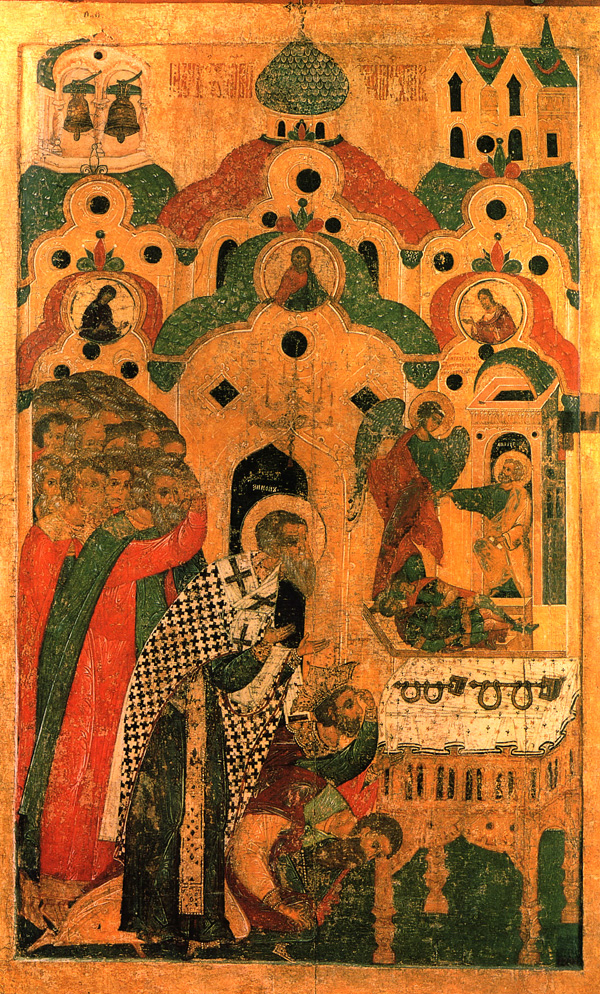
Commemoration of the miracle of Saint Basil the Great at Nicaea

Today the Church remembers a great miracle in Nicaea, when Saint Basil the Great, by his prayers, opened the
doors of the Cathedral Church.

During a visit to Nicaea, Emperor Valens, at the request of some prominent Arians, took the Cathedral away from the Orthodox by force and allowed the Arians to occupy it. The Orthodox were grief stricken by this terrible calamity. Later, when Saint Basil happened to arrive in Nicaea, the faithful wept and told him what the Emperor had done. The saint went to Constantinople and criticized Valens for his unjust action. The Emperor was furious, but knew that he had been wrong in giving the Cathedral to the heretics. He said, “Return to Nicaea and judge between the parties, but do not show any favoritism to your side.”

Saint Basil went back to Nicaea with an imperial decree and called the Arians together. He said, “The Emperor has given me authority to decide whether you or the Orthodox should have the church.”

They replied, “Very well, but judge the way that the Emperor would judge if he were here.”

Saint Basil ordered the Arians and the Orthodox to lock the doors of the church, affix their seals, and appoint some men to guard it. Then he told the Arians to go and pray for three days and nights, and then return. If the doors opened because of their prayers, they would be allowed to retain possession of the church. He said, “If the doors do not open for you, then we shall pray for just one night, and then return. If the doors open for us, then we shall own the building again. If they do not open for us, then it will be yours.”

The Arians accepted this proposal, but the Orthodox thought that Saint Basil was giving an unfair advantage to the heretics because he feared the Emperor. However, the church was locked and sealed, and guards were stationed there. After three days and nights, the Arians’ prayers had achieved nothing, so they continued praying until noon of the fourth day. When the doors still failed to open, they hung their heads in shame and went away.

Saint Basil led the Orthodox to the church of Saint Diomedes outside the city, and served an All-Night Vigil. The next morning, the hierarch led a procession back to the Cathedral as the people chanted “Holy God.” Halting before the doors of the church, he ordered them to lift their hands to Heaven and to cry, “Lord, have mercy.” Then they prayed, and Saint Basil made the Sign of the Cross over the doors three times and shouted, “Blessed is the God of the Christians, always, now and ever, and unto the ages of ages.”

Suddenly there was an earthquake which broke the locks, threw the bars on the floor, and split the seals, and then the doors flew open. Saint Basil entered the building with all the Orthodox. After celebrating the divine service, he dismissed the faithful.

Many Arians who came to see what would happen renounced their heresy and became Orthodox. As for Valens, he was amazed when he heard of this great miracle, but he did not convert to Orthodoxy. Later, he was wounded in a battle and he hid in a barn which was filled with straw. His enemies surrounded the barn and set it on fire. The evil tyrant perished in the flames and his soul departed to the everlasting fire.

The transfer of the relics of Saint Gregory the Theologian

According to some researchers, the uncovering of the relics of Saint Gregory the Theologian (Jan. 25) occurred at Nazianzus during the reign of Emperor Arkadios (395-408), that of Theodosios II (408-450), and that of Emperor Constantine Porphyrogenitos (911 – 959) when they were enshrined in the Church of the Holy Apostles at Constantinople. His honorable head is reverently kept in Vatopedi Monastery on Mount Athos.

Until the year 1204, when the Western Crusaders captured Constantinople, portions of Saint Gregory’s relics were kept in the church of Hagia Sophia, in the church of the Holy Apostles, and in the church of the Holy Resurrection.

Memory Eternal, Saliba Dabit

Our beloved Saliba Dabit fell asleep in the Lord Sunday evening. His faithful presence at St. Peter’s will be greatly missed. Please keep him and the family in your prayers.

Visitation will be Monday, January 24 5-7pm at Parkway Funeral Home
Flowers and body to arrive 4:15pm
Visitation with just family 4:30-5pm

There will also be a small visitation time between 9:30-10:00am on Tuesday February 25 at St. Peter’s.

The funeral will be Tuesday, January 25 10:00 am at St. Peter’s followed by a procession to Parkway Memorial Gardens on Highland Colony Parkway for Trisagion Prayers for the Departed and burial.

Daily Readings for Tuesday, January 18, 2022

ATHANASIOS AND CYRIL, PATRIARCHS OF ALEXANDRIA

NO FAST

Athanasios and Cyril, Patriarchs of Alexandria, Zenia the Martyr

ST. PAUL’S LETTER TO THE HEBREWS 13:7-16

Brethren, remember your leaders, those who spoke to you the word of God; consider the outcome of their lives, and imitate their faith. Jesus Christ is the same yesterday and today and for ever. Do not be led away by diverse and strange teachings; for it is well that the heart be strengthened by grace, not by foods, which have not benefited their adherents. We have an altar from which those who serve the tent have no right to eat. For the bodies of those animals whose blood is brought into the sanctuary by the high priest as a sacrifice for sin are burned outside the camp. So Jesus also suffered outside the gate in order to sanctify the people through his own blood. Therefore let us go forth to him outside the camp and bear the abuse he endured. For here we have no lasting city, but we seek the city which is to come. Through him then let us continually offer up a sacrifice of praise to God, that is, the fruit of lips that acknowledge his name. Do not neglect to do good and to share what you have, for such sacrifices are pleasing to God.

MATTHEW 5:14-19

The Lord said to his disciples, “You are the light of the world. A city set on a hill cannot be hid. Nor do men light a lamp and put it under a bushel, but on a stand, and it gives light to all in the house. Let your light so shine before men, that they may see your good works and give glory to your Father who is in heaven. Think not that I have come to abolish the law and the prophets; I have come not to abolish them but to fulfill them. For truly, I say to you, till heaven and earth pass away, not an iota, not a dot, will pass from the law until all is accomplished. Whoever then relaxes one of the least of these commandments and teaches men so, shall be called least in the kingdom of heaven; but he who does them and teaches them shall be called great in the kingdom of heaven.”

Saint Athanasius the Great, Archbishop of Alexandria

Saints Athanasius and Cyril were Archbishops of Alexandria. These wise teachers of truth and defenders of Christ’s Church share a joint Feast in recognition of their dogmatic writings which affirm the truth of the Orthodox Faith, correctly interpret the Holy Scripture, and censure the delusions of the heretics.

St Athanasius took part in the First Ecumenical Council when he was still a deacon. He surpassed everyone there in his zeal to uphold the teaching that Christ is consubstantial (homoousios) with the Father, and not merely a creature, as the Arians proclaimed.

This radiant beacon of Orthodoxy spent most of his life in exile from his See, because of the plotting of his enemies. He returned to his flock as he was approaching the end of his life. Like an evening star, he illumined the Orthodox faithful with his words for a little while, then reposed in 373. He is also commemorated on May 2 (the transfer of his holy relics).

Saint Cyril, Archbishop of Alexandria

Saints Athanasius and Cyril were Archbishops of Alexandria. These wise teachers of truth and defenders of Christ’s Church share a joint Feast in recognition of their dogmatic writings which affirm the truth of the Orthodox Faith, correctly interpret the Holy Scripture, and censure the delusions of the heretics.

St Cyril was the nephew of Patriarch Theophilus of Alexandria, who educated him from his youth. He succeeded to his uncle’s position in 412, but was deposed through the intrigues of the Nestorian heretics. He later resumed his See, however.

St Cyril presided at the Third Ecumenical Council in 431, which censured the Nestorian blasphemy against the Most Holy Theotokos. His wise words demonstrated the error of their false doctrine.

St Cyril departed to the Lord in the year 444, and is also commemorated on June 9 (the day of his repose).

Venerable Athanasius, Abbot of Syandemsk, Vologda

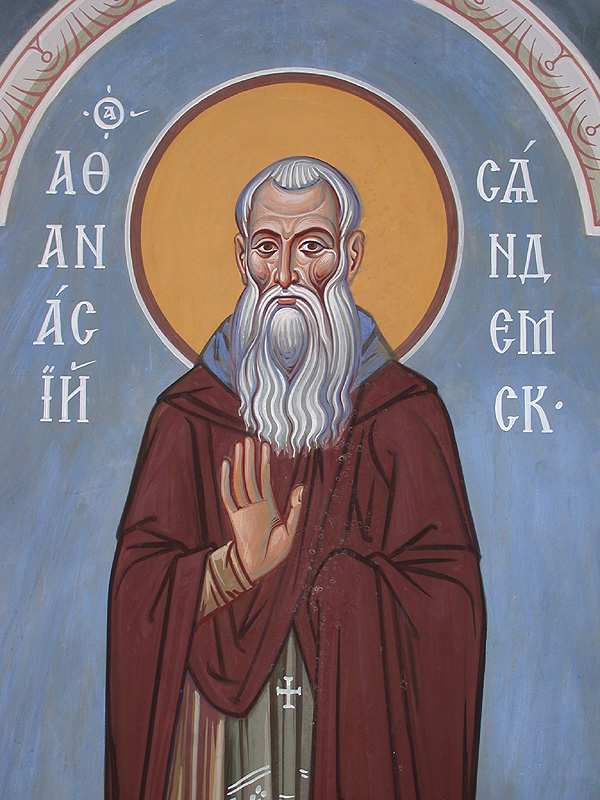
Saint Athanasius of Synadem and Vologda was a disciple of Saint Alexander of Svir (August 30). After the death of his mentor, he established the Dormition hermitage in the forests of Karelia, not far from the city of Olonets, on an island of Lake Synadem.

The slander and pettiness of the local inhabitants compelled Saint Athanasius to move back to the Svir monastery, where they chose him as igumen. Later returning to the Dormition hermitage, Saint Athanasius died in about the year 1550 in great old age, and was buried on one of the promontories of Roschinsk island. Afterwards, a church was built over his grave, named for Saints Athanasius and Cyril of Alexandria. The incorrupt relics of Saint Athanasius were placed in this church in 1720.

Righteous Athanasius of Novolotsk

Righteous Athanasius of Navolotsk went at the end of the sixteenth century from the Kargopol region to the Olonets land, where he founded a monastery 78 versts from what later became the city of Petrozavodsk. The saint died at a Verkholedsk suburb not far from Shenkursk.

Venerable Marcian of Cyrrhus in Syria

Saint Marcian of Cyrrhus lived in the desert near the city of Cyrrhus. He built a small hut and settled in it, passing his time in prayer, singing Psalms and reading spiritual books. He ate very little food, just enough to keep him alive. Reports of his holy life attracted to him many zealous ascetics, and Saint Marcian established a monastery for them.

God’s blessing rested upon the saint, and he possessed the gift of wonderworking. Once, a serpent crawled into his cell. The saint made the Sign of the Cross and the serpent perished, burned up by flames. At night, when the ascetic read, a heavenly light shone for him. The monk also worked many other miracles on behalf of the brethren. He died in peace about the year 388.

Venerable Schemamonk Cyril and Schemanun Maria, the parents of Saint Sergius of Radonezh

Saint Cyril and his wife Maria were the parents of Saint Sergius of Radonezh (September 25). They belonged to the nobility, but more importantly, they were devout and faithful Christians who were adorned with every virtue.

When the child in Maria’s womb cried out three times in church during Liturgy, people were astonished. Although frightened at first, Maria came to see this event as a sign from God that her child would become a chosen vessel of divine grace. She and her husband agreed that if the child was a boy, they would bring him to church and dedicate him to God. This child, the second of their three sons, was born around 1314. He was named Bartholomew at his baptism.

Because of civil strife, Saint Cyril moved his family from Rostov to Radonezh when Bartholomew was still a boy.

Later, when their son expressed a desire to enter the monastic life, Saints Cyril and Maria asked him to wait and take care of them until they passed away, because his brothers Stephen and Peter were both married and had their own family responsibilities. The young Bartholomew obeyed his parents, and did everything he could to please them. They later decided to retire to separate monasteries, and departed to the Lord after a few years. It is believed that Saints Cyril and Maria both reposed in 1337.

Forty days after burying his parents, Bartholomew settled their estate, giving his share to his brother Peter. He then went to the monastery when he was twenty-three years old, and was tonsured on October 7 with the name Sergius (in honor of the martyr Saint Sergius who is commemorated on that day). As everyone knows, Saint Sergius of Radonezh became one of Russia’s greatest and most revered saints.

Saints Cyril and Maria were glorified by the Orthodox Church of Russia in 1992. They are also commemorated on September 28, and July 6 (Synaxis of the Saints of Radonezh).

Saint Joachim I, Patriarch of Trnovo and Bulgaria

No information available at this time.

Saint Maximus, Archbishop of Serbia

No information available at this time.

Saint Maximus the New

Saint Maximus the New was the son of King Stephen of Serbia (December 10). He became a monk at Manasija, but had to flee into a mountainous region of Romania because of the Moslems. He was consecrated as Metropolitan of Wallachia. After a life of great spiritual endeavors, he fell asleep in the Lord on January 18, 1516 in a monastery he had founded.

Saint Ephraim the Lesser

Today little is known about the life of venerable Ephraim the Lesser, the great 11th-century writer, translator, philosopher, and defender of the Georgian Church. His work Reminiscences and other sources, however, provide us with the means to speculate about the major periods of his life and labors.

In 1027, when King Bagrat IV (1027-1072) ascended the Georgian throne, many noblemen of the Tao region in southern Georgia relocated to Greece. Among them was the honorable Vache, son of Karichi, whom scholars believe was Ephraim’s father.

After receiving a Greek education in Constantinople, Ephraim settled in the Black Mountains near Antioch and began his labors there. His achievements in Georgian theological and philosophical writing are immeasurable. The number of his works is almost one hundred, and the subjects cover nearly every branch of theological inquiry. Ephraim even developed his own theory of translation, which later formed the foundation for written composition in the Georgian language. His theory consists of three essential points:

1. A composition must be translated from the original, that is, from the language in which it was first written.

2. The translation must carry the same literal meaning as the original, but accuracy in this regard must not violate the nature of the language into which the text is being translated.

3. A section of commentary that examines all relevant historical, grammatical, and literary issues should be included with the translated text.

Ephraim translated five of the works of Saint Dionysius the Areopagite, The Ascetic Rules of Saint Basil the Great, the writings of Saint Ephraim the Syrian, commentaries on the Epistles and Psalms, and many other important patristic writings.

Among Ephraim the Lesser’s original works, his most significant is An Explanation of the Reasons for the Conversion of Georgia, a compilation of existing essays and his own commentaries on the nation’s conversion.

In the second half of the 11th century, the monks of Antioch and the Black Mountains began to deny the independence of the Georgian Church. Among other claims, they argued that none of the Apostles had preached the Christian Faith in Georgia. It became necessary to prove that the Georgian Church was indeed autocephalous, and members of the nation’s elite accordingly called upon Ephraim to settle this issue. Ephraim studied many patristic writings in the original Greek, gathered the ancient sources, and succeeded in fully securing the independent existence of the Georgian Church.

Saint Ephraim wrote the following about the Apostles’ preaching: “Know that from the time the Apostles were preaching, according to the Prophet David: Their voice was heard through all the earth, and their words resounded in every village (c.f. Ps. 18:4). In Georgia, Andrew the First-called preached the Gospel in Avazgia (now Abkhazeti), and from there he journeyed to Ossetia (now Shida Kartli). Bartholomew also preached in Georgia, in the Kartli region.”

Saint Ephraim never left the Black Mountains. In 1091 he was enthroned as the abbot of Kastana Monastery [The precise location of Kastana is unknown, but according to modern archaeologists, it was probably in the Black Mountains. For a full discussion of the subject see: Wachtang Z. Djobadze, Materials for the study of Georgian monasteries in the Western environs of Antioch on the Orontes (Louvain: Corpus Scriptorum Christianorum Orientalium, 1976), pp. 101-3]

Our holy father Ephraim reposed in the Lord around the year 1101. He is included in a list of the departed compiled by the Council of Ruisi-Urbnisi in 1103, and the year of his death has been approximated from the information given in this source.

Ephraim was canonized by the Orthodox Church of Georgia because of his God-pleasing life and the many commendable works he performed on behalf of the Church and his nation.

Venerable Hieromonk Alexei of Teklati

Saint Alexi (Shushania) was born September 23, 1852, in the village of Noqalaqevi, in the Senaki district of Samegrelo, to a pious Christian couple. His father died in 1868, after giving the sixteen-year-old future hieromonk his blessing to care for the family.

In the same year that his father died, Alexi journeyed to Jerusalem on a pilgrimage, and from there to Constantinople to visit his uncle, Islam Shushania, a successful merchant and a clever and pious man. During this visit, Alexi became fascinated with the trade industry and resolved to become a merchant as well. But he would soon discover that God’s will was different from his own.

One day Alexi borrowed a small icon of Saint John the Baptist from his uncle, confined himself to his room, and there began to experience great inner warfare. He was moved by a profound love for his mother, sisters, brothers, and friends, but at the same time he sensed an invisible force calling him to the spiritual life.

After several agonizing hours, Alexi finally asked himself, “How can I fulfill my father’s will? He entrusted me with the responsibility to look after the family—how can I reconcile this with God’s calling?”

To his great wonder, an invisible instructor answered him, saying, “If you die now, who will take over your responsibilities?” The answer was clear. “God will!” Alexi proclaimed. And he heard the voice again.

“So die to the world, entrust everything to God, and He will minister to your family.”

The encounter transformed Alexi’s life. Afterwards he confined himself to his room for months, reading the Holy Scriptures, and keeping a strict fast. Witnessing the radical change in Alexi’s way of life, his uncle thought it would be best for them to leave Constantinople and return to Georgia.

It was not long before Alexi’s loved ones realized he had made a covenant with God, and that he would enter the monastic life. His brothers and sisters were distressed upon hearing the news, but his mother gave thanks to God and blessed her son.

At the age of twenty Alexi moved to Teklati Women’s Monastery. He began to lead a strict ascetic life and went from village to village, caring for those ill with tuberculosis, cholera, and other serious illnesses, and burying the corpses of the homeless.

Several years passed, and many became convinced that Alexi was a fool-for-Christ. He preached the Word of God with intensity, and his life was an example for many. His preaching inspired his mother, Elene, his younger sister Salome, and his brother Besarion to join him in the monastic life. After he was tonsured a monk, Besarion made a pilgrimage to Jerusalem and remained there for several years.

Because of his exemplary service to the Lord, he was ordained a priest at Martvili Monastery. Later he was tonsured into the great schema. Alexi also spent time on Mt. Athos. After returning from the Holy Mountain, he made a pilgrimage to the Kiev Caves Monastery, then returned to Georgia to continue his labors.

Around the year 1885 Saint Alexi moved to Gelati Monastery, where he continued to study and produced several original works. In 1886 he was reassigned to Khobi Monastery and ordained a deacon by Bishop Grigol, and in 1888 he was ordained a hieromonk. Two years later, in 1890, he became ill and returned to be with his mother and sisters at Teklati Monastery.

According to God’s will his health was restored, and in 1891 Alexi fashioned a cell for himself in the mountainous village of Menji (also called “Archangels’ Hill”), near the place where he was born. He gathered his disciples and undertook a stricter ascetic life. Fr. Alexi’s health was so improved that he was able to celebrate the divine services again.

The holy father would receive alms, but he distributed most of what was given to him. He divided the alms in three parts: the first he put aside for his personal needs, the second, for the church and its guests, and the third, for the poor and infirm.

Saint Alexi kept a life-size cross in his cell, and when he prayed he supported the cross on his back, since it reminded him of the position in which Saint Simon of Cyrene carried the Holy Cross to Christ’s Crucifixion on Golgotha.

In spite of his strict ascetic life, Hieromonk Alexi was remarkably close to the people in his community and was loved by many for the spiritual warmth that he radiated.

After many years the strict ascetic life finally took its toll on Fr. Alexi’s health. He dismissed his pupils and spent the last years of his earthly life (from around the year 1915) with his cousins, the schemanuns Akepsima and Pasto. Saint Alexi reposed January 18, 1923, frail from a long and labor-filled life in the service of the Lord.

For forty days after his death, the schemanuns Akepsima and Pasto remained in his cell for fear that the Communist government’s henchmen would destroy his humble dwelling. Later they buried Fr. Alexi’s body at Teklati, and themselves began to labor at the Archangels’ Monastery. With the blessing of Metropolitan Eprem of Batumi-hemokmedi and Chqondidi, Schemanun Akepsima and Abbess Pasto translated Fr. Alexi’s incorrupt relics from Teklati to the Archangels’ Monastery and buried them near the east wall of the temple on January 8, 1960.

Saint Alexi was canonized on September 18, 1995.

Daily Readings for Monday, January 17, 2022

ANTHONY THE GREAT

NO FAST

Anthony the Great, Anthony the New of Veria, George the New Martyr of Ioannina, Theodosius the Emperor

ST. PAUL’S LETTER TO THE HEBREWS 13:17-21

Brethren, obey your leaders and submit to them; for they are keeping watch over your souls, as men who will have to give account. Let them do this joyfully, and not sadly, for that would be of no advantage to you. Pray for us, for we are sure that we have a clear conscience, desiring to act honorably in all things. I urge you the more earnestly to do this in order that I may be restored to you the sooner. Now may the God of peace who brought again from the dead our Lord Jesus, the great Shepherd of the sheep, by the blood of the eternal covenant, equip you with everything good that you may do His will, working in you that which is pleasing in His sight, through Jesus Christ; to whom be glory for ever and ever. Amen.

LUKE 6:17-23

At that time, Jesus stood on a level place, with a great crowd of his disciples and a great multitude of people from all Judea and Jerusalem and the seacoast of Tyre and Sidon, who came to hear him and to be healed of their diseases; and those who were troubled with unclean spirits were cured. And all the crowd sought to touch him, for power came forth from him and healed them all. And he lifted up his eyes on His disciples, and said: “Blessed are you poor, for yours is the Kingdom of God. Blessed are you that hunger now, for you shall be satisfied. Blessed are you that weep now, for you shall laugh. Blessed are you when men hate you, and when they exclude you and revile you, and cast out your name as evil, on account of the Son of man! Rejoice in that day, and leap for joy, for behold, your reward is great in heaven.”

Venerable and God-bearing Father Anthony the Great

Saint Anthony the Great is known as the Father of monasticism, and the long ascetical sermon in The Life of Saint Anthony by Saint Athanasius (Sections 16-34), could be called the first monastic Rule.

He was born in Egypt in the village of Coma, near the desert of the Thebaid, in the year 251. His parents were pious Christians of illustrious lineage. Anthony was a serious child and was respectful and obedient to his parents. He loved to attend church services, and he listened to the Holy Scripture so attentively, that he remembered what he heard all his life.

When Saint Anthony was about twenty years old, he lost his parents, but he was responsible for the care of his younger sister. Going to church about six months later, the youth reflected on how the faithful,in the Acts of the Apostles (4:35), sold their possessions and gave the proceeds to the Apostles for the needy.

Then he entered the church and heard the Gospel passage where Christ speaks to the rich young man: “If you would be perfect, go, sell what you possess and give it to the poor, and you will have treasure in heaven; and come follow Me” (Mt.19:21). Anthony felt that these words applied to him. Therefore, he sold the property that he received after the death of his parents, then distributed the money to the poor, and left his sister in the care of pious virgins in a convent.

Leaving his parental home, Saint Anthony began his ascetical life in a hut not far from his village. By working with his hands, he was able to earn his livelihood and also alms for the poor. Sometimes, the holy youth also visited other ascetics living in the area, and from each he sought direction and benefit. He turned to one particular ascetic for guidance in the spiritual life.

In this period of his life Saint Anthony endured terrible temptations from the devil. The Enemy of the race of man troubled the young ascetic with thoughts of his former life, doubts about his chosen path, concern for his sister, and he tempted Anthony with lewd thoughts and carnal feelings. But the saint extinguished that fire by meditating on Christ and by thinking of eternal punishment, thereby overcoming the devil.

Realizing that the devil would undoubtedly attack him in another manner, Saint Anthony prayed and intensified his efforts. Anthony prayed that the Lord would show him the path of salvation. And he was granted a vision. The ascetic beheld a man, who by turns alternately finished a prayer, and then began to work. This was an angel, which the Lord had sent to instruct His chosen one.

Saint Anthony tried to accustom himself to a stricter way of life. He partook of food only after sunset, he spent all night praying until dawn. Soon he slept only every third day. But the devil would not cease his tricks, and trying to scare the monk, he appeared under the guise of monstrous phantoms. The saint however protected himself with the Life-Creating Cross. Finally the Enemy appeared to him in the guise of a frightful looking small dark figure, and hypocritically declaring himself beaten, he thought he could tempt the saint into vanity and pride. The saint, however, vanquished the Enemy with prayer.

For even greater solitude, Saint Anthony moved farther away from the village, into a graveyard. He asked a friend to bring him a little bread on designated days, then shut himself in a tomb. Then the devils pounced upon the saint intending to kill him, and inflicted terrible wounds upon him. By the providence of the Lord, Anthony’s friend arrived the next day to bring him his food. Seeing him lying on the ground as if dead, he took him back to the village. They thought the saint was dead and prepared for his burial. At midnight, Saint Anthony regained consciousness and told his friend to carry him back to the tombs.

Saint Anthony’s staunchness was greater than the wiles of the Enemy. Taking the form of ferocious beasts, the devils tried to force the saint to leave that place, but he defeated them by trusting in the Lord. Looking up, the saint saw the roof opening, as it were, and a ray of light coming down toward him. The demons disappeared and he cried out, “Where have You been, O Merciful Jesus? Why didn’t You appear from the very beginning to end my pain?”

The Lord replied, “I was here, Anthony, but wanted to see your struggle. Now, since you have not yielded, I shall always help you and make your name known throughout all the world.” After this vision Saint Anthony was healed of his wounds and felt stronger than before. He was then thirty-five years of age.

Having gained spiritual experience in his struggle with the devil, Saint Anthony considered going into the Thebaid desert to serve the Lord. He asked the Elder (to whom he had turned for guidance at the beginning of his monastic journey) to go into the desert with him. The Elder, while blessing him in the then as yet unheard of exploit of being a hermit, decided not to accompany him because of his age.

Saint Anthony went into the desert alone. The devil tried to hinder him, by placing a large silver disc in his path, then gold, but the saint ignored it and passed by. He found an abandoned fort on the other side of the river and settled there, barricading the entrance with stones. His faithful friend brought him bread twice a year, and there was water inside the fort.

Saint Anthony spent twenty years in complete isolation and constant struggle with the demons, and he finally achieved perfect calm. The saint’s friends removed the stones from the entrance , and they went to Saint Anthony and besought him to take them under his guidance. Soon Saint Anthony’s cell was surrounded by several monasteries, and the saint acted as a father and guide to their inhabitants, giving spiritual instruction to all who came into the desert seeking salvation. He increased the zeal of those who were already monks, and inspired others with a love for the ascetical life. He told them to strive to please the Lord, and not to become faint-hearted in their labors. He also urged them not to fear demonic assaults, but to repel the Enemy by the power of the Life-Creating Cross of the Lord.

In the year 311 there was a fierce persecution against Christians, in the reign of the emperor Maximian. Wishing to suffer with the holy martyrs, Saint Anthony left the desert and went to Alexandria. He openly ministered to those in prison, he was present at the trial and interrogations of the confessors, and accompanying the martyrs to the place of execution. It pleased the Lord to preserve him, however, for the benefit of Christians.

At the close of the persecution, the saint returned to the desert and continued his exploits. The Lord granted the saint the gift of wonderworking, casting out demons and healing the sick by the power of his prayer. The great crowds of people coming to him disrupted his solitude, and he went off still farther, into the inner desert where he settled atop a high elevation. But the brethren of the monasteries sought him out and asked him to visit their communities.

Another time Saint Anthony left the desert and arrived in Alexandria to defend the Orthodox Faith against the Manichaean and Arian heresies. Knowing that the name of Saint Anthony was venerated by all the Church, the Arians said that he adhered to their heretical teaching. But Saint Anthony publicly denounced Arianism in front of everyone and in the presence of the bishop. During his brief stay at Alexandria, he converted a great multitude of pagans to Christ.

People from all walks of life loved the saint and sought his advice. Pagan philosophers once came to Abba Anthony intending to mock him for his lack of education, but by his words he reduced them to silence. Emperor Constantine the Great (May 21) and his sons wrote to Saint Anthony and asked him for a reply. He praised the emperor for his belief in Christ, and advised him to remember the future judgment, and to know that Christ is the true King.

Saint Anthony spent eighty-five years in the solitary desert. Shortly before his death, he told the brethren that soon he would be taken from them. He instructed them to preserve the Orthodox Faith in its purity, to avoid any association with heretics, and not to be negligent in their monastic struggles. “Strive to be united first with the Lord, and then with the saints, so that after death they may receive you as familiar friends into the everlasting dwellings.”

The saint instructed two of his disciples, who had attended him in the final fifteen years of his life, to bury him in the desert and not in Alexandria. He left one of his monastic mantles to Saint Athanasius of Alexandria (January 18), and the other to Saint Serapion of Thmuis (March 21). Saint Anthony died peacefully in the year 356, at age 105, and he was buried in the desert by his disciples.

The Life of the famed ascetic Saint Anthony the Great was written by Saint Athanasius of Alexandria. This is the first biography of a saint who was not a martyr, and is considered to be one of the finest of Saint Athanasius’ writings. Saint John Chrysostom recommends that this Life be read by every Christian.

“These things are insignificant compared with Anthony’s virtues,” writes Saint Athanasius, “but judge from them what the man of God Anthony was like. From his youth until his old age, he kept his zeal for asceticism, he did not give in to the desire for costly foods because of his age, nor did he alter his clothing because of the infirmity of his body. He did not even wash his feet with water. He remained very healthy, and he could see well because his eyes were sound and undimmed. Not one of his teeth fell out, but near the gums they had become worn due to his advanced age. He remained strong in his hands and feet…. He was spoken of everywhere, and was admired by everyone, and was sought even by those who had not seen him, which is evidence of his virtue and of a soul dear to God.”

The following works of Saint Anthony have come down to us:

Twenty Sermons on the virtues, primarily monastic (probably spurious).

Seven Letters to various Egyptian monasteries concerning moral perfection, and the monastic life as a spiritual struggle.

A Rule for monastics (not regarded as an authentic work of Saint Anthony).

In the year 544 the relics of Saint Anthony the Great were transferred to Alexandria, and after the conquest of Egypt by the Saracens in the seventh century, they were transferred to Constantinople. The holy relics were transferred from Constantinople in the tenth-eleventh centuries to a diocese outside Vienna. In the fifteenth century they were brought to Arles (in France), to the church of Saint Julian.

Venerable Anthony of Dymsk, Novgorod

Saint Anthony of Dymsk was born at Novgorod in about the year 1157. Once in church he heard the words of Christ: “If anyone would come after Me, let him deny himself and take up his cross and follow Me” (Mt.16:24), the saint resolved to leave the world and receive monastic tonsure under Saint Barlaam of Khutyn (November 6) at his monastery.

When he was dying, Saint Barlaam appointed Saint Anthony as igumen in his place; but Anthony, shunning glory, left the monastery and settled at the shores of Lake Dyma, on the outskirts of the city of Tikhvin. Here he founded a monastery and struggled there until the end of his own life.

According to Tradition, Saint Anthony made a journey to Constantinople, and returned to his monastery on the day that the igumen Barlaam died. Saint Anthony fell asleep in the Lord on June 24, 1224. In the year 1330 his relics were found incorrupt, and from that time they were glorified by many miracles.

Venerable Anthony of Chernoezero

Saint Anthony of Black Lake founded the Mother of God monastery at Black Lake [Chernoezero] in the Novgorod area, not far from the city of Chernopovets. The monastery was on an island of the Schirsk countryside. The monastery twice suffered complete destruction: in 1581, from the Lithuanians; and in 1682, from the Swedes. The monastery was closed in 1764.

Saint Anthony of Krasny Kholm

Saint Anthony of Krasny Kholm was initially a wilderness-dweller in the vicinity of White Lake. The hieromonk arrived in the region of Tver and settled near “Pretty Hillock” [“Krasny kholm”], at the bank of the River Mologa, building a chapel and cell there. After the discovery of an icon of Saint Nicholas, a stone church was built and a monastery founded, headed by the saint, who taught the brethren both by word and by example throughout his life. Saint Anthony died in 1481.

Emperor Theodosius the Great

The Holy Emperor Theodosius the Great during his reign (379-395) he delivered a decisive blow to paganism by issuing an edict, under which any sort of service to the pagan gods was considered a violation of the law. The zealous proponent of Orthodoxy promulgated many laws in defense of the Church and against heretics. He convened the Second Ecumenical Council (381).

He ended his life in Milan in 395 at the age of fifty. Saint Theodosius often said that he was more fortunate to be a member of Christ’s holy Church than an emperor.

Saint Achilles the Confessor

Saint Achilles the Confessor lived the life of a hermit in Egypt, and died during the fifth century.

Daily Readings for Sunday, January 16, 2022

12TH SUNDAY OF LUKE

NO FAST

12th Sunday of Luke, Veneration of Apostle Peter’s Precious Chains, Righteous Hierodeacon Makarios of Kalogeras, Romilo the Monk of Mount Athos, Nicholas the New-Martyr of Mytilene, Peusippos, Elasippos, and Mesippos the siblings, and their grandmother Neonilla

ST. PAUL’S LETTER TO THE COLOSSIANS 3:4-11

Brethren, when Christ who is our life appears, then you also will appear with him in glory. Put to death therefore what is earthly in you: fornication, impurity, passion, evil desire, and covetousness, which is idolatry. On account of these the wrath of God is coming upon the sons of disobedience. In these you once walked, when you lived in them. But now put them all away: anger, wrath, malice, slander, and foul talk from your mouth. Do not lie to one another, seeing that you have put off the old nature with its practices and have put on the new nature, which is being renewed in knowledge after the image of its creator. Here there cannot be Greek and Jew, circumcised and uncircumcised, barbarian, Scythian, slave, free man, but Christ is all, and in all.

LUKE 17:12-19

At that time, as Jesus entered a village, he was met by ten lepers, who stood at a distance and lifted up their voices and said: “Jesus, Master, have mercy on us.” When he saw them he said to them, “Go and show yourselves to the priests.” And as they went they were cleansed. Then one of them, when he saw that he was healed, turned back, praising God with a loud voice; and he fell on his face at Jesus’s feet, giving him thanks. Now he was a Samaritan. Then said Jesus: “Were not ten cleansed? Where are the nine? Was no one found to return and give praise to God except this foreigner?” And he said to him: “Rise and go your way; your faith has made you well.”

Veneration of the Precious Chains of the Holy and All-Glorious Apostle Peter

The Veneration of the Honorable Chains of the Holy and All-Praised Apostle Peter: In about the year 42, on the orders of Herod Agrippa, the Apostle Peter was thrown into prison for preaching about Christ the Savior. In prison he was held secure by two iron chains. During the night before his trial, an angel of the Lord removed these chains from the Apostle Peter and led him out from the prison (Acts 12:1-11).

Christians who learned of the miracle took the chains and kept them as precious keepsakes. For three centuries the chains were kept in Jerusalem, and those who were afflicted with illness and approached them with faith received healing. Patriarch Juvenal (July 2) presented the chains to Eudokia, wife of the emperor Theodosius the Younger, and she in turn transferred them from Jerusalem to Constantinople in either the year 437 or 439.

Eudokia sent one chain to Rome to her daughter Eudoxia (the wife of Valentinian), who built a church on the Esquiline hill dedicated to the Apostle Peter and placed the chain in it. There were other chains in Rome, with which the Apostle Peter was shackled before his martyrdom under the emperor Nero. These were also placed in the church.

On January 16, the chains of Saint Peter are brought out for public veneration.

Blessed Maximus the Fool-for-Christ of Totma, Vologda

Blessed Maximus, Priest of Totma, was for a certain time, a priest in the city of Totma in the Vologda diocese. For forty years he undertook the difficult exploit of foolishness for Christ, constantly in fasting and in prayer. Saint Maximus died in great old age on January 16, 1650 and was buried at the Resurrection church in which he served. The local veneration of the saint began in 1715, because of the numerous miracles occurring at his grave.

Martyred brothers Speusippus, Eleusippus, Meleusippus, and those with them, in Gaul

The Holy Martyrs Speusippus, Eleusippus, Meleusippus, and their grandmother Leonilla together with Neon, Turbo and Jonilla suffered in Gaul (by another account, in Cappadocia) in the second century, during the persecution under Marcus Aurelius (161-180).

Leonilla received Baptism in her old age from one of the disciples of Saint Polycarp, Bishop of Smyrna, and she afterwards converted her three grandsons (who were triplets) to Christ. The brothers, in their zeal for the Lord, pulled down idols and reproached the pagans for their folly. The judge ordered Leonilla to go to the prison and tell her grandchildren to renounce Christ and worship the idols. Instead, she praised them for their bravery and their firm confession of faith. All three were hanged on a tree, then flogged. Finally, the martyrs were thrown into a fire, but their bodies were undamaged by the flames.

After the torture and death of her grandchildren, Saint Leonilla was beheaded with a sword. Saint Jonilla also suffered with her. She saw the steadfast faith of the holy martyrs and said that she too was a Christian. The torturers hung her up by the hair, lacerated her body, then beheaded her. She left behind her husband and young son.

Saint Neon witnessed the exploits of the holy brothers, and wrote an account of their sufferings. He gave his manuscript to Turbo, and openly confessed himself a Christian, for which he was fiercely beaten and died from his beating.

Saint Turbo, after he copied out the exploits of the passion-bearers, also ended his life by martyrdom. These martyrs are particularly revered in Spain, where many churches are dedicated to them. The relics of the holy martyrs were given by the Byzantine emperor Zeno to a French nobleman from the city of Langres, where they now rest.

Martyr Danax the Reader, in Macedonia

The Holy Martyr Danax lived during the second century and served as reader at a church in Auleneia in Macedonia. During an invasion by pagans, the saint took the church vessels and intended to hide them, but he was seized by soldiers. Refusing to worship their loathsome idols, he was stabbed with a sword.

Saint Honoratus, Archbishop of Arles, founder of Lerins Monastery

Saint Honoratus was born in Gaul (modern France) about 350, and came from a distinguished Roman family. After a pilgrimage to Greece and Rome, he became a hermit on the isle of Lerins, where he was joined by Saints Lupus of Troyes (July 29), Eucherius of Lyons (November 16), and Hilary of Arles (May 5), among others.

The saint depleted his youthful vigor through fasting and asceticism, and so “the powers of the body made way for the power of the spirit.” Though in poor health, he managed to follow the same rule of fasting and keeping vigil as those who were younger and stronger than he. He would visit the sick when he was even sicker than they were, offering consolation for body and soul. Then, fearing he had not done enough for them, he would review each case in his mind to determine how he could ease their suffering.

Adorned with virtues, Saint Honoratus treated a variety of spiritual diseases, freeing many from their enslavement to vice. His insight into each person’s character enabled him to apply the appropriate remedies for restoring souls to spiritual health.

Saint Honoratus died in 429 shortly after being consecrated as Bishop of Arles. Saint Hilary, his relative and successor, delivered a eulogy which still survives.

Hieromartyr Damascene the New

The Hieromartyr Damascene the New was born in the village of Gabrovo of the Trnovo diocese in Bulgaria. He left his home as a young man and went to the Hilandar monastery on Mount Athos. Over time, he was ordained deacon and priest, fulfilling various obediences in the monastery. Later he was chosen as the igumen.

Saint Damascene often journeyed to various places on monastery business. One day Father Damascene was sent to Svishtov [Svištov, in Serbian], Bulgaria to collect rent from a Moslem on some property owned by the monastery. To avoid paying the debt, the man sent a Moslem woman to the room where the saint was staying. Then he and others broke in and accused Father Damascene of impropriety. If he was found guilty, he could be put to death.

The kadi (judge) did not believe that Father Damascene was guilty of the charges, but since the other Moslems had given false testimony against him, the judge had to find him guilty. Before taking him to be executed, he was given the choice of being put to death, or of saving his life by converting to Islam. The saint replied, “I was born a Christian, and I shall die a Christian; for to deny Christ is to forfeit eternal life. It would be madness if I agreed to preserve this temporary life in exchange for eternal perdition. I am sorry for you if you do not understand this.”

Seeing that nothing would induce the saint to deny Christ and accept their religion, the Moslems brought him to the place of execution. Saint Damascene asked for some time to pray, and his request was granted. After completing his prayers he made the Sign of the Cross and told them that he was ready. The holy New Martyr Damascene was hanged at Svishtov on January 16, 1771, and received an incorruptible crown of glory from Christ.

The wrath of God was not slow in overtaking the evil-doers, however. After they put the saint to death they got into a boat to cross the Danube River, and the boat capsized in a storm, drowning them.

Venerable Romilus of Ravenica

Saint Romilus the Hesychast was the disciple of Saint Gregory of Sinai (August 8). He was born in Vidin, Bulgaria of a Greek father and a Bulgarian mother. As a child, he possessed a maturity beyond his years, and disdained childish games and pursuits. His friends, and even his teacher, admired him for his learning and piety.

His parents wanted to marry him to a woman, but he longed for the monastic life. When he learned that they planned to force him into marriage, he fled to the Hodēgḗtria Monastery at Trnovo. The abbot accepted him and tonsured him with the name Romanus. From the beginning of his life as a monk, Romanus was known for his virtue and for his humility.

The monk Romanus, hearing of the monastery established by Saint Gregory of Sinai in the wilderness of Paroria, longed to dwell there. Although the abbot realized that the young man wished to live in a more remote area far from worldly distractions, he was reluctant to let him go. The desire of Romanus to go to Paroria grew stronger day by day. He spoke to the abbot again, and the Elder was grieved at the thought of losing the exemplary and well-loved Romanus. He realized, however, that keeping Romanus there might not be according to the will of God. Therefore, he blessed Romanus to depart, and gave him provisions for his journey.

Romanus traveled to Paroria with another monk named Hilarion and explained to Saint Gregory who they were and that they had come to be his disciples. Saint Gregory received them and assigned them to their obediences in the monastery. Since Hilarion was weaker, he was given lighter duties. Romanus, who was strong, received heavier labors. He would carry wood from the mountain, or sometimes stones. He also carried water from the river, and helped in the kitchen and in the bakery. He even tended the sick, who seemed to improve under his care. Seeing his humility, his cheerful obedience, and his piety, the other monks called him “Romanus the Good.”

Romanus received instruction in the spiritual life from Saint Gregory, who trained him to be a great ascetic. When Saint Gregory fell asleep in the Lord, Romanus grieved for him day and night. He did not wish to remain in that place without being subject to an Elder. He found another instructor who had already accepted Romanus’s fellow-traveler Hilarion as a disciple. Romanus subjected himself to this Elder, obeying him as he had obeyed Saint Gregory.

Because the three monks were assailed by robbers who deprived them of the necessities of life, they left Paroria and went back to Zagora. They settled at a place called Mogrin, about one day’s journey from Trnovo. For some reason, Romanus left the Elder to dwell in a remote place by himself. Hearing of the Elder’s death, he returned and fell upon his grave with tears, filled with regret that he had deserted his instructor. Then he fell at Hilarion’s feet and said, “Since I disobeyed the Elder’s order and left this place, I place myself under you from this day forward.” Hilarion, knowing that Romanus surpassed him in virtue, would not agree to this. Romanus insisted saying, “Unless you accept me under your authority, I shall not get up from the ground.” Seeing his great humility, Hilarion finally agreed to accept Romanus.

Hearing that the robbers had been subdued by Tsar Ivan Alexander of Bulgaria, Romanus and Hilarion decided to go back to Paroria, where they could live in solitude and contemplation. Later, Romanus was tonsured into the Great Schema with the name Romilus.

The incursions of the Moslems forced Romilus to return yet again to Zagora, where he built a hut in a remote place. Other monks in the area, through envy or jealousy, resented Romilus, so he traveled to Mt. Athos. There many monks came to him for spiritual counsel, and they disturbed his quietude. Fleeing human glory, he went from place to place until he came to Mt. Melana near Karyes. Even there, monks gathered around him, and he was able to console and instruct them for their profit. He taught them to wage war against the passions, and against the demons who seek the destruction of the soul. He also taught them to love God and their neighbor, seeking the good things which eye has not seen, nor ear heard (I Cor. 2:9).

Not only did he correct his own disciples, but sometimes an Elder would send his disciples to Saint Romilus for correction. He urged them not to question or contradict their Elder’s orders, but to obey him just as Christ obeyed the will of the Father (John 6:38). He warned them that those who refuse to submit to authority are easily led astray by the Enemy. He also urged the Elders to be gentle with their disciples, and to avoid harsh treatment.

Once again, the number of monks who sought spiritual conversation with him hindered his own spiritual struggles and prayer. Therefore, he moved to the northern part of Mt. Athos and built a cell where he could live in solitude. The more he fled worldly glory, however, the more this glory found him. When the location of his cell became known, they flocked to him just as before.

The Serbian despot John Ugljela was killed by the Turks at the Battle of Marica on September 26, 1371. This allowed the Moslems to attack Mt. Athos, so many of the monks (including Saint Romilus) fled to other places. Saint Romilus went to Valona in Albania. He thought that in this obscure place he would find solitude, but he was mistaken. Many monks and laymen came to him, afflicted with ignorance, enslaved to base passions, with no shepherd to guide them. Through his words and his example, he led many from darkness into the light of Christ.

Saint Romilus left Valona with his disciples and moved to Ravenica in Serbia, where there was a monastery dedicated to the Most Holy Theotokos. He settled near this place with his disciples. In 1375, he surrendered his soul to God and went to the heavenly Kingdom. It is said that his grave emitted an ineffable fragrance.

Even after his death, Saint Romilus performed great miracles, casting out demons, and healing all sorts of diseases and suffering. Through his holy prayers, may we obtain the forgiveness of our sins and great mercy from Christ our God, to Whom is due all glory, honor and worship, together with His unoriginate Father, and the Most Holy, good, and life-giving Spirit, now and ever, and unto ages of ages. Amen.