
Here is the live stream for Great Vespers – Wed 01/26/2022 If you need, here are instructions for accessing this content from your phone, tablet, computer, or TV.
Monthly Archives: January 2022
Daily Readings for Wednesday, January 26, 2022
WEDNESDAY OF THE 14TH WEEK
ABSTAIN FROM MEAT, FISH, DAIRY, EGGS, WINE, OLIVE OIL
Xenophon & his Companions, Symeon the Elder of Mount Sinai
ST. PAUL’S LETTER TO THE ROMANS 10:1-10
Brethren, my heart’s desire and prayer to God for Israel is that they may be saved. I bear them witness that they have a zeal for God, but it is not enlightened. For, being ignorant of the righteousness that comes from God, and seeking to establish their own, they did not submit to God’s righteousness. For Christ is the end of the law, that every one who has faith may be justified. Moses writes that the man who practices the righteousness which is based on the law shall live by it. But the righteousness based on faith says, Do not say in your heart, “Who will ascend into heaven?” (that is, to bring Christ down) or “Who will descend into the abyss?” (that is, to bring Christ up from the dead). But what does it say? The word is near you, on your lips and in your heart (that is, the word of faith which we preach); because, if you confess with your lips that Jesus is Lord and believe in your heart that God raised him from the dead, you will be saved. For man believes with his heart and so is justified, and he confesses with his lips and so is saved.
MATTHEW 22:35-46
At that time, a lawyer came up to Jesus and asked him a question, to test him. "Teacher, which is the great commandment in the law?" And he said to him, "You shall love the Lord your God with all your heart, and with all your soul, and with all your mind. This is the great and first commandment. And a second is like it, You shall love your neighbor as yourself. On these two commandments depend all the law and the prophets.
Now while the Pharisees were gathered together, Jesus asked them a question, saying, "What do you think of the Christ? Whose son is he?" They said to him, "The son of David." He said to them, "How is it then that David, inspired by the Spirit, calls him Lord, saying, 'The Lord said to my Lord, Sit at my right hand, till I put your enemies under your feet'? If David thus calls him Lord, how is he his son?" And no one was able to answer him a word, nor from that day did anyone dare to ask him any more questions.
Venerable Xenophon, his wife, Mary, and their two sons, Arcadius and John, of Constantinople

Saint Xenophon, his wife Maria, and their sons Arcadius and John, were noted citizens of Constantinople and lived in the fifth century. Despite their riches and position, they distinguished themselves by their simplicity of soul and goodness of heart. Wishing to give their sons John and Arcadius a more complete education, they sent them off to the Phoenician city of Beirut.
By divine Providence the ship on which both brothers sailed was wrecked. The waves tossed the brothers ashore at different places. Grieved at being separated, the brothers dedicated themselves to God and became monks. For a long time the parents had no news of their children and presumed them to be dead.
Xenophon, however, already quite old, maintained a firm hope in the Lord and consoled his wife Maria, telling her not to be sad, but to believe that the Lord watched over their children. After several years the couple made a pilgrimage to the holy places, and at Jerusalem they met their sons, living in asceticsm at different monasteries. The joyful parents gave thanks to the Lord for reuniting the family.
Saints Xenophon and Maria went to separate monasteries and dedicated themselves to God. The monks Arcadius and John, having taken leave of their parents, went out into the wilderness, where after long ascetic toil they were glorified by gifts of wonderworking and discernment. Saints Xenophon and Maria, laboring in silence and strict fasting, also received from God the gift of wonderworking.
Translation of the relics of Venerable Theodore, Abbot of Studion

Today the Church commemorates the transfer of the sacred relics of Saint Theodore of Studion (November 11) from the island of Prinkēpo to Studion Monastery, which occurred in the year 844 (or 845), under Patriarch Methodios of Constantinople (842 – 846). The holy Confessor's relics were preserved whole and incorrupt, to such an extent that even his skin did not undergo the slightest change.
In addition to the relics of Saint Theodore, those of his exiled brother, Saint Joseph, the Bishop of Thessaloniki (July 4), who also suffered at the hands of the iconoclasts, were taken to Constantinople. The holy relics of both brothers were placed beside the coffin of their Igoumen and uncle Saint Platon (April 5).1
1 Saint Platon is commemorated on April 4 in Greek usage.
Venerable Xenophon of Robeika
Saint Xenophon of Robeika was a student of Saint Barlaam of Khutyn (+ 1192, November 6). He was the head of the Khutyn monastery after the igumen Isidore (+1243). Resigning as igumen, Saint Xenophon founded the Trinity Monastery on the banks of the Robeika River (not far from Novgorod). Here he fell asleep in the Lord on June 28, 1262.
Martyrs Ananias the Presbyter, Peter, and seven soldiers, in Phoenicia
The Holy Martyrs Ananias the Presbyter, Peter the prison guard, and seven soldiers suffered in Phoenicia in the year 295. During a persecution of Christians under the emperor Diocletian (284-305), Saint Ananias was brought before Maximus the governor of Phoenicia. He had been arrested for confessing Christ and refusal to worship idols.
He was beaten with hammers, burnt with fire, and salt was sprinkled on his scorched body. After his terrible sufferings, a temple and the idols standing in it were destroyed through the prayers of Saint Ananias.
Peter and seven other soldiers who were stationed to guard Ananias and witnessed his suffering came to believe in Christ. They were drowned in the sea after lengthy torture.
Saint Simeon “the Ancient” of Mount Sinai
Saint Simeon the Elder was so named in order to distinguish him from Saint Simeon the Stylite (September 1). He practiced asceticism in Syria in the fifth century, and in his childhood years went out into the Syrian wilderness and lived in a cave in complete solitude.
Unceasing prayer, meditation, and contemplation of God were his constant occupation. The ascetic ate only the grass which grew about his cave. When people began to come to him to receive guidance, he wished to preserve his silence, so he left his cave and settled on one of the mountains of the Aman range. But here also his solitude was disturbed by many visitors. Saint Simeon withdrew to Mount Sinai, where formerly the Prophet Moses (September 4) received a revelation from God.
By divine Providence, the holy ascetic returned to Aman after a short stay on Sinai and founded two monasteries: one at the top of the mountain, the other at its base. As head of these monasteries, Saint Simeon guided the monks, warning them about the wiles of the Enemy of mankind, and he taught them how to struggle against temptations. He inspired and encouraged them in ascetic deeds, rousing them to think of their salvation. Because of the holiness of his life Saint Simeon received from God the gift of wonderworking.
After the many labors of his ascetic life, Saint Simeon departed to God around the year 390.
Saint Joseph, Bishop of Thessalonica, and brother of Saint Theodore of Studion
Saint Joseph, Archbishop of Thessalonica, was brother of Saint Theodore the Studite (November 11), and together they pursued a life of asceticism under the guidance of Saint Platon (April 5) in the monastery at Sakkudion, Bithynia.
Because of his ascetic life, Saint Joseph was unanimously chosen archbishop of the city of Thessalonica. He and his brother opposed the unlawful marriage of the emperor Constantine VI (780-797), for which he was tortured then banished to a barren island. The emperor Michael Rangabes (811-813) freed Saint Joseph from imprisonment.
Under the emperor Leo V the Armenian (813-820) the holy hierarch and his brother Saint Theodore suffered once more for their veneration of holy icons. Though they subjected him to torture, he remained steadfast in his faith. The iconoclast emperor ordered him to sign the iconoclast confession of faith, and when he refused they threw him into an even more foul prison.
Under the emperor Michael the Stammerer (820-829) Saint Joseph was set free, together with other monks who had suffered for their veneration of icons. He spent his final years at the Studion Monastery, where he died in 830.
Saint Joseph is renowned as a hymnographer. He composed triodia for Holy Week, several stikhera of the LENTEN TRIODION, a Canon for the Sunday of Prodigal Son (which is filled with the spirit of profound repentance), and other hymns. He wrote several sermons for feastdays, of which the best known is the Sermon on the Exaltation of the Precious and Life-Giving Cross of the Lord.
Blessed David IV, King of Georgia

At the end of the 11th century the Georgian Church underwent a trial of physically and spiritually catastrophic proportions.
The Seljuk sultan, Jalal al-Dawlah Malik Shah (1073-1092), captured the village of Samshvilde, imprisoned its leader, Ioane Orbeliani, son of Liparit, ravaged Kvemo (Lower) Kartli, and finally captured all of Georgia, despite the isolated victories of King Giorgi II (1072-1089). The fearful Georgians fled their homes to hide in the mountains and forests.
Tempted and deeply distressed by the difficult times, the nation that had once vowed its unconditional love for Christ began to fall into sin and corruption. People of all ages and temperaments sinned against God and turned to the path of perdition. God manifested His wrath toward the Georgian people by sending a terrible earthquake that devastated their Paschal celebrations.
In the year 1089, during this period of devastation and despair, King Giorgi II abdicated, designating his sixteen-year-old only son, David (later known as “the Restorer”), heir to the throne. It is written that the Heavenly Father said: I have found David My servant, with My holy oil have I annointed him (Ps. 88:19).
The newly crowned King David took upon himself enormous responsibility for the welfare of the Church. He supported the efforts of the Council of Ruisi-Urbnisi to restore and reinforce the authority of the Georgian Church and suppress the conceited feudal lords and unworthy clergymen. During King David’s reign, the government’s most significant activities were carried out for the benefit of the Church. At the same time, the Council of Ruisi-Urbnisi reasserted the vital role of the Orthodox Faith in rescuing the Georgian people from the godless mire into which they had sunk.
Foremost among King David’s goals at the beginning of his reign was the repatriation of those who had fled Georgia during the Turkish rule. The king summoned his noblemen and began to reunify the nation. The king’s efforts to reunify Georgia began in the eastern region of Kakheti-Hereti, but the Turks and traitorous feudal lords were unwilling to surrender the power they had gained in the area. Nevertheless, King David’s army was in God’s hands, and the Georgians fought valiantly against the massive Turkish army. King David himself fought like any other soldier: three of his horses were killed, but he mounted a fourth to finish the fight with a fantastic victory. The Turkish presence was eliminated from his country.
Soon, however, the uncompromising Seljuk sultan Mehmed (Muhammad) I of Baghdad (1105-1118) ordered an army of one hundred thousand soldiers to march on Georgia. When King David heard of the enemy’s approach, he immediately assembled a force of fifteen hundred men and led them towards Trialeti. A battle began in the early morning, and with God’s help the enemy was defeated. Simultaneously, the king’s adviser, Giorgi of Chqondidi, recaptured the town of Rustavi in 1115, as the Georgian army recovered the ravine of the Mtkvari River. (Giorgi of Chqondidi was King David’s teacher and closest adviser. He held the post of chancellor-procurator. At the council of Ruisi-Urbnisi, King David introduced a new law, combining the office of chancellor-procurator with the archbishopric of Chqondidi, the most influential episcopate in Georgia.) One year later, the Turks, who had been encamped between the towns of Karnipori and Basiani, were banished from the country. The “Great Wars” continued, and the holy king was crowned with new victories. David’s son Demetre (later the venerable Damiane), a young man distinguished in “wisdom, holiness, appearance and courage,” was a great asset to his father. The prince led a war on Shirvan, captured Kaladzori, and returned to his father with slaves and great riches, the spoils of war in those days. One year later, the villages of Lore and Agarani were rejoined to Georgia.
In spite of his victories, King David knew that it would be difficult for his meager army to protect the recovered cities and fortresses, while continuing to serve as a permanent military force. Thus it became necessary to establish a separate, permanent standing army. The wise king planned to draft men from among the Qipchaks, a northern Caucasian tribe, to form this army. He was well acquainted with the character of these people, and confident that they were brave and seasoned in war. Furthermore, David’s wife, Queen Gurandukhti, was a daughter of Atrak, the Qipchaks’ ruler. Atrak joyfully agreed to the request of his son-in-law, the king.
As a true diplomat seeking to maintain peaceful relations with the Qipchaks, King David took his adviser, Giorgi of Chqondidi, and traveled to the region of Ossetia in the northern Caucasus. There Giorgi of Chqondidi, an “adviser to his master and participant in his great works and victories,” reposed in the Lord. Following this, the dispirited King David declared that his kingdom would grieve for forty days. But he accomplished what he had set out to do, and selected forty thousand Qipchaks to add to the five thousand Georgian soldiers he had already enlisted. From that point on King David had a standing army of forty-five thousand men.
The king’s enormous army finally uprooted the Turkish presence in and around Georgia permanently. The defeated Turks returned in shame to their sultan in Baghdad, draped in black as a sign of grief and defeat. Nevertheless, the unyielding sultan Mahmud II (1118-1131) rallied a coalition of Muslim countries to attack Georgia. The sultan summoned the Arab leader Durbays bin Sadaka, commanded his own son Malik (1152-1153) to serve him, gathered an army of six hundred thousand men, and marched once more towards Georgia.
It was August of 1121. Before heading off to battle, King David inspired his army with these words: “Soldiers of Christ! If we fight bravely for our Faith, we will defeat not only the devil’s servants, but the devil himself. We will gain the greatest weapon of spiritual warfare when we make a covenant with the Almighty God and vow that we would rather die for His love than escape from the enemy. And if any one of us should wish to retreat, let us take branches and block the entrance to the gorge to prevent this. When the enemy approaches, let us attack fiercely!”
None of the soldiers thought of retreating. The king’s stunning battle tactics and the miracles of God terrified the enemy. As it is written, “The hand of God empowered him, and the Great-martyr George visibly led him in battle. The king annihilated the godless enemy with his powerful right hand.”
The battle at Didgori enfeebled the enemy for many years. The following year, in 1122, King David recaptured the capital city of Tbilisi, which had borne the yoke of slavery for four hundred years. The king returned the city to its mother country. In 1123 King David declared the village of Dmanisi a Georgian possession, and thus, at last, unification of the country was complete.
One victory followed another, as the Lord defended the king who glorified his Creator.
In 1106 King David had begun construction of Gelati Monastery in western Georgia, and throughout his life this sacred complex was the focus of his efforts on behalf of the revival of the Georgian Church. Gelati Monastery was the most glorious of all the existing temples to God. To beautify the building, King David offered many of the great treasures he had acquired as spoils of war. Then he gathered all the wise, upright, generous, and pious people from among his kinsmen and from abroad and established the Gelati Theological Academy. King David helped many people in Georgian churches both inside and outside his kingdom. The benevolent king constructed a primitive ambulance for the sick and provided everything necessary for their recovery. He visited the infirm, encouraging them and caring for them like a father. The king always took with him a small pouch in which he carried alms for the poor.
The intelligent and well-lettered king spent his free time reading the Holy Scriptures and studying the sciences. He even carried his books with him to war, soliciting the help of donkeys and camels to transport his library. When he tired of reading, King David had others read to him, while he listened attentively. One of the king’s biographers recalls, “Each time David finished reading the Epistles, he put a mark on the last page. At the end of one year, we counted that he had read them twenty-four times.”
King David was also an exemplary writer. His “Hymns of Repentance” are equal in merit to the works of the greatest writers of the Church.
This most valiant, powerful, and righteous Georgian king left his heirs with a brilliant confession when he died. It recalled all the sins he had committed with profound lamentation and beseeched the Almighty God for forgiveness.
King David completed his will in 1125, and in the same year he abdicated and designated his son Demetre to be his successor. He entrusted his son with a sword, blessed his future, and wished him many years in good health and service to the Lord. The king reposed peacefully at the age of fifty-three.
St. David the Restorer was buried at the entrance to Gelati Monastery. His final wish was carved in the stone of his grave: This is My rest for ever and ever; here I will dwell, for I have chosen her (Ps. 131:15).
Saint Theodore of Ajareli

No information available at this time.
Daily Readings for Tuesday, January 25, 2022
GREGORY THE THEOLOGIAN, ARCHBISHOP OF CONSTANTINOPLE
NO FAST
Gregory the Theologian, Archbishop of Constantinople, Kastinos, Archbishop of Constantinople
ST. PAUL’S LETTER TO THE HEBREWS 7:26-28; 8:1-2
Brethren, it was fitting that we should have such a high priest, holy, blameless, unstained, separated from sinners, exalted above the heavens. He has no need, like those high priests, to offer sacrifices daily, first for his own sins and then for those of the people; he did this once for all when he offered up himself. Indeed, the law appoints men in their weakness as high priests, but the word of the oath, which came later than the law, appoints a Son who has been made perfect for ever. Now the point in what we are saying is this: we have such a high priest, one who is seated at the right hand of the throne of the Majesty in heaven, a minister in the sanctuary and the true tent which is set up not by man but by the Lord.
JOHN 10:9-16
The Lord said, "I am the door; if any one enters by me, he will be saved, and will go in and out and find pasture. The thief comes only to steal and kill and destroy; I came that they may have life, and have it abundantly. I am the good shepherd. The good shepherd lays down his life for the sheep. He who is a hireling and not a shepherd, whose own the sheep are not, sees the wolf coming and leaves the sheep and flees; and the wolf snatches them and scatters them. He flees because he is a hireling and cares nothing for the sheep. I am the good shepherd; I know my own and my own know me, as the Father knows me and I know the Father; and I lay down my life for the sheep. And I have other sheep, that are not of this fold; I must bring them also, and they will heed my voice. So there shall be one flock, one shepherd.
Saint Gregory the Theologian, Archbishop of Constantinople
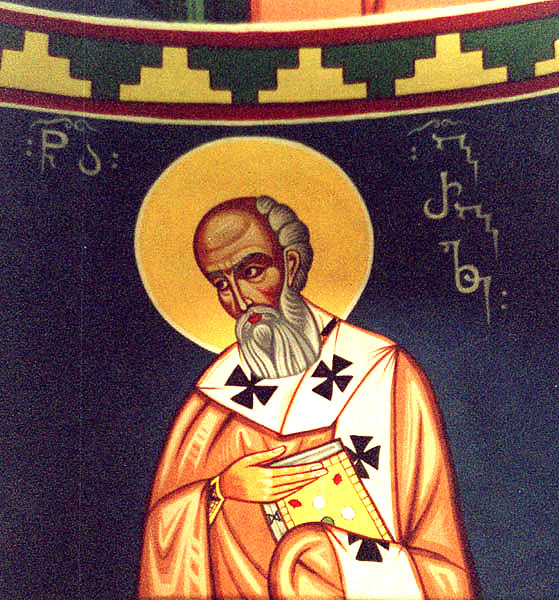
Saint Gregory the Theologian, Archbishop of Constantinople, a great Father and teacher of the Church, was born into a Christian family of eminent lineage in the year 329, at Arianzos (not far from the city of Cappadocian Nazianzos). His father, also named Gregory (January 1), was Bishop of Nazianzus. The son is the Saint Gregory Nazianzus encountered in Patristic theology. His pious mother, Saint Nonna (August 5), prayed to God for a son, vowing to dedicate him to the Lord. Her prayer was answered, and she named her child Gregory.
When the child learned to read, his mother presented him with the Holy Scripture. Saint Gregory received a complete and extensive education: after working at home with his uncle Saint Amphilochius (November 23), an experienced teacher of rhetoric, he then studied in the schools of Nazianzos, Caesarea in Cappadocia, and Alexandria. Then the saint decided to go to Athens to complete his education.
On the way from Alexandria to Greece, a terrible storm raged for many days. Saint Gregory, who was just a catechumen at that time, feared that he would perish in the sea before being cleansed in the waters of Baptism. Saint Gregory lay in the ship’s stern for twenty days, beseeching the merciful God for salvation. He vowed to dedicate himself to God, and was saved when he invoked the name of the Lord.
Saint Gregory spent six years in Athens studying rhetoric, poetry, geometry, and astronomy. His teachers were the renowned pagan rhetoricians Gymorias and Proeresias. Saint Basil, the future Archbishop of Caesarea (January 1) also studied in Athens with Saint Gregory. They were such close friends that they seemed to be one soul in two bodies. Julian, the future emperor (361-363) and apostate from the Christian Faith, was studying philosophy in Athens at the same time.
Upon completing his education, Saint Gregory remained for a certain while at Athens as a teacher of rhetoric. He was also familiar with pagan philosophy and literature.
In 358 Saint Gregory quietly left Athens and returned to his parents at Nazianzus. At thirty-three years of age, he received Baptism from his father, who had been appointed Bishop of Nazianzus. Against his will, Saint Gregory was ordained to the holy priesthood by his father. However, when the elder Gregory wished to make him a bishop, he fled to join his friend Basil in Pontus. Saint Basil had organized a monastery in Pontus and had written to Gregory inviting him to come.
Saint Gregory remained with Saint Basil for several years. When his brother Saint Caesarius (March 9) died, he returned home to help his father administer his diocese. The local church was also in turmoil because of the Arian heresy. Saint Gregory had the difficult task of reconciling the bishop with his flock, who condemned their pastor for signing an ambiguous interpretation of the dogmas of the faith.
Saint Gregory convinced his father of the pernicious nature of Arianism, and strengthened him in Orthodoxy. At this time, Bishop Anthimus, who pretended to be Orthodox but was really a heretic, became Metropolitan of Tyana. Saint Basil had been consecrated as the Archbishop of Caesarea, Cappadocia. Anthimus wished to separate from Saint Basil and to divide the province of Cappadocia.
Saint Basil the Great made Saint Gregory bishop of the city of Sasima, a small town between Caesarea and Tyana. However, Saint Gregory remained at Nazianzos in order to assist his dying father, and he guided the flock of this city for a while after the death of his father in 374.
Upon the death of Patriarch Valentus of Constantinople in the year 378, a council of bishops invited Saint Gregory to help the Church of Constantinople, which at this time was ravaged by heretics. Obtaining the consent of Saint Basil the Great, Saint Gregory came to Constantinople to combat heresy. In the year 379 he began to serve and preach in a small church called “Anastasis” (“Resurrection”). Like David fighting the Philistines with a sling, Saint Gregory battled against impossible odds to defeat false doctrine.
Heretics were in the majority in the capital: Arians, Macedonians, and Appolinarians. The more he preached, the more did the number of heretics decrease, and the number of the Orthodox increased. On the night of Pascha (April 21, 379) when Saint Gregory was baptizing catechumens, a mob of armed heretics burst into the church and cast stones at the Orthodox, killing one bishop and wounding Saint Gregory. But the fortitude and mildness of the saint were his armor, and his words converted many to the Orthodox Church.
Saint Gregory’s literary works (orations, letters, poems) show him as a worthy preacher of the truth of Christ. He had a literary gift, and the saint sought to offer his talent to God the Word: “I offer this gift to my God, I dedicate this gift to Him. Only this remains to me as my treasure. I gave up everything else at the command of the Spirit. I gave all that I had to obtain the pearl of great price. Only in words do I master it, as a servant of the Word. I would never intentionally wish to disdain this wealth. I esteem it, I set value by it, I am comforted by it more than others are comforted by all the treasures of the world. It is the companion of all my life, a good counselor and converser; a guide on the way to Heaven and a fervent co-ascetic.” In order to preach the Word of God properly, the saint carefully prepared and revised his works.
In five sermons, or “Theological Orations,” Saint Gregory first of all defines the characteristics of a theologian, and who may theologize. Only those who are experienced can properly reason about God, those who are successful at contemplation and, most importantly, who are pure in soul and body, and utterly selfless. To reason about God properly is possible only for one who enters into it with fervor and reverence.
Explaining that God has concealed His Essence from mankind, Saint Gregory demonstrates that it is impossible for those in the flesh to view mental objects without a mixture of the corporeal. Talking about God in a positive sense is possible only when we become free from the external impressions of things and from their effects, when our guide, the mind, does not adhere to impure transitory images. Answering the Eunomians, who would presume to grasp God’s Essence through logical speculation, the saint declared that man perceives God when the mind and reason become godlike and divine, i.e. when the image ascends to its Archetype. (Or. 28:17). Furthermore, the example of the Old Testament patriarchs and prophets and also the Apostles has demonstrated, that the Essence of God is incomprehensible for mortal man. Saint Gregory cited the futile sophistry of Eunomios: “God begat the Son either through His will, or contrary to will. If He begat contrary to will, then He underwent constraint. If by His will, then the Son is the Son of His intent.”
Confuting such reasoning, Saint Gregory points out the harm it does to man: “You yourself, who speak so thoughtlessly, were you begotten voluntarily or involuntarily by your father? If involuntarily, then your father was under the sway of some tyrant. Who? You can hardly say it was nature, for nature is tolerant of chastity. If it was voluntarily, then by a few syllables you deprive yourself of your father, for thus you are shown to be the son of Will, and not of your father” (Or. 29:6).
Saint Gregory then turns to Holy Scripture, with particular attention examining a place where it points out the Divine Nature of the Son of God. Saint Gregory’s interpretations of Holy Scripture are devoted to revealing that the divine power of the Savior was actualized even when He assumed an impaired human nature for the salvation of mankind.
The first of Saint Gregory’s Five Theological Orations is devoted to arguments against the Eunomians for their blasphemy of the Holy Spirit. Closely examining everything that is said in the Gospel about the Third Person of the Most Holy Trinity, the saint refutes the heresy of Eunomios, which rejected the divinity of the Holy Spirit. He comes to two fundamental conclusions. First, in reading Holy Scripture, it is necessary to reject blind literalism and to try and understand its spiritual sense. Second, in the Old Testament the Holy Spirit operated in a hidden way. “Now the Spirit Himself dwells among us and makes the manifestation of Himself more certain. It was not safe, as long as they did not acknowledge the divinity of the Father, to proclaim openly that of the Son; and as long as the divinity of the Son was not accepted, they could not, to express it somewhat boldly, impose on us the burden of the Holy Spirit” (Or. 31:26).
The divinity of the Holy Spirit is a sublime subject. “Look at these facts: Christ is born, the Holy Spirit is His Forerunner. Christ is baptized, the Spirit bears witness to this… Christ works miracles, the Spirit accompanies them. Christ ascends, the Spirit takes His place. What great things are there in the idea of God which are not in His power? What titles appertaining to God do not apply also to Him, except for Unbegotten and Begotten? I tremble when I think of such an abundance of titles, and how many Names they blaspheme, those who revolt against the Spirit!” (Or. 31:29).
The Orations of Saint Gregory are not limited only to this topic. He also wrote Panegyrics on Saints, Festal Orations, two invectives against Julian the Apostate, “two pillars, on which the impiety of Julian is indelibly written for posterity,” and various orations on other topics. In all, forty-five of Saint Gregory’s orations have been preserved.
The letters of the saint compare favorably with his best theological works. All of them are clear, yet concise. In his poems as in all things, Saint Gregory focused on Christ. “If the lengthy tracts of the heretics are new Psalters at variance with David, and the pretty verses they honor are like a third testament, then we also shall sing Psalms, and begin to write much and compose poetic meters,” said the saint. Of his poetic gift the saint wrote: “I am an organ of the Lord, and sweetly… do I glorify the King, all atremble before Him.”
The fame of the Orthodox preacher spread through East and West. But the saint lived in the capital as though he still lived in the wilderness: “his food was food of the wilderness; his clothing was whatever necessary. He made visitations without pretense, and though in proximity of the court, he sought nothing from the court.”
The saint received a shock when he was ill. One whom he considered as his friend, the philosopher Maximus, was consecrated at Constantinople in Saint Gregory’s place. Struck by the ingratitude of Maximus, the saint decided to resign the cathedra, but his faithful flock restrained him from it. The people threw the usurper out of the city. On November 24, 380 the holy emperor Theodosius arrived in the capital and, in enforcing his decree against the heretics, the main church was returned to the Orthodox, with Saint Gregory making a solemn entrance. An attempt on the life of Saint Gregory was planned, but instead the assassin appeared before the saint with tears of repentance.
At the Second Ecumenical Council in 381, Saint Gregory was chosen as Patriarch of Constantinople. After the death of Patriarch Meletius of Antioch, Saint Gregory presided at the Council. Hoping to reconcile the West with the East, he offered to recognize Paulinus as Patriarch of Antioch.
Those who had acted against Saint Gregory on behalf of Maximus, particularly Egyptian and Macedonian bishops, arrived late for the Council. They did not want to acknowledge the saint as Patriarch of Constantinople, since he was elected in their absence.
Saint Gregory decided to resign his office for the sake of peace in the Church: “Let me be as the Prophet Jonah! I was responsible for the storm, but I would sacrifice myself for the salvation of the ship. Seize me and throw me… I was not happy when I ascended the throne, and gladly would I descend it.”
After telling the emperor of his desire to quit the capital, Saint Gregory appeared again at the Council to deliver a farewell address (Or. 42) asking to be allowed to depart in peace.
Upon his return to his native region, Saint Gregory turned his attention to the incursion of Appolinarian heretics into the flock of Nazianzus, and he established the pious Eulalius there as bishop, while he himself withdrew into the solitude of Arianzos so dear to his heart. The saint, zealous for the truth of Christ, continued to affirm Orthodoxy through his letters and poems, while remaining in the wilderness. He died on January 25, 389, and is honored with the title “Theologian,” also given to the holy Apostle and Evangelist John.
In his works Saint Gregory, like that other Theologian Saint John, directs everything toward the Pre-eternal Word. Saint John of Damascus (December 4), in the first part of his book AN EXACT EXPOSITION OF THE ORTHODOX FAITH, followed the lead of Saint Gregory the Theologian.
Saint Gregory was buried at Nazianzos. In the year 950, his holy relics were transferred to Constantinople into the church of the Holy Apostles. Later on, a portion of his relics was transferred to Rome.
In appearance, the saint was of medium height and somewhat pale. He had thick eyebrows, and a short beard. His contemporaries already called the archpastor a saint. The Orthodox Church, honors Saint Gregory as a second Theologian and insightful writer on the Holy Trinity.
“O glorious Father Gregory, Your knowledge has overcome the pride of false wisdom. The church is clothed with your teaching as a robe of righteousness. We your children celebrate your memory crying out: Rejoice, O father of unsurpassable wisdom!” [Kontakion].
Saint Moses, Archbishop of Novgorod

Saint Moses, Archbishop of Novgorod (1325-1330, 1352-1359), in the world Metrophanes, was born at Novgorod. In his youth he secretly left his home and entered Tver’s Otroch monastery, where he became a monk. His parents found him, and at their insistence he transferred to a monastery near Novgorod. At this monastery he was ordained as a hieromonk, and later he was appointed archimandrite of the Yuriev monastery.
After the death of Archbishop David of Novgorod, Saint Peter (December 21) consecrated Moses as Archbishop of Novgorod in 1325. This was the first episcopal consecration to be performed in Moscow. Saint Moses did not guide his Novgorod flock for long, however. The quarrels and contentious factions, the conflagrations and other misfortunes weighed heavily on his soul, which sought monastic solitude. After four years, he petitioned to be allowed to retire and live in asceticism. He was succeeded by Saint Basil.
In 1330 the saint withdrew to the Kolmov monastery for tranquillity. He did not remain here very long, either. He found a desolate spot at Derevyanitsa, where he built the stone church of the Resurrection of Christ. At this place the monk spent more than twenty years at monastic deeds. After Basil’s death, Saint Moses yielded to the requests of the Novgorod people to be their archpastor once again. The ancient chronicler describes Saint Moses in this way: “He shepherded his flock as a good pastor; he defended the downtrodden, and protected destitute widows; he employed a company of copyists, and because of him many books were written, and he confirmed many in piety by his guidance.”
In the year 1354 Patriarch Philotheus of Constantinople (1354-1355, 1364-1376), as a token of his deep respect for Saint Moses gave him permission to wear polystavrion vestments (“many crosses”), and even sent him a set. He also permitted Saint Moses to deal directly with the Patriarch of Constantinople without intermediaries.
Archbishop Moses continued as hierarch for seven years, a period marked by the building of many churches in Novgorod and its environs. In 1352 the saint built a stone church in honor of the Dormition of the Most Holy Theotokos at Volotova; in 1355 a monastery was built in a place named Skovorodka, with a stone church in honor of the holy Archangel Michael. In 1357, churches were also built at three monasteries: at Radogovitsa near the Volotov Dormition church, at the Holy Spirit monastery, and at a women’s monastery. The churches were named for Saint John the Theologian (the first and third of these monasteries were founded by Saint Moses).
In 1359, feeling weak and sick, the saint withdrew into the Monastery of the Archangel Michael in Skovorodsk which he had founded. Saint Moses labored here in asceticism until his death on January 25, 1362. He was buried at the cathedral church.
The Feast of Saint Moses on April 19 commemorates the uncovering of his incorrupt relics in 1686.
Martyr Felicitas of Rome, and her seven sons
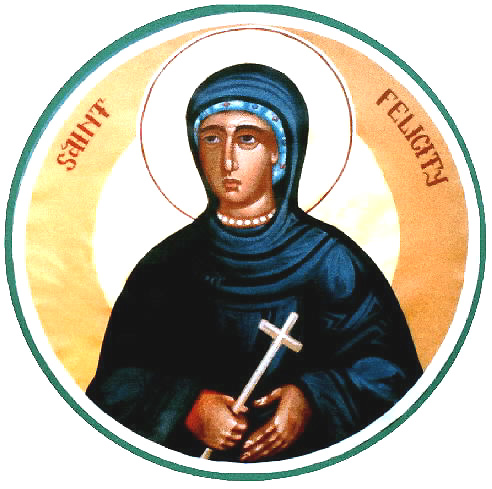
The Holy Martyr Felicitas with her Seven Sons, Januarius, Felix, Philip, Silvanus, Alexander, Vitalius and Marcial. Saint Felicitas was born of a rich Roman family. She boldly confessed before the emperor and civil authorities that she was a Christian. The pagan priests said that she was insulting the gods by spreading Christianity. Saint Felicitas and her sons were turned over to the Prefect Publius for torture.
Saint Felicitas witnessed the suffering of her sons, and prayed to God that they would stand firm and enter the heavenly Kingdom before her. All the sons died as martyrs before the eyes of their mother, who was being tortured herself.
Saint Felicitas soon followed her sons in martyrdom for Christ. They suffered at Rome about the year 164. Saint Gregory Dialogus mentions her in his Commentary on the Gospel of Saint Matthew (Mt.12:47).
Saint Publius the Ascetic of Syria
Saint Publius of Syria was born in the city of Zeugma on the Euphrates and was a senator. Renouncing the world, he gave away his possessions, became a monk, and lived an ascetical life in a cave on a mountain in the Syrian wilderness.
Saint Publius founded two monasteries: one for Greeks, and another for Syrians. He died in the year 380. Of his disciples, Saints Theoteknos, Theodotus, Gregory, and Aphthonius were particularly known for the sanctity of their life.
Saint Publius guided the monastery for over forty years and was eventually made an archimandrite. Though elevated in rank, he changed neither his garb nor his manner of life, but remained a strict ascetic.
Saint Mares the Singer in Syria
Saint Mares the Singer lived in a hut in fasting and prayer for thirty-seven years in the village of Homeron, not far from the city of Cyrrhus in Syria. He ate rough food, and wore clothes made from the hide of wild goats. He was handsome, and had a pleasant singing voice. Saint Mares reposed in the year 430.
Translation to Moscow of the Icon of the Mother of God “Assuage my Sorrow”
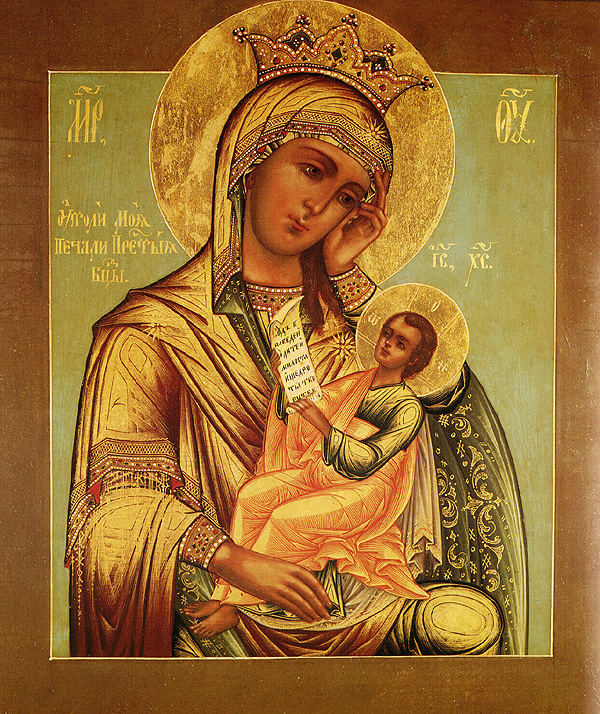
The “Assuage my Sorrows” Icon of the Most Holy Theotokos was glorified at Moscow by many miracles in the second half of the eighteenth century, particularly during a plague in 1771. The icon had been brought to Moscow by Cossacks in 1640 in the reign of Tsar Michael (1613-1645), and placed in the church of Saint Nicholas in the Pupishevo district of Moscow.
Once, perhaps after a fire and the rebuilding of the temple, the icon was carelessly put in a bell tower. However, the abundant mercies manifested by the Mother of God would one day bring about a renewed veneration of this holy icon.
The Feast of the wonderworking icon on January 25 was established in 1760 to commemorate the healing of a sick woman who had seen the icon in a vision. A voice instructed her to go to the church of Saint Nicholas in the Pupishevo district of Moscow where she would find this icon. “Pray before it, and you will receive healing.”
She obeyed and went to Moscow, where she found an icon, darkened by age and dust, in the church’s bell tower. When the sick woman saw the face and inscription she cried out, “It is She!” The woman, who previously had been unable to move her arms and legs, walked out of church on her own after a Molieben was served before the icon on January 25.
In 1760 an honored place was set aside for the Icon in the church, and later a chapel was built for it. The Church Services and the Akathist for the Icon date from this period. Copies of the “Assuage my Sorrows” Icon are to be found in some churches of Moscow and other cities. The church of Saint Nicholas at Pupishevo was destroyed in the 1930s, but by the grace of God the Icon has survived. It is now in the church of Saint Nicholas near Kuznetskaya Sloboda.
The “Assuage my Sorrows” Icon of the Most Holy Theotokos is also commemorated on September 25 and October 9.
Icon of the Mother of God “The Unexpected Joy”
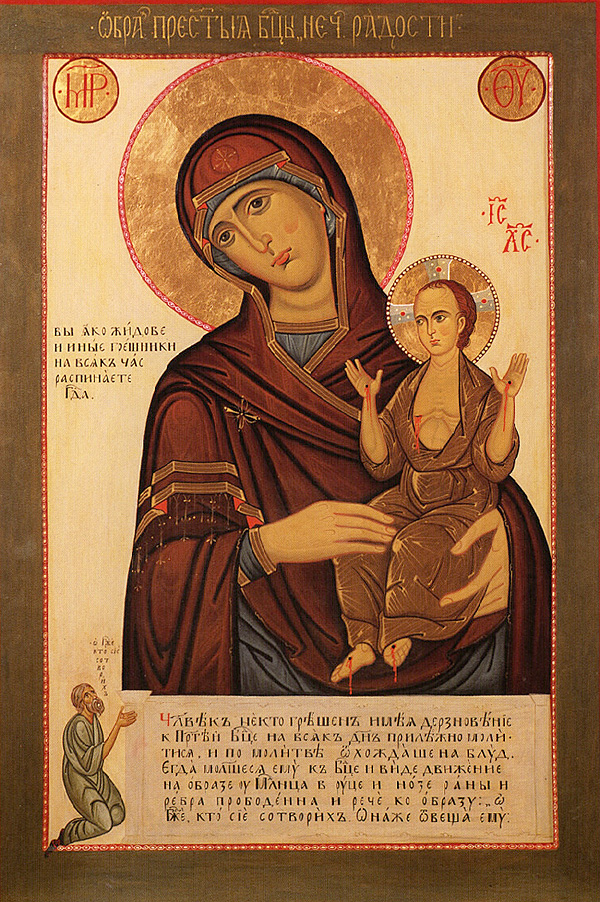
The “Unexpected Joy” Icon of the Most Holy Theotokos, is painted in this way: in a room is an icon of the Mother of God, and beneath it a youth is kneeling at prayer. The tradition about the healing of some youth from a bodily affliction through this holy icon is recorded in the book of Saint Demetrius of Rostov, The Fleece of Prayer [See Judges 6: 36-40].
The sinful youth, who was nevertheless devoted to the Theotokos, was praying one day before the icon of the All-Pure Virgin before going out to commit a sin. Suddenly, he saw that wounds appeared on the Lord’s hands, feet, and side, and blood flowed from them. In horror he exclaimed, “O Lady, who has done this?” The Mother of God replied, “You and other sinners, because of your sins, crucify My Son anew.” Only then did he realize how great was the depth of his sinfulness. For a long time he prayed with tears to the All-Pure Mother of God and the Savior for mercy. Finally, he received the unexpected joy of the forgiveness of his sins.
The “Unexpected Joy” icon is also commemorated on January 25 and May 1.
Saint Vladimir, Metropolitan of Kiev and Gallich
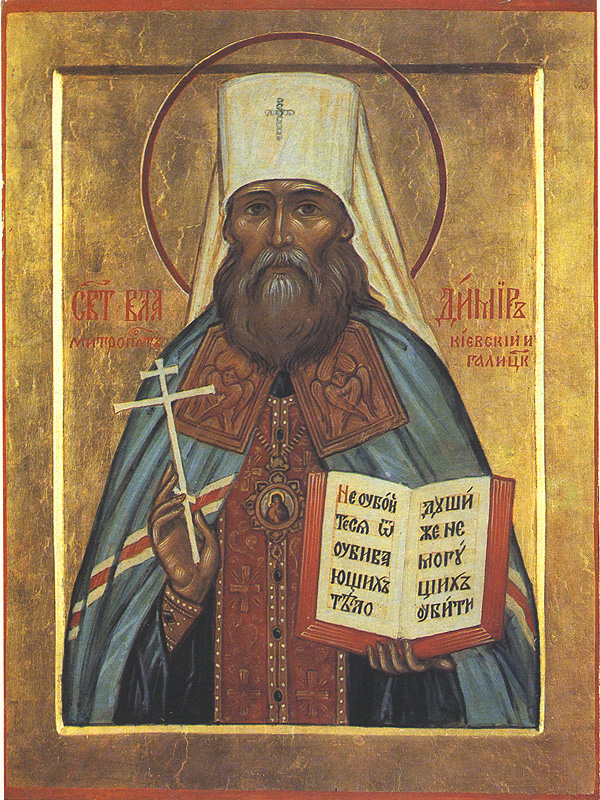
The holy Metropolitan Vladimir of Kiev was the first bishop to be tortured and slain by the Communists at the time of the Russian Revolution.
Basil Nikephorovich Bogoyavlensky was born in the province of Tambov of pious parents on January 1, 1848. His father, a priest, was later murdered. The young Basil graduated from the Theological Academy in Kiev in 1874, and taught in the Tambov seminary for seven years before he was ordained to the holy priesthood.
His wife died in 1886, and their only child died shortly thereafter. The bereaved widower entered the Kozlov monastery in Tambov and was given the name Vladimir. In 1888 he was consecrated bishop of Staraya Rus, and served as a vicar bishop of the Novgorod diocese. In 1891 he was assigned to the diocese of Samara. In those days people of his diocese suffered from a cholera epidemic and a crop failure. Bishop Vladimir devoted himself to caring for the sick and suffering, inspiring others to follow his example.
In 1892 he became Archbishop of Kartalin and Kahetin, then in 1898 he was chosen as Metropolitan of Moscow and Kolomna. He served fifteen years in this position.
Metropolitan Vladimir was distinguished by his compassion for the poor, and for widows and orphans. He also tried to help alcoholics and those who had abandoned the Church. The Metropolitan was also interested in the education of children in school, especially those who were studying in the theological schools.
In 1912, after the death of Metropolitan Anthony, he was appointed Metropolitan of Petrograd, administering that diocese until 1915. Because he disapproved of Rasputin, Metropolitan Vladimir fell out of favor with the Tsar, and so he was transferred to Kiev. On November 5, 1917 it was he who announced that Saint Tikhon (April 7) had been elected as Patriarch of Moscow.
The “Ukrainian Congress” was also calling for an autonomous Ukraine and for the creation of a Ukrainian Church independent from the Church of Russia. Metropolitan Vladimir suffered and grieved because of this question, warning that such a division in the Church would allow its enemies to be victorious. However, at the end of 1917, a Ukrainian Dominion was formed, and also a separate Ukrainian church administration (“rada”) led by the retired Archbishop Alexis Dorodnitzin. This uncanonical group forbade the commemoration of Patriarch Tikhon during church services, and demanded that Metropolitan Vladimir leave Kiev.
In January 1918 the civil war came to Kiev, and the two forces vied for control of the city. Many churches and monasteries were damaged by the cannon fire. The Bolsheviks seized the Kiev Caves Lavra on January 23, and soldiers broke into the churches. Monks were taken out into the courtyard to be stripped and beaten. At six thirty on the night of January 25, five armed soldiers and a sailor came looking for Metropolitan Vladimir. The seventy-year-old hierarch was tortured and choked in his bedroom with the chain of his cross. The ruffians tortured the Metropolitan and demanded money.
When they emerged, the Metropolitan’s cell attendant approached and asked for a blessing.The sailor pushed him aside and told him, “Enough bowing to these blood-drinkers. No more of it.” After blessing and kissing him, the Metropolitan said, “Good-bye, Philip.” Then he walked calmly with his executioners, just as if he were on his way to serve the Liturgy.
Metropolitan Vladimir was driven from the monastery to the place of execution. As they got out of the car, the holy martyr asked, “Do you intend to shoot me here?”
“Why not?” they replied.
After praying for a short time and asking forgiveness for his sins, Metropolitan Vladimir blessed the executioners, saying, “May God forgive you.” Then several rifle shots were heard.
In the morning, some women came to the gates of the Lavra and told the monks where the Metropolitan’s body could be found. He was lying on his back, with bullet wounds near his right eye and by his right collarbone. There were also several cuts and gashes on the body, including a very deep chest wound. The hieromartyr was carried into the Lavra church of Saint Michael, where he had spent his last days at prayer.
In Moscow, the All-Russian Church Council was in session when word came of Metropolitan Vladimir’s death. Patriarch Tikhon and his clergy performed a Memorial Service for the New Martyr Vladimir. A commission was formed to investigate the circumstances of Metropolitan Vladimir’s murder, but it was unable to carry out its duties because of the Revolution.The Council decided that January 25, the day of his death, would be set aside for the annual commemoration of all of Russia’s martyrs and confessors killed by the Soviets.
The holy New Martyr Vladimir of Kiev was glorified by the Orthodox Church of Russia in 1992. On the Sunday closest to January 25 (the day of Metropolitan Vladimir’s martyrdom) we also observe the Synaxis of Russia’s New Martyrs and Confessors.
New Martyr Auxentius of Constantinople
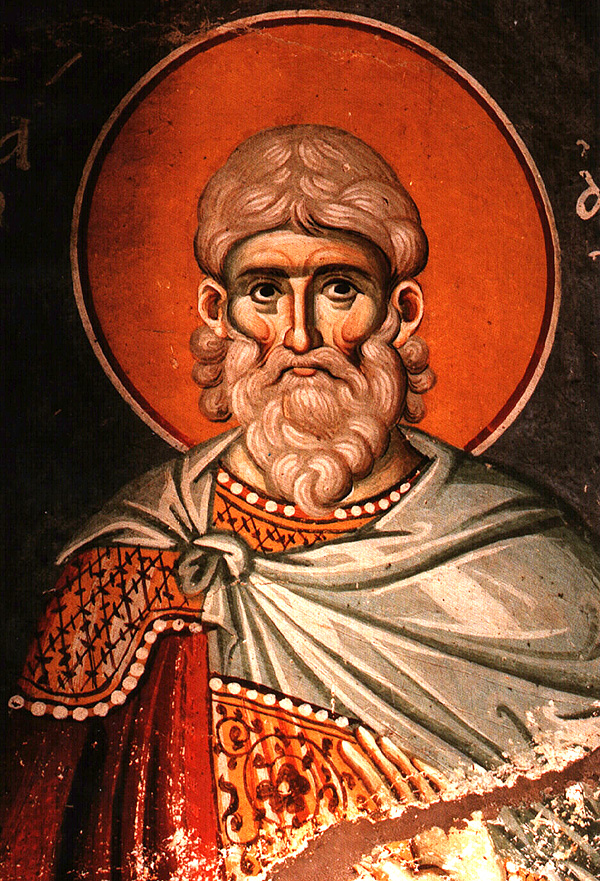
The holy New Martyr Auxentius was born in 1690 in the diocese of Vellas, part of the Metropolitan district of Ioannina in Greece. When he was a young man, he moved to Constantinople with his parents and became a furrier.
Later, he left his trade and went to work on the ships, leading a sinful life in pursuit of worldly pleasures. His Moslem coworkers turned against him and accused him of denying Christ to embrace Islam. Fearing that they would denounce him to the captain of the ship, Auxentius jumped ship and returned to Constantinople.
Auxentius bought a small boat and earned his living with it. He began to regret his previous conduct, and the desire for martyrdom grew within him. One day, a monk got into his boat in order to cross the water. This was Father Gregory, a monk of Xeropotamou Monastery on Mt. Athos.
He revealed to Father Gregory his desire to be a martyr for Christ. The wise monk praised his desire, but urged caution lest he should weaken under torture and deny Christ. He recommended that Auxentius move to a quiet place and become a monk. Heeding Father Gregory’s advice, Auxentius continued to work with his boat for a time, giving most of his money to the poor, and living as an ascetic.
Auxentius often prayed at the church of the Life-Giving Fountain, asking God to give him strength to become a martyr. Then he returned to his old ship, where his former shipmates began to beat him. They dragged him before the kadi, stating that he had converted to Islam, but then returned to Christianity.
Auxentius said, “I was, and am, an Orthodox Christian. I am prepared to suffer thousands of tortures for the sake of Christ.”
The furious Hagarenes began to beat Auxentius with an iron bar. He lost an eye and several teeth as a result. He remained steadfast in confessing Christ, in spite of all the tortures that were inflicted upon him, and absolutely refused to become a Moslem.
Father Gregory went to see Auxentius in prison, and was asked to bring him Holy Communion on his next visit. The monk did this, also urging him to remain strong in the Orthodox Faith.
The holy martyr was brought before the vizier, who urged him to respect Islam as good and true, instead of treating it with contempt. Saint Auxentius answered that he would never abandon his faith. In fact, he even urged the vizier to become a Christian. This enraged the vizier, and he sentenced Auxentius to death.
After praying for all Orthodox Christians, and for the whole world, Saint Auxentius was beheaded on January 25, 1720 at 9:00 A.M. Two days later, a heavenly light was seen by Christians and Moslems, shining on the body of the martyr.
The sultan’s tailor, an Orthodox Christian named Michael, went to the sultan and asked for the body. Patriarch Jeremiah III accompanied the body to the Church of the Life-Giving Fountain for the funeral and burial.
Two years later, when the saint’s relics were exhumed, a sweet fragrance came forth from them.
Venerable Anatole I of Optina
Saint Anatole (Zertsalov) was born with the name Alexis in the village of Bobolya on March 24, 1824. His father, Moses Kopev, was a deacon, and his mother’s name was Anna. The parents were exceptionally devout Christians who hoped that their children would enter the monastic life.
Their only son Alexis was taught to read from the age of five. He studied at the Saint Boris Theological Seminary, then later he entered the seminary at Kaluga. When he was fourteen, Alexis was stricken with a fever which kept him out of school for a year.
From a very early age, Alexis wanted to become a monk. He even thought about going to the Roslavl forests to live with the hermits at that place. His plans were not fulfilled, however, because a thunderstorm prevented him from continuing on his way. He decided to turn back, regarding the storm as a sign that God did not wish him to proceed on his journey.
The young man returned to seminary, where he was renamed Anatole M. Zertsalov. Sometimes students at Russian seminaries were given new names, as was the case with Saint Innocent Veniaminov (March 31).
After being healed of tuberculosis, he arrived at Optina Monastery with his mother. Saint Macarius (September 7) praised her for setting her son on such a good path. The Elder took Anatole under his wing, instructing him in the Jesus Prayer, and in the principles of the spiritual life. When Father Macarius was too busy, he blessed Anatole to seek advice from Father Ambrose or Father Anthony.
Anatole fulfilled various obediences in the monastery, beginning in the kitchen. He did not get much sleep, and then only on the wood pile. He was frequently transferred from cell to cell, and he experienced many sorrows and trials. These difficulties taught him the virtues of humility and patience.
Saint Ignatius Brianchaninov (April 30) once visited Optina hoping to meet and converse with monks experienced in the spiritual life, and was referred to Father Anatole, who was then a deacon. The bishop was impressed with Father Anatole, and related the details of their conversation to Father Macarius. The Elder began to beat him with his staff, and ordered him out of the room. When someone asked why he had been so harsh, Father Macarius said, “Why shouldn’t I scold him? It’s easy to become proud.”
After Father Macarius reposed in 1860, Father Anatole became very close to Father Ambrose. When Father Ambrose noticed that Father Anatole was mature enough to guide others, he began to train him for this service, just as Father Macarius had trained him.
Father Anatole was ordained to the priesthood in 1870. On August 3, 1871 he was assigned as Superior of the Spassky-Orlov Monastery, and raised to the rank of archimandrite. Father Anatole did not wish to leave Optina, and Father Ambrose made a formal request to have him assigned as his assistant, and so the appointment was made. Father Anatole was made Superior of the Skete in 1874, at the urging of Father Ambrose. Father Anatole accepted these duties out of obedience to his Elder, and fulfilled them to the best of his ability. Even in his new position, Father Anatole continued to respect and obey Father Ambrose.
Father Ambrose’s cell was to the right of the doors to the Skete, while that of Father Anatole was to the left. Visitors to one often went to see the other, as well. In addition to receiving visitors, Father Anatole maintained a correspondence with many people who relied on his advice.
Father Ambrose, because of his illness, relied greatly on Father Anatole in ordering life at the Shamordino Convent. He told the nuns that he rarely visited them because of his confidence in Father Anatole. Father Ambrose called him a great practicioner of the Jesus Prayer, who had received grace and the gift of unceasing prayer. Only one in a thousand received such grace, he informed the nuns.
Near the end of his life, Father Anatole had atained the same spiritual wisdom, discernment, and clairvoyance possessed by Father Macarius and Father Ambrose. He saw the secrets of the human soul, and was able to foretell future events.
After Father Ambrose’s repose in 1891, the bishop (who did not approve of Father Ambrose) forbade Father Anatole to visit Shamordino. This caused him deep sorrow, which affected his health. He traveled to Saint Petersburg in 1892 and met with Saint John of Kronstadt (December 20). On October 10, the anniversary of Father Ambrose’s death, they served together. Doctors in the capital examined him and found that his heart and lungs were not good.
Father Anatole’s health grew worse during 1893, and on October 10, he was secretly tonsured into the Great Schema.
Saint Anatole fell asleep in the Lord on January 25, 1894, and was buried near his beloved instructors Saint Ambrose and Saint Macarius.
The Moscow Patriarchate authorized local veneration of the Optina Elders on June 13,1996. The work of uncovering the relics of Saints Leonid, Macarius, Hilarion, Ambrose, Anatole I, Barsanuphius and Anatole II began on June 24/July 7, 1998 and was concluded the next day. However, because of the church Feasts (Nativity of Saint John the Baptist, etc.) associated with the actual dates of the uncovering of the relics, Patriarch Alexey II designated June 27/July 10 as the date for commemorating this event. The relics of the holy Elders now rest in the new church of the Vladimir Icon of the Mother of God.
The Optina Elders were glorified by the Moscow Patriarchate for universal veneration on August 7, 2000.
Saint Dositheus of Tbilisi

No information available at this time.
Saint Gabriel, Bishop of Imereti

Bishop Gabriel (Kikodze) was born November 15, 1825, in the village of Bachvi, in the western Georgian district of Ozurgeti in Guria. His father was the priest Maxime Kikodze.
From 1840 to 1845, Gabriel (Gerasime in the world) studied in Tbilisi and at the theological seminaries in Pskov and Saint Petersburg. In 1849, he graduated from the Saint Petersburg Theological Academy with a master’s degree, and in the same year he was married and returned to Georgia. Upon his return he was appointed dean of Tbilisi Seminary. In 1854 Saint Gabriel was ordained a deacon, and later a priest.
In 1856 a terrible grief befell Saint Gabriel: his wife and five children died during an epidemic that swept through the capital. After this tragedy Saint Gabriel received a blessing from the exarch Isidore to be tonsured a monk at Davit-Gareji Monastery, and in 1858 he was enthroned as abbot of this monastery. In the same year he was consecrated bishop of Gori, and then on July 2, 1860, he was transferred to the Imereti region. He shepherded the flock of this diocese to the end of his life. In 1869 the Abkhazeti diocese was also brought under his leadership. Saint Gabriel strove tirelessly to strengthen the faith of his flock, and to this end he traveled constantly throughout the villages, preaching and helping those in need. In the end it was his own character and example that proved to have the most powerful influence on his spiritual children.
There existed no differentiation among petitioners in the eyes of Bishop Gabriel: old or young, prince or pauper, relative, acquaintance or stranger—all were equal to him and equally deserving of his help, support, and protection. He would not tolerate lawlessness or immorality.
The simplicity of his character was evident even in his clothing, his dwelling, and the food he ate. It was not unusual for visitors, seeing the elder clad in a shabby monk’s robe, to take him for a servant. Bishop Gabriel was a merciful almsgiver and generously distributed aid to the widows and orphans in his community.
He sympathized deeply with the struggles of simple people and sought to establish a system of universal primary education. He offered his help to many young people by providing them with shelter and by often funding their studies. He would host dinners for the youth, leading long discussions to instill in them virtuous thoughts and to cultivate a love of humility in their young souls. Bishop Gabriel lived by the axiom: “Nothing is my own; all belongs to God.”
We know from Bishop Gabriel’s diaries the number of beggars he buried, the naked he clothed, the people for whom he paved the way to survival, the students for whom he created an opportunity for study, and the sick for whom he purchased medicine. Often in the winter Saint Gabriel would anonymously send firewood and money to families that were suffering from hunger and cold.
Despite all of this, Bishop Gabriel would receive letters accusing him of unrighteousness, injustice, immorality, ambition, and the selling of Church property without permission.
Bishop Gabriel’s strong nationalist sentiments (especially those pertaining to the Georgian language) often caused conflicts with the Russian exarch Evsevi. For this reason Bishop Gabriel became entangled in the politics of Georgian-Russian relations and he was held in high suspicion by officials of the Russian rule in Georgia. Bishop Gabriel began to be regarded as “untrustworthy” by his own government, and the officials assigned spies to watch over his every action.
In 1885 Bishop Gabriel’s secretary, the publicist Evstati Mchedlidze (Bosleveli), was killed. The bishop himself began to receive threatening letters, and he decided to leave Georgia. “My spiritual weakness was such that I became frightened,” he wrote in his memoirs. “It was not only for myself that I was afraid, seeing how I had already grown old and had little time remaining in the world. Rather, if they had killed me, a great disgrace would have fallen on the nation that had devoted itself so faithfully to its shepherd.”
But Bishop Gabriel never left Georgia. In his last years he began to suffer severe inner torment, and he often saw terrible visions—the enemy of mankind launched a final campaign to spiritually defeat the already physically weakened elder. Bishop Gabriel ceaselessly repeated the prayer “God be merciful to me, a sinner.”
Breathing his last, he prayed, “Remember me, O Lord, when Thou comest in Thy Kingdom!”
Bishop Gabriel reposed in Kutaisi on January 25, 1896. The winter was unusually harsh in western Georgia that year. The roads were covered with snow, and it was impossible to translate his holy relics from Kutaisi to nearby Gelati. The people waited for more agreeable weather, and until it arrived Bishop Gabriel’s relics remained at the City Cathedral in Kutaisi (this cathedral was destroyed during the Communist period).
For forty-six days all of Georgia mourned Bishop Gabriel’s passing, and during that time his body showed no signs of decay. In accordance with his will, the hierarch’s personal possessions were distributed to widows, orphans, and the poor. His parting address, in which he remitted the sins of all his flock and asked for the forgiveness of his own sins, was published as a final, enduring testament to his great faith.
Saint Vetranion of Tomis
Saint Vetranion (or Bretanion) lived during the IV century, and was the Bishop of Tomis, (now Constanța, Romania) in the Province of Scythia Minor.1 Little is known about his life except that he came from Cappadocia, and was elected to the See of Tomis about the year 360.2 He confessed the Orthodox Faith, and suffered a great deal from the heretical Emperor Valens (364 – 378), an adherent of the Arian heresy, and who persecuted the Church. During his reign, many Orthodox Christians were put to death.
Saint Vetranion, who possessed every virtue, was Bishop of all the cities of Scythia. According to Sozomen (a Church historian of the V century), when the Emperor Valens was campaigning against the Goths of Scythia, he stopped at Tomis and ordered its citizens to become Arians and to reject the Nicene Creed. Filled with divine zeal, the courageous hierarch rebuked Valens for distorting the Faith, and for his unjust persecution of the saints.Then the Saint repeated the following words of the Prophet-King David: “I spoke of thy testimonies before kings, and was not ashamed” (Psalm 118/119:46).3
As a result, Saint Vetranion was sent into exile. Later, Valens was forced by the public outcry against the Bishop's banishment to let him return to his flock.
In 373 or 374, Saint Basil the Great requested Junius Soranus, the ruler of Scythia Minor, to send him some relics of the Saints from that region. Junius sent the relics of Saint Savva the Goth (April 15) to Saint Basil along with a letter: the Epistle of the Church of God in Gothia to the Church of God in Cappadocia, and to all the local churches of the holy catholic Church. The sending of the relics and the writing of the letter have been attributed to Bishop Vetranion. The letter, written in Greek, is the oldest known document written on what is now Romanian soil.
Perhaps Bishop Vetranion did represent Tomis at the Third Ecumenical Council in 381; but it could be that his name was confused with that of Bishop Gerontius (or Terentius) of Tomis.
1 (Greek) ΜΕΓΑΣ ΣΥΝΑΞΑΡΙΣΤΗΣ: Ὁ Ἅγιος Βρετάννιος ὁ Ὁμολογητής. 25 Ιανουαρίου.
2 (Romanian) Vetranion – Dictionarul Teologilor Romani
3 Theodoret of Cyrrhus, A History Of The Church In Five Books, Chapter 35.
Daily Readings for Monday, January 24, 2022
MONDAY OF THE 14TH WEEK
NO FAST
Xenia, Deaconess of Rome, Vavylas the Holy Martyr, Xenia of St. Petersburg, Fool-for-Christ, Philo the Wonderworker, Bishop of Karpasia in Cyprus
ST. PAUL’S LETTER TO THE GALATIANS 5:22-26; 6:1-2
Brethren, the fruit of the Spirit is love, joy, peace, patience, kindness, goodness, faithfulness, gentleness, self-control; against such there is no law. And those who belong to Christ Jesus have crucified the flesh with its passions and desires. If we live by the Spirit, let us also walk by the Spirit. Let us have no self-conceit, no provoking of one another, no envy of one another. Brethren, if a man is overtaken in any trespass, you who are spiritual should restore him in a spirit of gentleness. Look to yourself, lest you too be tempted. Bear one another’s burdens, and so fulfill the law of Christ.
MATTHEW 22:2-14
The Lord said this parable, "The kingdom of heaven may be compared to a king who gave a marriage feast for his son, and sent his servants to call those who were invited to the marriage feast; but they would not come. Again he sent other servants, saying, 'Tell those who are invited, Behold, I have made ready my dinner, my oxen and my fat calves are killed, and everything is ready; come to the marriage feast.' But they made light of it and went off, one to his farm, another to his business, while the rest seized his servants, treated them shamefully, and killed them. The king was angry, and he sent his troops and destroyed those murderers and burned their city. Then he said to his servants, 'The wedding is ready, but those invited were not worthy. Go therefore to the thoroughfares, and invite to the marriage feast as many as you find.' And those servants went out into the streets and gathered all whom they found, both bad and good; so the wedding hall was filled with guests. But when the king came in to look at the guests, he saw there a man who had no wedding garment; and he said to him, 'Friend, how did you get in here without a wedding garment?' And he was speechless. Then the king said to the attendants, 'Bind him hand and foot, and cast him into the outer darkness; there men will weep and gnash their teeth.' For many are called, but few are chosen.
Venerable Xenia of Rome, and her two female servants
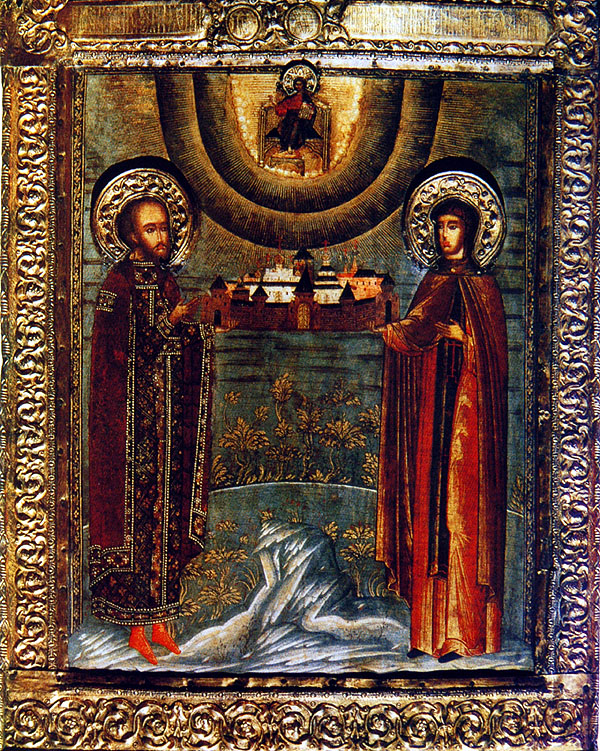
Saint Xenia of Rome, in the world Eusebia, was the only daughter of an eminent Roman senator. From her youth she loved God, and wished to avoid the marriage arranged for her. She secretly left her parental home with two servants devoted to her, and set sail upon a ship. Through the Providence of God she met the head of the monastery of the holy Apostle Andrew in Milassa, a town of Caria (Asia Minor). She besought him to take her and her companions to Milassa. She also changed her name, calling herself Xenia [which means “stranger” or “foreigner” in Greek].
At Milassa she bought land, built a church dedicated to Saint Stephen, and founded a woman’s monastery. Soon after this, Bishop Paul of Milassa made Xenia a deaconess, because of her virtuous life. The saint helped everyone: for the destitute, she was a benefactress; for the grief-stricken, a comforter; for sinners, a guide to repentance. She possessed a deep humility, accounting herself the worst and most sinful of all.
In her ascetic deeds she was guided by the counsels of the Palestinian ascetic, Saint Euthymius. The sublime life of Saint Xenia drew many souls to Christ. The holy virgin died in 450 while she was praying. During her funeral, a luminous wreath of stars surrounding a radiant cross appeared over the monastery in the heavens. This sign accompanied the body of the saint when it was carried into the city, and remained until the saint’s burial. Many of the sick received healing after touching the relics of the saint.
Following the death of Saint Xenia, first one of her former servants died, then the other. They were buried at the saint’s feet.
Saint Gerasimus, Bishop of Perm
Saint Gerasimus, Bishop of Great Perm and Ust’Vymsk, was the third bishop of the newly-enlightened Zyryani people, and he was a worthy successor to Saint Stephen, the Enlightener of Perm (April 26). He was elevated to the See of Perm sometime after 1416, and participated in many Church councils: one in 1438 to condemn the Unia and Metropolitan Isidore, and one in 1441, which defined the selection of the Metropolitan of All Rus by a Council of Russian pastors.
The saint assiduously cared for his newly-established flock, which suffered raids from Novgorodians, particularly from the pagan Vogulians. He went to their camps urging them to cease the pillaging of villages of the defenseless Christians of Perm. He was murdered by a Vogulian servant during one of his journeys through Perm in 1441 (according to Tradition, he was strangled with his omophorion). He was buried in the cathedral church of the first bishops of Perm, which later became the Annunciation church in the village of Ust’Vyma, northeast of the city of Yarenga, at the River Vychegda.
The celebration of his memory was established in 1607. On January 29 there is a general commemoration of the three Perm Hierarchs: Gerasimus, Pitirim, and Jonah.
Martyr John of Kazan
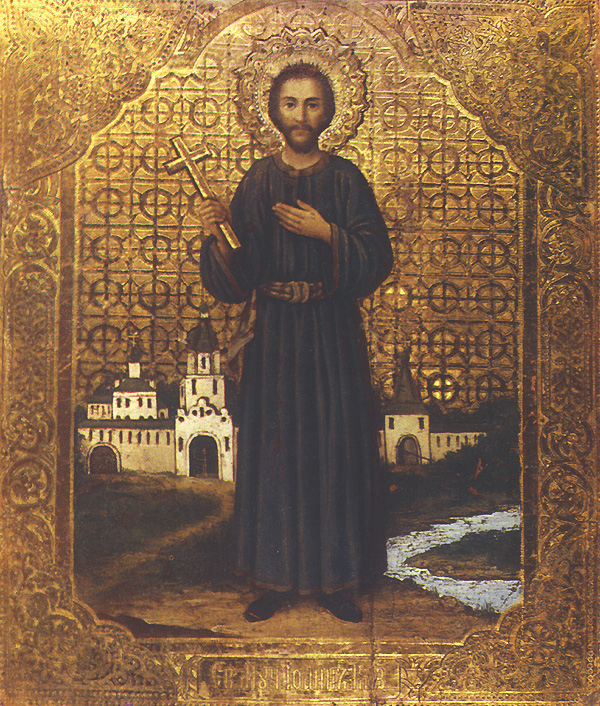
The Martyr John of Kazan suffered for Christ in the city of Kazan on January 24, 1529. During the reign of Great Prince Basil the Tatars swooped down upon Nizhni Novgorod. Many of the inhabitants were taken into captivity and brought to Kazan. Also among their number was the fearless John.
When the captives were distributed to their new owners, he was given to Alei-Shnura, who was related to the Khan. By day John honestly served his master, but at night he went without sleep and prayed, patiently enduring insults and abuse. The master resolved to force his servant to become a Moslem, but John firmly declared that he worshiped Jesus Christ as God.
In the winter the Tatars tied him up and led him to a Russian cemetery, mortally wounded him with swords, and threw him into the snow. That night, Saint John reached the door of some Russians living in Kazan, and he asked them to summon a priest. He received the Holy Mysteries and prayed all night, then died the following morning.
Martyr Babylas of Sicily, and his two disciples: Timothy and Agapius
The Holy Martyrs Babylas of Sicily and his two disciples Timothy and Agapius lived during the third century on the outskirts of Rome. Saint Babylas was born in the city of Reupolium into a rich family, and he was raised by his parents in the Christian Faith.
While still in his youth he abandoned the world, secretly going from the house of his parents to a mountain, where he spent all his time in fasting, prayer and silence. His two disciples, Timothy and Agapius, labored with him. Fleeing a persecution by the pagans, he went with his disciples to the island of Sicily, where they converted many unbelievers to Christ.
The governor of the island, angered by the missionary activity of Saint Babylas, ordered that he and his disciples be arrested, and he also had them tortured. The saints patiently endured their sufferings, and all three died by the sword. Their bodies were thrown into a fire, but the flames did not harm the warriors of Christ. They were buried on the island of Sicily by local Christians.
Saint Macedonius the Hermit of Syria
Saint Macedonius, a Syrian hermit, lived during the end of the fourth century and the beginning of the fifth. When he first embarked upon the path of asceticism, he led the life of a wanderer, roaming through the cities of Phoenicia, Cilicia, and Syria. Afterward, he spent forty-five years in the wilderness, in a deep pit, living under the open sky with no roof over his head, shunning human glory. Thus, he was called "Gouvas," which means "pit" in Syrian.
Crowds of people visited him, seeking spiritual help and guidance. Only in his old age did he accede to the requests of those who begged him to live in a narrow cell they built for him. Throughout his life Saint Macedonius ate just barley and water. Therefore, he was called “Krithophagos" (Κριθοφάγος), or "Barley-Eater." Only as he felt his strength fading did he agree to eat baked bread.
Because of his ascetical life, God granted him the power to cast out demons, and to heal the sick. He also healed the mother of the historian Theodoret of Cyrrhus (a small town near Antioch), who had been barren for a long time before she conceived. During labor, however, something went wrong, and she feared that she would lose the child. The Saint traced the Sign of the Cross in a vessel of water with his fingers, and told her to drink it. The child was born without any further difficulty.
Saint Macedonius performed many other miracles. He lived to an advanced age and reposed in peace around the year 420, after reaching his seventieth year.
Uncovering of the relics of Saint Anastasios the Persian

The uncovering of the relics of Saint Anastasios of Persia (January 22) took place in 638, ten years after his martyrdom. There are three traditions regarding his relics.
According to the first, which is also accepted by the English historian Saint Bede (May 27), the relics were transferred to Rome during the reign of Emperor Flavius Heraclius Augustus (reigned 610-645) and deposited in the Greek Monastery of the Three Fountains (“Tre Fontane”).
The second tradition states that the transfer of the relics to Constantinople, also during the reign of Heraclius, took place during the time of Pope Theodore I, who may have been from Jerusalem, and of Greek descent (see May 18).
The third tradition indicates that the relics were transferred to Venice from Constantinople in 1204 when the Doge Henry Dandolos removed them and placed them in the church of the Holy Trinity in Venice.
Today the Saint’s holy relics are in the Roman Catholic Church of Saint Francis in Venice. They survive in the form of a headless body, clothed in the garments of his time.
Metropolitan Sophronios Eustratiadis of Leontopolis declares that a Roman bishop transported the relics to Caesarea in Palestine, and later they were moved to Constantinople. His head is in Rome, where it is still kept.
Venerable Dionysius of Olympus

Saint Dionysius of Olympus was born into a family of poor parents in the village of Platina. When he was an infant, the Cross shone over his crib. Fond of prayer and reading spiritual books from his youth, Saint Dionysius decided to become a monk after the death of his parents. With this aim he went to Meteora, and then to Mount Athos. There he lived with a pious Elder, the priest Seraphim, and under his guidance he began to lead an ascetic life, keeping a strict fast. During Passion Week he went into the forest, and ate only chestnuts. Soon he was ordained deacon, and then priest.
The exalted life of Saint Dionysius became known, and many monks came to hear his edifying words. He also guided many lawless people onto the path of salvation, among whom was a robber who intended to rob the saint’s cell, but was moved to repentance by the Elder’s kind and wise words.
The brethren of the Philotheou monastery lost their igumen and asked Saint Dionysius to be their head. However, he did not receive enough votes, and dissensions arose. Valuing peace and love most of all, Saint Dionysius withdrew and went to Verria. Later, he fled to Mount Olympus in order to avoid being consecrated as a bishop.
Here those zealous for monasticism began to flock to him. Dionysius built cells for them and also a church and they spent their time in fasting and prayer. Having attained the spiritual heights, he worked many miracles. Often, through the prayers of the saint, the Lord punished iniquitous people who oppressed the monks of Olympus or broke the commandments of Christ. The holdings of a Turk who had expelled the monks and wrecked their monastery were destroyed by severe drought and by hail. The cattle of a herdsman who had oppressed the monastery were stricken with disease and sickness; because of her impudence, a maiden from one of the villages was subjected to an assault of the devil. They all received healing and deliverance from misfortune through the prayers of Saint Dionysius, after being led to penitence by his lack of malice.
The saint compiled a Rule for monastic life, and was an example of monastic activity. He built a church on Olympus, and also a monastery dedicated to the Prophet Elias. He left the brethren his final testament about the monastic life based on the Rule of the Holy Mountain.
Saint Dionysius died in the sixteenth century at an advanced age, and was buried on Olympus, in the church portico of the monastery he founded.
Venerable Philotheus, founder of Philotheou Monastery, Mount Athos
Saint Philotheus, the founder of the Philotheou Monastery on Mount Athos, lived toward the end of the tenth century.
Blessed Xenia of St. Petersburg

Saint Xenia lived during the eighteenth century, but little is known of her life or of her family. She passed most of her life in Petersburg during the reigns of the empresses Elizabeth and Catherine II.
Xenia Grigorievna Petrova was the wife of an army officer, Major Andrew Petrov. After the wedding, the couple lived in Saint Petersburg. Saint Xenia became a widow at the age of twenty-six when her husband suddenly died at a party. She grieved for the loss of her husband, and especially because he died without Confession or Holy Communion.
Once her earthly happiness ended, she did not look for it again. From that time forward, Xenia lost interest in the things of this world, and followed the difficult path of foolishness for the sake of Christ. The basis for this strange way of life is to be found in the first Epistle to the Corinthians (1 Cor. 1:18-24, 1 Cor. 2:14, 1 Cor. 3:18-19). The Lord strengthened her and helped her to bear sorrow and misfortune patiently for the next forty-five years.
She started wearing her husband’s clothing, and insisted that she be addressed as “Andrew Feodorovich.” She told people that it was she, and not her husband, who had died. In a certain sense, this was perfectly true. She abandoned her former way of life and experienced a spiritual rebirth. When she gave away her house and possessions to the poor, her relatives complained to the authorities. After speaking to Xenia, the officials were conviced that she was in her right mind and was entitled to dispose of her property as she saw fit. Soon she had nothing left for herself, so she wandered through the poor section of Petersburg with no place to lay her head. She refused all assistance from her relatives, happy to be free of worldly attachments.
When her late husband’s red and green uniform wore out, she clothed herself in rags of those colors. After a while, Xenia left Petersburg for eight years. It is believed that she visited holy Elders and ascetics throughout Russia seeking instruction in the spiritual life. She may have visited Saint Theodore of Sanaxar (February 19), who had been a military man himself. His life changed dramatically when a young officer died at a drinking party. Perhaps this officer was Saint Xenia’s husband. In any case, she knew Saint Theodore and profited from his instructions.
Saint Xenia eventually returned to the poor section of Petersburg, where she was mocked and insulted because of her strange behavior. When she did accept money from people it was only small amounts, which she used to help the poor. She spent her nights praying without sleep in a field outside the city. Prayer strengthened her, and in her heart’s conversation with the Lord she found the support she needed on her difficult path.
When a new church was being built in the Smolensk cemetery, Saint Xenia brought bricks to the site. She did this in secret, during the night, so that no one would know.
Soon her great virtue and spiritual gifts began to be noticed. She prophesied future events affecting the citizens of Petersburg, and even the royal family. Against her will, she became known as someone pleasing to God, and nearly everyone loved her.They said, “Xenia does not belong to this world, she belongs to God.” People regarded her visits to their homes or shops as a great blessing. Saint Xenia loved children, and mothers rejoiced when the childless widow would stand and pray over a baby’s crib, or kiss a child. They believed that the blessed one’s kiss would bring that child good fortune.
Saint Xenia lived about forty-five years after the death of her husband, and departed to the Lord at the age of seventy-one. The exact date and circumstances of her death are not known, but it probably took place at the end of the eighteenth century. She was buried in the Smolensk cemetery.
By the 1820s, people flocked to her grave to pray for her soul, and to ask her to intercede with God for them. So many visitors took earth from her grave that it had to be replaced every year. Later, a chapel was built over her grave.
Those who turn to Saint Xenia in prayer receive healing from illness, and deliverance from their afflictions. She is also known for helping people who seek jobs.
Martyrs Theodotion, Paul, and Pausirios
The Holy Martyrs and brothers according to the flesh Pausirius, Paul, and Theodotion lived in Egypt during the third century. Pausirius and Paul confessed their faith in Christ and suffered martyrdom under Diocletian (284-305). Theodotion converted to Christianity after witnessing their martyrdom. He also endured many torments before being put to death.
Saint Philon, Bishop of Kolpasteia, Crete
Saint Philon, Bishop of Kolpasteia (Crete) He died peacefully in the fifth century. He wrote a commentary on the Pentateuch, and on the Song of Songs.
Hieromartyr Philippicus and Martyr Barsimos
The Hieromartyr Philippicus the Presbyter and the Martyr Barsimos and two brothers were beheaded for their confession of faith in Christ.
Saint Macarius

No information available at this time.
Orthros and Divine Liturgy – Sun 01/23/2022
Here is the live stream for Orthros and Divine Liturgy – Sun 01/23/2022 If you need, here are instructions for accessing this content from your phone, tablet, computer, or TV.
Daily Readings for Sunday, January 23, 2022
14TH SUNDAY OF LUKE
NO FAST
14th Sunday of Luke, Hieromartyr Clement, Bishop of Ancyra, Agathangelus the Martyr, Righteous Father Dionysius of Olympus
ST. PAUL’S FIRST LETTER TO TIMOTHY 1:15-17
Timothy, my son, the saying is sure and worthy of full acceptance, that Christ Jesus came into the world to save sinners. And I am the foremost of sinners; but I received mercy for this reason, that in me, as the foremost, Jesus Christ might display his perfect patience for an example to those who were to believe in him for eternal life. To the King of ages, immortal, invisible, the only God, be honor and glory to the ages of ages. Amen.
LUKE 18:35-43
At that time, as Jesus drew near to Jericho, a blind man was sitting by the roadside begging; and hearing a multitude going by, he inquired what this meant. They told him, "Jesus of Nazareth is passing by." And he cried, "Jesus, Son of David, have mercy on me!" And those who were in front rebuked him, telling him to be silent; but he cried out all the more, "Son of David, have mercy on me!" And Jesus stopped, and commanded him to be brought to him; and when he came near, he asked him, "What do you want me to do for you?" He said, "Lord, let me receive my sight." And Jesus said to him, "Receive your sight; your faith has made you well." And immediately he received his sight and followed him, glorifying God; and all the people, when they saw it, gave praise to God.
New Martyrs and Confessors of Russia
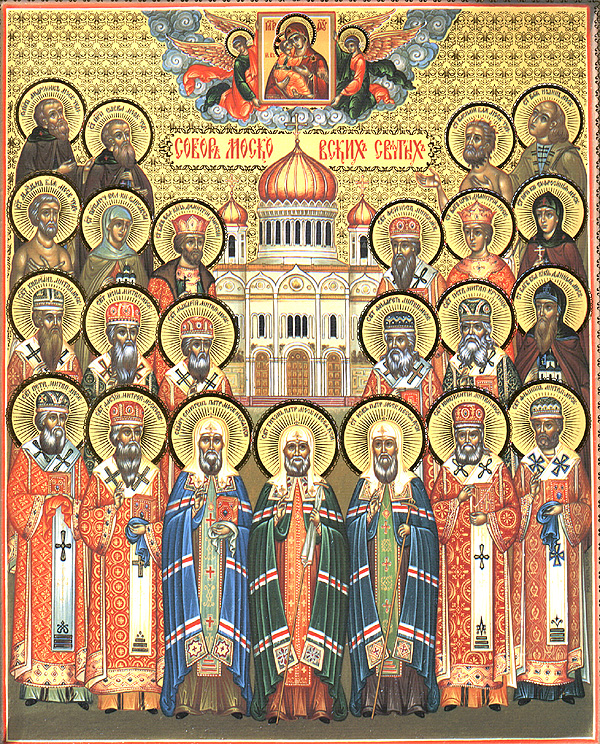
On the Sunday closest to January 25, the Church commemorates the Synaxis of the Holy New Martyrs and Confessors of Russia, remembering all those Orthodox Christians who suffered for Christ at the hands of the godless Soviets during the years of persecution. These include the royal Passion Bearers Tsar Nicholas II and his family, and the Grand Duchess Elizabeth. Countless thousands of martyrs, both clergy and laity also suffered, some of whose names are known, as well as millions of simple believers whose names have been lost to history.
It is estimated that the number of the New Martyrs of Russia, who were glorified by the Russian Orthodox Church at the Jubilee Council of 2000, far exceeds that of all the martyrs who died for Christ during the first three centuries of Christianity. The Russian Church lost millions of its sons and daughters, not only at the hands of external enemies, but also those of their own country. Among those who were murdered and tortured in the years of persecution were countless Orthodox: laity, monks, priests, and bishops, whose only “crime” was their unshakable faith in God.
In the long history of the world, never have so many new heavenly intercessors been glorified by the Church in such a way (more than one thousand New Martyrs were numbered among the saints). Among those who suffered for their faith were some who labored in America before the Russian Revolution: St. Tikhon, Patriarch of Moscow and All Russia (April 7); St. Alexander Hotovitzky (Dec. 4); St. John Kochurov (Oct. 31).
Hieromartyr Clement, Bishop of Ancyra, and Martyr Agathangelus
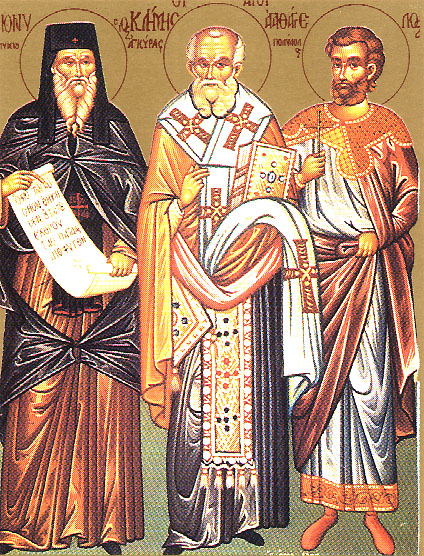
The Hieromartyr Clement was born in the Galatian city of Ancyra in the year 258, of a pagan father and a Christian mother. He lost his father when he was an infant, and his mother when he was twelve. She predicted a martyr’s death for him because of his belief in Christ.
A woman named Sophia adopted him and raised him in the fear of God. During a terrible famine in Galatia several pagans turned out their own children, not having the means to feed them. Sophia took in these unfortunates, and fed and clothed them. Saint Clement assisted her in this. He taught the children and prepared them for Baptism. Many of them died as martyrs for Christ.
Saint Clement was made a reader, and later a deacon. When he was eighteen he was ordained to the holy priesthood, and at age twenty he was consecrated Bishop of Ancyra. Soon afterwards the persecution against Christians under Diocletian (284-305) broke out.
Bishop Clement was denounced as a Christian and arrested. Dometian, the governor of Galatia, tried to make the saint worship the pagan gods, but Saint Clement firmly confessed his faith and valiantly withstood all the tortures.
They suspended him on a tree, and raked his body with sharp iron instruments so that his entrails could be seen. They smashed his mouth with stones, and they turned him on a wheel and burned him over a low fire. The Lord preserved His sufferer and healed his lacerated body.
Then Dometian sent the saint to Rome to the emperor Diocletian himself, with a report that Bishop Clement had been fiercely tortured, but had proven unyielding. Diocletian, seeing the martyr completely healthy, did not believe the report and subjected him to even crueler tortures, and then had him locked up in prison.
Many of the pagans, seeing the bravery of the saint and the miraculous healing of his wounds, believed in Christ. People flocked to Saint Clement in prison for guidance, healing and Baptism, so that the prison was literally transformed into a church. When word of this reached the emperor, many of these new Christians were executed.
Diocletian, struck by the amazing endurance of Saint Clement, sent him to Nicomedia to his co-emperor Maximian. On the ship, the saint was joined by his disciple Agathangelus, who had avoided being executed with the other confessors, and who now wanted to suffer and die for Christ with Bishop Clement.
The emperor Maximian in turn sent Saints Clement and Agathangelus to the governor Agrippina, who subjected them to such inhuman torments, that even the pagan on-lookers felt pity for the martyrs and they began to pelt the torturers with stones.
Having been set free, the saints healed an inhabitant of the city through the laying on of hands and they baptized and instructed people, thronging to them in multitudes. Arrested again on orders of Maximian, they were sent home to Ancyra, where the ruler Cyrenius had them tortured. Then they were sent to the city of Amasea to the proconsul Dometius, known for his great cruelty.
In Amasea, the martyrs were thrown into hot lime. They spent a whole day in it and remained unharmed. They flayed them, beat them with iron rods, set them on red-hot beds, and poured sulfur on their bodies. All this failed to harm the saints, and they were sent to Tarsus for new tortures. In the wilderness along the way Saint Clement had a revelation that he would suffer a total of twenty-eight years for Christ. Then having endured a multitude of tortures, the saints were locked up in prison.
Saint Agathangelus was beheaded with the sword on November 5. The Christians of Ancyra freed Saint Clement from prison and took him to a cave church. There, after celebrating Liturgy, the saint announced to the faithful the impending end of the persecution and his own martyrdom. On January 23, the holy hierarch was killed by soldiers from the city, who stormed the church. The saint was beheaded as he stood before the altar and offered the Bloodless Sacrifice. Two deacons, Christopher and Chariton, were beheaded with him, but no one else was harmed.
Venerable Gennadius of Kostroma

Saint Gennadius of Kostroma and Liubimograd, in the world Gregory, was born in the city of Mogilev into a rich family. He early displayed love for the church, and his frequent visits to monasteries evoked the dismay of his parents. Gregory, however, was firmly resolved to devote himself to God, and changing into tattered clothing, he secretly left his parental home and journeyed to Moscow.
He visited the holy places in Moscow, but he did not find it suitable in spirit and so set out to the Novgorod region. The destiny of the future ascetic was decided by an encounter with Saint Alexander of Svir (August 30). With his blessing, Gregory went to the Vologda forest to Saint Cornelius of Komel (May 19), and was tonsured by him with the name Gennadius. Together with Saint Cornelius, Gennadius moved on to the Kostroma forest. Here, on the shores of Lake Sura, in about the year 1529, there emerged the monastery of the Transfiguration of the Lord, afterwards called “the Gennadiev monastery”. Having become igumen, Saint Gennadius did not slacken his monastic efforts, and together with the brethren he went out to the monastery tasks: he chopped wood, carried firewood, made candles and baked prosphora. He also wore heavy chains. One of his favorite tasks was the painting of icons, with which he adorned his new monastery.
For his holy life Saint Gennadius received from the Lord the gift of clairvoyance and wonderworking. Journeying to Moscow on monastic affairs, at the house of the nobleman Roman Zakharin, the saint predicted to his daughter Anastasia that she would become Tsaritsa. Indeed, Tsar Ivan the Terrible chose her as his wife.
The Life of Saint Gennadius was written by his disciple, Iguman Alexis, between the years 1584-1587. In it was inserted his spiritual testament, dictated by Saint Gennadius himself. In it he commands the monks to observe the monastery Rule, to toil constantly, to be at peace with everyone, and to preserve the books collected at the monastery, while striving to understand their meaning. He said, “Strive towards the light, and shun the darkness.”
Saint Gennadius died on January 23, 1565, and was glorified by the Church on August 19, 1646.
Translation of the relics of Saint Theoctistus, Archbishop of Novgorod
The main Feast of Saint Theoctistus is December 23. He was glorified in 1664, because of the miraculous healings which took place at his relics. In 1786, the relics of the saint were transferred to Yuriev, where Archimandrite Photius built a chapel in his honor at the local cathedral.
Venerable Mausimas the Syrian
Saint Mausimas the Syrian lived in Syria, near the city of Cyrrhus. He voluntarily embraced poverty and devoted his life to the service of his neighbor. The doors of his hut were always open to anyone who had need of him.
In his hut there were two vessels: one with bread, and the other with oil. Anyone in need came to him and received the food from his hand. These vessels never became empty. The saint died at the end of the fourth century.
Saint Salamanēs the Silent of the Euphrates
Saint Salamanēs (Σαλαμάνης) was from the town of Kapersana (Καπερσανά) in Syria, on the west bank of the Euphrates River. Since he loved the solitary life, he followed the path of monasticism, building his cell near the Euphrates River.
The Bishop of the town, who was informed of the virtue of the venerable one, went to see him in order to ordain him to the priesthood. Arriving at the Saint's cell, the Archpastor ordered him to dismantle part of the wall so that he might enter. The Bishop spoke to him about the grace of the priesthood, but during the time he was in the cell, the Hierarch did not hear a single word from the Saint. Therefore, he departed, after ordering him to rebuild the wall.
Saint Salamanēs was content with his silence, prayer, and study of the Word of God. Thus, comforted by God, he led people's souls to Christ.
In the Synaxarion it is said that people from the place where Saint Salamanēs was born went to his cell because they wanted him to live near them. He did not protest their actions, nor agree to them, but maintained his silence. So they picked him up and brought him to their town, where they built a cell similar to the other one and enclosed him within. The Saint also remained in this cell in silence and prayer.
A few days later, some people went there by night from a town on other side of the river, who took the Saint and brought him to their town. He did not object when they took him away, neither opposing nor agreeing to it. Soon the inhabitants of the village on the other side of the river came at night to his new dwelling and heard him say this prayer: "O Lord Jesus Christ, have mercy on me and all the servants of Thy name, and those who worship Thee, our true God."
Saint Salamanēs was dead to this world, seeking only to obey the will of God. Therefore, he could say with Saint Paul: "It is no longer I who live, but Christ who lives in me, and the life I now live in the flesh I live by faith in the Son of God, who loved me and gave himself up for me" (Galatians 2:20).
The ascetic did not interrupt his feat of silence, speaking only to God. The Orthodox Church honors him as the first Saint to embrace complete silence, which he maintained until his death († ca. 400).
Saint Paulinus the Merciful, Bishop of Nola
Saint Paulinus the Merciful, Bishop of Nola, was descended from an aristocratic and wealthy family of Bordeaux (France). By virtue of his extensive education and upbringing, the twenty-year-old youth was chosen to become a Roman senator, later he became consul and finally, governor of the region of Campagna in Italy.
At twenty-five years of age, he and his wife were converted to Christ and were baptized. After this he completely changed his manner of life. He disposed of all his property, and distributed the money to the needy, for which he endured the scorn of his friends and servants.
Not having children of their own, the pious couple adopted poor orphans and raised them in the fear of God. In his searchings for a secluded life, Saint Paulinus went to the Spanish city of Barcelona.
News of his ascetic life spread about, and in 393 they asked him to be ordained as a priest. Soon he left Spain and went on to the city of Nola in Italy, where he was elected bishop.
When the Vandal barbarians invaded Italy and carried off many people to Africa in captivity, Saint Paulinus used church funds to ransom the captives. However, he did not have enough money to ransom the son of a certain poor widow from slavery in the household of the Prince of the Vandals. So, he volunteered to take his place. Dressed as a slave, Saint Paulinus began to serve the Vandal prince as a gardener.
Soon his identity was revealed to the ruler, King Riga, in a dream. Not only did he receive his own freedom, but he also won the release of all the other prisoners from Campania, and returned home with them.
Saint Paulinus is known both as a builder of churches and as a Christian poet. Among his many virtues, his love for mankind and his compassion for the poor and needy deserve special mention. He died at seventy-eight years of age on June 22, 431. Thirty-two of his poems and fifty-one of his letters survive. They contain various moral discourses filled with deep piety.
His relics are in Rome, in the church of the holy Apostle Bartholomew.
Commemoration of the Holy Fathers of the Sixth Ecumenical Council
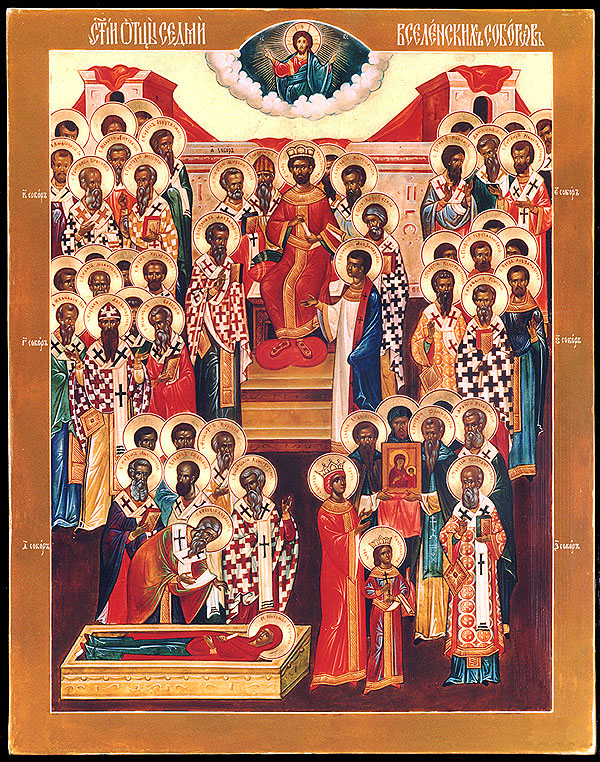
The Sixth Ecumenical Council was convened by the emperor Constantine Pogonatos (668-685) at Constantinople in the year 681 to combat the Monothelite heresy. At it 171 holy Fathers were present, who affirmed the doctrine of two wills in Jesus Christ, the divine and the human.
This Council was followed by another Council in the year 691, called the Council in Trullo. This Council addressed certain practical matters, and 102 canons were promulgated.
Synaxis of the Saints of Kostroma
The saints of Kostroma include
Saint Abramius of Galich, or Chukhloma Lake (July 20)
Saint Adrian of Monza (May 5)
Saint Alexander of Galich, abbot of Voche (March 27)
Saint Barnabas abbot of Verluga (June 11)
Saint Cyril of New Lake (February 4, November 7)
Saint Cyril of White Lake (June 9)
Saint Dionysius, Archbishop of Suzdal (June 26, October 15)
Saint Gennadius, abbot of Kostroma (August 19)
Saint Gregory, abbot of Pelshme, wonderworker of Vologda (September 30)
Saint James of Brileev (April 11)
Saint James of Galich Monastery (April 4, May 30)
Saint James of Zheleznoborovsk (April 11, May 5)
Saint Jonah, Metropolitan of Moscow (March 31, May 27, June 15)
Saint Macarius, abbot of Zheltovod and Unzha (July 25)
Saint Macarius of Pisma Monastery (January 10)
Saint Metrophanes, bishop of Voronezh (August 7, September 4, November 23)
Saint Pachomius, abbot of Nerekhta (March 21, May 15)
Saint Paisius, abbot of Galich (May 23)
Saint Paul of Obnora (January 10, October 7)
Saint Therapon of Monza (May 27, December 1).
Great Vespers – Sat 01/22/2022
Here is the live stream for Great Vespers – Sat 01/22/2022 If you need, here are instructions for accessing this content from your phone, tablet, computer, or TV.
Daily Readings for Saturday, January 22, 2022
TIMOTHY THE APOSTLE OF THE 70
NO FAST
Timothy the Apostle of the 70, The Righteous Martyr Anastasius of Persia, Joseph the Sanctified
ST. PAUL’S SECOND LETTER TO TIMOTHY 1:3-8
Timothy, my son, I thank God whom I serve with a clear conscience, as did my fathers, when I remember you constantly in my prayers. As I remember your tears, I long night and day to see you, that I may be filled with joy. I am reminded of your sincere faith, a faith that dwelt first in your grandmother Lois and your mother Eunice and now, I am sure, dwells in you. Hence I remind you to rekindle the gift of God that is within you through the laying on of my hands; for God did not give us a spirit of timidity but a spirit of power and love and self-control.
Do not be ashamed then of testifying to our Lord, nor of me his prisoner, but share in suffering for the gospel in the power of God.
MATTHEW 10:32-33; 37-38; 19:27-30
The Lord said to his disciples, “Every one who acknowledges me before men, I also will acknowledge before my Father who is in heaven; but whoever denies me before men, I also will deny him before my Father who is in heaven. He who loves father or mother more than me is not worthy of me; and he who loves son or daughter more than me is not worthy of me; and he who does not take his cross and follow me is not worthy of me.” Then Peter said in reply, “Lo, we have left everything and followed you. What then shall we have?” Jesus said to them, “Truly, I say to you, in the new world, when the Son of man shall sit on his glorious throne, you who have followed me will also sit on twelve thrones, judging the twelve tribes of Israel. And every one who has left houses or brothers or sisters or father or mother or children or lands, for my name’s sake, will receive a hundredfold, and inherit eternal life. But many that are first will be last, and the last first.”
Apostle Timothy of the Seventy

The Holy Apostle Timothy was from the Lycaonian city of Lystra in Asia Minor. Saint Timothy was converted to Christ in the year 52 by the holy Apostle Paul (June 29). When the Apostles Paul and Barnabas first visited the cities of Lycaonia, Saint Paul healed one crippled from birth. Many of the inhabitants of Lystra then believed in Christ, and among them was the future Saint Timothy, his mother Eunice and grandmother Loida (Lois) (Acts 14:6-12; 2 Tim. 1:5).
The seed of faith, planted in Saint Timothy’s soul by the Apostle Paul, brought forth abundant fruit. He became Saint Paul’s disciple, and later his constant companion and co-worker in the preaching of the Gospel. The Apostle Paul loved Saint Timothy and in his Epistles called him his beloved son, remembering his devotion and fidelity with gratitude.
He wrote to Timothy: “You have followed my teaching, way of life, purpose, faith, longsuffering, love, and patience” (2 Tim. 3:10-11). The Apostle Paul appointed Saint Timothy as Bishop of Ephesus, where the saint remained for fifteen years. Finally, when Saint Paul was in prison and awaiting martyrdom, he summoned his faithful friend, Saint Timothy, for a last farewell (2 Tim. 4:9).
Saint Timothy ended his life as a martyr. The pagans of Ephesus celebrated a festival in honor of their idols, and used to carry them through the city, accompanied by impious ceremonies and songs. Saint Timothy, zealous for the glory of God, attempted to halt the procession and reason with the spiritually blind idol-worshipping people, by preaching the true faith in Christ.
The pagans angrily fell upon the holy apostle, they beat him, dragged him along the ground, and finally, they stoned him. Saint Timothy’s martyrdom occurred in the year 93.
In the fourth century the holy relics of Saint Timothy were transferred to Constantinople and placed in the church of the Holy Apostles near the tombs of Saint Andrew (November 30) and Saint Luke (October 18). The Church honors Saint Timothy as one of the Apostles of the Seventy.
In Russian practice, the back of a priest’s cross is often inscribed with Saint Paul’s words to Saint Timothy: “Be an example to the believers in speech and conduct, in love, in faith, in purity” (1 Tim. 4:12).
Monastic Martyr Anastasius the Persian
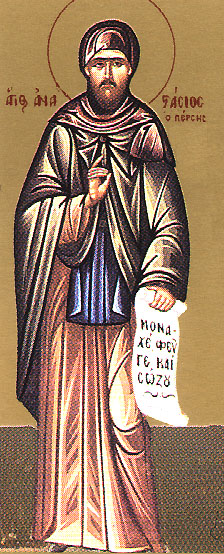
The Monk Martyr Anastasius the Persian was the son of a Persian sorcerer named Bavi. As a pagan, he had the name Magundates and served in the armies of the Persian emperor Chozroes II, who in 614 ravaged the city of Jerusalem and carried away the Life-Creating Cross of the Lord to Persia.
Great miracles occurred from the Cross of the Lord, and the Persians were astonished. The heart of young Magundates was inflamed with the desire to learn more about this sacred object. Asking everyone about the Holy Cross, the youth learned that upon it the Lord Himself was crucified for the salvation of mankind. He became acquainted with the truths of the Christian Faith in the city of Chalcedon, where the army of Chozroes was for a certain while. He was baptized with the name Anastasius, and then became a monk and spent seven years in one of the Jerusalem monasteries, living an ascetical life.
Reading the Lives of the holy martyrs, Saint Anastasius was inspired with the desire to imitate them. A mysterious dream, which he had on Great and Holy Saturday, the day before the Resurrection of Christ, urged him to do this.
Having fallen asleep after his daily tasks, he beheld a radiant man giving him a golden chalice filled with wine, who said to him, “Take this and drink.” Draining the chalice, he felt an ineffable delight. Saint Anastasius then realized that this vision was his call to martyrdom.
He went secretly from the monastery to Palestinian Caesarea. There he was arrested for being a Christian, and was brought to trial. The governor tried in every way to force Saint Anastasius to renounce Christ, threatening him with tortures and death, and promising him earthly honors and blessings. The saint, however, remained unyielding. Then they subjected him to torture: they beat him with rods, they lacerated his knees, they hung him up by the hands and tied a heavy stone to his feet, they exhausted him with confinement, and then wore him down with heavy work in the stone quarry with other prisoners.
Finally, the governor summoned Saint Anastasius and promised him his freedom if he would only say, “I am not a Christian.” The holy martyr replied, “I will never deny my Lord before you or anyone else, neither openly nor even while asleep. No one can compel me to do this while I am in my right mind.” Then by order of the emperor Chozroes, Saint Anastasius was strangled, then beheaded. After the death of Chozroes, the relics of the Monk Martyr Anastasius were transferred to Palestine, to the Anastasius monastery.
Monastic Martyr Anastasius the Deacon of the Kiev Near Caves
The Monk Martyr Anastasius, Deacon of the Kiev Caves, lived an ascetical life in the Near Caves. The hieromonk Athanasius the Sooty calls him brother of Saint Titus the Presbyter (February 27). In the manuscripts of the saints he is called a deacon. In the Service to the Synaxis of the Fathers of the Near Caves, it says that the Monk Martyr Anastasius possessed such steadfastness in God, that he received everything he asked for. His memory is celebrated also on September 28 and on the second Sunday of Great Lent.
Venerable Macarius of Zhabyn the Wonderworker

Saint Macarius of Zhabyn, Wonderworker of Belev, was born in the year 1539. In his early years he was tonsured with the name Onuphrius, and in the year 1585 he founded Zhabyn’s Monastery of the Entry of the Most Holy Theotokos into the Temple near the River Oka, not far from the city of Belev. In 1615 the monastery was completely destroyed by Polish soldiers under the command of Lisovski. Returning to the charred remains, the monk began to restore the monastery. He again gathered the brethren, and in place of the wooden church a stone church was built in honor of the Entry of the Most Holy Theotokos into the Temple (November 21), with a bell-tower at the gates.
The saint spent his life in austere monastic struggles, suffering cold, heat, hunger and thirst, as the monastery accounts relate. He often went deep into the forest, where he prayed to God in solitude. Once, when he was following a path in the forest, he heard a faint moaning. He looked around and saw a weary Polish man reclining against a tree trunk, with his sabre beside him. He had strayed from his regiment and had become lost in the forest. In a barely audible voice this enemy, who might have been one of the destroyers of the monastery, asked for a drink of water. Love and sympathy surged up within the monk. With a prayer to the Lord, he plunged his staff into the ground. At once, a fresh spring of water gushed forth, and he gave the dying man a drink.
When both the external and internal life of the monastery had been restored, Saint Onuphrius withdrew from the general monastic life, and having entrusted the guidance of the brethren to one of his disciples, he took the schema with the name Macarius. For the place of his solitude, he chose a spot along the upper tributary of the River Zhabynka. About one verst separated the mouth of the tributary and the banks of the River Oka.
The ascetical struggles of Saint Macarius were concealed not only from the world, but also from his beloved brethren. He died in 1623 at the age of eighty-four, at the hour when the roosters start to crow. He was buried opposite the gates of the monastery on January 22, the commemoration of Saint Timothy, where a church was later built and named for him.
The Iconographic Originals has preserved a description of Saint Macarius in his last years: he had gray hair with a small beard, and over his monastic riassa he wore the schema. Veneration of Saint Macarius was established at the end of the seventeenth century, or the beginning of the eighteenth. According to Tradition, his relics remained uncovered, but by 1721 they were interred in a crypt.
In the eighteenth century the monastery became deserted. The memory of his deeds and miracles was so completely forgotten, that when the incorrupt relics of the monastery’s founder were uncovered during the construction of the church of Saint Nicholas in 1816, a general panikhida was served over them. The restoration of the liturgical commemoration of Saint Macarius of Belev is credited to Igumen Jonah, who was born on January 22 (the Feast of Saint Macarius), and who began his own monastic journey at the Optina monastery not far from the Zhabyn monastery.
In 1875 Igumen Jonah became head of the Zhabyn monastery. His request to re-establish the Feast of Saint Macarius was strengthened by the petition of the people of Belev, who through the centuries had preserved their faith in the saint. On January 22, 1888, the annual commemoration of Saint Macarius of Zhabyn was resumed.
In 1889, a church dedicated to Saint Macarius was built at his tomb. Igumen Jonah, who lived at the monastery and actually participated in the construction, decided that in addition to the building project, the holy relics of Saint Macarius would also be uncovered. When everything was on the point of readiness, Saint Macarius appeared to the participants and sternly warned them that they should not proceed with their intention, or they would be punished. The memory of this appearance was reverently preserved among the monks of the monastery.
Saint Macarius of Zhabynsk is also commemorated on September 22.
377 Martyred Companions in Bulgaria
These 377 Christians were captured in Thrace by the Bulgars, and were slain in various ways.
Among the martyrs where the bishops Manuel, George, Peter, and Leontius; and the presbyters Sionius, Gabriel, John, Leontius and Parodus.
Saint Brihtwald of Wilton

Saint Brihtwald (Berhtwald) was the last Bishop of Ramsbury, Wiltshire. After his death, the See was transferred to Old Sarum.
Originally a monk of Glastonbury, he was renowned for his visions and prophecies. Saint Brihtwald died in 1045 and was buried in Glastonbury Abbey.
Saint Euthymius

No information available at this time.
Daily Readings for Friday, January 21, 2022
MAXIMUS THE CONFESSOR
ABSTAIN FROM MEAT, FISH, DAIRY, EGGS, WINE, OLIVE OIL
Maximus the Confessor, Martyrs Neophytos, Agnes, Patroclus, Maximus the Greek and Eugene of Trebizond, Neophytos the Martyr of Nicaea
ST. PAUL’S LETTER TO THE PHILIPPIANS 1:12-20
Brethren, I want you to know that what has happened to me has really served to advance the gospel, so that it has become known throughout the praetorian guard and to all the rest that my imprisonment is for Christ; and most of the brethren have been made confident in the Lord because of my imprisonment, and are much more bold to speak the word of God without fear. Some indeed preach Christ from envy and rivalry, but others from good will. The latter do it out of love, knowing that I am put here for the defense of the gospel; the former proclaim Christ out of partisanship, not sincerely but thinking to afflict me in my imprisonment. What then? Only that in every way, whether in pretense or in truth, Christ is proclaimed; and in that I rejoice. Yes, and I shall rejoice. For I know that through your prayers and the help of the Spirit of Jesus Christ this will turn out for my deliverance, as it is my eager expectation and hope.
LUKE 12:8-12
The Lord said to His disciples, "Every one who acknowledges me before men, the Son of Man also will acknowledge before the angels of God; but he who denies me before men will be denied before the angels of God. And every one who speaks a word against the Son of Man will be forgiven; but he who blasphemes against the Holy Spirit will not be forgiven. And when they bring you before the synagogues and the rulers and the authorities, do not be anxious how or what you are to answer or what you are to say; for the Holy Spirit will teach you in that very hour what you ought to say.
Venerable Maximus the Confessor
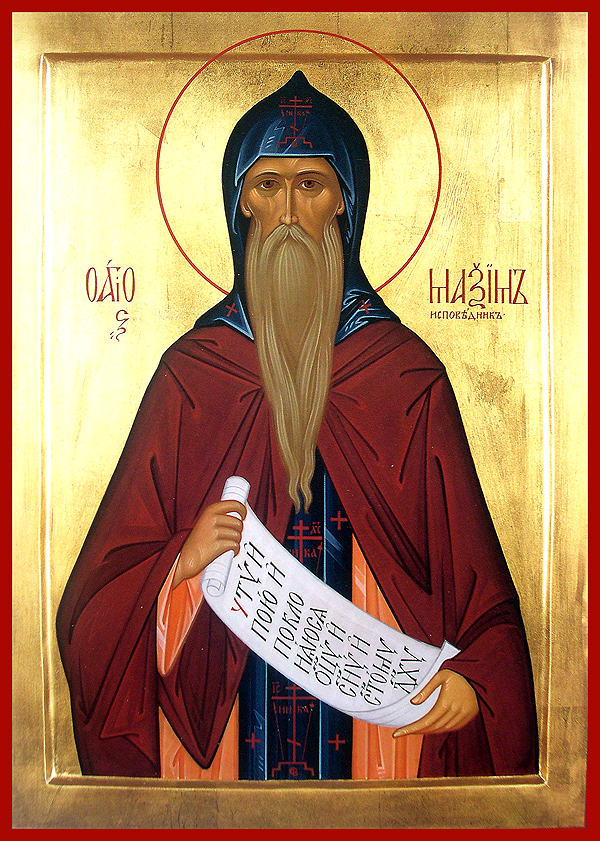
Saint Maximus the Confessor was born in Constantinople around 580 and raised in a pious Christian family. He received an excellent education, studying philosophy, grammar, and rhetoric. He was well-read in the authors of antiquity and he also mastered philosophy and theology. When Saint Maximus entered into government service, he became first secretary (asekretis) and chief counselor to the emperor Heraclius (611-641), who was impressed by his knowledge and virtuous life.
Saint Maximus soon realized that the emperor and many others had been corrupted by the Monothelite heresy, which was spreading rapidly through the East. He resigned from his duties at court, and went to the Chrysopolis monastery (at Skutari on the opposite shore of the Bosphorus), where he received monastic tonsure. Because of his humility and wisdom, he soon won the love of the brethren and was chosen igumen of the monastery after a few years. Even in this position, he remained a simple monk.
In 638, the emperor Heraclius and Patriarch Sergius tried to minimize the importance of differences in belief, and they issued an edict, the “Ekthesis” (“Ekthesis tes pisteos” or “Exposition of Faith),” which decreed that everyone must accept the teaching of one will in the two natures of the Savior. In defending Orthodoxy against the “Ekthesis,” Saint Maximus spoke to people in various occupations and positions, and these conversations were successful. Not only the clergy and the bishops, but also the people and the secular officials felt some sort of invisible attraction to him, as we read in his Life.
When Saint Maximus saw what turmoil this heresy caused in Constantinople and in the East, he decided to leave his monstery and seek refuge in the West, where Monothelitism had been completely rejected. On the way, he visited the bishops of Africa, strengthening them in Orthodoxy, and encouraging them not to be deceived by the cunning arguments of the heretics.
The Fourth Ecumenical Council had condemned the Monophysite heresy, which falsely taught that in the Lord Jesus Christ there was only one nature (the divine). Influenced by this erroneous opinion, the Monothelite heretics said that in Christ there was only one divine will (“thelema”) and only one divine energy (“energia”). Adherents of Monothelitism sought to return by another path to the repudiated Monophysite heresy. Monothelitism found numerous adherents in Armenia, Syria, Egypt. The heresy, fanned also by nationalistic animosities, became a serious threat to Church unity in the East. The struggle of Orthodoxy with heresy was particularly difficult because in the year 630, three of the patriarchal thrones in the Orthodox East were occupied by Monothelites: Constantinople by Sergius, Antioch by Athanasius, and Alexandria by Cyrus.
Saint Maximus traveled from Alexandria to Crete, where he began his preaching activity. He clashed there with a bishop, who adhered to the heretical opinions of Severus and Nestorius. The saint spent six years in Alexandria and the surrounding area.
Patriarch Sergius died at the end of 638, and the emperor Heraclius also died in 641. The imperial throne was eventually occupied by his grandson Constans II (642-668), an open adherent of the Monothelite heresy. The assaults of the heretics against Orthodoxy intensified. Saint Maximus went to Carthage and he preached there for about five years. When the Monothelite Pyrrhus, the successor of Patriarch Sergius, arrived there after fleeing from Constantinople because of court intrigues, he and Saint Maximus spent many hours in debate. As a result, Pyrrhus publicly acknowledged his error, and was permitted to retain the title of “Patriarch.” He even wrote a book confessing the Orthodox Faith. Saint Maximus and Pyrrhus traveled to Rome to visit Pope Theodore, who received Pyrrhus as the Patriarch of Constantinople.
In the year 647 Saint Maximus returned to Africa. There, at a council of bishops Monotheletism was condemned as a heresy. In 648, a new edict was issued, commissioned by Constans and compiled by Patriarch Paul of Constantinople: the “Typos” (“Typos tes pisteos” or “Pattern of the Faith”), which forbade any further disputes about one will or two wills in the Lord Jesus Christ. Saint Maximus then asked Saint Martin the Confessor (April 14), the successor of Pope Theodore, to examine the question of Monothelitism at a Church Council. The Lateran Council was convened in October of 649. One hundred and fifty Western bishops and thirty-seven representatives from the Orthodox East were present, among them Saint Maximus the Confessor. The Council condemned Monothelitism, and the Typos. The false teachings of Patriarchs Sergius, Paul and Pyrrhus of Constantinople, were also anathematized.
When Constans II received the decisions of the Council, he gave orders to arrest both Pope Martin and Saint Maximus. The emperor’s order was fulfilled only in the year 654. Saint Maximus was accused of treason and locked up in prison. In 656 he was sent to Thrace, and was later brought back to a Constantinople prison.
The saint and two of his disciples were subjected to the cruelest torments. Each one’s tongue was cut out, and his right hand was cut off. Then they were exiled to Skemarum in Scythia, enduring many sufferings and difficulties on the journey.
After three years, the Lord revaled to Saint Maximus the time of his death (August 13, 662). Three candles appeared over the grave of Saint Maximus and burned miraculously. This was a sign that Saint Maximus was a beacon of Orthodoxy during his lifetime, and continues to shine forth as an example of virtue for all. Many healings occurred at his tomb.
In the Greek Prologue, August 13 commemorates the Transfer of the Relics of Saint Maximus to Constantinople, but it could also be the date of the saint’s death. It may be that his memory is celebrated on January 21 because August 13 is the Leavetaking of the Feast of the Transfiguration of the Lord.
Saint Maximus has left to the Church a great theological legacy. His exegetical works contain explanations of difficult passages of Holy Scripture, and include a Commentary on the Lord’s Prayer and on Psalm 59, various “scholia” or “marginalia” (commentaries written in the margin of manuscripts), on treatises of the Hieromartyr Dionysius the Areopagite (October 3) and Saint Gregory the Theologian (January 25). Among the exegetical works of Saint Maximus are his explanation of divine services, entitled “Mystagogia” (“Introduction Concerning the Mystery”).
The dogmatic works of Saint Maximus include the Exposition of his dispute with Pyrrhus, and several tracts and letters to various people. In them are contained explanations of the Orthodox teaching on the Divine Essence and the Persons of the Holy Trinity, on the Incarnation of the Word of God, and on “theosis” (“deification”) of human nature.
“Nothing in theosis is the product of human nature,” Saint Maximus writes in a letter to his friend Thalassius, “for nature cannot comprehend God. It is only the mercy of God that has the capacity to endow theosis unto the existing… In theosis man (the image of God) becomes likened to God, he rejoices in all the plenitude that does not belong to him by nature, because the grace of the Spirit triumphs within him, and because God acts in him” (Letter 22).
Saint Maximus also wrote anthropological works (i.e. concerning man). He deliberates on the nature of the soul and its conscious existence after death. Among his moral compositions, especially important is his “Chapters on Love.” Saint Maximus the Confessor also wrote three hymns in the finest traditions of church hymnography, following the example of Saint Gregory the Theologian.
The theology of Saint Maximus the Confessor, based on the spiritual experience of the knowledge of the great Desert Fathers, and utilizing the skilled art of dialectics worked out by pre-Christian philosophy, was continued and developed in the works of Saint Simeon the New Theologian (March 12), and Saint Gregory Palamas (November 14).
Martyr Neophytus of Nicea
The Holy Martyr Neophytus, a native of the city of Nicea in Bithynia, was raised by his parents in strict Christian piety. For his virtue, temperance and unceasing prayer, it pleased God to glorify Saint Neophytus with the gift of wonderworking, while the saint was still just a child!
Like Moses, the holy youth brought forth water from a stone of the city wall and gave this water to those who were thirsty. In answer to the prayer of Saint Neophytus’ mother, asking that God’s will concerning her son might be revealed to her, a white dove miraculously appeared and told of the path he would follow. The saint was led forth from his parental home by this dove and brought to a cave on Mt. Olympus, which served as a lion’s den. It is said that he chased the lion from the cave so that he could live there himself. The saint remained there from the age of nine until he was fifteen, leaving it only once to bury his parents and distribute their substance to the poor.
During the persecution by Diocletian (284-305), he went to Nicea and boldly began to denounce the impiety of the pagan faith. The enraged persecutors suspended the saint from a tree, they whipped him with ox thongs, and scraped his body with iron claws. Then they threw him into a red-hot oven, but the holy martyr remained unharmed, spending three days and three nights in it. The torturers, not knowing what else to do with him, decided to kill him. One of the pagans ran him through with a sword (some say it was a spear), and the saint departed to the Lord at the age of sixteen.
Martyrs Eugene, Candidus, Valerian, and Aquila, at Trebizond

The Holy Martyrs Eugene, Candidus, Valerian and Aquila suffered for their faith in Christ during the reign of Diocletian (284-305) and Maximian (305-311), under the regimental commander Lycius. Valerian, Candidus and Aquila had hidden themselves in the hills near Trebizond, preferring life among the wild beasts to living with the pagans. They were soon found, however, and brought to Trebizond.
For their bold and steadfast confession of faith in Christ the holy martyrs were whipped with ox thongs, scraped with iron claws, then were burned with fire. Several days later Saint Eugene was also arrested, and subjected to the same tortures. Later, they poured vinegar laced with salt into his wounds. After these torments, they threw the four martyrs into a red-hot oven. When they emerged from it unharmed, they were beheaded, receiving their incorruptible crowns from God.
Virgin Martyr Agnes of Rome

The holy Virgin Martyr Agnes was born at Rome during the third century. Her parents were Christians and they raised her in the Christian Faith. From her youth she devoted herself to God, and dedicated herself to a life of virginity, refusing all other suitors.
When she refused to enter into marriage with the son of the city official Symphronius, one of his associates revealed to him that Agnes was a Christian. The wicked Eparch decided to subject the holy virgin to shame and he ordered that she be stripped and and sent to a brothel for disdaining the pagan gods. But the Lord would not permit the saint to suffer shame. As soon as she was disrobed, long thick hair grew from her head covering her body. An angel was also appointed to guard her. Standing at the door of the brothel, he shone with a heavenly light which blinded anyone who came near her.
The son of the Eparch also came to defile the virgin, but fell down dead before he could touch her. Through the fervent prayer of Saint Agnes, he was restored to life. Before his father and many other people he proclaimed, “There is one God in the heavens and on earth: the Christian God, and the other gods are but dust and ashes!” After seeing this miracle, 160 men believed in God and were baptized, and then suffered martyrdom.
Saint Agnes, at the demand of the pagan priests, was given over to torture. They tried to burn her as a witch, but the saint remained unharmed in the fire, praying to God. After this they killed her by stabbing her in the throat. Through her death at the age of thirteen, Saint Agnes escaped everlasting death and inherited eternal life. The holy virgin martyr was buried by her parents in a field they owned outside of Rome.
Many miracles occurred at the grave of Saint Agnes. Her holy and grace-filled relics rest in the church built in her honor, along the Via Nomentana.
Martyr Anastasius, disciple of Venerable Maximus the Confessor
The Holy Martyr Anastasius was a disciple of Saint Maximus the Confessor, and with him suffered persecution under the Monothelites. Saint Maximus and two of his disciples were subjected to the cruelest torments. Each one’s tongue was cut out, and his right hand was cut off. Then they were exiled to Skemarum in Scythia, enduring many sufferings and difficulties on the journey.
Saint Anastasius wrote the Life of his teacher, and died in the year 662.
Venerable Neophytus of Vatopedi, Mount Athos
This saint was the Prosmonarios (the keeper of a church, one who waits for and receives those who come to worship) at Vatopaidi Monastery on the Holy Mountain during the fourteenth century, and he was sent to the Monastery’s metochion (representation church) at Euboia. There he became very sick and so he prayed before the icon of the Mother of God, asking her to let him return to his monastery so that he might die there. Then he heard the voice of the Most Holy Theotokos telling him to return to his monastery, and to be prepared for death at any moment. Saint Neophytos immediately became well, and went back to Vatopaidi.
A year later, after receiving the Holy Mysteries of Christ, he heard again the voice of the Most Holy Theotokos coming from the mouth of her holy icon, telling him that it was time for him to fall asleep. He became ill once more and, after asking forgiveness from the brethren, he surrendered his soul to the Lord.
Venerable Maximus the Greek

Saint Maximus the Greek was the son of a rich Greek dignitary in the city of Arta (Epiros), and he received a splendid education. In his youth he travelled widely and he studied languages and sciences (i.e. intellectual disciplines) in Europe, spending time in Paris, Florence, and Venice.
Upon returning to his native land, he went to Athos and became a monk at the Vatopedi monastery. And with enthusiasm he studied ancient manuscripts left on Athos by the Byzantine Emperors Andronicus Paleologos and John Kantakuzenos (who became monks).
During this period the Moscow Great Prince Basil III (1505-1533) wanted to make an inventory of the Greek manuscripts and books of his mother, Sophia Paleologina, and he asked the Protos of the Holy Mountain, Igumen Simeon, to send him a translator. Saint Maximus was chosen to go to Moscow, for he had been brought up on secular and ecclesiastical books from his youth. Upon his arrival, he was asked to translate patristic and liturgical books into Slavonic, starting with the Annotated Psalter.
Saint Maximus tried to fulfill his task, but since Slavonic was not his native language, there were certain imprecisions in the translations.
Metropolitan Barlaam of Moscow highly valued the work of Saint Maximus, but when the See of Moscow was occupied by Metropolitan Daniel, the situation changed.
The new Metropolitan ordered Saint Maximus to translate the Church History of Theodoritus of Cyrrhus into Slavonic. Saint Maximus absolutely refused this commission, pointing out that “in this history are included letters of the heretic Arius, and this might present danger for the semi-literate.” This refusal caused a rift between Maximus and the Metropolitan. Despite their differences, Saint Maximus continued to labor for the spiritual enlightenment of Rus. He wrote letters against Moslems, Roman Catholics, and pagans. He translated Saint John Chrysostom’s Commentaries on the Gospels of Matthew and John, and he also wrote several works of his own.
When the Great Prince wished to divorce his wife Solomonia because of her infertility, the dauntless confessor Maximus sent the Prince his “Instructive Chapters on Initiating Right Belief,” in which he persuasively demonstrated that the Prince was obliged not to yield to bestial passions. The Prince never forgave Maximus for his audacity, and locked Saint Maximus in prison. From that moment a new period began in the life of the monk, filled with much suffering.
Mistakes in his translations were regarded as deliberate and intentional corruptions of the text by Saint Maximus. It was difficult for him in prison, but in his sufferings the saint also gained the great mercy of God. An angel appeared to him and said, “Endure, Abba! Through this temporary pain you will be delivered from eternal torments.”
In prison the Elder wrote a Canon to the Holy Spirit in charcoal upon a wall, which even at present is read in the Church: “Just as Israel was nourished with manna in the wilderness of old, so Master, fill my soul with the All-Holy Spirit, that through Him I may serve Thee always….”
After six years, Saint Maximus was set free from prison and sent to Tver. There he lived under the supervision of the good-natured Bishop Acacius, who dealt kindly with guiltless sufferer. The saint then wrote in his autobiography: “While I was locked in prison and grieving, I consoled and strengthened myself with patience.” Here are some more words from this vivid text: “Neither grieve, nor be sad, beloved soul, that you have suffered unjustly, for it behooves you to accept all for your benefit.”
Only after twenty years at Tver did they decide to let Maximus live freely, and remove the church excommunication. Saint Maximus, now about seventy years of age, spent the final years of his life at the Trinity-Sergiev Lavra. Oppression and work took their toil on his health, but his spirit remained vigorous, and he continued with his work. Together with his cell-attendant and disciple Nilus, the saint translated the Psalter from Greek into Slavonic.
Saint Maximus reposed on January 21, 1556. He was buried at the northwest wall of the Holy Spirit church of the Trinity-Sergiev Lavra. Many manifestations of grace took place at the grave of Saint Maximus, and a Troparion and Kontakion were composed in his honor. Saint Maximus is depicted on the icon of the Synaxis of the Saints of Radonezh (July 6).
Icon of the Mother of God “Comfort” or “Consolation”
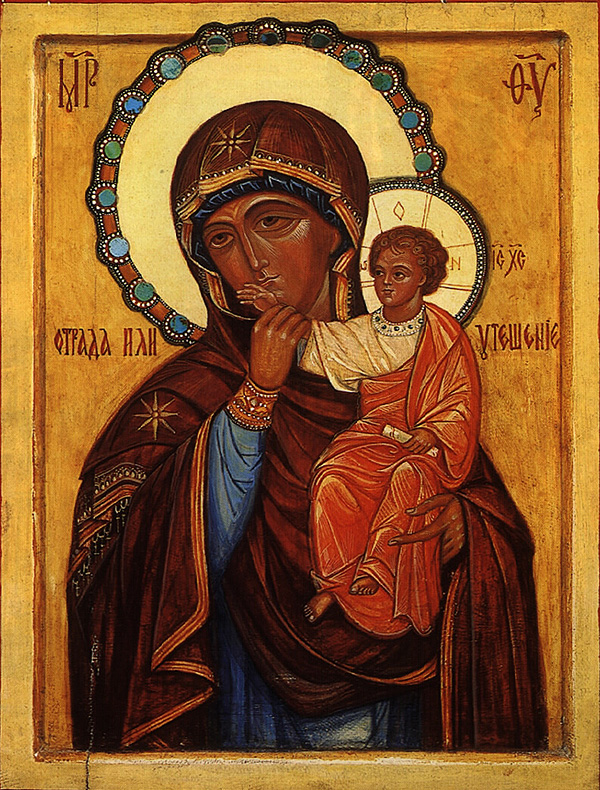
The Vatopedi “Comfort” or “Consolation” Icon of the Mother of God is in the old Vatopedi monastery on Athos, in the church of the Annunciation. It was called “Vatopedi” because near this monastery Arcadius, the son of Empreor Theodosius the Great, fell off a ship into the sea, and by the miraculous intercession of the Mother of God he was carried to shore safe and unharmed. He was found sleeping by a bush, not far from the monastery. From this event the name “Vatopedi” (“batos paidion,” “the bush of the child”) is derived. The holy Emperor Theodosius the Great (January 17), in gratitude for the miraculous deliverance of his son, embellished and generously endowed the Vatopedi monastery.
On the Vatopedi Icon, the Mother of God is depicted with Her face turned towards Her right shoulder. This is because on January 21, 807 She turned Her face towards the igumen of the monastery, who was standing near the holy icon, about to hand the keys of the monastery to the porter. A voice came from the icon and warned him not to open the monastery gates, because pirates intended to pillage the monastery. Then the Holy Child placed His hand over His Mother’s lips, saying, “Do not watch over this sinful flock, Mother, but let them fall under the sword of the pirates.” The Holy Virgin took the hand of Her Son and said again, “Do not open the gates today, but go to the walls and drive off the pirates.” The igumen took precautionary measures, and the monastery was saved.
In memory of this miraculous event a perpetual lamp burns in front of the wonderworking icon. Every day a Canon of Supplication is chanted in honor of the icon, and on Fridays the Divine Liturgy is celebrated. On Mt. Athos this icon is called “Paramythia,” “Consolation” (“Otrada”), or “Comfort” (“Uteshenie”).
Icon of the Mother of God “Stabbed”
The “Stabbed” Icon of the Mother of God, (Greek: “Esphagmeni.” Slavonic: “Zaklannaya”) dates from the fourteenth century, and is in the Vatopedi monastery on Mt. Athos, in a chapel dedicated to Saint Demetrius of Thessalonica. The icon was painted on canvas, and received its name of “The Stabbed” from the following event:
A certain ecclesiarch, a deacon of the Vatopedi monastery, was occupied with overseeing the order of a long service. Delayed by his duties, he was late for the meal in the trapeza. The annoyed cook refused to give him any food, and reminded him that he should come on time if he wished to eat. Offended, the deacon flew into a rage and he went to the church again. Standing before the icon of the Mother of God, he said, “How long must I go on serving You? I have toiled, but I have nothing to show for it. You don’t even care whether or not I have anything to eat!”
Then he struck Her on the cheek with a knife and pierced right through the canvas. Blood flowed from the wound, and the deacon was struck blind. The terrified transgressor fell down right in front of the icon, trembling all over, like Cain, the murderer of old.
The igumen, served the all-night Vigil praying for mercy and the salvation of the hapless one. After three years the All-Holy Virgin appeared to the igumen and said that she had forgiven the deacon, and would restore his health, but his hand which committed the sacrilege would be condemned at the Lord’s Second Coming.
The deacon recovered his sight, and deeply repented of his transgression. Settling himself in a stall opposite the icon he stabbed, he spent the rest of his life in repentance before it.
Three years after the deacon’s death, his bones were uncovered, according to the Athonite custom. His body had decomposed, but his right hand remained intact and was all black. This hand is preserved at the monastery in memory of the unfathomable love of the Mother of God. It is in rather poor condition, however, because Russian pilgrims would take pieces of it, believing it to be a relic.
Icon of the Mother of God “Xenophon Hodēgḗtria”
The “Xenophon Hodēgḗtria” Icon of the Mother of God according to tradition, this wonderworking icon was for many years at the Vatopedi monastery on Mt. Athos, in the katholikon in front of a column on the left cliros.
In 1730, it mysteriously disappeared not only from the church, but also from the monastery. Since the doors were locked, the monks assumed that thieves had stolen it. Soon they heard that the icon was at the Xenophon monastery, a three hour journey from Vatopedi.
Several monks were sent to return their spiritual treasure to the Vatopedi monastery. The icon was restored to its former place, and the Fathers of the monastery took precautions to prevent the icon from being stolen again. However, the icon of the Mother of God left the Vatopedi monastery and appeared at Xenophon a second and third time. Persuaded that this was actually a miraculous occurrence, the brethren of the monastery decided not to oppose the will of the Mother of God, and left the icon at Xenophon. As a sign of their blessing, the brethren provided candles and oil for the icon.
The “Hodēgḗtria” Icon at Xenophon is in the katholikon, before a column on the left cliros, the very same place it occupied at the Vatopedi monastery.
Martyr Fructuosis, Bishop of Tarragona, Spain, and his deacons Augurius and Eulogius
Saint Fructuosis lived during the persecution of Valerian and Gallienus in the third century, during the consulship of Amelianus and Bassus.
On Sunday, January 16, 259 Bishop Fructuosis of Tarragona, Spain was arrested with his deacons Augurius and Eulogius. He had already retired to his chamber when soldiers of the VII Gemina Legion came for him. Hearing them approach, he went to meet them.
“Come with us,” they told him, “the proconsul summons you and your deacons.”
When they arrived, they were thrown into a prison where other Christians were also being held. They comforted the bishop and asked him to remember them. The next day, Bishop Fructuosis baptized Rogatianus in the prison.
On Friday, January 21, Bishop Fructuosis and his deacons were brought out for their hearing. When the proconsul Aemelianus asked to have the bishop and his deacons brought before him, he was told that they were present. The proconsul asked Saint Fructuosis whether he was aware of the emperors’ orders.
“I do not know their orders,” he replied, “I am a Christian.”
Aemelianus said, “They have ordered that you worship the gods.”
Bishop Fructuosis answered, “I worship the one God Who made heaven and earth, and all that is in them” (Acts 4:24).
Then the proconsul asked, “Do you know that the gods exist?”
“No,” said the bishop, “I do not.”
“You will know later.”
Bishop Fructuosis raised his eyes to heaven and began to pray. The proconsul said, “The gods are to be obeyed, feared, and adored. If the gods are not worshiped, then the images of the emperors are not adored.”
Aemilianus the proconsul said to Augurius, “Do not listen to the words of Fructuosis.”
Deacon Augurius replied, “I worship almighty God.”
Turning to Deacon Eulogius, the proconsul Aemilianus asked, “Don’t you also worship Fructuosis?
“No,” said the deacon, “I do not worship Fructuosis, but I do worship Him Whom he worships.”
Aemilianus inquired of Saint Fructuosis, “Are you a bishop?”
The holy bishop replied, “Yes, I am.”
“You were,” said Aemilianus, then he ordered them to be burned alive.
As Saint Fructuosis and his deacons were being taken to the amphitheatre, many people felt sympathy for them, for the bishop was loved by both Christians and pagans. The Christians were not sad, but happy, because they knew that through martyrdom the saints would inherit everlasting life.
When offered a cup of drugged wine, Saint Fructuosis refused saying, “It is not yet time to break the fast.” In those days, Christians did not eat or drink anything on Wednesdays and Fridays until after sundown (Didache 8:1).
As they entered the amphitheatre, the Reader Augustalis asked the bishop to permit him to remove his sandals. Saint Fructuosis replied, “No, my son. I shall remove my own sandals.”
A Christian by the name of Felix took the bishop’s hand and asked him to remember him. The martyr said that he would remember the entire catholic Church throughout the world from East to West.
Now the time was at hand for the martyrs to receive their crowns of unfading glory. The officers who arrested them were standing nearby as Bishop Fructuosis addressed the crowd in a loud voice. He told them that they would not remain long without a shepherd, and that the Lord’s promises would not fail them in this life or in the next. He added that what they were about to witness represented the weakness of a single hour.
The three martyrs were tied to posts and a fire was lit. When the flames burned through their bonds, they knelt down and extended their arms in the form of a cross. They continued to pray in the midst of the fire until their souls were separated from their bodies.
Several people saw the heavens opened and beheld the three martyrs wearing crowns and ascending to heaven. They told Aemilianus to see how the martyrs had been glorified, but he was not worthy to behold them.
That night Christians went to the amphitheatre to put out the fire and gather the relics of the martyrs. Each one took a portion for himself. Saint Fructuosis later appeared to these Christians and admonished them for dividing their relics, saying that they had not done well. He ordered them to bring all of the relics together without delay. The holy relics were brought to the church with reverence, and were buried beneath the altar.
Saint George (John) of Georgia

Archimandrite John (Basil Maisuradze in the world) was born in the town of Tskhinvali in Samachablo around 1882. He was raised in a peasant family and taught to perform all kinds of handiwork. Basil was barely in his teens when he helped Fr. Spiridon (Ketiladze), the main priest at Betania Monastery, to restore the monastery between 1894 and 1896.
From his youth Basil was eager to enter the monastic life, and in 1903, according to God’s will, he moved to the Skete of Saint John the Theologian at Ivḗron Monastery on Mt. Athos. Among the brothers he was distinguished for his simplicity and obedience. He was tonsured a monk and named John in honor of Saint John the Theologian, whom he revered deeply and sought to emulate.
The monk John was soon ordained to the priesthood. Throughout his life the holy father dedicated himself to serving God and his brothers in Christ in hopes that his own life might be fruitful for them.
Fr. John remained on Mt. Athos for seventeen years. Then, due to the increasingly troubling circumstances there, he left the Holy Mountain with the other Georgian monks sometime between 1920 and 1921. He settled at Armazi Monastery outside of Mtskheta, where the Bolsheviks had left just one monk to labor in solitude. Once a band of armed Chekists broke into the monastery, led both Fr. John and the other monk away, and shot them in the back.
Believing them to be dead, they tossed them in a nearby gorge. A group of people later discovered Fr. John’s nearly lifeless body and brought it to Samtavro Monastery in Mtskheta. The other monk suffered only minor injuries and returned to the monastery on his own.
When his health had been restored, Fr. John went to Betania Monastery, where his first spiritual father was still laboring. He was appointed abbot shortly thereafter. Accustomed to hard work from his childhood, he skillfully administered the agricultural labors of the monastery. When visitors came to the monastery seeking advice or solace, Fr. John welcomed them warmly, spreading a festal meal before them. He enjoyed spending time with his guests, especially with children.
It is said that he always had candy or a special treat to give to the little ones. The children loved him so much that on the feast of Saint John the Theologian, while he was sprinkling the church with holy water, they skipped around him and tried to tousle his hair. The children’s parents were ashamed, but Fr. John cheerfully assured them that it was fitting to be so joyous on a feast day.
Truly Fr. John was endowed with a deep love for young people, and he was also blessed with the divine gifts of prophecy and wonderworking. Once a certain Irakli Ghudushauri, a student at Moscow Theological Seminary, visited him at the monastery. Fr. John received him with exceptional warmth, blessing him with tears of rejoicing. This student would later become Catholicos-Patriarch Ilia II, the beloved shepherd who continues to lead the flock of the Georgian faithful to this very day.
Fr. John disciplined himself severely. He worked hard all day and slept on a single piece of wood. He would spend entire nights praying. Many wondered when he rested and where he had acquired such a seemingly infinite supply of energy.
Occasionally thieves would steal food or domestic animals from the monastery. But the monastery also had many protectors, even within the Soviet government. A group of Christians who worked for the government while secretly practicing their faith supported Fr. John and Fr. George (Mkheidze) (see below), explaining and justifying them to the government as “guardians of a national cultural monument.”
Many of the miracles performed by Fr. John are known to us today, though he was wary of receiving honor for his deeds. Frs. John and George healed the deaf, and many of the terminally ill were brought to them for healing. After spending several days in the monastery, the infirm would miraculously be cleansed of their diseases. Fr. John bore the heaviest workload in the monastery. He sympathized deeply with Fr. George, who was ailing physically and unfit for strenuous labor. But Fr. John departed this life before Fr. George. Fr. John became ill and reposed in 1957, at the age of seventy-five. He was buried at Betania Monastery.
Fr. George (Mkheidze) was born in the village of Skhvava in the Racha region around 1877. He received a military education—a highly esteemed commodity among the Georgian aristocracy—but instead of pursuing a military career in defense of the Russian empire, he dedicated himself to Georgia’s national liberation movement. At one point the pious and learned George worked for Saint Ilia the Righteous as his personal secretary. He often met Saint Ilia’s spiritual father, the holy hierarch Alexandre (Okropiridze), and the holy hieromartyr Nazar (Lezhava), and he was acquainted with other important spiritual leaders of the time as well.
Desiring to sacrifice his life to God, George was tonsured into monasticism by the holy hieromartyr Nazar. His rare character combined a nobleman’s deportment with a monk’s humble asceticism. Fr. George was ordained a priest and soon after elevated to the rank of archimandrite.
Filled with divine love and patriotic sentiment, the holy father willingly endured the heavy burdens and spiritual tribulations afflicting his country at that time.
In 1924, while Fr. George was laboring at Khirsa Monastery in Kakheti in eastern Georgia, an armed Chekist mob broke into the monastery. The perpetrators beat him, cut off his hair, shaved his beard, and threatened to take his life. He sought refuge with his family, but to no avail—his brothers, who were atheists, shaved off his beard while he was sleeping. (One of Fr. George’s brothers later committed suicide, and the other, together with his wife, was shot to death by the Chekists.) In the same year, Fr. George visited Betania Monastery and was introduced to Fr. John (Maisuradze), with whom he would labor for the remainder of his life.
Fr. George’s health was poor, and he was able to perform only the lightest of tasks around the monastery. He tended the vegetable garden and took responsibility for raising the bees. He was extremely generous. At times he would give all the monastery’s food to the needy, assuring Fr. John that God Himself would provide their daily bread.
Tall, thin, and with an upright posture, Fr. George was strict in both appearance and demeanor. He spoke very little with other people, and children did not play with him as they did with Fr. John. Knowing his character, they tried to please him by reciting prayers and behaving themselves. Fr. George did not like to leave the monastery, but it was often necessary for him to travel to Tbilisi to visit his spiritual children— among whom were many secret Christians who worked for the government.
Fr. George was endowed with the gifts of prophecy and healing, but he was careful to hide them. When constrained to reveal them, he would pass them off as though they were nothing extraordinary. Once a certain pilgrim arrived at the monastery and was surprised to discover that Fr. George knew him by name. Sensing his great amazement, Fr. George told the pilgrim that he had attended his baptism some thirty years earlier, thus concealing his God-given gift. Fr. George knew in advance when his nephew was bringing his sisters, whom he had not seen in forty-eight years, to visit him at the monastery during Great Lent.
Enlightened with this foreknowledge, Fr. George prepared fish and a festal meal in honor of the occasion.
The prayers of Fr. George and Fr. John healed the former’s nephew, who was afflicted by a deadly strain of meningitis. They restored hearing to a deaf child and healed many others of their bodily infirmities.
In 1957, when Fr. John reposed in the Lord, Fr. George was tonsured into the great schema. He was given the name John in honor of his newly departed spiritual brother. Fr. George-John now bore full responsibility for the affairs of the monastery. His health deteriorated further under the weight of this heavy yoke. His spiritual children began to come from the city to care for him.
Once a twenty-year-old girl arrived at the monastery, complaining of incessant headaches. She had been told that the water from Betania Monastery would heal her. She remained there for one week and was miraculously healed. When she left to return home, Fr. George-John walked five miles to see her off, in spite of his physical frailty.
The Theotokos appeared to Fr. George-John in a vision and relieved his terrible physical pain. The protomartyr Thekla also appeared to him, presenting him with a bunch of grapes. Several days before his repose, the holy father was in the city when an angel appeared to him and announced his imminent repose. The angel told him to return to the monastery to prepare for his departure from this world.
Saint George-John (Mkheidze) reposed in 1960. He was buried at Betania Monastery, next to Fr. John (Maisuradze). These venerable fathers were canonized on September 18, 2003, at a council of the Holy Synod under the spiritual leadership of His Holiness Ilia II, Catholicos-Patriarch of All Georgia. Frs. John and George-John have been lovingly deemed “one soul in two bodies.”
1/23 announcements
January 23, 2022
Thirty-first Sunday after Pentecost
Hieromartyr Clement, Bishop of Ancyra
Timothy 1:15-17: Timothy, my son, the saying is sure and worthy of full acceptance, that Christ Jesus came into the world to save sinners. And I am the foremost of sinners; but I received mercy for this reason, that in me, as the foremost, Jesus Christ might display His perfect patience for an example to those who were to believe in Him for eternal life. To the King of Ages, immortal, invisible, the only God, be honor and glory to the ages of ages. Amen.
Luke 18:35-43: At that time, as Jesus drew near to Jericho, a blind man was sitting by the roadside begging; and hearing a multitude going by, he inquired what this meant. They told him, “Jesus of Nazareth is passing by.” And he cried, “Jesus, Son of David, have mercy on me!” And those who were in front rebuked him, telling him to be silent; but he cried out all the more, “Son of David, have mercy on me!” And Jesus stopped, and commanded him to be brought to Him; and when he came near, Jesus asked him, “What do you want me to do for you?” He said, “Lord, let me receive my sight.” And Jesus said to him, “Receive your sight; your faith has made you well.” And immediately he received his sight and followed Him, glorifying God; and all the people, when they saw it, gave praise to God.
Troparion of the Resurrection: When Mary stood at thy grave looking for thy sacred body, angelic powers shone above thy revered tomb, and the soldiers who were to keep guard became as dead men. Thou led hades captive and wast not tempted thereby. Thou didst meet the Virgin and didst give life to the world; O thou who art risen from the dead! O Lord, glory to thee.
Troparion of St. Clement: Thou didst blossom forth for the faithful, O most sacred Clement, as a branch of holiness, a staff of contest, a most sacred flower, and a sweet God-given fruit. But as a fellow-sufferer of martyrs and a fellow-prelate of hierarchs, intercede with Christ our God that our souls be saved.
Troparion of the Chains of St. Peter: O Holy Apostle, Peter, thou dost preside over the Apostles by the precious chains which thou didst bear. We venerate them with faith and beseech thee that by thine intercessions we be granted the great mercy.
Kontakion of the Presentation: Thou, O Christ God, who by your Birth, didst sanctify the Virgin’s womb, and as is meet, didst bless Simeon’s arms, and didst also come to save us, preserve thy fold in wars, and confirm them whom thou didst love; for thou alone art the Lover of mankind.
CALENDAR
UNTIL FURTHER NOTICE: All services listed on the calendar will be available through streaming and webcast.
Please continue to follow the CDC Guidelines to limit contagion and the spread of the COVID virus.
Sunday, January 23 (Thirty-first Sunday after Pentecost)
8:50 a.m. — Orthros (webcast)
9:00 a.m. — Christian Education
10:00 a.m. — Divine Liturgy (webcast)
Monday, January 24
Father Herman off
Tuesday, January 25 (Gregory the Theologian)
10:00 a.m. — Funeral for Saliba Dabit
Wednesday, January 26
6:30 p.m. — Daily Vespers
Thursday, January 27 (John Chrysostom)
Friday, January 28
NO Services
Saturday, January 29
Sunday, January 30 (The Three Hierarchs)
8:50 a.m. — Orthros (webcast)
9:00 a.m. — Christian Education
10:00 a.m. — Divine Liturgy (webcast)
SPECIAL ANNOUNCEMENTS
The Eucharist Bread …was offered by the Morrises for the Divine Liturgy this morning.
Eucharist Bread Schedule:
Eucharist Bread Coffee Hour
No Coffee Hour for the remainder of the month
January 23 Morris
January 30 Jones
February 1 (Tues. p.m.) D. Root (Artoklasia Bread)
(Feast of the Presentation of our Lord in the Temple)
February 6 Pacurari
February 13 Davis
February 20 Karam
February 23 (Wed. p.m.) Meadows (Artoklasia Bread)
(Feast of The Forerunner)
February 26 (Sat. a.m.) Brock
(Saturday of the Souls)
February 27 R. Root
We will discontinue Coffee Hour for the remainder of January due to the rise in Co-vid cases. We will re-evaluate the resumption of Coffee Hour and Pot Luck for the month of February.
Also, please remember that we still need your tithes and offerings which may be placed in the tithe box at the back of the nave or be mailed to: St. Peter Orthodox Church, P.O. Box 2084, Madison, MS 39130-2084.
We will pray the Trisagion Prayers for the Departed for the Forty Day Memorial for Tom Willingham on Sunday, February 13th.
Schedule for Epistle Readers – Page numbers refer to the Apostolos (book of the Epistles) located on the Chanters’ stand at the front of the nave. Please be sure to use this book when you read.
Reader Reading Page#
January 23 Ian Jones I Tim. 1:15-17 245
January 30 Brenda Baker Heb. 13:7-16 365
February 6 Walt Wood II Cor. 6:16-7:1 173
February 13 Kh. Be’Be’ Schelver II Tim. 3:10-15 258
February 20 Sam Habeeb I Cor. 6:12-20 265
February 26 (Sat. a.m. Ian Jones I Thess. 4:13-17 412
February 27 Walt Wood I Cor. 8:8-9:2 273
Continue to pray for Metropolitan Paul (who is also the brother of our Patriarch) and the Syriac Archbishop John of Aleppo who were abducted while on a humanitarian mission in Syria.
Please remember Fr. Joseph and Kh. Joanna Bittle, and their daughter Abigail, in your prayers.
Please remember the following in your prayers: Aidan Milnor, the Milnor family; Lamia Dabit and her family; Mary Greene (Lee and Kh. Sharon’s sister); Jay and Joanna; Fr. Leo and Kh. Be’Be’ and their family; Kathy Willingham; Marilyn (Kyriake) Snell; Jack and Jill Weatherly; Lottie Dabbs (Sh. Charlotte Algood’s mother), Sh. Charlotte and their family; Maria Costas (currently at St. Catherine’s Village).
Memory Eternal! Saliba Dabit fell asleep in the Lord this past Sunday. His funeral will be Tuesday morning, January 25th at St. Peter. His Forty Day Memorial will be Sunday, February 27th. Please keep Lamia and all of their family in your prayers.
Our prayers and condolences go to Christina Katool, her mother, Connie, and all of their family on the passing of Christina’s stepfather, Wayne Strabala, this past Monday.
Calendar Items:
* The Ladies will meet at the church at 10:00 a.m. on the second Saturday of the month to pray the Akathist to the Mother of God, Nurturer of Children on behalf of our children. They will also enjoy a book study afterwards.
* The Ladies will meet for lunch on the last Tuesday of the month.
* Great Vespers with Litia and Artoklasia for the Feast of the Presentation of the Lord on Tuesday, February 1st, beginning at 6:30 p.m.
* His Grace, Bishop NICHOLAS will be at St. Peter the weekend of March 5-6, 2022 to help us celebrate Fr. John’s retirement and our 35th anniversary as a parish. Please mark your calendars now.
* The dates for Stewpot for 2022 are Saturday, May 7th and Saturday, September 3rd.
Pledge Letters have been mailed. Please return them to the church as soon as possible.
House Blessings: Fr. Herman will be blessing homes January 7 – February 25 (except for February 23-37 when he will be out for the Winter Retreat). A sign-up sheet is located on the bureau in the hallway. Please indicate 3 dates that would work for your family and he will get back with you to schedule your house blessing. Everyone should their house blessed, but the responsibility for scheduling this lies with individuals and not Fr. Herman.
If you are not feeling well, PLEASE do not attempt to come to the services. This also includes anyone who may have been exposed to you during this time. Also, please let Fr. Herman know if you are not feeling well and have COVID like symptoms.
DOMSE Winter Retreat! The Diocese of Miami and the Southeast has rescheduled the annual Winter Retreat to the week-end of February 25-27, at St. Elias Orthodox Church in Atlanta. Registration is now open. Please go to the Diocesan website, DOMSE.org for information on registration, hotels, etc.
Dn. Richard is in charge of showing photos from St. Peter’s last 35 years for the celebration on March 5th. Please look through your photos and submit good selections to him within the next couple of weeks. They may be physical prints or digital clips. Be sure to put your name on them if you want them returned. The deadline for submitting your photos to Dn. Richard is the end of January. Suggested Categories:
Weddings, Baptisms, Chrismations Bible Studies
Fishing Trips Men’s and Women’s lunches
Retreats Angel Tree
Fall Festival Sunday School and Garden work
Stew Pot Work Days
Any other things involving the life of our parish
Instructions for streaming our services can be found on the parish website.
Fasting Discipline for January
Following January 6th, the traditional fasting discipline (no meat, dairy, eggs, fish, wine or oil) is observed on the remaining Wednesdays and Fridays of the month.
Major Commemorations for January
January 25 Gregory the Theologian
January 27 John Chrysostom
January 30 The Three Hierarchs
January 31 Cyros and John the Unmercenary Healers
Quotable: “Do not let pass any opportunity to pray for anyone, either at his request or at the request of his relatives, friends, of those who esteem him, or of his acquaintances. The Lord looks favorably upon the prayer of our love, and upon our boldness before him. Besides this, prayer for others is very beneficial to the one himself who prays for others; it purifies the heart, strengthens faith and hope in God, and enkindles our love for God and our neighbor. When praying, say thus: ‘Lord, it is possible for Thee to do this or that to this servant of Thine; do this for him, for Thy name is the Merciful Love of Men and the Almighty.”
St. John of Kronstadt, My Life in Christ
Worship: Sunday, January 30, 2022 (The Three Hierarchs)
Scripture: Hebrews 13:7-16; Luke 19:1-10
Celebrant: Father Herman
Epistle Reader: Brenda Baker
Prosphora: Jones
Coffee Hour: NO Coffee Hour
 Saint Peter Antiochian Orthodox Church
You must be logged in to post a comment.