Monthly Archives: December 2021

Daily Readings for Saturday, December 04, 2021

BARBARA THE GREAT MARTYR

ABSTAIN FROM MEAT, DAIRY, EGGS

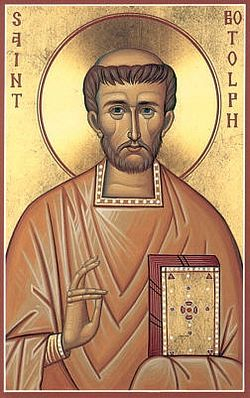
Barbara the Great Martyr, John the Righteous of Damascus, New Hieromartyr Seraphim, Bishop of the Phanar in Greece, Juliana the Martyr of Heliopolis, Alexander Hotovitzky, New Hieromartyr of Russia, Missionary to America

ST. PAUL’S LETTER TO THE GALATIANS 3:23-29; 4:1-5

Brethren, before faith came, we were confined under the law, kept under restraint until faith should be revealed. So that the law was our custodian until Christ came, that we might be justified by faith. But now that faith has come, we are no longer under a custodian; for in Christ Jesus you are all sons of God, through faith. For as many of you as were baptized into Christ have put on Christ. There is neither Jew nor Greek, there is neither slave nor free, there is neither male nor female; for you are all one in Christ Jesus. And if you are Christ’s, then you are Abraham’s offspring, heirs according to promise. I mean that the heir, as long as he is a child, is no better than a slave, though he is the owner of all the estate; but he is under guardians and trustees until the date set by the father. So with us; when we were children, we were slaves to the elemental spirits of the universe. But when the time had fully come, God sent forth his Son, born of a woman, born under the law, to redeem those who were under the law, so that we might receive adoption as sons.

MARK 5:24-34

At that time, a great crowd followed Jesus and thronged about him. And there was a woman who had had a flow of blood for twelve years, and who had suffered much under many physicians, and had spent all that she had, and was no better but rather grew worse. She had heard the reports about Jesus, and came up behind him in the crowd and touched his garment. For she said, “If I touch even his garments, I shall be made well.” And immediately the hemorrhage ceased; and she felt in her body that she was healed of her disease. And Jesus, perceiving in himself that power had gone forth from him, immediately turned about in the crowd, and said, “Who touched my garments?” And his disciples said to him, “You see the crowd pressing around you, and yet you say, ‘Who touched me?'” And he looked around to see who had done it. But the woman, knowing what had been done to her, came in fear and trembling and fell down before him, and told him the whole truth. And he said to her, “Daughter, your faith has made you well; go in peace, and be healed of your disease.”

Glorification of the Priestmartyr Alexander Hotovitzky
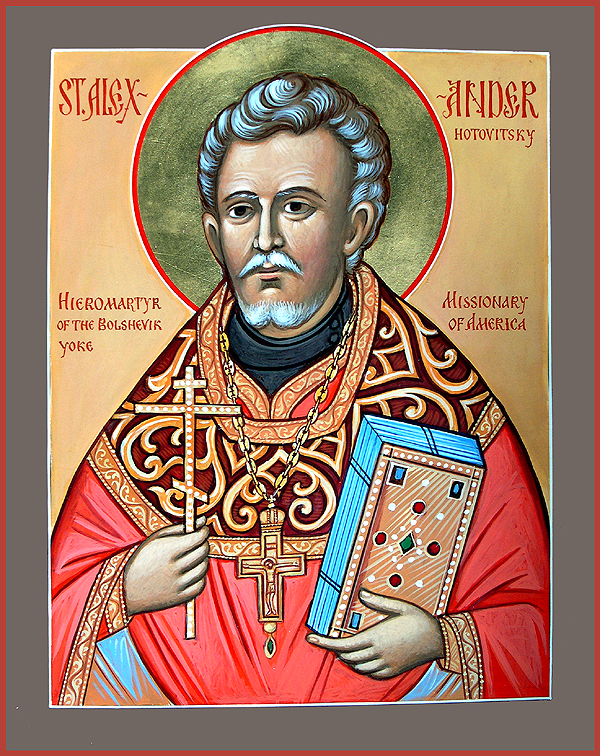
The New Martyr of Russia Alexander Hotovitzky was born on February 11, 1872 in the city of Kremenetz, into the pious family of Archpriest Alexander, who was Rector of the Volhynia Theological Seminary and would later be long remembered in the hearts of the Orthodox inhabitants of Volhynia as a good shepherd. Young Alexander received a good Christian upbringing from his parents, who instilled in him love for the Orthodox Church and for the people of God.

The future pastor was educated at the Volhynia Seminary and the Saint Petersburg Theological Academy, from which he graduated with a Master’s degree in 1895.

After graduation from the Academy, he was sent for missionary service to the Diocese of the Aleutians and North America, where he was assigned to the position of reader at the newly-established Saint Nicholas Orthodox Church in New York City. Following his marriage to Maria Scherbuhina, a graduate of the Pavlovsk Institute in Saint Petersburg, the Hieromartyr Alexander was ordained to the diaconate, and soon after, on February 25, 1896, to the priesthood by Bishop Nicholas (Ziorov) of the Aleutians, whom Father Alexander would always later remember with gratitude and love.

The ordination took place at the diocesan cathedral in San Francisco. In his address to the newly-ordained Father Alexander, Bishop Nicholas explained his selection of the new priest for ordained ministry in these words:

“Your special sense of decency, your good upbringing, your noble idealism, and your sincere piety immediately caused me to look favorably upon you and compelled me to single you out among the young people, with whom you used to visit me in Saint Petersburg…I could see that you had that special spark from God, which makes any service an action truly done for God’s sake, and without which a vocation becomes soul-less and dead work…Your first experience in preaching has shown you the power of this kind of inspiration: you saw how the people gathered around you and how attentively they stood and listened at length to your discourses… Why did these people listen to you rather than going to hear other preachers? Clearly the spark which burns within you attracts the hearts of these people like a magnet.”

A week after his ordination, the young priest returned to New York to assume the pastorate of the parish where he had previously served as reader. From 1898 to 1907, the New Martyr Alexander served as a pastor under the omophorion of Bishop Tikhon. Saint Tikhon, who, in the tragic year of 1917, was to be elevated by Divine Providence to the primatial see as Patriarch of Moscow, valued highly Father Alexander’s sincere piety, his gift of pastoral love, and his multifaceted theological erudition. The spectrum of his activity in the United States was quite broad and very fruitful. He was successful in missionary service, primarily among Uniates newly-emigrated from Galicia and Carpathian Rus. He was also one of the closest collaborators of the Orthodox archpastors in America and represented the Orthodox Church before American religious institutions and meetings.

Father Alexander’s missionary work was not without many temptations and sorrows. Archbishop, later Metropolitan, Platon (Rozhdestvensky) expressed gratitude for the Passion-bearer Alexander’s labors in America in an address delivered at the Divine Liturgy on February 26, 1914. Bidding farewell to Father Alexander, the Archbishop said, “One morning, during the years we worked together, you came to my room and, without saying much, unbuttoned your shirt, revealing a very large, bluish, bloody abrasion on your chest. That wound from a fanatic, who in a fit of rage attacked you wildly with a stick, followed the meeting of Russian people at which you had encouraged your own ethnic brother to renounce the pernicious Unia with Rome… My entire being was shaken to the core and I was profoundly moved, for before me at that moment was a genuine example of witness for Christ.”

Through Father Alexander’s efforts, Orthodox parishes were established in Philadelphia, Yonkers, and Passaic as well as other large and small towns throughout North America. The parishioners of these churches were cradle Orthodox whom fate had brought to the New World, as well as Carpatho-Russians converted from the Unia and former Protestant converts to the Orthodox Church.

An important contribution to the witness of the truth of Orthodoxy before heterodox American society was made by the American Orthodox Messenger, which was published in English and Russian under Father Alexander’s editorship. Articles by the editor regularly appeared in this journal.

The New Martyr Alexander actively participated in the establishment of an Orthodox diocesan mutual aid society and at various times, he served as treasurer, first secretary, and president of this organization. The society provided material aid to Austrian Carpatho-Russians, Macedonian Slavs, Russian troops in Manchuria, and to Russian prisoners of war in Japanese camps.

Father Alexander also took upon himself the ascetical burden of constructing the architecturally remarkable and majestic Saint Nicholas Cathedral in New York to replace the small parish church. The cathedral was to become an adornment of the city. He visited Orthodox communities throughout America soliciting funds for the construction of the Cathedral. In 1901, he also traveled to his homeland, Russia, for this purpose. In the annals of Saint Nicholas Church, which in 1903 became the diocesan Cathedral, it is recorded that, “This Cathedral was established and constructed in the City of New York in North America, under the supervision and through the efforts and labors of the most honorable Archpriest Father Alexander Hotovitzky in the year of Our Lord 1902.”

On February 26, 1906, Orthodox America celebrated the tenth anniversary of priestly service of Archpriest Alexander, one of its most remarkable pastors. Bishop Tikhon greeted the jubilarian with these words:

“As you remember your ordination as a priest of God at this anniversary, you are doubtless unwillingly contemplating how you have used your God-given talents, and asking yourself if the Grace of God was bestowed on you in vain and how far you have advanced on the path of moral perfection. As you judge yourself in this way, you are at the same time the judge and the accused. In order for a judgment to be fair, the testimony of onlookers, the witnesses, must be heard. Now they are speaking before you—listen to them. Thanks be to the Lord! We just heard their eloquent and heartfelt testimony praising you. For myself as your superior, I can testify that you have proven to be trustworthy, and have justified the expectations which were hoped for at your ordination.”

The sacrificial and dedicated pastoral service of the New Martyr Alexander in America was concluded on February 26, 1914, exactly eighteen years after his ordination to the priesthood. In his farewell address, Father Alexander said, “Farewell, American Orthodox Rus—my dear Mother, the Holy American Church. I, your ever-grateful son, bow fully to the ground before you. You gave birth to me spiritually, you nurtured me, from your depths you inspired me by your strength. Through the shining witness of your founders, through the enlightened apostolic teachings of your preachers, through the fervor of your faithful flock, you have given me the greatest possible joy—to be your son.”

From 1914 to 1917, Father Alexander served as a priest in Helsinki, Finland, where the majority of the population was Protestant. Although Finland was then part of the Russian Empire, the Orthodox clergy there had to exert great efforts to protect the Orthodox Karelians from the proselytic expansionism of the Finnish Lutherans. In Finland, the New Martyr Alexander was a loyal, active, and dedicated assistant to his archpastor—Sergius (Stragorodsky), the future Patriarch.

In August 1917, Archpriest Alexander was transferred to Moscow and assigned as assistant pastor of Christ the Savior Cathedral. Here he was again under the direct guidance of Saint Tikhon, with whom he had already been closely associated in America.

The Passion-bearer Alexander participated in the deliberations of the Church Council of 1917-18. When the Council discussed the drafting of a message to the Orthodox flock concerning elections to the State Council, he stated that, as the fate of Russia was at stake, the Church and the Council in particular should not shy away from the struggle to save the nation. Speaking about the efforts of the Council to upbuild the Church, he outlined his preliminary plans for order and healing in the internal life of the Church and stated with some bitterness, “It seems as if there were builders who were furiously preparing blueprints, plans and so forth for the construction of an edifice and at the same time were calmly observing the destruction brick by brick of this edifice by enemies.”

During the difficult years of the Civil War, the New Martyr Alexander collaborated closely with Saint Tikhon in the administration of the Moscow diocese. In 1918, under the spiritual leadership of the rector, Father Nicholas Arseniev, and the assistant pastor, Father Alexander, a brotherhood affiliated with Christ the Savior Cathedral was established. As its first activity, the brotherhood issued an appeal to the Orthodox flock, which Father Alexander helped write.

This document stated, “People of Russia! Christ the Savior Cathedral, the adornment of Moscow, the pride of Russia, the joy of the Orthodox Church has been condemned to slow destruction. This glorious monument to the great exploits of Russian warriors, who gave their lives for their native land and the Holy Orthodox Faith, has been denied state support…People of Russia! Will you really surrender this wonderful church of the Savior to mockery? Is it really true, as is claimed by the persecutors of the Holy Church, that the people of Russia no longer need holy things—Churches, sacraments, services, because all this is outdated and superstitious? Respond, you faithful! All of you, respond as one! Rise up and protect your holy things! May the generous and well-intentioned donations of the rich be added to the precious pennies of the faithful poor. Moscow, you are the heart of Russia! Preserve your holy shrine—your golden-domed Church of the Savior!…”

In response to this appeal, Orthodox inhabitants of Moscow joined the brotherhood of Christ the Savior Cathedral, and gave their alms to support the majestic church.

Pastoral service at that time was accompanied by much grief and danger. In May 1920 and November 1921 Father Alexander was arrested for brief periods. He was accused of violating the decrees concerning the separation of the Church from the state, and the school from the Church, by holding church school for the children.

In 1922, the Church was subjected to harsh tribulations when, under the pretext of helping the starving, ecclesiastical treasures including sacred vessels, icons, and other holy things were violently confiscated by the state. Heeding the appeal of Her holy primate, the Orthodox Church made generous donations to assist the starving. However, when Saint Tikhon issued a statement to his flock throughout Russia forbidding the cooperation of the clergy in surrendering sacred vessels for non-ecclesiastical use based on canon law, a slanderous campaign against the Church was begun in the press, Her primate was arrested, and a wave of court cases took place throughout Russia, in which servants of the Lord’s altar were accused of counter-revolutionary activity. During these trials many faithful servants of the Church of Christ were sentenced to death and shed their blood as hieromartyrs and martyrs.

During this difficult time for the Church, Father Alexander was unwaveringly guided by the statements of the Holy Patriarch to his flock and also followed his directives. Funds to assist the starving were collected at Christ the Savior Cathedral. At the same time, measures were undertaken to protect the sacred objects of this church. Meetings of the clergy and parishioners of Christ the Savior Cathedral were held at Father Alexander’s apartment in order to draft a resolution of the general parish meeting concerning the state decree.

A draft of the resolution, prepared by Father Alexander, protested against the violent confiscation of church valuables. A general meeting of parishioners was convened on March 23, 1922 at Christ the Savior Cathedral, presided by Archpriest Nicholas Arseniev. Father Alexander had already been arrested. This meeting adopted the final text of the resolution, which demanded guarantees from the state that all donations be used to save the lives of the starving. The participants in the meeting protest the poisonous publications against the Church as well as insults against the hierarchy. The drafting of this document was deemed by the authorities to be criminal counter-revolutionary activity.

After two court cases against the Church, in Petrograd and Moscow, which resulted in the executions of hieromartyrs and martyrs, a new highly visible trial of clergy and laity began in Moscow on November 27, 1922, during which they were accused of supposedly “attempting to retain in their hands possession of church valuables and, through the resulting starvation, to topple the Soviet regime.”

On trial in this case were 105 clergy and laity. Among the main defendants were Archpriest Sergius Uspensky, dean of the second district of forty churches in Prechistenka, Archpriest Nicholas Arseniev, dean of Christ the Savior Cathedral, Archpriest Alexander Hotovitzky, assistant pastor of this Cathedral, Ilya Gromoglasov, priest of Christ the Savior Cathedral, Lev Evgenievich Anohin, warden of this Cathedral, and Archpriest Simeon Golubev, rector of Saint John the Warrior Church.

The most significant part of the indictment submitted to the Court concerned the activity of the clergy and laity of Christ the Savior Cathedral. The indictment stated, “The main organizers and leaders of this criminal activity were Priest Hotovitzky, chairman of the council of parishes in this area, Priest Arseniev, rector of the Cathedral, Priest Zotikov, Priest Gromoglasov, former lawyer Kayutov, former deputy minister Shchepkin, the merchant Golovkin, and engineer Anohin. When the decree of the Supreme Central Executive Committee concerning the confiscation of church valuables was issued, they began their preliminary activities under the leadership of the priest Hotovitzky, who repeated to secretly gather the above named people at his apartment in order to plan with them the measures which they proposed to enact to achieve their criminal intentions.”

The case was in court for two weeks. After the detailed indictment was read, questioning of the defendants began. Father Alexander remained cool and calm during the questioning as he tried to protect the other defendants. He did not admit any guilt, stating, “I consider that it is not counter-revolutionary to ask for a corresponding amount of metal in return for church valuables.”

Following the interrogation of all the defendants and witnesses, at the Court session on December 6, the later infamous, sinister prosecutor Vishinsky delivered the concluding statement for the prosecution. He asked the court for a sentence of capital punishment for thirteen defendants including Archpriests Alexander Hotovitzky, Nicholas Arseniev, Sergius Uspensky, Priest Ilya Gromoglasov, Abbess Vera (Pobedinskaya) of the Novodevichii Women’s Monastery and L.E. Anohin. Vishinsky requested that the other defendants be sentenced to prison terms of varying length.

On December 11, defendants were given an opportunity to say a final word to the court. In his comments, Father Alexander attempted, first of all, to obtain the court’s leniency and mercy for his brother clergy, “I direct your attention to those who were at the meeting in my apartment: some of them are old and the others are very young and guilty of nothing. This was a completely ordinary meeting, it was not counter-revolutionary and it cannot by any means be characterized as a shady plot.”

The lengthiest final comments were delivered by the professor and priest Ilya Gromoglasov. This defendant attempted to gain the favor of the court by expounding on his former opposition to the Holy Synod. Concerning the conclusions of the prosecution, he said that he “knew nothing of the criminal organization headed by Hotovitzky.”

On December 13, the verdict of the revolutionary tribunal was announced. It was milder than the bloodthirsty verdicts delivered at previous trials held in Petrograd and Moscow in conjunction with the confiscation of church valuables. Each of the main defendants—Abbess Vera (Pobedinskaya), Archpriest Sergius Uspensky, and Archpriest Alexander Hotovitzky were sentenced to ten years in prison, the confiscation of their personal property and the deprivation of their civil rights for five years. The others were sentenced to lesser terms of imprisonment. Appeals for pardon, made by those who were sentenced to the longest terms of imprisonment, including that of Archpriest Alexander, were rejected by the presidium of the Supreme Central Executive Committee on February 16, 1923.

After the holy Patriarch Tikhon resumed his administration of the Church and made several statements regarding loyalty to the governmental authorities, many hierarchs, clergy, church leaders and laity, who had previously received sentences from the judiciary in conjunction with the confiscation of church valuables, were granted amnesty. Father Alexander was among those freed in October 1923. Following his liberation, he was not assigned to a parish but served by invitation at various churches in Moscow.

He remained free for only a short time. Already on September 4, 1924, E. Tuchkov, head of the 6th section of the Department of State Political Management, compiled a list of thirteen clergy and church leaders of Moscow and recommended that they be subjected to administrative exile. The New Martyr Alexander, who was included in the list, was characterized as follows in this document, “A priest and preacher with a post-graduate education, very active, zealous and influential among the Tikhonites. His outlook is anti-Soviet.”

On September 9, 1924, the New Martyr Alexander was subjected to an interrogation. “In my religious convictions,” he said at that time, “I consider myself to be a Tikhonite. My relations with the Patriarch are intimate rather than just strictly administrative, but lately, I have avoided meeting with Patriarch Tikhon, as I felt that this might inconvenience him due to my conviction in conjunction with the confiscation of church valuables. I have never expressed an opinion concerning the restoration of the former government and such a thought has not even crossed my mind.”

By a decision of a special meeting of the administration of the Department of State Political Management, the New Martyr Alexander was exiled to the Turuhan region for a period of three years. His already failing health was further weakened by his sojourn in the far north.

Following his return from exile, Father Alexander was raised to the rank of protopresbyter and became one of the closest assistants of the Deputy Locum Tenens of the Patriarchal Throne, Metropolitan (later Patriarch) Sergius, who knew him well since the time of his service in Finland.

In the 1930s, Protopresbyter Alexander served as rector of the Church of the Deposition of the Robe on Donskoy Street. One of the parishioners of this church recalls, “In 1936, Father Alexander did not preach, as he was apparently forbidden to do so. In 1936-7, I was present many times when Father Alexander served. He was a tall, gray-haired priest with gentle facial features, who looked extremely intelligent. Gray, trimmed hair, a small beard, very kind gray eyes, a high-pitched, loud tenor…pronounced exclamations distinctly and with inspiration…His appearance reminded me of many priests who were exiles from the western regions…Father Alexander had many parishioners who greatly revered him…Even today, I remember Father Alexander’s eyes. It seemed as if his glance penetrated your heart and embraced it with affection. I had the same feeling when I saw the holy Patriarch Tikhon…The same light also shining in Father Alexander’s eyes was testimony of his sanctity.”

In the fall of 1937, the New Martyr Alexander was arrested again. The documentary evidence about him at our disposal ends with this; however, a majority of oral reports testify to his death as a martyr. The Orthodox Church in America, on whose territory Protopresbyter Alexander served as a priest until 1914, venerates him as a passion-bearer, whose life as a confessor ended with sufferings for Christ. The place of his burial is unknown.

The Church of Russia also commemorates Saint Alexander on August 7, along with the Archpriests Alexei Vorobiev, Michael Plishevsky, John Voronets, the priests Demetrius Milovidov, and Peter Tokarev, the deacon Elisha Sholder, and Igumen Athanasius Egorov.

A photo gallery of the 1994 Glorification of Saint Alexander may be viewed here.

Greatmartyr Barbara and Martyr Juliana, at Heliopolis in Syria

The Holy Great Martyr Barbara lived and suffered during the reign of the emperor Maximian (305-311). Her father, the pagan Dioscorus, was a rich and illustrious man in the Syrian city of Heliopolis. After the death of his wife, he devoted himself to his only daughter.

Seeing Barbara’s extraordinary beauty, Dioscorus decided to hide her from the eyes of strangers. Therefore, he built a tower for Barbara, where only her pagan teachers were allowed to see her. From the tower there was a view of hills stretching into the distance. By day she was able to gaze upon the wooded hills, the swiftly flowing rivers, and the meadows covered with a mottled blanket of flowers; by night the harmonious and majestic vault of the heavens twinkled and provided a spectacle of inexpressible beauty. Soon the virgin began to ask herself questions about the First Cause and Creator of so harmonious and splendid a world.

Gradually, she became convinced that the souless idols were merely the work of human hands. Although her father and teachers offered them worship, she realized that the idols could not have made the surrounding world. The desire to know the true God so consumed her soul that Barbara decided to devote all her life to this goal, and to spend her life in virginity.

The fame of her beauty spread throughout the city, and many sought her hand in marriage. But despite the entreaties of her father, she refused all of them. Barbara warned her father that his persistence might end tragically and separate them forever. Dioscorus decided that the temperament of his daughter had been affected by her life of seclusion. He therefore permitted her to leave the tower and gave her full freedom in her choice of friends and acquaintances. Thus Barbara met young Christian maidens in the city, and they taught her about the Creator of the world, about the Trinity, and about the Divine Logos. Through the Providence of God, a priest arrived in Heliopolis from Alexandria disguised as a merchant. After instructing her in the mysteries of the Christian Faith, he baptized Barbara, then returned to his own country.

During this time a luxurious bathhouse was being built at the house of Dioscorus. By his orders the workers prepared to put two windows on the south side. But Barbara, taking advantage of her father’s absence, asked them to make a third window, thereby forming a Trinity of light. On one of the walls of the bath-house Barbara traced a cross with her finger. The cross was deeply etched into the marble, as if by an iron instrument. Later, her footprints were imprinted on the stone steps of the bathhouse. The water of the bathhouse had great healing power. Saint Simeon Metaphrastes (November 9) compared the bathhouse to the stream of Jordan and the Pool of Siloam, because by God’s power, many miracles took place there.

When Dioscorus returned and expressed dissatisfaction about the change in his building plans, his daughter told him about how she had come to know the Triune God, about the saving power of the Son of God, and about the futility of worshipping idols. Dioscorus went into a rage, grabbed a sword and was on the point of striking her with it. The holy virgin fled from her father, and he rushed after her in pursuit. His way became blocked by a hill, which opened up and concealed the saint in a crevice. On the other side of the crevice was an entrance leading upwards. Saint Barbara managed then to conceal herself in a cave on the opposite slope of the hill.

After a long and fruitless search for his daughter, Dioscorus saw two shepherds on the hill. One of them showed him the cave where the saint had hidden. Dioscorus beat his daughter terribly, and then placed her under guard and tried to wear her down with hunger. Finally he handed her over to the prefect of the city, named Martianus. They beat Saint Barbara fiercely: they struck her with rawhide, and rubbed her wounds with a hair cloth to increase her pain. By night Saint Barbara prayed fervently to her Heavenly Bridegroom, and the Savior Himself appeared and healed her wounds. Then they subjected the saint to new, and even more frightful torments.

In the crowd where the martyr was tortured was the virtuous Christian woman Juliana, an inhabitant of Heliopolis. Her heart was filled with sympathy for the voluntary martyrdom of the beautiful and illustrious maiden. Juliana also wanted to suffer for Christ. She began to denounce the torturers in a loud voice, and they seized her.

Both martyrs were tortured for a long time. Their bodies were raked and wounded with hooks, and then they were led naked through the city amidst derision and jeers. Through the prayers of Saint Barbara the Lord sent an angel who covered the nakedness of the holy martyrs with a splendid robe. Then the steadfast confessors of Christ, Saints Barbara and Juliana, were beheaded. Dioscorus himself executed Saint Barbara. The wrath of God was not slow to punish both torturers, Martianus and Dioscorus. They were killed after being struck by lightning.

In the sixth century the relics of the holy Great Martyr Barbara were transferred to Constantinople. Six hundred years later, they were transferred to Kiev (July 11) by Barbara, the daughter of the Byzantine Emperor Alexius Comnenos, Barbara, wife of the Russian prince Michael Izyaslavich. They rest even now at Kiev’s Saint Vladimir cathedral, where an Akathist to the saint is served each Tuesday.

Many pious Orthodox Christians are in the habit of chanting the Troparion of Saint Barbara each day, recalling the Savior’s promise to her that those who remembered her and her sufferings would be preserved from a sudden, unexpected death, and would not depart this life without benefit of the Holy Mysteries of Christ.

Martyr John of Damascus

Saint John of Damascus was born about the year 680 at Damascus, Syria into a Christian family. His father, Sergius Mansur, was a treasurer at the court of the Caliph. John had also a foster brother, the orphaned child Cosmas (October 14), whom Sergius had taken into his own home. When the children were growing up, Sergius saw that they received a good education. At the Damascus slave market he ransomed the learned monk Cosmas of Calabria from captivity and entrusted to him the teaching of his children. The boys displayed uncommon ability and readily mastered their courses of the secular and spiritual sciences. After the death of his father, John occupied ministerial posts at court and became the city prefect.

In Constantinople at that time, the heresy of Iconoclasm had arisen and quickly spread, supported by the emperor Leo III the Isaurian (717-741). Rising up in defense of the Orthodox veneration of icons [Iconodoulia], Saint John wrote three treatises entitled, “Against Those who Revile the Holy Icons.” The wise and God-inspired writings of Saint John enraged the emperor. But since the author was not a Byzantine subject, the emperor was unable to lock him up in prison, or to execute him. The emperor then resorted to slander. A forged letter to the emperor was produced, supposedly from John, in which the Damascus official was supposed to have offered his help to Leo in conquering the Syrian capital.

This letter and another hypocritically flattering note were sent to the Saracen Caliph by Leo the Isaurian. The Caliph immediately ordered that Saint John be removed from his post, that his right hand be cut off, and that he be led through the city in chains.

That same evening, they returned the severed hand to Saint John. The saint pressed it to his wrist and prayed to the Most Holy Theotokos to heal him so that he could defend the Orthodox Faith and write once again in praise of the Most Pure Virgin and Her Son. After a time, he fell asleep before the icon of the Mother of God. He heard Her voice telling him that he had been healed, and commanding him to toil unceasingly with his restored hand. Upon awakening, he found that his hand had been attached to his arm once more. Only a small red mark around his wrist remained as a sign of the miracle.

Later, in thanksgiving for being healed, Saint John had a silver model of his hand attached to the icon, which became known as “Of the Three Hands.” Some unlearned painters have given the Mother of God three hands instead of depicting the silver model of Saint John’s hand. The Icon “Of the Three Hands” is commemorated on June 28 and July 12.

When he learned of the miracle, which demonstrated John’s innocence, the Caliph asked his forgiveness and wanted to restore him to his former office, but the saint refused. He gave away his riches to the poor, and went to Jerusalem with his stepbrother and fellow-student, Cosmas. There he entered the monastery of Saint Savva the Sanctified as a simple novice.

It was not easy for him to find a spiritual guide, because all the monks were daunted by his great learning and by his former rank. Only one very experienced Elder, who had the skill to foster the spirit of obedience and humility in a student, would consent to do this. The Elder forbade John to do anything at all according to his own will. He also instructed him to offer to God all his labors and supplications as a perfect sacrifice, and to shed tears which would wash away the sins of his former life.

Once, he sent the novice to Damascus to sell baskets made at the monastery, and commanded him to sell them at a certain inflated price, far above their actual value. He undertook the long journey under the searing sun, dressed in rags. No one in the city recognized the former official of Damascus, for his appearance had been changed by prolonged fasting and ascetic labors. However, Saint John was recognized by his former house steward, who bought all the baskets at the asking price, showing compassion on him for his apparent poverty.

One of the monks happened to die, and his brother begged Saint John to compose something consoling for the burial service. Saint John refused for a long time, but out of pity he yielded to the petition of the grief-stricken monk, and wrote his renowned funeral troparia (“What earthly delight,” “All human vanity,” and others). For this disobedience the Elder banished him from his cell. John fell at his feet and asked to be forgiven, but the Elder remained unyielding. All the monks began to plead for him to allow John to return, but he refused. Then one of the monks asked the Elder to impose a penance on John, and to forgive him if he fulfilled it. The Elder said, “If John wishes to be forgiven, let him wash out all the chamber pots in the lavra, and clean the monastery latrines with his bare hands.”

John rejoiced and eagerly ran to accomplish his shameful task. After a certain while, the Elder was commanded in a vision by the All-Pure and Most Holy Theotokos to allow Saint John to write again. When the Patriarch of Jerusalem heard of Saint John, he ordained him priest and made him a preacher at his cathedral. But Saint John soon returned to the Lavra of Saint Savva, where he spent the rest of his life writing spiritual books and church hymns. He left the monastery only to denounce the iconoclasts at the Constantinople Council of 754. They subjected him to imprisonment and torture, but he endured everything, and through the mercy of God he remained alive. He died in about the year 780, more than 100 years old.

Saint John of Damascus was a theologian and a zealous defender of Orthodoxy. His most important book is the Fount of Knowledge. The third section of this work, “On the Orthodox Faith,” is a summary of Orthodox doctrine and a refutation of heresy. Since he was known as a hymnographer, we pray to Saint John for help in the study of church singing.

Saint John, Bishop of Polybotum

Saint John, Bishop of Polybotum (in Phrygia), was known as a denouncer of the heresy and impiety of Emperor Leo the Isaurian. Saint John opposed Leo for his iconoclasm, and taught his flock the Orthodox doctrine of the veneration of icons.

The saint died at the beginning of the eighth century. The Lord granted him the gift of healing the infirm and casting out evil spirits.

Saint Gennadius, Archbishop of Novgorod

Saint Gennadius, Archbishop of Novgorod, was descended from the Gonzov family and was, in the testimony of contemporaries, “dignified, intelligent, virtuous and learned in the Holy Scripture.” He was made a monk at the Valaam monastery, under the spiritual guidance of Saint Sabbatius of Solovki (September 27). From the year 1472, he was Archimandrite of the Chudov (Miracle of the Archangel Michael) monastery in Moscow. Zealous for celebrating divine services according to the Typikon, he and Bassian, Archbishop of Rostov, and later his successor Joasaph, fearlessly rose up in defense of the ancient Rule during a dispute at the consecration of the Dormition cathedral in Moscow during the years 1479-1481.

In 1483 Saint Gennadius began construction of a stone church at the Chudov monastery in honor of Saint Alexis, Metropolitan of Moscow (February 12), the founder of the monastery. On December 12, 1484 Saint Gennadius was consecrated as Archbishop of Novgorod. Already in Novgorod, but still honoring the memory of Saint Alexis, Gennadius did not cease to concern himself with the construction of the church, even contributing silver for the completion of this temple.

The time of holy Archbishop Gennadius as hierarch at Novgorod coincided with a terrible period in the history of the Russian Church. In 1470, Judaizing preachers, who traveled to Novgorod in the guise of merchants, had already begun to plant the weeds of heresy and apostasy among the Orthodox.

The first reports about the heresy reached Saint Gennadius in the year 1487. Four members of a secret society, in a state of intoxication, opened up and told the Orthodox of the existence of the impious heresy. As soon as it became known to him, the zealous archpastor immediately began an inquiry and with deep sorrow became convinced that the danger was a threat not only to local Novgorod piety, but also in Moscow, the very capital of Orthodoxy, where the leaders of the Judaizers had journeyed in 1480.

In September 1487 he sent to Metropolitan Gerontius at Moscow all the material from the inquiry, together with a list of the apostates he had discovered, as well as their writings. The struggle with the Judaizers became the main focus of Saint Gennadius’ archpastoral activity. In the words of Saint Joseph of Volokolamsk (September 9), “this archbishop, angered by the malevolent heretics, pounced upon them like a lion from out of the thicket of the Holy Scriptures and the splendid heights of the prophets and the apostolic teachings.”

For twelve years Saint Gennadius and Saint Joseph struggled against the most powerful attempts of the opponents of Orthodoxy to alter the course of history of the Russian Church and the Russian state. By their efforts the Orthodox were victorious. The works of Gennadius in the study of the Bible contributed to this victory. The heretics in their impious cleverness used texts from the Old Testament, but which were different from the texts accepted by the Orthodox. Archbishop Gennadius undertook an enormous task: bringing the correct listings of Holy Scripture together in a single codex. Up until this time Biblical books had been copied in Russia, following the example of Byzantium, not in their entirety, but in separate parts—the Pentateuch (first five books) or Octateuch (first eight books), Kings, Proverbs, the Psalter, the Prophets, the Gospels, the Epistles, and other instructive books.

The holy books of the Old Testament in particular often were subjected to both accidental and intentional errors. Saint Gennadius wrote about this with sorrow in a letter to Archbishop Joasaph: “The Judaizing heretical tradition adheres to the Psalms of David, or prophecies which they have altered.” Gathering around himself learned and industrious Biblical scholars, the saint collected all the books of the Holy Scripture into a single codex, and he gave his blessing for the Holy Books which were not found in manuscripts of the traditional Slavonic Bible to be retranslated from the Latin language. In 1499 the first complete codex of Holy Scripture in Slavonic (“the Gennadius Bible,” as they called it after its compiler) was published in Russia. This work became an integral link in the succession of Slavonic translations of the Word of God. From the God-inspired translation of the Holy Scripture by Saints Cyril and Methodius, through the Bible of Saint Gennadius (1499), reproduced in the first printed Bible (Ostrozh, 1581), the Church has maintained a Slavonic Biblical tradition right through the so-called Elizabethan Bible (1751) and all successive printed editions.

Together with the preparation of the Bible, the circle of church scholars under Archbishop Gennadius also undertook a great literary task: the compilation of the “Fourth Novgorod Chronicle.” Numerous hand-written books were translated, corrected and transcribed, bringing the Chronicle up to the year 1496.

Dositheus, the igumen of the Solovki monastery who was at Novgorod on monastery matters, worked for several years with Saint Gennadius compiling a library for the Solovki monastery. It was at the request of Saint Gennadius that Dositheus wrote the Lives of Saints Zosimas (April 17) and Sabbatius (September 27).

The majority of the books transcribed with the blessing of the Novgorod hierarch (more than 20), were preserved in the collection of Solovki manuscripts. Ever a zealous advocate for spiritual enlightenment, Saint Gennadius founded a school for the preparation of worthy clergy at Novgorod.

The memory of Saint Gennadius is preserved also in his work for the welfare of the Orthodox Church.

At the end of the fifteenth century many Russians were concerned about the impending end of the world, which they believed would take place at the end of the seventh millenium from the creation of the world (in 1492 A.D.). Therefore, in 1408, it was decided not to compute the Paschal dates beyond the year 1491. In September 1491, however, the Archbishops’ Council of the Russian Church at Moscow, with the participation of Saint Gennadius, decreed that the Paschalion for the eighth millenium be calculated.

Metropolitan Zosimas at Moscow on November 27, 1492 “set forth a cathedral Paschalion for twenty years,” and asked Bishop Philotheus of Perm and Archbishop Gennadius of Novgorod each to compile their own Paschalion for conciliar review and confirmation on December 21, 1492. Saint Gennadius finished calculating his Paschalion, which in contrast to that of the Metropolitan, extended for seventy years. It was distributed to the dioceses, with the approval of the Council, as the accepted Paschalion for the next twenty years. Included with the Paschalion was Saint Gennadius’s own commentary upon it in an encyclical entitled, “Source for the Paschalion Transposed to the Eight Thousandth Year.”

In his theological explanation of the Paschalion, based upon the Word of God and the holy Fathers, the saint wrote: “It is proper not to fear the end of the world, but rather to await the coming of Christ at every moment. For just as God might deign to end the world, so also might He deign to prolong the course of time.”

No one knows when the world created by God will end, “not even the angels of heaven, nor the Son, but only the Father “(Mt. 24:36). Therefore, the holy Fathers, inspired by the Holy Spirit, explained the cycle of years from the creation of the world precisely as a cycle. “This occurs in a circular motion, not having an end.” The saint contrasts the heretical methods of calculating the times with the way hallowed by the Church, a constant spiritual sobriety. Saint Gennadius expounded on the theological fundamentals of the Paschalion. He explained that on the basis of the cycle of years from the world’s creation, it is possible to determine a Paschalion for the future, as may be required. The Paschalion of Saint Gennadius, by his own testimony, was not something new that he created, but rather was based on a former tradition; in part, on the basis of the Paschalion for 1360-1492 under Saint Basil Kalika, Archbishop of Novgorod (July 3).

In 1539, under Archbishop Macarius of Novgorod, a Paschalion was compiled for the eighth millenium, based on the principles of the Paschalion of Saint Gennadius.

A prayer to the Most Holy Theotokos, which he composed in 1497, also demonstrates his deep spiritual life and prayerful inspiration. In addition to his letters to Metropolitans Zosimas and Simon, to Archbishop Joasaph, to Bishops Niphon and Prochorus, and a letter to the 1490 Council, Archbishop Gennadius also wrote a church “Small Rule” and the “Tradition for Monks,” who live according to the monastic Rule of skete life.

Leaving his archpastoral service in 1504, the saint lived in retirement at the Chudov monastery, where he peacefully fell asleep in the Lord on December 4, 1505. In the Stepen-Ranks book we read: “Archbishop Gennadius served as archbishop for nineteen years, beautifying the churches, improving the behavior of the clergy, and proclaiming the Orthodox Faith among the heretics. Then he lived at Moscow for a year and a half at the Chudov monastery, dedicated to the Miracle of the Archangel Michael and to Saint Alexis the Metropolitan and wonderworker, where he had been Archimandrite, and then he fell asleep in the Lord.”

The holy relics of Saint Gennadius were put into the church of the Miracle of the Archangel Michael at Chonae (September 6), in that place particularly venerated by him, where the relics of Saint Alexis, Metropolitan of Moscow rested. Saint Gennadius is also commemorated on the third Sunday after Pentecost, when the Church remembers all the Saints who shone forth at Novgorod.

Monastic Martyr, Hieromonk Seraphim, Bishop of the Phanar

The Hieromonk Seraphim, Bishop of the Phanar was from the village of Bezoula, Agrapha diocese in Greece. He lived in asceticism at first as a monk at the Monastery of the Most Holy Theotokos at Koronis, and later was chosen as bishop of the Phanar and Neochorion. For his refusal to accept Islam, he was beaten and impaled by the Turks in 1601. His head is at the monastery at Koronis and has been glorified by numerous miracles.

Icon of the Mother of God of Damascus

The Damascene Icon of the Mother of God, by ancient tradition, was painted by Saint John of Damascus in gratitude to the Theotokos for the miraculous healing of his right hand, cut off through the perfidy of Emperor Leo the Isaurian. This icon is also known as “Of the Three Hands” Icon of the Mother of God (June 28, and July 12).

In the ninth century in the time of the Iconoclasts, Saint John of Damascus (December 4) was zealous in his veneration of holy icons. Because of this, he was slandered by the emperor and iconoclast Leo III the Isaurian (717-740), who informed the Damascus caliph that Saint John was committing treasonous acts against him. The caliph gave orders to cut off the hand of the monk and take it to the marketplace. Towards evening Saint John, having asked the caliph for the cut-off hand, put it to its joint and fell to the ground before the icon of the Mother of God. The monk begged Our Lady to heal the hand, which had written in defense of Orthodoxy. After long prayer he fell asleep and saw in a dream that the All-Pure Mother of God had turned to him promising him quick healing.

Before this the Mother of God bid him toil without fail with this hand. Having awakened from sleep, Saint John saw that his hand was unharmed. In thankfulness for this healing Saint John placed on the icon a hand fashioned of silver, from which the icon received its name “Of Three Hands.” (Some iconographers, in their ignorance, have mistakenly depicted the Most Holy Theotokos with three arms and three hands.) According to Tradition, Saint John wrote a hymn of thanksgiving to the Mother of God: “All of creation rejoices in You, O Full of Grace,” which appears in place of the hymn “It is Truly Meet” in the Liturgy of Saint Basil the Great.

Saint John Damascene received monasticism at the monastery of Saint Savva the Sanctified and there bestowed his wonderworking icon. The Lavra presented the icon “Of Three Hands” in blessing to Saint Savva, Archbishop of Serbia (+ 1237, January 12). During an invasion of Serbia by the Turks, some Christians who wanted to protect the icon, entrusted it to the safekeeping of the Mother of God Herself. They placed it upon a donkey, which without a driver proceeded to Athos and stopped in front of the Hilandar monastery. The monks put the icon in the monastery’s cathedral church (katholikon). During a time of discord over the choice of igumen, the Mother of God deigned to head the monastery Herself, and from that time Her holy icon has occupied the igumen’s place in the temple. At the Hilandar monastery there is chosen only a vicar, and from the holy icon the monks take a blessing for every obedience.
Daily Readings for Friday, December 03, 2021

FRIDAY OF THE 11TH WEEK

ABSTAIN FROM MEAT, FISH, DAIRY, EGGS, WINE, OLIVE OIL

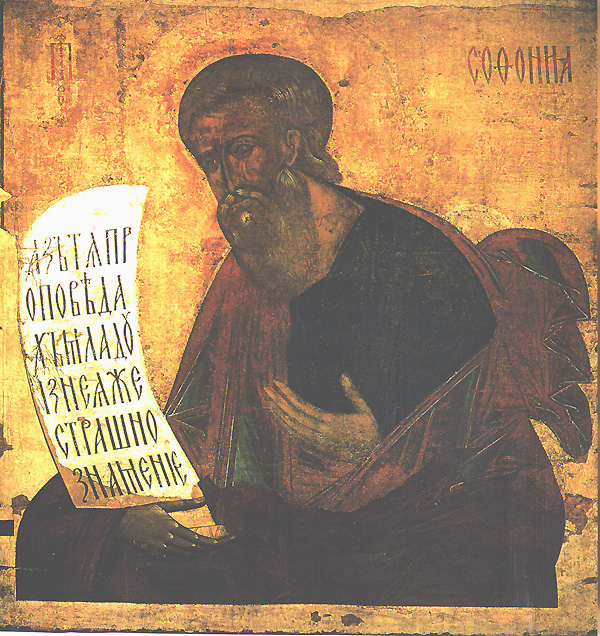
The Holy Prophet Sophonias (Zephaniah), Our Righteous Father John, Bishop and Hesychast, Holy Martyrs Agapius and Seleucius, Theodore, Archbishop of Alexandria, Angelis the New Martyr, Karpos the Hieromartyr

ST. PAUL’S FIRST LETTER TO THE THESSALONIANS 5:9-13; 5:24-28

Brethren, God has not destined us for wrath, but to obtain salvation through our Lord Jesus Christ, who died for us so that whether we wake or sleep we might live with him. Therefore encourage one another and build one another up, just as you are doing. But we beseech you, brethren, to respect those who labor among you and are over you in the Lord and admonish you, and to esteem them very highly in love because of their work. Be at peace among yourselves. He who calls you is faithful, and he will do it. Brethren, pray for us. Greet all the brethren with a holy kiss. I adjure you by the Lord that this letter be read to all the brethren. The grace of our Lord Jesus Christ be with you. Amen.

LUKE 20:19-26

At that time, the scribes and the chief priests tried to lay hands on Jesus at that very hour, but they feared the people; for they perceived that he had told this parable against them. So they watched him, and sent spies, who pretended to be sincere, that they might take hold of what he said, so as to deliver him up to the authority and jurisdiction of the governor. They asked him, “Teacher, we know that you speak and teach rightly, and show no partiality, but truly teach the way of God. Is it lawful for us to give tribute to Caesar, or not?” But he perceived their craftiness, and said to them, “Show me a coin. Whose likeness and inscription has it?” They said, “Caesar’s.” He said to them, “Then render to Caesar the things that are Caesar’s, and to God the things that are God’s.” And they were not able in the presence of the people to catch him by what he said; but marveling at his answer they were silent.

Prophet Zephaniah

The Prophet Zephaniah (Sophonias) was a contemporary of the Prophet Jeremiah and the Prophetess Oldama. He was from the tribe of Simeon, and was the ninth of the Twelve Minor Prophets of the Old Testament. The prophet lived at the royal court, where he preached repentance and helped King Josiah eliminate idol-worship.

He prophesied about the calamities that were to come for the people of Judea and the surrounding regions: Gaza, Ascalon, Crete, and against the Moabites, the Ammonites and the Ninevites.

Venerable Savva, Abbot of Zvenigorod, Disciple of Venerable Sergius of Radonezh

Saint Savva of Zvenigorod forsook the world in his early youth, and received the monastic tonsure from Saint Sergius of Radonezh (September 25 and July 5), and was his disciple and fellow-ascetic.

Saint Savva loved solitude, and avoided conversing with people. He lived in constant toil, lamenting the poverty of his soul, and trembling before the judgment of God. He was a model of simplicity and humility, and he attained such a depth of spiritual wisdom that “in the monastery of Saint Sergius he was the Father Confessor to all the brethren, a venerable and exceedingly learned Elder.”

When Great Prince Demetrios of the Don built the monastery of the Dormition of the Mother of God at the Dubenka River, in gratitude for the victory over Mamai, Savva became the Igoumen, with the blessing of Saint Sergius. Maintaining the simple manner of his life of asceticism, he ate plants, wore coarse clothing and slept on the ground.

After the departure of their Igoumen Saint Nikon (November 17) into the wilderness in 1392, the brethren of the Trinity-Saint Sergius Lavra asked Saint Savva to become the Igoumen of the monastery. Here he “shepherded the flock entrusted to him well, to the best of his ability, helped by the prayers of his Spiritual Father, Saint Sergius.” According to Tradition, the well outside the Lavra walls was built while he was Igoumen.

Prince Yuri of Zvenigorod, a godson of Saint Sergius, regarded Saint Savva with much love and esteem. He chose Saint Savva as his Spiritual Father and begged him to come and bestow his blessing upon his entire household. The Saint had hoped to return to his monastery, but the Prince begged him to stay and establish a new monastery, “in his fatherland, near Zvenigorod, at a place called Storozhi.”

Saint Savva acceded to the request of Prince Yuri, and praying tearfully before an icon of the Mother of God, he entreated her protection for that site in the wilderness. On Storozhi Hill, he built a small wooden church in honor of the Nativity of the Most Holy Theotokos, and nearby a small cell for himself. Here he established a monastery in 1399, with paternal love he accepted all who came seeking a life of quietude and seclusion.

Saint Savva worked very hard to build up the monastery. He dug a well at the foot of the hill, from which he carried water on his own shoulders. He encircled the monastery with a wooden palisade, and in a hollow above it, he dug out a cell where he could live in solitude.

In 1399 Saint Savva blessed his spiritual son, Prince Yuri, to go on a military campaign, predicting that the enemy would be defeated. Through the prayers of the holy Elder, the forces of the Prince won a speedy victory. Through the efforts of Saint Savva, a stone church of the Nativity of the Most Holy Theotokos was built to replace the old wooden one.

Saint Savva went to the Lord at an advanced age on December 3, 1406. He appointed his disciple, who was also named Savva, as his successor.

Veneration of the holy God-pleaser by the local people began immediately after his death. The miraculous curative power issuing from the Saint's grave, and his numerous appearances, convinced everyone that Igoumen Savva was "truly an unsetting sun of divine light, illumining all with its miraculous rays.” In a letter of 1539 Saint Savva was called a wonderworker. Tsar Alexis Mikhailovich had a special veneration for him, repeatedly visiting the monastery of Saint Savva on foot. Tradition has preserved for us a remarkable account of how Saint Savva was saved from a ferocious bear.

The Life of Saint Savva, compiled in the XVI century, relates how at the end of the XV century (1480-1490), the Sain appeared to Father Dionysios, the fourth Igoumen of Saint Savva Monastery and said: “Dionysios! Wake up and paint my icon.” When Father Dionysios asked who he was, he replied, “I am Savva, the founder of this place.”

Now Father Dionysios had not known the Saint personally, so he summoned Elder Habakkuk, who had known Saint Savva in his youth, hoping to convince himself that his dream was not a delusion. He described the Saint's outward appearance, and Father Habakkuk assured him that the Saint looked exactly as the Igoumen had seen him in the dream. Then Father Dionysios obeyed the command and painted an icon of Saint Savva.

The Feast Day of Saint Savvawas established at the Moscow Council of 1547. His incorrupt relics were recovered on January 19, 1652.

Saint Theodoulus, Eparch of Constantinople

Saint Theodoulus was an eparch during the reign of Theodosius the Great. He resigned his position because he did not want to be distracted by vain worldly cares.

After his wife’s death, Saint Theodoulus gave his wealth away to the poor and became a monk. He traveled to Edessa and lived on top of a pillar for thirty years, eating only once a week.

Saint Theodoulus the Stylite departed to the Lord around 440.

Venerable John the Silent of Saint Sabbas Monastery

Saint John the Silent was born around 454 in the city of Nicopolis, Armenia into the family of a military commander named Enkratius and his wife Euphemia. The boy began to study Holy Scripture, and he loved solitude and prayer with all his heart.

With the inheritance his parents left him, John built a church dedicated to the Most Holy Theotokos. At eighteen years of age, John became a monk, living an ascetic life of fasting, prayer, and temperance with ten other monks at the church he had founded.

At the request of the citizens of Colonia, the Metropolitan of Sebaste consecrated the twenty-eight-year-old John as Bishop of Colonia. Having assumed the episcopal throne, the saint did not alter his strict ascetic manner of life. Under the influence of the saint his relatives, his brother Pergamios (an associate of the emperors Zeno and Anastasius) and his nephew Theodore (an associate of the emperor Justinian), also lived in a Christian manner.

In John’s tenth year as bishop, the governorship of Armenia was assumed by Pazinikos, the husband of the saint’s sister, Maria. The new governor began to interfere in spiritual and ecclesiastical matters, and there was unrest in the Church. Saint John then went to Constantinople, and through Archbishop Euthymius, he entreated the emperor Zeno to defend the Armenian Church from the evil Governor.

Overwhelmed by worldly quarrels, John secretly left his diocese and sailed to Jerusalem. With tears he besought God to show him a place where he might live and find salvation. A bright star appeared, which led Saint John to the Lavra of Saint Savva.

John, concealing his episcopal rank, was accepted in the community as a simple novice. Under the guidance of the igumen Saint Savva(December 5), Bishop John toiled obediently for more than four years at every task he was assigned. When a guesthouse was built at the Lavra, Saint John served the workers, serving their food and assisting in the construction of the building. When a cenobitic monastery for novices was being built, John was once again assigned to help the workers.

Seeing Saint John’s humility and love of labor, Saint Savva deemed him worthy of ordination to presbyter. Saint John was forced to reveal his rank to Patriarch Elias of Jerusalem (494-517), who told Saint Savva that John could not be ordained. Moreover, he said that John was to live in silence, and that no one should trouble him. Soon the Lord also revealed Saint John’s secret to Saint Savva. Saint John spent four years in his cell, receiving no one and not going out even for church.

Desiring ever greater solitude and increased abstinence, Saint John quit the Lavra and withdrew into the desert, where he spent more than nine years, eating plants and grass. He survived a devastating incursion of the Saracens and did not perish, only because the Lord sent him a defender: a ferocious lion. When the enemy tried to harm the saint, the lion attacked them and they scattered in fright. Tradition speaks of many miracles Saint John performed during this time in the desert.

When Saint Savva returned after an extended stay in Scythopolis, he persuaded Saint John to forsake the wilderness and to live at the monastery. After this, the Lord, in a miraculous way, revealed to everyone at the Lavra that the monk John was actually a bishop.

When Saint John reached age seventy, his holy and God-bearing spiritual Father Saint Savva died. The saint grieved deeply over this, since he was not present at the time. Saint Savva appeared to him in a vision, and having consoled him, he foretold that there would be much toil ahead in the struggle against heresy. Saint John even had to leave his solitude to strengthen the brethren in the struggle with the Origenists.

Saint John the Silent spent sixty-six years at the Lavra of Saint Savva the Sanctified. Through his constant ascetic efforts, by his untiring prayer and humble wisdom, Saint John acquired the grace of the Holy Spirit. At his prayers, many miracles took place, and he was able to discern the secret thoughts of people. He healed the sick and those possessed by demons. Even during his lifetime he saved those who invoked his name from certain destruction. Once, he scattered fig seeds on barren rock, and a beautiful and fruitful tree sprang up. In time, the tree grew so much that it overshadowed the saint’s cell.

Saint John the Silent departed to the Lord in peace at the age of 104.

Hieromartyr Theodore, Archbishop of Alexandria

The Hieromartyr Theodore, Bishop of Alexandria, was born in Egypt in the city of Alexandria. This city was famous for its many martyrs and confessors: from the holy Evangelist Mark, Protomartyr of Alexandria (April 25), to Saint Athanasius the Great (January 18 and May 2), a pillar and confessor of Orthodoxy.

Regrettably, historical records do not give us precise details of Saint Theodore’s life and deeds, but the Church of Christ has preserved the name of the hieromartyr in its diptychs for all time.

A fiery preacher, powerful of word and church activity, Bishop Theodore evoked an angry hatred in the boisterous pagans of Alexandria, who did not like his preaching. During one of his sermons they surrounded and seized the saint. They beat him and jeered at him, but he did not offer resistance. They placed a crown of thorns on his head, and led him through the city.

Then they led him to the seacoast and threw him from a cliff into the sea, but the wind and the waves carried him back to dry land. The astonished pagans brought Saint Theodore to the prefect of the city, who commanded that he be subjected to harsh tortures. Not a word did the torturers hear from the tortured confessor, except his prayer to the Lord. Then the holy martyr was handed over to Roman soldiers and executed in the manner of the Apostle Paul, he was beheaded with a sword.

Monastic Martyr Cosmas of Saint Anne Skete, Mount Athos

Saint Cosmas was a monk of Saint Anne’s Skete on Mount Athos. He was executed in Constantinople on December 3, 1760 when he refused to convert to Islam. The specific details of his martyrdom are not known.

Saint George of Cernica and Caldarushani

Saint George was born in 1730, and became a monk on Mount Athos when he was a young man. He was a disciple of Saint Paisius Velichkovsky (November 15) who was then the igumen of Vatopedi Monastery.

Since the skete at Cernica had been deserted for almost thirty years, Metropolitan Gregory II of Wallachia asked Elder George to revive monastic life there according to the Athonite Typikon.

Saint George’s efforts at Cernica were so successful that Metropolitan Philaret II also entrusted him with leading the Caldarushani Monastery, which he guided until his death. Life at both monasteries followed the Athonite-Paisian hesychastic tradition.

Saint George was glorified by the Romanian Orthodox Church in 2005. His holy relics are in the Cernica Monastery, where they are venerated by the faithful.

New Martyr Angelos of Chios

No information available at this time.

Daily Readings for Thursday, December 02, 2021

THURSDAY OF THE 11TH WEEK

ABSTAIN FROM MEAT, FISH, DAIRY, EGGS

Habakkuk the Prophet, Our Righteous Father Cyril of Phileus, Myrope the Martyr of Chios, Joannicos the Monk of Devich, Porphyrios of Kavsokalyvia, Theophilos the Hermit

ST. PAUL’S FIRST LETTER TO THE THESSALONIANS 4:18-5:10

Brethren, comfort one another with these words. But as to the times and the seasons, brethren, you have no need to have anything written to you. For you yourselves know well that the day of the Lord will come like a thief in the night. When people say, “There is peace and security, ” then sudden destruction will come upon them as travail comes upon a woman with child, and there will be no escape. But you are not in darkness, brethren, for that day to surprise you like a thief. For you are all sons of light and sons of the day; we are not of the night or of darkness. So then let us not sleep, as others do, but let us keep awake and be sober. For those who sleep sleep at night, and those who get drunk are drunk at night. But, since we belong to the day, let us be sober, and put on the breastplate of faith and love, and for a helmet the hope of salvation. For God has not destined us for wrath, but to obtain salvation through our Lord Jesus Christ, who died for us so that whether we wake or sleep we might live with him.

LUKE 20:9-18

The Lord said this parable: "A man planted a vineyard, and let it out to tenants, and went into another country for a long while. When the time came, he sent a servant to the tenants, that they should give him some of the fruit of the vineyard; but the tenants beat him, and sent him away empty-handed. And he sent another servant; him also they beat and treated shamefully, and sent him away empty-handed. And he sent yet a third; this one they wounded and cast out. Then the owner of the vineyard said, 'What shall I do? I will send my beloved son; it may be they will respect him.' But when the tenants saw him, they said to themselves, 'This is the heir; let us kill him, that the inheritance may be ours.' And they cast him out of the vineyard and killed him. What then will the owner of the vineyard do to them? He will come and destroy those tenants, and give the vineyard to others." When they heard this, they said, "God forbid!" But he looked at them and said, "What then is this that is written: 'The very stone which the builders rejected has become the head of the corner'? Every one who falls on that stone will be broken to pieces; but when it falls on any one it will crush him.

Prophet Habakkuk

The Holy Prophet Habakkuk, the eighth of the Twelve Minor Prophets, was descended from the Tribe of Simeon, and he prophesied around 650 B.C.

The Prophet Habakkuk foresaw the destruction of the Jerusalem Temple, the Babylonian Captivity and the later return of the captives to their native land. During the war with the Babylonians the prophet withdrew to Arabia, where the following miracle occurred. When he was bringing dinner to the reapers, he met an angel of the Lord, and instantly by the strength of his spirit he was transported to Babylon, where at the time the Prophet Daniel was languishing in prison. The food intended for the reapers assuaged the hunger of the exhausted Prophet Daniel (Dan. 14:33-37).

After the end of the war with the Babylonians, the Prophet Habakkuk returned to his homeland and died at a great old age. His relics were found at the time of Emperor Theodosius the Younger (408-450), together with the relics of the Prophet Micah (August 14).

The Fourth Ode of the Psalter (“O Lord, I have heard thy report, and was afraid…”) is based on Habakkuk 3:2-19.

Venerable Athanasius “the Resurrected One”, Recluse of the Kiev Near Caves

Saint Athanasius, hermit of the Near Caves of Kiev, was a contemporary of the archimandrite Saint Polycarp (July 24) of the Kiev Caves. Saint Athanasius was grievously ill for a long time. When he died, the brethren prepared him for burial, and on the third day the igumen came to bury him. However, they all saw the dead man alive. He was sitting up and weeping. To all their questions he replied only: “Seek salvation, obey the igumen in everything, repent each hour and pray to our Lord Jesus Christ, to His All-Pure Mother and to Saints Anthony and Theodosius, to allow you to end your life here. Do not ask me anything else, for I must pray” (There is a similar story of Saint Hesychius [October 3] in THE LADDER of Saint John Climacus, Step 6).

After this he lived for twelve years more in solitude in a cave. During that time he spoke not a word to anyone. He wept day and night, and partook of a little bread and water only every other day. Just before his death, he assembled the brethren, and repeated his earlier words to them, and then he peacefully departed unto the Lord (in about the year 1176).

The monk Babylas, who had suffered illness and an infirmity of the legs for many years, was healed at his relics. “As I lay there,” he told the brethren, “I cried out in pain. Suddenly, Saint Athanasius appeared to me and said, ‘Come to me, and I shall heal you.’ I wanted to ask him how and when he had returned here, but he became invisible. I believed his words and asked to be taken to his relics. And indeed, I have been healed.” Saint Athanasius was buried in the Antoniev Cave. His memory is celebrated also on September 28 and on the second Sunday of Great Lent.

Venerable Athanasius the Recluse of the Kiev Caves

Saint Athanasius, Recluse of the Far Caves of Kiev is mentioned in the Fourth Ode of the general Canon of the Monastic Fathers of the Far Caves. The “Sayings and Lives of the Saints Who Repose in the Cave of Saint Theodosius” says that Saint Athanasius had no need of candles in the cave, since a heavenly light shone for him. He grants healing to all who approach him with faith.

The memory of Saint Athanasius is celebrated also on August 28 and on the second Sunday of Great Lent.

Martyr Myrope of Chios

The Holy Martyr Myrope was born in the city of Ephesus at the beginning of the third century. She lost her father at an early age, and her mother raised her in the Christian Faith. Saint Myrope frequently visited the grave of the Martyr Hermione (September 4), daughter of the holy Apostle Philip, took myrrh from her relics, and healed the sick with it.

During the persecution by Decius (249-251), Myrope went with her mother to the island of Chios, where they spent their time in fasting and prayer. Once, by order of the cruel governor of the island, the soldier Isidore (May 14), a man of deep faith and great piety, was martyred. Saint Myrope secretly removed the body of the martyr and buried it. The soldiers, who had been ordered not to allow the Christians to take Isidore’s body, were sentenced to death.

Saint Myrope took pity on the condemned, and she told the soldiers and then the governor what she had done. At the trial she confessed herself a Christian. For this they gave her a fierce beating and then threw her in prison. At midnight, while she was praying, a light shone in the prison. Saint Isidore appeared surrounded by angels, and Saint Myrope surrendered her soul to God. The prison was immediately filled with a sweet fragrance. The pagan guard, trembling at the vision, told this to a priest. Later, he accepted Baptism and a martyric death for his confession of Christ.

Saints John, Heraclemon, Andrew, and Theophilus, of Egypt

Saints John, Heraclemon, Andrew, and Theophilus lived in Egypt in the fourth century, and are mentioned in the life of Saint Onuphrius.

After he had buried Saint Onuphrius, Saint Paphnutius came upon an oasis which impressed him with its beauty and abundance of fruit-bearing trees. Four youths inhabiting this place came to him from out of the wilderness. The youths told Abba Paphnutius that in their childhood they had lived in the city of Oxyrhynchus (Upper Thebaid) and they had studied together. They had burned with the desire to devote their lives to God. Making their plans to go off into the desert, the young men left the city and after several days’ journey, they reached this place. A man radiant with heavenly glory had met them and led them to a desert Elder. “We have lived here six years already,” said the youths. “Our Elder dwelt here one year and then he died. Now we live here alone, we eat the fruit of the trees, and we have water from a spring.” The youths gave him their names, they were Saints John, Andrew, Heraclemon and Theophilus (Dec. 2).

The youths struggled separately the whole week long, but on Saturday and Sunday they gathered at the oasis and offered up common prayer. On these days an angel would appear and commune them with the Holy Mysteries. This time however, for Abba Paphnutius’ sake, they did not go off into the desert, but spent the whole week together at prayer. On the following Saturday and Sunday Saint Paphnutius together with the youths was granted to receive the Holy Mysteries from the hands of the angel and to hear these words, “Receive the Imperishable Food, unending bliss and life eternal, the Body and Blood of the Lord Jesus Christ, our God.”

Saint Paphnutius made bold to ask the angel for permission to remain in the desert to the end of his days. The angel replied that God had decreed another path for him. He was to return to Egypt and tell the Christians of the life of the desert-dwellers.

Having bid farewell to the youths, Saint Paphnutius reached the edge of the wilderness after a three day journey. Here he found a small skete, and the brethren received him with love. Abba Paphnutius related everything that he had learned about the holy Fathers whom he had encountered in the desert. The brethren wrote a detailed account of what Saint Paphnutius said, and deposited it in the church, where all who wished to do so could read it. Saint Paphnutius gave thanks to God, Who had granted him to learn about the exalted lives of the hermits of the Thebaid, and he returned to his own monastery.

Saints John, Heraclemon, Andrew, and Theophilus are also commemorated on June 12 with Saint Onuphrius.

Saint Jesse, Bishop of Tsilkani, Georgia

Saint Jesse of Tsilkani arrived in Georgia in the 6th century with the other Syrian fathers and companions of Saint John of Zedazeni.

At the recommendation of Saint John of Zedazeni, Catholicos Evlavios of Kartli consecrated Saint Jesse as bishop of Tsilkani. The holy father traveled throughout his diocese preaching the Holy Gospel. Passing from city to city, from valley to mountain and back, the kind shepherd worked wonders, healed the infirm, cleansed lepers, cast out demons and raised those who were confined to their beds.

Once, with the blessing of his teacher Saint John of Zedazeni, Saint Jesse performed a miracle to strengthen the people in their Faith. He descended to the bank of the Ksani River, followed by Saint John and a multitude of people. He made the sign of the Cross over the river, touched his staff to the water and commanded: “In the name of our Lord and God Jesus Christ, I command you, river: follow me!” Immediately the river reversed its current and began to flow backwards, following in Saint Jesse’s footsteps right up to Tsilkani Church.

Those living near Mtskheta and Tsilkani who witnessed this miracle glorified the Lord Jesus Christ for bestowing upon one of His children the gift of wonderworking.

When the Lord made known to the saint the day of his repose, he gathered his disciples and church servitors, bade them farewell, blessed them, partook of the Holy Mysteries of Christ, and reposed in peace. His last words were “Lord, into Thy hands I commit my spirit!”

Saint Jesse of Tsilkani is buried in the Tsilkani Church of the Most Holy Theotokos.

Saint Stephen Urosh, King of Serbia

Saint Stephen Urosh, King of Serbia, was son of King Dushan Nemany, and was born in the year 1337. In 1346 he was crowned king. Dushan sought the daughter of the French king for his son, but the Roman Pope insisted that the princess not change from the Latin confession. Dushan did not want to see a Catholic in his family, and because of this Saint Stephen Urosh entered into marriage with the daughter of Vlad, Prince of Walachia.

Upon the death of his father (+ 1355), Saint Stephen Urosh became the independent and actual ruler of Serbia. He was faithful to the Lord; like a father he provided for widows and orphans, he pacified quarrels and maintained peace, he was charitable to the poor, and he defended the downtrodden.

In the interests of peace in Serbia and indeed for the preservation of his own life, Saint Stephen was obliged to flee to his kinsman, Prince Lazar. Saint Stephen’s uncle, Vulkashin, immediately seized the throne, but his fear of rivals gave him no peace. Through his sister, Saint Stephen’s mother, he invited his nephew to come to the city of Skopje, on the pretext of a reconciliation. Greeting him with honor, as Tsar, he invited him to go hunting. When Saint Stephen, weary from the hunt, went off with his horse to a well and bent over to take a sip of water, Vulkashin struck him a mortal blow on the head with a mace.

Venerable Joannicius of Devic

Saint Ioannikios (Janićije) was a Serb from Zeta, near the Adriatic Sea. He was the son of pious and God-fearing parents, and he lived during the reign of the last medieval Serbian ruler, Prince George Branković (1427-1458). From his youth, Saint Ioannikios loved solitude, and as an adolescent he left his parents and made his way to eastern Serbia, where he settled in a wooded area called Chrna Reka (Black River), a few miles from the Ibar River. He found a narrow cave where, according to Tradition, Saint Peter of Koriša (June 5) had struggled during the XIII century.

Saint Ioannikios built a cell and lived there for many years in solitude, fasting, and unceasing prayer. In time, people began coming to him from all over Serbia in order to hear his words, and to receive his blessing. Others were drawn to him because they wanted him to guide them in the monastic life. A community grew around him, and they built a church near his cell. However, when people heard about the holiness of his life, he fled to Drnica and hid himself in the thick forest of Devič. Once again, the Saint lived in solitude, weeping, fasting, struggling with demons, and devoting himself to the unceasing Prayer of the Heart.

One day Prince George brought his terminally ill daughter to him, and the Saint healed her. The Prince wanted to know what he could do to express his gratitude. Saint Ioannikios asked him to built a monastery at Devič and dedicate it to the Entrance of the a Most Holy Theotokos into the Temple (November 21). After a holy and God-pleasing life, Saint Ioannikios reposed on December 2, 1430, when he was almost one hundred years old. His grace-filled and wonderworking relics are kept at the monastery. After his death, many miracles have taken place there, and those who entreat him with faith are healed of their sicknesses and afflictions.

In this monastery there once lived a renowned and godly nun, Sister Euphemia, who is better known in the Kossovo region as Blessed Stoina. She built an Ispostnica (House of Silence) in honor of St. Ioannikios. She fell asleep in the Lord in the year 1895.

Saint Ioannikios still performs miracles, just as he did in his lifetime, five hundred years ago. A certain man from Hercegovina, whose name was Miloš wanted to make a pilgrimage to Jerusalem to venerate the holy places. Just as he was about to embark on his journey, Saint Ioannikios appeared to him in a dream and told him not to go to Jerusalem. "It would be better," the Saint explained, "if you went to Devič and cleaned my church, and put it in order, instead of going to Jerusalem."

Miloš followed the Saint's advice and went to the neglected Devič monastery, cleaned it up, restored it, and gave it new life. He became a monk and remained there until the end of his life.

During the First World War and the Austrian occupation, a Hungarian officer arrived at Devič with some soldiers. He made Igoumen Damaskene take him to the tomb of Saint Ioannikios, and asked him what was under the slab. "It is a holy place," the Igoumen replied.

"What sort of holy place?" the officer asked. "You have some valuables hidden under there, don't you?"

The officer ordered the soldiers to break the slab with pick axes. As they were completing their task, the officer was stricken with pain in the middle of his body. He lay down on a bed and died before that evening. The terrified soldiers abandoned their work and fled from the monastery.

Saint Ioannikios is also commemorated on April 26, the uncovering of his holy relics.

Synaxis of the Gerontissa Icon of the Mother of God

The December 2 Feast Day of the Gerontissa Icon of the Mother of God commemorates a miracle which occurred on the night of December 1, 1948 when the Theotokos saved the Pantokrator Monastery on Mount Athos from a fire. Because of this event, the Icon also came to be known as the “Pyrosoteira” (“Rescuer from fire”).

The Gerontissa Icon is also commemorated on April 4.

Daily Readings for Wednesday, December 01, 2021

WEDNESDAY OF THE 11TH WEEK

ABSTAIN FROM MEAT, FISH, DAIRY, EGGS, WINE, OLIVE OIL

Nahum the Prophet, Ananias the Persian, Philaret the Merciful of Amnia, Holy Father Theocletus the Wonderworker, Archbishop of Lacedaemonia, Our Holy Fathers Ananius and Solochon, Archbishops of Ephesus

ST. PAUL’S FIRST LETTER TO THE THESSALONIANS 4:1-12

Brethren, we beseech and exhort you in the Lord Jesus, that as you learned from us how you ought to live and to please God, just as you are doing, you do so more and more. For you know what instructions we gave you through the Lord Jesus. For this is the will of God, your sanctification: that you abstain from unchastity; that each one of you know how to take a wife for himself in holiness and honor, not in the passion of lust like the heathen who do not know God; that no man transgress, and wrong his brother in this matter, because the Lord is an avenger in all these things, as we solemnly forewarned you. For God has not called us for uncleanness, but in holiness. Therefore whoever disregards this, disregards not man but God, who gives his Holy Spirit to you. But concerning the love of the brethren you have no need to have any one write to you, for you yourselves have been taught by God to love one another; and indeed you do love all the brethren throughout Macedonia. But we exhort you, brethren, to do so more and more, to aspire to live quietly, to mind your own affairs, and to work with your hands, as we charged you; so that you may command the respect of outsiders, and be dependent on nobody.

LUKE 20:1-8

At that time, as Jesus was teaching the people in the temple and preaching the gospel, the chief priests and the scribes with the elders came up and said to Him, “Tell us by what authority you do these things, or who it is that gave you this authority.” He answered them, “I also will ask you a question; now tell me, was the baptism of John from heaven or from men?” And they discussed it with one another, saying, “If we say, ‘From heaven, ‘ he will say, ‘Why did you not believe him?’ But if we say, ‘From men, ‘ all the people will stone us; for they are convinced that John was a prophet.” So they answered that they did not know whence it was. And Jesus said to them, “Neither will I tell you by what authority I do these things.”

Prophet Nahum

The Holy Prophet Nahum, whose name means “God consoles,” was from the village of Elkosh (Galilee). He lived during the seventh century B.C. The Prophet Naum prophesies the ruin of the Assyrian city of Nineveh because of its iniquity, the destruction of the Israelite kingdom, and the blasphemy of King Sennacherib against God. The Assyrian king Ashurbanipal died in 632 B.C., and over the next two decades, his empire began to crumble. Nineveh fell in 612 B.C.

Nahum differs from most of the prophets in as much as he does not issue any call to repentance, nor does he denounce Israel for infidelity to God.

Details of the prophet’s life are unknown. He died at the age of forty-five, and was buried in his native region. He is the seventh of the Twelve Minor Prophets

The Prophet Nahum and Saint Nahum of Ochrid (December 23) are invoked for people with mental disorders.

Righteous Philaret the Merciful of Amnia in Asia Minor

Righteous Philaret the Merciful, son of George and Anna, was raised in piety and the fear of God. He lived during the eighth century in the village of Amnia in the Paphlagonian district of Asia Minor. His wife, Theoseba, was from a rich and illustrious family, and they had three children: a son John, and daughters Hypatia and Evanthia.

Philaret was a rich and illustrious dignitary, but he did not hoard his wealth. Knowing that many people suffered from poverty, he remembered the words of the Savior about the dread Last Judgment and about “these least ones” (Mt. 25:40); the Apostle Paul’s reminder that we will take nothing with us from this world (1 Tim 6:7); and the assertion of King David that the righteous would not be forsaken (Ps 36/37:25). Philaret, whose name means “lover of virtue,” was famed for his love for the poor.

One day Ishmaelites [Arabs] attacked Paphlagonia, devastating the land and plundering the estate of Philaret. There remained only two oxen, a donkey, a cow with her calf, some beehives, and the house. But he also shared them with the poor. His wife reproached him for being heartless and unconcerned for his own family. Mildly, yet firmly he endured the reproaches of his wife and the jeers of his children. “I have hidden away riches and treasure,” he told his family, “so much that it would be enough for you to feed and clothe yourselves, even if you lived a hundred years without working.”

The saint’s gifts always brought good to the recipient. Whoever received anything from him found that the gift would multiply, and that person would become rich. Knowing this, a certain man came to Saint Philaret asking for a calf so that he could start a herd. The cow missed its calf and began to bellow. Theoseba said to her husband, “You have no pity on us, you merciless man, but don’t you feel sorry for the cow? You have separated her from her calf.” The saint praised his wife, and agreed that it was not right to separate the cow and the calf. Therefore, he called the poor man to whom he had given the calf and told him to take the cow as well.

That year there was a famine, so Saint Philaret took the donkey and went to borrow six bushels of wheat from a friend of his. When he returned home, a poor man asked him for a little wheat, so he told his wife to give the man a bushel. Theoseba said, “First you must give a bushel to each of us in the family, then you can give away the rest as you choose.” Philaretos then gave the man two bushels of wheat. Theoseba said sarcastically, “Give him half the load so you can share it.” The saint measured out a third bushel and gave it to the man. Then Theoseba said, “Why don’t you give him the bag, too, so he can carry it?” He gave him the bag. The exasperated wife said, “Just to spite me, why not give him all the wheat.” Saint Philaret did so.

Now the man was unable to lift the six bushels of wheat, so Theoseba told her husband to give him the donkey so he could carry the wheat home. Blessing his wife, Philaret gave the donkey to the man, who went home rejoicing. Theoseba and the children wept because they were hungry.

The Lord rewarded Philaret for his generosity: when the last measure of wheat was given away, an old friend sent him forty bushels. Theoseba kept most of the wheat for herself and the children, and the saint gave away his share to the poor and had nothing left. When his wife and children were eating, he would go to them and they gave him some food. Theoseba grumbled saying, “How long are you going to keep that treasure of yours hidden? Take it out so we can buy food with it.”

During this time the Byzantine empress Irene (797-802) was seeking a bride for her son, the future emperor Constantine Porphyrogenitos (780-797). Therefore, emissaries were sent throughout all the Empire to find a suitable girl, and the envoys came to Amneia.

When Philaret and Theoseba learned that these most illustrious guests were to visit their house, Philaret was very happy, but Theoseba was sad, for they did not have enough food. But Philaret told his wife to light the fire and to decorate their home. Their neighbors, knowing that imperial envoys were expected, brought everything required for a rich feast.

The envoys were impressed by the saint’s daughters and granddaughters. Seeing their beauty, their deportment, their clothing, and their admirable qualities, the envoys agreed that Philaret’s granddaughter, Maria was exactly what they were looking for. This Maria exceeded all her rivals in quality and modesty and indeed became Constantine’s wife, and the emperor rewarded Philaret.

Thus fame and riches returned to Philaret. But just as before, this holy lover of the poor generously distributed alms and provided a feast for the poor. He and his family served them at the meal. Everyone was astonished at his humility and said: “This is a man of God, a true disciple of Christ.”

He ordered a servant to take three bags and fill one with gold, one with silver, and one with copper coins. When a beggar approached, Philaret ordered his servant to bring forth one of the bags, whichever God’s providence would ordain. Then he would reach into the bag and give to each person, as much as God willed.

Saint Philaret refused to wear fine clothes, nor would he accept any imperial rank. He said it was enough for him to be called the grandfather of the Empress. The saint reached ninety years of age and knew his end was approaching. He went to the Rodolpheia (“The Judgment”) monastery in Constantinople. He gave some gold to the Abbess and asked her to allow him to be buried there, saying that he would depart this life in ten days.

He returned home and became ill. On the tenth day he summoned his family, he exhorted them to imitate his love for the poor if they desired salvation. Then he fell asleep in the Lord. He died in the year 792 and was buried in the Rodolpheia Judgment monastery in Constantinople.

The appearance of a miracle after his death confirmed the sainthood of Righteous Philaret. As they bore the body of the saint to the cemetery, a certain man, possessed by the devil, followed the funeral procession and tried to overturn the coffin. When they reached the grave, the devil threw the man down on the ground and went out of him. Many other miracles and healings also took place at the grave of the saint.

After the death of the righteous Philaret, his wife Theoseba worked at restoring monasteries and churches devastated during a barbarian invasion.

Martyr Ananias of Persia

While Saint Ananias was being tortured for his belief in Christ, he said, “I see a ladder leading to heaven, and radiant men calling me to a marvelous city of light.”

Venerable Botolph of Iken

No information available at this time.

12/5 announcements

December 5, 2021

God-bearing Father Sabbas the Sanctified

Galatians. (5:22-6:2): Brethren, the fruit of the Spirit is love, joy, peace, longsuffering, kindness, goodness, faith, meekness, self-control: against such there is no law. And those who belong to Christ have crucified the flesh with the passions and the lusts. If we live in the Spirit, let us also walk in the Spirit. Let us not become vainglorious, provoking one another, envying one another. Brethren, if a person is overtaken in any trespass, you who are spiritual should restore such a one in a spirit of meekness; looking to yourself, lest you also be tempted. Bear one another’s burdens, and so fulfill the law of Christ.

Luke. (13:10-17): At that time, Jesus was teaching in one of the synagogues on the Sabbath. And there was a woman who had had a spirit of infirmity for eighteen years; she was bent over and could not fully straighten herself. And when Jesus saw her, He called her and said to her, “Woman, you are freed from your infirmity.” And He laid His hands upon her, and immediately she was made straight, and she praised God. But the ruler of the synagogue, indignant because Jesus had healed on the Sabbath, said to the people, “There are six days on which work ought to be done; come on those days and be healed, and not on the Sabbath day.” Then the Lord answered him, “You hypocrite! Does not each of you on the Sabbath untie his ox or his ass from the manger, and lead it away to water it? And ought not this woman, a daughter of Abraham, whom Satan bound for eighteen years, be loosed from this bond on the Sabbath day?” As Jesus said this, all His adversaries were put to shame; and all the people rejoiced at all the glorious things that were done by Him.

Troparion of the Resurrection: Thou didst shatter death by thy Cross; thou didst open paradise to the thief; thou didst turn the mourning of the ointment-bearing women into joy, and didst bid thine Apostles proclaim warning that thou hast risen, O Christ, granting the world Great Mercy.

Troparion of our Venerable Father Sabbas the Sanctified: With the streams of thy tears, thou didst cultivate the barrenness of the desert; and by thy sighings from the depths, thou didst bear fruit a hundredfold in labours; and thou becamest a luminary, shining with miracles upon the world, O Sabbas our righteous Father. Intercede with Christ God that our souls be saved.

Troparion of the Chains of St. Peter: O Holy Apostle, Peter, thou dost preside over the Apostles by the precious chains which thou didst bear. We venerate them with faith and beseech thee that by thine intercessions we be granted the great mercy.

Kontakion Preparatory for Nativity: Today the Virgin comes unto the cave to give birth in an ineffable manner to the Word before the ages. Rejoice, therefore, O universe, when you hear, and glorify with the angels and the shepherds him who shall appear by his own will as a new babe, being God before the ages.

CALENDAR

UNTIL FURTHER NOTICE: All services listed on the calendar will be available through streaming and webcast.

Please continue to follow the CDC Guidelines to limit contagion and the spread of the COVID virus.

Sunday, December 5 (Sava the Sanctified)

8:50 a.m. — Orthros (webcast)

9:00 a.m. — Christian Education

10:00 a.m. — Divine Liturgy (webcast)

6:30 p.m. — Great Vespers with Litia and Artoklasia for the Feast of St. Nicholas

Monday, December 6 (Nicholas the Wonder-worker of Myra)

While the facts of the life of St. Nicholas have been mixed with legend through the centuries, there are things concerning him which give us cause to reflect during this season of Advent. He was born to a wealthy family, but his parents died when he was quite young. He moved to Myra where he grew up in the Church and gave away most of his money to help the poor. Later he became bishop of the church there and served diligently to see that the needs of the people were met. After his death, the people remembered him by telling stories of his good deeds and his faithful life. He serves as a good example to us of how we are to serve Christ, His Church, and the world.

Father Herman off

Tuesday, December 7

NO Services

11:30 a.m. — Ladies Lunch

Wednesday, December 8

6:30 p.m. — Advent Paraklesis

7:30 p.m. — Parish Council Meeting

Thursday, December 9 (Conception of the Theotokos)

NO Services

Friday, December 10

NO Services

Saturday, December 11

10:00 a.m. — Ladies meet for Akathist and Reading Group

4:45 p.m. — Choir Practice

6:00 p.m. — Great Vespers (No Ninth Hour)

Sunday, December 12 (Spyridon the Wonder-worker)

8:50 a.m. — Orthros (webcast)

9:00 a.m. — Christian Education

10:00 a.m. — Divine Liturgy (webcast)

12:00 p.m. — St. Nicholas Play during Coffee Hour

SPECIAL ANNOUNCEMENTS

The Eucharist Bread …was offered by the Meadows for the Divine Liturgy this morning.

Eucharist Bread Schedule (MODIFIED Coffee Hour — Coffee, pre-packaged food**):

Eucharist Bread Coffee Hour

December 5 Meadows D. Root, Baker

December 5 (Sun. p.m.) Henderson (Artoklasia bread)

(Feast-day of St. Nicholas)

December 12 Davis Henderson, Jones

December 18 (Sat. p.m.) Pacurari (Artoklasia bread)

(Sunday before the Nativity of our Lord)

December 19 D. Root Danereau, Alaeetawi, Katool

December 24 (Fri. p.m.) Karam Meadows, Pigott

December 26 Brock Schelver, Algood

December 31 Baker (Artoklasia bread)

(Feast of the Circumcision of our Lord; Feast-day of St. Basil the Great)

Please be reminded that it is common Antiochian practice to tilt your head back and open your mouth to receive the Body and Blood. Please be aware of this when you approach the Chalice.

We will continue to serve coffee (and juice for the children), and pre-packaged snacks, following the Divine Liturgy on Sunday mornings. We will also continue to use the disposable cups and individual sweeteners and creamers. Please use the available hand sanitizer before using the air-pots to get your coffee. Coffee will be served inside the fellowship hall and people will be free to go outside or to sit inside. For those sitting inside, we ask that you spread out and provide some space for each other. Please DO NOT congregate in front of the coffee table or in the entrance to the Fellowship Hall.

Schedule for Epistle Readers – Page numbers refer to the Apostolos (book of the Epistles) located on the Chanters’ stand at the front of the nave. Please be sure to use this book when you read.

Reader Reading Page#

December 5 Sh. Charlotte Algood Gal. 5:22-6:2 222

December 12 Kh. Sharon Meadows Eph. 5:8-19 78

December 19 Ian Jones Heb. 11:9-10, 32-40 348

December 24 (Fri. p.m.) Brenda Baker Gal. 4:4-7 351

December 26 Walt Wood Gal. 1:11-19 188

Also, please remember that we still need your tithes and offerings which may be placed in the tithe box at the back of the nave or be mailed to: St. Peter Orthodox Church, P.O. Box 2084, Madison, MS 39130-2084.

Continue to pray for Metropolitan Paul (who is also the brother of our Patriarch) and the Syriac Archbishop John of Aleppo who were abducted while on a humanitarian mission in Syria.

Please remember Fr. Joseph and Kh. Joanna Bittle, and their daughter Abigail, in your prayers.

Please remember the following in your prayers: Steve, Sheryl Chamblee; Aidan Milnor, the Milnor family; Sam and Lamia Dabit; Mary Greene (Lee and Kh. Sharon’s sister); Jay and Joanna; Fr. Leo and Kh. Be’Be’ and their family; Emad and Natalia Alaeetawi and their family; Tom and Kathy Willingham; Marilyn (Kyriake) Snell; Jack and Jill Weatherly; Darlene Amason and her family; Lottie Dabbs (Sh. Charlotte Algood’s mother), Sh. Charlotte and their family; Maria Costas (currently at St. Catherine’s Village); Eugene and Bea Berry.

We welcome Andrew Spiehler as a catechumen and ask that you remember him in your prayers as he pursues his journey into the Orthodox faith.

If you are not feeling well, PLEASE do not attempt to come to the services. This also includes anyone who may have been exposed to you during this time. Also, please let Fr. Herman know if you are not feeling well and have COVID like symptoms.

We will celebrate Fr. John’s Retirement as well as our 35th Anniversary and our annual visit from His Grace, Bishop NICHOLAS on the weekend of March 5-6, 2022. More information will be coming on the festivities in the near future.

Dn. Richard is in charge of showing photos from St. Peter’s last 35 years for the celebration on March 5th. Please look through your photos and submit good selections to him within the next couple of weeks. They may be physical prints or digital clips. Be sure to put your name on them if you want them returned. The deadline for submitting your photos to Dn. Richard is the end of January. Suggested Categories:

Weddings, Baptisms, Chrismations Bible Studies

Fishing Trips Men’s and Women’s lunches

Retreats Angel Tree

Fall Festival Sunday School and Garden work

Stew Pot Work Days

Any other things involving the life of our parish

Instructions for streaming our services can be found on the parish website.

Save the Date! The Diocese of Miami and the Southeast will hold their annual Winter Retreat January 28-30, at St. Elias Orthodox Church in Atlanta. More information will be available later.

Calendar Items:

* The Ladies will meet at the church at 10:00 a.m. on the second Saturday of the month to pray the Akathist to the Mother of God, Nurturer of Children on behalf of our children. They will also enjoy a book study afterwards.

* The Ladies will meet for lunch on the last Tuesday of the month.

* As is our usual custom in the parish during the Fast of the Nativity, we will pray the Advent Paraklesis on Wednesday evenings in place of Daily Vespers.

* The Parish Council Meeting on the November calendar has been moved from November 17th to December 8th and will address both months.

* The feastday of St. Nicholas will be celebrated with Great Vespers with Litia and Artoklasia TONIGHT, beginning at 6:30 p.m.

* The Christian Education classes will stage a St. Nicholas play during Coffee Hour next Sunday morning, December 12th.

* The next Workday at the Church is scheduled for Saturday, December 18th.

* His Grace, Bishop NICHOLAS will be at St. Peter the weekend of March 5-6, 2022 to help us celebrate Fr. John’s retirement and our 35th anniversary as a parish. Please mark your calendars now.

Fasting Discipline for December

During the Fast of the Nativity the traditional fasting (no meat, dairy, eggs, fish, wine or oil) discipline is observed each day of the week. Note, however, through December 19th there is a katlysis on Tuesdays and Thursdays when wine and oil are permitted, and on Saturdays and Sundays when fish, wine and oil are permitted. There will be no fasting of any kind from December 25th through January 4th.

Major Commemorations for December

December 5 Sava the Sanctified

December 6 Nicholas the Wonder-worker of Myra

December 9 Conception of the Theotokos

December 12 Spyridon the Wonder-worker

December 13 Herman of Alaska

December 15 Hieromartyr Eleutherios

December 20 Ignatios the God-bearer of Antioch

December 25 The Nativity of our Lord and Savior Jesus Christ

December 26 Synaxis of the Theotokos

December 27 Protomartyr Stephen

Quotable: “The extraordinary thing about the image of Saint Nicholas in the Church is that he is not known for anything extraordinary. He was not a theologian and never wrote a word, yet he is famous in the memory of believers as a zealot for orthodoxy, allegedly accosting the heretic Arius at the first ecumenical council in Nicaea for denying the divinity of God’s Son. He was not an ascetic and did no outstanding feats of fasting and vigils, yet he is praised for his possession of the ‘fruit of the Holy Spirit . . . love, joy, peace, patience, kindness, goodness, faithfulness, gentleness, self-control’ (Gal. 5:22-23). He was not a mystic in our present meaning of the term but he lived daily with the Lord and was godly in all of his words and deeds. He was not a prophet in the technical sense, yet he proclaimed the Word of God, exposed the sins of the wicked, defended the rights of the oppressed and afflicted, and battled against every form of injustice with supernatural compassion and mercy. In a word, he was a good pastor, father, and bishop to his flock, known especially for his love and care for the poor. Most simply put, he was a divinely good person.”

Fr. Thomas Hopko, The Winter Pascha

Worship: Sunday, December 12, 2021 (Spyridon the Wonder-worker; Forefathers of Christ)

Scripture: Ephesians 5:8-19; Luke 14:16-24

Celebrant: Father Herman

Epistle Reader: Kh. Sharon Meadows

Prosphora: Davis

Coffee Hour: Henderson/Jones