Here is the homily for Sunday, December 05, 2021.
You can also download the homily here .

THE CONCEPTION BY ST. ANNA OF THE MOST HOLY THEOTOKOS
ABSTAIN FROM MEAT, FISH, DAIRY, EGGS
The Conception by St. Anna of the Most Holy Theotokos, Hannah the Righteous, mother of Samuel the Prophet, Narses the Martyr of Persia, The Consecration of the Church of the Resurrection (Holy Sepulchre) in the Holy City of Jerusalem
Brethren, Abraham had two sons, one by a slave and one by a free woman. But the son of the slave was born according to the flesh, the son of the free woman through promise. Now this is an allegory: these women are two covenants. One is from Mount Sinai, bearing children for slavery; she is Hagar. Now Hagar is Mount Sinai in Arabia; she corresponds to the present Jerusalem, for she is in slavery with her children. But the Jerusalem above is free, and she is our mother. For it is written, “Rejoice, O barren one who does not bear; break forth and shout, you who are not in travail; for the children of the desolate one are many more than the children of her that is married.”
The Lord said, "No one after lighting a lamp covers it with a vessel, or puts it under a bed, but puts it on a stand, that those who enter may see the light. For nothing is hid that shall not be made manifest, nor anything secret that shall not be known and come to light. Take heed then how you hear; for to him who has will more be given, and from him who has not, even what he thinks that he has will be taken away.
Then his mother and his brothers came to him, but they could not reach him for the crowd. And he was told, "Your mother and your brothers are standing outside, desiring to see you." But he said to them, "My mother and my brothers are those who hear the word of God and do it.
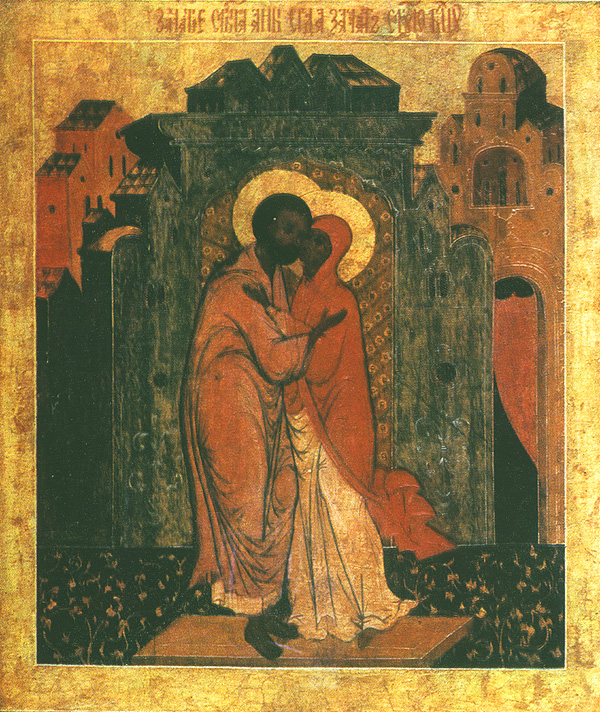
Saint Anna, the mother of the Virgin Mary, was the youngest daughter of the priest Nathan from Bethlehem, descended from the tribe of Levi. She married Saint Joachim (September 9), who was a native of Galilee.
For a long time Saint Anna was childless, but after twenty years, through the fervent prayer of both spouses, an angel of the Lord announced to them that they would be the parents of a daughter, Who would bring blessings to the whole human race.
The Orthodox Church does not accept the teaching that the Mother of God was exempted from the consequences of ancestral sin (death, corruption, sin, etc.) at the moment of her conception by virtue of the future merits of Her Son. Only Christ was born perfectly holy and sinless, as Saint Ambrose of Milan teaches in Chapter Two of his Commentary on Luke. The Holy Virgin was like everyone else in Her mortality, and in being subject to temptation, although She committed no personal sins. She was not a deified creature removed from the rest of humanity. If this were the case, She would not have been truly human, and the nature that Christ took from Her would not have been truly human either. If Christ does not truly share our human nature, then the possibilty of our salvation is in doubt.
The Conception of the Virgin Mary by Saint Anna took place at Jerusalem. The many icons depicting the Conception by Saint Anna show the Most Holy Theotokos trampling the serpent underfoot.
“In the icon Saints Joachim and Anna are usually depicted with hands folded in prayer; their eyes are also directed upward and they contemplate the Mother of God, Who stands in the air with outstretched hands; under Her feet is an orb encircled by a serpent (symbolizing the devil), which strives to conquer all the universe by its power.”
There are also icons in which Saint Anna holds the Most Holy Virgin on her left arm as an infant. On Saint Anna’s face is a look of reverence. A large ancient icon, painted on canvas, is located in the village of Minkovetsa in the Dubensk district of Volhynia diocese. From ancient times this Feast was especially venerated by pregnant women in Russia.

The Holy Prophetess Hannah dwelt in marriage with Elkanah, but she was childless. Elkanah took to himself another wife, Phennena, who bore him children. Hannah grieved strongly over her misfortune, and every day she prayed for an end to her barrenness, and vowed to dedicate her child to God.
Once, as she prayed fervently in the Temple, the priest Heli thought that she was drunk, and he began to reproach her. But the saint poured out her grief, and after she received a blessing, she returned home. After this Hannah conceived and gave birth to a son, whom she named Samuel (which means “Asked from God”).
When the child reached the age of boyhood, the mother herself presented him to the priest Heli, and Samuel remained with him to serve before the Tabernacle (1 Kings/1 Samuel 2: 1-21).
Saint Sophronius, Archbishop of Cyprus, was born into a Christian family on Cyprus, and he studied many sciences, but most of all he devoted himself to the reading of Holy Scripture. He became so accomplished in piety and good works, that he was granted the gift of wonderworking by the Lord. Following the death of Saint Damian, bishop of Cyprus, Saint Sophronius was chosen to replace him. As bishop, he proved himself a true father to his flock.
Saint Stephen the “New Light” was born at Constantinople in 838 and received a fine education. Under Patriarch Methodius, Stephen received monastic tonsure and shut himself in a cell attached to the church of Saint Peter in Constantinople. Later he went into seclusion, and over fifty years he constantly increased his ascetic efforts.
Toward the end of his life the saint acquired great grace from the Lord, shining in the constellation of the saints like the ancient ascetics of the Orthodox Church, so that he came to be called the “New Light.” According to the Prologue, he died in the year 912 and was buried in the church of Saint Antipas.

The “Unexpected Joy” Icon of the Most Holy Theotokos is painted in this way: in a room is an icon of the Mother of God, and beneath it a youth is kneeling at prayer. The tradition about the healing of some youth from a bodily affliction through this holy icon is recorded in the book of Saint Demetrius of Rostov, The Fleece of Prayer [See Judges 6: 36-40].
The sinful youth, who was nevertheless devoted to the Theotokos, was praying one day before the icon of the All-Pure Virgin before going out to commit a sin. Suddenly, he saw that wounds appeared on the Lord’s hands, feet, and side, and blood flowed from them. In horror he exclaimed, “O Lady, who has done this?” The Mother of God replied, “You and other sinners, because of your sins, crucify My Son anew.” Only then did he realize how great was the depth of his sinfulness. For a long time he prayed with tears to the All-Pure Mother of God and the Savior for mercy. Finally, he received the unexpected joy of the forgiveness of his sins.
The “Unexpected Joy” icon is also commemorated on January 25 and May 1.
No information available at this time
Here is the live stream for Advent Paraklesis – Wed 12/08/2021 If you need, here are instructions for accessing this content from your phone, tablet, computer, or TV.
WEDNESDAY OF THE 12TH WEEK
ABSTAIN FROM MEAT, FISH, DAIRY, EGGS, WINE, OLIVE OIL
Forefeast of the Conception by St. Anna of the Most Holy Theotokos, Patapius the Righteous of Thebes, Apollo, Tychikos, Sosthenes, Cephas, Epaphroditos, Caesar, & Onesiphoros, Apostles of the 70
Brethren, concerning the coming of our Lord Jesus Christ and our assembling to meet him, we beg you not to be quickly shaken in mind or excited, either by spirit or by word, or by letter purporting to be from us, to the effect that the day of the Lord has come. Let no one deceive you in any way; for that day will not come, unless the rebellion comes first, and the man of lawlessness is revealed, the son of perdition, who opposes and exalts himself against every so-called god or object of worship, so that he takes his seat in the temple of God, proclaiming himself to be God. Do you not remember that when I was still with you I told you this? And you know what is restraining him now so that he may be revealed in his time. For the mystery of lawlessness is already at work; only he who now restrains it will do so until he is out of the way. And then the lawless one will be revealed, and the Lord Jesus will slay him with the breath of his mouth and destroy him by his appearing and his coming. The coming of the lawless one by the activity of Satan will be with all power and with pretended signs and wonders, and with all wicked deception for those who are to perish, because they refused to love the truth and so be saved. Therefore God sends upon them a strong delusion, to make them believe what is false, so that all may be condemned who did not believe the truth but had pleasure in unrighteousness.
At that time, as some spoke to Jesus of the temple, how it was adorned with noble stones and offerings, he said, "As for these things, which you see, the days will come when there shall not be left here one stone upon another that will not be thrown down." And they asked him, "Teacher, when will this be, and what will be the sign when this is about to take place?" And he said, "Take heed that you are not led astray; for many will come in my name, saying, 'I am he!' and, 'The time is at hand!' Do not go after them. And when you hear of wars and tumults, do not be terrified; for this must first take place, but the end will not be at once.
Then he said to them, "Nation will rise against nation, and kingdom against kingdom; there will be great earthquakes, and in various places famines and pestilences; and there will be terrors and great signs from heaven.
But when you see Jerusalem surrounded by armies, then know that its desolation has come near. Then let those who are in Judea flee to the mountains, and let those who are inside the city depart, and let not those who are out in the country enter it; for these are days of vengeance, to fulfill all that is written. Alas for those who are with child and for those who give suck in those days! For great distress shall be upon the earth and wrath upon this people; they will fall by the edge of the sword, and be led captive among all nations; and Jerusalem will be trodden down by the Gentiles, until the times of the Gentiles are fulfilled.
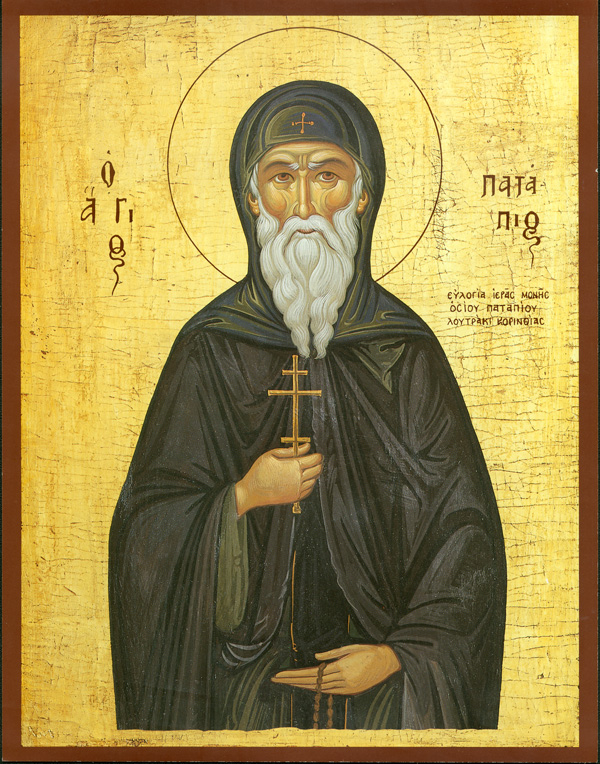
Saint Patapius was born at Thebes into a pious Christian family. Reaching the age of maturity, he scorned the vanities of the world and so went into the Egyptian desert where he became known for his ascetic deeds. Though he wished to dwell in silence, people began to come to him for advice.
He went eventually to Constantinople, where he obtained a cell at the city wall, near the Blachernae church. But here, too, he quickly became known. The sick began to throng about, and he having been vouchsafed the gift of healing, began to help all the needy.
After a life adorned with virtue and miracles, Saint Patapius fell asleep in the Lord and was buried in the church of Saint John the Baptist.
Saint Cyril of Chelma Hill, Enlightener of the Chudian People, was born in the city of White Lake. He was tonsured at the monastery of Saint Anthony the Roman, where for six years he passed through various obediences. Then, after wandering through the wilderness for three years, he settled in a wild region of Kargopolsk. And here, by a command from on high, he chose Chelma Hill for his constant abode. Many of the afflicted from the Chud people came to see Saint Cyril, whose luminous ascetic life and kindly preaching moved many to accept holy Baptism.
Toward the end of his life, Saint Cyril established a monastery and church in honor of the Theophany of the Lord. The monk dwelt upon Chelma Hill for fifty-two years, and died at the advanced age of 82.
Saints Sosthenes, Apollos, Cephas, Tychicus, Epaphroditus, Caesar, Onesiphorus, Apostles of the 70 were chosen and sent by the Lord Jesus Christ Himself to preach. They were chosen some time after the selection of the Twelve Apostles (Luke 10:1-24).
Saint Sosthenes, before accepting Christianity, was head of the Jewish synagogue at Corinth. During a riot against the Apostle Paul, he too suffered a beating. He was converted by Paul to faith in Christ and afterwards became bishop at Caesarea.
Saint Apollos (September 10) was a native of Alexandria and was a man of erudition. The chief place of his service was at Corinth. He toiled there for a long time and converted many to Christ. Towards the end of his life he preached on the island of Crete and was Bishop of Caesarea.
Saint Cephas was bishop at Colophon, Pamphylia.
Saint Tychicus, a native of Asia Minor, was a disciple and companion of the holy Apostle Paul. During Saint Paul’s first imprisonment, he delivered the Epistles to the Ephesians and to the Colossians. He replaced Saint Sosthenes on the episcopal throne at Caesarea.
Saint Epaphroditus, one of the Apostle Paul’s closest assistants and companions, was bishop of the Thracian city of Adriaca.
Saint Caesar preached at and was bishop of Dyrrhachium, a district of the Peloponnesos in Greece.
Saint Onesiphorus was bishop at Colophon (Asia Minor), and later at Corinth. He died a martyr in the city of Parium (not far from Ephesus) on the shores of the Hellespont, where he had gone to proclaim Christ among the local pagans.
All of these saints are also commemorated on March 30. The Church also remembers Saint Onesiphorus (September 7) with them.
The Holy Martyr Anthusa, the wife of a Roman official, was baptized by Saint Ambrose of Milan (December 7). When the city prefect’s wife Sunilda suggested that Saint Anthusa be baptized by an Arian, she refused. So she was committed to the fire, and received the crown of martyrdom.
These faithful servants of Christ suffered martyrdom during the reign of Emperor Zeno (474-491). Guneric, the ruler of the Vandal Kingdom in North Africa, began a savage persecution of the Orthodox, at the instigation of the Arian bishops Cyril and Balinardēs.
The faithful had gathered secretly in one of the churches for the Divine Liturgy, when suddenly barbarian soldiers burst into the church. Some of the worshippers fled, but 300 remained voluntarily, and so they were tortured and beheaded. Of the 62 clergy, two were burnt alive, and sixty had their tongues cut out. By the miraculous power of God, they continued to preach and to refute the Arian heresy. Among them were old men, young men, and heads of families, but all of them remained faithful to Christ and His Holy Church. They were beheaded in the year 477.
In Slavic usage, these holy martyrs are commemorated on December 8; while in Greek usage, they are commemorated on December 7.
TUESDAY OF THE 12TH WEEK
ABSTAIN FROM MEAT, FISH, DAIRY, EGGS
Ambrose, Bishop of Milan, Athenodoros the Martyr of Mesopotamia, Righteous Father Gerasimus, Ascetic of Euboia
Brethren, our testimony to you was believed. To this end we always pray for you, that our God may make you worthy of his call, and may fulfil every good resolve and work of faith by his power, so that the name of our Lord Jesus may be glorified in you, and you in him, according to the grace of our God and the Lord Jesus Christ.
Now concerning the coming of our Lord Jesus Christ and our assembling to meet him, we beg you, brethren, not to be quickly shaken in mind or excited, either by spirit or by word, or by letter purporting to be from us, to the effect that the day of Christ has come.
The Lord said to his disciples, "Beware of men who will lay their hands on you and persecute you, delivering you up to the synagogues and prisons, and you will be brought before kings and governors for my name's sake. This will be a time for you to bear testimony. Settle it therefore in your minds, not to meditate beforehand how to answer; for I will give you a mouth and wisdom, which none of your adversaries will be able to withstand or contradict. You will be delivered up even by parents and brothers and kinsmen and friends, and some of you they will put to death; you will be hated by all for my name's sake. But not a hair of your head will perish. By your endurance you will gain your lives.
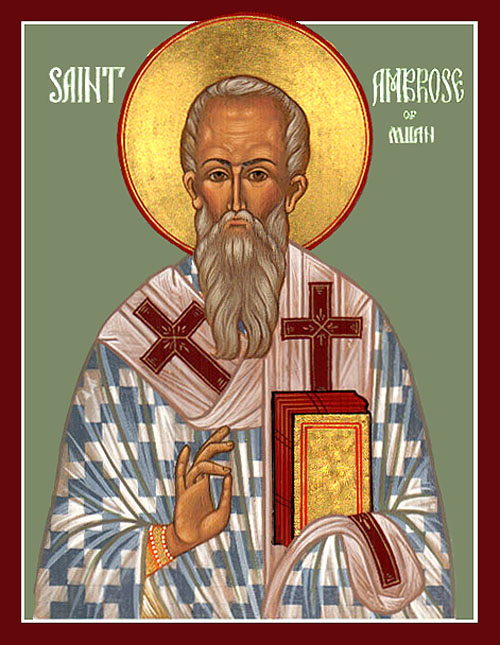
Saint Ambrose, Bishop of Milan, was born in the year 340 into the family of the Roman prefect of Gaul (now France). Even in the saint’s childhood there appeared presentiments of his great future. Once, bees covered the face of the sleeping infant. They flew in and out of his mouth, leaving honey on his tongue. Soon they flew away so high that they could no longer be seen. Ambrose’s father said that the child would become something great when he reached manhood.
After the death of the father of the family, Ambrose journeyed to Rome, where the future saint and his brother Satyrius received an excellent education. About the year 370, upon completion of his course of study, Ambrose was appointed to the position of governor (consular prefect) of the districts of Liguria and Aemilia, though he continued to live at Mediolanum (now Milan).
In the year 374 Auxentius, the Arian Bishop of Mediolanum, died. This led to complications between the Orthodox and the Arians, since each side wanted to have its own bishop. Ambrose, as the chief city official, went to the church to resolve the dispute.
While he was speaking to the crowd, suddenly a child cried out, “Ambrose for bishop!” The people took up this chant. Ambrose, who at this time was still a catechumen, considered himself unworthy, and tried to refuse. He disparaged himself, and even tried to flee from Mediolanum. The matter went ultimately before the emperor Valentinian the Elder (364-375), whose orders Ambrose dared not disobey. He accepted holy Baptism from an Orthodox priest and, passing through all the ranks of the Church clergy in just seven days, on December 7, 374 he was consecrated Bishop of Mediolanum. He dispersed all his possessions, money and property for the adornment of churches, the upkeep of orphans and the poor, and he devoted himself to a strict ascetic life.
Ambrose combined strict temperance, intense vigilance and work within the fulfilling of his duties as archpastor. Saint Ambrose, defending the unity of the Church, energetically opposed the spread of heresy. Thus, in the year 379 he traveled off to establish an Orthodox bishop at Sirmium, and in 385-386 he refused to hand over the basilica of Mediolanum to the Arians.
The preaching of Saint Ambrose in defense of Orthodoxy was deeply influential. Another noted Father of the Western Church, Saint Augustine (June 15), bore witness to this, having accepted holy Baptism in the year 387 by the grace of the preaching of the bishop of Mediolanum.
Saint Ambrose also actively participated in civil matters. Thus, the emperor Gracian (375-383), having received from him the “Exposition of the Orthodox Faith” (De Fide), removed, by decree of the saint, the altar of Victory from the halls of the Senate at Rome, on which oaths were wont to be taken. Displaying a pastoral boldness, Saint Ambrose placed a severe penance on the emperor Theodosius I (379-395) for the massacre of innocent inhabitants of Thessalonica. For him there was no difference between emperor and commoner. Though he released Theodosius from the penance, the saint would not permit the emperor to commune at the altar, but compelled him to do public penance.
The fame of Bishop Ambrose and his actions attracted to him many followers from other lands. From far away Persia learned men came to him to ask him questions and absorb his wisdom. Fritigelda (Frigitil), queen of the military Germanic tribe of the Markomanni, which often had attacked Mediolanum, asked the saint to instruct her in the Christian Faith. The saint in his letter to her persuasively stated the dogmas of the Church. And having become a believer, the queen converted her own husband to Christianity and persuaded him to conclude a treaty of peace with the Roman Empire.
The saint combined strictness with an uncommon kindliness. Granted a gift of wonderworking, he healed many from sickness. One time at Florence, while staying at the house of Decentus, he resurrected a dead boy.
The repose of Saint Ambrose, who departed to the Lord on the night of Holy Pascha, was accompanied by many miracles. He even appeared in a vision to the children being baptized that night. The saint was buried in the Ambrosian basilica in Mediolanum, beneath the altar, between the Martyrs Protasius and Gervasius (October 14).
A zealous preacher and valiant defender of the Christian Faith, Saint Ambrose received particular renown as a Church writer. In dogmatic compositions he set forth the Orthodox teaching about the Holy Trinity, the Sacraments, and Repentance: “Five Books on the Faith” (De Fide); “Explication of the Symbol of the Faith” (Explanatio Symboli); “On the Incarnation” (De Incarnationis); “Three Books on the Holy Spirit” (De Spiritu Sancto); “On the Sacraments” (De Sacramento); “Two Books on Repentance” (De Paenitentia). In writings about Christian morality, he explained the excellence of Christian moral teaching compared to pagan moral teaching.
A well-known work of Saint Ambrose, “On the Duties of the Clergy” (De Officiis Ministrorum) evidences his deep awareness of pastoral duty. He stresses that those who serve in the Church should have not only the proper knowledge of Church services, but also the proper knowledge of moral precepts.
Saint Ambrose was also a reformer of Church singing. He introduced antiphonal singing (along the Eastern or Syrian form) into the Western Church, which became known as “Ambrosian Chant.” He also composed twelve hymns which were used during his lifetime. The hymn, “Thee, O God, we praise” (Te Deum), attributed to Saint Ambrose, entered into the divine services of the Orthodox Church (Molieben).
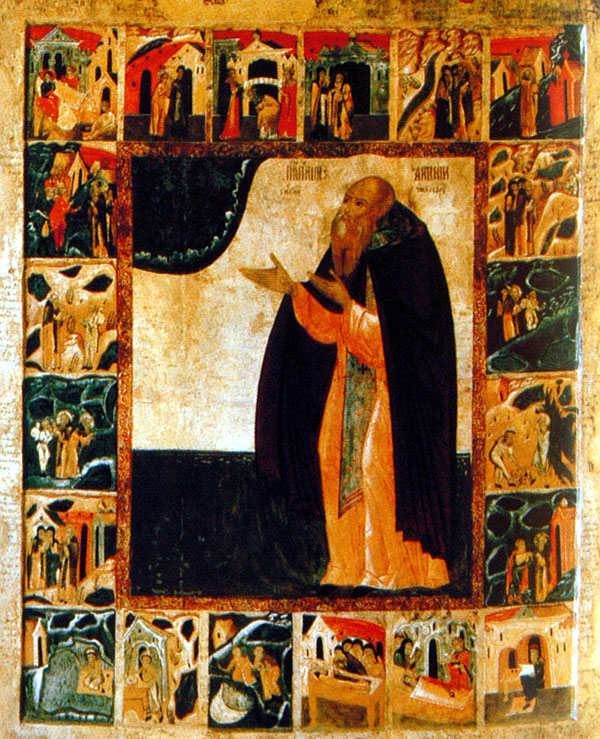
Saint Anthony of Siya, in the world Andrew, was born into a family of rich farmers in the village of Kekhta near the North Dvina river. In childhood he received a fine education, read much and learned iconography. After the death of his parents, Andrew went to Novgorod, and for five years worked for a boyar [nobleman] there. He later married, but his wife died after a year.
Then Andrew decided to devote himself to monasticism. He distributed his goods to the poor and as a wanderer came to the Pachomiev wilderness monastery at the River Kena. Saint Pachomius tonsured him with the name Anthony. Soon he was ordained a hieromonk, and Anthony, with the blessing of the igumen, celebrated the divine services by himself.
He went out with the other monks of the monastery to work for the monastery’s needs. Out of love for solitude Saint Anthony eventually left the Pachomiev wilderness, after choosing two companions from the monastic brethren, and he settled upon Mikhailov Island, on the one side washed by the River Sii, and on the other, by encircling lakes.
In this harsh frontier within the dense thickets Anthony built a chapel in 1520. But to clear the forest required difficult work, and Anthony’s companions began to grumble against him. Then quite unexpectedly an unknown man furnished them with the means of subsistence, offering money for good measure. The Siya monastery became famous, and inhabitants of surrounding villages often visited it. And again Saint Anthony, taking one disciple, withdrew to a still more remote place on Lake Palun. There, in a solitary cell, he dwelt for three years. When the igumen Theoctistus refused to guide the Siya monastery any longer, the brethren tried to persuade Saint Anthony to return to them. He finally acceded to the request of the monks, again became igumen and piously guided the monastery until his death in the year 1556, when he was seventy-nine years old.

Saint Nilus of Stolobnoye was born into a peasant family in a small village of the Novgorod diocese. In the year 1505 he was tonsured at the monastery of Saint Savva of Krypetsk (August 28) near Pskov. After ten years in ascetic life at the monastery he set out to the River Sereml, on the side of the city of Ostashkova; here for thirteen years he led a strict ascetic life in incessant struggle against the snares of the devil, who took on the appearance of reptiles and wild beasts. Many of the inhabitants of the surrounding area started coming to the monk for instruction, but this became burdensome for him and he prayed God to show him a place for deeds of quietude. Once, after long prayer he heard a voice saying, “Nilus! Go to Lake Seliger. There upon the island of Stolobnoye you can be saved!” Saint Nilus learned the location of this island from people who visited him. When he arrived there, he was astonished by its beauty.
The island, in the middle of the lake, was covered over by dense forest. Saint Nilus found a small hill and dug out a cave, and after a while he built a hut, in which he lived for twenty-six years. To his exploits of strict fasting and stillness [ie. hesychia] he added another—he never lay down to sleep, but permitted himself only a light nap, leaning on a prop set into the wall of the cell.
The pious life of the monk frequently roused the envy of the Enemy of mankind, which evidenced itself through the spiteful action of the local inhabitants. One time someone set fire to the woods on the island where stood the saint’s hut, but the flames went out in miraculous manner upon reaching the hill. Another time robbers forced their way into the hut. The monk said to them: “All my treasure is in the corner of the cell.” In this corner stood an icon of the Mother of God, but the robbers began to search there for money and became blinded. Then with tears of repentance they begged for forgiveness.
Saint Nilus performed many other miracles. He would refuse gifts if the conscience of the one offering it to him was impure, or if they were in bodily impurity.
Aware of his approaching end, Saint Nilus prepared a grave for himself. At the time of his death, an igumen from one of the nearby monasteries came to the island and communed him with the Holy Mysteries. Before the igumen’s departure, Saint Nilus prayed for the last time, censing around the holy icons and the cell, and surrendered his soul to the Lord on December 7, 1554. The translation of his holy relics (now venerated at the church of the Icon of the Mother of God “Of the Sign” in the city of Ostashkova) took place in the year 1667, with feastdays established both on the day of his death, and on May 27.
No information available at this time
The Holy Martyr Athenodorus, from Syrian Mesopotamia, led a monastic life from his youth. Denounced as a Christian, he was arrested and condemned to fierce tortures by the governor of the land, Eleusius. Miracles accompanied the martyrdom of the saint, which converted many of the pagans to the Christian Faith.
He was beheaded in the year 304.
We do not know when Saint Paul lived. There is only a short Life which says that he was the son of wealthy parents. He left secular life upon reaching maturity.
The appellation “Obedient” was bestowed upon the monk for his deep humility, and for the complete renunciation of his own will. Once, the monk stirred boiling tar with his hand, and received not the slightest burn from it. Some of the brethren regarded him as a God-bearing ascetic, but others became suspicious of him.
After fervent prayer, the monks received a unique vision proving that their brother was a true ascetic. By night they were all transported to Paradise and they conversed with Saint Paul, who permitted them to take a flower or twig with them as a remembrance. Awakening from sleep, they found in their hands the flowers and twigs from Paradise. After this Saint Paul went to Jerusalem, and then to Cyprus.
Having led a solitary life, he ended his life on Mount Paregoros [Mount Solace]. Before his death the voice of God said to him, “Ascend the mountain, Paul, and accept the end of life.”
Saint Philothea (Philofthea) of Argesh was born in Trnovo, the old capital of Bulgaria, around 1206. Her father was a farmer, and her mother was from Wallachia. She died when Philothea was still a child, and her father remarried.
The child was often punished by her stepmother, who accused her of being disobedient, and of giving their possesions away to the poor. Her father chastised her for this, but Philothea continued to attend church services and to do good to others, just as her mother had taught her. As she grew older, she was adorned with the virtues of prayer, virginity, and almsgiving.
Saint Philothea used to bring food to her father, who was out working in the fields. Not all of the food reached him, however, because the girl would give some of it to the poor children begging in the street. When he complained to his wife that she did not prepare enough food for him, she replied, “I send you plenty of food. Ask your daughter what she does with it.”
Becoming angry with Philothea, her father decided to spy on her to see what happened to the food. From a place of concealment, he saw her giving food to the poor children who came to her. In a violent rage, he took the axe from his belt and threw it at the twelve-year-old girl, hitting her in the leg. The wound was mortal, and she soon gave her pure soul into God’s hands.
The man was filled with fear and remorse, and tried to lift his daughter’s body from the ground, but it became as heavy as a rock. Then the wretch ran to the Archbishop of Trnovo to confess his sin and explain what had happened. The Archbishop and his clergy went with candles and incense to take up the martyr’s body and bring it to the cathedral, but even they were unable to lift it.
The Archbishop realized that Saint Philothea did not wish to remain in her native land, so he began to name various monasteries, churches, and cathedrals to see where she wished to go. Not until he named the Monastery of Curtea de Argesh in Romania were they able to lift her holy relics and place them in a coffin. The Archbishop wrote to the Romanian Voievode Radu Negru, asking him to accept the saint’s relics.
The Archbishop and his clergy carried the holy relics in procession as far as the Danube, where they were met by Romanian clergy, monastics, and the faithful. Then they were carried to the Curtea de Argesh Monastery.
Many people have been healed at the tomb of Saint Philothea in a small chapel in the belltower behind the monastery church, and those who entreat her intercession receive help from her. Each year on December 7 there is a festal pilgrimage to the Monastery, and people come from all over Romania. The relics of Saint Philothea are carried around the courtyard in procession, and there are prayers for the sick.
The holy Virgin Martyr Philothea is venerated in Romania, Bulgaria, and throughout the Orthodox world.
Saint Gregory of Mount Athos was born in Serbia, and pursued asceticism on Mt Athos. He built and dedicated the monastery of Saint Nicholas, which was later renamed Grigoriou in his honor.
In the records of Mt Athos the saint’s signature dating from 1405 was discovered. According to Tradition, the relics of Saint Gregory were taken from Athos by Serbian monks.

The Vladimir Icon of the Most Holy Theotokos of Seliger comes from the island of Seliger in the Tver Province of Russia.
NICHOLAS THE WONDERWORKER, ARCHBISHOP OF MYRA
ABSTAIN FROM MEAT, FISH, DAIRY, EGGS
Nicholas the Wonderworker, Archbishop of Myra, Nicholas the New Martyr of Asia Minor
Brethren, obey your leaders and submit to them; for they are keeping watch over your souls, as men who will have to give account. Let them do this joyfully, and not sadly, for that would be of no advantage to you. Pray for us, for we are sure that we have a clear conscience, desiring to act honorably in all things. I urge you the more earnestly to do this in order that I may be restored to you the sooner. Now may the God of peace who brought again from the dead our Lord Jesus, the great Shepherd of the sheep, by the blood of the eternal covenant, equip you with everything good that you may do His will, working in you that which is pleasing in His sight, through Jesus Christ; to whom be glory for ever and ever. Amen.
At that time, Jesus stood on a level place, with a great crowd of his disciples and a great multitude of people from all Judea and Jerusalem and the seacoast of Tyre and Sidon, who came to hear him and to be healed of their diseases; and those who were troubled with unclean spirits were cured. And all the crowd sought to touch him, for power came forth from him and healed them all. And he lifted up his eyes on His disciples, and said: “Blessed are you poor, for yours is the Kingdom of God. Blessed are you that hunger now, for you shall be satisfied. Blessed are you that weep now, for you shall laugh. Blessed are you when men hate you, and when they exclude you and revile you, and cast out your name as evil, on account of the Son of man! Rejoice in that day, and leap for joy, for behold, your reward is great in heaven.”
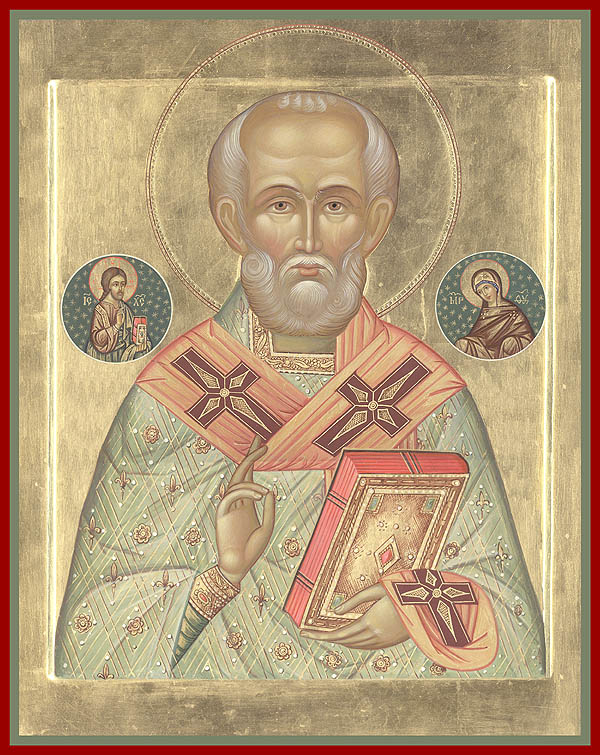
Saint Nicholas, the Wonderworker, Archbishop of Myra in Lycia is famed as a great saint pleasing unto God. He was born in the city of Patara in the region of Lycia (on the south coast of the Asia Minor peninsula), and was the only son of pious parents Theophanes and Nonna, who had vowed to dedicate him to God.
As the fruit of the prayer of his childless parents, the infant Nicholas from the very day of his birth revealed to people the light of his future glory as a wonderworker. His mother, Nonna, after giving birth was immediately healed from illness. The newborn infant, while still in the baptismal font, stood on his feet three hours, without support from anyone, thereby honoring the Most Holy Trinity. Saint Nicholas from his infancy began a life of fasting, and on Wednesdays and Fridays he would not accept milk from his mother until after his parents had finished their evening prayers.
From his childhood Nicholas thrived on the study of Divine Scripture; by day he would not leave church, and by night he prayed and read books, making himself a worthy dwelling place for the Holy Spirit. Bishop Nicholas of Patara rejoiced at the spiritual success and deep piety of his nephew. He ordained him a reader, and then elevated Nicholas to the priesthood, making him his assistant and entrusting him to instruct the flock.
In serving the Lord the youth was fervent of spirit, and in his proficiency with questions of faith he was like an Elder, who aroused the wonder and deep respect of believers. Constantly at work and vivacious, in unceasing prayer, the priest Nicholas displayed great kind-heartedness towards the flock, and towards the afflicted who came to him for help, and he distributed all his inheritance to the poor.
There was a certain formerly rich inhabitant of Patara, whom Saint Nicholas saved from great sin. The man had three grown daughters, and in desperation he planned to sell their bodies so they would have money for food. The saint, learning of the man’s poverty and of his wicked intention, secretly visited him one night and threw a sack of gold through the window. With the money the man arranged an honorable marriage for his daughter. Saint Nicholas also provided gold for the other daughters, thereby saving the family from falling into spiritual destruction. In bestowing charity, Saint Nicholas always strove to do this secretly and to conceal his good deeds.
The Bishop of Patara decided to go on pilgrimage to the holy places at Jerusalem, and entrusted the guidance of his flock to Saint Nicholas, who fulfilled this obedience carefully and with love. When the bishop returned, Nicholas asked his blessing for a pilgrimage to the Holy Land. Along the way the saint predicted a storm would arise and threaten the ship. Saint Nicholas saw the devil get on the ship, intending to sink it and kill all the passengers. At the entreaty of the despairing pilgrims, he calmed the waves of the sea by his prayers. Through his prayer a certain sailor of the ship, who had fallen from the mast and was mortally injured, was also restored to health.
When he reached the ancient city of Jerusalem and came to Golgotha, Saint Nicholas gave thanks to the Savior. He went to all the holy places, worshiping at each one. One night on Mount Sion, the closed doors of the church opened by themselves for the great pilgrim. Going round the holy places connected with the earthly service of the Son of God, Saint Nicholas decided to withdraw into the desert, but he was stopped by a divine voice urging him to return to his native country. He returned to Lycia, and yearning for a life of quietude, the saint entered into the brotherhood of a monastery named Holy Sion, which had been founded by his uncle. But the Lord again indicated another path for him, “Nicholas, this is not the vineyard where you shall bear fruit for Me. Return to the world, and glorify My Name there.” So he left Patara and went to Myra in Lycia.
Upon the death of Archbishop John, Nicholas was chosen as Bishop of Myra after one of the bishops of the Council said that a new archbishop should be revealed by God, not chosen by men. One of the elder bishops had a vision of a radiant Man, Who told him that the one who came to the church that night and was first to enter should be made archbishop. He would be named Nicholas. The bishop went to the church at night to await Nicholas. The saint, always the first to arrive at church, was stopped by the bishop. “What is your name, child?” he asked. God’s chosen one replied, “My name is Nicholas, Master, and I am your servant.”
After his consecration as archbishop, Saint Nicholas remained a great ascetic, appearing to his flock as an image of gentleness, kindness and love for people. This was particularly precious for the Lycian Church during the persecution of Christians under the emperor Diocletian (284-305). Bishop Nicholas, locked up in prison together with other Christians for refusing to worship idols, sustained them and exhorted them to endure the fetters, punishment and torture. The Lord preserved him unharmed. Upon the accession of Saint Constantine (May 21) as emperor, Saint Nicholas was restored to his flock, which joyfully received their guide and intercessor.
Despite his great gentleness of spirit and purity of heart, Saint Nicholas was a zealous and ardent warrior of the Church of Christ. Fighting evil spirits, the saint made the rounds of the pagan temples and shrines in the city of Myra and its surroundings, shattering the idols and turning the temples to dust.
In the year 325 Saint Nicholas was a participant in the First Ecumenical Council. This Council proclaimed the Nicean Symbol of Faith, and he stood up against the heretic Arius with the likes of Saints Sylvester the Bishop of Rome (January 2), Alexander of Alexandria (May 29), Spyridon of Trimythontos (December 12) and other Fathers of the Council.
Saint Nicholas, fired with zeal for the Lord, assailed the heretic Arius with his words, and also struck him upon the face. For this reason, he was deprived of the emblems of his episcopal rank and placed under guard. But several of the holy Fathers had the same vision, seeing the Lord Himself and the Mother of God returning to him the Gospel and omophorion. The Fathers of the Council agreed that the audacity of the saint was pleasing to God, and restored the saint to the office of bishop.
Having returned to his own diocese, the saint brought it peace and blessings, sowing the word of Truth, uprooting heresy, nourishing his flock with sound doctrine, and also providing food for their bodies. The face of Saint Nicholas resembled that of an Angel, resplendent with divine grace. A brilliant ray shone from his face, like that which shone from the face of Moses (Exodus 34:29), so that those who looked at him were astonished. Whoever was oppressed by some affliction or passion of the soul had only to behold the Saint, and his sorrow was eased at once. As for those who conversed with him, they soon found themselves advancing on the path of virtue. Not only were the faithful moved to compassion, but unbelievers as well, and they directed their steps on the path of salvation when they heard him speak. The evil of unbelief which had been implanted in their hearts since childhood was uprooted, and in its place, the word of truth was sown.
Even during his life the saint worked many miracles. One of the greatest was the deliverance from death of three men unjustly condemned by the Governor, who had been bribed. The saint boldly went up to the executioner and took his sword, already suspended over the heads of the condemned. The Governor, denounced by Saint Nicholas for his wrong doing, repented and begged for forgiveness.
Witnessing this remarkable event were three military officers, who were sent to Phrygia by the emperor Constantine to put down a rebellion. They did not suspect that soon they would also be compelled to seek the intercession of Saint Nicholas. Evil men slandered them before the emperor, and the officers were sentenced to death. Appearing to Saint Constantine in a dream, Saint Nicholas called on him to overturn the unjust sentence of the military officers.
He worked many other miracles, and struggled many long years at his labor. Through the prayers of the saint, the city of Myra was rescued from a terrible famine. He appeared to a certain Italian merchant and left him three gold pieces as a pledge of payment. He requested him to sail to Myra and deliver grain there. More than once, the saint saved those drowning in the sea, and provided release from captivity and imprisonment.
Having reached old age, Saint Nicholas peacefully fell asleep in the Lord. His venerable relics were preserved incorrupt in the local cathedral church and flowed with curative myrrh, from which many received healing. In the year 1087, his relics were transferred to the Italian city of Bari, where they rest even now (See May 9).
The name of the great saint of God, the hierarch and wonderworker Nicholas, a speedy helper and suppliant for all hastening to him, is famed in every corner of the earth, in many lands and among many peoples. In Russia there are a multitude of cathedrals, monasteries and churches consecrated in his name. There is, perhaps, not a single city without a church dedicated to him.
The first Russian Christian prince Askold (+ 882) was baptized in 866 by Patriarch Photius (February 6) with the name Nicholas. Over the grave of Askold, Saint Olga (July 11) built the first temple of Saint Nicholas in the Russian Church at Kiev. Primary cathedrals were dedicated to Saint Nicholas at Izborsk, Ostrov, Mozhaisk, and Zaraisk. At Novgorod the Great, one of the main churches of the city, the Nikolo-Dvorischensk church, later became a cathedral.
Famed and venerable churches and monasteries dedicated to Saint Nicholas are found at Kiev, Smolensk, Pskov, Toropetsa, Galich, Archangelsk, Great Ustiug, Tobolsk. Moscow had dozens of churches named for the saint, and also three monasteries in the Moscow diocese: the Nikolo-Greek (Staryi) in the Chinese-quarter, the Nikolo-Perervinsk and the Nikolo-Ugreshsk. One of the chief towers of the Kremlin was named the Nikolsk.
Many of the churches devoted to the saint were those established at market squares by Russian merchants, sea-farers and those who traveled by land, venerating the wonderworker Nicholas as a protector of all those journeying on dry land and sea. They sometimes received the name among the people of “Nicholas soaked.”
Many village churches in Russia were dedicated to the wonderworker Nicholas, venerated by peasants as a merciful intercessor before the Lord for all the people in their work. And in the Russian land Saint Nicholas did not cease his intercession. Ancient Kiev preserves the memory about the miraculous rescue of a drowning infant by the saint. The great wonderworker, hearing the grief-filled prayers of the parents for the loss of their only child, took the infant from the waters, revived him and placed him in the choir-loft of the church of Holy Wisdom (Hagia Sophia) before his wonderworking icon. In the morning the infant was found safe by his thrilled parents, praising Saint Nicholas the Wonderworker.
Many wonderworking icons of Saint Nicholas appeared in Russia and came also from other lands. There is the ancient Byzantine embroidered image of the saint, brought to Moscow from Novgorod, and the large icon painted in the thirteenth century by a Novgorod master.
Two depictions of the wonderworker are especially numerous in the Russian Church: Saint Nicholas of Zaraisk, portrayed in full-length, with his right hand raised in blessing and with a Gospel (this image was brought to Ryazan in 1225 by the future wife of Prince Theodore, the Byzantine Princess Eupraxia, who perished in 1237 with her husband and infant son during the incursion of Batu); and Saint Nicholas of Mozhaisk, also in full stature, with a sword in his right hand and a city in his left. This recalls the miraculous rescue of the city of Mozhaisk from an invasion of enemies, through the prayers of the saint. It is impossible to list all the grace-filled icons of Saint Nicholas, or to enumerate all his miracles.
Saint Nicholas is the patron of travelers, and we pray to him for deliverance from floods, poverty, or any misfortunes. He has promised to help those who remember his parents, Theophanes and Nonna.
Saint Nicholas is also commemorated on May 9 (The transfer of his relics) and on July 29 (his nativity).
In Italy, the relics of Saint Nicholas are in the Roman Catholic Basilica of Saint Nicholas in Bari; and his left arm is in Saint Nicholas Roman Catholic Church of Rimini.
In Russia, relics of Saint Nicholas are to be found in Christ the Savior Cathedral in Moscow, and in the Saint Alexander Nevsky Lavra in St. Petersburg.
The right hand of Saint Nicholas is in the church of Saint George the New in Bucharest, Romania.
In Greece, portions of the Saint's relics are in the Monasteries of Saint Nicholas Apo Bathia in Euboia, and Phaneromenē in Salaminos. A piece of the Saint's left arm is in the Metropolitan church of Volos. One of the Saint's teeth is at Kalabryta Monastery in the Peloponnēsos.
Saint Maximus, successor of Metropolitan Cyril III of Kiev (1243-1280), was a Greek by birth, and he arrived in Rus, then suffering under the Mongol (Tatar) Yoke, in 1283 as Metropolitan. The saint decided to remain at Kiev, but the city was completely devastated by the plundering incursions of the Tatars. Metropolitan Maximus withdrew to Briansk, and from there to Suzdal. During his visit to Volhynia the saint met with Saint Peter the igumen of the Rata monastery, (December 21), who would succeed him as metropolitan.
In 1295 the saint deposed James from the bishop’s cathedra at Vladimir and replaced him with Simon. During these terrible times the throne of the Great Prince was first at Vladimir, then at Pereslavl, then at Tver.
Apprehensive lest he insult the South Russian princes by moving to the north, the saint offered fervent prayers to the Mother of God, and She indicated Vladimir as the place of his residence.
In the year 1299 Metropolitan Maximus went to Vladimir, and in the following year he established Saint Theoctistus (December 23) as Bishop of Novgorod. In 1301, Metropolitan Maximus was in Constantinople for a Patriarchal Council, where at the urging of Saint Theognostus, Bishop of Zaraisk, he set forth questions concerning the needs of the Russian Church to be resolved by the Council.
Recognizing the need to build up the strength of subjugated Rus, the saint urged Prince Yuri Danilovich of Moscow to make peace with the holy Prince Michael of Tver. He also advised Yuri to journey to the Horde to receive the throne. In 1304, the saint installed Saint Michael of Tver (November 22) upon the Great-princely throne of Vladimir.
Setting an example of intense spiritual life for others, Metropolitan Maximus was concerned about the spiritual growth of his proverbial flock. Thus, the saint established rules for fasting for other times in addition to Great Lent. He ordained it for the Apostles’, Dormition and Nativity lenten periods, and he defined when fasting on Wednesdays and Fridays is allowed (in Russia until the fourteenth century they did not fast on the Midfeast and Leave-taking of Pascha).
The holy metropolitan was particularly concerned with upholding lawful marriage: “I write, therefore, about this, so that you my children, born and newly-sanctified in the baptismal font, will take your wife from the Holy, Catholic and Apostolic Church, for the woman is for the salvation of the man. If you cleave to them in promiscuity without marriage, does it benefit you? No, but rather beseech and implore them, whether young or old, to be married in the Church.”
The saint reposed on December 6, 1305, and his body was buried in the Dormition cathedral in Vladimir. A gilded covering was built over the saint’s grave.
The Maximov Icon of the Mother of God (April 18) was placed on the wall above the grave of the saint. It was painted in the year 1299 following a vision to Metropolitan Maximus. A description of this vision was inscribed on the left side of the crypt.
Here is the live stream for Great Vespers with Litia and Artoklasia – Sun 12/05/2021 If you need, here are instructions for accessing this content from your phone, tablet, computer, or TV.
Here is the live stream for Orthros and Divine Liturgy – Sun 12/05/2021 If you need, here are instructions for accessing this content from your phone, tablet, computer, or TV.
10TH SUNDAY OF LUKE
ABSTAIN FROM MEAT, DAIRY, EGGS
10th Sunday of Luke, Sabbas the Sanctified, Holy Martyr Diogenes, Philotheos the Righteous of Mount Athos, Nektarios the Bulgarian
Brethren, the fruit of the Spirit is love, joy, peace, patience, kindness, goodness, faithfulness, gentleness, self-control; against such there is no law. And those who belong to Christ Jesus have crucified the flesh with its passions and desires. If we live by the Spirit, let us also walk by the Spirit. Let us have no self-conceit, no provoking of one another, no envy of one another. Brethren, if a man is overtaken in any trespass, you who are spiritual should restore him in a spirit of gentleness. Look to yourself, lest you too be tempted. Bear one another’s burdens, and so fulfill the law of Christ.
At that time, Jesus was teaching in one of the synagogues on the sabbath. And there was a woman who had a spirit of infirmity for eighteen years; she was bent over and could not fully straighten herself. And when Jesus saw her, he called her and said to her, "Woman, you are freed from your infirmity." And he laid his hands upon her, and immediately she was made straight, and she praised God. But the ruler of the synagogue, indignant because Jesus had healed on the sabbath, said to the people, "There are six days on which work ought to be done; come on those days and be healed, and not on the sabbath day." Then the Lord answered him, "You hypocrites! Does not each of you on the sabbath untie his ox or his donkey from the manger, and lead it away to water it? And ought not this woman, a daughter of Abraham whom Satan bound for eighteen years, be loosed from this bond on the sabbath day?" As he said this, all his adversaries were put to shame; and all the people rejoiced at all the glorious things that were done by him.

Saint Savva the Sanctified was born in the fifth century at Cappadocia of pious Christian parents, John and Sophia. His father was a military commander. Journeying to Alexandria on military matters, John and Sophia left their five-year-old son Savva in the care of an uncle. When the boy reached eight years of age, he entered the monastery of Saint Flavian located nearby. The gifted child quickly learned to read and became an expert on the Holy Scriptures. In vain did his parents urge Saint Savva to return to the world and enter into marriage.
When he was seventeen years old he received monastic tonsure, and attained such perfection in fasting and prayer that he was given the gift of wonderworking. After spending ten years at the monastery of Saint Flavian, he went to Jerusalem, and from there to the monastery of Saint Euthymius the Great (January 20). But Saint Euthymius sent Saint Savva to Abba Theoctistus, the head of a nearby monastery with a strict cenobitic rule. Saint Savva lived in obedience at this monastery until the age of thirty.
After the death of the Elder Theoctistus, his successor blessed Saint Savva to seclude himself in a cave. On Saturdays, however, he left his hermitage and came to the monastery, where he participated in divine services and ate with the brethren. After a certain time Saint Savva received permission not to leave his hermitage at all, and he struggled in the cave for five years.
Saint Euthymius attentively directed the life of the young monk, and seeing his spiritual maturity, he began to take him to the Rouba wilderness with him. They set out on January 14, and remained there until Palm Sunday. Saint Euthymius called Saint Savva a child-elder, and encouraged him to grow in the monastic virtues.
When Saint Euthymius fell asleep in the Lord (+ 473), Saint Savva withdrew from the Lavra and moved to a cave near the monastery of Saint Gerasimus of Jordan (March 4). After several years, disciples began to gather around Saint Savva, seeking the monastic life. As the number of monks increased, a lavra sprang up. When a pillar of fire appeared before Saint Savva as he was walking, he found a spacious cave in the form of a church.
Saint Savva founded several more monasteries. Many miracles took place through the prayers of Saint Savva: at the Lavra a spring of water welled up, during a time of drought there was abundant rain, and there were also healings of the sick and the demoniacs. Saint Savva composed the first monastic Rule of church services, the so-called “Jerusalem Typikon”, accepted by all the Palestine monasteries. The saint surrendered his soul to God in the year 532.

Saint Gurias, Archbishop of Kazan, (in the world Gregory Rugotin), was the first archbishop of the Kazan diocese, established in 1555. He was born in the town of Radonezh outside Moscow into the family of a courtier. His parents were not wealthy, and so from his early years he had to serve Prince Ivan Penkov as steward of his estates.
From his youth, Gregory was pious, humble and gentle, and he preserved his chastity. Accused of improprieties with the prince’s wife, Gregory was locked up in an underground dungeon for two years. This undermined his health, but it also intensified and deepened his religious fervor. In prison, he wrote a small booklet to teach children how to read and write. He donated the proceeds from his primer to the needy.
Released from prison, Gregory was tonsured with the name Gurias at the Saint Joseph of Volokolamsk monastery, known for its strict monastic rule. In 1543, he was chosen by the brethren as igumen of this monastery. He administered it for almost nine years, and then he resigned as igumen and lived for two years as a simple monk.
Before becoming bishop, Saint Gurias directed the Trinity Selizharov monastery in Tver diocese for one year. He was chosen by lot to the See of Kazan. Assisted by Saint Barsanuphius (April 11), Saint Gurias devoted himself to missionary activity. In his eight years as bishop there, four monasteries were organized, and the Annunciation cathedral church and ten more city churches were built.
In 1561 the saint fell grievously ill and could no longer perform the divine services himself. On feastdays they carried him into the church, and he either sat or lay down, since he did not have the strength to walk or even stand.
Shortly before his death (1563), he received the great schema from Saint Barsanuphius, and he was buried in the Savior-Transfiguration monastery. On October 4, 1595, the incorrupt relics of the holy hierarchs Gurias and Barsanuphius were uncovered. Saint Hermogenes, Metropolitan of Kazan (May 12), was present at the uncovering of their relics, and he described this event in the lives of these saints.
On June 20, 1613, the relics of Saint Gurias were transferred from the Savior-Transfiguration monastery to the Annunciation cathedral church. At present, the relics rest in Kazan in a cemetery church named for the holy Princes Theodore of Murom and his sons David and Constantine (May 21).
The Martyr Anastasius the Fuller lived at Salona in Dalmatia during the third century. He was arrested and brought to trial because of his missionary activity in Salona. Saint Anastasius, boldly and without fear, confessed Christ as the true God and Creator of all. He even painted a cross on his door during the persecution of Diocletian (284-311).
Saint Anastasius was sentenced to death by the decision of the court, and the pagans tied a stone around his neck and threw his body into the sea. A righteous Christian, the rich matron Ascalopia, found the body of Saint Anastasius and reverently buried him in her estate church. The relics of the holy martyr were glorified by many miracles.
Saint Anastasius the Fuller is also commemorated on October 25.
Saint Karion lived in Scetis in Egypt during the fourth century. He became a monk and left his wife and two children behind in the world. When a famine struck Egypt, Saint Karion’s wife brought the children to the monastery and complained of their poverty and difficulties. The saint took his son, Zachariah, and the daughter remained with the mother.
He raised his son at the skete, and everyone knew that Zachariah was his son. When the lad grew up, the brethren began to grumble. The father and his son then went into the Thebaid, but complaints about them arose there, too. Then Saint Zachariah went to Lake Nitria, immersing himself in the foul-smelling water up to his nostrils and he stayed there for an hour. His face and his body were covered with welts, and he looked like a leper. Even his own father hardly recognized him.
The next time Saint Zachariah came for Holy Communion, it was revealed to the Saint Isidore the Presbyter what Zachariah had done. The holy priest said to him, “Child, last Sunday you communed as a man, but now you receive as an angel.”
After the death of his father, Saint Zachariah began to struggle together with Saint Moses the Black (August 28). “What must I do, to be saved?” asked Saint Moses. Hearing this, Saint Zachariah fell to his knees and said: “Why do you ask this of me, Father?”
“Believe me, my child, Zachariah,” Saint Moses continued, “I saw the Holy Spirit come down upon you, and that is why I ask you.”
Saint Zachariah then took the koukoulion (cowl) from his head, trampling it under his feet. After putting it on again he said, “If a man is not willing to be treated this way, he cannot be a monk.”
Saint Moses asked Zachariah just before his death, “What do you see, brother?”
“Isn’t it better if I keep silent, Father?” Saint Zachariah replied.
“Yes, child, remain silent”, agreed Saint Moses.
When the soul of Saint Zachariah was leaving his body, Abba Isidore lifted his gaze toward the heavens and said, “Rejoice, Zachariah my child, for the gates of the Kingdom of Heaven are opened to you.”
Saint Zachariah died towards the end of the fourth century and was buried in Skete with the Fathers.
Saint Nectarius of Mount Athos was raised by his father, who became a monk at the monastery of the holy Unmercenaries Cosmas and Damian in Bitolya (Bulgaria). He himself was tonsured on Mount Athos, and performed his obedience under experienced spiritual guides, Saint Philotheus and the Elder Dionysius. Like Job, the monk experienced exceptional bodily afflictions, and he peacefully gave up his soul to the Lord on December 5, 1500. The holy relics of the saint were uncovered four years later, exuding a wondrous fragrance.
Saint Philotheus of Karyes lived an ascetic life on Athos in the cell of Iagari near Karyes. He was the Spiritual Father of Saint Nectarius. Because of the purity of his life, he was granted the gift of clairvoyance.
The Holy Monastic Martyrs of Karyes were martyred by the Latins who came with fire and sword onto Mount Athos during the reign of the Byzantine Emperor Michael Paleologos (1259-1282), an apostate from Orthodoxy.
Bursting in upon the Karyes monastery, the Latins burned and devastated the Church of the Protaton [the only basilica on the Holy Mountain, built in 965], “leaving no one alive.” The Protos of the Holy Mountain, who had denounced the Latin rationalising as heresy, was after much torture hanged before the Protaton at the place called Chalkhos. Those hidden in caves around Karyes were cut down with swords. See October 10.
Saint Crispina lived at Thacora (Tagora) in Africa, and was arrested for professing Christianity. The proconsul Annius Anullinus presided at her trial at Theveste (or Tebessa) in December of 304.
Anullinus asked her if she was aware that she was required by law to offer sacrifice to the gods for the welfare of the emperors Diocletian and Maximian. She said that she did not know of this decree, and that her Christian faith would not allow her to offer sacrifice to false gods.
“Turn away from this superstition,” Anullinus said, “and submit to the sacred rites of the Roman gods.”
Saint Crispina replied that she knew no other god but the God worshiped by Christians. The proconsul threatened her with torture, and the saint said that she would gladly endure this for the sake of Christ.
Anullinus told her to stop being stubborn and to obey the edict. Crispina answered, “I will obey the edict given me by my Lord Jesus Christ.”
The proconsul repeated his threat of torture, saying that she would be forced to obey the edict. He also pointed out that the entire province of Africa had offered sacrifice, but Saint Crispina remained firm in her faith, saying that she would never offer sacrifice to demons.
Enraged that she would not accept the pagan gods, Anullinus said that she would be forced to bow before the idols and to offer incense. The courageous woman retorted that she would never do so as long as she lived.
Then the proconsul sought to persuade her that it would not be a sacrilege to offer sacrifice to the gods as required by law. She said, “May those gods, who have not made heaven and earth, perish.”
Anullinus urged Crispina to respect the Roman religion, but she said, “I have told you again and again that I am ready to endure any tortures rather than worship the idols which are the work of men’s hands.”
Anullinus told her that she spoke blasphemy and was not acting in a way which would ensure her safety. He then tried to humiliate her by ordering her head to be shaved. The holy martyr replied, “If I were not seeking my own well-being, I would not be on trial before you now. Let your gods speak, then I shall believe.”
The proconsul told her she could either live a long life, or die in agony before being beheaded. Saint Crispina told him, “I would thank my God if I obtained this. I would gladly lose my head for the Lord’s sake, for I refuse to offer sacrifice to those ridiculous deaf and dumb statues.”
Anullinus lost patience with her and ordered that the minutes of the trial be read back before he pronounced sentence. “Since Crispina persists in her superstition and refuses to offer sacrifice to the gods in accordance with our law, I order her to be executed by the sword.”
Saint Crispina said, “Thanks be to God, Who has deigned to free me from your hands.” She made the Sign of the Cross and stretched forth her neck to the executioner.
Saint Crispina was beheaded on December 5, 304 in accordance with the fourth edict of Diocletian. Saint Augustine mentions her in Sermons 286 and 354.
Here is the live stream for Great Vespers – Sat 12/04/2021 If you need, here are instructions for accessing this content from your phone, tablet, computer, or TV.
 Saint Peter Antiochian Orthodox Church
You must be logged in to post a comment.