Here is the homily for Friday, December 24, 2021.
You can also download the homily here .

THE NATIVITY OF OUR LORD AND SAVIOR, JESUS CHRIST
NO FAST
The Nativity of Our Lord and Savior, Jesus Christ, The Adoration of the Magi: Melchior, Gaspar, & Balthasar, The Commemoration of the Shepherds in Bethlehem who were watching their flocks and came to see the Lord
BRETHREN, when the time had fully come, God sent forth his Son, born of woman, born under the law, to redeem those who were under the law, so that we might receive adoption as sons. And because you are sons, God has sent the Spirit of his Son into our hearts, crying, "Abba! Father!" So you are no longer a slave but a son, and if a son then also an heir of God through Christ.
When Jesus was born in Bethlehem of Judea in the days of Herod the king, behold, wise men from the East came to Jerusalem, saying, "Where is he who has been born king of the Jews? For we have seen his star in the East, and have come to worship him." When Herod the king heard this, he was troubled, and all Jerusalem with him; and assembling all the chief priests and scribes of the people, he inquired of them where the Christ was to be born. They told him, "In Bethlehem of Judea; for so it is written by the prophet: 'And you, O Bethlehem, in the land of Judah, are by no means least among the rulers of Judah; for from you shall come a ruler who will govern my people Israel.'
Then Herod summoned the wise men secretly and ascertained from them what time the star appeared; and he sent them to Bethlehem, saying, "Go and search diligently for the child, and when you have found him bring me word, that I too may come and worship him." When they had heard the king they went their way; and lo the star which they had seen in the East went before them, till it came to rest over the place where the child was. When they saw the star, they rejoiced exceedingly with great joy; and going into the house they saw the child with Mary his mother, and they fell down and worshiped him. Then, opening their treasures, they offered him gifts, gold and frankincense and myrrh. And being warned in a dream not to return to Herod, they departed to their own country by another way.

Our Lord Jesus Christ, the Savior of the world, was born of the Most Holy Virgin Mary in the city of Bethlehem during the reign of the emperor Augustus (Octavian). Caesar Augustus decreed that a universal census be made throughout his Empire, which then also included Palestinian Israel. The Jews were accustomed to be counted in the city from where their family came. The Most Holy Virgin and the Righteous Joseph, since they were descended from the house and lineage of King David, had to go to Bethlehem to be counted and taxed.
In Bethlehem they found no room at any of the city’s inns. Thus, the God-Man, the Savior of the world, was born in a cave that was used as a stable.
“I behold a strange and most glorious mystery,” the Church sings with awe, “Heaven, a Cave; the Virgin the Throne of the Cherubim; the Manger a room, in which Christ, the God Whom nothing can contain is laid.” (Irmos of the 9th Ode of the Nativity Canon).
Having given birth to the divine Infant without travail, the Most Holy Virgin “wrapped Him in swaddling clothes, and laid Him in a manger” (Luke 2:7). In the stillness of midnight (Wisdom of Solomon 18:14-15), the proclamation of the birth of the Savior of the world was heard by three shepherds watching their flocks by night.
An angel of the Lord (Saint Cyprian says this was Gabriel) came before them and said: “Fear not: for behold, I bring you good tidings of great joy, which shall be to all people. For unto you is born this day in the city of David a Savior, Who is Christ the Lord” (Luke 2:10-11). The humble shepherds were the first to offer worship to Him Who condescended to assume the form of a humble servant for the salvation of mankind. Besides the glad tidings to the Bethlehem shepherds, the Nativity of Christ was revealed to the Magi by a wondrous star. Saint John Chrysostom and Saint Theophylactus, commenting on Saint Matthew’s Gospel, say that this was no ordinary star. Rather, it was “a divine and angelic power that appeared in the form of a star.” Saint Demetrius of Rostov says it was a “manifestation of divine energy” (Narrative of the Adoration of the Magi). Entering the house where the Infant lay, the Magi “fell down, and worshipped Him: and when they had opened their treasures, they presented Him gifts: gold, and frankincense, and myrrh” (Mt. 2:11).
The present Feast, commemorating the Nativity in the flesh of our Lord Jesus Christ, was established by the Church. Its origin goes back to the time of the Apostles. In the Apostolic Constitutions (Section 3, 13) it says, “Brethren, observe the feastdays; and first of all the Birth of Christ, which you are to celebrate on the twenty-fifth day of the ninth month.” In another place it also says, “Celebrate the day of the Nativity of Christ, on which unseen grace is given man by the birth of the Word of God from the Virgin Mary for the salvation of the world.”
In the second century Saint Clement of Alexandria also indicates that the day of the Nativity of Christ is December 25. In the third century Saint Hippolytus of Rome mentions the Feast of the Nativity of Christ, and appoints the Gospel readings for this day from the opening chapters of Saint Matthew.
In 302, during the persecution of Christians by Maximian, 20,000 Christians of Nicomedia (December 28) were burned in church on the very Feast of the Nativity of Christ. In that same century, after the persecution when the Church had received freedom of religion and had become the official religion in the Roman Empire, we find the Feast of the Nativity of Christ observed throughout the entire Church. There is evidence of this in the works of Saint Ephraim the Syrian, Saint Basil the Great, Saint Gregory the Theologian, Saint Gregory of Nyssa, Saint Ambrose of Milan, Saint John Chrysostom and other Fathers of the Church of the fourth century.
Saint John Chrysostom, in a sermon which he gave in the year 385, points out that the Feast of the Nativity of Christ is ancient, and indeed very ancient. In this same century, at the Cave of Bethlehem, made famous by the Birth of Jesus Christ, the empress Saint Helen built a church, which her mighty son Constantine adorned after her death. In the Codex of the emperor Theodosius from 438, and of the emperor Justinian in 535, the universal celebration of the day of the Nativity of Christ was decreed by law. Thus, Nikēphóros Callistus, a writer of the fourteenth century, says in his History that in the sixth century, the emperor Justinian established the celebration of the Nativity of Christ throughout all the world.
Patriarch Anatolius of Constantinople in the fifth century, Sophronius and Andrew of Jerusalem in the seventh, Saints John of Damascus, Cosmas of Maium and Patriarch Germanus of Constantinople in the eighth, the Nun Cassiane in the ninth, and others whose names are unknown, wrote many sacred hymns for the Feast of the Nativity of Christ, which are still sung by the Church on this radiant festival.
During the first three centuries, in the Churches of Jerusalem, Antioch, Alexandria and Cyprus, the Nativity of Christ was combined together with the Feast of His Baptism on January 6, and called “Theophany” (“Manifestation of God”). This was because of a belief that Christ was baptized on anniversary of His birth, which may be inferred from Saint John Chrysostom’s sermon on the Nativity of Christ: “it is not the day on which Christ was born which is called Theophany, but rather that day on which He was baptized.”
In support of such a view, it is possible to cite the words of the Evangelist Luke who says that “Jesus began to be about thirty years of age” (Luke 3:23) when He was baptized. The joint celebration of the Nativity of Christ and His Theophany continued to the end of the fourth century in certain Eastern Churches, and until the fifth or sixth century in others.
The present order of services preserves the memory of the ancient joint celebration of the Feasts of the Nativity of Christ and Theophany. On the eve of both Feasts, there is a similar tradition that one should fast until the stars appear. The order of divine services on the eve of both feastdays and the feastdays themselves is the same.
The Nativity of Christ has long been counted as one of the Twelve Great Feasts. It is one of the greatest, most joyful and wondrous events in the history of the world. “The angel said to the shepherds, ‘Behold, I bring you good tidings of great joy, which shall be to all people. For unto you is born this day in the city of David a Savior, Who is Christ the Lord. And this shall be a sign unto you: you shall find the babe wrapped in swaddling clothes, lying in a manger.’ Then suddenly there was with the angel a multitude of the heavenly hosts, glorifying God and saying: ‘Glory to God in the Highest, and on earth peace, good will toward men.’ Those who heard these things were astonished at what the shepherds told them concerning the Child. And the shepherds returned, glorifying and praising God for all the things that they had heard and seen” (Luke 2:10-20).
Thus the Nativity of Christ, a most profound and extraordinary event, was accompanied by the wondrous tidings proclaimed to the shepherds and to the Magi. This is a cause of universal rejoicing for all mankind, “for the Savior is Born!”
Concurring with the witness of the Gospel, the Fathers of the Church, in their God-inspired writings, describe the Feast of the Nativity of Christ as most profound, and joyous, serving as the basis and foundation for all the other Feasts.
Christ is Born! Glorify Him!
See also: Discourse on the Nativity of Christ by Saint Gregory Thaumatourgos, Bishop of Neocaesarea.
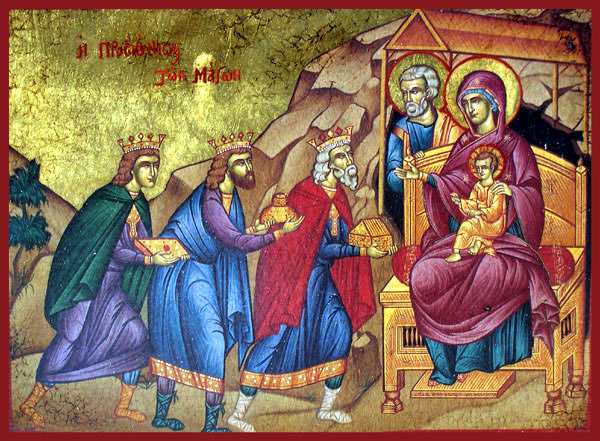
The Nativity of Christ was revealed to the Magi by a wondrous star. Saint John Chrysostom and Saint Theophylactus, commenting on Saint Matthew’s Gospel, say that this was no ordinary star. Rather, it was “a divine and angelic power that appeared in the form of a star.” Saint Demetrius of Rostov says it was a “manifestation of divine energy” (Narrative of the Adoration of the Magi). Entering the house where the Infant lay, the Magi “fell down, and worshipped Him: and when they had opened their treasures, they presented Him gifts: gold, and frankincense, and myrrh” (Mt. 2:11).
The names of the three Wise Men (Magi) do not appear in the Gospels. The tradition that there were three visitors from the east is very ancient, but their names are only mentioned in the Middle Ages.
Bones reputed to be the relics of the three kings have been in the cathedral at Cologne, Germany since 1164.

In the stillness of midnight (Wisdom of Solomon 18:14-15), the proclamation of the birth of the Savior of the world was heard by three shepherds watching their flocks by night.
An angel of the Lord (Saint Cyprian says this was Gabriel) came before them and said: “Fear not: for behold, I bring you good tidings of great joy, which shall be to all people. For unto you is born this day in the city of David a Savior, Who is Christ the Lord” (Luke 2:10-11). The humble shepherds were the first to offer worship to Him Who condescended to assume the form of a humble servant for the salvation of mankind.
Based on the Synodikon of the Solovetsk Monastery in northern Russian about 1500 AD — the exact date is unknown — the Priestmonk Jonah was born in the Pomeranian village of Varzuga in Russia's northern Murmansk district. After serving as a parish priest, he entered the Pechenga Monastery, where he became a close disciple of Saint Tryphon.
Saint Jonah was martyred in December 1589 — one year before the beginning of the Russian-Swedish War — during an attack on the monastery by Swedish-Finnish invaders. Tradition holds that he and his concelebrant, the Priestmonk Herman, were martyred during the celebration of the Divine Liturgy, as they were receiving the Eucharist. They, together with 115 monks and laypersons killed during the invasion, were venerated throughout the Novgorod region. In 2003, they were formally glorified by the Russian Orthodox Church for Church-wide veneration.
Here is the live stream for Festal Orthros and Divine Liturgy for the Fore-feast of the Nativity – Fri 12/24/2021 If you need, here are instructions for accessing this content from your phone, tablet, computer, or TV.
Here is the live stream for Royal Hours – Fri 12/24/2021 If you need, here are instructions for accessing this content from your phone, tablet, computer, or TV.
EVE OF THE NATIVITY OF CHRIST
ABSTAIN FROM MEAT, FISH, DAIRY, EGGS, WINE, OLIVE OIL
Eve of the Nativity of Christ, Eugenia the Righteous Nun-martyr of Rome
IN MANY AND VARIOUS WAYS God spoke of old to our fathers by the prophets; but in these last days he has spoken to us by a Son, whom he appointed the heir of all things, through whom also he created the world. He reflects the glory of God and bears the very stamp of his nature, upholding the universe by his word of power. When he had made purification for sins, he sat down at the right hand of the Majesty on high, having become as much superior to angels as the name he has obtained is more excellent than theirs. For to what angel did God ever say, "Thou art my Son, today I have begotten thee"? Or again, "I will be to him a father, and he shall be to me a son"? And again, when he brings the first-born into the world, he says, "Let all God's angels worship him." Of the angels he says, "Who makes his angels winds, and his servants flames of fire." But of the Son he says, "Thy throne, O God, is for ever and ever, the righteous scepter is the scepter of thy kingdom. Thou hast loved righteousness and hated lawlessness; therefore God, thy God, has anointed thee with the oil of gladness beyond thy comrades." And, "Thou, Lord, didst found the earth in the beginning, and the heavens are the work of thy hands; they will perish, but thou remainest; they will all grow old like a garment, like a mantle thou wilt roll them up, and they will be changed. But thou art the same, and thy years will never end.
In those days a decree went out from Caesar Augustus that all the world should be enrolled. This was the first enrollment, when Quirinius was governor of Syria. And all went to be enrolled, each to his own city. And Joseph also went up from Galilee, from the city of Nazareth, to Judea, to the city of David, which is called Bethlehem, because he was of the house and lineage of David, to be enrolled with Mary, his betrothed, who was with child. And while they were there, the time came for her to be delivered. And she gave birth to her first born son and wrapped him in swaddling clothes, and laid him in a manger, because there was no place for them in the inn.
And in that region there were shepherds out in the field, keeping watch over their flock by night. And an angel of the Lord appeared to them, and the glory of the Lord shone around them, and they were filled with fear. And the angel said to them, "Be not afraid; for behold, I bring you good news of a great joy which will come to all the people; for to you is born this day in the city of David a Savior, who is Christ the Lord. And this will be a sign for you: you will find a babe wrapped in swaddling clothes and lying in a manger." And suddenly there was with the angel a multitude of the heavenly host praising God and saying, "Glory to God in the highest, and on earth peace, good will among men!
When the angels went away from them into heaven, the shepherds said to one another, "Let us go over to Bethlehem and see this thing that has happened, which the Lord has made known to us." And they went with haste, and found Mary and Joseph, and the babe lying in a manger. And when they saw it they made known the saying which had been told them concerning this child; and all who heard it wondered at what the shepherds told them. But Mary kept all these things, pondering them in her heart. And the shepherds returned, glorifying and praising God for all they had heard and seen, as it had been told them.

In Slavic practice, on the eve of the Nativity of the Lord, the liturgical services consist of the Royal Hours with the Typika, Vespers, and the Divine Liturgy of Saint Basil the Great. At Vigil in the evening, Great Compline is followed by Matins.
If the Nativity falls on Sunday, however, the Royal Hours with the Typika are read on the preceding Friday. On Friday evening, the office of the Forefeast is served, December 24. The Liturgy of Saint John Chrysostom is served on Saturday morning. At Vigil in the evening, Great Compline is followed by Matins. On Sunday morning, the Liturgy of Saint Basil is celebrated.
If the Nativity falls on a Monday, Royal Hours with the Typika are read on Friday December 22. On Saturday evening and Sunday morning we follow the order for the Sunday before the Nativity with the office of the Forefeast for December 24. On Sunday morning the Liturgy of Saint John Chrysostom is served. Vigil on Sunday evening consists of Great Compline is followed by Matins. On Monday morning the Liturgy of Saint Basil is celebrated.
On the eve of the Nativity, instead of three readings from the Old Testament at Vespers, there are eight readings (from Genesis, Numbers, Micah, Isaiah, Baruch, Daniel, and two more readings from Isaiah). The entrance is made with the Gospel.
At the end of Liturgy the priest places a lighted candle in a candlestick in the center of the church. Then the troparion and kontakion of the Feast are sung. At Vigil on the evening of the twenty-fourth, Great Compline is followed by Matins.

The Holy Martyr Eugenia, was a Roman by birth. She lived at Alexandria, where her father Philip was sent by the emperor Commodus (180-192) to be Prefect of Egypt. Eugenia received a fine upbringing and was noted for her beauty and good disposition. Many illustrious youths sought her hand, but she did not wish to marry anyone, for she was determined to preserve her virginity.
Providentially, she became acquainted with the Epistles of the Apostle Paul. She yearned with all her soul to become a Christian, but kept this a secret from her parents. At that time, Christians were banished from Alexandria by the command of the emperor. Wishing to learn more about Christian teachings, she asked permission to visit one of the family estates outside the city, supposedly to enjoy the countryside. She left in the company of her two servants Protus and Hyacinthus, dressed in men’s clothes. She and her companions were baptized at a certain monastery by Bishop Elias (July 14), who learned about her in a vision. He blessed her to pursue asceticism at the monastery disguised as the monk Eugene.
By her ascetic labors, Saint Eugenia acquired the gift of healing. Once, a rich young woman named Melanthia turned to her for help. Seeing “Eugene,” this woman burned with an impure passion, and when she was spurned, she falsely accused the saint of attempted rape. Saint Eugenia came to trial before the Prefect of Egypt (her father), and she was forced to reveal her secret. Her parents and brothers rejoiced to find the one for whom they had long grieved.
After a while they all accepted holy Baptism. But Philip, after being denounced by pagans, was dismissed from his post. The Alexandrian Christians chose him as their bishop. The new Prefect, fearing the wrath of the people, did not dare to execute Philip openly, but sent assassins to kill him. They inflicted wounds upon Saint Philip while he was praying, from which he died three days later.
Saint Claudia went to Rome with her sons, daughter, and her servants. There Saint Eugenia continued with monastic life, and brought many young women to Christ. Claudia built a wanderers’ hostel and aided the poor. After several peaceful years, the emperor Galienus (260-268) intensified the persecution against Christians, and many of them found refuge with Saints Claudia and Eugenia.
Basilla, an orphaned Roman girl of imperial lineage, heard about the Christians and Saint Eugenia. She sent a trusted servant to the saint asking her to write her a letter explaining Christian teachings. Saint Eugenia sent her friends and co-ascetics, Protus and Hyacinthus, who enlightened Basilla, and she accepted holy Baptism.
Basilla’s servant then told her fiancé Pompey that his betrothed had become a Christian. Pompey then complained to the emperor against the Christians for preaching celibacy and denouncing idolatry. Basilla refused to enter into marriage with Pompey, and so they killed her with a sword.
They dragged Saints Protus and Hyacinthus into a temple to make them sacrifice to the idols, but just as they entered, the idol fell down and was shattered. The holy Martyrs Protus and Hyacinthus were beheaded. They also brought Saint Eugenia to the temple of Diana by force, but she had not even entered it, when the pagan temple collapsed with its idol.
They threw the holy martyr into the Tiber with a stone about her neck, but the stone became untied and she remained unharmed. She also remained unscathed in the fire. Then they cast her into a pit, where she remained for ten days. During this time the Savior Himself appeared to her and said that she would enter into the heavenly Kingdom on the day He was born. When this radiant Feast came, the executioner put her to death with a sword. After her death, Saint Eugenia appeared to her mother to tell her beforehand the day of her own death.
Saint Nicholas the Former General was a military commander under the Byzantine emperor Nikēphóros I (802-811). He was ordered to lead his troops against the Bulgars. On the eve of battle he was approached by the innkeeper’s daughter, but he resisted her shameless attempts to seduce him.
All his comrades perished in the battle, but Nicholas remained alive. It was revealed to him in a vision that his life was spared because he had overcome temptation. After this Saint Nicholas left the world and settled into a cave. He became a schemamonk, and prayed unceasingly for his fallen soldiers. By his great ascetic efforts he so pleased the Lord, that he was granted the gift of clairvoyance.
Saint Antiochus was from Galatia, and lived during the reign of Heraclius (610-641). He witnessed the martyrdom of the monks of Saint Savva’s Monastery (May 16) by the Saracens, and recorded their sufferings. He also wrote another book, called Pandect of the Scriptures. Divided into 130 chapters, the book examines the moral teachings of the Holy Scriptures.
A quote attributed to Saint Antiochus is found in the Evergetinos (Book 3:39). One of his best-known prayers is recited during Compline, “And grant us, Master, as we lay down to sleep, repose of both body and soul….”
THURSDAY OF THE 14TH WEEK
ABSTAIN FROM MEAT, FISH, DAIRY, EGGS, WINE, OLIVE OIL
Forefeast of the Nativity of Our Lord and Savior, Jesus Christ, Ten Martyrs of Crete, Paul, Archbishop of Neo-Caesarea, Rememberance of the Founding of the Holy and Great Church of Christ, Hagia Sophia in Constantinople, Naoum the Illuminator of The Bulgarians, Nicholas & John the New Martyrs
Timothy, my son, charge the rich in this world not to be haughty, nor to set their hopes on uncertain riches but on God who richly furnishes us with everything to enjoy. They are to do good, to be rich in good deeds, liberal and generous, thus laying up for themselves a good foundation for the future, so that they may take hold of the life which is life indeed. O Timothy, guard what has been entrusted to you. Avoid the godless chatter and contradictions of what is falsely called knowledge, for by professing it some have missed the mark as regards the faith. Grace be with you. Amen.
At that time, as Jesus was setting out on his journey, a man ran up and knelt before him, and asked him, "Good Teacher, what must I do to inherit eternal life?" And Jesus said to him, "Why do you call me good? No one is good but God alone. You know the commandments: 'Do not kill, Do not commit adultery, Do not steal, Do not bear false witness, Do not defraud, Honor your father and mother.' " And he said to him, "Teacher, all these I have observed from my youth." And Jesus looking upon him loved him, and said to him, "You lack one thing; go, sell what you have, and give to the poor, and you will have treasure in heaven; and come, follow me." At that saying his countenance fell, and he went away sorrowful; for he had great possessions. And Jesus looked around and said to his disciples, "How hard it will be for those who have riches to enter the kingdom of God!" And the disciples were amazed at his words. But Jesus said to them again, "Children, how hard it is to enter the kingdom of God! It is easier for a camel to go through the eye of a needle than for a rich man to enter the kingdom of God." And they were exceedingly astonished, and said to him, "Then who can be saved?" Jesus looked at them and said, "With men it is impossible, but not with God; for all things are possible with God.
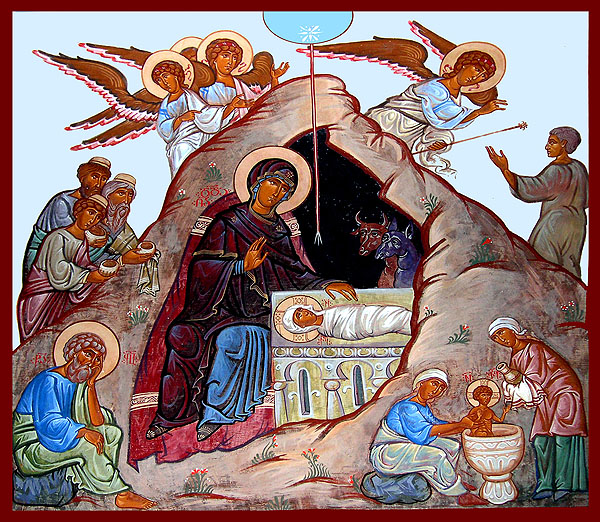
The Forefeast of the Nativity of the Lord begins on December 20. From now on, most of the liturgical hymns will be concerned with the birth of the Savior.
At Compline on this fourth day of the prefeast of the Nativity we sing, “Let us purify our minds, washing ourselves with the divine Mysteries; let us draw near in soul and body to Bethlehem, that we may behold the fearful dispensation of the birth of the Lord” (Ode Five of the Canon).

The Ten Holy Martyrs of Crete: Theodulus, Saturninus, Euporus, Gelasius, Eunician, Zoticus, Pompius, Agathopus, Basilides and Evaristus suffered for Christ during the third century under the emperor Decius (249-251). The governor of Crete, also named Decius, fiercely persecuted the Church, and arrested anyone who believed in Christ. Once, ten Christians were brought before him from various cities of Crete, who at the trial steadfastly confessed their faith in Christ and refused to worship idols.
For thirty days they were subjected to cruel tortures, and with the help of God they all persevered, glorifying God. Before their death they prayed that the Lord would enlighten their torturers with the light of the true Faith. Since pain did not influence them, the saints were beheaded.
Saint Paul of Constantinople (November 6) visited Crete about a hundred years later. He took the relics of the holy martyrs to Constantinople to serve as a protection for the city, and a source of blessings for the faithful.
Saint Theoctistus, Archbishop of Novgorod, prior to becoming a bishop, was igumen of the Annunciation monastery near Novgorod. After the death of Archbishop Clement in the year 1300, the people of Novgorod chose him as their Archbishop, and Metropolitan Maximus with the bishops Simeon of Rostov and Andrew of Tver consecrated Saint Theoctistus as Archbishop of Novgorod.
One of Saint Theoctistus’ concerns was the renovation and building of churches. He consecrated cathedrals in the name of Saints Boris and Gleb, and in the name of the Holy Fathers of the First Ecumenical Council. The monastery of Valaam was set in good order during his time.
In the year 1307, because of poor health, the saint withdrew to the Annunciation monastery, where he lived until his death, devoting himself to the ascetic deed of silence. Saint Theoctistus was glorified in 1664, because of the miraculous healings at his relics. In 1786, the relics of the saint were transferred to Yuriev, where Archimandrite Photius built a chapel in his honor at the local cathedral.

Saint Niphon, Bishop of Cyprus was born in Paphlagonia, and was educated at Constantinople. In childhood he was gentle and good, and he often attended church services, but in his youth he began to lead a prodigal and sinful life. He sometimes came to his senses, and he was horrified by the extent of his fall; but believing that he was lost and could not receive forgiveness, he resumed his impious life.
He once met a friend who gazed into his face for a long time with astonishment. When Niphon asked why he was staring, the friend replied, “I have never seen your face like this before. It is black, like that of an Ethiopian.” These words showed to Niphon his fallen state, and he began to cry out to the Mother of God, begging Her intercession.
After an intense and long prayer he saw that the face of the Mother of God on the holy icon was radiantly bright with a smile. From that time Niphon prayed incessantly to the Queen of Heaven. If he fell into sin, the face of the Mother of God turned away from him, but after tears and prayers, She mercifully turned toward him again.
Finally, Niphon completely turned his life around and began to spend his time in prayer and repentance. After an illness, from which he received healing from the Mother of God, he received the Holy Mysteries, and then accepted monastic tonsure and intensified his efforts, exhausting his body in the struggle against the passions.
This struggle lasted for many years, and devils often attacked Saint Niphon, but with the help of God he overcame them. He received from God the gift to discern evil spirits and defeat them, and also to see the departure of the soul after death. Already advanced in age, and arriving at Alexandria, he was pointed out to the Patriarch in a vision as one worthy to assume the office of bishop. They made him bishop of the city of Constantia on the island of Cyprus. However, he did not remain there for long. Saint Niphon knew the time of his death three days beforehand. Saint Athanasius the Great visited him before his blessed repose. On his deathbed the saint was granted to see angels and the All-Pure Mother of God.
Saint Paul, Bishop of Neocaesarea, suffered under the emperor Licinius (311-324). At his trial he firmly confessed his faith, and was subjected to beatings. They tortured him also with hunger, but he remained steadfast. Then they scorched his hands with red-hot iron and locked him in a prison at the banks of the Euphrates.
After Licinius was executed in the year 324, when Saint Constantine became the sole ruler of the Roman Empire, and Christians in prison received their freedom, Saint Paul returned to his flock. He was a participant at the First Ecmenical Council at Nicea, convened in the year 325, at which the Arian heresy was condemned and the Symbol of Faith adopted. At the end of the Council, the Emperor Constantine solemnly received the Council participants and kissed Saint Paul’s burned hand. After long years of guiding his flock, Saint Paul peacefully fell asleep in the Lord.

Saint Nahum was a disciple of Saints Cyril and Methodius (May 11), one of their coworkers known as the Five Followers.
Saint Nahum was a man of great learning, and he spoke several languages. After a visit to Rome, he settled on the shores of Lake Ochrid. There he built a monastery at the time when Saint Clement of Ochrid (July 27) was serving as a bishop.
Many monks gathered around Saint Nahum, who was known as a great wonderworker and a man of prayer. He also labored to translate the Holy Scriptures from Greek into Slavonic.
Saint Nahum fell asleep in the Lord in 910, and his holy relics continue to work miracles of healing for those who venerate them in faith.
Here is the live stream for Advent Paraklesis Service – Wed 12/22/2021 If you need, here are instructions for accessing this content from your phone, tablet, computer, or TV.
WEDNESDAY OF THE 14TH WEEK
ABSTAIN FROM MEAT, FISH, DAIRY, EGGS, WINE, OLIVE OIL
Forefeast of the Nativity of Our Lord and Savior, Jesus Christ, Anastasia the Great Martyr, Chrysogonos, Theodota, Evodias, & Eutychianus, the Martyrs, The opening of the gates of the Great Church of God
Timothy, my son, do not be hasty in the laying on of hands, nor participate in another man’s sins; keep yourself pure. No longer drink only water, but use a little wine for the sake of your stomach and your frequent ailments. The sins of some men are conspicuous, pointing to judgment, but the sins of others appear later. So also good deeds are conspicuous; and even when they are not, they cannot remain hidden. Let all who are under the yoke of slavery regard their masters as worthy of all honor, so that the name of God and the teaching may not be defamed. Those who have believing masters must not be disrespectful on the ground that they are brethren; rather they must serve all the better since those who benefit by their service are believers and beloved. Teach and urge these duties. If any one teaches otherwise and does not agree with the sound words of our Lord Jesus Christ and the teaching which accords with godliness, he is puffed up with conceit, he knows nothing; he has a morbid craving for controversy and for disputes about words, which produce envy, dissension, slander, base suspicions, and wrangling among men who are depraved in mind and bereft of the truth, imagining that godliness is a means of gain. There is great gain in godliness with contentment; for we brought nothing into the world, and we cannot take anything out of the world; but if we have food and clothing, with these we shall be content. But those who desire to be rich fall into temptation, into a snare, into many senseless and hurtful desires that plunge men into ruin and destruction. For the love of money is the root of all evils; it is through this craving that some have wandered away from the faith and pierced their hearts with many pangs. But as for you, man of God, shun all this.
The Lord said, "Whoever divorces his wife and marries another, commits adultery against her; and if she divorces her husband and marries another, she commits adultery." And they were bringing children to him, that he might touch them; and the disciples rebuked them. But when Jesus saw it he was indignant, and said to them, "Let the children come to me, do not hinder them; for to such belongs the kingdom of God. Truly, I say to you, whoever does not receive the kingdom of God like a child shall not enter it." And he took them in his arms and blessed them, laying his hands upon them.
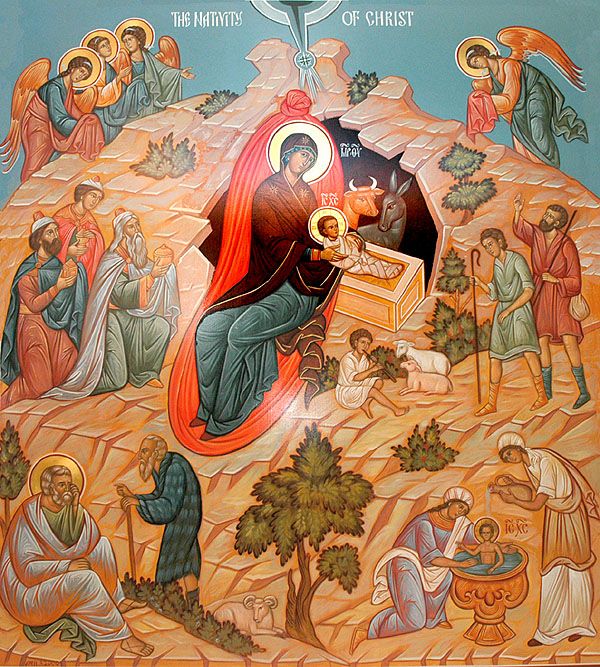
The Forefeast of the Nativity of the Lord begins on December 20. From now on, most of the liturgical hymns will be concerned with the birth of the Savior.
At Vespers for this third day of the prefeast of the Nativity we sing, “Christ is born on earth to crush the power of evil, to enlighten those in darkness, and to free the captives. Let us go forth to meet Him.”

The Great Martyr Anastasia the Deliverer from Potions, a Roman by birth, suffered for Christ at the time of Diocletian’s persecution of Christians. Her father was a pagan, but her mother was secretly a Christian. Saint Anastasia’s teacher in her youth was an educated and pious Christian named Chrysogonus. After the death of her mother, her father gave Saint Anastasia in marriage to a pagan named Publius, but feigning illness, she preserved her virginity.
Clothing herself in the garb of a beggar, and accompanied by only one servant, she visited the prisons. She fed, doctored and often ransomed captives who were suffering for their faith in Christ. When her servant told Publius about everything, he subjected his wife to a beating and locked her up at home. Saint Anastasia then began to correspond secretly with Chrysogonus, who told the saint to be patient, to cleave to the Cross of Christ, and to accept the Lord’s will. He also foretold the impending death of Publius in the sea. After a certain while Publius did indeed drown, as he was setting out with a delegation to Persia. After the death of her husband, Saint Anastasia began to distribute her property to the poor and suffering.
Diocletian was informed that the Christians who filled the prisons of Rome stoically endured tortures. He gave orders to kill them all in a single night, and for Chrysogonus to be sent to him at Aquileia. Saint Anastasia followed her teacher at a distance.
The emperor interrogated Chrysogonus personally, but could not make him renounce his faith. Therefore, he commanded that he be beheaded and thrown into the sea. The body and severed head of the holy martyr were carried to shore by the waves. There by divine Providence, the relics were found by a presbyter named Zoilus who placed them in a coffer, and concealed them at his home.
Saint Chrysogonus appeared to Zoilus and informed him that martyrdom was at hand for Agape, Chione and Irene (April 16), three sisters who lived nearby. He told him to send Saint Anastasia to them to encourage them. Saint Chrysogonus foretold that Zoilus would also die on the same day. Nine days later, the words of Saint Chrysogonus were fulfilled. Zoilus fell asleep in the Lord, and Saint Anastasia visited the three maidens before their tortures. When these three martyrs gave up their souls to the Lord, she buried them.
Having carried out her teacher’s request, the saint went from city to city ministering to Christian prisoners. Proficient in the medical arts of the time, she zealously cared for captives far and wide, healing their wounds and relieving their suffering. Because of her labors, Saint Anastasia received the name Deliverer from Potions (Pharmakolytria), since by her intercessions she has healed many from the effects of potions, poisons, and other harmful substances.
She made the acquaintance of the pious young widow Theodota, finding in her a faithful helper. Theodota was taken for questioning when it was learned that she was a Christian. Meanwhile, Saint Anastasia was arrested in Illyricum. This occurred just after all the Christian captives there had been murdered in a single night by order of Diocletian. Saint Anastasia had come to one of the prisons, and finding no one there, she began to weep loudly. The jailers realized that she was a Christian and took her to the prefect of the district, who tried to persuade her to deny Christ by threatening her with torture. After his unsuccessful attempts to persuade Saint Anastasia to offer sacrifice to idols, he handed her over to the pagan priest Ulpian in Rome.
The cunning pagan offered Saint Anastasia the choice between luxury and riches, or grievous sufferings. He set before her gold, precious stones and fine clothing, and also fearsome instruments of torture. The crafty man was put to shame by the bride of Christ. Saint Anastasia refused the riches and chose the tools of torture.
But the Lord prolonged the earthly life of the saint, and Ulpian gave her three days to reconsider. Charmed by Anastasia’s beauty, the pagan priest decided to defile her purity. However, when he tried to touch her he suddenly became blind. His head began to ache so severely that he screamed like a madman. He asked to be taken to a pagan temple to appeal to the idols for help, but on the way he fell down and died.
Saint Anastasia was set free and she and Theodota again devoted themselves to the care of imprisoned Christians. Before long, Saint Theodota and her three sons accepted a martyrdom. Her eldest son, Evodus, stood bravely before the judge and endured beatings without protest. After lengthy torture, they were all thrown into a red-hot oven.
Saint Anastasia was caught again and condemned to death by starvation. She remained in prison without food for sixty days. Saint Theodota appeared to the martyr every night and gave her courage. Seeing that hunger caused Saint Anastasia no harm whatsoever, the judge sentenced her to drowning together with other prisoners. Among them was Eutychianus, who was condemned for his Christian faith.
The prisoners were put into a boat which went out into the open sea. The soldiers bored holes in the boat and got into a galley. Saint Theodota appeared to the captives and steered the ship to shore. When they reached dry land, 120 men believed in Christ and were baptized by Saints Anastasia and Eutychianus. All were captured and received a martyr’s crown. Saint Anastasia was stretched between four pillars and burned alive. A certain pious woman named Apollinaria buried her body, which was unharmed by the fire, in the garden outside her house.
In the fifth century the relics of Saint Anastasia were transferred to Constantinople, where a church was built and dedicated to her. Later the head and a hand of the Great Martyr were transferred to the monastery of Saint Anastasia [Deliverer from Potions], near Mount Athos.
TUESDAY OF THE 14TH WEEK
ABSTAIN FROM MEAT, FISH, DAIRY, EGGS, WINE, OLIVE OIL
Forefeast of the Nativity of Our Lord and Savior, Jesus Christ, Juliana of Nicomedia & her 630 Companion Martyrs, Themistocles the Martyr of Myra, Peter, Metropolitan of Moscow
Timothy, my son, refuse to enrol younger widows; for when they grow wanton against Christ they desire to marry, and so they incur condemnation for having violated their first pledge. Besides that, they learn to be idlers, gadding about from house to house, and not only idlers but gossips and busybodies, saying what they should not. So I would have younger widows marry, bear children, rule their households, and give the enemy no occasion to revile us. For some have already strayed after Satan. If any believing man or woman has relatives who are widows, let him assist them; let the church not be burdened, so that it may assist those who are real widows. Let the elders who rule well be considered worthy of double honor, especially those who labor in preaching and teaching; for the scripture says, “You shall not muzzle an ox when it is treading out the grain, ” and, “The laborer deserves his wages.” Never admit any charge against an elder except on the evidence of two or three witnesses. As for those who persist in sin, rebuke them in the presence of all, so that the rest may stand in fear. In the presence of God and of Christ Jesus and of the elect angels I charge you to keep these rules without favor, doing nothing from partiality.
At that time, the Pharisees came up to Jesus and in order to test him, asked, "Is it lawful for a man to divorce his wife?" He answered them, "What did Moses command you?" They said, "Moses allowed a man to write a certificate of divorce, and to put her away." But Jesus said to them, "For your hardness of heart he wrote you this commandment. But from the beginning of creation, 'God made them male and female. For this reason a man shall leave his father and mother and be joined to his wife, and the two shall become one flesh.' So they are no longer two but one flesh. What therefore God has joined together, let not man put asunder." And in the house the disciples asked him again about this matter. And he said to them, "Whoever divorces his wife and marries another commits adultery against her; and if she divorces her husband and marries another, she commits adultery.
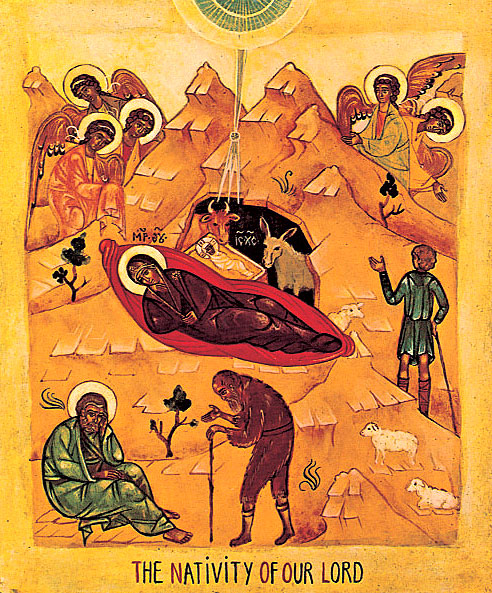
The Forefeast of the Nativity of the Lord begins on December 20. From now on, most of the liturgical hymns will be concerned with the birth of the Savior.
During Matins (after the first Sedalen) on this second day of the prefeast of the Nativity we sing, “The unapproachable God in His tender mercy approaches me; He wills to be born in the flesh in the city of Bethlehem. He receives human nature from a Virgin maiden. Let us eagerly run to greet Him, crying out in fear: O Lord, glory to Thee.”

The Holy Virgin Martyr Juliana, daughter of an illustrious pagan named Africanus, was born in the city of Nicomedia. As a child, she was betrothed to a certain Elusius, one of the emperor’s advisors. Saint Juliana was endowed with a profound intellect and goodness of soul. She saw through the delusion and deception of the pagan faith, and secretly accepted holy Baptism.
When the time of her wedding approached, Juliana refused to be married. Her father urged her not to break her engagement, but when she refused to obey him, he began to beat her viciously. Then Africanus handed his daughter over to the Eparch, who happened to be Elusius, Juliana’s former fiancé. Elusius fervently asked Juliana to marry him, promising not to require her to abandon her faith. Saint Juliana refused and said that she’d rather be put to death.
They beat the saint both long and harshly, but after each beating she received healing and new strength from God. Her punishment took place before a large number of people. Of these, 500 men and 130 women came to confess Christ after witnessing the steadfastness and courage of the holy virgin miraculously healed from her wounds. They were all beheaded, and were baptized in their own blood.
Convinced of the futility of attempting to separate the holy virgin from her heavenly Bridegroom, Eleusius sentenced Juliana to death. She accepted the sentence with joy and glorified the Lord for permitting her to receive a martyr’s crown. The holy Martyr Juliana was executed in the year 304.
Saint Juliana is the subject of an Anglo-Saxon poem, believed to have been written by Cynewulf in the eighth century.
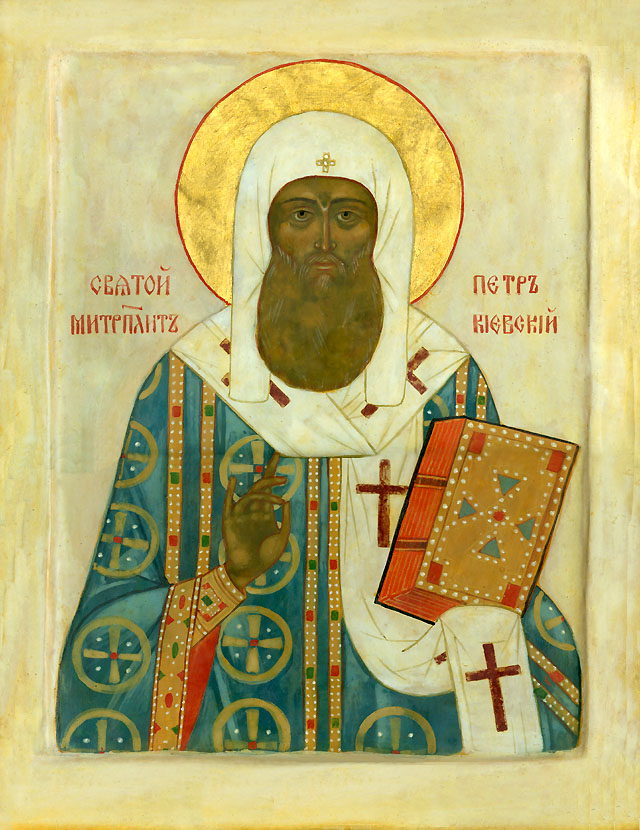
Saint Peter, Metropolitan of Moscow, was born in Volhynia of pious parents, Theodore and Eupraxia. Even before the birth of her son, the Lord revealed to Eupraxia the preordained blessedness of her son. At the age of twelve, young Peter entered a monastery. He successfully studied the book sciences of those times and eagerly fulfilled his monastic obediences. The future saint devoted much time to an attentive study of the Holy Scriptures, and he also learned iconography. The icons painted by Saint Peter were distributed to the brethren and to Christians who visited the monastery.
Because of his virtuous and ascetic life, the igumen of the monastery had Saint Peter ordained as a hieromonk. After years of ascetic labors at the monastery, the hieromonk Peter, with the blessing of the igumen, left the monastery in search of a solitary place.
He built a cell at the Rata River and began to pursue asceticism in silence. Afterwards, at the place of his ascetic exploits, a monastery was formed, called the Novodvorsk. A church dedicated to the Savior was built for the monks who came to him. Chosen as igumen, Saint Peter guided his spiritual children, and never became angry with a guilty monk. Instead, he instructed the brethren by word and by example. The virtuous igumen and ascetic became known far beyond the vicinity of the monastery. Prince Yuri of Galicia frequently visited the monastery in order to receive spiritual instruction from the holy ascetic.
Once, in his travels through the Russian land, Metropolitan Maximus of Kiev and Vladimir (December 6) visited the monastery with words of instruction and edification. Having received the blessing of Saint Maximus, Saint Peter presented him with an icon of the Dormition of the Most Holy Theotokos, which he had painted. Saint Maximus prayed before the icon for the salvation of the Russian land entrusted to him by God until the end of his days.
When Metropolitan Maximus died, the See of Vladimir remained for a certain time unoccupied. An abbot named Gerontius, aspiring to become the primate of Russia, went to Constantinople with Saint Peter’s vestments, archpastoral staff, and the icon he had painted. The Great Prince of Vladimir, Saint Michael of Tver (November 22), sent him to the Patriarch of Constantinople with a petition that he be appointed as Metropolitan of Russia.
On the suggestion of Prince Yuri of Galicia, Igumen Peter reluctantly went to the Patriarch of Constantinople with a petition that he be consecrated as Metropolitan. God chose Saint Peter to nourish the Russian Church. The Mother of God appeared to Gerontius during a storm on the Black Sea and said, “You labor in vain, for you will never be bishop. The one who painted this icon, the Rata igumen Peter, shall be elevated to the throne of Kiev.”
The words of the Mother of God were fulfilled. Patriarch Athanasius of Constantinople (1289-1293) elevated Saint Peter as Metropolitan of Russia, bestowing upon him the hierarchal vestments, staff and icon, brought by Gerontius. Upon his return to Russia in 1308, Metropolitan Peter arrived at Kiev after a year, and then proceeded on to Vladimir.
The chief hierarch was tested by many trials during his first years of guiding the Russian metropolitanate. Suffering beneath the Tatar (Mongol) Yoke the Russian land was in turmoil, and Saint Peter was often obliged to change the place of his residence. During this period the saint’s labors and concerns to affirm the true Faith and morality in the realm were particularly important. On his journeys throughout the diocese, he incessantly instructed the people and clergy on preserving Christian piety. He also brought quarrelsome princes to peace and unity.
In the year 1312 the saint made a journey to the Horde, where he received a decree from Khan Uzbek, safeguarding the rights of the Russian clergy.
In 1325 Metropolitan Peter, at the request of Great Prince John Kalita (1328-1340), transferred the metropolitan See from Vladimir to Moscow. This event had very great significance for all the Russian land. Saint Peter prophetically predicted deliverance from the Tatar Yoke and that Moscow would become the foremost city in Russia.
With his blessing, the foundation of the cathedral of the Dormition of the Most Holy Theotokos in the Moscow Kremlin was laid in August 1326.
Saint Peter fell asleep in the Lord on December 21, 1326. The holy relics of the saint were buried in the Dormition cathedral in a stone crypt, which he himself had prepared. Many miracles were accomplished through the saint’s prayers. Many healings were even done secretly, which testifies to his profound humility even after death.
The veneration of the first hierarch of the Russian Church was affirmed and spread throughout the Russian land. In 1339, under Saint Theognostus (March 14), Saint Peter was numbered among the saints. Princes kissed the cross on the saint’s tomb as a sign of their fidelity to the Great Prince of Moscow.
As a particularly venerated protector of Moscow, Saint Peter was called on to witness the drawing up of government treaties. The people of Novgorod once had the right of nominating their own bishop in the cathedral of Saint Sophia. After their annexation to Moscow under Ivan III, they swore an oath that henceforth they would only consecrate their archbishops at the grave of Saint Peter the Wonderworker. And it was at the grave of the saint that the first hierarchs of Russia were named and chosen.
The Russian Chronicles mention him frequently, and no significant state undertaking was initiated without prayers at the grave of Saint Peter. The relics of Saint Peter were transferred in 1472 and 1479. In memory of these events, feastdays were established for October 5 and August 24.
Saint Juliana, Princess of Vyazma and Novy Torg, a daughter of the noble Maximus Danilov, was known for her virtues and her chastity. Her spouse, Prince Simeon of Vyazma, and also Prince Yuri of Smolensk, were compelled to flee their native lands, which the Lithuanian prince Vitovt had seized. Then Prince Basil of Moscow bestowed the Tver city of Torzhok upon the exiled princes.
Prince Yuri became captivated by Juliana’s beauty and tried in every way to persuade her to commit adultery, but Juliana remained faithful to her husband. During a feast, Prince Yuri killed Juliana’s husband, in the hope of taking her by force. Saint Juliana resisted the ravisher, wounding him with a knife. The enraged Prince Yuri ordered that her hands and feet be cut off, and that her body be thrown into the Tvertsa River.
Troubled by his conscience and censured by everyone, Prince Yuri fled to the Tatars, but even there he did not find peace. He settled in the Ryazan wilderness where he died in 1408.
The martyrdom of Saint Juliana occurred in the winter of 1406. In the spring of 1407, they saw the body of Princess Juliana floating in the river. A certain peasant heard a voice from above, commanding that the body of Saint Juliana be buried in the Torzhok cathedral on the right side by the south doors.
A tomb for her body was afterwards built at the Savior-Transfiguration cathedral, where many received healing from her. In connection with the glorification of Saint Juliana on June 2, 1819 a chapel was built on the right-hand side, and dedicated to her. At the cathedral of the Transfiguration of the Lord, where earlier there had been a chapel over the grave of the saint, a church was built and also dedicated to Saint Juliana in 1906.
Blessed Procopius, Fool-for-Christ, of Vyatka, was the son of pious peasants. When Procopius reached age twenty, they wanted him to marry, but he secretly went to the city of Khlynov and took upon himself the feat of foolishness. The holy fool endured hunger, cold, mocking and insults. The Lord glorified him with the gift of clairvoyance. Blessed Procopius died at the age of forty-nine in 1627.

The Holy Martyr Themistocles lived in the city of Myra of Lycia during the reign of the persecutor of Christians, Decius (249-251). Themistocles was a shepherd. During the persecution he concealed within his home a certain Christian named Dioskorides, while he himself went out to the pursuers. They tortured him cruelly, and he received a martyr’s crown for Christ in the year 251.

In the second half of the 10th century King Davit Kuropalates constructed the Khakhuli Church in southern Georgia. He also founded Khakhuli Monastery, which in later centuries would become a center of spirituality, science, and education. Today this monastery is located on Turkish territory, but the grace of the ascetic labors of the fathers who labored there in the past pours forth hope upon the Georgian people to this day.
Many holy and wonderworking fathers labored at Khakhuli Monastery, including Saint Basil the son of King Bagrat III, the brothers George and Saba of Khakhuli, Saint Hilarion of Tvali and many other God-fearing ascetics, whose righteousness and spiritual feats were guided by the holy abbot Macarius.
Fr. Macarius was a great ascetic, teacher, and prophet. Novices and wise, experienced elders alike flocked to him for advice and blessings. The young monk George, later the great ascetic George of the Holy Mountain, was brought to Saint Macarius to receive his blessing. Saint Macarius called George his spiritual son.
By the grace of God, Saint Macarius reconciled his responsibilities as abbot of the monastery with the great spiritual labor of solitude. He earned the title “the Faster” for his exceptional ascesis in fasting and prayer. It is said that, as abbot of Khakhuli Monastery, “he shone like the morning sunrise and guided the spiritual activity and secular life of the entire Tao-Klarjeti region.”
Saint Macarius reposed around the year 1034.
 Saint Peter Antiochian Orthodox Church
You must be logged in to post a comment.